This article is published under the terms of the Creative Commons Attribution License 4.0 Author(s) retain the copyright of this article. Publication rights with Alkhaer Publications. Published at:
http://www.ijsciences.com/pub/issue/2016-02/
DOI: 10.18483/ijSci.931
; Online ISSN: 2305-3925; Print ISSN: 2410-4477
Tala GUEYE(Correspondence)
[email protected]
Characterization of Phenotypic Diversity of
Sorghum Collection for Developing Breeding
Material
Tala GUEYE
1
, Bassirou SINE
2
, Ndiaga CISSE
2
, Cyril DIATTA
2
,
Saliou Ndiaye
1
1Ecole Nationale Superieure d’Agriculture (ENSA), BPA296, Thies (Senegal) 2Institut Sénégalais de Recherche Agricole (ISRA/CERAAS)
Abstract: Agro-morphological characterization of sorghum collection in Senegal showed a wide range of variation, linked to traits like plant duration, plant height, and yield components. Sorghum accessions or landrace characterized by short duration, high, and low-medium yield components are the most represented in the collection. Simple correlations between variables of different types relating to phenology, vegetative growth, and yield components are very different, showing a relative independence of characters, and thus a wide phenotypic diversity. This diversity can be explained by plant duration, plant height, grain weight per foot, and the shape of the panicle. From these agro-morphological characteristics, varietal groups based on similarity were identified and accessions with interesting agro-morphological characteristics clustered. Racially diversity, dominated by Guinea, caudatum and Durra are also observed. This collection is an interesting breeding material for improving sorghum.
Keywords: Sorghum, landrace, phenotypic diversity, plant improvment
Introduction
Sorghum (Sorghum bicolor (L.) Moench) is an important staple food for millions of people in tropical arid and semi-arid regions of Africa, Asia, and South America. Its production is estimated at 60 million tons, over an area of about 43 million hectares. In Africa and Asia, 90% of arable land is used to grow sorghum, with average yields of 810-1150 kg / ha (FAO, 2009). Genetic diversity of sorghum is being threatened by various anthropic factors including habitat destruction, commercial agricultural practices, industrial activities and the wide adoption of improved cultivars (Reddy et al, 2006). With the global awareness on the importance of Plant Genetic Resources over the past four decades, collection and conservation of germplasm have become integral components in plant breeding programs (Rosenow and Dahlberg, 2000). In Senegal, several collections have been implemented, including one on genetic resources of sorghum, developed at the National Centre for Agronomic Research (CNRA). Since 1996, seed renewal, in the collection, concerned only improved varieties, not local ecotypes which have been
http://www.ijSciences.com
Volume 5
–
February 2016 (02
)
39
limited number of sub-collections of sorghum, with the objective to assess the agro-morphological diversity of sorghum collection, and to identify main characters of these different provenences, especially those related to sorghum landrace.
Material and Method
Plant material studied is divided into four different sub-collections, which represent the national sorghum collection with:
1. Subseries local sorghums (Coll. SL), an outcome of the 1987 FAO prospection, with 69 accessions of Guinea type. These accessions have a cycle of between 90 and 110 days, and a height between 2.5 to 4 m; 2. Subseries of belated ecotypes (Coll. T), consisting of local ecotypes and improved varieties that were introduced following prospecting from 1977 to 1978. These ecotypes have a cycle between 120 to 140 days, and a height between 2 and 4 m; 3. Subseries of very belated ecotypes
(Coll.TT), composed of local ecotypes and introduced varieties, from harvests of 1970, 1971 and 1972. It is for most of the anthocyanin height sorghums between 2 and 4 m and cycle between 125 and 160 days;
4. Subseries ROCARS (Coll. R) consisting of selected varieties, from Research Network for West and Central African Sorghum. These varieties, which generally belong to race caudatum have a cycle of between 80 and 120 days and a height between 1.5 and 3 m.
The study focused on 110 provenances of Sorghum, who survived to difficult and inappropriate, storage conditions, which have thereby caused an erosion of seeds. The Three first sub-collection (local, belated and very belated), are the most affected with the respective germination rate of 26.5% and 31%. Seeds of their provenances were able to maintain their germination capacity. The last subseries or ROCARS had better survival seed with a germination rate of 62%. On a sample of 418 accessions sown, involving all sub-collections, only 110 have germinated, which Represented a rate of 26%.
Conduct of Testing
The trial was established in the field during rainy season 2009, at CNRA in Bambey region (14 ° 42'N, 16 ° 28'W). The climate of this area is Sudano-Sahelian characterized by a rainy season, which lasts four months and a rainfall, which varies between 400 and 800 mm. In 2009, 663 mm of rainfall was recorded at CNRA from June to October. The test has received 475 mm of rainfall
and irrigation water supply was made to allow late accessions to complete their cycle. Each accession was sown on a line of 5 m and a spacing of 80 cm between rows and 40 cm between the seed holes on the line. Each row thus contains 13 seed holes. A background NPK fertilizer (15-15-15) was applied uniformly on all plots at the dose of 150 kg ha-1 before planting. Fifteen days after sowing, plants were maintained 3 per pocket for each accession followed by spreading of coverage fertilizers (Urea 46% N) with 50 kg ha-1. This same dose was used in stage Montaison.
Studied Traits
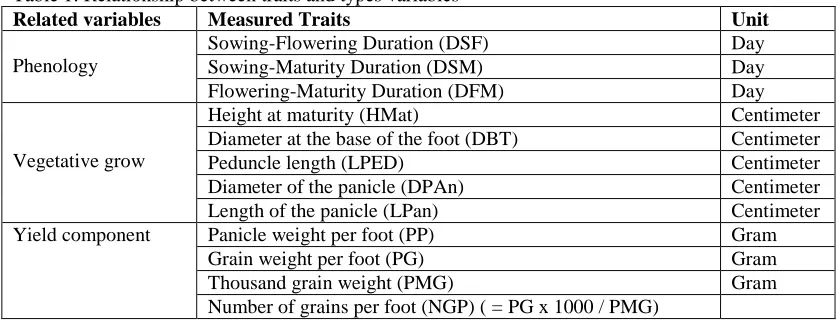
The diversity of the collection was studied using twenty phenotypic variables, with 12 quantitative variables and 8 qualitative variables (IBPGR / ICRISAT 1993; Kannababu et al., 2006). The measured quantitative characteristics are listed below:
1. Sowing-Flowering Duration (DSF) in number of days
2. Sowing-Maturity Duration (DSM) in number of days
3. Flowering-Maturity Duration (DFM) in number of days
4. Height at maturity (HMat) in cm
5. Diameter at the base of the foot (DBT) in cm
6. Peduncle length (LPed) in cm
7. Diameter of the panicle (DPAn) in cm 8. Length of the panicle (LPan) in cm 9. Panicle weight per foot (PP) in g 10. Grain weight per foot (PG) in g 11. Thousand grains weight (PMG) in g 12. Number of grains per foot (NGP = PG x
1000 / PMG).
These characters can be summarized in three groups of variables, related to (1) Phenology, (2) Vegetative growth, and (3) Yield Components (Table 1).
Evaluated qualitative characteristics are listed below:
1. Stay-green (STGR) at physiological maturity,
2. Color of plant (CPI),
3. Compactness and shape of panicle (PSC), 4. Panicle exsertion (Ex),
5. Coverage grain by glumes (CvGl), 6. Color of the grains (PMF), 7. Texture of the endosperm (Tend), 8. The presence of testa (SCBR).
Statistical Analyses
http://www.ijSciences.com
Volume 5
–
February 2016 (02
)
40
variables and the distribution of headcount (in percentage) in the different modalities of discrete variables. For the principal component analysis (PCA), before launching it, DSM, DFM, HMat, LPep, LPan, PG, PP, NGP and PMG were considered as continuous variables active and variables DSF, DBT, DPan are considered as continuous variables illustrative. This was an innovative strategy developed to avoid redundancy of information on accessions. Simple correlations between variables and significance tests correlations coefficients were achieved with the SPSS software (version 10.0)
Results
Phenology
At the level of the collection, sowing - maturity duration varies from 69 to151 days. However, more than half of the accessions showed a sowing - maturity duration less than 100 days (Figure 1). This imbalance in favor of short cycles did not, however, affect the wide range of variation of the cycle, which is a synonym of an important phenological diversity in this collection.
Vegetative growth
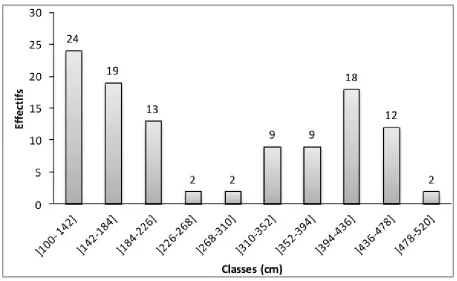
Plant height at physiological maturity in the collection varies from 100 to 514.3 cm. Depending on plant height from the ground to the top of the panicle, accessions can be divided into two groups (Figure 2). The first group, representing 52.7%, concerns accessions whose height is between 100 and 250 cm and is dominated by improved varieties of caudatum race. The second group, characterized by plants with greater than 250 cm height, is dominated by local accessions, or introduced varieties of Guinea type.
Yield components
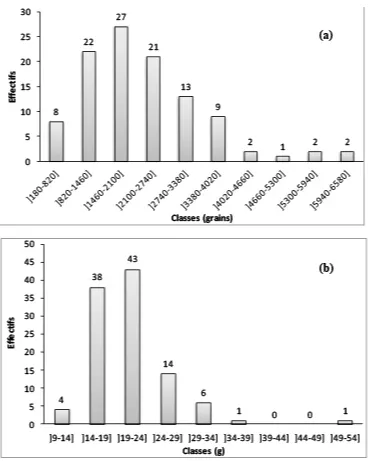
The frequency distribution of the number of grains per plant (NGP) and thousand grains weight (PMG) is in favor of low to medium performance. The number of grains per foot (NGP), varies from 180 to 6563 grains, and half of the accessions has an NGP less than 2000 grains (Figure 3a). Thousand grains weight varies from 10 to 51.7 g and more than 80% of accessions (Figure 3b) have a low thousand grains weight (PMG <25 g).
Relations between variables within the same group and variables of different groups.
Most of the simple correlations between variables within the same group are positive and significant (Table 2). Correlation coefficients vary respectively from 0.51 to 0.97 for phenological variables and are significant at 1%. For variables of vegetative growth, only the correlation between diameter at the base of the foot and peduncle length was not significant. Also among yield components, only
thousand grains weight was not significantly correlated with a number of grains per foot or with panicle weight per foot. The relationships between variables of the 3 differents groups (phenology, growth, and yield components) are highly contrasted (Table 3). Phenological variables and yield components are highly related to the variables of the vegetative growth at the threshold of 1%. Strong positive correlations were observed between thousand grains weight and sowing-maturity duration (r = 0.55) and flowering to maturity duration (r = 0.56). Similar relationships were observed between variables of vegetative growth (HMat, DTB, DPAn) and cycle (DSF, MSC), with correlation coefficients that vary from 0.26 to 0.46. A long period of maturation is therefore not only favors good vegetative growth but also good grain filling. However, peduncle length, panicle length and number of grains per foot are not related to variables of phenology.
Identifying varietal groups through the similarity of continuous variables
http://www.ijSciences.com
Volume 5
–
February 2016 (02
)
41
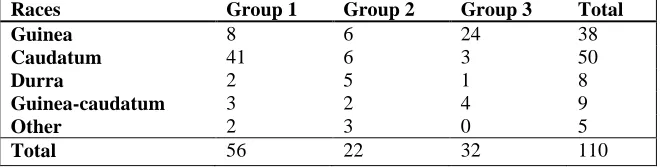
characterized by large grains, and high thousand grain yield (PMG), are well represented in group 2 (62.5%). This distribution of races of the collection in the PCA plan 1 x 2 shows a good structuring of accessions by race.
Characterization of racial groups in the collection by nominal variables
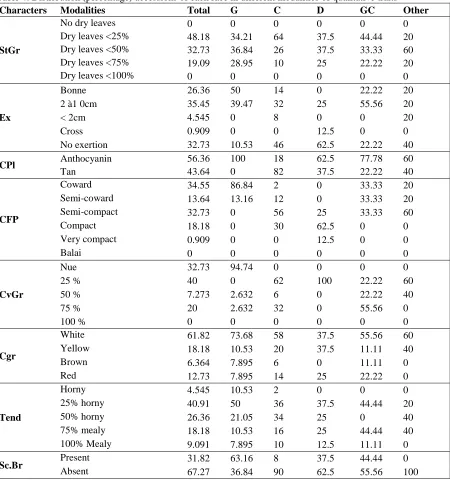
Sorghum collection is mainly dominated by accessions of Guinea race, Caudatum, and Durra. Table 4 shows that Guinea is characterized by anthocyanin color, loose panicles (86.6%), and non-covered grains of glumes (94.7%). The Durra often are characterized by a bent peduncle at the top (12.5%) but present for the majority (62.5%) poor exsertion panicle with a compact panicle (62.5%) to very compact (12.5 %) and large grains covered
around 25% of glumes (100%). These
characteristics are associated with a good resistance to drought. The Caudatum races are identified by a tan and a wide range of shapes and grain panicles covered with glumes. Accessories with clear grains, without a testa, and with a curled endosperm (10.5%) belong to Guinea race. Accessions Guinea-caudatum with a completely mealy endosperm represent 11.1%. Accessions with vitreous grain have not been observed.
Discussions
The low percentage of germination observed can be explained by unsuitable storage conditions of seed collection. Also since 1996, apart from improved varieties vulgarized, accessions remained for almost 15 years without being renewed, this has negatively impacted on their ability to germinate (Diatta, 2011). This study showed the race structuring of the collection and the predominance of Guinea, caudatum and Durra, within races. A Strong presence of accessions of Guinea race can be explained by geographical location in relation to the history of domestication of sorghum (Kondombo et al., 2008). Accessions of caudatum race, for against, are the result of a process of introductions and results of research that has much focused on this race. Accessions belonging to Durra race are poorly represented in the collection. They are mainly grown in flood recession along the Senegal River valley and are perfectly suited to very severe agro-climatic conditions of the Senegal River Valley (Luce, 1985; Cissé, 2001; Roy et al., 2005). The agro-morphological characterization of sorghum collection revealed a wide range of variation linked particularly to cycle, plant height, and thousand grains weight. These variations are very similar to those found in the rainy season, at the World sorghum collection maintained at ICRISAT (Gopal Reddy et al., 2006). The cycle length being a variable significantly associated with climate zones (Kondombo et al., 2008), this large
variation of the cycle, with local ecotypes may be explained by the diversity of material collection locations spread over all seven agro-ecological zones of Senegal. Positive and significant correlations observed between variables of the same group (phenology, vegetative growth, and yield components) are classic in sorghum and were expected. Sine (2009) noted that within the different groups of variables, relations between constitutive variables of the same group remain very strong. Correlations between variables of different groups remained very mixed. Positive correlations between phenological variables and variables of vegetative growth are in conformity with the results found by Kondombo (2001). It is established that in sorghum when the length of the cycle increases, the plant operates in the sense of an increase in aboveground biomass. Strong, positive correlation between thousand grains weight and flowering to maturity duration shows that a long maturation period would favor a good grain filling and, therefore, a good grain quality. In addition accessions with large diameters of the stem have better-filled grains. According to Abbassenne et al. (1998) grain yield in rainfed conditions and under severe environment, is the result of the length, the filling speed and capacity of translocation assimilât stored in the stem. Shortening of the cycle length observed at very late accessions collection seems to be related to photoperiod. The limitation of photoperiodic ecotypes cycle at the length of the rainy season is an interesting adaptation key for improving agriculture in the West African savannah (Traore et al., 2000; Clerget, 2004; Clerget, 2008). A significant number of accessions have green leaves at maturity (stay-green). These accessions with fresh stems sips of water to the maturity better resist drought. According to Xu et al. (2000) chlorophyll persistence is a component of drought tolerance which enables plants to resist premature senescence following a major water stress occurring after flowering. Bad exsertion panicle observed in very late accessions and ROCARS, is caused by water stress after a break in rainfall occurred during the period of head emergence-flowering. According to Chantereau and Nicou (1991), water stress at this stage shortens the length of the peduncle which releases badly inflorescence of the flag leaf sheath. The predominance of light colored grain accessions without a testa, and with good texture of the endosperm is explained by the fact that these types of accessions are those that are best suited to the preparation of couscous (local meal). In Senegal, one of the main criteria for adoption of a variety by
farmers beyond the agro-morphological
http://www.ijSciences.com
Volume 5
–
February 2016 (02
)
42
collection due to low production of traditional beer in Senegal. The accessions with clear grain without a testa, and with vitreous endosperm are Guinea race, which is characterized by high quality of their grain (Traoré, 2000; Grenier, 2000). Accessions from race Caudatum Durra and Guinea-caudatum generally have grain floury texture. The absence of accessions Guinea-caudatum with completely glassy texture at the collection reflects the difficulty in combining, by hybridization and introgression, good character Guinea grains and good productivity caudatum. According to Grenier (2000) breeding programs to develop hybrid combining quality Guinea grains with high yields caudatum did not have the expected success, with consumers and farmers in West Africa. This explains, in part, the low adoption of such varieties. Within the collection, among the most productive Accessories (group 3), Guinea is predominant compared to caudatum. A study conducted in Mali by Luce (1994), on the performance of sorghum ecotypes of breeds caudatum and Guinea, showed that in the same culture conditions, photoperiodic landraces types Guinea have higher or equal to that of Production improved varieties early to caudatum type. According to the same study, for intermediate and late cycles, the results are equivalent, sometimes with a certain superiority of Guinea sorghums. This shows the need to promote these local accessions, which by their great potential, associated with a good adaptation to the environment, appropriate photoperiod, good grain quality, and above all a good capacity for local preparations, have a certain advantage over varieties improved from abroad.
Conclusion
Senegal's sorghum collection contains a large agro-morphological diversity with racial structuring and races like Guinea, Caudatum and Durra are the most represented. This collection is dominated by accessions characterized by short cycle, greater height, and low to average yield components. The agro-morphological diversity of sorghum in the collection can be explained by the cycle, plant height, grain weight and form of the panicle. Varietal groups based on the similarity of their agro-morphological characteristics were well structured and accessions with interesting characteristics identified. These accessions could be used in breeding programs to improve various characteristics such as disease resistance, drought, grain quality and fodder. However this collection underutilized is in danger of extinction due to several unfavorable factors, including unsuitable storage conditions of seeds and non-renewal of seeds, continuously. That is why this study is of great interest because it allows one hand to enrich the passport data of the collection, and also to
realize the renewal of seeds of all accessions of the collection. Nevertheless, it is urgent to develop conservations strategies and efficient managements of plant genetic resources in the West African sub-region through technological innovation realistic and achievable locally.
Références
1. Abbassenne F., Bouzerzour H. & Hachemi L., 1998. Phénologie et production du blé dur (Triticum durum
Desf.) en zone semi-aride. Ann. Agron., 18 : 24-36. 2. Centre de Coopération Internationale en Recherche
Agronomique pour le Développement ; Groupe de Recherche et d'Echanges Technologiques ; Ministère des affaires étrangères (France), 2002. Mémento de l'agronome. Paris : CIRAD, 1691 p.
3. Chantereau J., Nicou R., 1991. Le sorgho. Paris : Maison Neuve et Larose, 159 p. (Le technicien d’agriculture tropicale ; n°18)
4. Cissé N., 2001. La culture de sorgho au Sénégal. In: Comas J., MacPherson H.G. eds. La culture du sorgho de décrue en Afrique de l’Ouest et du Centre: Situation actuelle et définition d´un Plan d´Action Régional, AECI, FAO, pp 111-121.
5. Clerget B., 2004. Le rôle du photopériodisme dans l’élaboration du rendement de trois variétés de sorgho cultivées en Afrique de l’Ouest. Thèse de doctorat : agronomie, Ecole Doctorale ABIES, Institut National Agronomique Paris-Grignon, p 103.
6. Clerget B., 2008. Variabilité de la vitesse de développement chez le sorgho cultivé (Sorghum bicolor
(L.) Moench) et relation avec le photopériodisme. Cahiers Agricultures, 17 (2) : 101-106.
7. Diatta C., 2011. Caractérisation agro-morphologique de 199 accessions de Sorgho (Sorghum bicolor (L) Moench) de la collection de l’ISRA. Mémoire de DEA, Agronomie et protection des cultures, Ecole Nationale Supérieure D’agriculture de Thiès (ENSA) / Université de Thiès, Sénégal, 69 p.
8. FAO, 2009. FAOSTAT: FAO Statistical Databases,
production data.
http://faostat.fao.org/site/567/DesktopDefault.aspx?PageID =567#ancor.
9. Grenier C., 2000. Diversité génétique des sorghos cultivés, gestion des ressources génétiques et contribution des marqueurs moléculaires à la constitution de core collections. Thèse de Doctorat : biologie des populations et écologie. Université Montpellier II, 80 p, + Annexes. 10. Habindavyi E., 2009. Morphological characterization of
sorghum (Sorghum bicolor (L.) Moench) diversity on Burundi. CBM Master’s thesis. Swedish Biodiversity Center, 48 p, + annexes.
11. House L.R., 1987. Manuel pour la sélection du sorgho. Deuxième édition. Patancheru, Inde, ICRISAT, p 229. 12. IBPGRI, ICRISAT, 1993. Descriptors for Sorghum
(Sorghum bicolor (L.) Moench). Rome: International Board for Plant Genetic Resources; Patancheru (India): International Crops Research Institute for the Semi-Arid Tropics. Pagination double.
13. Kannababu N., Audilakshmi S., Elangovan M., Tonapi V., Seetharama N., 2006. National Guidelines for the conduct of tests for Distinctness, uniformity, and stability. ITG/03, Sorghum 28-10-2003, India, 21 p.
14. Kondombo C.P., 2001. Evaluation agronomique et fourragère de 194 lignées recombinantes de sorgho.
Mémoire d’ingénieur du développement rural : option agronomie. Université polytechnique de Bobo-Dioulasso, Burkina Faso, 89 P.
http://www.ijSciences.com
Volume 5
–
February 2016 (02
)
43
107-113.16. Le Roy X., Kane M., Sy M., Ball O., Diallo O., Ba A., 2005. Le sorgho de décrue dans la vallée du Sénégal. IRD, 7 P.
17. Luce C. 1994. Le rendement d'écotypes de sorgho des races caudatum et guinea. Agriculture et développement (2) : 35-38.
18. Luce C., 1985. Quelques données du programme sorgho au Sénégal. Atelier régional Ouest Africain du sorgho (ICRISAT Mali, 21-25 Octobre 1985). Institut Sénégalais de Recherches Agricoles (ISRA), Sénégal, 13 p.
19. Luce C., 1988. L’amélioration du sorgho au Sénégal : acquis (1950-1986) et perspectives de recherches. Institut Sénégalais de Recherches Agricoles (ISRA), Sénégal, 1 (2) : 1-24.
20. Ministère de l’Agriculture, 1995. Sénégal : Rapport de pays pour la conférence technique internationale de la FAO sur les ressources phytogénétiques. Leipzig, 1996, 30 p. 21. Murty D. S., Tabo R., Ajayi O., 1995. Production et
gestion des semences d'hybrides du sorgho. Institut International de Recherche sur les Cultures des Zones Tropicales Semi-arides (ICRISAT) Patancheru, Inde. Bulletin d'information Numéro 41, 68 p.
22. Reddy V.G., Upadhyaya H.D., Gowda C.L.L., 2006. Current Status of Sorghum Genetic Resources at ICRISAT: Their Sharing and Impacts. International Crops Research Institute for the Semi-Arid Tropics (ICRISAT). SAT eJournal, 2 (1): 1-5.
23. Rosenow D.T., Dahlberg J.A., 2000. Collections, conversion and utilization of sorghum. In Smith C.W., Frederiksen R.A., eds. Sorghum: origin, history,
technology and production. New York, USA: John Wiley and Sons, Inc, pp 309–328.
24. Sine B., 2009. Evaluation agro-morphologique d’une core collection de sorgho (Sorghum bicolor (L. Mœnch) et caractérisation racinaire de variétés contrastées pour la détermination de critères racinaire d’adaptation à la sécheresse. Thèse de Doctorat : agro-physiologie, faculté des sciences et techniques, Université Cheikh Anta Diop de Dakar, Sénégal, 155 p.
25. Tékété M. L., 2011. Caractérisation des cycles de différentes variétés de mil et de sorgho : variation du photopériodisme selon la latitude. Mémoire de Master : Agroforesterie, Ecologie, Adaptation, Université cheikh Anta Diop de Dakar, Sénégal, 40 p.
26. Teetes G.L., Young W.R., Jotwani MG., et al, 1980.
Introduction à la lutte intégrée contre les ennemis du sorgho. Rome : FAO, 164 p.
27. Traoré S.B., Reyniers F.N., Vaksmann M., Kone B., Sidibé A., Yorote A., Yattara K., Kouressy M., 2000. Adaptation à la sécheresse des écotypes locaux de sorgho du Mali.
Sciences et changements planétaires/sécheresse. 12 (04) : 227-37.
28. Trouche G., Da S. Pale G., Sohoro A., Ouedraogo O., Den Gosso G., 2001. Evaluation participative de nouvelles variétés de sorgho au Burkina. Sélection participative, Montpellier, 5-6 septembre, 2001, pp 36-55.
29. Xu W., Subudhi P.K., Crasta O.R., Rosenow D.T., Mullet J.E., Nguyen H.T., 2000. Molecular mapping of QTLs conferring Stay-green in grain sorghum (Sorghum bicolor
L. Moench). Genome, 43: 461-469.
Tables
Table 1: Relationship between traits and types variables
Related variables Measured Traits Unit
Phenology
Sowing-Flowering Duration (DSF) Day
Sowing-Maturity Duration (DSM) Day
Flowering-Maturity Duration (DFM) Day
Vegetative grow
Height at maturity (HMat) Centimeter
Diameter at the base of the foot (DBT) Centimeter
Peduncle length (LPED) Centimeter
Diameter of the panicle (DPAn) Centimeter
Length of the panicle (LPan) Centimeter
Yield component Panicle weight per foot (PP) Gram
Grain weight per foot (PG) Gram
Thousand grain weight (PMG) Gram
http://www.ijSciences.com
Volume 5
–
February 2016 (02
)
44
Table 2: simple correlations between variables studied
Variables DSF DSM DFM HMat DBT LPéd LPan DPan PP PG NGP
DSM 0,97**
DFM 0,51** 0,71**
HMat 0,45** 0,41** 0,14
DBT 0,46** 0,46** 0,28** 0,44**
LPéd -0,06 -0,08 -0,11 0,68** 0,05
LPan 0,03 0,03 0,00 0,73** 0,25** 0,78**
DPan 0,38** 0,39** 0,26** 0,64** 0,41** 0,35** 0,62**
PP 0,18 0,20* 0,20* 0,32** 0,45** 0,23* 0,36** 0,50**
PG 0,21* 0,23* 0,21* 0,29** 0,38** 0,21* 0,27** 0,42** 0,90**
NGP 0,01 0,00 -0,03 0,25** 0,26** 0,28** 0,33** 0,32** 0,85** 0,91**
PMG 0,48* 0,55** 0,56** 0,07 0,22* -0,20* -0,19* 0,14 0,16 0,22* -0,17
** The correlation is significant at the 0.01; * The correlation is significant at the 0,05 ; DSF : Sowing-Flowering Duration; DSM : Sowing-Maturity Duration; DFM : Sowing-Flowering-Maturity Duration; HMat : Height at maturity; DBT : Diameter at the base of the foot; LPed : Peduncle length ; LPan : Length of the panicle; DPan : Diameter of the panicle; PP : Panicle weight per foot; PG : Grain weight per foot; NGP : Number of grains per foot; PMG : Thousand grain weight.
Table 3: Distribution of the main races of the collection in the three groups defined by the PCA
Races Group 1 Group 2 Group 3 Total
Guinea 8 6 24 38
Caudatum 41 6 3 50
Durra 2 5 1 8
Guinea-caudatum 3 2 4 9
Other 2 3 0 5
http://www.ijSciences.com
Volume 5
–
February 2016 (02
)
45
Table 4: Distribution (percentage) accessions of each race in different modalities of qualitative traits
Characters Modalities Total G C D GC Other
StGr
No dry leaves 0 0 0 0 0 0
Dry leaves <25% 48.18 34.21 64 37.5 44.44 20
Dry leaves <50% 32.73 36.84 26 37.5 33.33 60
Dry leaves <75% 19.09 28.95 10 25 22.22 20
Dry leaves <100% 0 0 0 0 0 0
Ex
Bonne 26.36 50 14 0 22.22 20
2 à1 0cm 35.45 39.47 32 25 55.56 20
< 2cm 4.545 0 8 0 0 20
Cross 0.909 0 0 12.5 0 0
No exertion 32.73 10.53 46 62.5 22.22 40
CPl Anthocyanin 56.36 100 18 62.5 77.78 60
Tan 43.64 0 82 37.5 22.22 40
CFP
Coward 34.55 86.84 2 0 33.33 20
Semi-coward 13.64 13.16 12 0 33.33 20
Semi-compact 32.73 0 56 25 33.33 60
Compact 18.18 0 30 62.5 0 0
Very compact 0.909 0 0 12.5 0 0
Balai 0 0 0 0 0 0
CvGr
Nue 32.73 94.74 0 0 0 0
25 % 40 0 62 100 22.22 60
50 % 7.273 2.632 6 0 22.22 40
75 % 20 2.632 32 0 55.56 0
100 % 0 0 0 0 0 0
Cgr
White 61.82 73.68 58 37.5 55.56 60
Yellow 18.18 10.53 20 37.5 11.11 40
Brown 6.364 7.895 6 0 11.11 0
Red 12.73 7.895 14 25 22.22 0
Tend
Horny 4.545 10.53 2 0 0 0
25% horny 40.91 50 36 37.5 44.44 20
50% horny 26.36 21.05 34 25 0 40
75% mealy 18.18 10.53 16 25 44.44 40
100% Mealy 9.091 7.895 10 12.5 11.11 0
Sc.Br Present 31.82 63.16 8 37.5 44.44 0
Absent 67.27 36.84 90 62.5 55.56 100
http://www.ijSciences.com
Volume 5
–
February 2016 (02
)
46
Figures
Figure 1: Frequency distribution of accessions depending on Semi-Flowering Duration
http://www.ijSciences.com
Volume 5
–
February 2016 (02
)
47
http://www.ijSciences.com
Volume 5
–
February 2016 (02
)
48
Figure 4: Definition of the axes of the planes 1x2, 1x3 by active continuous variables (in continuous lines) and
continuous variables illustrative (dashed).
DSF: sowing-flowering duration; DSM : sowing-maturity duration; DFM: flowering-maturity duration; HMat: height at maturity; DBT: diameter at the base of the stem; LPed: length of peduncle; LPan: panicle length; DPan: diameter of the panicle; PP: panicle weight per foot; PG: grain weight per foot; NGP: number of grains per foot; PMG: thousand grains weight.
Figure 5: Grouping of accessions according to their agro-morphological traits