UniMorph 2.0: Universal Morphology
Christo Kirov
1, Ryan Cotterell
1, John Sylak-Glassman
1, G´eraldine Walther
2Ekaterina Vylomova
3, Patrick Xia
1, Manaal Faruqui
4, Sebastian Mielke
1, Arya D. McCarthy
1Sandra K ¨ubler
5, David Yarowsky
1, Jason Eisner
1, Mans Hulden
61Johns Hopkins University,2University of Zurich,3University of Melbourne 4Google,5Indiana University,6University of Colorado
Baltimore, Zurich, Melbourne, New York, Bloomington, Boulder
{ckirov1, ryan.cotterell, jcsg, paxia, sjmielke, arya, yarowsky, eisner}@jhu.edu, [email protected] [email protected], [email protected], [email protected], [email protected]
Abstract
The Universal Morphology (UniMorph) project is a collaborative effort to improve how NLP handles complex morphology across the world’s languages. The project releases annotated morphological data using a universal tagset, the UniMorph schema. Each inflected form is associated with a lemma, which typically carries its underlying lexical meaning, and a bundle of morphological features from our schema. Additional supporting data and tools are also released on a per-language basis when available. UniMorph is based at the Center for Language and Speech Processing (CLSP) at Johns Hopkins University in Baltimore, Maryland. This paper details advances made to the collection, annotation, and dissemination of project resources since the initial UniMorph release described at LREC 2016.
Keywords:morphology, multilingual, lexical resources
1.
Introduction
Complex morphology is ubiquitous among the languages of the world. For example, roughly 80% of languages use morphology to mark verbal tense and 65% mark nomi-nal case (Haspelmath et al., 2005). While overlooked in the past, explicit modeling of morphology has been shown to improve performance on a number of downstream HLT tasks, including including machine translation (MT) (Dyer et al., 2008), speech recognition (Creutz et al., 2007), parsing (Seeker and C¸ etinoˇglu, 2015), keyword spotting (Narasimhan et al., 2014), and word embedding (Cotterell et al., 2016b). This has led to a surge of new interest and work in this area (Durrett and DeNero, 2013; Ahlberg et al., 2014; Nicolai et al., 2015; Faruqui et al., 2016). The Universal Morphology (UniMorph) project, centered at the Center for Language and Speech Processing (CLSP) at Johns Hopkins University is a collaborative effort to improve how NLP systems handle complex morphology across the world’s languages. The project releases anno-tated morphological data using a universal tagset, the Uni-Morph schema. Each inflected form is associated with a lemma, which typically carries its underlying lexical meaning, and a bundle of morphological features from our schema. Additional supporting data and tools are also re-leased on a per-language basis when available.
Kirov et al. (2016) introduced version 1.0 of the UniMorph morphological database, created by extracting and normal-izing the inflectional paradigms included in Wiktionary (www.wiktionary.org), a large, broadly multi-lingual crowd-sourced collection of lexical data. This paper de-scribes UniMorph 2.0. It details improvements in Wik-tionary extraction and annotation, as well as normaliza-tion of non-Wiknormaliza-tionary resources, leading to a much higher quality morphological database. The new dataset spans 52 languages representing a range of language families. As in UniMorph 1.0, we provide paradigms from
highly-inflected open-class word categories — nouns, verbs, and adjectives. Many of the included languages are extremely low-resource, e.g., Quechua, Navajo, and Haida. This data was used as the basis for the CoNLL 2017 Shared Task on Morphological Learning (http://sigmorphon.org/ conll2017) (Cotterell et al., 2017).
2.
Wiktionary Extraction
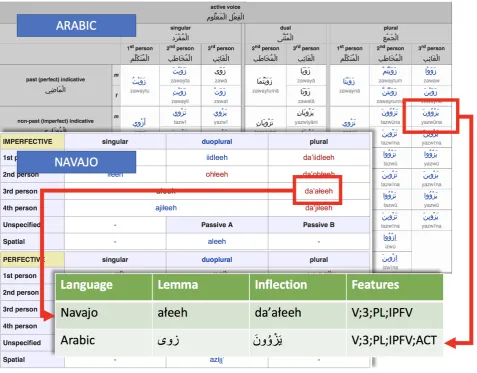
In Kirov et al. (2016), we introduced version 1.0 of the Uni-Morph morphological database, based on a very large-scale parsing and normalization of Wiktionary. Wiktionary is a broadly multilingual resource with many crowd-sourced morphological paradigms in the form of custom HTML ta-bles. Figure 1 illustrates the challenge associated with ex-tracting this data. Wiktionary is designed for human, rather than machine readability, and authors have extensive free-dom in formatting data. This leads to wildly differing table layouts across languages which need to be converted to a consistent tabular format.
The extraction process developed for UniMorph 1.0 re-lied heavily on statistical, visual, and positional heuristics (Sylak-Glassman et al., 2015b) to:
1. Determine which entries in an HTML table are in-flected forms and which are grammatical descriptors.
2. Link each inflected form with its appropriate descrip-tors.
3. Convert each set of linked descriptors into a univer-sal feature annotation schema, described in detail in Sylak-Glassman (2016).1
This led to a large dataset of 952,530 unique noun, verb, and adjective lemmas across 350 languages. Unfortunately,
1unimorph.github.io/doc/unimorph-schema.
Figure 1: Paradigm extraction and normalization.
the UniMorph 1.0 dataset was very error-prone due to the inability of our heuristics to fully cover the degree of incon-sistency found in Wiktionary. For many lemmas, inflected forms were systematically linked to incorrect feature vec-tors. To correct these errors, we noted that for each part-of-speech within a language in Wiktionary, authors use only a handful of distinct table layouts. Thus, it was sufficient for a human to verify and correct a single lemma parse from a particular layout, and apply those corrections to all similar lemma parses. A custom verification and correction process was created and applied to 8 languages (Arabic, Finnish, Georgian, German, Navajo, Russian, Spanish, and Turkish) in preparation for the SIGMORPHON 2016 Shared Task on Morphological Reinflection (Cotterell et al., 2016a).
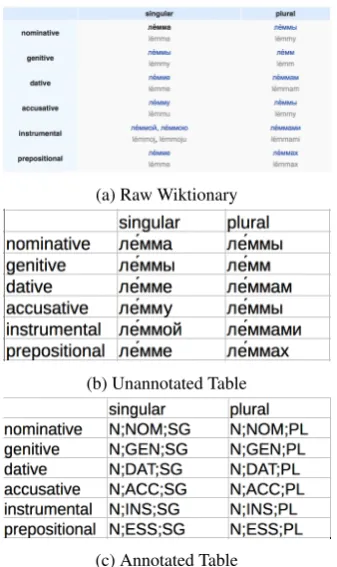
For UniMorph 2.0, we noticed that the effort required to verify and correct an automatic parse of a Wiktionary table layout was greater than or equal to the effort required for a human to directlyannotate a table with UniMorph fea-tures instead. Figure 2 illustrates this simplified process. Each language’s HTML tables were parsed using Python’s
pandas library (pandas.pydata.org) and grouped according to their tabular structure and number of cells. Each group represents a different type of paradigm (e.g., regular verb).
For each group, a sample table was selected, and an
(a) Raw Wiktionary
(b) Unannotated Table
[image:3.595.86.255.66.350.2](c) Annotated Table
Figure 2: Annotation process
lemma form features
gravitar gravitaras V;SBJV;PST;2;SG;LGSPEC1
gravitar gravitases V;SBJV;PST;2;SG;LGSPEC2
[image:3.595.52.290.664.721.2]As each example table is identical in structure to all mem-bers in the same layout group, annotating just one example allows mapping every inflected form in every table in the group to its corresponding morphological features. This minimizes the human annotation effort required per lan-guage, to the point that only 3 annotators were able to pro-duce a complete initial dataset for 47 Wiktionary languages in a matter of days (data for these 47 languages, listed in Table 2, supplants the corresponding language data in the UniMorph 1.0 dataset).
Some of the extracted paradigms from Wiktionary were subject to additional post-processing. In particular, some Wiktionary tables contain multiple forms in the same cell. In the case of multiple forms, we separated them into their own entries. Looking at another Spanish example, we sep-aratetuandvosforms corresponding to dialect differences in the choice of second person pronoun.
gravitar gravitas(t´u) V;IND;PRS;2;SG gravit´as(vos)
gravitar gravitas V;SBJV;PST;2;SG;LGSPEC3
gravitar gravit´as V;SBJV;PST;2;SG;LGSPEC4
Finally, the content of all initial annotations was also veri-fied as linguistically sensible by a second, larger set of ad-judicators who were either native speakers of the language they reviewed or had significant expertise through research. The final dataset sizes are given by language in table 2.
3.
Non-Wiktionary Data Sources
In additional to our large database of annotated inflected forms derived from Wiktionary, UniMorph 2.0 includes morphological data for several additional languages from non-Wiktionary sources. Data for Khaling, Kurmanji Kur-dish, and Sorani Kurdish was derived from the Alexina project (Walther et al., 2013; Walther et al., 2010; Walther and Sagot, 2010).2 Novel data for Haida, a severely en-dangered North American language isolate, was prepared by Jordan Lachler (University of Alberta). Basque lan-guage data was extracted from a manually designed finite-state morphological analyzer (Alegria et al., 2009). Data for all these additional languages was reformatted to match the Wiktionary-derived data using custom Python scripts. Any dataset-specific annotation was manually mapped to the UniMorph schema standard.
4.
Supplementary Structured Data
As discussed in Kirov et al. (2016), we also mine additional structured data from Wiktionary. A number of Wiktionary pages contain lists of derived words under the HTML head-ing ‘Related/Derived Terms’ — ‘sunflower’ for example, appears on the list for the base lemma ‘flower.’ Further-more, Wiktionary also contains tables of lemma transla-tions. The English lemma ‘flower’ contains the translation entry ‘Danish: blomstre.’ As part of UniMorph 1.0, we col-lected an average of 3.42 derived terms per lemma across 76,038 lemmas, and an average of 3.54 translations per an-notated lemma.
For UniMorph 2.0, we are releasing two additional resource types. First, only a subset of Wiktionary languages and lemmas contain embedded morphological tables. There are many more bare lemmas with no form of morphological an-notation. We also scrape these lemmas, and provide a list of them along with their associated part of speech.
Second, for a number of languages in UniMorph, we provide multi-word English glosses for complex inflected wordforms. For example, the Spanish wordcompr´abamos
is mapped to the gloss ‘(we) were buying.’ These glosses are generated for languages where adequately-sized lemma-to-lemma translation dictionaries are available, via the following general process:
1. Perform a generally language-independent conversion of UniMorph feature vectors to an English gloss tem-plate, e.g., V;1;PL;PST;IPFV → ‘(we) were VBG.’ Here, VBG is a Penn Treebank tag which indicates that the template can be filled with the-ingform of an English verb.
2. Given an inflected lemma in the language with a particular feature vector and lemma translation, find the corresponding gloss template, e.g.,compr´abamos,
comprar, V;1;PL;IPFV→‘buy: (we) were VBG’
3. Replace the English lemma placeholder in the tem-plate with the appropriately generated form of the En-glish lemma, ‘buy, (we) were VBG’ → ‘(we) were buying’
2https://gforge.inria.fr/projects/
Language Inflections Glosses
Amharic 566553 1736981 Farsi 206711 582449 Hausa 55860 124492 Hungarian 2814006 9754197 Oromo 26690 246856 Russian 560067 2219960 Somali 451217 1144096 Spanish 153121 368636 Ukrainian 20288 41590 Yoruba 127833 356502
[image:4.595.90.249.69.229.2]Total 4982569 16575759
Table 1: English glosses by language.
Generating complicated tenses of multi-word lemmata (e.g. “They will not have looked it up”) and robustly generating appropriate English inflections for diverse and noisy trans-lation dictionaries, are both a challenge and strength of this work.
Table 1 shows the a summary of the current resource sizes of selected languages, along with the number of distinct inflections covered, and the number of expanded phrasal glosses generated given multiple translations per lemma.
5.
Community Features
Following the model of Universal Dependencies (UD),3, UniMorph is intended to be a highly collaborative project. To that end, all data and tools associated with the project are released on a rolling basis with a permissive open source li-cense. The main portal for the UniMorph project, which provides a high-level overview of project goals and activi-ties, iswww.unimorph.org. The hub for downloadable data and resources is unimorph.github.io. A full specification of the UniMorph annotation schema is avail-able. For each language, the site indicates how many forms and paradigms have been extracted, the source of the data, and available parts of speech. The site is also designed to encourage community involvement. Each language is associated with a public issue tracker that allows users to discuss errors and issues in the available data and annota-tions. Interested users can also become part of the Uni-Morph mailing list.
Moving forward, we also intend to develop connections with other morphological resources. The Universal Depen-dencies project, for example, provides a token-level cor-pus complementary to the UniMorph type-level data. A preliminary survey of UD annotations shows that approx-imately 68% of UD features map directly to UniMorph schema equivalents. This set covers 97.04% of complete UD tags. Some UD features lie outside the current scope of UniMorph, which marks primarily morphosyntactic and morphosemantic distinctions. These include, for example, markers for abbreviated forms and foreign borrowings.
3universaldependencies.org
Language Family Lemmata/Forms
Albanian Indo-European 589 / 33483
Arabic Semitic 4134 / 140003
Armenian Indo-European 7033 / 338461
Basque Isolate 26 / 11889
Bengali Indo-Aryan 136 / 4443
Bulgarian Slavic 2468 / 55730
Catalan Romance 1547 / 81576
Czech Slavic 5125 / 134527
Danish Germanic 3193 / 25503
Dutch Germanic 4993 / 55467
English Germanic 22765 / 115523
Estonian Uralic 886 / 38215
Faroese Germanic 3077 / 45474
Finnish Uralic 57642 / 2490377
French Romance 7535 / 367732
Georgian Kartvelian 3782 / 74412
German Germanic 15060 / 179339
Haida Isolate 41 / 7040
Hebrew Semitic 510 / 13818
Hindi Indo-Aryan 258 / 54438
Hungarian Uralic 13989 / 490394
Icelandic Germanic 4775 / 76915
Irish Celtic 7464 / 107298
Italian Romance 10009 / 509574
Khaling Sino-Tibetan 591 / 156097
Kurmanji Kurdish Iranian 15083 / 216370
Latin Romance 17214 / 509182
Latvian Baltic 7548 / 136998
Lithuanian Baltic 1458 / 34130
Lower Sorbian Germanic 994 / 20121
Macedonian Slavic 10313 / 168057
Navajo Athabaskan 674 / 12354
Northern Sami Uralic 2103 / 62677
Norwegian Bokm˚al Germanic 5527 / 19238
Norwegian Nynorsk Germanic 4689 / 15319
Persian Iranian 273 / 37128
Polish Slavic 10185 / 201024
Portuguese Romance 4001 / 303996
Quechua Quechuan 1006 / 180004
Romanian Romance 4405 / 80266
Russian Slavic 28068 / 473481
Scottish Gaelic Celtic 73 / 781
Serbo-Croatian Slavic 24419 / 840799
Slovak Slavic 1046 / 14796
Slovene Slavic 2535 / 60110
Sorani Kurdish Iranian 274 / 22990
Spanish Romance 5460 / 382955
Swedish Germanic 10553 / 78411
Turkish Turkic 3579 / 275460
Ukrainian Slavic 1493 / 20904
Urdu Indo-Aryan 182 / 12572
[image:4.595.318.523.75.592.2]Welsh Celtic 183 / 10641
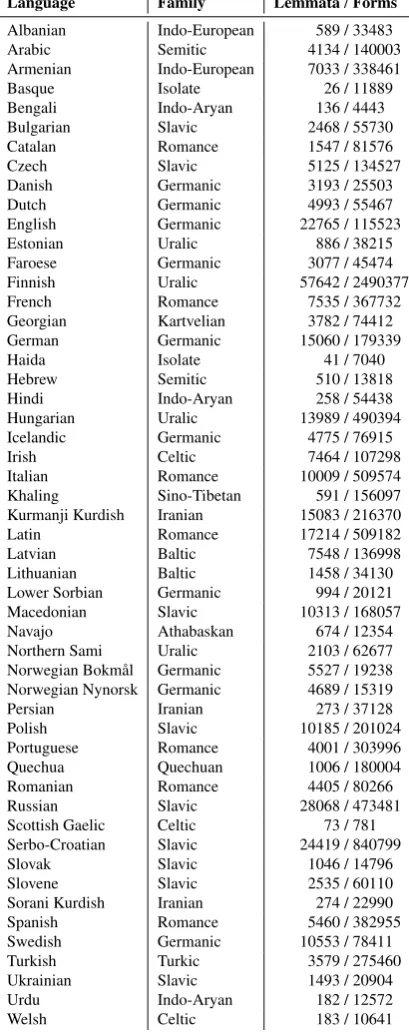
Table 2: Total number of lemmata and forms available for each language in the morphological database.
6.
Conclusion
non-Wiktionary data sources. The project welcomes community involvement, and all data and tools are released under a per-missive open-source license atunimorph.github.io. UniMorph 2.0 data has already been used as the basis for the successful CoNLL 2017 Shared Task on Morpholog-ical Learning, the first shared task on morphology in the CoNLL community (Cotterell et al., 2017).
7.
Bibliographical References
Ahlberg, M., Forsberg, M., and Hulden, M. (2014). Semi-supervised learning of morphological paradigms and lex-icons. InProceedings of the 14th Conference of the Eu-ropean Chapter of the Association for Computational Linguistics, pages 569–578, Gothenburg, Sweden, April. Association for Computational Linguistics.
Alegria, I., Etxeberria, I., Hulden, M., and Maritxalar, M. (2009). Porting Basque morphological grammars to
foma, an open-source tool. InInternational Workshop on Finite-State Methods and Natural Language Processing, pages 105–113. Springer.
Choi, J., de Marneffe, M.-C., Dozat, T., Ginter, F., Gold-berg, Y., Hajiˇc, J., Manning, C., McDonald, R., Nivre, J., Petrov, S., Pyysalo, S., Silveira, N., Tsarfaty, R., and Zeman, D. (2015). Universal Dependencies. Accessi-ble at: http://universaldependencies.github.io/docs/, Jan-uary.
Cotterell, R., Kirov, C., Sylak-Glassman, J., Yarowsky, D., Eisner, J., and Hulden, M. (2016a). The SIGMOR-PHON 2016 shared task—morphological reinflection. In
Proceedings of the 14th SIGMORPHON Workshop on Computational Research in Phonetics, Phonology, and Morphology, pages 10–22, Berlin, Germany, August. Association for Computational Linguistics.
Cotterell, R., Sch¨utze, H., and Eisner, J. (2016b). Mor-phological smoothing and extrapolation of word embed-dings. In Proceedings of the 54th Annual Meeting of the Association for Computational Linguistics (Volume 1: Long Papers), pages 1651–1660, Berlin, Germany, August. Association for Computational Linguistics. Cotterell, R., Kirov, C., Sylak-Glassman, J., Walther,
G., Vylomova, E., Xia, P., Faruqui, M., K¨ubler, S., Yarowsky, D., Eisner, J., and Hulden, M. (2017). The CoNLL-SIGMORPHON 2017 shared task. In CoNLL-SIGMORPHON 2017 Shared Task.
Creutz, M., Hirsim¨aki, T., Kurimo, M., Puurula, A., Pylkk¨onen, J., Siivola, V., Varjokallio, M., Arisoy, E., Saraclar, M., and Stolcke, A. (2007). Analysis of morph-based speech recognition and the modeling of out-of-vocabulary words across languages. In Human Language Technologies 2007: The Conference of the North American Chapter of the Association for Com-putational Linguistics; Proceedings of the Main Con-ference, pages 380–387. Association for Computational Linguistics.
Durrett, G. and DeNero, J. (2013). Supervised learning of complete morphological paradigms. InProceedings of the 2013 Conference of the North American Chapter of the Association for Computational Linguistics: Hu-man Language Technologies, pages 1185–1195, Atlanta,
Georgia, June. Association for Computational Linguis-tics.
Dyer, C., Muresan, S., and Resnik, P. (2008). Generalizing word lattice translation. InProceedings of the 46th An-nual Meeting of the Association for Computational Lin-guistics, pages 1012–1020, Columbus, Ohio, June. As-sociation for Computational Linguistics.
Faruqui, M., Tsvetkov, Y., Neubig, G., and Dyer, C. (2016). Morphological inflection generation using character se-quence to sese-quence learning. InProceedings of the 2016 Conference of the North American Chapter of the As-sociation for Computational Linguistics: Human Lan-guage Technologies, pages 634–643, San Diego, Cali-fornia, June. Association for Computational Linguistics. Haspelmath, M., Dryer, M., Gil, D., and Comrie, B. (2005). The world atlas of language structures (WALS). Kirov, C., Sylak-Glassman, J., Que, R., and Yarowsky, D. (2016). Very-large scale parsing and normaliza-tion of Wiknormaliza-tionary morphological paradigms. In Pro-ceedings of the Tenth International Conference on Lan-guage Resources and Evaluation (LREC 2016), pages 3121–3126. European Language Resources Association (ELRA), May.
Narasimhan, K., Karakos, D., Schwartz, R., Tsakalidis, S., and Barzilay, R. (2014). Morphological segmentation for keyword spotting. InProceedings of the 2014 Con-ference on Empirical Methods in Natural Language Pro-cessing (EMNLP), pages 880–885, Doha, Qatar, Octo-ber. Association for Computational Linguistics.
Nicolai, G., Cherry, C., and Kondrak, G. (2015). Inflection generation as discriminative string transduction. In Pro-ceedings of the 2015 Conference of the North American Chapter of the Association for Computational Linguis-tics: Human Language Technologies, pages 922–931, Denver, Colorado, May–June. Association for Compu-tational Linguistics.
Seeker, W. and C¸ etinoˇglu, O. (2015). A graph-based lattice dependency parser for joint morphological segmentation and syntactic analysis. Transactions of the Association for Computational Linguistics, 3:359–373.
Sylak-Glassman, J., Kirov, C., Post, M., Que, R., and Yarowsky, D. (2015a). A universal feature schema for rich morphological annotation and fine-grained cross-lingual part-of-speech tagging. In Cerstin Mahlow et al., editors,Proceedings of the 4th Workshop on Systems and Frameworks for Computational Morphology (SFCM), Communications in Computer and Information Science, pages 72–93. Springer, Berlin, September.
Sylak-Glassman, J., Kirov, C., Yarowsky, D., and Que, R. (2015b). A language-independent feature schema for inflectional morphology. InProceedings of the 53rd Annual Meeting of the Association for Computational Linguistics and the 7th International Joint Conference on Natural Language Processing (ACL-IJCNLP), pages 674–680, Beijing, July. Association for Computational Linguistics.
In Proceedings of the SaLTMiL Workshop on Creation and Use of Basic Lexical Resources for Less-Resourced Languages (at LREC), Valetta, Malta. European Lan-guage Resources Association (ELRA).
Walther, G., Sagot, B., and Fort, K. (2010). Fast develop-ment of basic NLP tools: Towards a lexicon and a POS tagger for Kurmanji Kurdish. InProceedings of the 29th International Conference on Lexis and Grammar, Bel-grade.
Walther, G., Jacques, G., and Sagot, B. (2013). Uncover-ing the inner architecture of KhalUncover-ing verbal morphology, September. Presentation at the 3rd Workshop on Sino-Tibetan Languages of Sichuan, Paris, September 2013. Zeman, D. (2008). Reusable tagset conversion using tagset