Jyoti et al, International Journal of Computer Science and Mobile Applications,
Vol.3 Issue. 8, August- 2015, pg. 62-79 ISSN: 2321-8363
©2015, IJCSMA All Rights Reserved, www.ijcsma.com 62
DETECTION AND AVOIDANCE OF
CONGESTION CONTROL THROUGH
ROUTING PROTOCOLS
Mrs. Sonal Beniwal, Jyoti
Computer Science and Engineering, (Network Security), BPSMV KHANPUR KALN SONIPAT, INDIA
ABSTRACT: In wireless network communication mobile network communication has becomes very important. Manet is a temporary network that means nodes moves without any fixed infrastructure. In Manet nodes are generally communicated with each other over various wireless links and also changes network topologies due to nodes are movable. Routing is a problem in Manet because there is no router between source & destination so; mobile nodes themselves act as the routers. In Manet, routing depend upon topologies, router source etc. This paper describes the research work done in recent and new mechanism to estimates the network congestion and avoiding them, so that network performance will improve. Our goal in this paper is to achieve high throughput and low end to end delay in congested network.
Keywords— MANET, GSR, AODV
1.
INTRODUCTION
In Manet, congestion control is a major problem. Congestion means when transmission of
number of packets across the network is greater than the capacity of the network then network
becomes congested. Due to congestion packets have to be dropped and also decrease the
performance of the network. So, finding the congestion free shortest path is a main issue in
Jyoti et al, International Journal of Computer Science and Mobile Applications,
Vol.3 Issue. 8, August- 2015, pg. 62-79 ISSN: 2321-8363
©2015, IJCSMA All Rights Reserved, www.ijcsma.com 63
1.1 Ad hoc Network:
In this new era of communications, mobile communication [1] and mobile computing
have exhibited a tremendous rise in popularity among researchers and practitioners. The advent
of new powerful, efficient and compact devices like Personnel Digital Assistants (PDAs),
Pagers, Laptops, Cellular Phones, having extraordinary processing power paved the way for
better communication technologies and mobile computations. At the same time, market for the
wireless telephones and the Communication devices are experiencing a rapid growth. The
availability of Internet and the Internet based applications in these devices delivered through
emerging technologies is giving a push to the move. The thirst for information is increasing day
to day. An ad hoc network is a collection of wireless mobile hosts forming a temporary network
without the aid of any established infrastructure or centralized administration. In such an
environment, it may be necessary for one mobile host to enlist the aid of other hosts in
forwarding a packet to its destination, due to the limited range of each mobile host‟s wireless
transmissions. Mobile ad hoc networks (MANET) [4] do not rely on any fixed infrastructure but
communicate in a self-organized way.
1.2 Infrastructured and ad-hoc networks:
Wireless communication between mobile users is becoming more popular than ever
before. This is due to the recent technological advances in laptop computers and wireless data
communication devices, such as wireless modems and wireless LANs. This has lead to lower
prices and higher data rates, which are the two main [2] reasons why mobile computing
continues to enjoy rapid growth. There are two distinct approaches for enabling wireless
communication between two hosts. The first approach to let the existing cellular network
infrastructure carry data. The major problem is that networks based on the cellular infrastructure
are limited to places where there exists such a cellular network infrastructure.
The second approach is to form an ad-hoc network among all users want to communicate
Jyoti et al, International Journal of Computer Science and Mobile Applications,
Vol.3 Issue. 8, August- 2015, pg. 62-79 ISSN: 2321-8363
©2015, IJCSMA All Rights Reserved, www.ijcsma.com 64
forward data packets to make sure that the packets are delivered from source to destination. This
form of networking is limited in range by the individual nodes transmission ranges and is
typically smaller as compared to the range of [1] cellular systems. This does not mean that the
cellular approach is better than the ad-hoc approach. Ad-hoc networks have several advantages
compared to traditional cellular systems. These advantages include:
On demand setup
Fault tolerance
Unconstrained connectivity
A mobile ad hoc network (MANET) is formed by a group of mobile nodes connected by
wireless links. The nodes can talk to each other by direct peer-to-peer wireless communication
when they are close to each other. When the sender and receiver are far away, their packets can
be forwarded by the intermediate nodes along a multi-hop path.
In contrary to infrastructured networks, an ad-hoc network (Figure 1(b)) lacks any
infrastructure. There are no base stations, no fixed routers and no centralized administration. All
nodes may move randomly and are connecting dynamically to each other. Therefore all nodes
are operating as routers and need to be capable to discover and maintain routes to every other
node in the network and to propagate packets accordingly. Mobile ad-hoc networks may be used
in areas with little or no communication infrastructure: think of emergency searches, rescue
Jyoti et al, International Journal of Computer Science and Mobile Applications,
Vol.3 Issue. 8, August- 2015, pg. 62-79 ISSN: 2321-8363
©2015, IJCSMA All Rights Reserved, www.ijcsma.com 65
(a) An infrastructured network with two base stations. (b)A mobile ad-hoc networks.
2.
MANET
Such devices can communicate with another node that is immediately within their radio range or
one that is outside their radio range. For the latter scenario, an intermediate node is used to rely
or forward the packet from the source toward the destination. [1] An ad-hoc wireless network is
self-organizing and adaptive. The term “ad-hoc‟ tends to imply “can be mobile, standalone, or
networked.” Ad hoc nodes or devices should be able to detect the presence of other such devices
and to perform the necessary handshaking to allow the sharing of information and services. A
mobile ad-hoc network (MANET) is self-created [1] and self-organized by a set of mobile nodes
called hosts. The nodes are interconnected by single-hop or multiple hop wireless connection,
and each node may serve as a packet level router for other nodes in the mobile ad hoc network.
The goal of mobile ad hoc networking is to extend mobility into the realm of
autonomous, mobile, wireless domains, where a set of nodes, [2] which may be combined routers
Jyoti et al, International Journal of Computer Science and Mobile Applications,
Vol.3 Issue. 8, August- 2015, pg. 62-79 ISSN: 2321-8363
©2015, IJCSMA All Rights Reserved, www.ijcsma.com 66
use of such mobile, wireless, multi-hop ad-hoc networks, which are only called ad-hoc networks
here for simplicity, are:
I) Instant infrastructure:
Unplanned meeting, spontaneous [1] interpersonal communication etc. Cannot rely on
any infrastructure. Infrastructure needs planning and administration. It would take too long to set
up this kind of infrastructure; therefore, ad-hoc connectivity has to set up.
II) Disaster relief:
Infrastructure typically breaks down in disaster areas. Hurricanes cut phone and power
lines, floods destroy base station, fires burn serves. Emergency teams can only rely on an
infrastructure they can setup themselves. No forward planning can be done and set-up must be
extremely fast and reliable.
III) Remote areas:
Even if infrastructure could be planned ahead, it is sometimes too expensive to set up an
infrastructure in sparsely [2] populated areas. Depending on the communication pattern, ad-hoc
networks or satellite infrastructures can be a solution.
IV)Effectiveness:
Services provided by existing infrastructure might be too expensive for certain
application.[4] Registration procedure might take too long, and communication overheads might
be too high with existing networks. Application- tailored ad-hoc networks can offer a better
solution.
3. HISTORY OF MANET
The whole life cycle of ad-hoc networks could be categorized into the first, second, and the
third generation ad-hoc networks systems. Present ad-hoc networks systems are considered the
Jyoti et al, International Journal of Computer Science and Mobile Applications,
Vol.3 Issue. 8, August- 2015, pg. 62-79 ISSN: 2321-8363
©2015, IJCSMA All Rights Reserved, www.ijcsma.com 67
The first generation goes back to 1972. At the time, [3] they were called PRNET (Packet
Radio Networks). In conjunction with ALOHA (Areal Locations of Hazardous Atmospheres)
and CSMA (Carrier Sense Medium Access), approaches for medium access control and a kind of
distance-vector routing PRNET were used on a trial basis to provide different networking
capabilities in a combat environment. The second generation of ad-hoc networks emerged in
1980s, when the ad-hoc network systems were further enhanced and implemented as a part of the
SURAN (Survivable Adaptive Radio Networks) program. [5] This provided a packet-switched
network to the mobile battlefield in an environment without infrastructure. This program proved
to be beneficial in improving the radios' performance by making them smaller, cheaper, and
resilient to electronic attacks.
In the 1990s, [3] the concept of commercial ad-hoc networks arrived with notebook
computers and other viable communications equipment. At the same time, the idea of a
collection of mobile nodes was proposed at several research conferences.
4. CHARACTERISTICS OF MANET
A MANET consists of mobile platforms (e.g., a router with multiple hosts and wireless
communication devices), herein simply referred to ad “nodes”, which are free to move about
arbitrarily. The nodes may be located in or airplanes, ships, trucks, cars, perhaps even on people.
MANETs have several salient characteristics that have to be taken into account when
considering their design and deployment:
I) Dynamic topologies: Nodes are free to move arbitrarily within the network (or leave and
join the network) causing random topology changes [6] which can happen rapidly at
unpredictable times.
II) Bandwidth-constrained variable capacity links: Wireless links will continue to have
significantly lower capacities compared to traditional hardwired links. In addition, the
Jyoti et al, International Journal of Computer Science and Mobile Applications,
Vol.3 Issue. 8, August- 2015, pg. 62-79 ISSN: 2321-8363
©2015, IJCSMA All Rights Reserved, www.ijcsma.com 68
multiple access, fading, noise and interference conditions, etc, is often much less than a
radio‟s maximum transmission rate.
III) Throughput: These networks have lesser throughput than the wired network,
because of its lower capacity, noise, interference conditions.
IV)Limited physical security: Mobile wireless networks are generally more prone to
physical security threats than hardwired networks. The increased possibility of
eavesdropping, spoofing, and denial of service attacks should be carefully considered.
Existing link [7] security techniques are often applied within wireless network control in
MANETs provides additional robustness against the single points of failure of more
centralized approaches.
V) Heterogeneity: There are various types of system from PDA to Laptops. While the
above characteristics are common to any kind of wireless network, MANETs are further
distinguished by their “Infrastructure less” property. There is no centralized
administration or pre-existing infrastructure that takes care of the network management
and existence. It is obvious that the routing function is of utmost importance for the
viability of an ad hoc network
1.12 Types of Ad-Hoc Routing Protocols : Basically there are two types of routing protocols.
I. Proactive Routing Protocols:
The sender of the packet explicitly mentions the list of all nodes in the packet‟s header, identifying each forwarding „hop‟ by the address of the next node to which to transmit the packet on its way to destination host. In this protocol [8] the nodes don‟t need to exchange the routing
table information periodically and thus reduces the bandwidth overhead in the network. Each
mobile node participating in the protocol maintains a „routing cache‟, which contains the list of
routes that the node has learnt. Whenever the node finds a new route it adds the new route in its
„routing cache. Each mobile node also maintains a sequence counter „request id‟ to uniquely
identify the requests generated by a mobile host. The pair < source address, request id> uniquely
identifies any request in the Ad Hoc network. The protocol does not need transmission between
Jyoti et al, International Journal of Computer Science and Mobile Applications,
Vol.3 Issue. 8, August- 2015, pg. 62-79 ISSN: 2321-8363
©2015, IJCSMA All Rights Reserved, www.ijcsma.com 69
Here in the nodes keep updating their routing tables by periodical messages. [8]This type
of protocols maintains fresh lists of destinations and their routes by periodically distributing
routing tables throughout the network. The main disadvantages of such algorithms are:
1. Respective amount of data for maintenance.
2. Slow reaction on restructuring and failures.
II. Destination Sequence Distance Vector (DSDV)
A) Destination Sequenced Distance Vector Routing (DSDV)25
The Destination-Sequenced Distance [8] Vector Routing Algorithms applies distance
vector routing approach to mobile ad-hoc networks. In this each node has a routing table, which
maintains a set of distances for each possible destination and the number of hops to each
destination. When a node has to select one of its direct neighbours to relay a data packet, it
selects the entry with the minimum distance. To keep the set of distances up to date, each node
periodically broadcasts its routing table to all neighbours. A node, which receives an update
message from one of its neighbours updates its own routing table and applies a shortest path
algorithm. When the neighbourhood of a node changes, routing information in table is
exchanged. Two types of update packets are transmitted in DSDV protocol full dump, and
incremental dump. A full dump contains the whole routing table of a node. In contrast, an
incremental dump contains only the changes since the last full dump.
B) Global State Routing (GSR) Protocol 25
This protocol is based on Link State Routing, which has the advantage of routing
accuracy, and dissemination method to avoid inefficient flooding in LS routing. Each node
maintains a neighbour list, a topology table, a next hop table, a distance table. The neighbour list
contains the list of nodes adjacent to the node. [8] The topology table contains the link state
information reported by a destination and a timestamp indicating the time at which this is
generated. The next hop table and the distance table contain the neat hop and the distance of the
Jyoti et al, International Journal of Computer Science and Mobile Applications,
Vol.3 Issue. 8, August- 2015, pg. 62-79 ISSN: 2321-8363
©2015, IJCSMA All Rights Reserved, www.ijcsma.com 70
and the distance of the link to it (generally hop count equals one) by examining each packet in its
inbound queue and broadcasts this information to its neighbour. Upon receiving the link state
message from its neighbours, each node updates the link state information corresponding to that
neighbour in the topology table to the most up to date information using timestamps. The routing
table information is exchanged periodically with the neighbours only. GSR is suitable for a
mobile environment where mobility is high and bandwidth is high. The drawback of [10] GSR
are the large size of routing message, which consumes considerable bandwidth and the latency of
the link state change propagation, which depends on update period.
I) Reactive or On Demand Routing Protocols:
Here the routes are created only when they are needed. The application of this protocol
can be seen in the Dynamic Source Routing Protocol (DSR) [17] and the Ad-hoc On- demand
Distance Vector Routing Protocol (AODV).In today‟s world the most common ad-hoc protocols
are the Ad-hoc On-demand Distance Vector routing protocol and the Destination-Sequenced
Distance-Vector routing protocol and the Dynamic Source Routing. All these protocols are quite
insecure because attackers can easily obtain information about the network topology. This type
of protocols finds a route on demand by flooding the network with Route Request packets. The
main disadvantages of such algorithms are:
1. High latency time in route finding.
2. Excessive flooding can lead to network clogging.
Examples of on-demand algorithms are:
Ad hoc On-demand Distance Vector(AODV) (RFC 3561)
Dynamic Source Routing (RFC 4728)
Flow State in the Dynamic Source Routing
Jyoti et al, International Journal of Computer Science and Mobile Applications,
Vol.3 Issue. 8, August- 2015, pg. 62-79 ISSN: 2321-8363
©2015, IJCSMA All Rights Reserved, www.ijcsma.com 71
A. Dynamic Source Routing (DSR)
The DSR is a simple and efficient on-demand source routing protocol designed for multi hop
wireless ad-hoc networks. DSR doesn‟t require any existing network infrastructure. DSR allows
network to [9] be completely self-organizing and self-configuring. It uses source routing which
is a technique in which the sender of a packet determines the complete sequence of nodes
through which the node has travel.
B. Ad hoc On-Demand Distance Vector Routing (AODV)
The Ad Hoc On-Demand Distance-Vector Protocol (AODV) is intended for use by the
mobile nodes for routing data in Ad Hoc networks. AODV is an extension of
Distance-Sequenced Distance-Vector routing protocol a Table Driven routing protocol for Ad Hoc
networks that is discussed in the previous section. AODV is designed to improve upon the
performance characteristics of DSDV in the creation and maintenance of routes. The primary
objectives of AODV protocol are:
To broadcast discovery packets only when necessary,
To distinguish between local connectivity management and general topology
maintenance and
To disseminate information about changes in local connectivity to those neighbouring
mobile nodes those are likely to need the information.
5. EFFECTS OF CONGESTION
As WSN is a multi-hop network, congestion taking place at a single node may diffuse to the
whole network and degrade its performance drastically. Congestion causes many folds of
Jyoti et al, International Journal of Computer Science and Mobile Applications,
Vol.3 Issue. 8, August- 2015, pg. 62-79 ISSN: 2321-8363
©2015, IJCSMA All Rights Reserved, www.ijcsma.com 72
1. Increases energy dissipation rates of sensor nodes
2. Causes a lot of packet loss, which in turn diminish the network throughput and
3. Hinders fair event detections and reliable data transmission.
4. Large queuing delays are experienced as the packet arrival rate nears the link capacity.
6. OBJECTIVES
Our objective in this paper is to provide efficient data rate throughout the network operation,
handling varying traffic rates. Congestion is main factor in degrading network throughput. To
satisfy this objective we propose techniques to detect congestion, and take action to maintain a
constant traffic rate. Our aim is to try and maintain network in an ideal state in which it will
deliver maximum packets allowed by network bandwidth consistently. Initial step towards
achieving this goal is to categorize packet loss and congestion types in wireless networks.
7. CNGESTION DETECTION
In our work we have proposed a congestion control technique. But accurate congestion detection is also equally important. AODV routing protocol is used to make a route from source to destination. To show congestion multiple sources to single destination are used, which results in path of common nodes and congestion may occur in that path. Before discussing the detail of congestion detection mechanism a light has been put on AODV protocol.
Table 3.1: Proposed Packet Format
The proposed packet is shown in table 3.1. It contains source id, destination id occupies 2 bytes. Source id is used to identify the node, which is ready to discover the route. Destination node verifies the packet received from route, which contains source id.
Source
ID
Destination
ID
Hop
Count
MAC OCS Queue
Jyoti et al, International Journal of Computer Science and Mobile Applications,
Vol.3 Issue. 8, August- 2015, pg. 62-79 ISSN: 2321-8363
©2015, IJCSMA All Rights Reserved, www.ijcsma.com 73
The Hop count is incremented once the packet is successfully sent. It occupies 1 byte field. Hop count determines number of nodes is connected to the particular node.
Medium Access Control (MAC) is for accessing the particular channel.
Overall Congestion Standard is used to verify the congestion aware route. It occupies
4-byte field.
Queue length occupies 2 bytes field, which verifies the packet dropping ratio.
Channel activity Cact is used to verify the occupation of the channel, which occupies 2
bytes field.
Figure 3.2 shows the path shared by two sources. At node number 34 sharing of paths started as indicated by a blue circle in the figure. The channel bandwidth in WSN is always fixed and can’t be altered so nodes have to transmit message within that limit. When message from source 1 is transmitted to destination and after same time source 2 transmits then it senses the path is already acquired by other and no space to transmit the new message to destination. It will
wait for some moment at node 34, if this waiting time is high then source node may
consider the loss of packets as no feedback from sink node is received within expected
time and again new packet will be lost if path is still engaged.
Figure 3.2: Common path for two sources to destination
0 20 40 60 80 100 120 140 160 180 200
Jyoti et al, International Journal of Computer Science and Mobile Applications,
Vol.3 Issue. 8, August- 2015, pg. 62-79 ISSN: 2321-8363
©2015, IJCSMA All Rights Reserved, www.ijcsma.com 74
8. Results & Discussion
In this work we used AODV routing protocol and based on the channel bandwidth and waiting
time congestion in the network is found out. To simulate the AODV WSN environment we have
used MATLAB as a tool because it provides many toolboxes which helped in simulating the
environment of network. Initial parameters considered for it are tabulated in table 4.1 below.
Table 4.1: Initialization parameters considered for the network
Parameters Specifications
Area Size 100x100 mtr
No. of Nodes 100
Mac 802.11
Mobility Model Random Way Point
Protocol AODV
Transmission Range 30mtr
Packet Size 512 bytes
Pause time Yes
Traffic Source CBR
Radio Range 250m
Simulation Time 50 sec
Jyoti et al, International Journal of Computer Science and Mobile Applications,
Vol.3 Issue. 8, August- 2015, pg. 62-79 ISSN: 2321-8363
©2015, IJCSMA All Rights Reserved, www.ijcsma.com 75
The simulation time for the algorithm has been set to 50 seconds, for 50 seconds congestion in
the path may occur for some time intervals. The congestion profile for 50 seconds in shown in
figure 4.2. When congestion occurs the value is set to 1 otherwise it is 0. Figure shows that
maximum continuous congestion time is 43-50 seconds. During this time a new congestion free
route is searched by the affected source node. That route doesn‟t include the affected nodes or
nodes already present in present route. To see the congestion condition at respective time
intervals a graph for channel bandwidth and total bandwidth requirement for both data channels
is plotted in figure 4.3. It shows that when limit is violated and waiting time exceeded,
congestion occurred.
Figure 4.2: congestion profile for the network.
0 5 10 15 20 25 30 35 40 45 50
0 0.1 0.2 0.3 0.4 0.5 0.6 0.7 0.8 0.9 1
Time in seconds
C
o
n
g
e
s
ti
o
n
Jyoti et al, International Journal of Computer Science and Mobile Applications,
Vol.3 Issue. 8, August- 2015, pg. 62-79 ISSN: 2321-8363
©2015, IJCSMA All Rights Reserved, www.ijcsma.com 76
Figure 4.5: New route constructed by source node after congestion in the path
The route may be longer than original and to measure the efficiency of algorithm, data packets
received is calculated. In this we have not considered the energy loss of data packets in travelling
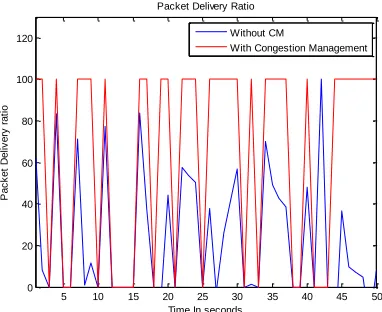
a long distance. This has been kept for future work. A comparison of packet delivery ratio is
shown in figure 4.6. it is the ratio of total number of packets received to total number of packets
sent. In this case some packets sent by second path could accommodate in the channel bandwidth
and rest raise alarm for congestion in the path. If figure 4.6 is compared with figure 4.2, it shows
the congestion is removed by proposed method only when congestion was in the path and packet
delivery ratio is highest at that time.
Figure 4.6: Percentage of Packet delivery ratio for proposed algorithm
0 20 40 60 80 100 120 140 160 180 200
0 20 40 60 80 100 120 140 160 180 200 1 2 3 4 5 6 7 8 9 10 11 12 13 14 15 16 17 18 19 20 21 22 23 24 25 26 27 28 29 30 31 32 33 34 35 36 37 38 39 40 41 42 43 44 45 46 47 48 49 50 51 52 53 54 55 56 57 58 59 60 61 62 63 64 65 66 67 68 69 70 71 72 73 74 75 76 77 78 79 80 81 82 83 84 85 86 87 88 89 90 91 92 93 94 95 96 97 98 99 100
5 10 15 20 25 30 35 40 45 50
0 20 40 60 80 100 120
Time In seconds
P a c k e t D e liv e ry r a ti o
Packet Delivery Ratio
Without CM
Jyoti et al, International Journal of Computer Science and Mobile Applications,
Vol.3 Issue. 8, August- 2015, pg. 62-79 ISSN: 2321-8363
©2015, IJCSMA All Rights Reserved, www.ijcsma.com 77
9 . CONCLUSION
Initially in this paper we prove that traffic bottlenecks is a major issue in WSNs and that queue
formation starts very early when bottlenecks appear in the network. Thus, in order to avoid
queue formation the data rate of the incoming flow must be severely reduced. In case that this
action is omitted, buffer fill-up is going to happen, while the time that passes until the nodes‟
buffers fill-up depends on the difference between incoming and outgoing flows. In order to solve
this issue congestion control algorithms needs to be applied. These algorithms can be based
either on traffic or resource control. According to the results of this paper, the traffic control
method is an effective method for transient congestion occurrences but can be proven
inappropriate when application needs all data to be transferred to sink. For this reason we base
our proposed algorithms to the resource control method, a method that has not attracted a lot of
interest due to the overhead that it creates. In this paper we addressed all possible problems that
resource control methods may face and presented a novel algorithm. Before presenting the two
algorithms, we study a number of issues that were raised in relation with topology control
algorithms. Specifically, we studied whether source-based trees can provide an effective
topology control solution as sink-based trees do. The results show that source based can provide
a proper solution under specific circumstances and for specific applications. Source based trees
constituted the base for the first novel algorithm that we presented.
10.
FUTURE WORK
This research area is never ending area as due to sensor nodes battery constraint, researcher
always try to develop algorithm which may consumes very less energy during transmission and
reception as well as in detection mechanism executed on that. In our work we have not
considered the energy concept at nodes, but in actual the congestion detection is done at node
which takes energy of node in processing, decreasing the alive time of node. In future work,
energy can be considered as a constraint in the algorithm as it may happen as with our case, after
Jyoti et al, International Journal of Computer Science and Mobile Applications,
Vol.3 Issue. 8, August- 2015, pg. 62-79 ISSN: 2321-8363
©2015, IJCSMA All Rights Reserved, www.ijcsma.com 78
congestion. It‟s a path with many hopes. These should be decreased so that energy of packets don‟t reduces much.
REFERENCES
[1] H. M. El-Sayed, O. Bazan, U. Qureshi, M. Jaseemuddin” Performance Evaluation of
TCP in Mobile Ad hoc Networks”, Second International Conference on Innovation in Information Technology (IIT‟05).
[2] V.Elamathi, D.Dhivya “To Avoid Congestion by Using Flooding Approach in
Wireless Ad Hoc Networks”, International Journal of Engineering Science and
Innovative Technology (IJESIT) Volume 2, Issue 2, March 2013.
[3] S. Floyd and K. Fall, “Promoting the use of end-to-end congestion control in the
internet” IEEE/ACM Transactions on Networking, 7(4), August 1999.
[4] Nishu Garg, R.P.Mahapatra “MANET Security Issues “, IJCSNS International
Journal of Computer Science and Network Security, VOL.9 No.8, August 2009.
[5] Anup W. Burange, PRMIT & R,Badnera,Dr. Vijay T. Ingole “Minimization of
Congestion in Mobile Ad-Hoc Network “,International Journal of Advance Research
in Computer Science and Management Studies Research Paper Volume 1, Issue 7,
December 2013.
[6] L. Xia, Z. Liu, Y. Chang, P. Sun, “An Improved AODV Routing Protocol Based on
the Congestion Control and Routing Repair Mechanism”, Int. Conf. Communications
and Mobile Computing, IEEE, China, 2009, vol. 2, pp. 259-262.
[7] S. Yin, and X. Lin, “MALB: MANET adaptive load balancing”, In Vehicular
Jyoti et al, International Journal of Computer Science and Mobile Applications,
Vol.3 Issue. 8, August- 2015, pg. 62-79 ISSN: 2321-8363
©2015, IJCSMA All Rights Reserved, www.ijcsma.com 79
[8] Special issue on Computational Intelligence, IEEE Journal on Selected Areas in
Communications (JSAC), Volume 15, Issue 2, February 1997.
[9] Gasim Alandjani and Eric E. Johnson, “Fuzzy Routing in Ad Hoc Networks” IEEE
2003.
[10] S. Floyd and V. Jacobson. “Random early detection gateways for congestion
avoidance”, IEEE/ACM Transactions on Networking, 1(4):397–413, 1993.
[11] V. Firoiu and M. Borden, “A study of active queue management for congestion
control”, In Proceedings of the IEEE Infocom, pages 1435–1444, Tel Aviv, Mar