2016
On Minimum Spanning Subgraphs of Graphs
With Proper Connection Number 2
Zhenming Bi
Gary Chartrand
Western Michigan University, [email protected]
Garry L. Johns
Ping Zhang
Follow this and additional works at:https://digitalcommons.georgiasouthern.edu/tag
Part of theDiscrete Mathematics and Combinatorics Commons
This article is brought to you for free and open access by the Journals at Digital Commons@Georgia Southern. It has been accepted for inclusion in Theory and Applications of Graphs by an authorized administrator of Digital Commons@Georgia Southern. For more information, please contact [email protected].
Recommended Citation
Bi, Zhenming; Chartrand, Gary; Johns, Garry L.; and Zhang, Ping (2016) "On Minimum Spanning Subgraphs of Graphs With Proper Connection Number 2,"Theory and Applications of Graphs: Vol. 3 : Iss. 2 , Article 2.
DOI: 10.20429/tag.2017.030202
Cover Page Footnote
We greatly appreciate the valuable suggestions made by anonymous referees that resulted in an improved paper.
Abstract
An edge coloring of a connected graph G is a proper-path coloring if every two vertices of G are connected by a properly colored path. The minimum number of colors required of a proper-path coloring ofG is called the proper connection number pc(G) ofG. For a connected graphGwith proper connection number 2, the minimum size of a connected spanning subgraphH ofG with pc(H) = 2 is denoted by µ(G). It is shown that if sand t are integers such that t≥ s+ 2 ≥5, then µ(Ks,t) = 2t−2. We also determine µ(G) for several classes of complete multipartite graphs G. In particular, it is shown that if G = Kn1,n2,...,nk is a complete k-partite graph, where
k≥3,r=Pk−1
i=1 ni ≥3 and t=nk≥r2+r, then µ(G) = 2t−2r+ 2.
1
Introduction
An edge coloring of a connected graph Gis a rainbow coloringof G if every two vertices are connected by a path where no two edges are colored the same (a rainbow path). A connected graph G with a rainbow coloring is a rainbow-connected graph. The minimum number of colors required for a rainbow coloring of a connected graph G is its rainbow connection
number rc(G). These concepts were introduced and studied by Chartrand, Johns, McKeon
and Zhang in 2006 resulting in the 2008 paper [3]. Since then, much research has been done on these topics. In fact, a book [5] has been written on rainbow connection in graphs.
An edge coloring of a graphGis aproper coloringofGif every two adjacent edges ofGare assigned distinct colors. The minimum number of colors required of a proper edge coloring of G is its chromatic index, denoted by χ0(G). An edge coloring of a connected graph G is called a proper-path coloring if every two vertices of G are connected by a properly colored path (a proper path). The minimum number of colors required of a proper-path coloring of G is called the proper connection number pc(G) of G. Therefore, pc(G) ≤ χ0(G) for every connected graph G. This concept was independently introduced and studied in [1, 2]. Recently, much research has been done on these concepts and, in fact, there is a dynamic survey on this topic due to Li and Magnant [4].
In [1] it was shown that every complete multipartite graph that is neither a complete graph nor a star has proper connection number 2. In fact, many connected graphs have been shown to have proper connection number 2. On the other hand, a graph can have a large proper connection number. For example, pc(T) = ∆(T) for every tree T. Indeed, we have the following observation (see [1]).
Observation 1.1 Let G be a nontrivial connected graph containing bridges. If the maxi-mum number of bridges incident with a single vertex in G is b, then pc(G)≥b.
While trees can have large proper connection number, this is not true for 2-connected graphs. The following theorem is due to Borozan, Fujita, Gerek, Magnant, Manoussakis, Montero and Tuza in [2].
... . . . . . . . . . . . ... ... . . . . . . . . . . . ... ...... ... . . . . . . . . . . . ... ...... ... . . . . . . . . . . . ... ... . . . . . . . . . . . ... ... . . . . . . . . . . . ... ...... ... . . . . . . . . . . . ... ... . . . . . . . . . . . ... ... . . . . . . . . . . . ... ... . . . . . . . . . . . ... ... . . . . . . . . . . . ... ... . . . . . . . . . . . ... ... . . . . . . . . . . . ... ... . . . . . . . . . . . ... ... . . . . . . . . . . . ... ...... ... . . . . . . . . . . . ... ........ ... ... ... ... ... ... ...... ...... ... ... ... ... ... ...... ...... ... ...... ...... ...... ...... ... ...... ...... .... . . . . . . . . . . . . . . . . . . . . . . . . . . . . . . . . . . . . . . . . . . . . . . . . . . . . . . . . . . . . . . . . . . . . . . . . . . . . . . . . . . . . . . . . . . . . . . . . . . . . . . . . . . . . . . . . . . . . . . . . . . . . . . . . . . . . . . . . . . . . . . . . . . . . . . . . . . . . . . . . . . . . . . . . . . . . . . . . . . . . ... ... ... ... ...... ...... ...... ...... .. ... ... ... ...... ...... ...... . . . . . . . . . . . . . . . . . . . . . . . . . . . . . . . . . . . . . . . . . . . . . . . . . . . . . . . . . . . . . . . . . . . . . . . . . . . . . . . . . . . . . . . . . . . . . . . . . . . . . . . . . . . . . . . . . . . . . 1 3 2 1 3 3 2 3 3 3 3 1 1 1 1 2 2 1 2
1 2 1
2 1
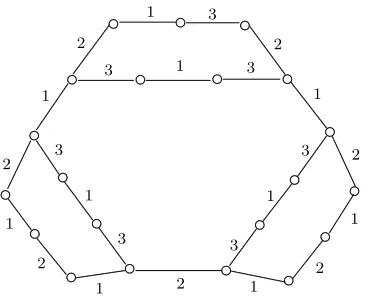
Figure 1: A 2-connected graph G with proper connection number 3
The upper bound 3 in Theorem 1.2 cannot be improved as it was shown in [2] that 2-connected graphs with proper connection number 3 exist. The 2-connected graph G in Figure 1 has proper connection number 3. A proper-path 3-coloring ofGis shown in Figure 1. The graph G in Figure 1 is, of course, also edge connected. That is, there exist 2-edge connected graphs with proper connection number 3. While verifying that the proper connection number of the graphGof Figure 1 is 3 may require some time, there is a class of 2-edge connected graphs with proper connection number 3, the verification of which is more immediate.
A graph Gis afriendship graphif every two distinct vertices ofGhave a unique common neighbor. A friendship graph has odd order 2k+1 for some positive integerk. The friendship graph of order 3 isK3 and the friendship graph of order 2k+ 1≥5 is obtained by identifying
one vertex from each of k triangles.
Proposition 1.3 If G is the friendship graph of order 7, then pc(G) = 3.
Proof. Label the vertices of G as shown in Figure 2(a). First, the edge coloring c0 where c0(wx1) =c0(wy1) =c0(wz1) = 1, c0(wx2) =c0(wy2) =c0(wz2) = 2 and c0(x1x2) =c0(y1y2) =
c0(z1z2) = 3 is a proper-path 3-coloring ofG and so pc(G)≤3.
... . . . . . . . . . . . ... ....... ... ... . . . . . . . . . . . ... ... . . . . . . . . . . . ... ....... ... . . . . . . . . . . . ... ...... ...... ...... ........ ....... ... . . . . . . . . . . . ... ... . . . . . . . . . . . ... ....... ... . . . . . . . . . . . ... ... . . . . . . . . . . . ... ... . . . . . . . . . . . ... ... . . . . . . . . . . . ... ...... ... . . . . . . . . . . . ... ...... ...... ...... ..... ...... ... ... ... .. ... ...... ...... ...... .. .. .. .. .. .. .. .. .. .. .. .. .. .. .. .. .. .. .. .. .. .. .. .. .. .. .. .. .. .. .. .. .. .. .. .. .. .. .. .. .. .. . ... ...... ...... ...... ...... ...... ... ...... ... ...... . . . . . . . . . . . . . . . . . . . . . . . . . . . . . . . . . . . . . . . . . . . . . . . . . . . . . . . . . . . . . . . . . . . . . . ...... ...... ...... ... . . . . . . . . . . . . . . . . . . . . . . . . . . . . . . . . . . . . . . . . . . . . . . . . . . . . . . . . . . . . . . . . . . . . . . . . . . . . . . . . . . . ...... ...... ...... ...... ...... ... ...... ... ... ... ... ... ... ... ...... ...... ...... . . . . . . . . . . . . . . . . . . . . . . . . . . . . . . . . . . . . . . . . . . . . . . . . . . . . . . . . . . . . . . . . . . . . . . . . . . . . . . . . . . . . . . . . . . . . . . . . . . . . . . . . . . . . . . . . . . . . . . . . . . . . . . . . . . . . . . . . . . . . . . . . . . . . . . . . . . . . . . . . . . . . . . . . ...... ...... ... ...... ... . . . . . . . . . . . . . . . . . . . . . . . . . . . . . . . . . . . . . . . . . . . . . . . . . . . . . . . . . . . . . . . . . . . . . . . . . . . ...... ... .... ...... ...... ...... w T1 w w
y2 z1 y2
2 1 2 1 1 1 2 2 (b) (c) x2 2 2 1 z2
x1 x2
x1
T2
(a)
z1 y2 z1
1 2
z2 y1
T3
z2 y1 y1
x1 x2
2 1
Figure 2: The friendship graph of order 7
Next, we show that pc(G) ≥ 3. Assume, to the contrary, that there is a proper-path 2-coloring c of G with the colors 1 and 2. Denote the triangle with vertices x1, x2, w by T1,
shown in Figure 2(a). We claim that in each of the three triangles T1, T2, T3, the two edges
incident with w are assigned different colors by c.
Assume, to the contrary, that one of T1, T2, T3 has its two edges incident withw colored
the same, say c(wx1) = c(wx2) = 1. Since there is a proper x1 −y1 path and there is
a proper x1 − z1 path, at least one edge incident with w in T2 and T3 is colored 2, say
c(wy1) = c(wz1) = 2. SinceG contains a propery1−z1 path, either wy2 orwz2 is colored 1,
say c(wy2) = 1. Since G contains a proper x1 −y2 path, c(y1y2) = 1. Thus, (y1, w, z2, z1)
is the unique proper y1−z1 path, which implies that c(wz2) = 1 and c(z1z2) = 2. However
then, there is no proper x1−z2 path, which produces a contradiction. Thus, as claimed, in
each of three triangles T1, T2, T3, the two edges incident with w are assigned different colors
by c. Hence, we may assume that c(wx1) = c(wy1) = c(wz1) = 1 and c(wx2) = c(wy2) =
c(wz2) = 2, as shown in Figure 2(b).
Since G contains a proper x1 −y1 path, it follows that c(x1x2) = 1 or c(y1y2) = 1, say
the former. There is now only one possible properx2−z2 path, namely, (x2, w, z1, z2), which
implies that c(z1z2) = 2. However then, there is only one proper x2 − y2 path, namely
(x2, w, y1, y2), which implies that c(y1y2) = 2. Thus, we arrive at the coloring of G shown
in Figure 2(c). However then, there is no proper y1 −z1 path, producing a contradiction.
Hence, pc(G)≥3 and so pc(G) = 3.
The proof of Proposition 1.4 and the proper-path 3-coloring of Gdescribed in this proof can be extended to give the following result.
Corollary 1.4 Every friendship graph of order at least 7has proper connection number 3.
We have noted that many graphs have proper connection number 2. Certainly, many 2-connected graphs have proper connection number 2. If G is a noncomplete connected graph containing a connected spanning subgraphH such that pc(H) = 2, then pc(G) = 2 as well. In fact, every noncomplete connected supergraphF of H with V(F) = V(H) also has proper connection number 2. This suggests the following concept. For a connected graph G with pc(G) = 2, let µ(G) denote the minimum size of a connected spanning subgraph H of G with pc(H) = 2. In this context, we refer to a spanning subgraph H of G with µ(G) edges as a minimum spanning subgraph of G. In what follows, we determine µ(G) for some familiar graphs Gwith pc(G) = 2.
2
Complete Bipartite Graphs
We now investigate this concept for complete multipartite graphs that are neither a star nor a complete graph, beginning with complete bipartite graphs Ks,t with 2≤s≤t. SinceKs,t
contains a Hamiltonian path if and only if t−s ≤ 1, it follows that this minimum size is t+s−1 for these graphs. It therefore suffices to consider those graphs Ks,t with t−s≥2.
We begin with the graphsK2,t where t ≥4.
Proof. Let U ={u1, u2} and W ={w1, w2, . . . , wt} be the two partite sets ofK2,t and let H = K2,t− {u1w2, u2w1}. Thus, the size of H is 2t−2. We show (1) pc(H) = 2 and (2)
H has the minimum size of a connected spanning subgraph of K2,t with proper connection
number 2.
First, we show that pc(H) = 2. Define the edge coloring c:E(H)→ {1,2} by
c(uiwj) =
1 if either i= 1 and j = 1 or 3≤j ≤t−1 or (i, j) = (2, t)
2 if either i= 2 and 2≤j ≤t−1 or (i, j) = (1, t).
To verify that c is a proper-path coloring of H, we show that every two vertices of H are connected by a proper path. Let x and y be two nonadjacent vertices of H.
? If{x, y}={u1, u2}, then (u1, w3, u2) is a proper u1−u2 path.
If{x, y}={u1, w2}, then (u1, wt, u2, w2) is a proper u1−w2 path.
If{x, y}={u2, w1}, then (u2, wt, u1, w1) is a proper u2−w1 path.
? Letx=wi and y=wj where 1≤i < j ≤t. First, suppose thatx∈ {w1, w2}.
If x = w1 and y =wj for 2 ≤ j ≤ t−1, then (w1, u1, wt, u2, wj) is a proper w1−wj
path.
Ifx=w1 and y=wt, then (w1, u1, wt) is a proper w1−wt path.
If x = w2 and y =wj for 3 ≤ j ≤ t−1, then (w2, u2, wt, u1, wj) is a proper w2−wj
path.
Ifx=w2 and y=wt, then (w2, u2, wt) is a proper w2−wt path.
Next, suppose that x=wi where 3≤i≤t−1.
Ify =wj for i+ 1≤j ≤t−1, then (wi, u1, wt, u2, wj) is a proper wi−wj path.
Ify =wt, then (wi, u1, wt) is a proper wi−wt path.
Hence, cis a proper-path coloring of H and so pc(H) = 2.
Next, we show that H has the minimum size of a connected spanning subgraph of K2,t
with proper connection number 2. Suppose that there is a connected spanning subgraph F ofK2,t having less than 2t−2 edges for which pc(F) = 2. Necessarily, at least three vertices
ofW have degree 1 in F. It cannot occur that three vertices of degree 1 inF are adjacent to the same vertex of U, for otherwise pc(F) ≥3 by Observation 1.1. Hence, we may assume that the vertices wi, 1 ≤ i ≤ 3, have degree 1 in F and that u1w1, u1w2, u2w3 are edges of
F. Any proper-path coloring c : E(F) → {1,2} of F must assign distinct colors to u1w1
and u1w2, say c(u1w1) = 1 and c(u1w2) = 2. We may assume, without loss of generality,
that c(u2w3) = 1. LetP be a proper w1−w3 path in F. Thus, P = (w1, u1, wj, u2, w3) for
some integer j ≥ 4. Since c(w1u1) = c(u2w3) = 1 and P is a proper path, it follows that
c(u1wj)6= 1 and c(wju2)6= 1 and so c(u1wj) =c(wju2) = 2, which is a contradiction.
Next, we determine µ(Ks,t) for all integers s and t with t ≥s+ 2≥5.
Proof. Let G=Ks,t with partite sets
U ={u1, u2, . . . , us} and W ={w1, w2, . . . , wt}.
Write t=sq+r for integers q and r where 0≤r ≤s−1.
First, we construct a connected spanning subgraph H of G of size 2t −2 such that pc(H) = 2. We consider two cases, according to whetherr = 0 or 1≤r≤s−1.
Case 1. r = 0. Partition the set W into q ≥ 2 subsets W1, W2, . . . , Wq where |Wi| = s
for 1≤i≤q such thatW1 ={w1, w2, . . . , ws} and W2 ={ws+1, ws+2, . . . , w2s}.
? First, suppose that s = 3. If q = 2, let Q1 = (u1, w3, u2, w4, u1) = C4 and Q2 =
(u2, w5, u3, w6, u2) =C4. If q ≥ 3, then for each integeri with 3≤ i ≤q, letQi =C6
be a Hamiltonian cycle of the subgraph G[U ∪Wi] = K3,3 of G induced by U ∪Wi.
LetH be the spanning subgraph of Gwith
E(H) =E(Q1)∪E(Q2)∪ · · · ∪E(Qq)∪ {u1w1, u1w2}. (1)
? Next, suppose that s ≥ 4. Let U0 = U − {u1, u2} and W0 = W1 − {w1, w2}. Let
Q1 =C2s−4 be a Hamiltonian cycle in the subgraphG[U0∪W0] =Ks−2,s−2 ofGinduced
byU0∪W0 and for each integer i with 2≤i≤q, let Qi =C2s be a Hamiltonian cycle
in the subgraph G[U ∪Wi] = Ks,s of G induced by U ∪Wi. Let H be the spanning
subgraph of G whose edge set is described in (1). Hence, the size ofH is 2t−2.
It remains to show that pc(H) = 2. We first define an edge coloring c : E(H) → {1,2}. For 1 ≤ i ≤ q, let c be a proper edge coloring of the even cycle Qi. Also, let c(u1w1) = 1
and c(u1w2) = 2. Next, we show that c is a proper-path coloring of H. Let x and y be two
nonadjacent vertices of H. If x and y lie on some even cycle Qp for some p∈ {1,2, . . . , q},
then there is a proper x−y path in H. Thus, we may assume thatx and y do not lie on a common even cycle Qi where 1≤i≤q.
First, suppose that s = 3. Since x and y do not lie on a common even cycle Qi where
1≤i≤q, it follows that x, y ∈U∪ {w1, w2, . . . , w6}. Let H0 be the subgraph of H induced
by U ∪ {w1, w2, . . . , w6}. We may furthermore assume that the edges of H0 are colored as
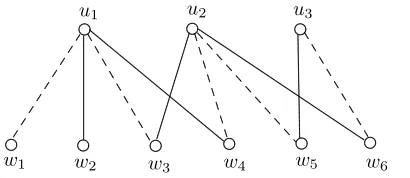
shown in Figure 3, where a solid edge and a dashed edge are colored differently. Ifx, y ∈U, say x=u1 and y=u3, then (u1, w3, u2, w5, u3) is a properx−ypath. Thus, we may assume
that at least one of xand y does not belong to U, say y ∈W. Theny=wi for some i with i= 1,2, . . . ,6. A case-by-case argument shows that there is a proper x−y path inH0 (and so in H). For example, (u1, w4, u2, w6) is a proper u1 −w6 path and (w1, u1, w4, u2, w6) is a
proper w1−w6 path.
Next, suppose that s≥4. Since every two distinct vertices ofU lie on the even cycleQ2,
it follows that at least one of x and y does not belong to U, say y ∈ W. We consider two subcases, according to whether x∈U or x∈W.
Subcase 1.1. x∈ U. First, suppose that y=wi for 3≤ i≤s. Then x∈ {u1, u2}. Since
xlies onQ2 andyis adjacent to a vertex z onQ2, there are twox−ypaths passing through
z, one of which is proper. Next, suppose that y∈ {w1, w2}. Since x and y are nonadjacent,
x =ui for some i with 2 ≤i ≤ s. Then x lies on Q2 and y is adjacent to the vertex u1 on
... .. . . . . . . . . . . . . .
... ...... ...... ...... ...
.. . . . . . . . . . . . . .
... ........ ...
.. . . . . . . . . . . . . .
... ....... ..........
... ...
... ...
... ...
... ...
... ... ...
... ...
... ...
... ...
... ...
... ...
... ...
... ...
... ...
... ...
... ...
... ...
... ...
... ....
... ...
... ...
... ...
... ...
... ......
...... ......
...... ......
...... ... ...
... ...
... ...
... ...
... ...... ......
...... ......
...... ......
... ... ... ... ... ... ...... ... ... ... ... ...
w4 w5 w6
w3 w2
w1
u1 u2 u3
Figure 3: A subgraph H0 inH when s= 3
Subcase 1.2. x ∈ W. We may assume that x = wi and y =wj where 1 ≤ i < j. First,
suppose that i ∈ {1,2}. If (i, j) = (1,2) orj ≥ s+ 1, then (wi, u1, wj) is a proper wi −wj
path in H. Next, suppose that 3≤ j ≤s. Then x is adjacent to u1 of Q2 and y is adjacent
to a vertex z of Q2 (where it is possible that u1 = z). There are two x−y paths passing
through z, one of which is proper. Next, suppose that i ≥ 3. Hence, x ∈ Wa and y ∈ Wb
where 1≤a < b≤q. Then x is adjacent to a vertexz on Qb and y lies on Qb. Thus, there
are twox−y paths passing through z, one of which is proper.
Case 2. 1 ≤ r ≤ s −1. Partition the set W into q + 1 subsets W0, W1, W2, . . . , Wq
where |W0| = r and |Wi| = s for 1 ≤ i ≤ q such that W0 = {w1, w2, . . . , wr} and W1 =
{wr+1, wr+2, . . . , wr+s}.
? For r = 1, let W0 = W1 − {w2} and U0 = U − {u1}. Now, let Q1 = C2s−2 be a
Hamiltonian cycle in the subgraph G[U0 ∪W0] = Ks−1,s−1 of G induced by U0 ∪W0
and for 2 ≤ i ≤ q if q ≥ 2, let Qi = C2s be a Hamiltonian cycle in the subgraph G[U ∪Wi] = Ks,s of G induced by U ∪Wi. Let H be the spanning subgraph of G
whose edge set is described in (1).
? For r= 2, let Qi =C2s be a Hamiltonian cycle in the subgraph G[U ∪Wi] =Ks,s for
1≤i≤q. Let H be the spanning subgraph ofG whose edge set is described in (1).
? Forr= 3, let Q0 = (u1, w3, u2, w4, u1) =C4. LetU0 =U− {u1} and W0 =W1− {w4}.
Now let Q1 =C2s−2 be a Hamiltonian cycle in the subgraph G[U0∪W0] =Ks−1,s−1 of
Ginduced byU0∪W0. For each integeriwith 2≤i≤q, letQi =C2sbe a Hamiltonian
cycle in the subgraphG[U∪Wi] =Ks,s ofGinduced byU∪Wi. LetH be the spanning
subgraph of G whose edge set is
E(H) =E(Q0)∪E(Q1)∪ · · · ∪E(Qq)∪ {u1w1, u1w2}. (2)
? Forr ≥4, letW0 =W0−{w1, w2}andU0 ={u1, u2, . . . , vr−2}. Now, letQ0 =C2r−4 be
a Hamiltonian cycle in the subgraphG[U0∪W0] =Kr−2,r−2ofGinduced byU0∪W0 and
for 1≤ i≤q, letQi =C2s be a Hamiltonian cycle in the subgraphG[U ∪Wi] =Ks,s
of G induced by U ∪Wi. Let H be the spanning subgraph of G whose edge set is
described in (2).
c(u1w2) = 2. An argument similar to that in Case 1 shows that cis a proper-path coloring
of H and so pc(H) = 2.
Next, we show that the minimum size of a connected spanning subgraph of Ks,t with
proper connection number 2 is 2t−2. Suppose that there is a connected spanning subgraph F of Ks,t having less than 2t−2 edges but pc(F) = 2. Necessarily, at least three vertices
of W have degree 1 in F. It cannot occur that three vertices of degree 1 in F are adjacent to the same vertex of U, for otherwise, pc(F) ≥ 3 by Observation 1.1. We may assume that the vertices wi, 1 ≤ i ≤ 3, have degree 1 in F. Suppose that e1, e2, e3 are the three
pendant edges that are incident with w1, w2 or w3, respectively. Any proper-path coloring
c:E(F)→ {1,2} of F must assign the same color to two of e1, e2, e3, say c(e1) =c(e2) = 1.
Thus, e1 and e2 cannot be adjacent, say e1 = u1w1 and e2 = u2w2. Let P be a proper
w1−w2 path in F, say P = (w1, u1, wi, . . . , wj, u2, w2) for some integers i, j ∈ {3,4, . . . , t}.
Let P0 =P − {w1, u1, u2, w2} be the subpath of P. Then P0 has even length and the edges
of P0 are colored alternately 2 and 1. However then, c(wju2) = c(u2w2) = 1, which is a
contradiction. Therefore, the minimum size of a connected spanning subgraph of Ks,t with
proper connection number 2 is 2t−2.
Combining Theorems 2.1 and 2.2, we obtain the following.
Corollary 2.3 If s and t are integers with t ≥s+ 2≥4, then µ(Ks,t) = 2t−2.
The proof of Theorem 2.2 gives rise to the following useful corollary.
Corollary 2.4 LetF be a connected spanning subgraph of the complete bipartite graphKs,t
with partite sets U andW, where|U|=s, |W|=t and 1≤s ≤t andt ≥3. If at least three vertices of W have degree 1 in F, then pc(F)≥3.
3
Complete Multipartite Graphs
We now look at complete k-partite graphs for k ≥ 3. Let G = Kn1,n2,...,nk be the complete
k-partite graph of order n = Pk
i=1ni, where 1 ≤ n1 ≤ n2 ≤ · · · ≤ nk and k ≥ 3. Since G
contains a Hamiltonian path if and only if nk ≤ Pk
−1
i=1 ni + 1, it follows that µ(G) = n−1
in this case. Thus, it suffices to consider the case when nk ≥ Pk
−1
i=1 ni + 2. We begin by
establishing an upper bound forµ(G) for such complete k-partite graphs G.
Proposition 3.1 LetG=Kn1,n2,...,nk be the completek-partite graph of ordern=
Pk i=1ni,
where 1≤n1 ≤n2 ≤ · · · ≤nk and k≥3. If nk ≥Pk
−1
i=1 ni+ 2, then µ(G)≤2nk−2.
Proof. Let V1, V2, . . . , Vk be the partite sets of G with |Vi| = ni for 1 ≤ i ≤ k and let F
be the complete bipartite graph with partite sets V1 ∪V2∪ · · · ∪Vk−1 and Vk. It follows by
the proofs of Theorems 2.1 and 2.2 that F contains a connected spanning subgraph H of size 2nk−2 such that pc(H) = 2. SinceF is a connected spanning subgraph of G, it follows
that G contains a connected spanning subgraphH of size 2nk−2 such that pc(H) = 2 and
so µ(G)≤2nk−2.
Proposition 3.2 LetG=Kn1,n2,...,nk be the completek-partite graph of ordern=
Pk i=1ni,
where 1≤n1 ≤n2 ≤ · · · ≤nk and k≥3. If nk =Pk
−1
i=1 ni+ 2, then µ(G) = 2nk−2.
Proof. Since G has order n with nk = Pk
−1
i=1 ni + 2, it follows by Proposition 3.1 that
µ(G)≤2nk−2. Every connected spanning subgraphH of G of size 2nk−3 is a tree. Since G contains no Hamiltonian path, it follows that pc(H) = ∆(H) ≥ 3. Thus, there is no connected spanning subgraph of size 2nk −3 having proper connection number 2. Hence, µ(G)≥2nk−2 and so µ(G) = 2nk−2.
We now investigate µ(G) for the complete 3-partite graphsG. To simplify the notation, let G = Kr,s,t be a complete 3-partite graph where 1 ≤ r ≤ s ≤ t and t ≥ r+s+ 2. We
show that the upper bound described in Proposition 3.1 is attainable when r = s = 1 and t≥4. First, we state a useful observation.
Observation 3.3 If F is a connected spanning subgraph of a graph G such that pc(F) = pc(G) = 2, then µ(G)≤µ(F).
Proposition 3.4 For each integer t≥4, µ(K1,1,t) = 2t−2.
Proof. Since K2,t ⊆K1,1,t, it follows by Observation 3.3 and and Theorem 2.1 that µ(K1,1,t)≤µ(K2,t)≤2t−2.
Thus, it suffices to show that µ(K1,1,t) ≥ 2t −2. Assume, to the contrary, that there is
a connected spanning subgraph F of K1,1,t of size m < 2t −2 with pc(F) = 2. Thus, at
least three vertices of W have degree 1 in F. Let the partite sets of K1,1,t be {u}, {v} and W ={w1, w2, . . . , wt}.
First, suppose that exactly three vertices of W have degree 1 in F. Thus, m ≥ 2t−3. Since m < 2t −2, it follows that m = 2t −3 and so uv /∈ E(F). However then, F is a bipartite subgraph of K2,t with partite sets {u, v} and W. Since F has three vertices of
degree 1 in W, it then follows by Corollary 2.4 that pc(F)≥3, which is impossible.
Next, suppose that at least five vertices of W have degree 1 in F. Then either u or v is incident with at least three bridges in F and so pc(F) ≥ 3 by Observation 1.1, which is a contradiction. Thus, exactly four vertices of W have degree 1 in F and each of u and v is incident with exactly two of these four vertices. Therefore, we may assume that the vertices wi (1 ≤ i ≤ 4) have degree 1 in F and uw1, uw2, vw3, vw4 are edges of F. Furthermore, if
uv /∈ E(F), then F is a bipartite subgraph of K2,t with partite sets {u, v} and W. Again,
since F has four vertices of degree 1 in W, it then follows that pc(F)≥3 by Corollary 2.4, which is impossible. Thus, we assume that uv ∈E(F).
Any proper-path coloring c:E(F)→ {1,2}of F must assign distinct colors to uw1 and
uw2, sayc(uw1) = 1 and c(uw2) = 2 and distinct colors tovw3 and vw4, say c(vw3) = 1 and
c(vw4) = 2. Assume, without loss of generality, that c(uv) = 1. Any properw1−w3 pathP
in F must begin with w1, u and terminate withv, w3. Necessarily, the only other vertex on
P is wj for some j with 5 ≤j ≤t, that is, P = (w1, u, wj, v, w3). Since c(w1u) = c(vw3) = 1
it follows that c(uwj) =c(vwj) = 2, which is a contradiction.
Proposition 3.5 For an integer t≥11, if G∈ {K1,2,t, K1,1,1,t}, then
µ(G) = 2t−4.
Proof. Since K1,2,t is a spanning subgraph of K1,1,1,t, it follows by Observation 3.3 that µ(K1,1,1,t)≤µ(K1,2,t). Thus, it suffices to show thatµ(K1,2,t)≤2t−4 andµ(K1,1,1,t)≥2t−4
for each integert ≥11.
We first show that µ(K1,2,t)≤2t−4. Let G=K1,2,t, whose partite sets are {x, z}, {y}
and W ={w1, w2, . . . , wt}. Let F be the connected spanning subgraph of G obtained from
the path P3 = (x, y, z) by joining w1 and w2 to x, w3 and w4 to y, w5 and w6 to z, w7 to
x and z, wi to x and y for 8 ≤ i ≤ t−2, wi to y and z for i = t−1, t. The graph F is
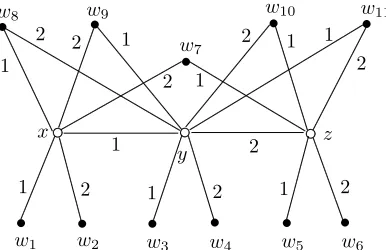
shown in Figure 4 for t= 11. Since (i) there are six vertices of W of degree 1 in F, namely wi for 1≤i≤6, (ii) the remainingt−6 vertices of W have degree 2 in F and (iii) there are
exactly two edges in G[{x, y, z}], it follows that the size ofF is 2t−4.
... . . . . . . . . . . . ... s s s s s ... . . . . . . . . . . . ... .......
s s s s s s ... ... ... ... ... ...... ...... ...... ...... ...... ... ... ... ... ...... ...... ...... ...... ... ... ... ... ...... ...... ...... ...... ...... ...... ...... ...... ...... ... ...... ...... ...... ...... ...... ...... .... .... .... .... .... .... .... .... .... .... .... .... .... .... .... .... .... .... .... .... .... .... .... .... .... .... .... .... .... .... .... .... .... .... .... ...... ...... ...... ...... ...... ...... ...... ... ... ... ... ... ...... ...... ...... ...... ...... ...... ... ... ... ... ... ... ... ... ... ... ... ... ... ... ... ... ... ... ... ... ... ... ... ... ...... ...... ...... ...... . w7 w11
w1 w2 w3 w4 w5 w6
w8
x z
y
w9 w10
Figure 4: A connected spanning subgraph F of K1,2,11 for t= 11
Since there is a proper-path 2-edge coloring of F, it follows that pc(F) = 2. Such a proper-path 2-edge coloring of F is shown in Figure 5 for t = 11. If t ≥12, then (1) color the two edges wix and wiy (10≤ i≤ t−2) as w8x and w8y, (2) color the two edges wt−1y
and wt−1z as w10y and w10z and (3) color the two edges wty and wtz as w11y and w11z. It
can be verified that for every two nonadjacent vertices uand v of F, there is a proper u−v path in F. For example, if 12 ≤ i ≤ t−2, then (w8, x, w9, y, wi) is a proper w8−wi path
inF.
... . . . . . . . . . . . ... s ... . . . . . . . . . . . ... ......
s s s
s
s s s s s s ...... ...... ...... ...... ...... ...... ...... ...... ...... ...... ...... ...... . ... ... ... ... ... ... ... ... ... ... ... ... ...... ...... ...... ...... ...... ......... ... ... ... ... ... ... ... ...... ... ...... ... ...... ...... ... ... ... ... ... ... ... ... ............ ... ... ... ... ... ... ... ... ... ... ... ... ... ... ... ... ... ... ... ... ... ... ... ... ... ...... ...... ...... ...... . ... ... ... ... ... ... ... ... ... ... ... ...... ... ...... ...... ... ... ... ... ... ... ... ... ...... ...... ... ...... ... ... ... ... ... ... ... ...... ...... ...... ...... ...... .... x z y 1
2 1 1
2
w11
2
w7 2 1
2
w8
1
1 2
w1 w2 w3 w4 w5 w6
1 2 1 2 1 2
w9 w10
Next, we show thatµ(K1,1,1,t)≥2t−4. Let G=K1,1,1,t whose partite sets are {x}, {y},
{z}andW ={w1, w2, . . . , wt}. Assume, to the contrary, thatµ(G)≤2t−5. Then there is a
connected spanning subgraph F of G of size m≤2t−5 with pc(F) = 2. We consider three cases, according to the number of edges in the subgraphG[{x, y, z}] induced by{x, y, z}.
Case 1. The subgraph G[{x, y, z}] contains no edge. Then F is a connected spanning subgraph of K3,t with pc(F) = 2. Since µ(K3,t) = 2t−2, the size of F is at least 2t−2,
which is impossible.
Case 2. The subgraph G[{x, y, z}] contains exactly one edge, say e = xy is an edge of
G[{x, y, z}]. Since the size of F is at most 2t−5, at least six vertices of W have degree 1 inF. It cannot occur that three vertices of degree 1 inW are adjacent to a vertex in F, for otherwise, pc(F)≥3 by Observation 1.1. Thus, we may assume, without loss of generality, that the vertices wi (1 ≤ i ≤ 6) have degree 1 in F and xw1, xw2, yw3, yw4, zw5, zw6. Any
proper-path coloringc:E(F)→ {1,2}of F must assign distinct colors to the two adjacent pendant edges in F, say c(xw1) = c(yw3) = 1 and c(xw2) = c(yw4) = 2. Then a proper
w1−w3 path must be (w1, x, y, w3) and so c(xy) = 2; while a proper w2−w4 path must be
(w2, x, y, w4) and soc(xy) = 1, which is impossible.
Case3. The subgraphG[{x, y, z}]contains at least two edges. Then at least seven vertices ofW have degree 1 in F. Thus, three vertices of degree 1 inW are adjacent to a vertex inF and so pc(F)≥3 by Observation 1.1, which is impossible.
Hence, µ(K1,1,1,t)≥2t−4. Since 2t−4≤µ(K1,1,1,t)≤µ(K1,2,t)≤2t−4, it follows that µ(K1,1,1,t) = µ(K1,2,t) = 2t−4.
Proposition 3.5 is a special case of a more general result. Let G = Kn1,n2,...,nk be the
complete k-partite graph, where k ≥ 3, let r = Pk−1
i=1 ni and t = nk. We now present a
formula for µ(G) when r≥3 and t is sufficiently large compared to r.
Theorem 3.6 Let G=Kn1,n2,...,nk be a complete k-partite graph where
k ≥3, r=Pk−1
i=1 ni ≥3 and t=nk.
If t ≥r2+r, then
µ(G) = 2t−2r+ 2.
Proof. Denote the partite sets of GbyV1, V2, . . . , Vk, where |Vi|=ni for 1≤i≤k. First,
we show that µ(G) ≥ 2t−2r+ 2. Let H be a minimum connected spanning subgraph of G with pc(H) = 2. Certainly, every vertex of Vk has degree at least 1 in H. Also, at most
2r vertices of Vk have degree 1, for otherwise, there are vertices of H incident with three
or more pendant edges and so pc(H) ≥ 3 by Observation 1.1, contradicting the fact that pc(H) = 2. Thus, at most two vertices of Vk of degree 1 can be adjacent to the same vertex
of ∪k−1
i=1Vi. If any two vertices w0, w00 of degree 1 in Vk are incident with edges of the same
color, then H[∪k−1
i=1Vi] must contain an edge of the other color. Thus, the size of H must be
at least
X
w∈Vk
degHw !
and so µ(G)≥2t−2r+ 2.
Next, we show that µ(G) ≤ 2t − 2r + 2. To verify this, we show that there exists a connected spanning subgraph F of size 2t − 2r + 2 in G such that pc(F) = 2. Let ∪k−1
i=1Vi = {v1, v2, . . . , vr}, where the only edges of F[∪ik=1−1Vi] are vr−2vr−1 and vr−1vr. Let Vk = {w1, w2, . . . , wt} where degFwi = 1 for 1 ≤ i ≤ 2r. In particular, for 1 ≤ i ≤ r, w2i−1 and w2i are adjacent to vi. Next, we define an edge coloring c : E(F) → {1,2} as
follows. Let c(vr−2vr−1) = 1, c(vr−1vr) = 2, c(viw2i−1) = 1 and c(viw2i) = 2 for 1 ≤ i ≤ r.
There are r2 distinct pairs of vertices in {v1, v2, . . . , vr}. For each such pair {va, vb}, two
verticesw0 andw00 in{w2r+1, w2r+2, . . . , wr2+r}are selected, which are both joined tova and
vb, where c(vaw0) = c(vbw00) = 1 andc(vaw00) = c(vbw0) = 2. If t > r2+r, then each vertex
in {wr2+r+1, wr2+r+2, . . . , wt} is joined to two vertices in {v1, v2, . . . , vr}, where one edge is
colored 1 and the other edge is colored 2. This completes the construction of F and the edge coloring c of F. The subgraph F and the coloring c of F are illustrated in Figure 6 for K2,2,20, where each solid edge is colored 1 and each dashed edge is colored 2.
... . . . . . . . . . . . ... ...... ...... ..........
s s s s s s s s
s s s
s s s s s s s s s
... ... ... ... ... ... ... ... ... ... ... ... ... ... ... ... ... ... ... ... ... .. ... ... ... ... ... ... ... ... ... ... ... ... ... ... ... ... ... .... ... ... ... ... ... ... ... ... ... ... ... ... ... ... ... ... ... ... ...... ... ...... ...... ...... ... ...... ...... ...... ... ...... ... ...... ...... ...... ...... ...... ...... ...... ...... ...... ...... ... ... ... ... ... ... ... ... ... ... ... ... ... ... ... ... ... ... ... ... ... ... ... ... ... ... ... ... ... ... ... ... ... ... ... ... ... ... ... ... ... ... ... ... ... ... ... ... ... ... ... ... ... ...... ...... ...... ...... ...... ...... ...... ...... ...... ... ... ... ...... ... ... ...... ... ...... ... ... ...... ... ...... ... ...... ... ... ... ... ... ... ... ... ... ... ... ... ... ... ... ... ... ... ... ... ... ... ... ... ... ... ...... ...... ...... ...... ...... ...... ...... ...... ...... ...... ... ... ... ... ... ... ... ... ... ... ... ... ... .... ... ... ...... ... ... ... ...... ... ... ... ... ...... ... ... ... ...... ... ... ....... ... ... ... ... ... ... ... ... ... ... ... ... ... ...... ... ... ... ... ... ... ... ... ... ... ... ... ... ... ... ... ... ... ... ... ... ... ... ... ... ... ... ... ... ... ... ... ... ... ... ... ... ... ... ... ... ... ... ... ... ... ... ... ... ... ... ... ... ... ... ... ... ... ... ... ... ... ... ... ... ... ... ... ... ... ... ... ... ... ... ... ... ... ... ... ... ... ... ... ... ... ... ... ... ... ... ... ... ... ... ... ... ... ... ... ... ... ... ... ... ... ... ... ... ... ... ... ... ... ... ... ... ... ... ... ... ... ... ... ... ... ... ... ... ... ... ... ... ... ... ... ... ... ... ... ... ... ... ... ... ... ... ... ... ... ... v2
v1 v3 v4
w1 w2 w3 w4 w5 w6 w7 w8
w11 w12
w15
w17 w18
w13 w14 w16 w19 w20
w9 w10
Figure 6: A subgraph F of K2,2,20 and an edge coloring ofF
We now show that cis a proper-path 2-coloring of F. It remains to show that every two nonadjacent vertices x and y of F are connected by a proper path. This is obvious if there is a proper path of length 2 connecting x and y. Thus, we consider the other possibilities, namely either x, y ∈ Vk or exactly one of x and y belongs to Vk. First, we consider the
situation when x, y ∈Vk. There are three cases.
Case 1. {x, y} ={wi, wj} where 1≤ i6=j ≤2r. Suppose that wivp and wjvq are edges
in F where 1≤p < q ≤r. We consider three subcases, according to whether p < q ≤r−3 orp, q ≥r−2 or p≤r−3 and q≥r−2.
Subcase 1.1. p < q ≤r−3. If c(wivp) 6=c(wjvq), say c(wivp) = 1 and c(wjvq) = 2, then
there exists a vertex ws where s > 2r such that vpws, wsvq ∈ E(F) and c(vpws) = 2 and c(wsvq) = 1. Then (wi, vp, ws, vq, wj) is a proper wi−wj path in F. If c(wivp) = c(wjvq),
say c(wivp) = c(wjvq) = 1, then there are vertices wa and wb where a, b > 2r such that vpwa, wavr−1, vqwb, wbvr ∈ E(F) with c(wavr−1) = c(wbvr) = 1 and c(wavp) = c(wbvq) = 2.
Thus, (wi, vp, wa, vr−1, vr, wb, vq, wj) is a proper wi−wj path in F.
? If wivr−2 and vr−1wj are both colored 2, then (wi, vr−2, vr−1, wj) is a proper wi−wj
path inF.
? If wivr−2 and vr−1wj are both colored 1, then there is a vertex wa with a > 2r
such that vr−2wa, wavr ∈ E(F) such that c(vr−2wa) = 2 and c(wavr) = 1. Hence,
(wi, vr−2, wa, vr, vr−1, wj) is a proper wi−wj path inF.
? If wivr−2 and vr−1wj are colored differently, say c(wivr−2) = 1 and c(vr−1wj) = 2,
then there is a vertex wa with a > 2r such that vr−2wa, wavr−1 ∈ E(F) such that
c(vr−2wa) = 2 and c(wavr−1) = 1. Hence, (wi, vr−2, wa, vr−1, wj) is a proper wi −wj
path inF.
An argument for the situation where wivr−1, wjvr ∈ E(F) is similar. Next, assume that wivr−2, wjvr∈E(F).
? If c(wivr−2) = 2 and c(vrwj) = 1, then (wi, vr−2, vr−1, vr, wj) is a proper wi −wj path
inF.
? If c(wivr−2) = 1 and c(vrwj) = 2, then there is a vertex wa with a > 2r such that vr−2wa, wavr ∈ E(F) such that c(vr−2wa) = 2 and c(wavr) = 1. Hence, (wi, vr−2, wa, vr, wj) is a proper wi−wj path inF.
? If wivr−2 and vrwj are colored the same, say c(wivr−2) = c(vrwj) = 1, then there is a
vertex wa with a >2r such that vr−2wa, wavr−1 ∈ E(F) such that c(vr−2wa) = 2 and c(wavr−1) = 1. Hence, (wi, vr−2, wa, vr−1, vr, wj) is a proper wi−wj path inF.
Subcase 1.3. p ≤ r −3 and q ∈ {r − 2, r− 1, r}. Suppose that q = r − 2 and so wivp, wjvr−2 ∈E(F).
? If wivp and wjvr−2 are colored differently, say c(wivp) = 1 and c(wjvr−2) = 2, then
there is a vertex wa with a > 2r such that c(wavp) = 2 and c(wavr−2) = 1. Hence,
(wi, vp, wa, vr−2, wj) is a proper wi−wj path inF.
? If c(wivp) = c(vr−2wj) = 1, then there are vertices wa and wb with a, b > 2r such
that vpwa, wavr, vr−1wb, wbvr−2 ∈E(F) where c(wavr) =c(vr−1wb) = 1 and c(wavp) = c(vr−2wb) = 2. Then (wi,vp, wa,vr,vr−1, wb, vr−2, wj) is a proper wi−wj path inF.
? Ifc(wivp) = c(vr−2wj) = 2, then there is a vertexwawitha >2rsuch thatvpwa, wavr−1 ∈
E(F) such that c(vpwa) = 1 and c(wavr−1) = 2. Hence, (wi, vp, wa, vr−1, vr−2, wj) is
a proper wi−wj path in F.
The situations for q =r−1 or q=r are similar.
Case 2. {x, y}={wi, wj} where 2r < i6=j ≤t. Since each ofwi and wj is incident with
two edges of different colors in F, it follows that there exist p, q ∈ {1,2, . . . , r} such that wivp, wjvq ∈E(F) andc(wivp)6=c(wjvq). Ifvp =vq, then (wi, vp, wj) is a properwi−wj path
in F; while if vp 6= vq, then there is a vertex wa with a > 2r such that vpwa, wavq ∈ E(F)
Case 3. {x, y} = {wi, wj} where 1 ≤ i ≤ 2r and 2r + 1 ≤ j ≤ t. Suppose that wivp ∈ E(F). Choose vq such that c(wivp)6=c(wjvq). We may assume that vp 6= vq. Then
there is a vertex wa with a > 2r such that vpwa, wavq ∈ E(F) where c(wivp) 6= c(vpwa).
Thus, (wi, vp, wa, vq, wj) is a proper wi−wj path inF.
Next, we consider the situation when exactly one ofxandybelongs toVk, sayx∈Vk and y =vj for some integer j with 1 ≤j ≤r. First, suppose that x=wi where 2r+ 1≤i ≤t.
Let wivp, wivq ∈ E(F), where say c(wivp) = 1 and c(wivq) = 2. Then there is a vertex wa with a > 2r such that vjwa, wavp ∈ E(F) and c(wavj) = 1 and c(wavp) = 2. Thus,
(wi, vp, wa, wj) is a proper wi−wj path inF. Next, suppose that x=wi where 1≤i≤2r.
Let wivp ∈ E(F), where say c(wivp) = 1. Then there is a vertex wa with a >2r such that vjwa, wavp ∈ E(F) and c(wavj) = 1 and c(wavp) = 2. Thus, (wi, vp, wa, wj) is a proper wi−wj path inF.
Hence,cis a proper-path 2-coloring ofF and so pc(F) = 2. Therefore,µ(G)≤2t−2r+ 2 and so µ(G) = 2t−2r+ 2.
What remains then is determining µ(G) for G = Kn1,n2,...,nk, where k ≥ 3, r =
Pk−1 i=1 ni
and t = nk, when r + 2 ≤ t < r2 +r. Of course, the more general problem is that of
determining or at least finding bounds forµ(G) for other connected graphs Gnot possessing a Hamiltonian path.
Closing Remarks: In a relatively short period after the concept of proper-path colorings in graphs was introduced, it has been studied by many, resulting in numerous beautiful theorems and intriguing conjectures and open questions (such as in the previous paragraph). Li and Magnant’s a dynamic survey [4] provides useful information on this topic.
References
[1] E. Andrews, E. Laforge, C. Lumduanhom and P. Zhang, On proper-path colorings in graphs. J. Combin. Math. Combin. Comput. To appear.
[2] V. Borozan, S. Fujita, A. Gerek, C. Magnant, Y. Manoussakis, L. Monteroa and Z. Tuza, Proper connection of graphs. Discrete Math. 312 2550-2560, 2012.
[3] G. Chartrand, G. L. Johns, K. A. McKeon and P. Zhang, Rainbow connection in graphs.
Math. Bohem. 133 85–98, 2008.
[4] X. Li and C. Magnant, Properly colored notions of connectivity - a dynamic survey, Theory and Applications of Graphs: Vol. 0: Iss. 1, Article 2. 2015.
[5] X. L. Li and Y. F. Sun, Rainbow Connections of Graphs. Springer, Boston, MA, 2012.