Abstract
the sequences of many genomes are available; there-fore, relevant methods are needed for rapid and effi-cient identification of functional genes. the ability of tumour cells to resist apoptosis induced by anticancer agents may decide the success of failure of tumour elimination. although the cd95-signalling pathway is functional in tumour cells, the increased resistance of tumour cells to cd95-mediated apoptosis has been widely reported. In order to identify genes that might determine the response of tumour cells to cd95-me-diated apoptosis, we modified the conventional techni-cal knock out (tKo) strategy for isolation of genes that function in cd95-mediated apoptosis. due to the fact that multiple different plasmids are usually intro-duced into the same cells, the effectiveness of the con-ventional tKo strategies is low. to overcome this ob-stacle, we replaced the conventional tKo strategy (based on stably expressed randomly fragmented cdna libraries) with a multi-cycle selection procedure (based on transiently expressed randomly fragmented cdna libraries with multi-cycle selection). using this approach we could rapidly and significantly identify small numbers of antisense mRna molecules, whose re-introduction into different tumour types confirmed their ability to block the pro-apoptotic function of their cognate genes. thus, our modified tKo strategy provides a generally applicable procedure for the iden-tification of functional genes with pro-apoptotic prop-erties that may be clinically relevant to tumor therapy.
I
ntRoductIonalteration in the control of apoptosis mediated through the cd95 system contributes to the patho-genesis of a number of disorders, such as cancer. de-creased sensitivity to cd95-mediated apoptosis is a common trait shared by many cancer cells, which pro-vides them with critical survival advantages ultimately promoting malignancy [1]. apoptosis can be triggered by a vast variety of signals, including the activation of different death receptors of the tumour necrosis re-ceptor (tnf-R) family, g-irradiation and various chemical agents. the signalling pathways activated by various apoptotic stimuli converge into a common death pathway either at the mitochondrial level or at the level of effector caspase activation [2, 3]. the
sen-sitivity to apoptosis induction in any cell, however, critically depends on the expression and activity of multiple apoptosis-regulatory proteins [4, 5].
In recent investigations we have demonstrated that the cd95 (aPo-1/fas) -mediated signalling pathways are functional in many tumour cell lines [6, 7, 8].
although the components of the cd95 signalling pathway have extensively been characterized, there might still be additional, yet to be identified function-ally relevant gene products that decisively determine the response of human cancer cells to cd95-mediated apoptosis.
the results of the human genome project (HGP) now provide complete sequence information of the human genome, allowing the identification of func-tional human genes and to elucidate their functions that are involved in particular signal transduction ways such as a cell cycle, growth factor-mediated path-ways or apoptosis. Herein, the efficacy of the screen-ing procedure applied has a major impact on the antic-ipated results. both yeast two-hybrid system and dna microarrays have been widely used for the identifica-tion of funcidentifica-tional genes. the yeast two-hybrid system is a powerful method for the detection of direct inter-actions between proteins in vivo and for identification of genes whose products interacts with protein de-rived from a cdna library. the method is limited, by the fact that the interaction does not always reflect a role in phenomenon of interest and false-positive re-sults are frequent. the dna microarray technique is based on observation of changes in gene expression during various intracellular processes [9, 10]. However, using this method is difficult to identify functional genes associated with qualitative alterations, such as phosphorylation, that are responsible for alterations in a phenotype without any change in the expression of specific genes.
In this report, we describe the modification of a gene discovery system based on the conventional tech-nical knock out (tKo) strategy [11, 12] and our pub-lished functional screening [8] for rapid and efficient identification of functional genes in cd95-mediated apoptosis pathways, using randomly fragmented cdna libraries. However, as the conventional tKo strategy requires weeks for each selection cycle, we here used an approach that capitalizes on the rapidity of the appearance of specific phenotypes, that
tran-Eur J Med Res (2010) 15: 162-168 © I. Holzapfel Publishers 2010
I
dEntIfIcatIon of
c
andIdatE
G
EnEs wItH
P
Ro
-
aPoPtotIc
P
RoPERtIEs by
f
unctIonal
s
cREEnInG of
R
andoMly
f
RaGMEntEd
c
dna l
IbRaRIEs
M. Hassan1, c. Matuschek2, P. a. Gerber1, M. Peiper3, w. budach2, E. bölke2
siently express randomly fragmented cdna libraries. we here demonstrate that this modified tKo strategy is in fact useful to identify rapid and functional genes in the post- genome era. In summary, our modified tKo strategy provides a generally applicable proce-dure for the identification of functional genes with pro-apoptotic properties that may be clinically relevant for tumor therapy.
E
xPERIMEntalP
RotocolConstruction of randomly fragmented cDNA libraries:
the cdna libraries were generated from a mixture of Rnas harvested from cell lines derived from melanoma (a375), keratocanthoma (Hs 892-t), squa-mous cell carcinoma (cls-354), renal cell carcinoma (acHn), and human breast adenocarcinoma (Mcf-7) before and after treatment with the agonistic anti-cd95 antibody cH11 (500 ng/ml) for 1, 2, 3, 6, 12 hours, so that both constitutive and cH11-induced mRna transcripts were included. double stranded cdna was generated using the cdna synthesis Kit according to the manufacturer’s protocol (clontech, usa). the provided primers had been modified by in-tegration of the restriction sites Hind III and bgl II so that the entire cdna population could be inserted into the ptKo2 vector [12] between the Hind III-bgl II restriction sites in the antisense orientation.
Amplification and representative control of the library:
the anti-sense cdna library consisting of approxi-mately 1x10⁶independent clones was washed off from
agar by thoroughly scraping the surface using 1 ml lb-medium containing 100 µg/ml ampicilline. the result-ing bacterial suspension was allowed to grow in lb-medium containing 100µg/ml ampicilline for 3- 4 h. the isolation and purification of the dna plasmids were performed by using the plasmid purification kit according to the manufacturer’s protocol (Qiagen, Germany). the representative control of cdna li-brary was based on the analysis of a PcR- generated population of cdna inserts using pairs of primers corresponding to the flanking regions of the vector. In addition, we used several pairs of primers, which correspond to internal sequences of certain cdna se-quences that are expected to be present in our cdna library.
Cell culture and transfection procedures: the different tumour cell lines a375, Hs892-t, cls-354, HepG2, acHn and Mcf-7 expressing the human gene for cd95 were grown in dMEM medium supplemented with 10 % fcs (sigma, Germany) 2 mM l-glutamine and 100 units/ml penicillin/streptomycin (GIbco, Germany). transfection was performed using the nu-cleofectortMmethod according to the established
pro-tocol modified with the nucleofector optimization kit (amaxa, Germany) as described previously [13], [8]. briefly, a375, Hs892-t, cls-354, HepG2, acHn and Mcf-7 cells were plated a day before transfection so that the confluence of the cell culture was under 80% at the day of transfection. following the washing with cold Pbs, cells were detached from dishes and washed twice in Pbs. a 1x10⁶cells were used for nucleofector
transfection with 2 µg of the plasmid carrying the li-brary dna. after transfection, the cells were plated in two culture dishes and allowed to grow for 24 hour before starting with the selection.
Identification of pro-apoptotic genes using randomly fragmented cDNA libraries: the randomly fragmented cdna libraries were introduced into a375, Hs892-t, cls-354, HepG2, acHn and Mcf-7 cells by the nu-cleofector transfection kit (amaxa, Germany). after 24h, cells that had been transfected with randomly fragmented cdna library were treated with the ago-nistic anti-cd95 antibody cH11 (500 ng/ml) after transient transfection (modified tKo methods with multi-cycle selection) or with cH11 (500 ng/ml) and hygromycin (300 µg/ml) (conventional tKo proce-dure with one cycle selection). after 5 days, surviving clones were picked manually and plasmids were puri-fied from transfected cells as described [8]. then, we introduced isolated plasmids into E. coli for the amplification. after purification of amplified plasmids we re-introduced these plasmids into the target cells and repeated these cycles five times. finally, isolated plasmids were introduced into E. coli and transformed E.coli were plated on a lb agar plate. Each independent plasmid was isolated from clones of
E. coli cells. the sequences of the antisense cdnas included in these plasmids were analyzed with an auto-mated dna sequencer. finally, we searched for the target genes and identified them as previously de-scribed [8].
Assessment of cell survival: a375, Hs892-t, cls-354, HepG2, acHn and Mcf-7 cells in exponential growth phase were transfected with selected antisense cdnas clones using the nucleofector transfection protocol (amaxa biosystem). transfected cells were then transferred to 96-microwell plates (Gibco, Ger-many) at 1x10⁴ cells per well in a 0.1 ml standard
growth medium at 37°c and 5% (v/v) co2. after 24 h transfected cells were exposed to the anti-cd95 an-tibody cH11 (500 µg/ml) in standard growth medium. subsequently, plates were incubated for 12 hours. the percentage of viable cells was then determined using the colorimetric Mtt assay (Roche, Germany) as de-scribed previously [8].
Detection of apoptosis using Annexin V/propidium io-dide (PI): cells transfected either with ptKo2 empty vector or with antisense cdnas directed against newly identified genes were cultured for 24h before exposure to anti-cd95 antibody cH11 (250 ng/ml) for 24 hours. cells were then washed with Pbs twice, stained with annexin V/PI as described [13], [6] and subject-ed to flow cytometry analysis using a facscalibur (becton dickinson biosciences, Heidelberg, Ger-many).
R
EsultsPREPaRatIon ofantIsEnsE cdna lIbRaRIEs
we started with the preparation of several libraries of ~1x10⁶ different randomly fragmented cdnas from
cls-354 (head and neck squamous cell carcinoma), acHn (Renal cell carcinoma), Mcf-7 (breast adenocarcino-ma), HepG2 (Hepatocellular carcinoma) cells during cH11-triggered (i.e.cd95-mediated) apoptosis, using the ptKo2 EbV-based vector as detailed (fig. 1a).
tHEoRIGInaltEcHnIcalKnocKout(tKo)
PRotocol andItsModIfIcatIon
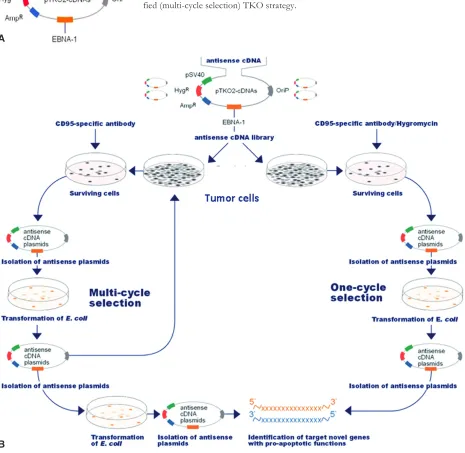
a schematic diagram of functional genetic screening for pro-apoptotic regulation of cd95-mediated apop-tosis with the tKo method is presented in fig. 1b. according to the original tKo protocol, the tumour cell lines were transfected with randomly fragmented
cdna libraries and then treated simultaneously with both the agonistic anti-cd95 antibody cH11 and hy-gromycin. after four weeks, surviving clones stably expressing antisense cdnas were picked manually to purify the plasmid cdna for further amplification in
E. coli. this tKo procedure functioned optimally with the delivery of a single cdna-encoding plasmid per cell. However, multiple different plasmids were usually introduced into the same cell, which then may contain the specific antisense cdna of pro-apoptotic gene together with other unrelated background, ran-domly fragmented cdnas (data not shown). there-fore, we extended the original tKo protocol (based on stably expressed anti-sense cdnas) by a
modifica-Fig. 1. construction of the randomly fragmented cdna library in ptKo2 vector. a) Plasmids that contained randomly cdna libraries under the control of psV40. HygR, hygromycin; ampR, ampicillin; Ebna-1, Epstein-barr virus nuclear antigen type, coding sequence; oriP, Episomal origin of replication; splice/Poly(a)+, splice and polyadenylation signal derived from sV40. b) schematic diagram of the functional screening for genes with pro-apoptotic function during cd95-mediated (cH11-trig-gered) apoptosis in tumour cells, using the original (one cycle selection)- and the modi-fied (multi-cycle selection) tKo strategy.
A
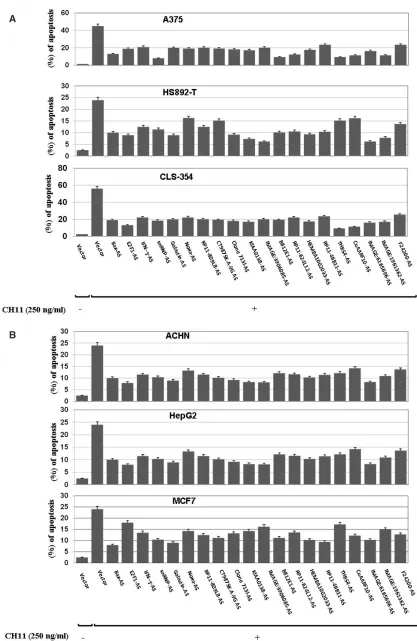
Fig. 2. apoptotic function of target genes. Extent of apoptosis 96 h after treatment with cH11 in: a) populations of a375 (Melanoma), Hs892-t (Kerathokanthoma), cls-354 (Head and neck squamous cell carcinoma). b) Populations of acHn (re-nal cell carcinoma), HepG2 (hepatocellular carcinoma), Mcf-7 (breast adenocarcinoma). the cells were transiently transficted with either mock-vector (ptKo2) or with the different isolated antisense cdna construct (encoding for anti-sense Rna mole-cules). after 48h, the transected cells were exposed to cH11 for a further 48h, followed by flow cytometric analysis using an-nexin V/PI. data are the mean ± sd of three independent experiments performed separately.
A
tion using a multi-cycle selection procedure of tran-siently expressed antisense libraries.
In the modified tKo method (fig. 1b), tumour cell lines (a375, Hs892-t, cls-354, acHn, HepG2, Mcf-7) were transfected with randomly fragmented cdna libraries first, and then exposed to agonistic anti-cd95 antibody (cH11) for five days. surviving clones transiently expressing randomly fragmented cdna libraries were picked manually and the plasmid dna was purified from these surviving cells. the iso-lated plasmids were pooled and introduced into E. coli
for limited amplification. after purification, the ampli-fied plasmids were re-introduced into a375, cls-354, Hs892-t, acHn, HepG2, and Mcf-7 cells. the cycles were repeated five times. finally, we introduced isolated plasmids into E. coliand transformed E.coli cells were plated on an lb agar plate. Each independent plasmid was isolated from clones of E. coli. the sequences of cdnas included in these plasmids were sequenced and the target genes were identified as described [8].
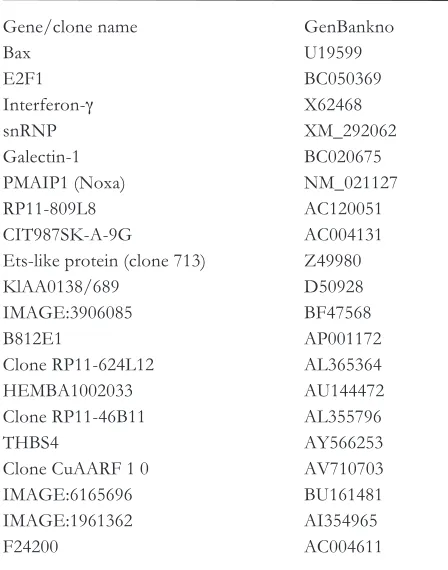
using the modified technical knock out (tKo) strategy (fig. 1b) several genes (with apoptotic prop-erties) were identified. these include Ifn-g[14], E2f-1 [E2f-15]snRnP [E2f-16, E2f-17], bax [E2f-18], Galectin-E2f-1 [E2f-19] as well as phorbol-12-myristate-13-acetate-induced protein 1, MaIP1(noxa) [13], ets-like protein [20], fer-1-like3, myoferlin [21] and Homo sapiens thrombospondin 4 [22]. However, inhibition of cd95-mediated pathways to apoptosis was noted in a375, Hs892-t, cls-354 (fig. 2a) as well as in acHn, HepG2 and Mcf-7 cells (fig. 2b) that expressed antisense Rna molecules tar-geting 11 unknown and 9 known genes (table 1),
eventually demonstrating the validity of the modified tKo strategy for rapid and efficient identification of apoptotic mediators. Moreover, the inhibition of cd95-mediated apoptosis pathways in tumour cells by the knockout of known and unknown identified genes by their cognate antisense Rna molecules confirmed the importance of the identified genes for the modula-tion of cd95-mediated apoptosis pathways in tumour cells.
d
IscussIonIn this study, we demonstrated the validity of the modified tKo procedure for the rapid and efficient identification of genes that function in cd95-mediat-ed apoptosis pathways. we examincd95-mediat-ed two proccd95-mediat-edures for the expression of antisense cdna libraries in our tumour model: the original tKo procedure (based on stably expressed antisense cdnas) and the modified tKo procedure (based on transiently expressed cdna libraries with multi-cycle selection). using the modified tKo procedure we could rapidly and effi-ciently identify functional genes with very low back-ground. although previous studies identified several genes by tKo strategies using antisense cdna li-braries [8, 23, 24, 25, 12], the modified tKo proce-dure is the first transient proceproce-dure that is successfully used to identify functional genes involved in the cd95-mediated apoptosis pathway.
notably, the modified tKo procedure may ideally function with the delivery of single plasmid encoding efficient inhibitory antisense Rna molecule per cell. However, in all transfection systems frequently multi-ple plasmids are introduced into the same cell. thus, background clones exhibiting cd95-mediated apopto-sis pathways can be observed when a cell contains an inhibitory antisense Rna molecule and other unrelat-ed background antisense Rna molecules. to over-come this problem, we performed multi-cycle selec-tion and determined numbers of surviving clones af-ter each cycle. we also compared the validity of con-ventional and the modified tKo procedure in order to confirm the efficiency of the modified tKo proce-dure. taken together, the modified tKo procedure can be successfully used when a change in phenotype appears within a short period of time (up to one week). since plasmids are gradually lost from trans-fected cells one week after transfection, it is not advis-able to use the modified tKo procedure when a change in phenotype appears in this time period. In the case of cd95-mediated apoptosis pathways the change in phenotype appears 96 h after the start of treatment with anti cd95 antibody (cH11).
besides the identification of functional genes based on the downregulation of gene expression and loss of gene function using a gene-silencing tool (accumula-tion of antisense Rna molecules) as it was performed in this study, there are also alternative strategies such as differential display and microarray technologies that can be used to identify genes that are turned on or turned off in association with a particular phenotype. yet, genes identified using these strategies might prove difficult to identify genes, which are directly related to a specific change in phenotype. notably, this was
pos-Table 1. functional genes, whose cognate antisense Rna molecules conferring resistance to the agonistic anti-cd95 antibody (cH11)-induced apoptosis in different tumour cell types.
Gene/clone name Genbankno
bax u19599
E2f1 bc050369
Interferon-g x62468
snRnP xM_292062
Galectin-1 bc020675
PMaIP1 (noxa) nM_021127
RP11-809l8 ac120051
cIt987sK-a-9G ac004131
Ets-like protein (clone 713) Z49980
Klaa0138/689 d50928
IMaGE:3906085 bf47568
b812E1 aP001172
clone RP11-624l12 al365364
HEMba1002033 au144472
clone RP11-46b11 al355796
tHbs4 ay566253
clone cuaaRf 1 0 aV710703
IMaGE:6165696 bu161481
IMaGE:1961362 aI354965
sible using the modified tKo procedure. More impor-tantly, we successfully identified candidate genes with pro-apoptotic function during cd95-mediated apop-tosis in tumour cells.
It should be noted that the inhibition of apoptosis by antisense Rna molecules is not necessarily com-plete, as due to the presence of multiple apoptotic pathways, the disruption of one factor (pathway) usu-ally causes only a reduction in apoptosis rather than complete inhibition.
our results furthermore illustrate that the pheno-types of cells harbouring the antisense Rna mole-cules of bax, Ifn-g, E2f-1, snRnP, or Galectin-1 are correlated with the phenotype of positive clones ob-tained by the modified tKo procedure. Moreover, harbouring the antisense Rna molecules of the corre-sponding cognate unknown genes showed a significant reduction of apoptosis after the treatment with cH11 (fig. 2), confirming the usefulness and validity of the modified tKo procedure. although the pro-apoptotic functions of the identified genes have been confirmed in the cd95-mediated apoptosis, the mechanisms of their active role in apoptosis have not yet been as-sessed in detail.
taken together, the successful isolation and identifi-cation of known and unknown pro-apoptotic genes convincingly confirms that the modified tKo strategy provides a powerful tool for rapid and efficient identi-fication of functional genes in post-translational events in the cell suffering apoptosis under certain cir-cumstances. further studies, are needed to elucidate the exact role of the newly identified pro-apoptotic genes in the apoptotic signalling cascade.
Acknowledgements: we thank a. Kimchi (weizmann Institute of science, Rehovot, Israel) for kindly providing us with ptKo vectors. this work was supported by grant from dr Mildred scheel foundation (Ha 10-2202) and deutsche forschung Gemeinschaft (Ha 5081/3-1) to M. Hassan.
R
EfEREncEs1 Khong, H. t. and Restifo, n. P. (2002) natural selection of tumor variants in the generation of "tumor escape" phenotypes. nature immunology. 3, 999-1005
2 Green, d. R. and Reed, J. c. (1998) Mitochondria and apoptosis. science (new york, n.y. 281, 1309-1312 3 thornberry, n. a. and lazebnik, y. (1998) caspases:
ene-mies within. science (new york, n.y. 281, 1312-1316 4 Hannun, y. a. (1997) sphingolipid second messengers:
tumor suppressor lipids. advances in experimental medi-cine and biology. 400a, 305-312
5 coustan-smith, E., Kitanaka, a., Pui, c. H., Mcninch, l., Evans, w. E., Raimondi, s. c., behm, f. G., arico, M. and campana, d. (1996) clinical relevance of bcl-2 overexpression in childhood acute lymphoblastic leukemia. blood. 87, 1140-1146
6 Hassan, M., feyen, o. and Grinstein, E. (2009) fas-in-duced apoptosis of renal cell carcinoma is mediated by apoptosis signal-regulating kinase 1 via mitochondrial damage-dependent caspase-8 activation. cell oncol. 31, 437-456
7 cetindere, t., nambiar, s., santourlidis, s., Essmann, f. and Hassan, M. Induction of indoleamine 2, 3-dioxyge-nase by death receptor activation contributes to apoptosis of melanoma cells via mitochondrial damage-dependent Ros accumulation. cellular signalling. 22, 197-211
8 Hassan, M., Mirmohammadsadegh, a., selimovic, d., nambiar, s., tannapfel, a. and Hengge, u. R. (2005) Identification of functional genes during fas-mediated apoptosis using a randomly fragmented cdna library. cell Mol life sci. 62, 2015-2026
9 van berkum, n. l. and Holstege, f. c. (2001) dna mi-croarrays: raising the profile. current opinion in biotech-nology. 12, 48-52
10 serebriiskii, I. G., toby, G. G., finley, R. l., Jr. and Golemis, E. a. (2001) Genomic analysis utilizing the yeast two-hybrid system. Methods in molecular biology (clifton, n.J. 175, 415-454
11 Kimchi, a. (2003) antisense libraries to isolate tumor suppressor genes. Methods in molecular biology (clifton, n.J. 222, 399-412
12 deiss, l. P. and Kimchi, a. (1991) a genetic tool used to identify thioredoxin as a mediator of a growth inhibitory signal. science (new york, n.y. 252, 117-120
13 Hassan, M., alaoui, a., feyen, o., Mirmohammadsadegh, a., Essmann, f., tannapfel, a., Gulbins, E., schulze-os-thoff, K. and Hengge, u. R. (2008) the bH3-only mem-ber noxa causes apoptosis in melanoma cells by multiple pathways. oncogene. 27, 4557-4568
14 chawla-sarkar, M., lindner, d. J., liu, y. f., williams, b. R., sen, G. c., silverman, R. H. and borden, E. c. (2003) apoptosis and interferons: role of interferon-stimulated genes as mediators of apoptosis. apoptosis. 8, 237-249 15 Elliott, M. J., farmer, M. R., atienza, c., Jr., stilwell, a.,
dong, y. b., yang, H. l., wong, s. l. and McMasters, K. M. (2002) E2f-1 gene therapy induces apoptosis and in-creases chemosensitivity in human pancreatic carcinoma cells. tumour biol. 23, 76-86
16 degen, w. G., aarssen, y., Pruijn, G. J., utz, P. J. and van Venrooij, w. J. (2000) the fate of u1 snRnP during anti-fas induced apoptosis: specific cleavage of the u1 snRna molecule. cell death and differentiation. 7, 70-79 17 overzet, K., Gensler, t. J., Kim, s. J., Geiger, M. E., van
Venrooij, w. J., Pollard, K. M., anderson, P. and utz, P. J. (2000) small nucleolar RnP scleroderma autoantigens associate with phosphorylated serine/arginine splicing factors during apoptosis. arthritis and rheumatism. 43, 1327-1336
18 Guo, b., cao, s., toth, K., azrak, R. G. and Rustum, y. M. (2000) overexpression of bax enhances antitumor ac-tivity of chemotherapeutic agents in human head and neck squamous cell carcinoma. clin cancer Res. 6, 718-724 19 sotomayor, c. E. and Rabinovich, G. a. (2000)
"Galectin-1 induces central and peripheral cell death: plications in t-cell physiopathology". developmental im-munology. 7, 117-129
20 liedtke, c., Groger, n., Manns, M. P. and trautwein, c. (2003) the human caspase-8 promoter sustains basal ac-tivity through sP1 and Ets-like transcription factors and can be up-regulated by a p53-dependent mechanism. the Journal of biological chemistry. 278, 27593-27604 21 yasunaga, s., Grati, M., cohen-salmon, M., El-amraoui,
a., Mustapha, M., salem, n., El-Zir, E., loiselet, J. and Petit, c. (1999) a mutation in otof, encoding otoferlin, a fER-1-like protein, causes dfnb9, a nonsyndromic form of deafness. nature genetics. 21, 363-369
22 stenina, o. I., ustinov, V., Krukovets, I., Marinic, t., topol, E. J. and Plow, E. f. (2005) Polymorphisms a387P in thrombospondin-4 and n700s in throm-bospondin-1 perturb calcium binding sites. faseb J. 19, 1893-1895
24 levy-strumpf, n., deiss, l. P., berissi, H. and Kimchi, a. (1997) daP-5, a novel homolog of eukaryotic translation initiation factor 4G isolated as a putative modulator of gamma interferon-induced programmed cell death. Mole-cular and cellular biology. 17, 1615-1625
25 deiss, l. P., feinstein, E., berissi, H., cohen, o. and Kimchi, a. (1995) Identification of a novel serine/threo-nine kinase and a novel 15-kd protein as potential media-tors of the gamma interferon-induced cell death. Genes & development. 9, 15-30
Received: February 8, 2010 / Accepted: March 9, 2010
Address for correspondence: dr. Mohamed Hassan clinic of dermatology Moorenstr. 5
40225 duesseldorf Germany