R E S E A R C H A R T I C L E
Open Access
Effect of numbering of return envelopes on
participation, explicit refusals, and bias:
experiment and meta-analysis
Thomas V Perneger
1,2*, Stéphane Cullati
1,2, Sandrine Rudaz
1, Thomas Agoritsas
1,2,3, Ralph E Schmidt
4,
Christophe Combescure
1,2and Delphine S Courvoisier
1,2Abstract
Background:Tracing mail survey responses is useful for the management of reminders but may cause concerns
about anonymity among prospective participants. We examined the impact of numbering return envelopes on the participation and the results of a survey on a sensitive topic among hospital staff.
Methods:In a survey about regrets associated with providing healthcare conducted among hospital-based doctors
and nurses, two randomly drawn subsamples were provided numbered (N = 1100) and non-numbered (N = 500) envelopes for the return of completed questionnaires. Participation, explicit refusals, and item responses were compared. We also conducted a meta-analysis of the effect of questionnaire/envelope numbering on participation in health surveys.
Results:The participation rate was lower in the“numbered”group than in the“non-numbered”group (30.3% vs. 35.0%, p = 0.073), the proportion of explicit refusals was higher in the“numbered”group (23.1% vs 17.5%, p = 0.016), and the proportion of those who never returned the questionnaire was similar (46.6% vs 47.5%, p = 0.78). The means of responses differed significantly for 12 of 105 items (11.4%), which did not differ significantly from the expected frequency of type 1 errors, i.e., 5% (permutation test, p = 0.078). The meta-analysis of 7 experimental surveys (including this one) indicated that numbering is associated with a 2.4% decrease in the survey response rate (95% confidence interval 0.3% to 4.4%).
Conclusions:Numbered return envelopes may reduce the response rate and increase explicit refusals to participate in a sensitive survey. Reduced participation was confirmed by a meta-analysis of randomized health surveys. There was no strong evidence of bias.
Keywords:Health surveys, Survey participation, Survey numbering, Bias, Sensitive topic, Meta-analysis
Background
The protection of the identity of participants is an im-portant issue in health surveys, particularly when the topic of the survey is perceived to be sensitive or in-trusive by potential respondents. The reasons are both ethical and pragmatic. The risk of breaching par-ticipants’privacy should be minimized in all research as a matter of principle. In addition, people who fear that
answers may be traced back to them may choose not to participate at all, may skip the sensitive questions, or may alter their responses, consciously or unconsciously, to make them more inconspicuous or acceptable [1]. Non-response may cause selection bias, and altered answers may cause information bias (similar to social desirability bias). For these reasons health surveys are typically anonymous. However, many surveys employ a study identifier, such as a study number, that is used to track responses and manage reminders. This identifier may raise concerns among potential participants about the traceability of the respondent.
* Correspondence:[email protected] 1
Division of Clinical Epidemiology, University Hospitals of Geneva, Geneva, Switzerland
2
Faculty of Medicine, University of Geneva, Geneva, Switzerland Full list of author information is available at the end of the article
Some (but not all) older studies suggest that respondent identification may decrease participation in surveys [2-9]. Several [3-5] were marketing studies in which respon-dent motivations and concerns about confirespon-dentiality may differ from those of health surveys. Studies in the health or health care domain have reported small and non-significant differences in response rates associated with respondent identifiability [6-9].
We report here on a potentially sensitive study where the numbering of return envelopes may have increased non-response and possibly caused bias. The context was a mail survey of a random sample of hospital doctors and nurses regarding their experience of regrets encountered during patient care [10]. A previous qualitative study established that this was indeed a sensitive topic for most health care professionals [11]. The survey cover letter in-formed the potential participants that this was a research project in which participation was voluntary, that the data would not be linked with personal identifiers, and that the number on the return envelope would only be used to track responses and avoid sending unnecessary reminders. The front page instructed the recipient to check the ap-propriate box and send back the questionnaire without filling it in if a) the respondent had not practiced patient care in the past 5 years, b) the respondent did not wish to participate, or c) the respondent had retired. Upon receipt of the first returned questionnaires it appeared that an un-usually large proportion explicitly declined to participate. To compensate for the anticipated low sample size, and to test the hypothesis that numbering of the return en-velopes contributed to this problem, we selected an additional random sample of doctors and nurses. For this additional sample the return envelopes were not numbered, so that everyone received the initial mailing and the subsequent reminders.
In this report, we compare the original sample (num-bered surveys) and the additional sample (non-num(num-bered surveys) in terms of overall response rate, the proportion of explicit refusals, and the distributions of survey variables among the respondents. We also performed a meta-analysis of randomised studies of health surveys that compared participation rates for traceable and untraceable responses.
Methods
Design, population and data collection
In this study two consecutive samples were drawn from the same randomly ordered sampling frame, but the two samples were contacted at different moments in time, two months apart. Thus the design deviated from a classic randomized study in that the random allocation was not concurrent. The study population included all doctors and nurses employed at University Hospitals of Geneva, a large teaching hospital in Geneva, Switzerland. Separate
lists of doctors and nurses were ordered at random, and the first 550 of each list were included in the initial mail-ing (ranks 1 through 550 on each list, total 1100). For the second mailing, an additional 250 doctors and 250 nurses were selected from the same lists (ranks 551 through 800 on each list, total 500). Each returned envelope was classi-fied according to the participation outcome (completed, refusal, not eligible), after which completed questionnaires were assigned a new number before data entry. This guar-anteed that the anonymous questionnaire database could never be linked with the survey management database that contained personal identifiers. Non-respondents of the first sample and the whole second sample were sent reminder mailings at 3 weeks, 6 weeks, and 9 weeks. These procedures, i.e., the original study protocol as well as the extension, were approved by the Ethics com-mittee for research on human subjects of the University Hospitals of Geneva.
Study variables
The independent variable in this analysis was the num-bering of the return envelopes, versus no numnum-bering. The dependent variables were the survey response rate among eligible participants and the proportion of expli-cit refusals. To analyse bias, we examined all variables measured in the questionnaire among the respondents (105 items). The first section of the questionnaire enquired about the most strongly regretted situation in the context of providing health care in the past 5 years, the second per-tained to mechanisms that can be used to cope with regrets related to patient care in general, and additional sections measured life satisfaction, work satisfaction, quality of sleep, self-esteem, depression, self-rated health, and sickness leave in the past 6 months (Table 1).
Analysis
Analyses were conducted using SPSS version 18, and the permutation test was implemented in R [13].
Meta-analysis
Because the impact of envelope numbering on partici-pation was of borderline statistical significance, we performed a meta-analysis of similar studies, in order to obtain a clearer assessment of this effect. A separate protocol is not available for thisad hocproject, but we applied the requirements of the PRISMA statement [14] as much as possible (Additional file 1). The objective was to compare participation rates for identifiable and non-identifiable surveys. To be eligible the study had to compare respondent identification (by a code or study number) with a completely anonymous data-collection method, address a health-related topic and have a ran-domized or quasi-ranran-domized design. Two of the authors (TP and DC) used the following search in PubMed and Embase: (anonymity OR anonymous OR numbering OR numbered OR coded OR tracking OR tracing) AND (response OR participation) AND (questionnaires [MeSH]) AND (randomized OR randomised OR randomly), without
any limitation on year of publication or language. In addition we examined reference lists of the identified papers and relevant reviews [2]. From each study the reviewers abstracted the numbers of eligible persons and the numbers of participants in each study arm. We obtained a pooled difference in proportions of respon-dents using a random-effects meta-analysis, with inverse variance weights. The between-study heterogeneity was measured by the statistic I2. The meta-analysis was per-formed using Comprehensive Meta-Analysis 2.0.
Results
Participation and refusal rates
Of the initial 1600 potential respondents (1100 in the initial sample and 500 in the 2ndsample), 116 were con-sidered as ineligible for the survey, either because they were not involved in patient care, had retired, or their survey package was returned by the post office due to an invalid address. Among the 1484 eligible persons (1038 in the initial sample and 446 in the 2nd sample), 470 (31.7%) returned a completed questionnaire, 318 (21.4%) expressed an explicit refusal, and 696 (46.9%) never returned the questionnaire.
The participation was higher and explicit refusals were fewer when the returned envelopes were not numbered (Table 2). The absolute difference in proportions of parti-cipants was 4.7% (95% CI −0.4% to 10.0%, p = 0.073) in favor of non-numbered envelopes. The proportion of explicit refusals was lower by 5.6% (95% CI 1.1% to 9.9%, p = 0.016) for non-numbered envelopes. The pro-portions of potential participants who did not respond were similar in the 2 groups, within a percentage point. Among returned surveys, the proportion of explicit refusal was 10.0% (95% CI 2.5% to 17.1%, p = 0.011) higher when the envelopes were numbered. The impact of numbering envelopes on the response rate was simi-lar in doctors and nurses (stratified analysis not shown), so their results were combined.
Participant characteristics
Among the 470 persons who completed the questionnaire there were 323 (69.5%) women, 240 (51.7%) nurses, and 312 (67.2%) employees who worked full time or nearly full-time. The mean age was 40.5 years (SD 9.2) and mean number of years since starting patient care was 15.0 years (SD 9.9). The majority (295, 63.3%) rated their health as excellent or very good, and a similar proportion (318, 68.2%) did not miss any workdays because of health prob-lems in the past 6 months. These characteristics were similar in the 2 study groups.
Exploring bias
The 2 groups of participants were compared on 105 sur-vey items. Most differences were small and statistically
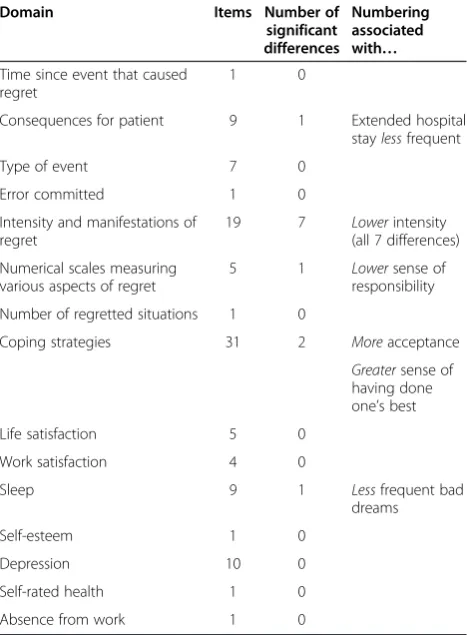
Table 1 Domains addressed in the questionnaire, number of items per domain, and number of significant
differences between numbered and non-numbered surveys
Domain Items Number of significant differences
Numbering associated with…
Time since event that caused regret
1 0
Consequences for patient 9 1 Extended hospital
staylessfrequent
Type of event 7 0
Error committed 1 0
Intensity and manifestations of regret
19 7 Lowerintensity
(all 7 differences)
Numerical scales measuring various aspects of regret
5 1 Lowersense of
responsibility
Number of regretted situations 1 0
Coping strategies 31 2 Moreacceptance
Greatersense of having done one’s best
Life satisfaction 5 0
Work satisfaction 4 0
Sleep 9 1 Lessfrequent bad
dreams
Self-esteem 1 0
Depression 10 0
Self-rated health 1 0
non-significant, but 12 (11.4%) exceeded the significance level of 0.05 (Table 1). Most notably, respondents in the non-numbered group reported significantly higher inten-sity for 7 of 19 manifestations of their strongest regret within the past 5 years (Figure 1). This was confirmed by a higher sense of responsibility for the regretted situation (assessed on a numerical scale).
Among the 1000 random permutations of group as-signment (i.e., under the null hypothesis), the number of nominally significant tests varied between 0 and 25 out of 105. In 19 permutations, the number of signifi-cant tests was 12, and in 40 others it was 13 or more (one-sided p = 0.059); in addition, in 19 permutations there were no significant tests (two-sided p = 0.078).
Meta-analysis of participation rates
The search is depicted in Figure 2. The PubMed search identified 144 citations of which 3 were eligible [7-9], and the Embase search identified 220 papers of which two were eligible [7,9]. Both searches also initially identi-fied a study by Asch [15], which was excluded because it compared 2 strategies that ensured anonymity: one group had no identifiers, and the other was asked to send back a
coded postcard separately from the questionnaire. An add-itional eligible paper was retrieved from reference lists [6]. The identified articles and the abstracted results were identical for the two reviewers.
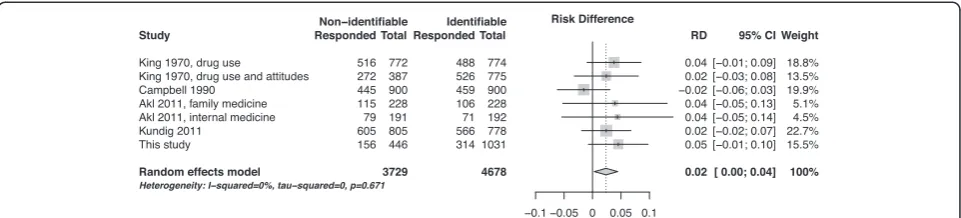
The four papers [6-9] reported on 6 separate experi-ments. These results were combined with the results of this study (Table 3, Figure 3). The pooled difference in partici-pation rates was 2.4% (95% confidence interval, 0.3% to 4.4%). We detected no between-study heterogeneity in the effect of numbering (I2= 0%).
Discussion
We found that numbering return envelopes in a survey about health care provider regrets has significantly in-creased the proportion of explicit refusals to participate and reduced the overall survey response rate. The reduc-tion in the proporreduc-tion of participants of 4.7% did not reach the pre-specified level of statistical significance of 0.05 (p = 0.073). This constitutes weak evidence against the hypothesis of no effect. Pooling this result with similar observations made in previous studies suggests that num-bering questionnaires reduces participation by approxi-mately two to three percentage points.
Whether this decrease is important enough to affect survey data collection procedures is debatable. Numbering questionnaires or return envelopes allows the researcher to send reminders only to those who have not yet responded. This reduces costs, and avoids the irritation some respondents may feel when they receive an un-necessary reminder. A small reduction in the response rate may be an acceptable price to pay for these bene-fits. On the other hand, response rates in mail surveys are typically lower than desirable, and may be declining [16,17]. Any measure that increases the response rate of a survey and its representativeness of the target popula-tion is welcome. Optimal response rates can be obtained only through an accumulation of design features that yield marginal gains, including a clear explanation of the utility of the survey, an attractive layout, incentives, and reminders [2]. It appears that the assurance of con-fidentiality may be another useful measure.
It is unclear whether numbering survey returns plays a role in all surveys or only in those instances where confi-dentiality is particularly important. We tested the effect of numbering in a sensitive survey. Regrets felt by doctors
Table 2 Participation and explicit refusals in a survey of patient-care related regret, for numbered versus non-numbered return envelopes
Numbered envelopes Non-numbered envelopes P value
Returned a completed questionnaire 30.3% (314/1038) 35.0% (156/446) 0.073
Never returned the questionnaire 46.6% (484/1038) 47.5% (212/446) 0.78
Explicit refusals among eligible persons 23.1% (240/1038) 17.5% (78/446) 0.016
Explicit refusals among returned envelopes 43.3% (240/554) 33.3% (78/234) 0.011
and nurses may be related to errors or to communication issues when providing healthcare. A potential respondent may well decide that it may not be prudent to participate and run the risk of being identified. Among previous stud-ies of the effect of numbering, one concerned medical residency programs, which is not a particularly sensitive topic, and others pertained to drug use, AIDS knowledge, and patient safety climate. The meta-analysis did not show
any amount of heterogeneity. There is thus far no evi-dence that the degree of sensitivity of the survey topic modifies the effect of questionnaire numbering.
Regardless of the effect of numbering, this survey was notable by its low response rate of 31.7%. While such re-sponse rates are not uncommon (e.g., [18]), participation was considerably lower than in several surveys of doctors and nurses conducted at the same hospital in recent years,
Figure 2PRISMA flow diagram.
Table 3 Health care surveys that compared identifiable and non-identifiable surveys
Author, year Population Survey topic Intervention Control
King, 1970 College students Drug use Coded questionnaire Non-coded
questionnaire King, 1970 College students Drug use and attitudes
Campbell, 1990 General population AIDS knowledge Numbering with warning of reminders Non-numbered questionnaire
Akl, 2011 Residency program directors (Family medicine)
Characteristics of residency program Questionnaire numbered“to avoid sending reminders”
Non-numbered questionnaire
Akl, 2011 Residency program directors (Internal medicine)
Kundig, 2011 Hospital staff Patient safety culture Numbered questionnaire Non-numbered
questionnaire
which typically yielded response rates between 50% and 60% [19-21]. We believe that the topic of the survey – regret related to health care–was the chief cause of this reluctance to participate. By definition a regretted situ-ation is unpleasant to recall, and revisiting it in detail and sharing these details with others may be too much to ask for, whether confidentiality is guaranteed or not. As evidence of an unusual and possibly emotional response pattern, we have not previously seen explicit refusals approaching the proportion of 21.4% observed in this study; in our experience less than one tenth of the eligible sample will check the “I do not wish to participate”box in a typical survey–e.g., about 5% in a survey of health insurance plan members [22]. Limited evidence suggests that people who explicitly refuse to participate in a survey may differ from those who fail to respond [23]. Our results suggest that regret related to providing health-care may have been a too sensitive topic for many potential respondents.
A low response rate may cause selection bias, but the numbering of return envelopes may also produce informa-tion bias, by causing the respondents to answer differently than they would have done in the absence of numbering. These 2 types of bias cannot be distinguished in our study. In comparisons of item responses, 12 of 105 differences between the numbered and non-numbered groups were statistically significant. However, the various survey items were mutually correlated, and a permutation test showed that this proportion (11.4%) did not significantly differ from the type 1 error rate of 5% that characterizes the null hypothesis of no bias. It is tempting to focus on the elevated proportion of significant differences observed for the regret intensity items (7 out of 19) and to con-clude that response bias concerns these particularly sen-sitive items. However, any post-hoc selection of a subset of items increases the likelihood of misinterpreting type 1 errors as true differences. Of note, a low response rate does not always imply a large amount of bias [23]; e.g., in a patient opinion survey, the mean problem scores obtained after the first mailing, when only about 30% of questionnaires hada been returned, differed by less than one tenth of a standard deviation from the final results
(difference 1.9 points, SD 23.8), when a response rate of 70% had been achieved [24].
This study has several limitations. First, the study was set up in the middle of an ongoing survey, prompted by an unusual response pattern, and not planned in advance. Therefore randomization was non-concurrent (numbered envelopes were sent first and non-numbered were sent two months later, even though both samples were drawn from the same randomly ordered lists). The delay could alter the outcomes if it changed exposure to external events that might influence survey response, such as a summer holiday period; however, this was not the case to our knowledge. Second, the sample size was driven by the primary purpose of the survey (data collection on regret), and not by a power analysis related to the comparison of numbered and non-numbered envelopes; as a result the size of the second (non-numbered) group was compara-tively low. A post-hoc power estimation suggests that the power to detect a difference between 30% and 35% with the actual sample size was below 50%. Perhaps most im-portantly, we were not able to establish with certainty the reasons for the negative effect of envelope number-ing, as we did not discuss the motivations of the respon-dents and non-responrespon-dents. The meta-analysis included only a small number of eligible studies, and had limited power to examine differences between survey identifiability methods (e.g., different effect of questionnaire numbering versus envelope numbering).
As our study employed paper questionnaires and pos-tal delivery, the results are not directly applicable to electronic surveys. However, concerns about anonymity and traceability may be particularly important for elec-tronic surveys, because online privacy management re-mains opaque and potentially untrustworthy for many users. This may contribute to the low participation rates regularly encountered in internet surveys e.g., [25].
Conclusions
Our results, along with the meta-analysis of similar studies, indicate that the identifiability of completed questionnaires will lower the response rate of postal surveys by two to three percentage points. However, there was no strong
evidence that identifiability causes bias. Further research should ascertain whether this effect depends on the sur-veyed population, the contents of the questionnaire, or other characteristics of the data-collection process.
Additional file
Additional file 1:PRISMA checklist. Competing interests
The authors declare that they have no competing interests.
Authors’contributions
TP planned the study, analyzed the data, conducted the systematic review, wrote the manuscript. SC and SR planned the study, managed the data collection, interpreted the results, revised the manuscript. TA, RS planned the study, interpreted the results, revised the manuscript. DC planned the study, conducted the systematic review, interpreted the results, revised the manuscript. CC conducted the meta-analysis, interpreted the results, revised the manuscript. All authors approve the manuscript.
Acknowledgment
The study was supported by a Research & Development grant (PRD-09-II-20) from Geneva University Hospitals.
Author details
1Division of Clinical Epidemiology, University Hospitals of Geneva, Geneva,
Switzerland.2Faculty of Medicine, University of Geneva, Geneva, Switzerland. 3Department of Clinical Epidemiology and Biostatistics, McMaster University,
Hamilton, Canada.4Swiss Center for Affective Sciences, University of Geneva, Geneva, Switzerland.
Received: 13 September 2013 Accepted: 10 January 2014 Published: 15 January 2014
References
1. Tourangeau R, Yan T:Sensitive questions in surveys.Psychol Bull2007,
133:859–83.
2. Edwards PJ, Roberts I, Clarke MJ, DiGuiseppi C, Wentz R, Kwan I, Cooper R, Felix LM, Pratap S:Methods to increase response to postal and electronic questionnaires.Cochrane Database Syst Rev2009,3, MR000008.
3. Albaum G:Do source and anonymity affect mail survey results?J Acad Marketing Sci1987,15:74–81.
4. McKee DO:The effect of using a questionnaire identification code and message about non-response follow-up plans on mail survey response characteristics.J Market Res Soc1992,34:179–91.
5. Futrell CM, Stem DE, Fortune BD:Effects of signed versus unsigned internally administered questionnaires for managers.J Bus Res1978,
6:91–8.
6. King FW:Anonymous versus identifiable questionnaires in drug usage surveys.Am Psychol1970,25:982–5.
7. Campbell MJ, Waters WE:Does anonymity increase response rate in postal questionnaire surveys about sensitive subjects? A randomised trial.J Epidemiol Community Health1990,44:75–76.
8. Akl EA, Gaddam S, Mustafa R, Wilson MC, Symons A, Grifasi A, McGuigan D, Schünemann HJ:The effects of tracking responses and the day of mailing on physician survey response rate: three randomized trials. PloS One2011,6:e16942.
9. Kundig F, Staines A, Kinge T, Perneger TV:Numbering questionnaires had no impact on the response rate and only limited impact on response content of a patient safety culture survey: randomized trial.J Clin Epidemiol2011,64:1262–5.
10. Courvoisier DS, Cullati S, Haller CS, Schmidt RE, Haller G, Agoritsas T, Perneger TV:Validation of a 10-item care-related regret intensity scale (RIS-10) for healthcare professionals.Med Care2013,51:285–91. 11. Courvoisier DS, Agoritsas T, Perneger TV, Schmidt RE, Cullati S:Regrets
associated with providing healthcare : qualitative study of experiences of hospital-based physicians and nurses.PloS One2011,6:e23138.
12. Dwass M:Modified randomization tests for nonparametric hypotheses. Ann Math Stat1957,28:181–7.
13. Core Team R:R: A language and environment for statistical computing.
Vienna, Austria: R Foundation for Statistical Computing; 2013. http://www.R-project.org/.
14. Moher D, Liberati A, Tetzlaff J, Altman DG, The PRISMA Group:Preferred Reporting Items for Systematic Reviews and Meta-Analyses: The PRISMA statement.PLoS Med2009,6(6):e1000097.
15. Asch DA:Use of a coded postcard to maintain anonymity in a highly sensitive mail survey: cost, response rates, and bias.Epidemiology1996,
7:550–1.
16. Morton LM, Cahill J, Hartge P:Reporting participation in epidemiologic studies: a survey of practice.Am J Epidemiol2006,163:197–203. 17. Galea S, Tracy M:Participation rates in epidemiologic studies.Ann
Epidemiol2007,17:643–53.
18. Shanafelt TD,et al:Burnout and satisfaction with work-life balance among US physicians relative to the general US population.Arch Intern Med
2012,172:1377–85.
19. Hudelson PM, Junod-Perron N, Perneger TV:Attitudes of physicians and medical students toward caring for immigrant patients.Eval Health Prof
2010,33:452–72.
20. Agoritsas T, Courvoisier DS, Combescure C, Deom M, Perneger TV:Does prevalence matter to physicians in estimating post-test probability? A randomized trial.J Gen Intern Med2011,26:373–8.
21. Courvoisier DS, Genevay S, Cedraschi C, Bessire N, Griesser-Delacrétaz AC, Monnin D, Perneger TV:Job strain, work charactreristics, and back pain: study in a University hospital.Eur J Pain2011,15:634–40.
22. Etter JF, Perneger TV:Analysis of non-response bias in a mailed health survey.J Clin Epidemiol1997,50:1123–8.
23. Nohr EA, Frydenberg M, Henriksen TB, Olsen J:Does low participation in cohort studies induce bias?Epidemiology2006,17:413–8.
24. Perneger TV, Chamot E, Bovier PA:Non-response bias in a survey of patient perceptions of hospital care.Med Care2005,43:374–80. 25. Sinclair M, O’Toole J, Malawaraarachchi M, Leder K:Comparison of
response rates and cost-effectiveness for a community-based survey: postal, internet and telephone modes with generic or personalised recruitment approaches.BMC Med Res Methodol2012,12:132.
doi:10.1186/1471-2288-14-6
Cite this article as:Pernegeret al.:Effect of numbering of return envelopes on participation, explicit refusals, and bias: experiment and meta-analysis.BMC Medical Research Methodology201414:6.
Submit your next manuscript to BioMed Central and take full advantage of:
• Convenient online submission
• Thorough peer review
• No space constraints or color figure charges
• Immediate publication on acceptance
• Inclusion in PubMed, CAS, Scopus and Google Scholar
• Research which is freely available for redistribution