Iranian Rehabilitation Journal, Vol. 12, No. 21, September 2014
Original Article
The effect of rehabilitation method based on Existential Approach and
Olson's model on Marital Satisfaction
1Maedeh Naghiyaee; Bahman Bahmani, PhD.
*; Bijhan Khorasani, PhD.
Aida Dehkhoda.; Fahimeh Alimohamadi
University of Social Welfare and Rehabilitation Sciences, Tehran, Iran
Ali Ghanbari Motlagh, PhD.
Shahid Beheshti University of Medical Sciences and Health Services, Tehran, Iran
Objectives: Mastectomy as a treatment for breast cancer can disturb marital satisfaction of many couples.
In this way, existential anxieties stemming from this potentially deleterious event, and inefficient responses to them, could be mediating. The purpose of this study is to investigate the effectiveness of a rehabilitation method based on existential approach and Olson's marital enrichment model on marital satisfaction of women who had undergone mastectomy and their husbands .
Methods: In this study, a single subject research design is used. The study population comprised couples
who had referred to Radiotherapy department of Imam Hussein hospital in Tehran, that among them three couples whose average age was 20 to 50 years old, wife's had undergone mastectomy, tumor has not spread to other parts of the body, and had no prior history of psychiatric disorders before cancer, were selected through purposeful sampling and Intervention in 12 sessions of 90 minutes once a week, has been designed to suit their specific needs. The level of couple's marital satisfaction was evaluated using Dyadic Adjustment Scale.
Results: Comparing couple's scores on the diagram during 9 time measurement (3 times baseline, 4 times
during intervention, and 2 times follow up assessment) and calculating recovery percentage, represent increasing in score of marital adjustment scale .
Discussion: So it seems that, this kind of an eclectic couple therapy, by considering couples existential
anxiety, has been promoted their marital satisfaction. Explanations are given in discussion part .
Keywords: Marital satisfaction, eclectic method based on existential approach, Olson's model
Submitted: 22 June 2014 Accepted: 2 August 2014
Introduction
Breast cancer is a common chronic illness among women. according to American Cancer Society reports, a woman living in the US has a 12.15%, or a 1 in 8, life time risk of being diagnosed with breast cancer (1). Due to increases in screening, early detection, and technology, women with breast cancer are living much longer; however, they continue to face many psychosocial difficulties related to the experience of having breast cancer (2). One of the prevalent treatment methods employed for breast cancer, is Mastectomy which is a technique involving cutting and disembodying the breast with tumor in a surgical operation (3) and psychological distresses in these patient are expected (4). In fact probability
of losing one breast or both is the most major concern of women with breast cancer (3), Because due to serious deformation of the breast tissues, body image disturbance and severe psychological consequences, most of its effects demonstrate on marital relationships with husband (5), that's why professionals refer breast cancer as relational cancer (6). Disease that targets couples relationships and even after the end of treatment, marks an important transition period for patients, the time that women are faced with themselves as a cancer survivor (7,8) and may start an extended period of cure, when existential issues with unpredictability and uncertainty are highlighted (9).
1. Retrieved from the Master thesis.
Meanwhile, spouses as well as many changes that may experience in their lifestyle (10) have major concerns about possibility of losing wife (11,12), uncertainty, unpredictability and lack of preparation to help wife (13). Although these existential anxieties are normal consequences of facing with life threatening events in short time (14) in a case of inability to finding and giving meaning effectively, can lead to demoralization (15-17), which could disturb couples relationship and their marital satisfaction (18,19). Therefore, couples confront with a significant task: the task of giving meaning to this potentially fatal disease with its all consequences and integrate it with all aspects of their lives. Despite several interventions conducted for couples facing breast cancer, but lack of equal effectiveness for both patients and their partners, limited maintenance of improvements over time or, common concern with brief psychosocial interventions (20), not paying attention to couple's existential anxiety and emphasis on promoting couple's relationships (21) were their gaps. It seems that this apparent confusion about the purpose of couple interventions is understandable, and obviously their development and testing in the context of cancer care is a relatively new field of study (20, 21). So this question remains that, by considering breast cancer as existential-psychological stressors which can affect couple's relationships and disturb their marital satisfaction, what is the effective intervention to meet couple's needs? It seems that preparing an intervention which simultaneously consider couples existential crisis and finding meaning and promoting their relationships, is vital. The aim of existential therapy in relation to life threatening illnesses is that by providing supportive environment help individual to confront with existential concerns like death anxiety, uncertainty, meaninglessness, loneliness, and uncontrollability which intensify by cancer threats (22). On other hand, Olson's model is based on systems theory which aims to helping couples to be aware of each other, exploring thoughts and feelings, promoting empathy and intimacy and effective relationships
and problem solving (23). Therefore the aim of this study is to evaluate the effectiveness of an eclectic rehabilitation method to couple therapy based on an existential approach with Olson's marital enrichment model on marital satisfaction of mastectomy women and their husband.
Methods
A single case experimental design which called an A-B form, with three baselines (every 10 days) and two follow-up (every 3 weeks) was used in this study. Also the result was compared with other measurements during and end of intervention (in third, sixth, ninth and twelfth sessions). The statistical population was chosen from couples who had referred to radiotherapy department of Imam Hussein hospital in Tehran that among them three couples whose average age was 20 to 50 year, wife's had undergone mastectomy, tumor has not spread to other parts of the body, and had no prior history of psychiatric disorders before cancer, had lower score in DAS scale, and the women that had high score in Demoralization Scale, were selected through purposive sampling and Intervention in 12 sessions of 90 minutes once a week, has been designed to suit their specific needs.
The data were collected by Dyadic Adjustment Scale (DAS) (24), and Demoralization scale (25). DAS scale is a 32-item scale and one of the most widely used self-report measures of marital satisfaction. An alpha coefficient for the DAS scale was reported 96%. Demoralization Scale is a 24-item scale and widely used self- report measures of Demoralization. An alpha coefficient for the DS scale was reported 94%. Table (1) is showing couples demographics including and age, duration of marriage, education, DAS and DS scores. All couples were under 50 years old, and maximum length of marriage was 32 years. Their educations were Elementary, high school and diploma. Also, couple's DAS and DS scores were respectively under and beyond the cut-off point.
Table 1. Characteristics of Couples duration of marriage
Couple A Couple B Couple C
Age of women Age of husband Duration of marriage Education of women Education of husband
DAS Score (W) DAS Score(H)
DS Score(W)
43 48 27 High school
Diploma 80 85 34
48 50 32 High school
Diploma 75 82 34
35 36 13 Diploma Elementary
The protocol of an eclectic method to couple therapy based on Existential approach with Olson's model has developed within two stages of interventions that each one has three sub stage including beginning, middle and the final stage. The therapy were designed and performed with a particular focus on specific goals. The total goals of beginning sub stage of existential therapy can be summarized as: to create a safe space for the couples to procure a sense of security, to establish a therapeutic relationship for preparing the groundwork for outflowing couple's anxieties, to proliferate the feeling and ideas. The middle sub-stage’ goals were focused on couple's self-disclosure, being aware of here and now, existential anxieties such as death, loneliness, unpredictability and uncontrollability events, responsibility, meaninglessness, feelings of guilt and couples communication about this anxieties and distorted thoughts and beliefs which limit their perspective about unpredictable events of life. The aim of final sub stage of existential therapy was devoted to summarize the content and to evaluate the effect of intervention and preparing them to second stage. The total goals of beginning sub stage of marital enrichment intervention were getting to know the process of marital enrichment program. The middle sub-stage’ goals were focused on barriers to communication, promoting their conversation skills, emotional support, and intimacy. The aim of final sub stage was devoted to summarize the
content and to evaluate the effect of intervention. Like other single-subject designs, Chart analysis process was used to analyze the data. Also the emerged changes were considered as the effect of independent variable on the dependent variable.
Results
The results of 3 cases are explained one by one as follow:
Couple A – As indicated in table (1), the marital
satisfaction score of woman and her husband respectively were 80-81 and 85 at the baseline statement. These scores show lower level of marital satisfaction in DAS. Woman obtained a score of 90 at the end of session 3; and her husband obtained 96; this increasing continued until the end of the intervention. As in last session, woman score in follow up 2 was 130, and husband score was 135 in DAS. This result indicates increase in marital satisfaction of couple. Woman and her husband recovery percentage respectively are 62% and 58% for marital satisfaction. Also demoralization level of woman is 34 at the baseline statement. These scores show higher level of demoralization in DS. Woman obtained a score of 20 at the end of session 3; this reduction continued until the end of the intervention. As in last session, woman score in follow up 2 was 10 in DS. This result indicates reduction in woman demoralization. Woman (A) recovery percentage is 70% (figure 1).
0 50 100 150
baseline1baseline2baseline3 session3 session6 session9session12 folo
DAS
and
DS
Fig 1. Marital satisfaction and Demoralization trend of couple A
Couple B - The marital satisfaction score of
woman and her husband respectively were 75 and 82 at the baseline statement as indicated in table
(1),. These scores show lower level of marital satisfaction in DAS. Woman obtained a score of 95 at the end of session 3; and her husband obtained
91; this increasing continued until the end of the intervention. As in last session, woman score in follow up 2 was 128, and husband score was 120 in DAS. This result indicates increase in marital satisfaction of couple. Woman and her husband recovery percentage respectively are 70% and 46% for marital satisfaction. Also demoralization level of woman is 33 at the baseline statement. These
scores show higher level of demoralization in DS. Woman obtained a score of 24 at the end of session 3; this reduction continued until the end of the intervention. As in last session, woman score in follow up 2 was 13 in DS. This result indicates reduction in woman demoralization. Woman B recovery percentage is 60% (figure 2).
0 50 100 150
baseline1baseline2baseline3 session3session6session9session12 folo
DAS
and
DS
Fig 2. Marital satisfaction and Demoralization trend of couple B
Couple C - The marital satisfaction score of
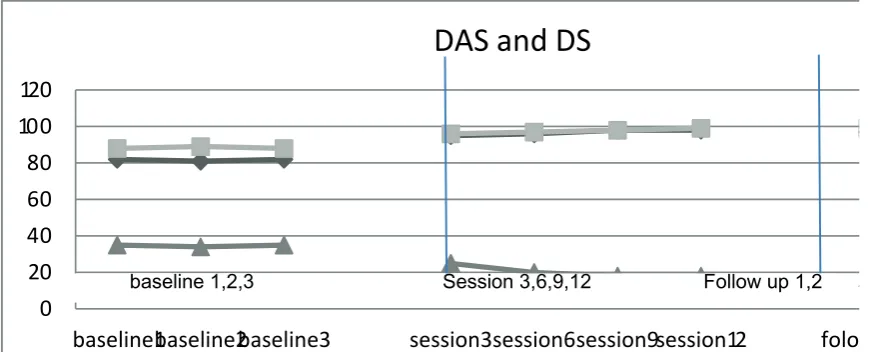
woman and her husband respectively were 82 and 88 at the baseline statement. These scores show lower level of marital satisfaction in DAS. Woman obtained a score of 95 at the end of session 3; and her husband obtained 91; during other sessions we don’t see significant increasing until the end of intervention. As in last session, woman score in follow up 2 was 97, and husband score was 99 in DAS. This result indicates not increasing in marital satisfaction of couple. Woman and her husband
recovery percentage respectively are 18% and 11% for marital satisfaction. Also demoralization level of woman is 35 at the baseline statement. These scores show higher level of demoralization in DS. Woman obtained a score of 25 at the end of session 3; this reduction continued until the end of the intervention. As in last session, woman score in follow up 2 was 17 in DS. This result indicates reduction in woman demoralization. Woman C recovery percentage is 51% (figure 3).
0 20 40 60 80 100 120
baseline1baseline2baseline3 session3session6session9session12 folo
DAS
and
DS
Fig 3. Marital satisfaction and Demoralization trend of couple C
baseline 1,2,3 Session 3,6,9,12 Follow up 1,2
The trend of changes in couples’ marital satisfaction scores within 9 times of completing
questioner is presented in the table (2).
Table 2. Couples marital satisfaction scores Marital
satisfaction Baseline1 Baseline2 Baseline3 Session3 Session6 Session9 Session12 Follow1 Follow2
woman A 80 81 81 90 105 117 128 130 130
husband A 85 85 85 96 111 120 133 135 135
woman B 75 74 75 95 115 118 125 127 128
husband B 82 81 82 91 109 113 120 120 120
woman C 82 81 82 95 96 98 98 97 97
husband C 88 89 88 96 97 98 99 99 99
Table (2) shows the marital satisfaction scores changes for all couples in Dyadic adjustment Scale. As shown in the table, couples A and B score's in marital satisfaction, increased during sessions, from baseline to follow up. But we don’t
see this about couple C, so that their scores have not changed significantly. The trend of changes in women's demoralization scores within 9 times of completing questioner is presented in the table (3).
Table 3. Women demoralization scores
Demoralization Baseline1 Baseline2 Baseline3 Session3 Session6 Session9 Session12 Follow1 Follow2
woman A 34 34 34 20 15 12 12 10 10
woman B 33 33 34 24 17 15 15 13 13
woman C 35 34 35 25 20 18 18 17 17
Table (3) indicates that women's demoralization scores decreased during sessions from baseline to follow up. So we can say that the hypothesis which is based on the effectiveness of an eclectic couple therapy based on existential approach with Olson's model on mastectomy women and their husband has been proved.
Discussion
Increasing the trend of marital satisfaction scores can be perceived as the effectiveness of eclectic couple therapy based on existential approach and Olson's model on mastectomy women and their husband. These hypotheses can be proven true with the following discussion: couples experience an existential crisis following breast cancer. The crisis involves violations of basic assumptions about their sense of control and ability to predict the future. Such major stressors challenge or shatter individuals’ world- and self-views because there is a discrepancy between the information inherent in the stressor, on the one hand, and couple’s positively skewed expectations and beliefs about the world, on the other hand. For example, the belief that ‘bad things do not happen to good people’ is seriously challenged when a ‘good person’ gets a cancer diagnosis.
In these couples, denial of existential anxiety led them to feel sadness and guilt and fear of recurrence. At the same time, couple's inability to
communicate about this fears with each other, led them to feel existential loneliness more and more that laid out a deep gap in their relationships. Moreover, demoralized women, because of felling incompetency and inability to give meaning to these events, started to making meaning such as paying off, God punishment, and God revenge. These meanings could disturb couple's marital satisfaction. In fact not only present situation was not adapting to their expected situation, but also, inefficient meaning barricaded them to communicate and cope effectively.
References
1. American Cancer Society. Breast cancer facts & figures. Atlanta: American Cancer Society, Inc.; 2011-2012.
2. Pukay-Martin MD. Couple connection and cancer:
Understanding the mechanisms of partner support for women with breat cancer: University of North Carolina; 2009.
3. Cohen MZ, Kahn DL, Steeves R. Beyond body image: The
experience of breast cancer. Oncol Nurs Forum. 1998;25:835-41.
4. Compas BE, Luecken L. Psychological adjustment to breast cancer. Current directions in psychological science. American Psychological Society. 2001;11(3):111-4.
5. Avci IA, Kumcagız H. Marital Adjustment and Loneliness Status of Women With Mastectomy and Husbands Reactions. Asian Pacific J Cancer Prev. 2011;12:453-9.
6. Northouse LL, Templin T, Mood D, Oberst M. Coples
adjustment to breast cancer and benign breast disease:A longitudinal analysis. Psycho-Oncology. 1998;7:37-48.
7. Marcus AC, Garrett Km, Cella D, Wenzel LB, Brady MJ,
Crane LA. Telephon counseling of breast cancer patients after treatment:A description of a randomized clinical trial. Psycho-oncology. 1998;7:470-82.
8. Mullane M, Dooley BE, Bates U. Validation of the
Demoralization Scale in an Irish advanced cancer sample. Palliative and Supportive Care. 2009;7:323-30.
9. Bahmani B, Etemadi A, Shafiabadi A, Delavar A, Ghanbari Motlagh A. Cognitive-Existential group therapy and Cognitive Instructional therapy for breast cancer patients. Developmental Psychology: Iranian Psychologist. 2010;6(23):201-14.
10. Fekete EM, Stephens MAP, Mickelson KD, Druley JA .The role of perceived emotional responsiveness. Families,Systems&Heaalth. 2007;2:204-17.
11. Baider L, Walch N, Perry Sh, De-Nour AK. cancer in
married couples:higher or lower distress. Journal of psychosomatic research. 1998;3:239-48.
12. Carlson L.E, Bultz B.D, Pierre M, Speca M. Patners
ofcancer patients: Part II,Current psychosocial interventions and suggestions for improvememnt. Journal of Psycho Oncology. 2000;3:33-43.
13. Kayser K. Enhancing dyadic coping during a time of crisis: A theory-based intervention with breast cancer patients and their partners. In: Revenson T, Kayser K, Bodenmann G, editors. Couples coping with stress: Emerging perspectives on dyadic coping Washington, DC: American Psychological Association; 2005. p. 175-94.
14. Koenig H. Religion, Spirituality, and Medicine: Research Findings and Implications for Clinical Practice. Southern
Medical Journal. 2004;12:1194-200.
15. Kissane DW, Clark DM, Street AF. Demoralization
syndrome. A relevant psychiatric diagnosis for palliative care .Journal of Palliate care 2001;17:12-21.
16. Vehling S, Lehmann C, Oechsle K, Bokemeyer C, Krull A, Koch U, et al. Global meaning and meaning-related life attitudes: exploring their role in predicting depression, anxiety,and demoralization in cancer patients. Support Care Cancer. 2011;19:513-20.
17. Vehling S, Lehmann C, Oechsle K, Bokemeyer C, Krull A, Koch U, et al. Is advanced cancer associated with demoralization and lower global meaning? The role of tumor stage and physical problems in explaining existential distress in cancer patients. Psycho-Oncology. 2012;21:54-63.
18. Frankle VE. Psychotherapy and existentialism: New York: Washington Square Press; 1967.
19. Kalantarkousheh FM, Hassan SA. Function of life meaning and marital communication among Iranian spouses in Universiti Putra Malaysia. Procedia Social and Behavioral Sciences. 2010;5:1646-9.
20. Baik OM, Adams KB. Improving the well-being of couples facing cancer: A review of couples-based psychosocial interventions. Journal of Marital and Family Therapy. 2011;2:250-66.
21. Hopkinson JC, Okamoto L, Addington-Hall JM. The
effectiveness of patient-family carer (couple) intervention for the management of symptoms and other health –related problems in people affected by cancer: A systematic literature search and narrative review. Journal of pain and symptom management. 2011;7:1-32.
22. Corey G. Theory and practice of counseling and
psychotherapy, translated by Seyed Mohamadi, Y. Tehran: Arasbaran Publication; 2005.
23. Bowling T, Hill CM. An overview of marriage enrichment. The family Journal. 2005;13:87-94.
24. Spanier G. Measuring Dyadic Adjustment: New scale for assessing the quality of marriage and similar dyads.. Journal of marriage and family. 1976;1:15-28.
25. Kissane D, Wein S, Love A ,Qing LX. The Demoralization Scale: a Report of Its Development and Preliminary Validation. Journal of Palliative Care. 2004;20:269-76.
26. Kusner GK. Couples dyadic spirituality and marital