Volume 57, 2018, Pages 196–213
LPAR-22. 22nd International Conference on Logic for Programming, Artificial Intelligence and Reasoning
Reasoning About Prescription and Description Using
Prioritized Default Rules
Valentin Cassano
12, Carlos Areces
12, and Pablo Castro
131
Consejo Nacional de Investigaciones Cient´ıficas y T´ecnicas, Argentina 2 Secci´on de Computaci´on, FaMAF, UNC, Argentina
3
Departamento de Computaci´on, FCEFQyN, UNRC, Argentina {vcassano,areces}@famaf.unc.edu.ar [email protected]
Abstract
In this paper we introduce a prioritized default logic. We build this logic modularly from Standard Deontic Logic by the addition of default rules and priorities among them. Our main aim is to provide a logical framework to reason about scenarios where prescriptive and descriptive statements coexist and may be incomplete and contradictory. We motivate and illustrate the technical elements of our work with the use of examples (classical, and coming from software engineering). In addition, we present sound, complete, and terminating (with loop check) tableau-based proof calculi for credulous and sceptical reasoning in our logic.
1
Introduction
Prescriptive and descriptive statements are easily found in many fields: Artificial Intelligence, Software Engineering, Legal Argumentation, etc. On the one hand, prescriptive statements refer to ideal behaviors or situations: they indicate how “things ought to be”. On the other hand, descriptive statements refer to particular states of affairs: they indicate how “things are”. The logical treatment of prescriptive and descriptive statements goes back to the pioneer work of von Wright [49]. Nowadays, it mostly constitute part of Modal Logic [10], withStandard
Deontic Logic (SDL) being its most famous member (see [15] for a brief introduction toSDL;
and [7, 30] for in-depth introductions and historical remarks). SDL is the basic modal logic interpreted in serial models. SDL copes well with some elements of representing, and reason-ing from, prescriptive and descriptive statements, e.g., violations. At the same time, it is also acknowledged that it exhibits some shortcomings in situations involvingcontrary-to-duties, pre-scriptions arising in the context of violations; or, more generally, in scenarios involving stratified prescriptions. These shortcomings are usually exposed by so-calledparadoxes, prescriptive and descriptive statements that are intuitively consistent but whose logical formalization gives rise to a logical inconsistency.
default rules. Default logics are among the best-known non-monotonic logics. Work on default logics started with Reiter’s seminal paper ‘A Logic for Default Reasoning’ [43] and continued with many variants and addenda to Reiter’s original ideas [3, 4, 6, 12]. Default logics are characterized by default rules (or defaults). Defaults provide a way of reasoning with incomplete information by augmenting what is known, with what is plausible but cannot be obtained by classical reasoning. They also provide a way of reasoning in the presence of inconsistencies circumventing the classical idea that from a contradiction everything follows. Furthermore, they provide a way of reasoning with defeasible conclusions, i.e., conclusions which can be withdrawn in the light of new information. These features of defaults make them particularly useful to model conditional obligations and what follows from them. The incorporation of priorities among defaults offers the possibility of a faithful representation of scenarios involving stratified prescriptions and overriding. Our main aim is to provide a framework to reason about scenarios where prescriptive and descriptive statements coexist and may be incomplete and contradictory. We illustrate the technical elements of our work via examples.
Initial ideas combining non-monotonic and deontic logics go back to the work of Horty [32], Alchourron [1], and Nute [40]. In brief, Horty adapts Reiter’s non-monotonic framework [43] to reason about norms; Alchourron presents a dyadic logic for capturing defeasible reasoning using a revision operator; and Nute described a framework for defeasible reasoning over deontic formulas. Following these seminal work, many other authors developed different kinds of non-monotonic deontic systems. Worth mentioning are the approaches of McCarty [37], proposing to encode normative default reasoning in ProLog; the framework given by van der Torre et al. [45], formalizing different types of obligation overriding; and the more recent non-monotonic systems described in [48] and [39]. The former uses dynamic semantics for epistemic modalities to reason about deontic formulas, and the latter adapts Horty’s ideas to reason about rights and contracts between agents. Also worth mentioning are the approaches presented in [25] and [29]. In [25], Goble presents a formalism to reason aboutprima facie obligations introducing an operator to capture conditional obligations, and using a notion similar to the one of extensions we introduce below to provide semantics. One of the main differences between this and our approach is that we use default rules containing prerequisites, justifications, and consequents, thus allowing for a finer look at the notion of extension. In [29], Hansen uses maximally consistent sets to define the semantics of conditional obligation (deontic alternatives). This is related to the use of extensions in our approach, as they may be seen as possible consistent situations where norms are fulfilled. Our approach gains in interest since it is built onSDL, which directly enables the use of tableau methods for constructing extensions. The work reported in [46] is also closely related to ours. Therein a ternary deontic operatorO is presented. A formula O(α | β\γ) reads: ‘αshould be the case ifβ is the case, unlessγis the case’. As explained by the authors, the ‘unless’ clause is analogous to the justification in a default rule. This said, the semantics of O is given by means of a modal logic, in contrast to the usual notion of extension for default rules. The approach, however, provides interesting intuitions and examples that illustrate the use of these kinds of normative operators.
in Modal Logic with well-known benefits (see [27] for a good introduction to modal tableau systems). They allow for systematic proof constructions, and the exploration and production of counterexamples. Our proof calculus retains these properties. To the best of our knowledge no tableau-based proof calculus has been proposed in the literature combining Default Logic and SDL. Tableau systems for Default Logic have been developed in, e.g., [2, 44]. Ours is based on ideas found in [13]. Our proof calculus is constructed over tableaux for SDL, but the techniques can be used to obtain non-monotonic versions of tableaux for other deontic logics.
One additional characteristic of our approach is the inclusion of the universal modality [26] into the framework ofSDL. This modality becomes useful as it permits a clean presentation of statements that have a global status, in addition to those that have local impact. Its inclusion simplifies the definition of consequence, and of the proof system.
Structure. In Section2we recall the basics ofSDL. In Section3we introduce our extension of Prioritized Default Logic, calledDSDL, built onSDL. In Section4we motivate and illustrate some of the technical elements of our work with the use of examples. In Section5we cover the basic definitions of a tableau-based proof calculus forSDLand introduce a tableau-based proof calculus forDSDL. Finally, in Section 6 we discuss our work and present some final remarks. Proofs of results can be found in AppendixA.
2
Deontic Preliminaries
By Standard Deontic Logic (SDL), we mean basic modal logic over the class of models with a
serial accessibility relation (see, e.g., [15, 7, 30]). We extendSDL with the global modality A (see [26]), and call the resulting systemSDLA. We define the syntax and semantics of SDLA below. We assume basic knowledge of Modal Logic [9,42].
Syntax: LetPbe a denumerable set ofproposition symbols. p,q, rare variables for propo-sition symbols. Lowercase Roman letters (possibly with indices) indicate members ofP. The setFof wffs of SDLAis determined by the grammar:
F::=p| ¬F1|F1∧F2|OF1|AF1
The symbols ¬ and ∧ are the boolean logical connectives of negation and conjunction. O is
the(deontic) modality of obligation. A is the universal modality. The symbols >, ⊥, ∨, and
⊃(truth, falsity,disjunction, and material implication) are defined from ¬and∧ in the usual
way. The deontic modality ofpermission Pis ¬O¬. The existential modalityE is¬A¬. The members ofFareformulas. Lowercase and uppercase Greek letters indicate formulas and sets of formulas, respectively.
Semantics: The formulas in Fare interpreted overKripke models that areserial. A Kripke model, notationM, is a tuplehW, R, viwhere: Wis a non-empty set;R⊆W×W;v:P→2W.
The elements of W are called worlds, R is the accessibility relation, and v is the valuation
Msatisfies ϕatw, notationM, w|=ϕ, according to the following rules:
M, w|=p iff w∈v(p)
M, w|=¬ϕ iff M, w6|=ϕ
M, w|=ϕ∧ψ iff M, w|=ϕandM, w|=ψ
M, w|=Oϕ iff for allw0∈W, ifwRw0, thenM, w0|=ϕ
M, w|=Aϕ iff for allw0∈W, M, w0|=ϕ
For Φ⊆F, Msatisfies Φat w, notation M, w|= Φ, if, for all ϕ∈Φ,M, w|=ϕ. Mvalidates Φ, notationM|= Φ, if, for allw,M, w|= Φ.
Logical Consequence: There are two reasonable notions oflogical consequencebetween sets of formulas (assumptions), and formulas (their consequences), that can be built on|=: global logical consequence, notation|=g; andlocal logical consequence, notation|=l. Define Φ|=gϕiff
for every Kripke modelM, ifM|= Φ, then,M|=ϕ. Define Φ|=lϕiff for every Kripke model
Mand worldw, if M, w |= Φ, then,M, w |=ϕ. It follows that |=l ⊆ |=g, but not vice versa.
The global modality A enables us to uniformly handle global and local logical consequence: Φ |=g ϕ iff A(Φ) |=l ϕ, where A(Φ) = {Aϕ | ϕ∈Φ} [26]. For this reason, we define logical
consequence simply as local logical consequence and drop the superscriptl. We write|=ϕ if
∅ |=ϕ. If Φ is finite, Φ|=ϕiff|= (
∧
Φ)⊃ϕ.3
Prioritized Deontic Default Logic
Default Logic is a class of Non-monotonic Logics characterized by defaults and extensions. Defaults and extensions are arrangements of formulas of an underlying logic. Extensions and consequence in the underlying logic are used as a way of justifying a notion ofdefault
conse-quence. A Default Logic is calledprioritized when defaults are structured in a predefined order,
imposing additional constraints on extensions [12,19,20]. Prioritized Default Logics are useful in many application areas as they naturally impose an ordering among defaults. For instance, if we take defaults as formalizing defeasible conditional norms, we can easily represent the fact that some norms precede others. We introduce a particular Prioritized Default Logic, called
DSDLA, built onSDLA. Our presentation brings default consequence to the fore.
Syntax: Formulas are members of F, i.e., formulas ofSDLA. Defaults are members of D. The set D contains all triples (π, ρ, χ), notation π ρ χ, where {π, ρ, χ} ⊆F. The formulas π, ρ, and χ, are called the prerequisite, the justification, and the consequent, of the default, respectively. We single out the uppercase Greek letter ∆ for sets of defaults and the lowercase Greek letter δ for defaults. We define Π∆ ={π | π
ρ
χ∈∆}, P∆ = {ρ | π
ρ
χ∈∆}, and X∆={χ|π
ρ
χ∈∆}.
Semantics: The setAcontains all tupleshΦ,∆,≺iwith Φ and ∆ finite subsets ofFandD, respectively, and≺a partial order on ∆. The members ofAare(default) assumption sets. The semantics ofhΦ,∆,≺iis given by extensions and logical consequence inSDLA. In this setting, an extension may be seen as an interpretation structure of a syntactical kind (taking the usual role of a model). Extensions are defined in Def.3.4.
Definition 3.1. LetA=hΦ,∆,≺i; then,π ρ χ istriggered by ∆0 inAif Φ∪X∆0 |=π. It is
blocked by ∆0 inAif there is%∈(P∆0∪ρ) s.t. Φ∪X∆0∪χ|=¬%. It isdetached by ∆0 inAif
Example 1. Letδ1=p
q
¬randδ2=>
r
¬q, and ∆ ={δ1, δ2}; bothδ1 andδ2 are detached by∅ inh{p},∆,∅i. δ1 is blocked by{δ2} inh{p},∆,∅i. δ2 is blocked by{δ1} inh{p},∆,∅i.
Definition 3.2. LetA=hΦ,∆,≺i, and ∆0⊆∆; then,δ∈(∆−∆0) isenabled inAw.r.t. ∆0 if δis detached by ∆0inA; and there is no otherδ00∈(∆−∆0) detached by ∆0 inAs.t.δ00≺δ.
Example 2. Let A=hΦ,{δ1, δ2},{δ1≺δ2}i. Ifδ1 and δ2 are detached by ∅ in A, then δ1 is enabled inA w.r.t. ∅, and δ2 is not. If δ2 is detached by {δ1} in A, then δ2 is enabled inA w.r.t.{δ1}. Ifδ1 is not detached by∅in Abutδ2 is, thenδ2 is enabled inAw.r.t.∅.
Definition 3.3. LetA=hΦ,∆,≺i; then, ∆0 =S
0≤i∆0i is aseries of enabled detachments if
∆00=∅and
∆0i+1 =
(
∆0i∪ {δ0} ifδ0 ∈(∆−∆0i) is enabled inAw.r.t. ∆0i
∆0i otherwise.
Definition 3.4 (Extension). The set of extensions of hΦ,∆,≺i, notationE(Φ,∆,≺), has as its elements all Φ∪X∆0 s.t. ∆0 is a series of enabled detachments (and only those elements).
Example 3. E({p},{p ¬q r,> ¬r q},{p ¬q r≺ > ¬r q}) ={{p, r}}.
Default Consequence: We define default consequence inDSDLAas a relation|≈ ⊆A×F. IfhΦ,∆,≺i |≈ϕ, we say thatϕis adefault consequenceofhΦ,∆,≺i. If≺=∅, we simply write
hΦ,∆i |≈ϕ. Two commonly accepted views of default consequence aresceptical andcredulous. Formally,ϕis a sceptical default consequence ofhΦ,∆,≺i, notationhΦ,∆,≺i |≈sϕ, ifffor every extensionE of hΦ,∆,≺i, E |=ϕ. In turn,ϕ is a credulous default consequence ofhΦ,∆,≺i, notationhΦ,∆,≺i |≈c ϕ, ifffor some extension E ofhΦ,∆,≺i,E|=ϕ. We use|≈ when there is no need to distinguish between sceptical and credulous default consequence. Monotonicity in DSDLAreads: ifhΦ,∆,≺i |≈ϕ, then,hΦ∪Φ0,∆∪∆0,≺0i |≈ϕ, where≺ ⊆ ≺0. DSDLAis non-monotonic.
Some Remarks and Easily Established Properties of Extensions: Def.3.4corresponds to extensions as defined by Lukaszewicz in [35] (modulo priorities). This definition of extension is better behaved than Reiter’s [43], in particular, by this definition anyhΦ,∆,≺i always has at least one extension. In addition, this definition of extensions guaranteessemi-monotonicity, i.e., for every extensionE ofhΦ,∆,≺i, there is an extensionE0 ofhΦ,∆∪∆0,≺0is.t.E⊆E0, where≺ ⊆ ≺0and for allδ
1, δ2∈∆ andδ0∈∆0, ifδ1≺0δ0andδ0≺0δ2, thenδ1≺δ0andδ≺δ2. This formulation of semi-monotonicity allows us to define a tableau based proof calculus that can take advantage of a partial use of default assumption sets, see Section5. Clearly,≺defines a prioritized default logic [12,19,20]. Ifδ1≺δ2, we say thatδ1 precedes, or has higher priority than,δ2. Our view of ≺differs from some standard approaches, e.g., [12], in that defaults are not included in an extension if this depends on defaults with lesser priority. This is closely related to the “prescriptive” approach in [19,20] (single-pass breadth-first iteration only).
4
Some Features of the Formalism
The examples in this section are meant to clarify some concepts and definitions. They also motivate and illustrate some of the technical elements of our work. We start analysing a classical example from the literature in our formalism. We then move to our intended field of application on the modelling of software requirements. The following terminology is useful:
Forrester’s Paradox. First presented in [23], this paradox is a puzzle involving contrary-to-duty reasoning. We recall this paradox as presented in [38]. Consider the English statements:
(1) ‘It is obligatory that John does not kill his mother’.
(2) ‘If John does kill his mother, it is obligatory that he does kill her gently’. (3) ‘John does kill his mother’.
(4) ‘If John does kill his mother gently, he does kill his mother’.
InSDL, (1) to (4) are typically formalized as:1
(1’)O(¬k) (2’)k⊃Og (3’)k (4’)g⊃k
Let E be the set of plain English sentences (1) to (4), and Φ the set of formulas (1’) to (4’); Forrester’s Paradox is a mismatch between our intuitive understanding of E, their formalization as Φ, and what follows from what in each case. More precisely, let |=i be our
intuitive understanding of reasoning fromE, and|=f be formal reasoning from Φ. The paradox
is a mismatch between|=i and|=f (an issue of adequacy of formalization).
Let us elaborate on the mismatch between|=iand|=f by revisiting the discussion presented
in [38]. Therein, it is proven that: Φ |=f O(¬k)∧k, i.e., O(¬k)∧k is a formal consequence
of Φ. Let O(¬k)∧k be the formalization of (†) ’John is obliged not to kill his mother but he does kill her’, it seems reasonable that: E|=i (†); i.e., (†) is an intuitive consequence of E; alternatively,Einvolve a violation (to the obligation not to kill). In [38] it is also proven that: Φ|=f Og. LetOg be the formalization of (‡) ‘John is obliged to kill his mother gently’; it also
seems reasonable that: E|=i(‡); this is a case of so-calledcontary-to-duty reasoning.
In both cases above |=i and |=f coincide. But [38] points out that: g⊃k |=f O(g⊃k); from which it can be proven that: Φ|=f Ok. This is rather untenable. If we take Okas the formalization of (††) ‘John is obliged to kill his mother’, it is not at all clear that: E|=i (††); in fact, it seems reasonable that: E 6|=i (††). Making things worse, it can be proven that: Φ |=f O(¬k) and Φ |=f Ok; which results in Φ being formally inconsistent. On the other
hand,E is intuitively consistent. The last two cases reveal that |=f over-generates w.r.t. |=i.
Forrester’s Paradox is precisely about this over-generation.
The Global Modality: The previous discussion of Forrester’s Paradox is not particular to [38] but standard in the literature on deontic reasoning. To be noted, however, in this discussion|=f intertwines global and local logical consequence,|=fg and|=fl, without drawing a proper distinction between them. Let us be more precise:
(G) Observe that g⊃k |=fg O(g⊃k), whereas g⊃k 6|= f
l O(g⊃k). So when it is said that
g⊃k|=f O(g⊃k),|=f refers to|=f
g, and so not to|= f
l. Moreover, ifg⊃k6|=
f O(g⊃k),
then, Φ is a consistent set of sentences, and Φ6|=f Ok.
(L) But clearly|=f is not |=f
g in all cases. If it were, thenk|=f Ok, and this would result in
{O(¬k), k}being immediately inconsistent. This is certainly undesirable; as it undermines formal reasoning about violations in the system,O(¬k)∧k, by reducing it to a triviality. Thus, in this case at least,|=f refers to|=fl.
The case analysis in(G)and(L)shows that there is a need to distinguish between formulas likeg⊃k, which have a global status, and those likek, which have a local status. The extension from SDL to SDLA serves this purpose. SDLA brings the global modality A into the picture.
This modality is well-known in the literature on Modal Logic, but it is not used explicitly in the literature on Deontic Logic. Aenables us to draw a clear distinction between the global and the local. InSDLA‘John does kill his mother’ is adequately formalized ask, while ‘If John does kill his mother gently, he does kill his mother’ is adequately formalized asA(g⊃k). This captures explicitly, and in the object language, the global status of the meaning of ‘killing gently’ which is in all cases a form of ‘killing’. The inclusion ofAin the object language also makes it clear why ‘John does kill his mother’ should be formalized as k and not as Ak; as this is true of a particular world, not in all worlds. Aalso raises the question of whether obligations should be preceded by it. Though the inclusion of Adoes not solve the paradoxical status of E, insofar as their formalization is concerned, it does improve the clarity of the formalism. In particular, the inclusion ofAreduces |=f to |=fl; enabling us to work with global and local formulas in a uniform setting while retaining the capability of drawing the proper distinctions.
Deontic Reasoning with Defaults: The mismatch between|=iand|=f in Forrester’s
Para-dox is due to the consideration that Eis intuitively consistent, but its formalization in SDL, andSDLA, “makes it” inconsistent. This understanding of Forrester’s Paradox can be seen as a particular instance ofreasoning consistently in the presence of inconsistent information, in this case contrary-to-duty statements. The extension of SDLA to DSDLA accommodates for this logical point of view. InDSDLAwe formalize prescriptive statements as defaults and descrip-tive statements as formulas. Intuidescrip-tively, we can understand defaults as conditional defeasible norms, and formulas as particular situations or scenarios.2
To illustrate this point of view, let (1) and (2), and (3) and (4) in Forrrester’s Paradox above be formalized as the defaults (δ1) > O(¬k) and (δ2)k Og, and as the formulask andA(g⊃k), respectively. Define F=h{k,A(g⊃k)},{δ1, δ2}i; it follows that:
(i)F|≈cO(¬k)∧k (ii)F|≈cOg (iii) F6|≈c⊥
Cases (i) to (iii) offer some insight into Forrester’s Paradox: formal and intuitive reasoning coincide. In this sense, |≈c brings formal reasoning closer to |=i. Yet |≈c
does not solve Forrester’s Paradox: F |≈c O(g ⊃k) and F|≈c O(k). So there is still a mismatch w.r.t. |=i.
Incidentally, this mismatch does not originate from normative reasoning. Instead, it stems from the interaction betweenA and the K formula O(g ⊃ k) ⊃(Og ⊃ Ok) which is valid in SDL. FromA(g⊃k) we can concludeO(g⊃k), and from this fact andKwe can concludeOg⊃Ok. We obtain Ok as soon as we detachk Og. There is an obvious technical solution for this problem inDSDLA, replace the sentenceA(g⊃k) by the default (δ3)>
¬Og
A(g⊃k) and add extra constraints to block the detachment of this new default if (δ2) has been detached, e.g., δ2≺δ3. In this scenario we cannot credulously concludeOk. This carries with it the benefit of matching our intuition,|≈cand|=i coincide, but also the added cost of losing the naturalness of the first formalization. Whether or not this is a cost that we are willing to assume is certainly a matter of debate.
Mine Pump Example: Beyond philosophical considerations, deontic reasoning has inter-esting applications in Computer Science and Software Engineering [47]. Such is the case in Goal-Oriented Requirements Engineering (GORE) [34]. GORE aims at formally specifying the informal requirements of a system via a set ofgoals applicable to particulardomains. Goals are prescriptive statements specifying what must be achieved by the system. Domains are declara-tive statements about the environment in which the system operates. Formalization of informal
requirements brings with it: removal of the ambiguities of informal languages, tool-support, and the possibility of automatic analyses. This is particularly interesting for the analysis of
conflicts; situations in which the goals in a requirements specification diverge (they are not
satisfiable relative to some domain). Conflicts are not obvious, and it is extremely useful to detect them, specially in early stages of analysis. Let us note that conflicts do not necessarily render useless the entire set of goals. In some cases, consistency is restored in some maximal way (e.g., by dropping a minimal set of goals giving rise to the conflict). When uniqueness of the solution is not guaranteed, we may wish to properly inspect all alternatives. Deontic Logic adds to this the possibility of reasoning about “normal” or “ideal” situations, and to distinguish them from those that exhibit “faults,” modeled as violations (see [14, 33, 47] for an in-depth introduction to the use of Deontic Logic in fault-tolerance). But Deontic Logic alone does not allow us to adequately deal with the conflicting nature of requirements. It is precisely at this point where Default Logics prove their worth [5]. Let us illustrate what the combination of Deontic Logic and Default Logic can do by means of an example, adapted from [18].
Deontic Reasoning with Defaults (cont.): Suppose that in a gold mine there is a con-troller which has two sensors indicating the level of water and of methane in the mine. From the information provided by the sensors, the controller turns on/off a pump that regulates the level of water in the mine. Consider the following scenario:
(1) ‘If the water level is high, the water must be drained’. (2) ‘If the methane level is high, the pump must be off’. (3) ‘Whenever the pump is off, the water is not drained’. (4) ‘The pump is on’.
(5) ‘The level of water is high’. (6) ‘The level of methane is high’.
In this scenario: (1) and (2) are goals, and (3) to (6) are domain properties. Following [5], we formalize goals as defaults, and domain properties as formulas. A possible formalization is:
(1’)w Od (2’)m O(¬p) (3’)A(¬p⊃ ¬d) (4’)p (5’)w (6’)m
If Φ ={A(¬p⊃ ¬d)}, ∆ ={(1’), (2’)},M1=hΦ∪ {w, m},∆i, andM2=hΦ∪ {¬p, w},∆i,
(i)M1|≈
s
Od∨O(¬p) (ii)M16|≈
s
Od (iii)M16|≈
s
O(¬p) (iv)M2|≈
s
Od∧ ¬d
Intuitively, (i) to (iii) tell us that the goals can be reached individually, but not jointly. This indicates a conflict w.r.t. the domain properties under consideration. A finer analysis reveals thatM1 has two extensions: Φ∪ {p, w, m,Od}and Φ∪ {p, w, m,O(¬p)}. The sets of defaults generating these extensions are maximally satisfiable sets of goals. In other words extensions tell us which goals are jointly satisfiable, and which ones are in conflict and need to be revised to restore consistency. (iv) tells us that the domain properties in M2 result in a violation of (1’). This use of deontic concepts in the analysis of goals enables us to distinguish between normal and faulty behavior in goal specifications.
by (2’). Alternatively, we may wish not to impose any additional structure on defaults, but to formalize (1) as (1”)w ¬m Od. Intuitively, this tells us that (1”) is voided if the level of methane is too high. Formally, ifM01=hΦ∪ {w, m},∆,≺i, andM3=hΦ∪ {w, m},{(1”), (2’)}i,
(v)M01|≈sO(¬p) (vi)M016|≈sOd (vii)M3|≈
s
O(¬p) (viii)M36|≈
s
Od
The multiple extensions problem of the scenario without safety regulations, resulting from a conflict, is resolved in the scenario including safety regulations via prioritization, or by listing the explicit conditions under which a goal is voided. In this particular scenario we obtain the same set of default consequences, albeit for different reasons.
Final Remarks: The discussion of Forrester’s Paradox in terms of credulous default conse-quence inDSDLAyields some interesting observations; in particular w.r.t. the inclusion of the global modality Ain deontic reasoning, and the use of defaults in the formalization of condi-tional norms. It is worth mentioning that credulous default consequence in DSDLA enables us to reason about the violation of an obligation while keeping the violated obligation in force (as opposed to cancelling it). This is a point of departure betweenDSDLAand some standard works on non-monotonic deontic reasoning (where in cases of violations the violated obligation is cancelled). Evidently, Forrester’s Paradox is not solved in DSDLA. We do not claim that this is the case either. Instead, we employ this classical and well-known scenario as a means to illustrate some of the features of our formalism. DSDLA, in line with many other works on nonmonotonic deontic reasoning, sometimes satisfies our intuition, sometimes fails it; in any case, the benefit is to have at hand a set of logical tools for rigorous discussion.
We have also shown a novel use of sceptical default consequence in DSDLAin the context of formal goal oriented requirements. This is an area of research not as well explored from the perspective on (defeasible) deontic reasoning. The formalization of the Mine Pump scenario is similar to Forrester’s Paradox. However, in the analysis of goal specifications, practical con-cerns set aside philosophical considerations. Correct goal specifications are essential for the production of dependable and reliable software based systems. In this respect, methods accom-modating different kinds of analyses are highly desirable; even more if they come equipped with tool-support. The presented formalism is a combination of two orthogonal logical frameworks, Default Logic on the one side, and Deontic Logic on the other. An important characteristic of this framework is that it is amenable to tableaux reasoning, as it is shown in the next section.
5
Tableaux-based Proof Calculus
The benefits of equipping a logical system with a proof calculus are well-known. We develop a non-monotonic proof calculus forDSDLA based on tableaux for SDLA. The proof calculus is sound, complete, and terminating (with loop checks). We comment on the technical challenges of the proof system as well as some of its gains.
Basic Tableau Rules: We begin by recalling the basic definitions of a tableau system for SDLA[10,11,36,42]. These will be used in the formulation of the tableau system forDSDLA.
A tableau is a tree whose nodes are either a pair of a formula ϕand a natural number i,
notation @iϕ(borrowed from Hybrid Logic [8]), or a pair of natural numbersiandj, notation
(i, j). Intuitively, @iϕmeans thatϕis true at worldi; whereas (i, j) means thatj is accessible
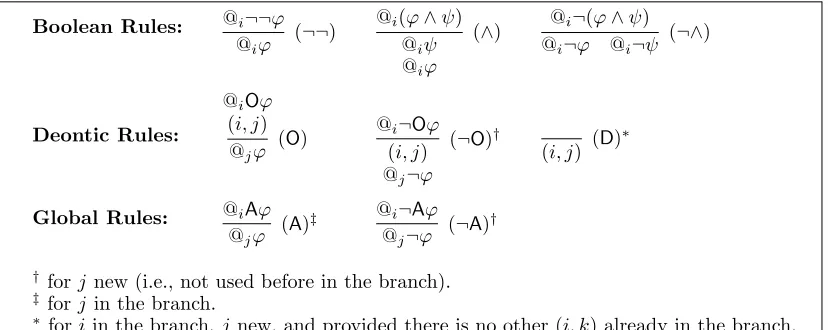
for the boolean logical connectives. (O) and (¬O) are rules for deontic obligation. (A) and (¬A) are rules for the global modality. (D) is the rule for seriality. The rules for all other connectives in the language are derived from the rules just introduced. Rules are applied as usual: premisses must belong to the branch; side conditions must be met (if any); the branch is extended according to the consequents.
Boolean Rules: @i¬¬ϕ
@iϕ
(¬¬) @i(ϕ∧ψ) @iψ
@iϕ
(∧) @i¬(ϕ∧ψ) @i¬ϕ @i¬ψ
(¬∧)
Deontic Rules:
@iOϕ
(i, j) @jϕ
(O) @i¬Oϕ (i, j) @j¬ϕ
(¬O)†
(i, j) (D) ∗
Global Rules: @iAϕ
@jϕ
(A)‡ @i¬Aϕ @j¬ϕ
(¬A)†
† forj new (i.e., not used before in the branch). ‡ forj in the branch.
∗ fori in the branch,j new, and provided there is no other (i, k) already in the branch.
Figure 1: Tableau Rules forSDLA
The discussion that follows is standard but useful to establish some basic terminology. Tableaux formulate aproof calculus forprovability, i.e., proofs without assumptions. In partic-ular, any tableau for¬ϕ is anattempt at proving ϕ; and any closed tableau (Def. 5.1) for ¬ϕ
is asuccessful proof attempt, or aproof of ϕ, notation `ϕ. This proof calculus issound and
complete, i.e., ` ϕ iff |= ϕ[42]. Though in its present form the calculus is non-terminating,
termination can be achieved with the use of loop checks [11].
Definition 5.1. A branch isclosed, noted (N), if @iϕand @i(¬ϕ) occur in the branch; otherwise
it isopen, noted (H). A tableau isclosed if all of its branches are closed; otherwise it isopen.
We extend the proof calculus for provability to one fordeducibility (proofs from a set Φ of assumptions) with the addition of the rule (A) in Fig.2.
Assumption Rules:
@0ϕ
(A)forϕ∈Φ
Figure 2: Tableau Rules forSDLA(cont.)
Φ, notation Φ`ϕ. This proof calculus for deducibility is also sound andcomplete: Φ`ϕiff Φ|=ϕ[36]. Again, termination can be ensured with the use of loop-checks.
Tableaux enjoy an interesting property: if a tableau for @0(¬ϕ) from Φ has a branch that is open and saturated (Def.5.2), there is no proof ofϕfrom Φ, notation Φ6`ϕ[36]. This result enables us to use tableaux also as a system to establish thenon-existence of proofs.
Definition 5.2. A branch of a tableau issaturated, notation (), if the application of any rule results in the addition of a new node that is already present in the branch, or the application of the rule is blocked by loop checking.
Tableau Rules for Defaults: Let T be the tableaux system for SDLA just described, we could formulate a tableau system TD for DSDLA by constructing suitable tableaux in T for
E ⊃ ϕ, for E an extension of hΦ,∆,≺i. It is also not difficult to see how we could use T for generating an arbitrary extension E by traversing ≺ in a breadth-first manner (see, e.g., [2, 44]). Generating all extensions requires some ingenuity, e.g., we must keep track of already explored combinations of default rules, but it is possible. This naive formulation ofTD,
however, suffers from some drawbacks. First, the exploration of extensions would be defined outside of the framework of T. Second, it necessarily requires the complete construction of extensions; something that we wish to avoid whenever possible given its computational cost [28]. Third, it offers no insight into what it means to reason with defaults; a clear departure from the traditional understanding of a proof calculus. The technical challenge in formulating a reasonable notion of tableaux for DSDLA is to internalize reasoning with defaults in the
framework of tableaux allowing for partial use of extensions. We show that by treating defaults
similarly to how we treat formulas in the rule (A) in Fig. 2 we can achieve this desideratum. The resulting tableau system formulates a proof calculus forDSDLA which retains some the desirables properties of this kind of calculi.
Adefault tableau is a tree whose nodes are either a pair of a formulaϕand a natural number
i, notation @iϕ; a pair of natural numbers i and j, notation (i, j); or a defaultπ ρ
χ. We talk about acredulous or sceptical default tableau for ϕfrom hΦ,∆,≺i. A credulous default tableau iswell-formed if its root is @0ϕ; the rules in Fig.1 are applied as usual; the rule (A) in Fig.2is applied to the formulas in Φ; and the rule (C) in Fig.3is applied to the defaults in ∆. A sceptical default tableau iswell-formed if its root is @0ϕ; the rules in Fig.1 are applied as usual; the rule (A) in Fig. 2 is applied to the formulas in Φ; and the rule (S) in Fig. 3 is applied to the defaults in ∆. Observe that the rules (C) and (S) in Fig.3are applicable only if their side conditions are met.3 These side conditions need (auxiliary) tableaux inSDLAbut are decidable. Intuitively, (C) and (S) correspond to the use of defaults as defeasible conditional
assumptions. Their side conditions guarantee the correctness of reasoning with defaults insome
(credulous) orall (sceptical) extensions, respectively.
Definition 5.3. Let A = hΦ,∆,≺i; then π ρ χ is `-triggered by ∆0 in A if there is a closed tableau for¬πfrom Φ∪X∆0, i.e., Φ∪X∆0 `π. It is `-blocked by ∆0 in A if for some
% ∈ (P∆0 ∪ρ), there is a closed tableau for % from Φ∪X∆0, i.e., Φ∪X∆0∪χ ` ¬%. It is `-detached ∆0 in Aif it is`-triggered and not`-blocked by ∆0 inA.
Definition 5.4. LetA=hΦ,∆,≺i, and ∆0 ⊆∆; thenδ∈(∆−∆0) is`-enabled inAw.r.t. ∆0 ifδis`-detached by ∆0 inA, and no otherδ00∈(∆−∆0)`-detached by ∆0 inAis s.t.δ00≺δ.
A proof calculus for credulous (sceptical) default deducibility is obtained by defining any well-formed credulous (sceptical) default tableau for¬ϕfromhΦ,∆,≺ias anattempt at proving
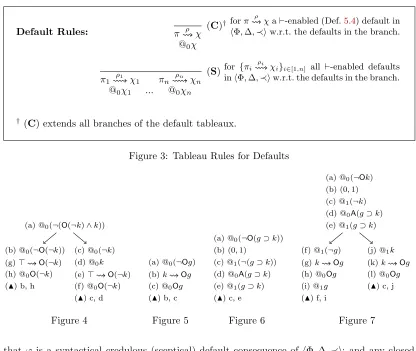
Default Rules: π ρ χ @0χ
(C)† forπ ρ
χa`-enabled (Def.5.4) default in hΦ,∆,≺iw.r.t. the defaults in the branch.
π1
ρ1 χ
1 @0χ1 ...
πn ρn χ
n
@0χn
(S)for {πi ρi
χi}i∈[1,n] all `-enabled defaults inhΦ,∆,≺iw.r.t. the defaults in the branch.
† (C) extends all branches of the default tableaux.
Figure 3: Tableau Rules for Defaults
(a) @0(¬(O(¬k)∧k))
(b) @0(¬O(¬k)) (g)> O(¬k) (h) @0O(¬k) (N) b, h
(c) @0(¬k) (d) @0k (e)> O(¬k) (f) @0O(¬k) (N) c, d
Figure 4
(a) @0(¬Og) (b)k Og (c) @0Og (N) b, c
Figure 5
(a) @0(¬O(g⊃k)) (b) (0,1)
(c) @1(¬(g⊃k)) (d) @0A(g⊃k) (e) @1(g⊃k) (N) c, e
Figure 6
(a) @0(¬Ok) (b) (0,1) (c) @1(¬k) (d) @0A(g⊃k) (e) @1(g⊃k)
(f) @1(¬g) (g)k Og (h) @0Og (i) @1g (N) f, i
(j) @1k (k)k Og (l) @0Og (N) c, j
Figure 7
that ϕ is a syntactical credulous (sceptical) default consequence ofhΦ,∆,≺i; and any closed (Def.5.1) credulous (sceptical) default tableau as asuccessful credulous (sceptical) default proof attempt, i.e., acredulous (sceptical) default proof ofϕfromhΦ,∆,≺i, notationhΦ,∆,≺i|∼cϕ (hΦ,∆,≺i |∼s ϕ). The proof calculus for credulous (sceptical) default deducibility is sound
andcomplete (w.r.t.extensions). Termination is guaranteed by the termination of tableaux for
SDLA. This claim is made precise in Thm.5.1; the proof of which can be found in AppendixA. Theorem 5.1(Soundness, Completeness, and Termination). hΦ,∆,≺i|∼cϕiffhΦ,∆,≺i |≈cϕ.
hΦ,∆,≺i|∼sϕiffhΦ,∆,≺i |≈sϕ. If`terminates, then, both|∼c and|∼s terminate.
Example 4. Let F =h{k,A(g ⊃ k)},{(> O(¬k)),(k Og)}i; Figs. 4 to 7 are credulous
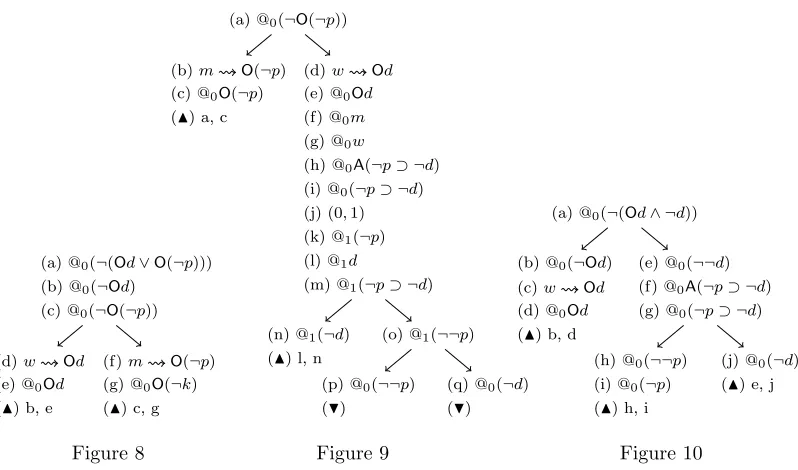
default proofs ofO(¬k)∧k,Og,O(g⊃k), andOk, fromF, respectively (cf. Forrester’s Paradox). Let ∆ ={(w Od),(m O(¬p))}, andM1=h{A(¬p⊃ ¬d), w, m},∆i; Fig. 8 is a sceptical default proof ofOd∨O(¬p) fromM1. Fig.9 shows an open sceptical default for¬O(¬p) from M1. LetM2=h{A(¬p⊃ ¬d),¬p, w},∆i; Fig. 10is a sceptical default proof ofOd∧ ¬dfrom M2. Let (w Od)≺(m O(¬p)), andM10 =h{A(¬p⊃ ¬d), w, m},∆,≺i; pruning the right sub-tree from the node (a) in Fig.9 results in a sceptical default proof ofO(¬p) fromM1.
(a) @0(¬(Od∨O(¬p))) (b) @0(¬Od)
(c) @0(¬O(¬p))
(d)w Od (e) @0Od (N) b, e
(f)m O(¬p) (g) @0O(¬k) (N) c, g
Figure 8
(a) @0(¬O(¬p))
(b)m O(¬p) (c) @0O(¬p) (N) a, c
(d)w Od (e) @0Od (f) @0m (g) @0w
(h) @0A(¬p⊃ ¬d) (i) @0(¬p⊃ ¬d) (j) (0,1) (k) @1(¬p) (l) @1d
(m) @1(¬p⊃ ¬d)
(n) @1(¬d) (N) l, n
(o) @1(¬¬p)
(p) @0(¬¬p) (H)
(q) @0(¬d) (H)
Figure 9
(a) @0(¬(Od∧ ¬d))
(b) @0(¬Od)
(c)w Od (d) @0Od (N) b, d
(e) @0(¬¬d) (f) @0A(¬p⊃ ¬d) (g) @0(¬p⊃ ¬d)
(h) @0(¬¬p) (i) @0(¬p) (N) h, i
(j) @0(¬d) (N) e, j
Figure 10
In this way, they avoid meta-logical arguments involving extensions, bridging the gap between Default Logic and Theorem Proving, and between Non-monotonic and Classical reasoning.
Our proof calculi are also remarkably simple. They are so in the following sense. In Fit-ting’s terms [22], a tableau system is a formal proof procedure, existing in many varieties and for several logics, but always having certain characteristics. It is a refutation procedure: to prove a formula, the initial step is to begin with a syntactical expression asserting the contrary. Successive steps syntactically break down this assertion into cases. Finally, there are impos-sibility conditions for closing cases. The sought after proof is obtained if all cases are closed. Credulous and sceptical default tableaux operate in the way just described. To prove thatϕ is a default consequence ofhΦ,∆,≺i, our proof attempt begins with @0(¬ϕ). We continue by syntactically breaking down formulas into their components. We are interested in deducibility from default assumption sets, formulas and prioritized defaults. The rule (A) in Fig.2allow us to incorporate formulas in a proof attempt; the rules (C) and (S) in Fig.3allow us to incorpo-rate prioritized defaults into a proof attempt, depending on whether we are proving credulously or sceptically. Finally, closing cases indicate the impossibility conditions that are needed to make a proof attempt an actual proof. The key observation is that simplicity is obtained by how we treat defaults in a proof attempt.
Default tableaux offer some insight into proving with defaults. Moreover, they enjoy some desirable properties. In particular, they do not require the complete construction of extensions for proofs. This can be immediately seen from the fact that a default tableau might close from a subset of the defaults being considered. In some cases, this becomes a practical advantage.
claim thatϕis a sceptical default consequence ofhΦ,∆,≺i. This is made precise in Prop. 5.1
Proposition 5.1. If a sceptical default tableau for¬ϕfromhΦ,∆,≺ihas an open and saturated branch, then, there is an extensionE∈E(Φ,∆,≺) s.t.E6|=ϕ, i.e.,hΦ,∆,≺i 6|≈sϕ.
Building a suitable counterexample to the claim thatϕis a credulous default consequence of hΦ,∆,≺i is not as direct. Observe that a closed credulous default tableau for ¬ϕ from
hΦ,∆,≺i indicates that there is an extensionE∈E(Φ,∆,≺) s.t.E |=ϕ, i.e.,hΦ,∆,≺i |≈cϕ. However, a saturated and open branch of a credulous default tableau for ¬ϕ from hΦ,∆,≺i
is not an indication that hΦ,∆,≺i 6|≈c ϕ. Instead, it is an indication that the particular extension E ∈ E(Φ,∆,≺) considered in the default tableau is s.t. E 6|= ϕ. This extension is not a suitable counterexample since there might be a different extension E0 ∈E(Φ,∆,≺), not considered in the default tableaux s.t. E0 |= ϕ, resulting in hΦ,∆,≺i |≈c ϕ. The issue with credulous default tableaux is that they are notconfluent: it is not possible, in general, to extend a partially constructed credulous default tableau for¬ϕfromhΦ,∆,≺ito a closed one, even if one such closed credulous default tableau is guaranteed to exist. This is an intrinsic characteristic of credulous reasoning, as credulous default consequences depend on a particular selection of defaults, not of arbitrary ones. Lack of confluence for credulous default tableaux can be successfully dealt with by applying enabled defaults in a breadth-first manner; exploring the search space of credulous default tableaux until a closed one is found, or no closed one exists. Nonetheless, the problem of producing a suitable counterexample remains: suppose that we exhaust the search space and we have found that there are no closed credulous default tableaux, what do we exhibit as a suitable counterexample? The answer to this question requires further exploration.
6
Conclusions and Final Remarks
We developed a Prioritized Default Logic. This logic, which we callDSDLA, is built modularly from SDLA via the addition of defaults and priorities among them. We have placed special attention to the definition of default consequence bringing to the fore credulous and sceptical default consequence. We illustrated some of the features ofDSDLAwith the use of examples. In particular, we have discussed credulous default consequence inDSDLAresorting to Forrester’s Paradox. Departing from some standard works on nonmonotonic deontic reasoning, credulous default consequence inDSDLAenables us to reason about the violation of obligations without cancelling the violated obligation. We have also shown a novel application of sceptical default consequence inDSDLAin the context of Goal Oriented Requirements Engineering. We believe that this lays open an interesting avenue for application of our logic.
In addition, we developed tableau-based proof calculi for credulous and sceptical default consequence in DSDLA. Our proof calculi are sound, complete and terminating using loop-checks. We have shown that they also have some desirable properties. In particular, they internalize reasoning with defaults, and do not require the complete construction of extensions to prove whether a formula is a default consequence. Sceptical default tableaux retain the capability of producing counter-examples (as extensions). We discussed some reasons why the production of counter-examples is not trivial for credulous default tableaux; but this issue requires further exploration.
References
[1] C. Alchourr´on. Detachment and defeasibility in deontic logic. Studia Logica, 57(1):5–18, 1996. [2] G. Amati, L. Aiello, D. Gabbay, and F. Pirri. A proof theoretical approach to default reasoning
I: Tableaux for default logic. Journal of Logic and Computation, 6(2):205–231, 1996.
[3] G. Antoniou. A comparative survey of default logic variants. In International Conference on Formal and Applied Practical Reasoning (FAPR’96), volume 1085 ofLNCS, pages 15–28. Springer, 1996.
[4] G. Antoniou. Nonmonotonic Reasoning. The MIT Press, Cambridge, 1997.
[5] G. Antoniou. The role of nonmonotonic representations in requirements engineering.International Journal of Software Engineering and Knowledge Engineering, 8(3):385–399, 1998.
[6] G. Antoniou and K. Wang. Default logic. In D. Gabbay and J. Woods, editors,The Many Valued and Nonmonotonic Turn in Logic, volume 8 ofHandbook of the History of Logic, pages 517–555. North-Holland, 2007.
[7] L. ˚Aqvist. Deontic logic. In D. Gabbay and F. Guenthner, editors, Handbook of Philosophical Logic, volume 8, pages 147–264. Springer Netherlands, Dordrecht, 2007.
[8] C. Areces and B. ten Cate. Hybrid logics. In Blackburn et al. [10].
[9] P. Blackburn, M. de Rijke, and Y. Venema.Modal Logic. Cambridge U Press, 2001.
[10] P. Blackburn, J. van Benthem, and F. Wolter, editors. Handbook of Modal Logic. Elsevier, 2007. [11] T. Bolander and P. Blackburn. Termination for hybrid tableaus.Journal of Logic and Computation,
17(3):517–554, 2007.
[12] G. Brewka and T. Eiter. Prioritizing default logic. In S. H¨olldobler, editor, Intellectics and Computational Logic, volume 19 ofApplied Logic Series, pages 27–45. Kluwer, 2000.
[13] V. Cassano, C. L´opez Pombo, and T. Maibaum. A propositional tableaux based proof calculus for reasoning with default rules. InInternational Conference on Automated Reasoning with Analytic Tableaux and Related Methods (TABLEAUX 2015), volume 9323 ofLNAI, pages 6–21. Springer, 2015.
[14] P. Castro. Deontic Action Logics for Specification and Analysis of Fault-Tolerance. PhD thesis, Department of Computer and Software, McMaster University, 2009.
[15] B. Chellas. Modal Logic: An Introduction. Cambridge U Press, 1980.
[16] M. D’Agostino. Tableau methods for classical propositional logic. In D’Agostino et al. [17], pages 45–123.
[17] M. D’Agostino, D. M. Gabbay, R. Hahnle, and J. Posegga, editors.Handbook of Tableau Methods. Springer, 1999.
[18] R. Degiovanni, N. Ricci, D. Alrajeh, P. Castro, and N. Aguirre. Goal-conflict detection based on temporal satisfiability checking. In31st IEEE/ACM International Conference on Automated Software Engineering (ASE 2016), pages 507–518, 2016.
[19] J. Delgrande and T. Schaub. Expressing preferences in default logic.Artificial Intelligence, 123(1-2):41–87, 2000.
[20] J. Delgrande, T. Schaub, H. Tompits, and K. Wang. A classification and survey of preference handling approaches in nonmonotonic reasoning.Computational Intelligence, 20(2):308–334, 2004. [21] U. Egly and H. Tompits. Proof-complexity results for nonmonotonic reasoning.ACM Transactions
on Computational Logic, 2(3):340–387, 2001.
[22] M. Fitting. Introduction. In D’Agostino et al. [17], pages 1–43.
[23] J. Forrester. Gentle murder, or the adverbial samaritan. The Journal of Philosophy, 81:193–197, 1984.
[25] L. Goble. Prima facie norms, normative conflicts, and dilemmas. In Gabbay et al. [24], pages 241–352.
[26] V. Goranko and S. Passy. Using the universal modality: Gains and questions. Journal of Logic and Computation, 2(1):5–30, 1992.
[27] R. Gore. Tableau methods for modal and temporal logics. In D’Agostino et al. [17], pages 297–396. [28] G. Gottlob. Complexity results for nonmonotonic logics. Journal of Logic and Computation,
2(3):397–425, 1992.
[29] J. Hansen. Prioritized conditional imperatives: problems and a new proposal.Autonomous Agents and Multi-Agent Systems, 17(1):11–35, 2008.
[30] R. Hilpinen and P. McNamara. Deontic logic: A historical survey and introduction. In Gabbay et al. [24], pages 3–136.
[31] G. Hoffmann and C. Areces. Htab: a terminating tableaux system for hybrid logic. Electronic Notes in Theoretical Computer Science, 231:3–19, 2009.
[32] J. Horty. Nonmonotonic foundations for deontic logic. In Nute [41], pages 17–44.
[33] S. Khosla and T. Maibaum. The prescription and description of state based systems. InTemporal Logic in Specification, volume 398 ofLNCS, pages 243–294. Springer, 1987.
[34] A. Lamsweerde. Requirements Engineering: From System Goals to UML Models to Software Specifications. Wiley, 2009.
[35] W. Lukaszewicz. Considerations on default logic: An alternative approach. Computational Intel-ligence, 4:1–16, 1988.
[36] F. Massacci. Single step tableaux for modal logics. Journal of Automated Reasoning, 24(3):319– 364, 2000.
[37] T. McCarty. Defeasible deontic reasoning. Fundamenta Informaticae, 21(1/2):125–148, 1994. [38] P. McNamara. Deontic logic. In D. M. Gabbay and J. Woods, editors,Logic and the Modalities
in the Twentieth Century, volume 7 ofHandbook of the History of Logic, pages 197–288. North-Holland, 2006.
[39] Robert Mullins. Rights in default logic. In13th International Conference Deontic Logic in Com-puter Science (DEON 2016), pages 18–21. College Publications, 2016.
[40] D. Nute. Apparent obligation. InDefeasible Deontic Logic[41], pages 287–315. [41] D. Nute, editor. Defeasible Deontic Logic. Kluwer, 1997.
[42] G. Priest. An Introduction to Non-classical Logic: From If to Is. Cambridge U Press, 2000. [43] R. Reiter. A logic for default reasoning. Artificial Intelligence, 13(1-2):81–132, 1980.
[44] V. Risch. Analytic tableaux for default logics.Journal of Applied Non-Classical Logics, 6(1):71–88, 1996.
[45] L. van der Torre and Y. Tan. The many faces of defeasibility in defeasible deontic logic. In Nute [41], pages 79–121.
[46] L. van der Torre and Y. Tan. Contextual deontic logic. InFormal Models of Agents (ModelAge’97), volume 1760 ofLNCS, pages 240–251. Springer, 1999.
[47] R. Wieringa and J.-J. Meyer. Applications of deontic logic in computer science: A concise overview. In J.-J. Meyer and R. Wieringa, editors,Deontic Logic in Computer Science, pages 17–40. John Wiley & Sons, 1994.
[48] M. Willer. Dynamic foundations for deontic logic. In N. Charlow and M. Chrisman, editors, Deontic Modality. Oxford U Press, 2016.
A
Proof of Selected Theorems
We refer to a default tableau when there is no need to distinguish between a credulous or sceptical default tableau. We assume all default tableaux are well-formed. We assume thatT is the set of all tableaux forSDLA andTD is the set of all default tableaux forDSDLA.
Definition A.1. Letτ ∈TD; definepT(τ) as the tree obtained by removing all nodesnofτ
that are a default rule, re-linking the immediate predecessor ofnwith the immediate successor ofn. Define pD(τ) as the set of defaults inτ. Letβ be a branch ofτ, definepD(β) as the set of defaults inβ. Let A=hΦ,∆,≺i,E = Φ∪∆0 ∈E(A), and τ be a default tableau fromA; define pE(τ) = τ0, whereτ0 is obtained from τ by pruning all sub-trees ofτ starting from a node with a default not in ∆0.
Lemma A.1. Ifτ is a default tableau from hΦ,∆,≺i, pT(τ) is a tableau from Φ∪X(pD(τ)).
Proof. Immediate by construction.
Lemma A.2. Letτ be a default tableau for¬ϕfromhΦ,∆,≺i; ifβ is an open and saturated branch ofτ; Φ∪X(pD(β))6|=ϕ. Proof. Immediate from LemmaA.1and from completeness of T.
Lemma A.3. Letτ be a default tableau for¬ϕfromhΦ,∆,≺i; ifβ is an open and saturated branch ofτ, Φ∪XpD(β)is an extension ofhΦ,∆,≺i. Proof. It suffices to show thatpD(β) is a
series of enabled detachments (Def.3.1). This fact is immediate by construction.
Proposition A.1. Letτ be a sceptical default tableau for¬ϕfromhΦ,∆,≺i; ifβ is an open and saturated branch ofτ,hΦ,∆,≺i 6|≈sϕ. Proof. Immediate from LemmasA.2andA.3. Lemma A.4. LetA=hΦ,∆,≺i, andτ be a closed sceptical default tableau for ¬ϕ fromA; for everyE ∈E(A),pT(pE(τ)) extends to a closed tableau. Proof. By cases. Let E= Φ∪∆0 be any extension ofA; ifβ is a closed branch ofτ s.t.pD(β)⊆∆0, then,β is a closed branch ofpT(pE(τ)). Ifβ is a closed branch of τ s.t. pD(β)*∆0, then, there is a prefixβ0 ofβ that is a branch of pE(τ). This prefixβ0 is not necessarily closed (we may have pruned the suffix closing the branch). Nonetheless, the side conditions of the default expansion rule (S) in Fig.3
guarantee thatβ0is a prefix of a closed branchβ00ofpE(τ). Thusβ0extends to a closed branch ofpT(pE(τ)).
Proposition A.2. LetA=hΦ,∆,≺i, andτ be a closed sceptical default tableau for¬ϕfrom
A;A|≈ϕ. Proof. By contradiction. Suppose that there isE∈E(A) s.t.E6|=ϕ. Then, every
tableau for¬ϕfrom E is open (from the soundness of T). ButpT(pE(τ)) extends to a closed tableau for¬ϕfrom E (from LemmaA.4).
Lemma A.5. Let A = hΦ,∆,≺i, and τ be a credulous default tableau from A; there is E ∈E(A) s.t. Φ∪pD(β) ⊆ E; in other words, pT(pE(τ)) = pT(τ); alternatively, pE(τ) is a tableau fromE. Proof. Immediate by construction.
Proposition A.3. Let τ be a closed credulous default tableau for ¬ϕ from hΦ,∆,≺i;
hΦ,∆,≺i |≈cϕ. Proof. Immediate from LemmaA.5and the soundness ofT.
E |=ϕand Φ6|=ϕ, τ uses some of the consequents of the defaults in ∆0 to close the tableau. Each time thatτ uses one such consequentX{δ},τ0uses the default expansion rule (C) in Fig.3 to introduce all defaults in ∆0 precedingδbefore introducingδ(this is due to the fact that we need to satisfy the side condition of the default expansion rule (C) before incorporating δ to τ0). The result follows from this fact.
Proposition A.4. IfhΦ,∆,≺i |≈c ϕ, then there is a closed credulous default tableau for ¬ϕ
fromhΦ,∆,≺i. Proof. Immediate from LemmaA.6.