VOLUME 41, ARTICLE 16, PAGES 461
-
476
PUBLISHED 1 AUGUST 2019
http://www.demographic-research.org/Volumes/Vol41/16/ DOI: 10.4054/DemRes.2019.41.16
Descriptive Finding
The role of education and educational–
occupational mismatches in decisions regarding
commuting and interregional migration from
eastern to western Germany
Silvia Maja Melzer
Thomas Hinz
This publication is part of the Special Collection on “Spatial Mobility, Family Dynamics and Gender Relations,” organized by Guest Editors Sergi Vidal and Johannes Huinink.
© 2019 Silvia Maja Melzer & Thomas Hinz.
This open-access work is published under the terms of the Creative Commons Attribution 3.0 Germany (CC BY 3.0 DE), which permits use, reproduction, and distribution in any medium, provided the original author(s) and source are given credit.
1 Introduction 462
2 Data and methods 463
2.1 Data 463
2.2 Methods 466
3 Results 466
3.1 Who chooses to commute and who chooses to migrate from eastern to western Germany?
466
3.2 Commuting as a stepping-stone, or as an alternative? 468
4 Discussion and conclusion 470
The role of education and educational–occupational mismatches in
decisions regarding commuting and interregional migration from
eastern to western Germany
Silvia Maja Melzer1Thomas Hinz2
Abstract
OBJECTIVEThis paper investigates commuting and interregional migration from eastern to western Germany, and asks, first: Who chooses to migrate and who chooses to commute? Second: Does commuting serve as a stepping-stone or as a long-term alternative to migration? And third: What role does education and educational–occupational mismatch play in those choices?
METHODS
We use the Socio-Economic Panel data from 1992 to 2013 and multilevel multinomial logit models with random effects, as well as cross-classified multilevel logit with random effects.
RESULTS
People with higher education are more likely to migrate than to remain immobile or to commute, while people who have spent less time in education are more likely to commute than to remain immobile or to migrate. Educational–occupational mismatches reduce the likelihood of migration for both men and women, but they reduce the likelihood of commuting only for men. For women, educational–occupational mismatches increase the likelihood of commuting. Moreover, commuting serves as a stepping-stone to migration, rather than as a long-term alternative to it, especially for the highly educated.
CONTRIBUTION
We investigate the relationship between migration and commuting more directly than has been the case in previous research. Moreover, we advance previous research by showing how educational–occupational mismatch influences decisions as to whether to
commute or to migrate. Our analysis shows how education, educational–occupational mismatch, and gender are interrelated and intertwined with each other, and how gender-specific mobility patterns follow from these interrelations.
1. Introduction
This paper examines the role of education and educational–occupational mismatch in men’s and women’s job-related mobility from eastern to western Germany, including both interregional migration and commuting.
Even though previous research on interregional migration and commuting has underlined the necessity of investigating both forms of mobility simultaneously (e.g., Brown et al. 2015; Lundholm 2010: 462), to date interregional migration (e.g., Huinink, Vidal, and Kley 2014; Melzer 2013; Nivalainen 2010) and commuting (e.g., Huber 2012, 2014; Sandow and Westin 2010) have usually been investigated separately (Eliasson, Lindgren, and Westerlund 2003: 828; Nivalainen 2010: 146; some exceptions are Brown et al. 2015; Green, Hogarth, and Shackleton 1999; Huber 2014; Hunt 2006; Kalter 1994; Pfaff 2012; Romaní, Suriñach, and Artiís 2003). Ignoring the fact that both forms of mobility are interrelated and can either substitute for (Green, Hogarth, and Shackleton 1999; Nivalainen 2010) or complement each other (Lundholm 2010; Sandow and Westin 2010), leads to incomplete investigations (Romaní, Suriñach, and Artiís 2003) and, in the worst case, to biased results. For instance, analyzing migration without commuting is problematic, as either the population at risk of interregional migration is incomplete because commuters are excluded from the sample, or the categories of analysis are blurred because commuters and people who remain immobile are combined in one group (Melzer 2016). Thus, there is still a need for a thorough, solid, and adequately combined research strategy focusing on both forms of mobility.
Existing research emphasizes the importance of education in mobility choices, both as a theoretical consideration (Borjas 1987; Sjaastad 1962) and as an empirical finding, indicating that the highly educated are more likely to migrate (e.g., Borjas 1987; Melzer 2013, 2016; Nivalainen 2010). In line with the few studies that investigate the impact of education on commuting and migration simultaneously, we expect that higher education fosters both migration and commuting, compared to remaining stationary (e.g., Eliasson, Lindgren, and Westerlund 2003; Huber 2014; Hunt 2006; Lundholm 2010; Melzer 2016; Nivalainen 2010; Romaní, Suriñach, and Artiís 2003). However, we expect commuters to be generally less-educated than migrants (e.g., Huber 2014; Hunt 2006; Melzer 2016; Sandow and Westin 2010).
We advance the existing research by asking what role educational–occupational mismatches play in migration and commuting from eastern to western Germany. Both forms of mobility are overwhelmingly directed from the economically weaker eastern Germany to the economically stronger western Germany (Haas and Hamann 2008; Haas 2012; Melzer 2016; Statistisches Bundesamt 2010: 13). Mobility and educational– occupational mismatches are interrelated and have been treated in the literature on educational–occupational mismatch as competing choices (Büchel and Battu 2003). Regional labor markets, especially when they are economically weak as in eastern Germany, provide limited job opportunities and increase the chances of bad educational–occupational matches, while commuting and migration can help to avoid such unfavorable job matches (Büchel and Battu 2003). Facing an unsatisfactory job offer, a person chooses between: (1) accepting the job offer and working in a bad job match; (2) remaining unemployed; and (3) applying for jobs outside the region and eventually becoming mobile. We assume that there is a path dependency in mobility choices and that people who are currently working in inadequately matched jobs have already faced the decision between mobility and a bad job match and decided against mobility, and will decide the same in the future. However, we expect the negative effect of inadequately matched jobs to be weaker on commuting than migration, as commuting permits remaining in one’s region of origin.
2. Data and methods
2.1 Dataworking-age population between 16 and 63 years that spent at least one year in eastern Germany.
For the analysis of mobility choices (presented in Table 2), the dependent variable, mobility form, distinguishes between people who are currently immobile (~stayer), people who currently commute (~commuters) on a daily or weekly basis from eastern to western Germany, and those who migrated (~migrants) during the previous year. Migration is identified as a change of address from eastern to western Germany between two years. As we are interested in the events that lead to migration and not its consequences, migration represents a terminal event and periods following migration are censored. Such censoring does not apply to commuting episodes, as persons who are currently commuting are still potential migrants. To increase the comparability between migrants, commuters, and stayers, this sample includes only the working population, as commuters are by definition employed. It is composed of 7,390 people (and 48,788 yearly observations), among whom 1,282 commute (4,110 observations) and 398 (405 observations) migrate.
To investigate how commuting and migration are interrelated, we use the migration dummy as a dependent variable and commuting as an independent dummy variable indicating that a person is currently commuting. To capture all the motives that cause people to migrate, in the second analysis we also include persons who are currently unemployed. Being unemployed might be an alternative to regional mobility, but unemployed will also have the greatest incentive to migrate, as migration could allow them to return to work. This extends the data to 73,631 observations for a total of 9,477 persons (see Table 1).
The independent variables of main interest to us are education, measured in years, and educational–occupational mismatch, measured as a dummy variable. To facilitate our interpretation, education is centered at nine years, which corresponds to a lower secondary school diploma.
Following the operationalization by Büchel and Battu (2003: 5), educational– occupational mismatch is measured by contrasting actual educational level with a subjective evaluation of the skills necessary to perform a job. If the discordance between the subjective evaluation of the necessary skills to perform a job and the actual formal educational level was ‘substantially’ high, and a respondent specified that they were working in a job where they did not need their qualification, they were classified as inadequately matched. In a second step, a variable on occupational position was used to validate this construct.
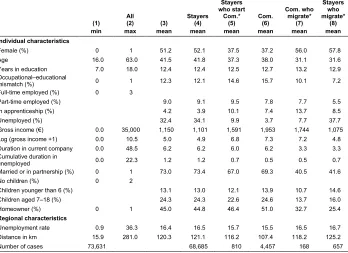
education than stayers (additional 0.3 years), while migrants spend 0.8 years longer in the educational system and commuters who migrate spend 0.5 years longer (see Table 1). 12.1% of stayers and 14.6% of stayers who start commuting are in a bad job match, compared with only 7.2% of migrants. Among persons actively engaged in commuting, 15.7% are in a bad job match, but only 10.1% of commuters who are going to migrate soon are in bad job matches.
Table 1: Descriptive results: characteristics of people who remain immobile (stayers), who commute (Com.), and those who migrate (Mig.) for 1992–2013
(1) All(2) (3) Stayers(4)
Stayers who start
Com.* (5) Com.(6)
Com. who migrate* (7) Stayers who migrate* (8) min max mean mean mean mean mean mean Individual characteristics
Female (%) 0 1 51.2 52.1 37.5 37.2 56.0 57.8
Age 16.0 63.0 41.5 41.8 37.3 38.0 31.1 31.6
Years in education 7.0 18.0 12.4 12.4 12.5 12.7 13.2 12.9 Occupational–educational
mismatch (%) 0 1 12.3 12.1 14.6 15.7 10.1 7.2 Full-time employed (%) 0 3
Part-time employed (%) 9.0 9.1 9.5 7.8 7.7 5.5 In apprenticeship (%) 4.2 3.9 10.1 7.4 13.7 8.5
Unemployed (%) 32.4 34.1 9.9 3.7 7.7 37.7
Gross income (€) 0.0 35,000 1,150 1,101 1,591 1,953 1,744 1,075 Log (gross income +1) 0.0 10.5 5.0 4.9 6.8 7.3 7.2 4.8 Duration in current company 0.0 48.5 6.2 6.2 6.0 6.2 3.3 3.3 Cumulative duration in
unemployed 0.0 22.3 1.2 1.2 0.7 0.5 0.5 0.7
Married or in partnership (%) 0 1 73.0 73.4 67.0 69.3 40.5 41.6 No children (%) 0 2
Children younger than 6 (%) 13.1 13.0 12.1 13.9 10.7 14.6 Children aged 7–18 (%) 24.3 24.3 22.6 24.6 13.7 16.0 Homeowner (%) 0 1 45.0 44.8 46.4 51.0 32.7 25.4 Regional characteristics
Unemployment rate 0.9 36.3 16.4 16.5 15.7 15.5 16.5 16.7 Distance in km 15.9 281.0 120.3 121.1 116.2 107.4 118.2 125.2 Number of cases 73,631 68,685 810 4,457 168 657
Note: * In the year before commuting or migration. SOEP 1992–2013.
correlated with mobility, such as gender, being married or having a partner, and the interaction between those variables and age, children, and children’s age.
2.2 Methods
In the first step we employ multilevel multinomial logit models with random effects (RE) that allow us to investigate mobility choices simultaneously, while accounting for the nested structure of the panel data. In the second step we use cross-classified RE logit models to investigate how migration and commuting decisions are interrelated, as people relocate also within eastern Germany, which violates the nested structure upon which standard hierarchical models are estimated (Rabe-Hesketh and Skrondal 2012: Chapter 9).
3. Results
3.1 Who chooses to commute and who chooses to migrate from eastern to western Germany?
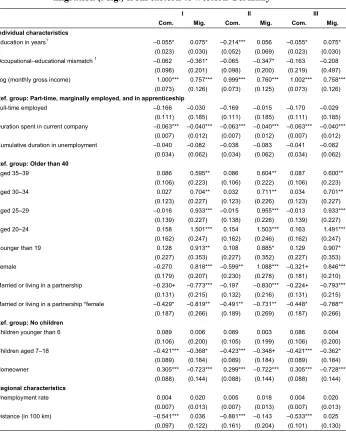
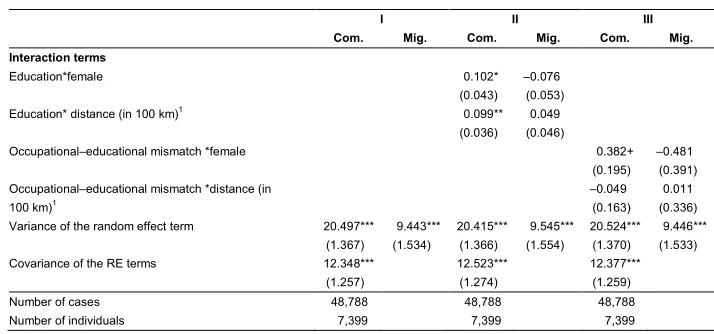
Table 2: Estimated regression coefficients and standard errors from
multinomial two-level logit models predicting commuting (Com.) and migration (Mig.) from eastern to western Germany
I II III
Com. Mig. Com. Mig. Com. Mig. Individual characteristics
Education in years1 –0.055* 0.075* –0.214*** 0.056 –0.055* 0.075*
(0.023) (0.030) (0.052) (0.069) (0.023) (0.030) Occupational–educational mismatch1 –0.062 –0.361* –0.065 –0.347* –0.163 –0.208
(0.098) (0.201) (0.098) (0.200) (0.219) (0.497) Log (monthly gross income) 1.000*** 0.757*** 0.999*** 0.760*** 1.002*** 0.758***
(0.073) (0.126) (0.073) (0.125) (0.073) (0.126) Ref. group: Part-time, marginally employed, and in apprenticeship
Full-time employed –0.166 –0.030 –0.169 –0.015 –0.170 –0.029 (0.111) (0.185) (0.111) (0.185) (0.111) (0.185) Duration spent in current company –0.063*** –0.040*** –0.063*** –0.040*** –0.063*** –0.040***
(0.007) (0.012) (0.007) (0.012) (0.007) (0.012) Cumulative duration in unemployment –0.040 –0.082 –0.038 –0.083 –0.041 –0.082
(0.034) (0.062) (0.034) (0.062) (0.034) (0.062) Ref. group: Older than 40
Aged 35–39 0.086 0.595** 0.086 0.604** 0.087 0.600** (0.106) (0.223) (0.106) (0.222) (0.106) (0.223) Aged 30–34 0.027 0.704** 0.032 0.711** 0.034 0.701**
(0.123) (0.227) (0.123) (0.226) (0.123) (0.227) Aged 25–29 –0.016 0.933*** –0.015 0.955*** –0.013 0.933***
(0.139) (0.227) (0.138) (0.226) (0.139) (0.227) Aged 20–24 0.158 1.501*** 0.154 1.503*** 0.163 1.491***
(0.162) (0.247) (0.162) (0.246) (0.162) (0.247) Younger than 19 0.128 0.913** 0.108 0.885* 0.129 0.907* (0.227) (0.353) (0.227) (0.352) (0.227) (0.353) Female –0.270 0.818*** –0.599** 1.088*** –0.321+ 0.846***
(0.179) (0.207) (0.230) (0.278) (0.181) (0.210) Married or living in a partnership –0.230+ –0.773*** –0.197 –0.830*** –0.224+ –0.793***
(0.131) (0.215) (0.132) (0.216) (0.131) (0.215) Married or living in a partnership *female –0.429* –0.819** –0.491** –0.731** –0.448* –0.788**
(0.187) (0.266) (0.189) (0.269) (0.187) (0.266) Ref. group: No children
Children younger than 6 0.089 0.006 0.089 0.003 0.086 0.004 (0.106) (0.200) (0.105) (0.199) (0.106) (0.200) Children aged 7–18 –0.421*** –0.368* –0.423*** –0.348+ –0.421*** –0.362* (0.089) (0.184) (0.089) (0.184) (0.089) (0.184) Homeowner 0.305*** –0.723*** 0.299*** –0.722*** 0.305*** –0.728***
(0.088) (0.144) (0.088) (0.144) (0.088) (0.144) Regional characteristics
Unemployment rate 0.004 0.020 0.005 0.018 0.004 0.020 (0.007) (0.013) (0.007) (0.013) (0.007) (0.013) Distance (in 100 km) –0.541*** 0.036 –0.881*** –0.143 –0.533*** 0.025
Table 2: (Continued)
I II III
Com. Mig. Com. Mig. Com. Mig. Interaction terms
Education*female 0.102* –0.076
(0.043) (0.053) Education* distance (in 100 km)1 0.099** 0.049
(0.036) (0.046)
Occupational–educational mismatch *female 0.382+ –0.481 (0.195) (0.391) Occupational–educational mismatch *distance (in –0.049 0.011
100 km)1 (0.163) (0.336)
Variance of the random effect term 20.497*** 9.443*** 20.415*** 9.545*** 20.524*** 9.446*** (1.367) (1.534) (1.366) (1.554) (1.370) (1.533) Covariance of the RE terms 12.348*** 12.523*** 12.377***
(1.257) (1.274) (1.259)
Number of cases 48,788 48,788 48,788
Number of individuals 7,399 7,399 7,399
Note: SOEP 1992–2013; Standard errors in parentheses; +p < 0.10, *p < 0.05, **p < 0.01, ***p < 0.001;1one sided test.
As previous literature on migration from eastern to western Germany indicates specific effects (e.g., Hunt 2006; Melzer 2013), Model II and III display gender-specific differences in education and educational–occupational mismatches using interactions. Although higher education reduced the likelihood of commuting for both men and women, the effect is half as strong for women. As in the joint Model I, there is a negative effect on commuting for men working in inadequately matched jobs (see Model II). For women working in inadequately matched jobs, the likelihood of commuting increases by 24.4% (calculated based on Model III: exp(–0.163+– 0.321+0.382)–1).
Both men and women in partnerships are less likely to migrate than single persons. However, the likelihood of commuting for men in partnerships is only 20.5% lower than for single men, while the likelihood of commuting for women in partnerships is 60.5% lower.
3.2 Commuting as a stepping-stone, or as an alternative?
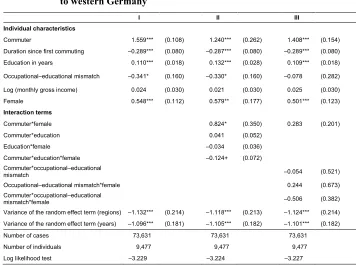
Commuters are four times more likely to migrate than persons remaining immobile (Model I). However, with every additional year that passes since the first commuting episode, the likelihood of migrating is reduced by 25.1%.
Table 3: Estimated regression coefficients and standard errors from cross-classified multilevel logit models predicting migration from eastern to western Germany
I II III
Individual characteristics
Commuter 1.559*** (0.108) 1.240*** (0.262) 1.408*** (0.154) Duration since first commuting –0.289*** (0.080) –0.287*** (0.080) –0.289*** (0.080) Education in years 0.110*** (0.018) 0.132*** (0.028) 0.109*** (0.018) Occupational–educational mismatch –0.341* (0.160) –0.330* (0.160) –0.078 (0.282) Log (monthly gross income) 0.024 (0.030) 0.021 (0.030) 0.025 (0.030) Female 0.548*** (0.112) 0.579** (0.177) 0.501*** (0.123) Interaction terms
Commuter*female 0.824* (0.350) 0.283 (0.201)
Commuter*education 0.041 (0.052)
Education*female –0.034 (0.036)
Commuter*education*female –0.124+ (0.072) Commuter*occupational–educational
mismatch –0.054 (0.521)
Occupational–educational mismatch*female 0.244 (0.673) Commuter*occupational–educational
mismatch*female –0.506 (0.382)
Variance of the random effect term (regions) –1.132*** (0.214) –1.118*** (0.213) –1.124*** (0.214) Variance of the random effect term (years) –1.096*** (0.181) –1.105*** (0.182) –1.101*** (0.182)
Number of cases 73,631 73,631 73,631
Number of individuals 9,477 9,477 9,477 Log likelihood test –3.229 –3.224 –3.227
Note: SOEP 1992–2013; Standard errors in parentheses. Controlled for log monthly gross income; employment status; duration spent at company; duration spent unemployed; age; marital status; marital status*female; children, homeownership, regional unemployment rates. +p < 0.10, *p < 0.05, **p < 0.01, ***p < 0.001.
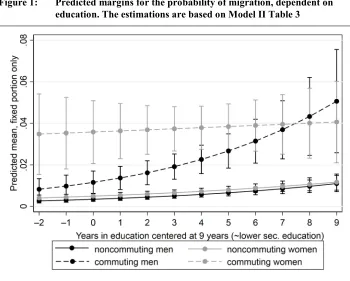
women have a very high likelihood of migrating, regardless of their education, comparable only to the likelihood of migrating of commuting men with a high level of education. Stayers and commuters working in inadequately matched jobs are, independent of their gender, less likely to migrate (compare Model I and III).
Figure 1: Predicted margins for the probability of migration, dependent on education. The estimations are based on Model II Table 3
4. Discussion and conclusion
commuters are usually less educated than migrants (e.g., Huber 2014). Some studies also indicate that commuters, especially those commuting for long periods, are more likely to have lower or middle levels of education (e.g., Sandow and Westin 2010). Therefore, our results highlight that studying migration and commuting separately leads to new insights.
Bad job matches reduce the likelihood of becoming mobile and the likelihood of migration even more than the likelihood of commuting. This finding corresponds to the assumptions expressed in the literature concerning educational–occupational matches, which describes working in a mismatched job as an alternative to regional mobility (Büchel and Battu 2003). Thus, it seems that people who have chosen to work in a mismatched job once, and have therefore already decided against regional mobility, are in general less prone to mobility and are more likely to remain immobile in later periods. However, there is a gender gap: our results indicate that while working in a mismatched job reduces the likelihood of commuting for men, it increases the likelihood for women.
Studying the sequence of mobility pattern by estimating cross-classified RE models, we found that commuting from eastern to western Germany has a strong positive effect on migration and is usually a stepping-stone to migration, rather than an alternative. Commuting provides the possibility of gathering necessary information on the future region or employer. However, the longer ago commuting started, the less likely commuters are to migrate. Thus, for one group of people, commuting functions as an alternative to migration. The crucial point is that there is a strong connection between commuting and migration. Investigating both mobility forms simultaneously broadens our understanding of people’s choices, illustrating also that the highly educated are not necessarily prone to all forms of mobility, as they are more likely to migrate but less likely to commute from eastern to western Germany.
The research on regional migration emphasizes that women who have a partner are often not able to carry out their migration wishes, owing to conservative gender norms, and to their comparatively lower earnings and bargaining power within the couple, which affect mobility decisions (Nisic and Melzer 2016; Shauman and Noonan 2007). The fact that fewer women than men in partnerships commute seems to be just another ‘symptom’ of the inability of married women to pursue independent careers. However, women who start commuting are more likely than men to migrate soon afterwards. As women in partnerships are usually not able to outbalance their partners’ mobility costs (cf. Nisic and Melzer 2016), the high likelihood of migration among commuting women indicates that they are a highly selected group.
References
Borjas, G.J. (1987). Self-selection and the earnings of immigrants. The American
Economic Review77(4): 531–553.
Brown, D.L., Champion, T., Coombes, M., and Wymer, C. (2015). The migration-commuting nexus in rural England: A longitudinal analysis. Journal of Rural Studies 41: 118–128.doi:10.1016/j.jrurstud.2015.06.005.
Büchel, F. and Battu, H. (2003). The theory of differential overqualification: Does it work? Scottish Journal of Political Economy 50(1): 1–16. doi:10.1111/1467-9485.00251.
Eliasson, K., Lindgren, U., and Westerlund, O. (2003). Geographical labour mobility: Migration or commuting? Regional Studies 37(8): 827–837. doi:10.1080/ 0034340032000128749.
Green, A.E., Hogarth, T., and Shackleton, R.E. (1999). Longer distance commuting as a substitute for migration in Britain: A review of trends, issues and implications.
International Journal of Population Geography 5(1): 49–67. doi:10.1002/
(SICI)1099-1220(199901/02)5:1<49::AID-IJPG124>3.0.CO;2-O.
Haas, A. (2012). Mobilität zwischen Regionen: Pendlerströme fließen überwiegend von Ost nach West. Nürnberg: Institut für Arbeitsmarkt- und Berufsforschung (IAB-Forum 2/2012).http://doku.iab.de/forum/2012/Forum2_2012_Haas.pdf.
Haas, A. and Hamann, S. (2008). Ost-West-Vergleich: Pendeln – ein zunehmender Trend, vor allem bei Hochqualifizierten. Nürnberg: Institut für Arbeitsmarkt-und Berufsforschung (IAB Kurzbericht 6/2008). http://doku.iab.de/kurzber/ 2008/kb0608.pdf.
Huber, P. (2012). Do commuters suffer from job-education mismatch? Applied
Economics Letters 19(4): 349–352.doi:10.1080/13504851.2011.577004.
Huber, P. (2014). Are commuters in the EU better educated than non-commuters but worse than migrants? Urban Studies 51(3): 509–525. doi:10.1177/004209801 3498282.
Hunt, J. (2006). Staunching emigration from East Germany: Age and the determinants of migration. Journal of the European Economic Association 4(5): 1014–1037.
doi:10.1162/JEEA.2006.4.5.1014.
Kalter, F. (1994). Pendeln statt Migration? Die Wahl und Stabilität von Wohnort-Arbeitsort-Kombinationen. Zeitschrift für Soziologie 23(6): 460–476.
doi:10.1515/zfsoz-1994-0604.
Lundholm, E. (2010). Interregional migration propensity and labour market size in Sweden, 1970–2001. Regional Studies 44(4): 455–464. doi:10.1080/00343400 802662674.
Melzer, S.M. (2013). Reconsidering the effect of education on East–West migration in Germany. European Sociological Review 29(2): 210–228. doi:10.1093/ esr/jcr056.
Melzer, S.M. (2016).Causes and consequences of the gender-specific migration from
East to West Germany. Nürnberg: Institut für Arbeitsmarkt- und
Berufsforschung.
Nisic, N. and Melzer, S.M. (2016). Explaining gender inequalities that follow couple migration. Journal of Marriage and Family 78(4): 1063–1082. doi:10.1111/ jomf.12323.
Nivalainen, S. (2010). Essays on family migration and geographical mobility in Finland. Helsinki: PTT Publications.
Pfaff, S. (2012). Commuting or relocation? Mobility decisions in Germany between 2000 and 2009. Zeitschrift für Soziologie 41(6): 458–477. doi:10.1515/zfsoz-2012-0604.
Rabe-Hesketh, S. and Skrondal, A. (2012).Multilevel and longitudinal modeling using Stata. College Station: Stata Press.
Romaní, J., Suriñach, J., and Artiís, M. (2003). Are commuting and residential mobility decisions simultaneous? The case of Catalonia, Spain. Regional Studies 37(8): 813–836.doi:10.1080/0034340032000128730.
Sandow, E. and Westin, K. (2010). The persevering commuter: Duration of long-distance commuting. Transportation Research Part A: Policy and Practice
44(6): 433–445.doi:10.1016/j.tra.2010.03.017.
Shauman, K.A. and Noonan, M.C. (2007). Family migration and labor force outcomes: Sex differences in occupational context. Social Forces 85(4): 1735–1764.
Sjaastad, L.A. (1962). The costs and returns of human migration.Journal of Political
Economy 70(5): 80–93.
Statistisches Bundesamt (2010). 20 Jahre Deutsche Einheit: Wunsch oder Wirklichkeit. Wiesbaden: Statistisches Bundesamt.