Susana Silva
1, 2, A–G, Dulce Sousa
3, B, C, E, Vivian Rezende
4, B, C, E,
Arcília Teixeira
4, B, C, E, Bruno Peixoto
2, 5, A–GThe Psychometric Properties of the Portuguese Version
of the Stroke Quality of Life Scale
Własności psychometryczne portugalskiej wersji Skali Jakości Życia
po Udarze Mózgu
1 Psychology Department, The Advanced Institute of Health Sciences – North (Advanced Polytechnic and
University Cooperative [CESPU]), Gandra, Portugal
2 Psychology and Health Research Unit (UnIPSa), Research Center on Health Sciences (CICS), Gandra, Portugal 3 Hospital de São João, Porto, Portugal
4 Hospital da Santa Casa da Misericórdia do Marco de Canavezes, Marco de Canavezes, Portugal 5 Sciences Department, The Advanced Institute of Health Sciences – North (CESPU), Gandra, Portugal
A – research concept and design; B – collection and/or assembly of data; C – data analysis and interpretation;
D – writing the article; E – critical revision of the article; F – final approval of article; G – other
Abstract
Background. Quality of life (QoL) is currently of particular importance to health services and is regarded a key dimension for the assessment of stroke outcomes. However there are few instruments available for the Portuguese population.
Objectives. The aim of the present work is to determine the psychometric properties of the Portuguese version of the Stroke Quality of Life Scale (ECVI-38), including acceptability, construct and criterion validity.
Material and Methods. The sample comprised 51 patients with a clinical history of stroke (2 to 24 months prior) from the outpatient clinic of two Portuguese hospitals.. Patients with neuropsychiatric pathologies or other health conditions that might affect QoL were excluded. Parallel to the application of the ECVI-38, several other tests were used in order to determine the discriminative and concurrent validity of the scale.
Results. The ECVI-38 showed good acceptability, with missing data below 10%, and ceiling and floor effects below 80%. Cronbach’s alpha for the total scale was 0.94 and ranged between 0.7 and 0.9 in each domain. ECVI-38 results were able to differentiate patients according to the severity of neurological impairment. Every domain of the scale correlated significantly with instruments of similar content.
Conclusions. The Portuguese version of the ECVI-38 showed good psychometric characteristics (Adv Clin Exp Med 2012, 21, 6, 781–790).
Key words: quality of life, stroke, psychosocial assessment, validation.
Streszczenie
Wprowadzenie. Jakość życia (QoL) jest obecnie szczególnie ważna w świadczeniu usług zdrowotnych i jest uważa-na za kluczowy element oceny wyniku leczenia udaru. Jeduważa-nak istnieje kilka instrumentów dostępnych dla populacji portugalskiej.
Cel pracy. Określenie właściwości psychometrycznych wersji portugalskiej Skali Jakości Życia po Udarze Mózgu (ECVI-38), w tym dopuszczalności, konstrukcji i trafności kryterialnej.
Materiał i metody. Do badań włączono 51 pacjentów z udarem w wywiadzie (2–24 miesięcy wcześniej) z dwóch portugalskich szpitali. Pacjenci z zaburzeniami neuropsychiatrycznymi lub innymi chorobami, które mogą mieć wpływ na QoL, zostali wykluczeni z badań. Oprócz ECVI-38 zastosowano też inne testy w celu określenia dyskry-minacyjnej i diagnostycznej trafności skali.
Wyniki. ECVI-38 wykazała dobrą akceptowalność, brakujących danych było < 10%, a efekt sufit/podłoga < 80%. α-Cronbacha dla całej skali była 0,94 i wynosiła 0,7–0,9 w każdej domenie. Wyniki ECVI-38 pozwalały
pogrupo-Adv Clin Exp Med 2012, 21, 6, 781–790 ISSN 1899–5276
ORIGINAL PAPERS
Stroke is one of the leading causes of death in Europe, and the primary cause of acquired brain lesions [1]. While the mortality rate is decreasing, the prevalence of incapacity from stroke is grow-ing [2, 3].Approximatelyone third of stroke pa-tients die at medium term; a similar proportion of patients recover completely or are left with only minor deficiencies. The remaining patients survive with moderate to severe post-stroke ef-fects [4]. In Portugal, stroke is the cause of a large percentage of cases of incapacity and functional dependency, as well as the majority of registered deaths [5].
Unlike many other pathologies, stroke is sud-den, not allowing the individuals and their families to adapt to its outcomes in advance [6]. Impair-ment of motor functions, limitations to daily life activities, cognitive and language dysfunctions [6, 7], depression and anxiety [8] are some of the con-sequences with direct impact on the quality of life (QoL) of these patients and their families [5, 9, 10]. Beyond this, when the risk of stroke reoccurrence is taken under consideration, it should be expected the onset of fear and insecurity has additional im-pact on QoL [2].
For a significant period of time, the assessment of stroke consequences were focussed on mortality rates, reoccurrence rates and incapacity rates [11], relegating QoL to secondary status or simply ig-noring it. However, the assessment of QoL pro-vides a holistic view of the patient’s recovery, al-lowing clinicians and caregivers to adopt strategies aimed at improving it [1, 6]. In summary, there are five areas of concern where the assessment of post-stroke QoL is very helpful: 1) the detection of potentially treatable psycho-social problems; 2) as-sessment of domains not covered by neurological examinations; 3) assessment of stroke outcomes in clinical trials; 4) assessment of the effectivenessof clinical interventions; and 5) assessment of public health interventions [9].
There are several tools for the assessment of Qol, but few are designed specifically for stroke patients. Generic instruments like the Medical Outcomes Study 36 Item Short Form Health Sur-vey are often used in this context, but this ques-tionnaire underestimates the effects of stroke [3], because it doesn´t cover all of the aspects of the disease, which include areas such as language, con-centration and memory [9]. Therefore, the use of
specific instruments is more likely to detect the ef-fects of stroke on QoL [3].
The Stroke Specific Quality of Life Scale (SS-QoL) [12] and the Stroke Impact Scale (SIS, 2.0) [13] appeared due to the need for a specific tool for assessing post-stroke QoL. However, these two scales were developed in Anglo-Saxon coun-tries, which are socio-culturally distinct from the Latin cultures [14].
The Escala de Calidad de Vida para el Ic-tus (Stroke Quality of Life Scale – ECVI-38) was developed in 2004 in the Neurology and Neurosurgery Institute in Cuba, with the sole aim of rectifying the lack of any instrument in Spanish [14–16]. The ECVI-38 is a 38-item scale covering eight domains: Physical Status (PS); Communication (CO); Cognition (CG); Emo-tions (EM); Feelings (FE); Basic Daily Activities (BDA); Common Daily Activities (CDA); Social and Familial Functioning (SFF).
Due to the linguistic and cultural proximities of Portugal to the Latin culture, the authors of the pres-ent article aim to assess the psychometric character-istics of the Portuguese translation of the ECVI-38, namely its acceptability, reliability (internal consis-tency) and validity (discriminative and concurrent).
Material and Methods
The Sample
The sample was collected at the Physical Medi-cine outpatient clinics of two Portuguese hospitals: the Hospital de São João, and the Hospital da San-ta Casa da Misericórdia do Marco de Canavezes. The participants were selected through an analy-sis of their medical records. The study involved 93 patients who had undergone a stroke episode (ischemic or hemorrhagic) from two months to two years prior to the study. Twenty-one were ex-cluded due to deterioration of their mental status and language deficits that prevented them from answering the questions. Twenty-one other pa-tients with a clinical history of neuropsychiatric pathologies or other health conditions that could influence QoL were also excluded.
The two hospitals’ ethics committees ap-proved the study. All of the participants gave their informed consent.
wać pacjentów według ciężkości zaburzeń neurologicznych. Każda domena skali korelowała istotnie statystycznie z instrumentami o podobnej treści.
Wnioski. Portugalska wersja ECVI-38 wykazuje dobre właściwości psychometryczne (Adv Clin Exp Med 2012, 21, 6, 781–790).
The average age of the participants was 65.53 (SD = 13.6), with an average of 5.02 years of edu-cation (SD = 3.95). Additional characteristics of the sample are presented in Table 1.
Assessment
In order to determine the psychometric char-acteristics of the Portuguese version of the EC-VI-38, several additional instruments were also used in order to establish the discriminative and concurrent validity of the scale.
The Stroke Quality
of Life Scale (ECVI-38)
As described above, the ECVI-38 is a 38-item scale covering eight domains. It is filled out by the in-terviewer in accordance with the answers of the pa-tient or the caregiver. The answers are listed on a Lick-ert scale with five points, where 5 represents the worst possibility and 1 the absence of the given problem.
For the domains PS, CO, CG, BDA, CDA and SFF the examiner asks: “Usually, how do you feel about…?”; with the following possible answers: 5: Very bad, 4: Bad, 3: Normal, 2: Good and 1: Very good. For the FE (feeling) domain the examiner asks: “How often do you feel...?”, with the follow-ing options: 5: Never; 4: A few times; 3: Some of the time; 2: Most of the time; 1: Always. The score for each domain is calculated according to the fol-lowing formula:
Score = × 100mean – 15 – 1
According to the formula, the score for each domain is between 0 and 100. The total score of the scale is the mean score of all the domains [14–16].
Barthel’s Index
Barthel’s Index (BI) has been widely used in the context of stroke in order to quantify and to track a patient’s level of (in)dependence in daily activi-ties [17, 18]. This index assesses patient’s level of independence on ten basic daily activities. The ob-tained results range from 0 (maximum dependence) to 100 (total independence) [17, 18]. In the present study, the results of this scale were correlated to the Basic Daily Activities (BDA) and Social and Famil-ial Functioning (SFF) of the ECVI-38.
Lawton’s Instrumental Daily
Activities Scale (LS)
This is a generic tool that assesses the level of independence and the ability to perform tasks nec-essary for independent living in the community, such as using the telephone, shopping, preparing meals, housekeeping, laundry, the use of transpor-tation, the preparation of medication and money management [19, 20]. A maximum score of 8 rep-resents a complete level of independence in those tasks. In the present study, the results of the LS were correlated with the Common Daily Activities (CDA) and Social and Familial Functioning (SFF) domains of the ECVI-38.
Table 1. Characteristics of the sample
Tabela 1. Charakterystyka badanych
n %
Gender (Płeć)
male 31 60.8
female 20 39.2
Marital status (Stan cywilny)
married 37 72.5
single 6 11.8
widow 6 11.8
divorced 2 3.9
Current professional status (Obecny status zawodowy)
inactive 5 9.8
active 46 90.2
Profession (Rodzaj zawodu)
white collar 16 31.4
blue collar 35 68.6
Type of stroke (Rodzaj udaru)
ischemic 37 72.5
hemorragic 13 25.5
Laterality of stroke (Lateralizacja udaru)
right 20 39.2
left 30 58.8
bilateral 1 2
Localization (Umiejscowienie)
cortical 18 35.3
subcortical 21 41.2
Hospital Anxiety and Depression
Scale (HADS)
This scale was used in order to assess emotional aspects of the sample in the current study, namely depression and anxiety [21, 22]. The results were correlated with the results of the Cognition (CG) and Emotions (EM) domains of the ECVI-38.
Montreal Cognitive Assessment
(MOCA)
The MOCA is a cognitive screening test that as-sesses executive functions, visual-spatial, memory, attention, concentration and orientation skills [23, 24]. The results of this test were be correlated with the Cognition (CG) domain of the ECVI-38.
National Institutes of Health
Stroke Scale (NIHSS)
The NIHSS was used in order to assess the neu-rological status of the sample in the present study. It covers 11 domains commonly affected by stroke: Level of Consciousness; Extraocular Movements; Vi-sual Fields; Facial Palsy; Arm Strength; Leg Strength; Limb Ataxia; Sensory Function; Language; Dysar-thria; and Inattention [25, 26]. The results obtained in this study were correlated with the Physical Status (PS) domain of the ECVI-38; the Language results were be correlated with the Communication (CO) domain of the ECVI-38. Also, the use of the NIHSS allowed the sample to be divided into three groups with different degrees of neurological impairment in order to determine the discriminative capacity of the Portuguese version of the ECVI-38.
The Procedure
The assessments were carried in single ses-sions lasting approximately fifty minutes, and the instruments were administered to all participants by the same researcher in identical order.
Initially the original scale was translated and retranslated by two persons who spoke both Span-ish and Portuguese. This process ensured the ac-curacy of the translation into Portuguese.
Statistical Analysis
In order to determine the psychometric charac-teristics of the Portuguese version of the ECVI-38, a statistical analysis was carried out, using Microsoft Office Excel 2007 and IBM SPSS Statistics 20 for Windows. Significance was established at p ≤ 0.05.
Psychometric Analysis of the
ECVI-38
Acceptability
Acceptability refers to the quality of the data. The quality of the ECVI-38 data was tested by analyzing missing data and the score distribution (ceiling and floor effects).
Missing data refers to the proportion of subjects who failed to complete at least one item of the scale. Missing data below 10% was the quality criteria adopted [16]. Ceiling and floor effects are defined, respectively, as the percentage of participants that answer in the extremes (maximum and minimum) of the scale. The adopted acceptability criteria were ceiling and floor effects under 80% [16].
Construct Validity
Construct validity was determined through the reliability (Chronbach’s alpha) of the total scale and its domains, through the correlations between the domains and the total scale and an inter-domain correlation (Pearson’s correlation). To complement the analysis of construct validity, an analysis by hypothesis was determined, mean-ing that the discriminative validity was estab-lished. This domain was tested by comparing the results obtained on the ECVI-38 by three groups with different degrees of neurological impairment (the Jonckheere-Terpstra test). The groups were obtained by dividing the sample according to the results on the NIHSS as follows:
– Group I: mild, with NIHSS results under 5 points;
– Group II: moderate, with NIHSS results from 5 to 9 points; and
– Group III: severe, with NIHSS results of 10 points or higher.
Criterion Validity
Criterion validity was established by correlat-ing the different domains of ECVI-38 with instru-ments of similar content. Pearson’s correlations were performed as follows: PS vs. the NIHSS; CO vs. the language domain of the NIHSS; CG vs. the MOCA; EM and FE vs. the HADS; BDA vs. the BI; CDA vs. the LS; SFF vs.the LS and BI.
Results
Table 2. Results obtained on the administered scales
Tabela 2. Wyniki uzyskane wg zastosowanych skal
Mean
(Średnia) Standard Deviation (Odchylenie standardowe) n %
BI 77.06 23.54
LS 3.59 2.54
HADS Total 14.9 8.81
MOCA 17.63 6.45
NIHSS 4.24 3.84
Grade I Impairment 33 64.7
Grade II Impairment 12 23.5
Grade III Impairment 6 11.8
Barthel’s Index (BI); Lawton’s Instrumental Daily Activities Scale (LS); Hospital Anxiety and Depression Scale (HADS); Montreal Cognitive Assessment (MOCA); National Institutes of Health Stroke Scale (NIHSS).
Table 3. Results obtained on the ECVI-38 and its domains
Tabela 3. Wyniki uzyskane za pomocą ECVI-38 i jej domeny
Domain (Domena) Mean
(Średnia) Standard Deviation (Odchylenie standardowe) Confidence interval (Przedział ufności) I. Physical status (Stan fizyczny) 38.24 27.44 30.52–45.95 II. Communication (Komunikacja) 23.53 26.27 16.14–30.92 III. Cognition (Poznanie) 30.72 26.85 23.17–38.27
IV. Emotions (Emocje) 64.51 12.26 61.06– 67.96
V. Feelings (Uczucia) 29.41 22.75 23.01–35.81
VI. Basic daily activities
(Podstawowe codzienne zajęcia) 37.87 35.72 27.82–47.91 VII. Common daily activities
(Powszechne codzienne zajęcia) 55.02 41.5 43.35–66.70 VIII. Social and familial functioning
(Funkcjonowanie w społeczeństwie i rodzinie) 39.91 26.16 33.55–47.26
ECVI-38 Data
The results obtained by the participants on the ECVI-38 are displayed in Table 3.
ECVI-38 Psychometric Data
Acceptability
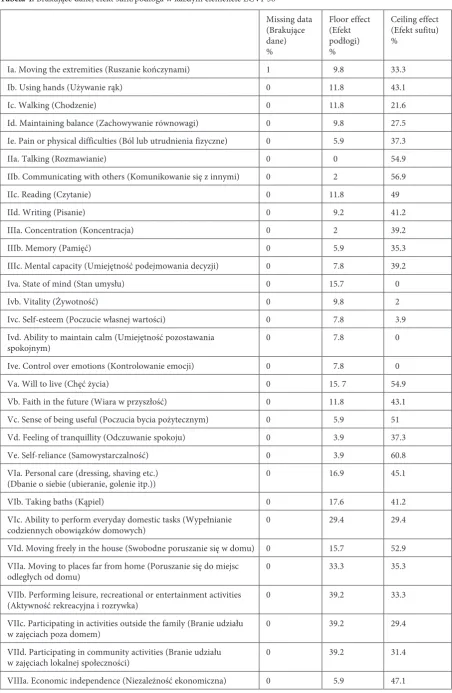
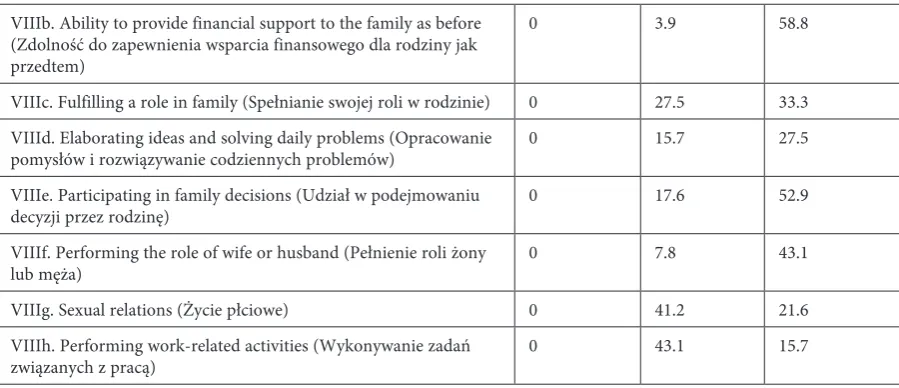
The analysis of Table 4 shows that missing data in each question is clearly under 10% and that the ceiling and floor effects remain below 80%. This is true of both the individual ECVI-38 domains and the total scale (Table 5).
Construct Validity
The reliability values of the total scale and its individual domains are presented in Table 6. These values range from satisfactory (EM and FE) to very good (DLCA and the total ECVI-38).
Table 7 presents the correlations between EC-VI-38 domains and the total scale are presented. All of the correlation values were significant.
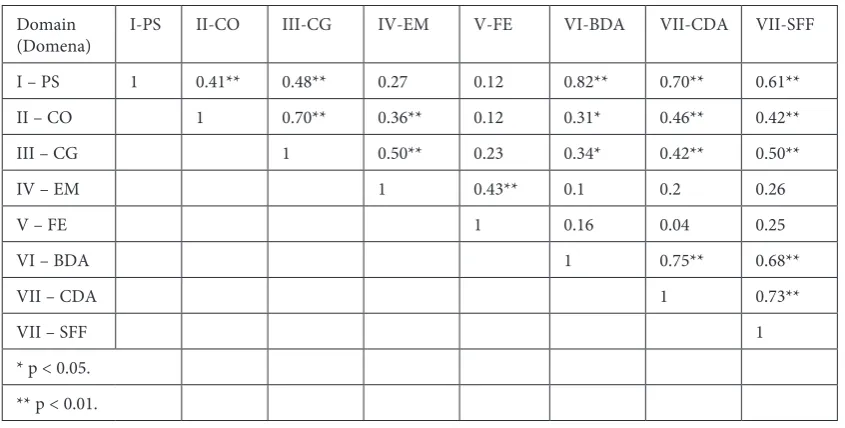
In Table 8, inter-domain correlations are pre-sented. Most of these values are significant.
The mean ranks on the ECVI-38 for the three categories of neurological impairment are present-ed in Table 9. The comparisons show significant differences between the groups.
Criterion Validity
Table 4. Missing data, ceiling and floor effects in each item of the ECVI-38
Tabela 4. Brakujące dane, efekt sufit/podłoga w każdym elemencie ECVI-38
Missing data (Brakujące dane) %
Floor effect (Efekt podłogi) %
Ceiling effect (Efekt sufitu) %
Ia. Moving the extremities (Ruszanie kończynami) 1 9.8 33.3
Ib. Using hands (Używanie rąk) 0 11.8 43.1
Ic. Walking (Chodzenie) 0 11.8 21.6
Id. Maintaining balance (Zachowywanie równowagi) 0 9.8 27.5 Ie. Pain or physical difficulties (Ból lub utrudnienia fizyczne) 0 5.9 37.3
IIa. Talking (Rozmawianie) 0 0 54.9
IIb. Communicating with others (Komunikowanie się z innymi) 0 2 56.9
IIc. Reading (Czytanie) 0 11.8 49
IId. Writing (Pisanie) 0 9.2 41.2
IIIa. Concentration (Koncentracja) 0 2 39.2
IIIb. Memory (Pamięć) 0 5.9 35.3
IIIc. Mental capacity (Umiejętność podejmowania decyzji) 0 7.8 39.2
Iva. State of mind (Stan umysłu) 0 15.7 0
Ivb. Vitality (Żywotność) 0 9.8 2
Ivc. Self-esteem (Poczucie własnej wartości) 0 7.8 3.9 Ivd. Ability to maintain calm (Umiejętność pozostawania
spokojnym) 0 7.8 0
Ive. Control over emotions (Kontrolowanie emocji) 0 7.8 0
Va. Will to live (Chęć życia) 0 15. 7 54.9
Vb. Faith in the future (Wiara w przyszłość) 0 11.8 43.1 Vc. Sense of being useful (Poczucia bycia pożytecznym) 0 5.9 51 Vd. Feeling of tranquillity (Odczuwanie spokoju) 0 3.9 37.3 Ve. Self-reliance (Samowystarczalność) 0 3.9 60.8 VIa. Personal care (dressing, shaving etc.)
(Dbanie o siebie (ubieranie, golenie itp.)) 0 16.9 45.1
VIb. Taking baths (Kąpiel) 0 17.6 41.2
VIc. Ability to perform everyday domestic tasks (Wypełnianie
codziennych obowiązków domowych) 0 29.4 29.4
VId. Moving freely in the house (Swobodne poruszanie się w domu) 0 15.7 52.9 VIIa. Moving to places far from home (Poruszanie się do miejsc
odległych od domu) 0 33.3 35.3
VIIb. Performing leisure, recreational or entertainment activities
(Aktywność rekreacyjna i rozrywka) 0 39.2 33.3
VIIc. Participating in activities outside the family (Branie udziału
w zajęciach poza domem) 0 39.2 29.4
VIId. Participating in community activities (Branie udziału
w zajęciach lokalnej społeczności) 0 39.2 31.4
VIIIb. Ability to provide financial support to the family as before (Zdolność do zapewnienia wsparcia finansowego dla rodziny jak przedtem)
0 3.9 58.8
VIIIc. Fulfilling a role in family (Spełnianie swojej roli w rodzinie) 0 27.5 33.3 VIIId. Elaborating ideas and solving daily problems (Opracowanie
pomysłów i rozwiązywanie codziennych problemów) 0 15.7 27.5 VIIIe. Participating in family decisions (Udział w podejmowaniu
decyzji przez rodzinę) 0 17.6 52.9
VIIIf. Performing the role of wife or husband (Pełnienie roli żony
lub męża) 0 7.8 43.1
VIIIg. Sexual relations (Życie płciowe) 0 41.2 21.6 VIIIh. Performing work-related activities (Wykonywanie zadań
związanych z pracą) 0 43.1 15.7
Discussion
Undergoing a stroke implies a change in dif-ferent aspects of the subject’s life and a constant search for functional adaptation and well-being. Assessment of a stroke’s physical outcome is an
essential element in these patients’ follow-up, but it should not be the only one. The rehabili-tation of stroke patients must also address psy-chosocial factors [27]. The patients’ psychologi-cal status is at least as important to their QoL as their physical functioning is [3, 28–30]. There-fore the development of a Portuguese version of a Qol instrument in the context of stroke is of crucial importance.
For the study of the ECVI-38 psychometric characteristics, the authors of the current study followed the gold standard methods for analyzing QoL assessment instruments [13, 16, 31]. With re-spect to acceptability, these methods assume that:
Table 5. Missing data, ceiling and floor effects in each domain and in the entire ECVI-38
Tabela 5. Brakujące dane, efekt sufit/podłoga w każdym elemencie i całej skali ECVI-38
Floor effect (Efekt podłogi) %
Ceiling effect (Efekt sufitu) % I. Physical status (Stan
fizy-czny) 0 5.9
II. Communication
(Komunikacja) 0 17.6 III. Cognition (Poznanie) 0 23.5 IV. Emotions (Emocje) 2 0 V. Feelings (Uczucia) 0 11.8 VI. Basic daily activities
(Podstawowe codzienne zajęcia)
13.7 23.5
VII. Common daily activi-ties (Powszechne codzienne zajęcia)
23.5 25.5
VIII. Social and familial func-tioning (Funkcjonowanie w społeczeństwie i rodzinie)
0 2
Entire ECVI-38 (Cała skala) 0 0
Table 6. Reliability values of the ECVI-38 and its domains
Tabela 6. Wartości wiarygodności ECVI-38 i jej domen Cronbach’s alpha
I. Physical status (Stan fizyczny) 0.85 II. Communication (Komunikacja) 0.82 III. Cognition (Poznanie) 0.85 IV. Emotions (Emocje) 0.7 V. Feelings (Uczucia) 0.71 VI. Basic daily activities
(Podstawowe codzienne zajęcia) 0.93 VII. Common daily activities
(Powszechne codzienne zajęcia) 0.97 VIII. Social and familial functioning
(Funkcjonowanie w społeczeństwie i rodzinie)
0.85
Entire ECVI-38 (Cała skala) 0.94
Table 4. Missing data, ceiling and floor effects in each item of the ECVI-38
missing data should be less than 10% and ceiling and floor effects should be under 80%. The Por-tuguese version of the ECVI-38 showed integral compliance to these indicators. The low ceiling and floor effects attest to the quality of the instru-ment in differentiating a wide range of effects. At the same time, it seems to overcome the main limitations of the most common instruments used with the post-stroke context, such as the BI and Rankin’s scale [9, 15].
With respect to construct validity, the Portu-guese ECVI-38 shows very good reliability, and its domains ranged from a satisfactory to a very good level. These data are in accordance to the original version of the scale in which the FE domain had the lowest Chronbach’s alpha [15].
The obtained correlations between the EC-VI-38 domains and the total scale were all sig-nificant. As in the original version, the obtained values range between mild correlations (the FE domain) to strong correlations (CDA). In addi-tion to this, strong inter-domain correlaaddi-tions were observed. Nevertheless, some of the least concep-tually related domains (CO and FE) showed lower correlation values. This observation, besides its concordance with the original study [15], does not
Table 7. Correlations between ECVI-38 domains and the entire scale
Tabela 7. Korelacja między domenami ECVI-38 i całą skalą
Domain (Domena) r p
I. Physical status (Stan fizyczny) 0.84 < 0.001 II. Communication
(Komunikacja) 0.66 < 0.001 III. Cognition (Poznanie) 0.72 < 0.001 IV. Emotions (Emocje) 0.45 < 0.001 V. Feelings (Uczucia) 0.31 0.26 VI. Basic daily activities
(Podstawowe codzienne zajęcia) 0.8 < 0.001 VII. Common daily activities
(Powszechne codzienne zajęcia) 0.85 < 0.001 VIII. Social and familial
function-ing (Funkcjonowanie w społeczeństwie i rodzinie)
0.83 < 0.001
Table 8. ECVI-38 inter-domain correlations
Tabela 8. Korelacja między domenami ECVI-38
Domain
(Domena) I-PS II-CO III-CG IV-EM V-FE VI-BDA VII-CDA VII-SFF I – PS 1 0.41** 0.48** 0.27 0.12 0.82** 0.70** 0.61** II – CO 1 0.70** 0.36** 0.12 0.31* 0.46** 0.42**
III – CG 1 0.50** 0.23 0.34* 0.42** 0.50**
IV – EM 1 0.43** 0.1 0.2 0.26
V – FE 1 0.16 0.04 0.25
VI – BDA 1 0.75** 0.68**
VII – CDA 1 0.73**
VII – SFF 1
* p < 0.05. ** p < 0.01.
Physical Status (PS); Communication (CO); Cognition (CG); Emotions (EM); Feelings (FE); Basic Daily Activities (BDA); Common Daily Activities (CDA); Social and Familial Functioning (SFF).
Table 9. Mean ranks and comparisons between the three groups of varying degrees of neurological impairment
Tabela 9. Średnie rangi i porównania między trzema gru-pami o różnym stopniu zaburzeń neurologicznych
ECVI-38 Mean Rank I. Mild (Łagodne) 17.27 II. Moderate (Średnie) 33.92 III. Severe (Ciężkie) 35
Table 10. Correlations between ECVI-38 domains and scales of similar content
Tabela 10. Korelacja między domenami ECVI-38 i skala-mi o podobnej zawartości
r p
PS vs NIHSS 0.62 < 0.01 CO vs NIHSS Language 0.57 < 0.01 CG vs MOCA –0.29 < 0.05 EM vs HADS 0.6 < 0.01 FE vs HADS 0.49 < 0.01 BDA vs BI –0.8 < 0.01 CDA vs LS –0.7 < 0.01 SFF vs BI –0.68 < 0.01 SFF vs LS –0.7 < 0.01 Physical Status (PS); Communication (CO); Cognition (CG); Emotions (EM); Feelings (FE); Basic Daily Activities (BDA); Common Daily Activities (CDA); Social and Familial Functioning (SFF); Barthel’s Index (BI); Lawton’s Instrumental Daily Activities Scale (LS);Hospital Anxiety and Depression Scale (HADS); Montreal Cognitive Assessment (MOCA); National Institutes of Health Stroke Scale (NIHSS).
come as a surprise, since it has been consistently reported in studies of the same nature [13, 31].
The Portuguese version of ECVI-38 revealed a good discriminative capability for different de-grees of neurological impairment. This observa-tion is, once again, consistent with the original study [15]. The Portuguese ECVI-38 also showed its criterion validity by the strong and significant
corrections between its domains and instruments specific to the same functions.
In comparison to other QoL assessment tools used in the context of stroke, the ECVI-38 is the smallest. The SS-QOL has 78 items [12] and the SIS 20 has 64 [13]. Despite its dimension, the EC-VI-38 reveals psychometric properties close to its counterparts. The acceptability indicators used in this study are common to those used in validation studies of the two aforementioned scales. However, it seems that in neither the SS-QOL nor the SIS 20 was the percentage of missing data was analyzed. Despite the small size of the current study, the discriminative capacity of the ECVI-38 was tested with three groups of different degrees of neurolog-ical impairment, while in the SIS 20 study only two groups were used [13], and the SS-QOL study only included patients with mild impairment [12].
Recently, a Portuguese version of the SIS 20 was created [32]. Although its authors have found similarities with the original version, they did not provide any acceptability criteria and the discrimi-native capability seems to be unclear. In addition, the domains of the SIS 20 were correlated with a generic scale (Chedoke-McMaster Stroke Assess-ment), making a comparison with the ECVI-38 very difficult.
In conclusion, the Portuguese version of the ECVI-38 is very similar to the original version. It exhibits adequate psychometric properties to as-sess a wide range of symptoms and to detect sig-nificant changes in the QoL of stroke patients. Fur-ther studies should consider increasing the sample size, including stroke patients that have not been sign to rehabilitation units and determining the test-retest properties of the scale.
References
[1] Hohmann C, Radziwill R, Klotz JM, Jacobs AH: Health-Related Quality of Life after Ischemic Stroke: The Impact of Pharmaceutical Interventions on Drug Therapy (Pharmaceutical Care Concept). Health Qual Life Outcomes 2010, 8, 59.
[2] Fernández-Concepción O, Fiallo-Sánchez MC, Álvarez-González MA, Roca MA, Concepción-Rojas M, Chávez L: Calidad de vida del paciente con accidente cerebrovascular: una visión desde sus posibles factores determinan-tes. Revista de Neurología 2004, 32 (8), 725–731.
[3] Lin K, Fu T, Wu C, Hsieh Y, Chen C, Lee P: Psychometric comparisons of the Stroke Impact Scale 3.0 and Stroke-Specific Quality of Life Scale. Qual Life Res 2010, 19, 435–443.
[4] Birtane M, Tastekin N: Quality of Life After Stroke. Trakya Univ Tip Fak Derg 2010, 27 Suppl 1, 63–68.
[5] Martins T, Ribeiro J, Garrett C: Incapacidad y calidad de vida del paciente afectado por un accidente vascular cerebral: evaluación nueve meses después del alta hospitalaria. Revista de Neurología 2006, 42 (11), 655–659.
[6] Patel MD, McKevitt C, Lawrence E, Rudd AG, Wolfe CD: Clinical determinants of long-term quality of life after stroke. Age Ageing 2007, 36, 316–322.
[7] Dhamoon MS, Moon YP, Paik MC et al.: Quality of life after first ischemic stroke: The Northern Manhattan Study. Neurology 2010, 75, 328–334.
[8] Donnellan C, Hickey A, Hevey D, O’Neill D: Effect of mood symptoms on recovery one year after stroke. Int J Geriatr Psychiatry 2010, 25, 1288–1295.
[10] Hopman WM, Verner J: Quality of life during and after inpatient stroke rehabilitation. Stroke 2003, 34 (3), 801–805.
[11] Carod-Artal FJ, González-Gutiérrez JL, Egido-Herrero JA, Varela de Seijas E: Propiedades métricas de la ver-sión española del perfil de las consecuencias de la enfermedad de 30 ítems adaptado al ictus (SIP30-AI). Revista de Neurología 2007, 45 (11), 647–654.
[12] Williams LS, Weinberger M, Harris LE, Clark DO, Biller J: Development of a stroke specific quality of life scale. Stroke 1999, 30 (7), 1362–1369.
[13] Duncan PW, Wallace D, Lai SM, Johnson D, Embretson S, Laster LJ: The stroke impact scale version 2.0: evalu-ation of reliability, validity and sensitivity to change. Stroke 1999, 31, 2131–2140.
[14] Fernández-Concepción O, Ramírez-Pérez E, Álvarez MA, Buergo-Zuáznabar MA: Validación de la escala de calidad de vida para el ictus (ECVI-38). Revista de Neurología 2008, 46 (3), 147–152.
[15] Fernández-Concepción O, Román-Pastoriza Y, Álvarez-González MA, Verdecia-Fraga R, Ramírez-Pérez E, Martínez-González-Quevedo J, Buergo-Zuaznábar MA: Desarrollo de una escala para evaluar la calidad de vida en los supervivientes a un ictus. Revista de Neurología 2004, 39 (10), 915–923.
[16] Fernández-Concepción, O, Verdecia-Fraga R, Álvarez-González MA, Román-Pastoriza Y, Ramírez-Pérez E:
Escala de calidad de vida para el ictus (ECVI-38): evaluación de su aceptabilidad, fiabilidad y validez. Revista de Neurología 2005, 41 (7), 391–398.
[17] Mahoney F, Barthel D: Functional evaluation: the Barthel Index. Md State Med J 1975, 14, 56–61.
[18] Araújo F, Pais Ribeiro JLP, Oliveira A, Pinto C: Validaçăo do Indice de Batrhel numa amostra de idosos năo institucionalizados. Revista Portuguesa de Saúde Pública 2007, 25, 2.
[19] Lawton MP, Brody EM: Assessment of older people: self-maintaining and instrumental activities of daily living. Gerontologist 1969, 9(3), 179–186.
[20] Araújo F, Pais Ribeiro JLP, Oliveira A, Pinto C, Martins T: Validaçăo da escala de Lawton e Brody numa amos-tra de idosos năo institucionalizados. Acta do 7ş Congresso Nacional de Psicologia da Saúde (pp.655–659) 2008. Porto: Universidade do Porto.
[21] Zigmond AS, Snaith RP: The Hospital Anxiety and Depression Scale. Acta Psychiatr Scand 1983, 67, 361–370.
[22] Pais Ribeiro J, Silva I, Ferreira T, Martins A, Meneses R, Baltar M: Validation study of a Portuguese version of the Hospital Anxiety and Depression Scale. Psychol Health Med 2007, 12(2), 225–237.
[23] Nasreddine Z, Phillips NA, Bérdirian V et al.: The Montreal Cognitive Assessment, MoCA: A brief screening tool for mild cognitive impairment. Am Geriatr Soc 2005, 53, 695–699.
[24] Duro D, Simőes M, Ponsiano E, Santana I: Validation Studies of the Portuguese experimental version of the Montreal Cognitive Assessment (MoCA): confirmatory factor analysis. J Neurol 2010, 257, 728–734.
[25] Brott T, Adams HP, Olinger CP et al.: Measurements of acute cerebral infarction: a clinical examination scale. Stroke 1997, 31, 2004–2010.
[26] Castro P, Mendonça T, Abreu P, Carvalho M, Azevedo E: National Institute of Health Stroke Scale (NIHSS) International initiative – versăo portuguesa. Sinapse 2008, 8(1), 67–68.
[27] MacKenzie AE, Chang AM: Predictors of quality of life following stroke. Disabil Rehabil 2002, 25(5), 259–265.
[28] Hahn E A, Cella D, Chassany O, Fairclough DL, Wong GY, Hays RD: Clinical Significance Consensus Meeting Group. Precision of Health-Related Quality-of-Life Data Compared With Other Clinical Measures. Mayo Clin Proc 2007, 82(10), 1244–1254.
[29] Edwards JD, Koehoorn M, Boyd LA, Levy AR: Is Health-Related Quality of Life Improving After Stroke? A Comparison of Health Utilities Indices Among Canadians With Stroke Between 1996 and 2005. Stroke 2010, 41, 996.
[30] Golomb BA, Vickrey BG, Hays RD: A review of health-related quality-of-life measures. Pharmacoeconomics 2001, 19 (2), 155–185.
[31] Hilari K, Smith, SC: Psychometric properties of the Stroke and Aphasia Quality of Life Scale (SAQOL-39) in a generic stroke population. Clin Rehabil 2009, 23, 544–557.
[32] Gonçalves RS, Gil JN, Cavalheiro LM, Costa RD, Ferreira PL: Reliability and validity of the Portuguese version of the Stroke Impact Scale 2.0 Qual Life Res 2012, 21(4), 691–696.
Address for correspondence:
Bruno Peixoto
Instituto Superior de Ciências da Saúde – Norte (CESPU,crl.) Rua Central de Gandra, 1317
4585-116 Gandra Portugal
Tel.: 00351 962501501
E-mail: [email protected]
Conflict of interest: None declared