Volume 4, Issue 1, 2017
85 Available online at www.ijiere.com
International Journal of Innovative and Emerging
Research in Engineering
e-ISSN: 2394 - 3343 p-ISSN: 2394 - 5494
Stateless Trust Based Opportunistic Multicast Routing
Protocol In Multi-Hop Wireless Network
Vaishali P. Latke
#1, Navnath B.Pokale
#2, Sagar P.Latake
#3#1,2Department of Computer Engineering, BSCOER, Pune University, Pune, India, #3 S/W Engineer, Speed TechServe Pvt.Ltd, Pune, India
Abstract –
Opportunistic routing is a new technology for designing routing protocol in wireless network. Traditional protocol in the wireless network does not use the broadcast nature of wireless medium, but opportunistic routing takes the benefit of broadcast nature of wireless medium to transmit packet from source to destination. In opportunistic routing intermediate relays transmit the packet from source to destinations opportunistically. The concept of opportunistic routing is implemented in TOR, ExOR; also an idea of multicasting is introduced in TOMR. TOMR presents an idea of multicasting in opportunistic routing. Here, in this paper we have implemented an idea of multicasting in trust based opportunistic routing. At last we have simulated the stateless TOMR protocol in NS2 and discussed the performance of protocol in terms of packet delivery ratio, packet loss ratio, throughput, delay, and routing overheads.
Keywords- Opportunistic Routing, Multicasting, Trust, Multi-hop Wireless Network, NS2.
I. INTRODUCTION
Most of the protocols implemented in wireless network treats wireless link as point to point link, which uses the predetermined path for forwarding the packets from source to destination. The unstable nature and infrastructure-less property of wireless network raises the problem of reliability in communication. Due to this unreliable and unpredictable nature of wireless medium, network security is gaining the more attention from research scholars in order to protect it from malicious behaviour.
Opportunistic routing takes the advantage of broadcast nature of wireless medium and transmits packet from source to destination. Also opportunistic routing is capable to increase the network throughput by using broadcast nature. Every opportunistic routing notices the two important issues;
1) Candidate selection and 2) Prioritization of relays.
Existing ad-hoc routing protocols uses the minimum hop count as link metric. But the author of [3] has given the new solution to implement the routing protocol in wireless network. Author of [3] has given new path metric ETX (Expected Transmission Count) , which determines the link quality of wireless network. ETX is a high throughput path metric. ETX of a link is the predicted number of data transmission required to send a packet over that link. The ETX of a wireless link can be calculated using forward and reverse delivery ratio of link.
ETX =1/DRf × 1/DRr
DRf is the measured probability of a data packet successfully arrives at recipient and the reverse delivery ratio, DRr,
is the probability that the ACK packet is successfully received.
In addition to the ETX metric author of [2] added an idea of trust in order to improve the reliability communication over wireless network, and invented a new metric called E2TX. E2TX is the combination of trust and ETX which improves the network security as well as gives high throughput. In [2] E2TX was implanted for unicast communication, but multicast was not implemented. Author of [12] have implemented the idea of E2TX for multicasting in multi-hop wireless network.
In section II we will discuss different unicast opportunistic routing protocols and multicast routing protocol in wireless network. Section III explains an idea of trust metrics, in section IV we have discussed an idea of multicasting. In section V we will discuss the algorithms related to protocol. Section VI and VII addresses the important issues: candidate selection and prioritization of relays respectively. At last we have discussed the performance of TOMR with respect to end to end delay, throughput, packet loss ratio, packet delivery ratio, and routing overheads.
Volume 4, Issue 1, 2017
86 In this section we have discussed the different opportunistic routing protocol implemented for unicast communication over wireless network. OR takes the advantage of broadcast nature of wireless network to transmit the packet from source to destination. OR also considers the two issues : candidate selection and prioritization of relays.
A. Extremely Opportunistic Routing Protocol
Author of [1] used ETX metric to choose a candidate forwarder set in ExOR. ExOR offers better performances over traditional routing protocols. In ExOR after a transmission; all nodes in the candidate set need s to wait for high priority nodes to forward a packet . In ExOR Multicast is also not implemented.
B. Trust Opportunistic Routing Protocol
Author of [2] implemented the E2TX metric for candidate selection and prioritization of relays in multi-hop wireless network. The idea of ETX path metric is proposed in [3], and same is used to calculates the quality of link to make the forwarding decision. In paper [2], in addition to the link quality metric authors have added the trust value associated with each node in the network. Author of [2] combined these two, link quality metric ETX and trust value of a node in the network and developed a new metric E2TX (ETX and Trustworthiness) to make routing decision in wireless network. Each node in the networks derives the E2TX value for all its neighbours and depending upon E2TX value the candidate set is determined. TOR gives better performance over classical routing ExOR in terms of packet delivery ratio, delay and routing overheads. Multicast is not implemented.
C. Idea of Multicasting
Multicasting is not implemented in the above mentioned protocols in wireless network. Numbers of multicast protocols are in existence for the WSN. Most of the multicast protocols for WSN and MANET uses a tree based, mesh structure to connect to the multicast member such as[10] GMR, [9] ADMR uses tree based structure which uses common broadcast flooding for multicasting. ODMRP [14], CAMP [13], uses mesh based structure. Also multicast algorithms rely on routing tables maintained at intermediate node for constructing and maintaining multicast tree. RBMulticast [4] is a completely stateless protocol which uses only location information for multicasting without creating tree or maintenance or even neighbour table maintenance, which makes it ideally suited for wireless network. Major work is introduced by authors of [12] by combining the idea of multicasting in trust opportunistic routing in multi-hop wireless network. In this paper we have implemented an idea of multicasting which makes TOMR protocol stateless and gives relief from the creation of multicasting tree and costly state maintenance table at each node. Due to stateless property of implemented protocol it is well suited for wireless network.
III.EXISTING METRICS We explain our problem with following definitions.
A. Definition I
As in [2] G= (V,E) denotes the topology of network, which is directed graph with wireless nodes set V and link set E (communication links joining the nodes).
B. Definition II
As in [2] as a metric of wireless link, trust value is used to indicate trustworthiness of transmission behaviors over a link.
C. Definition III
As mentioned in [11] let us assume node j is one of the node i’s neighboring node. Trust value assigned by node i on node j is denoted by T(i,n) after the nth topology update. The trust value is calculated as ratio of number of packet
transferred to the number of packet that has been received correctly. Statistical model used is
T(i,n)=Rij(n)/Fij(n) (1)
Where Rij (n) and Fij (n) are the number of packet that have been received by i and forwarded from j at time t
respectively, and 0≤ T (i, t) ≤1.
With every topology change node updates its trust value which is calculated by moving average model. At nth
topology updating cycle,
Tj(i, n) =α .Tj (i,n-1)+(1-α).Tj(i, n) (2)
Where, Tj(i,n) is node j’s trust value measured during nthtopology updating cycle. 0 < α <1 is a weighting factor used
to trade off between current measurement and previous estimation. D. Definition IV
In [3] opportunistic routing uses the ETX metric to weight the link quality for selection of next hop relay. ETX measures the Expected Number of Transmissions required to send a single packet across the link by broadcasting one probe packet every second and counting number of probes received in last 10 seconds.
ETX=1/(1-Pf).(1-Pr) (3)
Pf and Pr denote the loss probability of link in forward and reverse direction. E2TX metric in [2] is derived from the both
Volume 4, Issue 1, 2017
87 E2TX(n)j = (1-Tj(n)) . ETXj (4)
Where, E2TX is combined metric of node j, when network lies in nth topology. E. Definition V
The combined metric E2TXj holds true value only if the trust value of nodeis greater than the threshold trust value.
Tj ≥ Tthreshold
Where, Tthreshold denotes the trust threshold of entire network.
IV.ASSUMPTIONS In TOMR protocol [12] authors have made some assumptions.
All nodes in the wireless network are present in the two dimensional space.
Assumption is made that the location service module is present inside the protocol stack which returns the (x,y) co-ordinates of the members present in the multicast group.
Protocol creates the “multicast region” centered on the node. Also assumption is made that each multicast region corresponds to the one quadrant of the network, for a grid centered at the source node.
The location service module calculates the (x,y) co-ordinates of each node present in the multicast group to determine the distance of the longest possible multicast member. Following mathematical equation (Pythagoras Theorem) is used to calculate distance.
|SM|2 = |(x
2-x1)|2 + |(y2-y1)|2 (5)
Where, SM is the distance of source node S(x1,y1) from the multicast member M1(x2,y2).
Using formula (5) the distance of longest possible destination is calculated for each multicast quadrant.
V. PROTOCOL OVERVIEW
When, node wants to send a single packet to multiple destinations then packet headers are configured with the multicast member present in respective regions. Formula (5) is used to select longest possible multicast members. Candidate selection is done for each of them in their respective regions. Once the prioritization of selected relays is done then packets are forwarded to the multicast members. Packet splitting and forwarding is done at each forwarding candidate in that region by using the following algorithm.
Multicast Send Algorithm
Fig 1 Multicast send algorithm
Volume 4, Issue 1, 2017
88 Multicast Receive Algorithm
Fig 2 Multicast Receive Algorithm
VI.CANDIDATE SELECTION
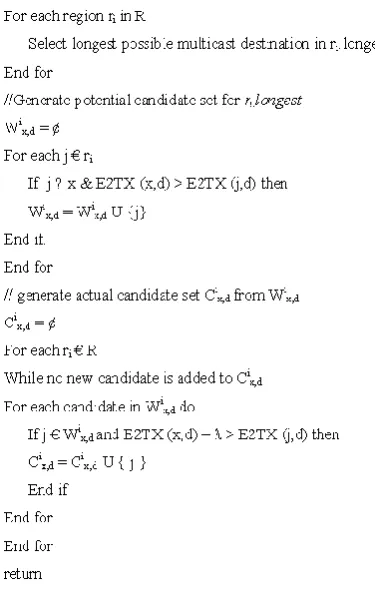
Unlike candidate selection in TOR, proposed protocol uses different strategy. Once the multicasting module locates and calculates the distance of longest possible multicast group member in each quadrant. Candidate selection for the longest possible destination is done in each quadrant using following algorithm
Volume 4, Issue 1, 2017
89 Fig. 4 End to end delay Vs Time
Fig. 5 Packet loss ratio Vs Time
VII. PRIORITIZATION OF RELAYS
After completion of selection of candidate relay set, the another issue needs to be noticed in OR is prioritization of the selected relays. The comparison of E2TX of each node is done to assign priorities using theorem in [2].
Theorem : (Priority rule for relays) For any node, once its relays have been determined, there lays should be prioritized
in the decreasing order of their corresponding E2TX in order to provide the assurance that each node has a higher trustworthiness and less number of retransmission.
VIII. IMPLEMENTATION RESULTS
When we run the TOMR protocol, ETX and trust value of each node should be assigned and computed in advance. 1. If a node joins the network or as soon as it is turned on, its trust value is set to an initial value 0.5 or calculated
during first topology
2. Each node then calculate the link quality metric ETX by sending the probe packet to its neighbour node, which the node locates within the transmission range of the sending node, according to the definition 4;
3. After procedure (1) and (2), each node can drive the combined metric E2TX by using the formula (4); 4. TOMR creates the four multicast region by using the location service module.
5. A source node collects all E2TX of its neighbour nodes for candidate selection and prioritization of selected relay nodes as in TOR.
Volume 4, Issue 1, 2017
90 Fig. 7 Routing overheads Vs Time
Fig. 8 Packet Delivery Ratio Vs Time
6. When the mentioned above procedure is finished or network topology changes, the trust value of each node can be updated by formula (1) and (2), and moreover, trust judging phrase unfolds.
7. If trust value of a node is less than Tthreshold, this node will be elicited as a selfish or malicious node, so it will be
omitted in next routing phase from security of network point of view.
Firstly we have implemented the protocol with 100 nodes and discussed the performance of protocol with respect to time using following parameters.
1. End to end delay. 2. Packet loss ratio. 3. Packet delivery ratio. 4. Throughput.
5. Routing overheads.
Table 1: Performance of TOMR
We have implemented the protocol in wireless network of 100 nodes and we have run simulation for 250 seconds. Results of the simulation are as discussed below.
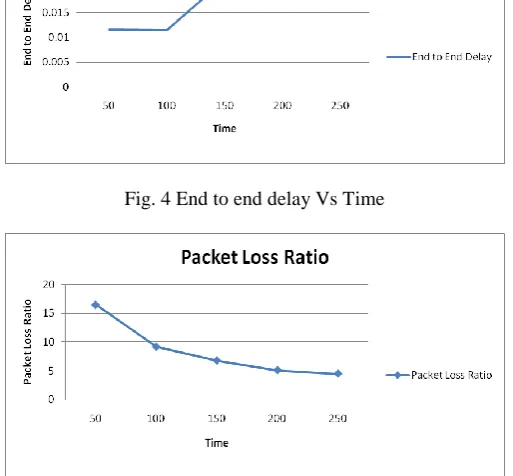
Fig. 4 shows the graph of end to end delay Vs time. End to end delay between the packets is consistent throughout the simulation. Initially delay is consistent from start to middle of the simulation and then shows quite increase in it. Then till the end of simulation delay remains consistent.
Fig. 5 shows the graph of packet loss ratio Vs time. Packet loss ratio for implemented protocol is more at the start of simulation because it needs to find the location of destination node. Later packet loss ratio continuously decreases with the increasing time.
Parameters Number of Nodes
60 80 100 125
No. of packet sent 501 506 504 513
No. of packet received 485 489 481 488
Average end to end delay 20.232 26.050 16.979 21.192
Average packet delivery
ratio 96.806 96.640 95.499 95.126
Average routing overheads 12.043 14.239 16.770 19.648
Average throughput 54.34 65.14 76.74 90.00
Average packet loss ratio 3.1936 3.3597 4.501 4.8733
Volume 4, Issue 1, 2017
91 Fig. 6 shows the graph of throughput Vs time. The graph shows consistent and high throughput for the protocol under consideration.
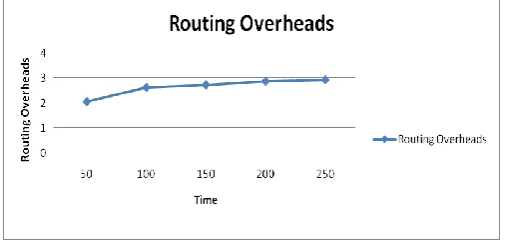
Fig. 7 shows the graph of routing overheads Vs time. For the protocol under consideration routing overheads are consistent as well as are within tolerable limit.
Fig. 8 shows the graph for the packet delivery ratio Vs time. Packet delivery ratio for implemented protocol is high as well as continuously increasing with respect time.
From above the above discussed results it is clear that implemented protocol gives better performance in terms of all parameters. Now, we will discuss the performance of TOMR with different number of nodes in the network.
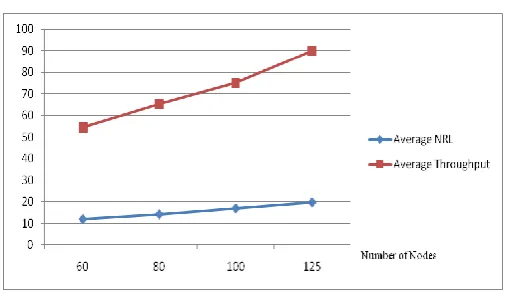
Table 1 shows the performance of the TOMR with different number of nodes. We have simulated the implemented TOMR protocol with different number of nodes like 60, 80,100 and 125. From the graph shown in fig. 10, it is clear that TOMR gives consistent as well as better performance with the change in density of nodes in the wireless network. Fig 9 shows the graph for end to end delay, Packet loss ratio, and packet delivery ratio Vs number of nodes. Results for above mentioned parameters are consistent for all values of number of nodes.
Fig 10 shows the graph for average normalized routing load and throughput Vs number of nodes. The value of throughput is increasing with the number of nodes in the network which shows that TOMR offers high throughput. Also the value of NRL is consistent and within tolerable limit.
Fig 9: Average E2ED,PDR, PLR Vs No. Of nodes
Fig 10: Average NRL, Throughput Vs No. Of nodes
CONCLUSION
In this paper, we implemented the idea of multicasting in trust based opportunistic routing proposed in [12]. We have used optimum algorithm for candidate selection using existing E2TX metric. Also we have implemented effective algorithm for selecting limited multicast member instead of doing it for all members.
We have verified the performance of TOMR, it offers high throughput as effect of ETX metric, as well as it gives high packet delivery ratio and low packet loss ratio. We are also successful to limit the routing overheads within tolerable limit.
Volume 4, Issue 1, 2017
92 REFERENCES
[1] S. Biswas and R. Morris, ExOR: Opportunistic multi-hop routing for wireless networks, in Proceedings of ACM SIGCOMM, 2005, pages.133-144.
[2] WangBo, HuangChuanhe ,YangWenzhong , WangTong,” Trust Opportunistic Routing Protocol in Multi-hop Wireless
Networks”, in Proceedings of ACM SIGCOMM, pp.563-567,2010.
[3] D. S. J. De Couto, D. Aguayo, 1. Bicket, and R. Morris, A high throughput path metric for multi-hop wireless routing, in
Proceedings of ACM MOBICOM, 2003, pp. 134-146.
[4] Chen-Hsiang Feng, Wendi B. Heinzelman “RBMulticast: Receiver Based Multicast for Wireless Sensor Networks” Wireless Communications and Networking Conference, 2009. WCNC 2009. IEEE pp.1-6
[5] E.Rozncr,J.Seshadri,YMehta,L.Qiu, Simple Opportunistic Routing Protocol for Wireless Mesh Networks, 2nd IEEE Workshop
on Wireless Mesh Networks,2006.
[6] E.Rozncr,J.Seshadri,YMehta,L.Qiu, Simple Opportunistic Routing Protocol for Wireless Mesh Networks, 2nd IEEE Workshop
on Wireless Mesh Networks,2006.
[7] “MORE protocol”, April 2011[html], http://en.wikipedia.org/wiki/MORE_protocol.
[8] Ad-hoc on-demand distance vector routing,” Mobile Computing Systems and Applications, 1999. Proceedings. WMCSA. Second IEEE Workshop on, pp. 90–100.
[9] S. Zhang, C. Zhu, J. K. O. Sin, and P. K. T. Mok, “A novel ultrathin elevated channel low-temperature poly-Si TFT,” IEEE Electron Device Lett., vol. 20, pp. 569–571, Nov. 1999.
[10] Jetcheva J. G., Johnson D. B.: Adaptive Demand-Driven Multicast Routing in Multi-Hop Wireless Ad Hoc Networks. In 2001
ACM International Symposium on Mobile Ad Hoc Networking and Computing (MobiHoc2001), October 2001.
[11] Sanchez J.A., Ruiz P.M., Stojmenovic I. GMR: Geographic Multicast Routing for Wireless Sensor Network, In Proceeding in
Sensor, Meshand Ad-hoc Communication and Network, IEEE, Secon 06, 2006,Virginia, USA.
[12] Sagar P. Latake, Gitanjali R. Shinde, “Trust Opportunistic Multicast Routing (TOMR) Protocol In Multi-Hop Wireless Network” At International Journal Of Computer Science And Information Technologies, Vol. 4 (3), 2013, pp 481-484, Issn 0975–9646.
[13] J.J.Garcia-Luna-Aceves and Ewerton L. Madruga “The Core- Assisted Mesh Protocol Selected Areas in Communications, IEEE Journal on Volume 17, Issue 8, Aug 1999 Page(s):1380 – 1394.
[14] Lee,S.-J.; Gerla, M.; Chiang, C.-C; “On Demand Multicast Routing Protocol” Wireless adaptive