www.ijsernet.org Page 1
THE ROLE OF CULTURE IN ACHIEVING CENSUS OBJECTIVE IN 2006
CENSUS EXERCISE IN ASABA (PART 2)
NWABUDIKE C. PATRICK
Nnamdi Azikiwe University Awka, Anambra State OBIENUSI EARNEST. A
Nnamdi Azikiwe University Awka, Anambra State NKWOCHA K. FRIDAY
Nnamdi Azikiwe University Awka, Anambra State IHEUKWUMERE S. OJI
Nnamdi Azikiwe University Awka, Anambra State
ABSTRACT
A lot have been written about census in Nigeria. National Population Commission is mandated by law to provide accurate data of the Nigerian population.The purpose of the study is to evaluate the 2006 census exercise in Asaba, capital of Delta state, with a view to suggesting ways of improving the exercise in future. This study went on looked at what a census is and a brief history of census in Nigeria, effect of culture on the successful conduct of the census enumeration in Asaba and to determine the factor that best determine the successful conduct of census enumeration in Asaba. Suggestions were made among which are; government should endeavour to improve on road network and electricity distribution, a Biometric technology approach is recommended for carrying out the population census, Just like China and India, more enumerators should be used to ensure effective coverage of the country and NPC staff should be re-trained on application of new technologies such as Satellite Imagery, remote sensing techniques, machine readable forms, and other ICT devices used in conducting a modern census.
KEYWORD;census exercise, census personnel, enumeration and population
INTRODUCTION
The term “CENSUS” comes from the Latin word CENSERE meaning taxing or assessing. For Romans, it means a register of adult male citizens and their property for purposes of taxation, the distribution of military obligations and the determination of political status (Starr, 1987).The most important source of information about the population of a country or any locality within it is the population census. In the words of the United Nation Development Programme (2006) “a census of population can be defined as the total process of collecting, compiling and publishing demographic, economic .
www.ijsernet.org Page 2
To enhance effective planning for government, planners and administrators.
The information will be used effectively for projecting and planning for a suitable economy in Asaba, and
To ensure better research understanding in the area of census exercise.
SOURCES OF DATA
The data for this research were generated from both primary and secondary sources. The primary sources included questionnaires and interviews. The secondary data were gathered from existing body of knowledge such as textbooks, newspapers, journals, and pre-existing related research work in the library and newspaper archive. These sources provided the subjective and qualitative data that was used in descriptive and qualitative analysis. The above sources were complemented by looking at the relevant records and books of the National Population Commission.
SAMPLE POPULATION
The target population comprises of heads of households (men and women) who have spent more than 15 years and above either as indigenes or migrants in Asaba town of Delta State. The target population of the study is 150,032 people (NPC 2006). Having stated the population of Asaba according to the 2006 census, the study deemed it wise to project the population of Asaba to 2016 which is the same year the research was carried out, for Asaba as the state capital is expected to have increased in population due to influx of people.
Population projection theoretical models is stated as
Pt + n = Pt + nr Pt ……….(equ 1 )
Where: Pt + n = population at new date Pt = initial population n = time interval r = annual growth rate
Pt + n = Pt + nr Pt
Nigeria growth rate = 3.2% Pt = 150,032
n = 2016 – 2006
Pt + n = 150032 + 10 ×3.2× 150032
100
= 150032 + 48010.24
Pt + n = 198,042 persons by 2016
SAMPLE AND SAMPLING TECHNIQUES
www.ijsernet.org Page 3 considerations, the study decided to use Taro Yamani theoretical model to select the sample size of this research.
Therefore, Taro Yamani desired sample size as:
……… (equ2 )
Where N= population sample=198042
n = sample size,
The level of (allowable error) that is 0.05(5%)
n=
n=
n= =400(Target Population)
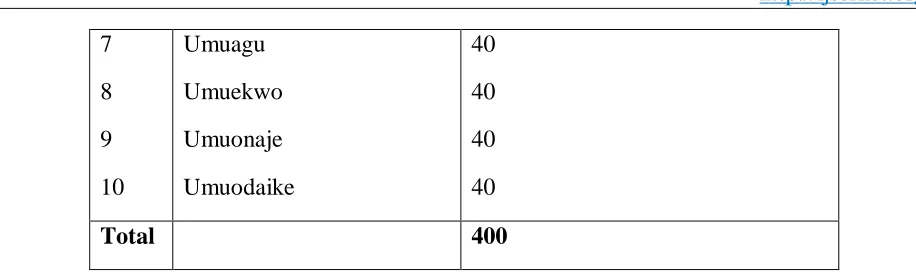
Having projected the population of Asaba, the study used judgmental and simple random technique in distribution of questionnaire to the selected quarters in Asaba. This is as a result of being unable to get the population of Asaba quarters by quarters for even distribution of questionnaire according to their equal population percentage sampling, hence the forty questionnaire to each of the randomly selected quarters as shown in table 1
Table 1: Distribution of questionnaire in Asaba
S/N Respondent quarters Number of questionnaire sent
1
2
3
4
5
6
Anwai
Ezinei
Isi eke
Nnebisi
Okwe
Umuagi
40
40
40
40
40
www.ijsernet.org Page 4 7
8
9
10
Umuagu
Umuekwo
Umuonaje
Umuodaike
40
40
40
40
Total 400
METHOD OF DATA ANALYSIS
The Principal Component Analysis
It is a technique used to emphasize variation and bring out strong patterns in a dataset. It finds the principal components of data and it is often used to make data easy to explore and visualize. The study made use of principal component analysis to validate research objective since it sought to ascertain the factor that best determine the success of a census exercise.
The Weighted Mean and Standard Deviation
The choice of the weighted average in this study is based on the fact that the questionnaires designed for the study were Likert scale questionnaires in which weights were attached to the responses.
The weighted mean is obtained as
=
Where is the weight of the ith cell; = n = sample size of the study Similarly the weighted standard is obtained as
S =
PRENTATION OF DATA
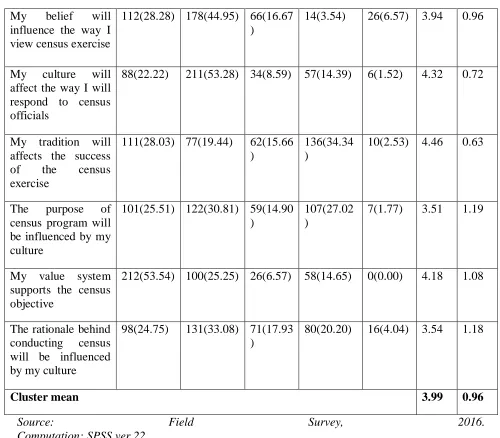
Table 2: Effects of culture on achieving census objectives
Questions Responses Statistics
SA (percent)
A
(percent)
SD (percent )
D
(percent)
UD (percent )
www.ijsernet.org Page 5 My belief will
influence the way I view census exercise
112(28.28) 178(44.95) 66(16.67 )
14(3.54) 26(6.57) 3.94 0.96
My culture will affect the way I will respond to census officials
88(22.22) 211(53.28) 34(8.59) 57(14.39) 6(1.52) 4.32 0.72
My tradition will affects the success of the census exercise
111(28.03) 77(19.44) 62(15.66 )
136(34.34 )
10(2.53) 4.46 0.63
The purpose of census program will be influenced by my culture
101(25.51) 122(30.81) 59(14.90 )
107(27.02 )
7(1.77) 3.51 1.19
My value system supports the census objective
212(53.54) 100(25.25) 26(6.57) 58(14.65) 0(0.00) 4.18 1.08
The rationale behind conducting census will be influenced by my culture
98(24.75) 131(33.08) 71(17.93 )
80(20.20) 16(4.04) 3.54 1.18
Cluster mean 3.99 0.96
Source: Field Survey, 2016.
Computation: SPSS ver.22
Table 2 shows the computed descriptive scores of items tailored towards answering research question three. The decision rule is to accept all items with a mean score of 3.00 and above and reject any with a mean score below 3.00. From table 2 all items have mean scores above 3.00 and they are therefore all accepted signifying that culture has a great effect with achieving objective of census exercise.
Results: Principal Component Analysis
www.ijsernet.org Page 6
Factor Name Label Standardized Label
Infrastructures X1 Z1
Quality and adequate personnel X2 Z2
Culture X3 Z3
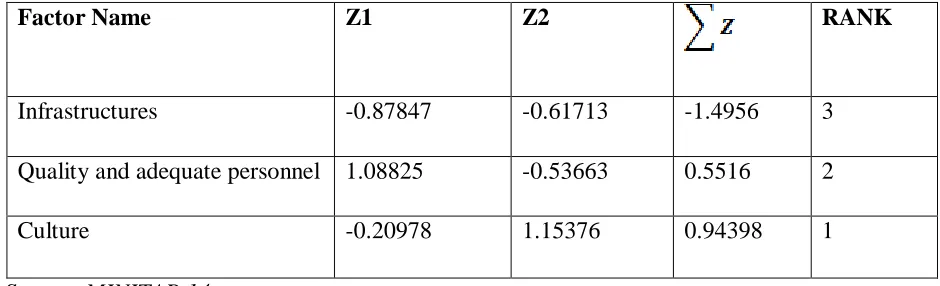
Table 3 contains the factors that determine the success of a census exercise; their standardized values and ranks. Here, the score of every factor was standardized (transformed) to Z-score at zero mean and a unit standard deviation.
Table 4: Factors that determine the success of a census; their standardized values and ranks
Factor Name Z1 Z2 RANK
Infrastructures -0.87847 -0.61713 -1.4956 3
Quality and adequate personnel 1.08825 -0.53663 0.5516 2
Culture -0.20978 1.15376 0.94398 1
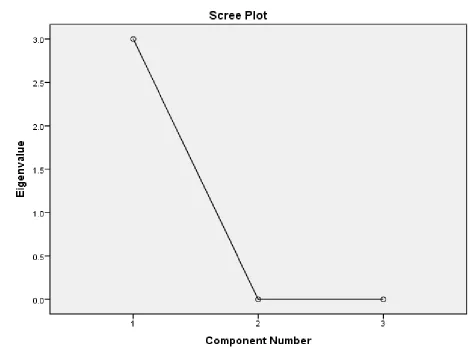
www.ijsernet.org Page 7 Fig 1: A scree plot of the eigenvalues against the component number of the factors
From the scree plot we have that only one factor is important for our analysis having eigenvalue 3.0 which is above 1.
Table 5: Eigen analysis of the Correlation Matrix
Eigenvalue 3.0000 0.0000 -0.0000
Proportion 1.000 0.0000 -0.0000
Cumulative 1.000 1.0000 1.0000
Table 6: Principal Component Regression (PCR)
www.ijsernet.org Page 8
Infrastructure 0.577 0.610 0.542
Quality and adequate personnel -0.577 0.775 -0.257
Culture 0.577 0.165 -0.800
Source: MINITAB 14
From table 6, we have that the first principal component explains 100.0 percent of the total variance in the model. This indicates that the first principal component is the most important among the components. Hence, factors of infrastructure is extracted.
FINDINGS
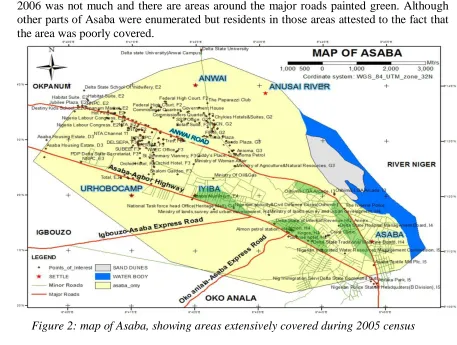
1. Inadequate infrastructure; from figure 5, it will be observed that areas covered during 2006 was not much and there are areas around the major roads painted green. Although other parts of Asaba were enumerated but residents in those areas attested to the fact that the area was poorly covered.
Figure 2: map of Asaba, showing areas extensively covered during 2005 census
www.ijsernet.org Page 9 rained as Asaba is heavily flooded after rainfall because of very poor drainage system by the road side due to poor road network.
3. They should be proper enlightenment in other to get the people ready for head count.
CONCLUSSION
The population of any society is the most important aspect of its resource base as well as her ability for development. This aspect is based on its demographic structure and quality of education of citizenry, growth rate, spatial distribution size, health and social welfare. Population data’s are very important inputs into the planning process in any area. As the country is due for another round of census, if these suggestions are incorporated into the plans, more effective, accurate and reliable population and housing census result will be achieved. This willensure a high quality and effective data base for socio-economic planning and development in the society.
RECOMMENDATION
The study, based on the findings, proposed the following recommendations:
1. Since availability of infrastructure affect the effectiveness of census exercise, government should endeavour to improve on road network and electricity distribution.
2. Just like China and India, more enumerators should be used to ensure effective coverage of Asaba.
3. 2006 census organizers have refused to learn from past experience by scheduling census to when the general election will hold. This has lead to the manipulation of enumeration results to suit the political class, enumeration is being hijacked and result falsified.
REFERENCES
Adamu, S. O. (1989). Population and Planning in Nigeria in TekenaTamuno and Atanda, J. A (eds) Nigeria Since Independence The First 25 Years Government and Public Policy. Nigeria, Ibadan: Heinneman Publications.
Adepoju, A. (1981). Military rule and Population issues in Nigeria and Africa Affairs. pp. 29-47. Ibadan. Heinneman publications
Adigwe, F. (1978). Essentials of Government for West Africa. Nigeria. Ibadan: Heinneman Publications.
Adim, F. (2007, January 12). Delay in release gave room for manipulation in The Guardian. P.27 Afolayan, A. A. (1982). Population in Mabogunje A. L (ed) Geographical
Perspective on Nigerian Development. Nigeria. Ibadan: HeinnemanPublications. Akerele, T. (2007, January 15). Matters arising. The Guardian newspaper. p. 65.
Aluko, S. A. (1965). How many Nigerians? An Analysis of Nigeria’s Census Problems, 1901-63 in Afri. Affairs 3(3): 371-392.
Alexander, H. W. (1999). The estimation of reliability when several trials are available. Psychometrika12:79–99. Agbor, Alcels concerts publishers.
www.ijsernet.org Page 10 Atkinson, D. B., &Nevill, A. M. (1998). Statistical methods for assessing measurement error (reliability) in variables relevant to Sports Medicine.Sports Med. 26:217–238. New York: Nova Publishers
Ayeni, O. O., & Adewale, O. S. (2001). A Geo-referenced Information System for Population Management. International Conference on Spatial I n fo r m a t io n fo r S u s t a i n a b l e Development, Nairobi, Kenya. 2-5 October 2001.
Ayodele, T. (2007, January 12). Disquiet as population result affirms old pattern. The Guardian newspaper. p. 26.
Bamgbose, J. A. (1998). Falsification of Population Census Data in a heterogeneous Nigerian state: The fourth republic example (Ph.D Thesis University of Ibadan) Available at http://www.academicjournals.org/AJPSIRISSN 1996-0832 © 2009 Academic Journals Blumer, H. (1969). Symbolic Interactionism: Perspective and Method, Englewood Cliffs, NJ:
Prentice-Hall. Vol-8
Brown, D. E. (1991). Human universals. New York: McGraw-Hill publisher.
Cassedy, J. (1969). Demography in Early America: Beginnings of the Statistical Minds. Harvard University press.
Chang, I. &Leelie, F. (2000). In China: A Headache of a Head Count. Wall street journal. November 2, p: 21
Clarke, J. (1971). Population Geography and the Developing Countries. London: paragom publisher.
Cohen, R. &Swerdlik, M. (2010). Psychological testing and assessment. Boston: McGraw-Hill Higher Education
Diamond, L. J. (1998). Class, Ethnicity and Democracy in Nigeria: The Failure of the First Republic. Syracuse, New York: Syracuse University Press, pp. 131-133
EAD Manual (2005). Federal Republic of Nigeria, Enumeration Areas Delineation Country-Wide: Training and Reference Manual for Census 2 0 0 5 . N a t io n a l P o p u l a t io n Commission, Abuja, Nigeria.
Ejemeyovwi, D. O. (2008). The environment of the Niger Delta. A contribution in G, Ojie (ed.) reversed Man and his Environment. A publication of GST, Delta State University. In Press.
Enieayejuni, A. T. &Agoyi, M. (2011). A Biometric Approach Census and National Identification in Nigeria: A Prerequisite for Planning and Development‖ in Journal of Asian- Transactions on Basic and Applied Sciences vol.1.
Eze, B. U. (2015). Census Exercise in Nigeria: Lessons, Problems and Prospects. A journal publication of the department of Geography and Meteorology, Nnamdi Azikiwe University, Awka. Vol 1, p. 87
Federal Republic of Nigeria Official Gazette (2007). “Federal Republic of Nigeria Official Gazette”.No. 24, Vol. 91, Supplementary Copy, Printed and Published - the Federal Government Printer, Lagos, Nigeria. 15th May 2007.
Headsman, F. (1997). Literature and Information on Documentation. Berlin, pullahinc, p. 920 Horsley, G. H. R. (1987). New Documents Illustrating Early Christianity: A Review of the
www.ijsernet.org Page 11 Iweka, D. E. &Ugbechie, C. O. (2002). Human Geography. Agbor, Alcels concerts publishers. Kent, A. (1971). Library Surveys in Encyclopedia of Library and information Science. Vol 6.
New York, marcel delete, pp. 75-84.
Kolapo, Y., Obasola, K., &Ibona, J. (2007, February 6). Lagos Protests Census Results, Heads For Tribunal: The Punch
Kolapo, Y. &Faloseyi, M. (2007, February 6). Lagos and the fallacies in national census figures in The Punch. p.3.
Lalasz, R. (2006). In the News, the Nigerian Census. www.prb.org.
Maines, D. (1977). Social Organization and Social Structure in Symbolic Interactionist Thought. Annual Review of Sociology, vol 3. Hauppauge, New York: Nova Publishers, p. 159. Makama, S. (2005). The NPC Chairman, Chief SamailaMakama, Comments on All set for 2006
Population and Housing Census. March 20, 2006,
Maduagba, I. I. (1987). The Population Census of Nigeria from Colonial Times: An evaluation of their Coverage and Accuracy. Lagos, New age publishers.
Margeot, H. &Ramjith, S. (2001). The South African Census 2001 Spatial Information System Data Capture Problems. International Conference on Spatial Information for Sustainable Development, Nairobi, Kenya. 2-5 October 2001
McElroy, J. (2006). Creating Small Area Population Estimates. Available at http://charlotte.utdallas.edu/mais/priwrkshp/2006/Mcelrov/litReview.htm
Mead, G. H. (1934). Mind, Self and Society, Chicago: University of Chicago Press.
Mimiko, F. (2006). Census in Nigeria: The Politics and the Imperative of Depolarization African and Asian Studies, vol. 5, pp. 1-22.
Mitchell, M., &Sidanius, J. (1995). Social Hierarchy and the Death Penalty: A Social Dominance Perspective. Political Psychology, vol 16, pp. 591-619.
Momoh, A., &Adejumobi, S. (1999). The Nigerian Military and the Crisis of Democratic Transition a Study in the Monopoly of power. Nigeria. Lagos: Civil Liberties Organization. Muogbo, O., Fagbemi, S. &Subair, G. (2007, January 10). Kano has largest population. Tribune.
P. 1.
Musa, S. (1987). Population Census: A Multi Indisciplinary Effect, 2nd November. Pp; 26-28. National Population Census (2013). Ethnicity, religion and their possible impact on it. Retrieved
from www.doublegist.com.
National Population Commission. (1992). Vital Registration Manual, (2nd Ed). Abuja: pp13-18 Ndukwe, K. N. (2001). Digital Technology in Surveying and Mapping: Principles, Applications
and Legislative Issues. Enugu, Nigeria. RhyceKerx, Publications.
Nu’man, F. (1992). The Muslim Population in the United State: A Brief Statement. Washington DC, American muslim council. Retrieved from http//www.amcjornal.com
Nwachukwu, J. J., &Odjegba, E. T. (2001). Compaction in a reservoir Sandstone of the Niger Delta. Nigeria Journal of Mining and Geology, vol. 37, No.2 pp208-307.
Nwosu, H. N., &Ofoegbu, R. (1986). Introduction to Politics. Nigeria, Enugu:Fourth Dimension Publishers.
www.ijsernet.org Page 12 Odemerho, F. &Ejemeyovwi, D. O. (2008). The physiographic and drainage system of Delta State, Nigeria. In Odemerho, F. (ed.). Delta State in maps. A publication of Geography and Regional Planning, Delta State University, Abraka.
Odemerho, F. (2008). The geology of Delta Sate. In Odemerho, F. (ed.) Delta State in maps. A publication of Geography and Regional Planning Department, Delta State University press. Abraka.
Odewumi, S. (2000). Problems of Census in Nigeria in Odumosu T, Atere W and Adewunmi F (eds), Social Problems and Planning Studies in Nigeria. Nigeria. Lagos: Centre for Planning Studies Lagos State University.
Odimegwu, F. (2013, 11th August). Nigerian Census Challenge: The Sun newspaper, P: 1 Odunfa, S. (2006). Nigeria‘s counting controversy. Bbc.co.uk BBC News.
Okolo, A. (1999). The Nigerian Census, problem and prospects. The American Statisticians, Vol 53, pp: 321-325.
Onyeka, B. V (2007, January 12). It is tinted with political permutations in The Guardian newspaper, p 28.
Onyekakeyah, L. (2007, January, 23). Paradox of population distribution in Nigeria. The Guardian newspaper. P.15.
Onyeka, B. V. (2007, January 12). It is tinted with political permutations in the punch newspaper. P. 28Okafor, S. (1981). Indirect Rule: The Development of Central Legislative in Nigeria. Nigeria: Lagos, Nelson.
Okolo, A. (1999). The Nigerian Census: Problems and Prospects. The American Statistician 53; 321-325 in J.R. Weeks (2008). Population: An Introduction to Concepts and Issues tenth edition .London: ADWORTH Ltd.
Oluleye, J. J. (1985). Military Leadership in Nigeria 1966 – 1979. Nigeria, Ibadan. University Press Limited.
Olokor, F. (2013, April 16). 2016 census: FG insists on accurate data quality. Punch Newspaper Nigeria Retrieved from http://www.punchng.com.
Osinaike, R., Aiyeola, T., &Alao, S. (2006, February 24). In Search of True Population Figure, Guardian newspaper limited, Lagos.
Oyedele, D. (2003, April 19). NPC: We lack accurate figures on Nigeria Population. This day Newspaper. p.1.
Pinker, S. (2002). The blank slate: The modern denial of human nature. New York: Penguin publisher.
Prasad, P. (1993). Symbolic Processes in the Implementation of Technological Change: A Symbolic Interactionist Study of Work Challenges of National Population Census and Computerization. Academy of Management Journal, vol.36, no.6.
Skerry, P. (2000). Counting on the census: race, group identity and the evasion of politics. Massachusetts, US: Brookings Institution Press. Pp.11 Starr, P. (1987). The Sociology of Official Statistic in the Politics of Number. In Alonso, W. & Starr, P. (Eds). New York. Russell sage foundation.
www.ijsernet.org Page 13 Tinubu, B. A. (2007, February 6.). The falsification of lagos census figures being the test of a
report by the Lagos State Government. Punch newspaper. P.12
Tijani, I. (1990). Census in Nigeria Lessons for the 1991 head count in Johnson, S. (ed) Readings In selected Nigerian Problems. Nigeria. Lagos: Okanlawon publishers
Tripathi, R. R. (2001). Mapping for the 2000 Round of Censuses: Issues and Possible Solutions. Symposium on Global Review of 2000 Round of Population and Housing Censuses: Mid-Decade Assessment and Future Prospects. Statistics Division, Department of Economic and Social Affairs, United Nations Secretariat, New York, 7-10 August 2001.
Udeogu, R. A. (1992). The 1991 Population Census and its implication. Vol 3, pp: 5-7 Retrieved from http//www.npc.gov.ng
United Nations Development Programme. (2006). Human Development Report. New York. Oxford University Press.
Varma, S. P. (1996). Modern Political Theory. Delhi, Vikas Publishing House.
Williams, M. (2003) Citizenship education and lifelong learning: Power and Place. Hauppauge, New York: Nova Publishers.
Weeks, J. R. (2008). Population: An Introduction to Concepts and Issues. Tenth edition. London, WadsworthLtd