University of Kentucky University of Kentucky
UKnowledge
UKnowledge
Theses and Dissertations--Management Management
2014
Conversational Dynamics: Decision Making as Discourse
Conversational Dynamics: Decision Making as Discourse
Zackary R. Edens
University of Kentucky, [email protected]
Right click to open a feedback form in a new tab to let us know how this document benefits you. Right click to open a feedback form in a new tab to let us know how this document benefits you.
Recommended Citation Recommended Citation
Edens, Zackary R., "Conversational Dynamics: Decision Making as Discourse" (2014). Theses and Dissertations--Management. 7.
https://uknowledge.uky.edu/management_etds/7
STUDENT AGREEMENT: STUDENT AGREEMENT:
I represent that my thesis or dissertation and abstract are my original work. Proper attribution has been given to all outside sources. I understand that I am solely responsible for obtaining any needed copyright permissions. I have obtained needed written permission statement(s) from the owner(s) of each third-party copyrighted matter to be included in my work, allowing electronic distribution (if such use is not permitted by the fair use doctrine) which will be submitted to UKnowledge as Additional File.
I hereby grant to The University of Kentucky and its agents the irrevocable, non-exclusive, and royalty-free license to archive and make accessible my work in whole or in part in all forms of media, now or hereafter known. I agree that the document mentioned above may be made available immediately for worldwide access unless an embargo applies.
I retain all other ownership rights to the copyright of my work. I also retain the right to use in future works (such as articles or books) all or part of my work. I understand that I am free to register the copyright to my work.
REVIEW, APPROVAL AND ACCEPTANCE REVIEW, APPROVAL AND ACCEPTANCE
The document mentioned above has been reviewed and accepted by the student’s advisor, on behalf of the advisory committee, and by the Director of Graduate Studies (DGS), on behalf of the program; we verify that this is the final, approved version of the student’s thesis including all changes required by the advisory committee. The undersigned agree to abide by the statements above.
CONVERSATIONAL DYNAMICS: DECISION MAKING AS DISCOURSE
DISSERTATION
A dissertation submitted in partial fulfillment of the requirements for the degree of Doctor of Philosophy in the
College of Business and Economics at the University of Kentucky
By
Zackary Robert Edens
Lexington, Kentucky
Director: Dr. Walter Ferrier, Professor of Management
Lexington, Kentucky
ABSTRACT OF DISSERTATION
CONVERSATIONAL DYNAMICS: DECISION MAKING AS DISCOURSE
This dissertation examines decision making as discourse to capture subtle
characteristics and processes within top management team discussions and examines their influence on decision outcomes. Additionally, this approach allows for exploration of decision making processes in real time by utilizing audio analysis techniques that can provide a more dynamic and integrative view of conversations and discussions as they relate to the dialogue and debate that goes on within top management teams, as well as providing an alternate pathway of study for top management team and group research, decision making studies, and the fields of communication and conversational analysis.
KEYWORDS: Decision making, strategy, conversational analysis, task performance,
group dynamics
Zackary Robert Edens
_____________________________ Student’s Signature
12-15-2014
CONVERSATIONAL DYNAMICS: DECISION MAKING AS DISCOURSE
By
Zackary Robert Edens
Dr. Walter Ferrier
_____________________________ Director of Dissertation
Dr. Steve Skinner
_____________________________ Director of Graduate Studies
12-15-2014
ACKNOWLEDGEMENTS
I am forever grateful to all of those who have touched my life in a positive way,
foremost among them my parents who have always been the truest embodiment of love
and support that I can possibly imagine. Dad, you’re my best friend and you’re also the
best in every sense of the word and I am thankful every day that in light of the countless
examples of how not to be, you remain an example of how to be; I couldn’t have done
this without you and it is my greatest privilege to have the honor of being your son.
Mom, I miss you and I know you are always watching over me; you were my first and
finest teacher and you laid the foundation for everything that I have accomplished.
To my closest friends: Dr. Eric Nybo, Professor Mike Pepper and his wife Pam,
my Uncle Tom and Aunt Kathy Edens, Joe Bennett, Emily Davidson, Lauren Ditsch, and
Howard and Sheila Stewart: Thank you for your continued support, I love each of you.
To President Charles Shearer and Dr. Gerald Seebach from Transylvania, and Dr.
Brian Dineen, Dr. Tom Goldsby, Dr. Frank Scott and Dr. Ikenna Uzuegbunam from UK:
Thank you for believing in me, through your assistance I was able to make this a reality.
To the Reverends Wayne B. Smith and Brewster McLeod: Thank you for
instilling and nurturing the Faith within me, it has sustained me through every challenge.
To my committee members Dr. Nancy Johnson, Dr. Brian Murtha, and Dr. Kevin
Real: I am greatly appreciative and grateful for your guidance and patience.
But, most significantly to this endeavor, to my Chair, Dr. Walter Ferrier: Thank
you for supporting me as both a scholar and a young man facing a variety of challenges –
you were always there for me regardless of how difficult that may have been and are also
TABLE OF CONTENTS
Acknowledgements………iii
List of Tables………..vi
List of Figures………vii
Chapter One: Introduction………...1
Chapter Two: Theoretical Background………3
Chapter Three: Research Objectives Structure and Sequencing………..13
Chapter Four: Methods Research Setting and Sample……….17
Mixed Methods Approach……….19
Dimensions of Conversations………20
Utterance Categorization Methodology……….21
Categories of Utterances………25
Categorization by Independent Coders………..27
Variety Measures – Quantitative………...28
Variety Measures – Qualitative……….32
Performance Ratings by Independent Expert Assessors………....33
Chapter Five: Analysis Quantitative Assessments………..38
Quantitative Insights………...41
Qualitative Assessments………53
Qualitative Insights………53
Chapter Six: Discussion and Theory Building Implications Results Summary………...59
Limitations……….64
Future Research……….67
Conclusion……….74
Appendices Appendix A: Team Responses for Assumptions, Recommendations, and Implementation………..75
Appendix B: Expert Raters Scorecard Template………...91
Appendix C: Variety Score Plots………...92
Vita………...112
LIST OF TABLES
Table 4.1: Initial Categories………...22
Table 4.2: Raters’ Scores, Point Total Averages, and Rankings………...37
Table 5.1: Descriptive Measures………....39
Table 5.2: Percentage of Team Discussion by Utterance Count………...40
Table 5.3: Variety Calculations……….41
Table 5.4: Team Discussion Descriptives/Performance Correlations………...42
Table 5.5: Counts of Utterance Type/Performance Correlations………...45
Table 5.6: Conversation Structure Construct/Performance Correlations………..48
Table 5.7: Counts of Utterance Type/Basic Dimension Descriptives Correlations……...49
LIST OF FIGURES
Figure 2.1: Permeation of Conversational Structure through Multiple Decision Making
Constructs………..10
Figure 4.1: Basic Dimensions of Conversation……….21
Figure 4.2: Example of Simple (Lower Variety) Conversation……….30
Figure 4.3: Example of Diverse (Higher Variety) Conversation………...31
Figure 4.4: Example of Core Questions and Team Responses………..35
Figure 5.1: Quantitative Findings Summation………...52
Figure 5.2: Overall Directionality Examples……….54
Figure 5.3: Smoothness of Interchange Examples……….56
CHAPTER ONE
INTRODUCTION
Strategic decisions are the essential deliverables that come from top management
teams, the internal discussions and careful considerations that serve to shape the direction
of an organization going forward and the reflections of what has been successful (and not
successful) for the organization in the past. Any decision is, at its core, a confluence of
problems, opportunities, experiences, perspectives, information, intuition, culture,
creativity, bias, fear, and hope – each of which has a shared individual and group
collective identity that is indicative of the worldview and attitude of those making
decisions and serves as an embodiment of the people, teams, organizations and markets
that exist to influence, and be influenced by, decision making. The parts of this
confluence are all elements and contributing pieces to decision making, but they are each
separate parts of a greater whole that includes intra-group dynamics and communications,
a whole that is bounded and shaped by a process, and it is that process and its structure
that provide a viable and intriguing area for exploration.
The foremost means by which structure matriculates into group communication
processes is through the methods and means of communication that groups undertake.
These communications can come in a variety of forms including written notes, messages,
and electronic mail, but the most prominent form of communication that shapes key
decisions and process advancements vital to the success and future of the organization is
through face to face conversations. The structural components of conversations are vital
to decision making and this study works to operationalize and expand our current
valuable added dimension to the existing decision making, top management team, and
group process literature. By finding a way to elucidate the internal processes and
procedures of decision making and shed light on previously underexplored processes that
are difficult to observe in practice, this research plays a key role in gaining a better
understanding of not only how important decisions are made, but also how the best, most
successful, top management groups and decision making teams are able to make them.
How some organizations are able to make decisions more effectively and more efficiently
than their competitors, through more refined processes and distinct structural properties,
is a key aspect of what differentiates successful firms from others that are not as
CHAPTER TWO
THEORETICAL BACKGROUND
While competitive interactions between independent organizations are clear,
definable, and externally directed, there still remains a significant need to assess the not
easily observable internal aspects of strategic decision making that occur within an
organization, most specifically the interactions that occur within the firm’s top
management structure that lead to the deployment of actions (and reactions) against other
organizations (Child, 1972; Hitt & Tyler, 1991; D’Aveni, 1994; Finkelstein & Hambrick,
1996; Hambrick, Finkelstein, & Mooney, 2005; Clark & Maggitti, 2011). Prior research
has found that individual group member satisfaction with a decision outcome can effect
both the implementation of the decision (Mathieu, Maynard, Rapp, & Gilson, 2008;
Priem, Harrison, & Muir, 1995) and whether or not the individual members of the group
want to work with that same collection of group members again in future sessions
(Schweiger, Sandberg, & Ragan, 1986). Thus, in addition to making an objectively high
quality (logical, sound, and/or accurate) and strategically viable decision, both
commitment to the process by which the decision was reached and subjective within
group affective satisfaction (individuals’ positive feelings toward other group members)
are key outputs of the decision making process (Hackman & Morris, 1975; Gladstein,
1984; Isabella & Waddock, 1994, Knight et al. 1999).
Additionally, the works of Bourgeois (1980 & 1985; Bourgeois & Brodwin 1984;
Bourgeois & Eisenhardt, 1988) suggest that agreement on goals without agreement on
means correlates with poor performance and uncertainty; conversely Dess (1987) had
positively related to organizational performance (but not agreement on both). Further,
Priem (1990) and Priem, Harrison, & Muir (1995) found that pushes to make an earlier,
quicker decision or to coerce rapid commitment can have detrimental effects on final
performance outcomes and that the temporal relationship of consensus with performance
is curvilinear. A number of studies (Baum & Wally, 2003; Dooley, Fryxell, & Judge,
2000; Perlow, Okhuysen, & Repenning, 2002; Kownatzki, et al. 2013) also demonstrate
mixed results on the effect that speed of decision making has on final decision quality,
thus there is still presently a lack of agreement on how exactly internal organizational
processes and procedures impact final decisions and performance outcomes.
Dean and Sharfman (1996) found that decision making processes themselves are
in fact key to the determinants of decision success, but the question of why some
organizations are able to make “better” (have more optimal outcomes, or higher quality),
faster, and seemingly more comprehensive decisions than their competitors still remains.
Previous work has found that decision comprehensiveness is both positively
(Fredrickson, 1984; Smith, Gannon, Grimm, & Mitchell, 1988) and negatively
(Fredrickson & Mitchell, 1984) linked to organizational outcomes and performance,
principally contingent upon the stability of the industry in which the organizations that
were studied operated. Further, start up businesses operating in the technology sector
whose top management teams engaged in significant dialogue and debate have been
shown to make not only quicker, but also more comprehensive decisions (Talaulicar,
Grundei, & Werder, 2005) and clear, open communication within and between groups
combined construct, interactional) is one of the hallmarks of positive perceptions of
justice within organizations (Kernan & Hanges, 2002).
Previous studies (including Greenberg & Folger, 1983 and Bies & Shapiro, 1988)
have shown that employee involvement in decision making engenders greater feelings of
organizational justice and the underlying, colloquial assumption is that a commitment to
rationally and thoroughly discussing relevant issues and engaging in measured,
systematic debate before making a decision increases the likelihood of making a quality
decision and improving organizational performance. But are more methodical, slower
speed, extended dialogue and more procedurally driven groups truly better equipped to
make higher quality decisions than faster speed, quicker interaction groups? Does the
variety of types of statements within a conversation impact decision quality and limit (or
potentially increase) counterproductive work behaviors (Cohen-Charash & Spector,
2001; Gruys & Sackett, 2003)?
These issues remain largely under-explored. The structural processes and
procedures of decision making as a conversational construct are inherently core practices
that remain internalized within individual groups and are thus difficult to collect data on;
organizational group process research has yet to fully integrate discourse as a core tenet
of study, as has decision making work, and while research in those areas is the proverbial
“well-tilled soil,” conversational analysis remains a tool that has been largely left in the
shed (Suddaby, 2006). At present there is still considerable need to open the black box of
traditionally non-observable firm actions (such as private decisions made by discussions
that take place out of the public eye) in order to explore not just what we see by way of
individual firms, both those organizations that exhibit successful practices (through
observation of achievements and realized goals) and those organizations that do not
(Frederickson, 1984; Frederickson & Iaquinto, 1989; Eisenhardt & Zbaracki, 1992; Dean,
Sharfman & Ford, 1993a and 1993b; Isabella & Waddock, 1994; Lawrence, 1997;
Nokelainen, 2008).
While the black box of research varies considerably from another type of black
box, the device found on commercial airplanes that serves as the cockpit voice recorder,
the opening of the latter is a key component to opening the former in group process and
decision making research. Speaking coach Joan Detz popularized the colloquial phrase
“It’s not what you say but how you say it” as part of her successful advice series on
public speaking, however, the manner of speaking, a process that seems inherently
subconscious and rooted in individual differences, is perhaps more of a series of
collective norms borne of socialization and culture (Cialdini & Trost, 1998; Nolan,
Schultz, Cialdini, Goldstein, & Griskevicius, 2008) or sense making and pattern
recognition (Weick, 1996; Simon & Kotovsky 1963; Simon & Sumner, 1968; Simon,
1972). Beyond assigned roles, the norms for communicating are largely consistent as part
of an inter-organizational group dynamic, including but not limited to the pace, sequence,
and timing of interjections; speaking out of turn carries with it the potential for
admonishment or disregard of the speaker, in some cases overshadowing the relevance or
brilliance of the contribution from a content perspective.
As an extension of discussion patterns, work in group development has focused
on attempting to identify the different types of interactions across multiple potential
emergence, reinforcement” and Poole’s series of works (1981; 1983a; 1983b; Poole &
Roth 1989a; 1989b) on the different activity tracks, interspersed with breakpoints, that
groups may employ (task, relation, and topic related). McGrath (1991) introduced the
notion of a “satisficing/least effort” or default path for groups as part of his TIP theory
(time, interaction, and performance) wherein groups may follow a number of different
potential pathways through a general framework of four modes (inception, technical
problem solving, conflict resolution, and execution) that further brings to light the need to
explore the viability of optimal patterns compared to default ones. Wheelan (1990; 1994)
further attempted to create a composite of group development in her integrated model,
that was more linear in nature and focused largely on group maturation, that patterns of
speaking are first established before moving into sequences of actual work or project
related discussions. In essence, while “it’s not just what you say, it’s how you say it” is
certainly of significance, perhaps an equally important consideration is substantially more
integrative: it’s not just what you say and how you say it, but also when and where you
say it within a group discussion setting.
Thus, the importance of not just finding the proper means of expression, but also
the proper timing and manner of expression carries within it a substantial structural
component that can be of utmost importance in decision making. One specific group that
is likely to have collective norms borne of a socialization process would be a decision
making team within an organization who has shaped and refined a framework of not just
saying the “right/correct” or “provocative” things, but also communicating those things to
each other in such a manner as to be consistent with the collective group’s perceptions
demographic characteristics of top decision making teams heavily influence a wide
variety of processes within organizations (Hambrick & Mason, 1984; Wiersema &
Bantel, 1992; Finkelstein & Hambrick, 1996, Knight et al. 1999). The proper structure of
communication can be essential to making higher quality decisions, as well as insuring
that the team is still able to work together amicably in the future (Schweiger et al., 1986;
Schweiger & Sandberg, 1991; Schweiger, Sandberg, & Rechner, 1989; Smith et al.,
1994).
As such, it is important to be able to break open conversations, the means of
intra-group communication, and examine what lies inside them as part of a deeper
understanding of consistent long term group process and decision making (Gouran &
Hirokawa, 1996), as studies dependent on top management team demographic data have
lacked consistent findings (Certo, et al., 2006) and have struggled to demonstrate the
same strength of relationships on metrics of heterogeneity (education, function, tenure) in
longer tenured teams as in shorter tenured teams (Carpenter, 2002). As previous research
has found, task conflict (disagreement over the best methods for completing an activity)
is not inherently negative (Jehn, 1995; Poole & Gardner, 2006; Folger, Poole, & Stutman,
2009), as it can lead to better decisions and group satisfaction (with other members as
well as the decision itself) but relationship conflict (conflicts between individual
personalities, also widely referred to as affective conflict) can have a net negative
influence on both decision quality and the decision making group’s satisfaction with the
outcome (Amason, 1996; Amason 1998; Eisenhardt, Kahwajy, & Bourgeois, 1997).
Political and power seeking behaviors (including observable spoken communications, but
coded fashion) have also been shown to negatively impact firm performance when
utilized within both formal and informal top management team discussion structures
(Eisenhardt & Bourgeois, 1988; Tost, Gino, & Larrick, 2013).
While the aforementioned conflicts can occur in isolation, in long-term teams
they can occur together (Amason, 1996; Simons & Peterson, 2000). As such, perhaps the
best way to examine the impact of processes of internal firm actions on outcomes of
performance is to utilize the “other” form of black boxes: audio recordings that capture
the key meetings, moments, and conversations between an organization’s top decision
making team members. Past research on decision making has relied primarily on post
activity surveys taken after the conclusion of discussion and conversation flow has been
analyzed as a function of email exchanges, with findings that moral conversation and
contemplation lead to more ethical decisions (Gunia, Wang, Huang, Wang, &
Murnighan, 2012). However, in none of those studies did the communication exchanges
occur in a face to face discussion setting, limiting the essence of what can be truly
construed as conversational exchange, particularly considering that conversations are
intended to help shape group norms and to guide members to “make sense of what is
appropriate or inappropriate” (Gunia, Wang, Huang, Wang, & Murnighan, 2012;
Bettenhausen & Murnighan, 1991; Cialdini, Reno, & Kallgren, 1990; Milgram, 1963). A
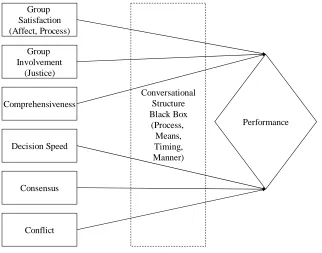
Figure 2.1:Permeation of Conversational Structure through Multiple Decision Making
Constructs
Performance Conversational
Structure Black Box
(Process, Means, Timing, Manner) Comprehensiveness
Conflict Group Satisfaction (Affect, Process)
Group Involvement
(Justice)
Decision Speed
Consensus
Thus, in sum, given that a conversation is “situated within specific contexts and
designed with specific attention to these contexts”, the utilization of audio recordings
presents a unique opportunity to investigate the decision making process as it occurs and
evolves in real time as opposed to relying on self-reported participant follow up data
(Goodwin & Heritage, 1990). Priem, Lyon, and Dess (1999) urged researchers to pursue
more difficult (and potentially more rewarding) integrations of qualitative research
methods into the existing quantitative landscape of top management and decision making
team research and a deeper examination of conversations through audio recordings
provides an avenue by which to engage in that pursuit. Prior research with questionnaires
and post-decision interviews has lacked the ability to accurately assess decision making
while reflection on a decision can be useful, the analysis of the process through audio
recordings may lead to different, not entirely participant response reliant, data and
conclusions and provide an easier, more formulaic pathway by which to analyze a
decision through the exact words and directives of the decision makers, a consideration
that has thus far been under explored and exists as a gap within the literature. Further, the
audio recordings also afford the opportunity to assess the more subtle elements of
discussion, such as pacing and sequencing, that would not be as easily observable in
post-activity administered surveys. Circumventing (and potentially eliminating) the need to
rely solely on self-reported data is a significantly valuable component of developing and
utilizing this methodology and helps to address the question of “how do higher
performing teams make better decisions?” through an examination of the structures of
CHAPTER THREE
RESEARCH OBJECTIVES
The characteristics of decision making can be affected by a wide variety of
conversational attributes, but for this dissertation, the focus is upon categories of
utterances and the structural properties and sequencing of comments, specifically the
diversity of conversational elements, properties that come from an analysis of the
categories of utterances and the processes of communication, not the direct content of
what is being uttered. The foremost goal is to use those components to answer the central
question of “How does the structure of a conversation impact the performance outcomes
of the decision that results from that conversation?” in order to gain a better
understanding of the “hows”, “wheres”, and “whens” of conversational structure, before
delving into the specific “whats” of the discussions themselves.
The core objective is focused on further examining the key processes of decision
making and integrating the fields of linguistics, communications, and conversational
analysis with management and strategy research in order to examine “old” (or enduring)
problems with a “new” (to the management and strategy fields) lens. Conversations are
dynamic, they unfold over the course of intra-group communications and while time is an
explicit property of conversational changes and patterns, no two conversations are exactly
alike temporally or structurally, and as such are best viewed and explored in the moment
and exhaustively as opposed to retrospectively and broadly. As noted, previous research
has relied heavily on assessing the decision making process through post hoc reviews,
usually through surveys following a meeting session, and analyzing conversations
research, an augmentation and improvement on current established practices. While the
post hoc approach has sufficed, it is not optimal and would significantly benefit from an
augmentation by means of real time analysis of decision making conversations.
Thus, an inductive approach, similar to the seminal late 1980’s works of
Bourgeois and Eisenhardt (Eisenhardt & Bourgeois, 1988; Bourgeois & Eisenhardt,
1988; Eisenhardt, 1989), was adopted for this exploration; the ultimate goal being to
utilize process driven approaches in order to elucidate testable and valid theories to
expand the understanding of how conversational and communicational variances within
decision making groups can influence and impact the ultimate successes and failures of
group decisions. As such, the very nature of such a study is inherently iterative and in a
constant state of construction, a building theme that consistently pervades the content and
evolution of this study. Not only does this work look to shed new light on top
management team decision making processes, but it would also introduce and employ
new means and methods of doing so in strategic management and organizational studies,
providing key methodological advancements in addition to expanding the existing
knowledge base.
Structure and Sequencing
Previous research has shown that, similar to individuals, decision making groups
can have prevailing cognitive processes, a phenomenon often referred to as group
strategic consensus (Klimoski & Mohammed, 1994; Axelrod, 1976; Prahalad & Bettis,
1986). Broadly, these collective processes are generally considered to be a “good” thing
assumed to be necessary to denote a logical, thorough, and adequately analyzed
discussion that leads to a reasonable conclusion (Schweiger, Sandberg, & Ragan, 1986;
Cosier & Rechner, 1985). Within each topic and across the entirety of the recorded
decision making process, there is a course that the conversation itself follows. While it is
simplistic to assert that words compose utterances which in turn compose conversations,
conversational variety pervades each of the indispensable steps within the exchange of
ideas and furthers the process of coming toward a consensus, also impacting decision
speed, comprehensiveness, and quality.
Collectively, conversational utterances are the core inputs that team members
perceive, interpret, and enact and those utterances shape the group decision making
process as they are funneled, filtered, and shaped by the experiences, cognitions, and
debates among the decision making team members. Thus, the decision conversation, as a
sequence of those conversational utterances, is the fundamental process that filters,
solidifies, and elaborates upon the raw decision inputs in order to produce decision
outcomes. As the ideas and utterances enter into the forum of discussion, some are
immediately disregarded, others are considered provocative and bantered about between
group members as part of the broader conversation, and ultimately only a select few
verbalized notions are able to overcome the obstacles and to be refined through
discussion and elaboration to the point of agreement and worthwhile utilization as a
decision outcome of the conversational process. There are barriers and hurdles to
overcome, and the various forms of resistance are not inherently discouraging, but rather
discussion that ultimately creates an accepted conversational process that becomes
pervasive throughout a group’s patterns of communication with each other.
Within a group, the sequence of a conversation is likely to be expected to follow a
general pattern, which will vary contingent upon the type of conversation and the nature
of the group or organization within which it is occurring. Some cultures may be strictly
business, others may prefer a lighthearted beginning to a conversation, and still others
may be more free flowing between directly relevant topics and tangentially related
subjects. Conditions such as roles, specialization, and the nature of the meeting itself
(regularly scheduled, emergency, etc.) can all impact the flow of conversation – the more
frequent the interaction, the greater the likelihood of an expected flow led by the
individual charged with leading the discussion (including a higher likelihood of strategic
consensus (Finkelstein, Hambrick, & Cannella, 2009)), while a less frequent interaction
could entail a more complex, unexpected topic and/or dynamic resolution that is driven
by a source other than the individual at the top of the hierarchy.
Essentially, with increased repetition of tasks comes the expectation of less
conversational utterance variety, and the less routine the conversation itself (such as a
high level, strategy focused, top management team planning session), the greater the
likelihood of a more dynamic and inherently less static conversation – a characteristic
which could impact or perhaps even supercede traditional roles, norms, and
conversational expectations. Thus, examples from previous literature, coupled with the
integration of conversational analysis techniques such as those utilized by Holmes
(1995), Holmes & Sykes (1993), Goodwin & Heritage (1990), Schweiger, Sandberg, &
(2000), worked to shape the construct of conversational variety, the attribute of
sequencing examined here. Conversations that do not feature a high degree of utterance
repetition (little successive matching or sequencing between the same consecutively
repeated type of utterance) would be high in conversational variety, but conversations
that do see a large degree of utterance repetition (though not necessarily always in direct
sequences as mentioned with optimal matching) would see conversational simplicity, low
CHAPTER FOUR
METHODS
Research Setting and Sample
The setting for the study was an experimental design involving MBA students
participating in a case study decision making simulation. Each team was provided with an
identical case study focused on a large American supermarket chain (Whole Foods
Market) facing increasing challenges from competitors and a changing consumer demand
environment as well as an identical subset of required, open-ended questions to answer
pertaining to the assumptions, strategic initiatives, and potential avenues through which
to implement suggested changes. The teams were charged with taking on the roles of
outside consultants to Whole Foods and given broad windows of time in which to
complete their recommendations on how the supermarket should approach the planning
surrounding their growth strategies and future prospects. The teams were not tightly
constrained in how long or short their conversation had to be, recording commenced as
the students entered their discussion room and ceased as they exited; average length of
discussion was 29.69 minutes, median 29.91, standard deviation 8.46 minutes, all teams
within two standard deviations.
Whole Foods has a uniquely constructed brand identity that focuses on a welcome
and exciting in store experience for consumers shopping for organic and natural food
products and a corporate culture that focuses on teamwork and organizational and store
fit for employees, while also discouraging unionization. While the chain has been very
successful, it has also faced increased competition from both similar (organic and natural
expanded their organic and natural product offerings in addition to continuing to carry a
more traditional mix of non-organic and processed food items. As a result of the
increased competition, Whole Foods has faced a number of strategic challenges such as
considering expanding their product offerings into clothing, continuing their premium
pricing, and maintaining food quality standards, all challenges that the student teams
considered when recommending strategies and implementation plans for the future of the
supermarket chain.
The sample of students contained 16 teams of 3-4 students each and each of the
students was already part of an existing work group as part of their required MBA
program curriculum. The groups had already worked together extensively for over four
months, were each of mixed gender compositions (although Verdi & Wheelan (1992)
found that gender composition has no influence on group development patterns), and had
both familiarity with each other individually and previous experience completing work
team simulations, making this experimental design an ideal one given those previous
projects. Previous studies by Gersick (1988, 1989) and Jehn (1997) have also utilized
qualitative techniques with small numbers (six-eight total) of teams or work groups.
The audio recordings were collected as a running dialogue from each of the
groups by laptop computer and smart phone microphone recordings and were then
uploaded to the research team database before being transcribed into document form. The
verbal utterances of the conversations were used as the primary unit of observation to
establish the sequential patterns of conversation and to better capture the process of
as the core unit of analysis provides an easier, more formulaic pathway by which to
analyze a decision through the exact words and directives of the decision makers.
Mixed Methods Approach
A mixed methodological approach was selected for this study to assess both
qualitative and quantitative aspects of conversations and their impact on assessed team
performance. Utilization of both aspects was done in order to provide a more complete
assessment of findings and to mitigate the limitations of the individual types (principally
the challenge of generalizability with qualitative methods and the loss of detail with
quantitative methods) (Creswell & Clark, 2011, p. 8). Qualitative assessment is essential
in order to clearly capture the variety of the individual teams’ conversations, an element
which is of critical importance to this study (Ragin, 1987).
Broadly, there are two primary types of mixed methodological studies: “mixed
collection studies, which combine two or more kinds of data; and mixed
data-analysis studies, which combine two or more analytical strategies, examine qualitative
data with quantitative methods, or explore quantitative data with qualitative techniques”
with this exploration focusing on the mixed data-analysis approach, specifically assessing
qualitative data with both qualitative and quantitative methods (Small, 2011, p. 57).
Given the very nature of speech itself, a conversation is highly qualitative and interactive
in nature, beholden to the interpretations of the individuals participating in the
interactions and those outsiders who may observe the conversation without directly
participating in it. As such, and coupled with each individual utterance being used as a
spoken sequences in multiple methodological ways, with quantitative analysis supporting
qualitative observations as noted by Small (2011), who used quantitative surveys to
support qualitative interview findings, and Creswell and Clark (2011) who stated: “it is
best to explore qualitatively to learn what questions, variables, theories, and so forth need
to be studied and then follow up with a quantitative study to generalize and test what was
learned from the exploration” (p. 9).
Dimensions of Conversations
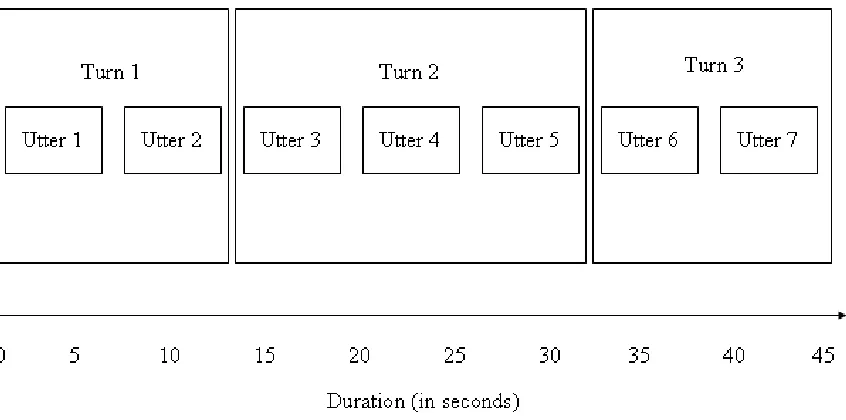
The basic dimensions of descriptive characteristics were broken down into several
measurable variables including counts of total utterances, total turns, and total length of
conversation in minutes. The counts of utterances were done irrespective of utterance
type; every sentence that was spoken was counted as a separate unit for analysis. Turns
were counted as the number of consecutive (uninterrupted by another speaker) sentences
spoken by a group member, again irrespective of the type or types of utterances spoken in
that turn. As these are the foremost building blocks of conversations, generating a
baseline understanding of the outermost skeleton of the conversations themselves is vital
to better understanding the more complex inter-workings of dialogue. An illustrative
Figure 4.1: Basic Dimensions of Conversation
From those utterance, turn, and minute length counts, several descriptive ratios
were then calculated: Utterances per turn, Utterances per minute, Turns per minute, and
Average duration of turn (in seconds). Each of these ratios were calculated as the titles
would suggest, respectively; the number of total utterances of a team’s discussion was
divided by the number of total turns, the number of total turns was divided by the length
of the conversation in minutes, the number of turns was divided by the length of the
conversation in minutes, and sixty seconds was divided by the average number of turns
per minute to give an average of the length of each uninterrupted spoken turn.
Utterance Categorization Methodology
The categories of utterances were delineated through a series of integrative steps
building upon each other and refining the number and classifications of categories across
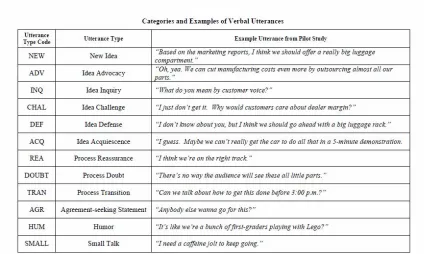
multiple steps. An initial group of categories outlined below in Table 1, influenced by
Schegloff, 2007), was taken from a pilot study simulation conducted by this exploratory
study’s research supervisor that was related to, but separate from, this study. In that pilot
study, student groups were asked to work together in a strategic, multifunctional task to
create a new type of car out of Lego building block pieces, considering elements of
marketing, strategic positioning and car features, and then build a functional Lego
prototype of their design. The decision making sessions were recorded on audio files and
the resulting coding in Table 4.1 was utilized to provide a baseline from which to build a
set of utterance categorizations to be used in this analysis.
Table 4.1: Initial Categories
Those pilot study categories were subsequently compared to additional prior work
from management research and the fields of linguistics, psychology, speech and
Ting-Toomey (1983), Bales (1950), Poole, Folger, & Hewes (1987), Hewes (1979), Poole,
Seibold, & McPhee (1985), and Chang, Bordia, & Duck (2003). Further, the Group
Working Relationship Coding System (GWRCS) developed in Poole (1983) and Poole &
Roth (1989) (as well as used extensively (and most pertinently to this study) in Poole &
Dobosh’s (2010) work on the conflict management processes and interactions that
occurred within a group of jury deliberations) was utilized as a guiding framework for
both category development and study design. The GWRCS (which includes categories of:
focused work, critical work, opposition, open discussion, capitulation, tabling, and
relational integration) was used in Poole & Dobosh (2010) as a means of studying within
group interactions, particularly focusing on confrontations or conflicts between members
during discussions, and coded those interactions in 30-45 second segments. That style
was adapted here from a set temporal unit to single utterances as the unit of investigation
in order to generate more frequent and voluminous data, as well as more specific and
finely grained measurements. A composite coding scheme of the groups detailed above
was created to reconcile the approaches into a single framework of potential categories
for this investigation.
Once the overlaps and discrepancies between the approaches were noted, the
broad findings were presented to an exploratory coding group of five doctoral students
for discussion and brainstorming. Those five students were then asked to independently
create their own coding scheme for a sample audio file, based in part on the presented
categories but also with integration of any additional categories that the individual coders
felt should be included that were not represented in the preliminary categories. The
individual exploratory group members and those categories were then submitted to the
primary researcher and overlaid by the primary researcher in a consecutive rolling
format, first comparing two members’ categorizations, then comparing that coupled
composite to another member’s categorizations, then comparing that new three member
composite to the fourth member’s categorizations and so forth. The rolling format
allowed for a consistent, multi-faceted and multi-tiered approach that sought both general
consensus on terminology, as well as consensus on the type of utterance; for example, if
both parties of coders considered a given utterance to be an “A” type of statement, that
utterance was categorized as an “A” statement, and if every “B” statement for one party
was called an “C” statement by another party (overarching agreement on categorization
but utilization of a different terminology by an individual), then for internal consistency
all “C” statements were recoded as “B” statements so as to provide clarification without
losing richness.
Remaining reconciliations, necessary when disagreements persisted beyond direct
agreements and terminological clarifications, were then assessed by the primary
investigator who qualified each remaining disagreement, in some cases combining
categories constructed by exploratory coders and in others creating a new category to
combine two of the exploratory coder’s categories. Upon completion of the composite set
of categories, another meeting with the five member doctoral student coding group was
convened and the composite set was presented for their discussion, debate, and approval,
and at the conclusion of that meeting and completion of the remaining reconciliations,
seven categories were submitted by the primary investigator to the exploratory group for
categorization title and defining parameters of each utterance type and the developed
coding scheme was then submitted to a separate, independent coding pool who was not
involved in the category construction process for categorization of all audio files
according to the developed coding scheme.
Categories of Utterances
Across the multiple team samples, certain categories of utterances become more
obvious and displayed consistency as part of the decision making process. Reflecting the
rolling coding format and subsequent reconciliations, the following seven categories were
selected and then approved by the preliminary five doctoral student coding group for the
final coding scheme, with definitions, parameters, and broad examples included to serve
as guidelines for subsequent transcript coding:
Agreement: Phrases such as “I agree” “I like that” “I feel the same way” and “I
couldn’t have said it better myself” or a direct restatement of another speaker’s assertion
in the affirmative all serve to encourage a speaker to continue with the expression of their
ideas and to demonstrate that those ideas have the support of other members, facilitating
an increase in the idea sharing process.
Challenge: Phrases such as “I don’t know about that” “That doesn’t seem right”
“I’m afraid that’s wrong” and “How can that be?” all serve to call into question the
validity of the point of an initial speaker. While not inherently negative, these phrases can
serve to drive the conversation forward and potentially alter the direction if at least one
party isn’t comfortable with the path one group member is heading down in regards to the
Elaboration: Phrases such as “I feel that this makes sense due to…” “I think it is
option A because…” “I considered two choices but felt this one was the best in light
of…” and “What I was trying to say at first was…” all serve to more clearly elucidate the
initial topic matter for continued discussion; from a contextual perspective, elaboration
statements serve to support a central theme, which could be affirmative of, or
contradictory to, an initial statement, and are a type of utterance that provide additional
insight beyond just a direct response or introduction of a new idea.
New Idea: Phrases such as “One of my ideas was…” “Maybe we should
consider…” “Building on that previous point, another direction we could explore is…”
and “I’m just throwing this out there, but…” all serve to introduce a new initial topic and
to facilitate discussion around that topic, with possible reconsideration or affirmation of
previous topics that could be related to the new idea. While a new idea could have some
elements of overlap with prior discussions, it presents enough of a departure from an
existing stream of conversation to serve as a new focus and central discussion point for
the subsequent flow of conversation that follows it.
Proceeding: Phrases such as “Alright, the first thing we should discuss…” “The
next item on the agenda” “I think we should come back to that” and “It’s time for us to
rank our options” all serve administrative functions to keep the discussion group on
course and focused on the central goals of the discussion itself. Requests for tabling or a
re-examination of a previously closed topic of discussion are also considered proceeding
statements as they are inherently procedural and deal with moving the discussion forward
but also serve as a reminder of the focal components of the conversation, to reach a
Questioning: Phrases such as “What if we…?” “How do we justify…?” “Are you
holding out on us?” and “Which ones do you mean?” all serve to stimulate further
conversation and draw the participants deeper into the discussion. These phrases are
utilized to stimulate conversation, incite emotions or reactions, and to create a response,
thereby facilitating a more impassioned debate over the issue at hand.
Relational Integration: Phrases such as “Did you see the game last night?” “I saw
the cutest puppy this morning” “I really love your sweater, I have one just like it” and
“We should all get together and share a pizza sometime” all serve to engender positive
emotions for the decision making team and to increase camaraderie amongst the group’s
members. Instances of small talk, off topic conversation, and the utilization of humor
through either stories with anecdotes or group inside jokes all have the purpose of
providing brief (and in some cases, sustained) moments of levity to the discussion itself,
facilitating intra-group engagement beyond just the tasks at hand and humanizing the
group members as they work towards their collective goal.
Categorization by Independent Coders
Upon establishing the final coding scheme and seven categories, three
independent graduate student coders from a diversity of campus programs (educational
psychology, diplomacy, and merchandising) were selected, trained, and given access to
the complete set of audio file transcripts. The coders were trained by the primary
investigator in accordance with the established coding guidelines and each of the three
worked independently to code each of the sixteen teams’ audio files in their entirety
were then compared to create a single composite file that was used in subsequent
analyses; out of 6577 total verbal utterances across all 16 teams, all three coders agreed
on categorizations in 2672 (40.63%) instances and at least two of the three agreed in 6133
(93.25%) instances. The remaining 444 (6.75%) cases were then assessed by the primary
investigator and dissertation committee chair to reach consensus on which category those
utterances best fit into, giving every coded utterance a 2/3 or 3/5 majority decision for
successive analysis. For all 6577 utterances, Fleiss’ Kappa score was .455, Cohen’s
Kappa .459, and Krippendorf’s Alpha .455.
The reconciled independent coder assessments of each utterance were then
tabulated by individual type, creating a sum total of each category of utterance for each
team, building on the construct of utterances by specifying which types were most and
least represented in the population. Subsequently, the category counts were then divided
by the teams’ total utterance counts to provide a standardized percentage of the given
team’s discussion population of each utterance type. These coded utterances were then
utilized in examining the quantitative variety measures.
Variety Measures - Quantitative
Variety scores for each team were calculated in an iterative manner, using a
rolling assessment of total utterances of a given type as a percentage of the number of
elapsed utterances of the conversation to that point of the discussion. Conversational
utterance variety contains elements of dialogue that mirror competitive actions and
holistic Gestalt psychology (as applied by Rindova, Ferrier, & Wiltbank, 2002 and
reveal trends within a conversation, with tempo serving as a consistent standard for
temporal observations (Chen, Smith, & Grimm, 1992; Ferrier, Smith, & Grimm, 1999;
Miller & Chen, 1996). This aggregated set of spoken utterances over the duration of a
team’s conversation compares favorably to action-repertoire analysis (Ferrier, 2001;
Ferrier & Lee, 2002) as well as the sequential analysis of pattern recognition and
unfolding (Schegloff, 1984, 1987, & 2007; Simon & Kotovsky, 1963; Simon & Sumner,
1968; Simon, 1972; Abbott, 1990; Pettigrew, 1992a & 1992b; Van de Ven, 1992).
Using the Herfindahl-Hirschman Index, the percentages were then squared and
summed, and the square root of that total was subtracted from one (1) in order to achieve
a running assessment of how similar the value was to itself over the course of the
discussion; the lower the running total, the less varied (similar to itself) the conversation
was to that point. Longer sequences of “sameness” would drive the variety score lower
(branding the conversation as more simple), as the total score would reflect higher
concentrations of fewer categories, and more varied distributions of utterances across
categories would drive the variety score higher as a result of the increased variance in
utterance types spoken. The groups’ final variety scores, the scores as of the last utterance
of a specific group’s conversation, were used to assess the overall variety of their
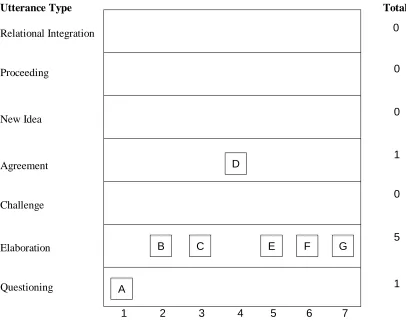
conversations. Two example conversation slices and transcripts, one of lower and one of
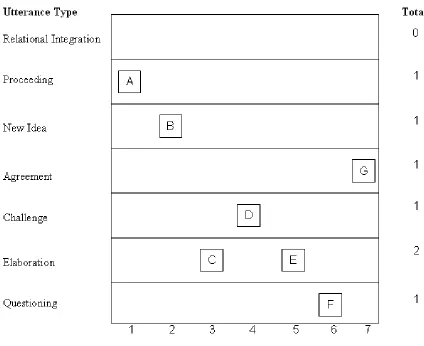
Figure 4.2: Example of Simple (Lower Variety) Conversation
1 2 3 4 5 6 7
Utterance Type Total
Relational Integration
Proceeding
New Idea
Agreement
Elaboration Challenge
Questioning A
G F
E D
C B
0
0
0
1
0
5
1
Utterance A (Questioning): “Which one do we think would generate the most new customers?”
Utterance B (Elaboration): “None of them are really focused on generating more customers.”
Utterance C (Elaboration): “They’re more on improving what we already do to make it better.”
Utterance D (Agreement): “You’re right.”
Utterance E (Elaboration): “I forgot one of the objectives was customer focus.”
Utterance F (Elaboration): “A big objective is a strategy for the whole store.”
Figure 4.3: Example of Diverse (Higher Variety) Conversation
Utterance A (Proceeding): “So we need to make a list of strategic recommendations.”
Utterance B (New Idea): “I think the most important thing is more TV advertising.”
Utterance C (Elaboration): “They’re not reaching their customers with the radio ads.”
Utterance D (Challenge): “But TV advertising is more expensive.”
Utterance E (Elaboration): “They’re trying to cut costs, not add them.”
Utterance F (Questioning): “But don’t TV ads have a broader customer reach?”
Utterance G (Agreement): “They do, that helps offset the additional cost.”
each team (controlling for the elapse of the first 10% of the conversation), and a time to
conversational flat-line (determined by constructing an overall 5% range, between 2.5%
above and 2.5% below, the final variety score and establishing at which number of
utterance, and thus percentage of the total conversation, the given team’s discussion was
last outside that range – vis-à-vis that the discussion had “flat-lined” similar to a heart
monitor when a heartbeat stops).
Variety Measures – Qualitative
Sequential time series variety score plots were utilized to provide a qualitative
component of analysis to augment the quantitative calculations. Adapting qualitative
techniques developed by Monge (1990), the sequenced plots were classified by their
exhibition of an overall directionality of the conversational trend over time (decreasing
variety, “U” shaped (sustained period(s) of decreasing followed by sustained increasing)
variety, consistent (largely flat, low variation) variety, and increasing variety) and the
smoothness of pattern interchange between sequential series of utterances (contrasting a
rough, jagged, or saw tooth like pattern to a smoother, less jagged, or sinusoidal pattern).
The plots were then grouped by visual similarities along these parameters, fitted to a
collective trendline with their other similar plots, and the grouped plots were then
compared to their requisite teams’ performance scores and ranks.
The plots were grouped in order to determine if any similarities between the plots’
patterns and trends also lent themselves to similarities in assessed group performance
success or lack thereof, to examine the degree that process conformity may play in group
principles of Gersick’s (1988, 1989, 1991) theory of punctuated equilibrium, which,
similar to this study, used natural workgroups and problem solving groups in a laboratory
based setting. If the groups demonstrated decision making processes similar to Gersick’s
model, it would be expected to see long periods of inertia (herein an initial decrease of
conversational variety score toward a simpler, more similar conversation type and a
general maintenance of that “sameness” in lack of utterance variety) punctuated by
periods of radical change (a rapid influx of utterance types not initially utilized by a given
group) as the discussion focused on the key decision elements that required greater
thought, discussion, and discourse between group members. By assessing the variety
scores in a qualitative manner, performance comparisons can be made both between
groups, for uniformity of performance measures, as well as to the punctuated equilibrium
model to assess the merit of punctuated conversational change as opposed to consistent
variety of conversational discourse throughout the entirety of a group’s recorded
discussion.
Performance Ratings by Independent Expert Assessors
Concurrent with the student coders completing their categorizations of the team
responses, four expert performance raters (two business faculty members and two area
business professionals) were selected to assess the action plans and strategic
recommendations of the sixteen student groups. As part of the exercise, the student
groups were asked to provide a list of the assumptions they considered when making their
strategic recommendations, and from those assumptions and strategic recommendations
strategic recommendations, and implementation plan were the core deliverables from the
student teams and each team was rated independently on each of those three categories by
each of the four expert performance raters on a 1-5 scale, with one being “ineffective,
infeasible, or irrelevant” and five being “effective, feasible, and relevant” to the core task
of organizational strategic planning. A brief example is seen below in Figure 4.4; the core
questions that appeared on the student handouts and the individual team assumptions,
recommendations, and implementation plan responses for each team are included in
Figure 4.4: Example of Core Questions and Team Responses
Core Questions on Student Handouts
1. What are the assumptions that your team considered about the situation Whole Foods
(Grocery chain) finds itself in?
2. List your strategic recommendations and rank in order of importance and potential
impact.
3. What exactly will it take to implement your most important, highest ranked strategic
recommendation?
Team 1 Responses
Assumptions
1. People will want organic foods if it’s available; there’s a large market for all organic
products, not just foods because at the end they started with the organic clothing or
whatever.
Strategic Recommendations
1. Have cards, similar to Kroger, that track what customers are buying to make sure that
they have the products that the customers want
Implementation Plan
1. The Kroger card idea, given that customers are already used to that technology. We
can gather a lot of data on what the customers are doing and individualize our direction
The performance scores for each team were then averaged across the four expert
raters for each individual category and totaled for an overall score, as well as ranked
using a simple points system where the team receiving the highest score for each coder
was awarded 16 points, the second highest 15, and so forth. Ties were grouped into tiers;
if one performance rater had a tie for highest score, both of those student teams were
awarded 16 points, with the third highest score still receiving 14 points (with subsequent
tiers evaluated in the same fashion) and the individual raters’ scores then being totaled to
achieve a composite team ranking score with the final rankings determined by team point
totals sorted from highest to lowest (highest scoring team being ranked number one). In
the event of ties in the composite team rankings, the overall (raw, non-ranked) average
scores were used to break the ties in the rankings.
Additionally, establishing a set of performance rankings allows for the utilization
of Spearman’s rank correlation in addition to Pearson’s. This is a key consideration for a
study of this nature where the relationship between group performance ratings and the
other variables of interest may not be linear, as Spearman’s rank correlation is less
sensitive to outliers than Pearson’s and provides a nonparametric coefficient that can still
provide the positive or negative directionality of the relationship (Spearman, 1904; Myers
and Well, 2003). Preserving that directionality is essential given the potential for large
outliers within the performance score averages. The raters’ performance score averages,
point totals, and rankings can be seen in Table 4.2. Total score, total points, and total rank
signify the composite score of assumptions, strategic recommendations, and
implementation plans, with the individual comparisons for assumptions, strategic
CHAPTER FIVE
ANALYSIS
The primary quantitative variables of interest fall into three major categories:
Basic Dimensions of Discussion Descriptive Characteristics, Counts of Utterance Types,
and Conversational Variety Structure Constructs (which include both quantitative and
qualitative measures). Each of these three broader categories, as well as the individual
variable components that comprise them, are compared to both each other and the
aforementioned performance scores and rankings in order to assess the outcomes of
group decision quality and the implementation viability of each individual team’s
suggested strategic recommendations. Additionally, while the primary qualitative
assessments of variety are also considered conversation structure constructs, they will be
explicated in a separate section.
Quantitative Assessments
Basic Dimensions of Discussion Descriptive Characteristics
The basic dimension measures were utilized to provide a baseline for subsequent
analysis and to compare the lengths of the group conversations in both absolute and
standardized ways, given that the groups had significantly varied lengths of discussion
durations and amounts of both utterances and turns. These measures can be seen in their
Table 5.1: Descriptive Measures
Team Utter Turn Utter/Turn Utter/Min Turn/Min
Turn
Duration Min
1 403 217 1.9 9.8 5.3 11.4 41.2
2 414 259 1.6 13.9 8.7 6.9 29.8
3 570 352 1.6 14.8 9.1 6.6 38.5
4 288 172 1.7 16.7 10.0 6.0 17.2
5 287 90 3.2 7.3 2.3 26.2 39.4
6 324 128 2.5 11.8 4.7 12.9 27.5
7 271 187 1.4 15.8 10.9 5.5 17.2
8 265 144 1.8 9.5 5.2 11.6 27.8
9 454 248 1.8 15.8 8.6 7.0 28.8
10 327 222 1.5 15.4 10.4 5.7 21.3
11 450 228 2.0 15.0 7.6 7.9 30.0
12 422 264 1.6 14.0 8.7 6.9 30.2
13 229 139 1.6 14.5 8.8 6.8 15.8
14 795 438 1.8 20.1 11.1 5.4 39.6
15 620 368 1.7 16.0 9.5 6.3 38.7
16 458 243 1.9 14.3 7.6 7.9 32.0
Average 411.1 231.2 1.9 14.0 8.0 8.8 29.7
Median 408.5 225.0 1.7 14.6 8.7 6.9 29.9 St. Dev. 150.86 93.38 0.44 3.12 2.49 5.18 8.46
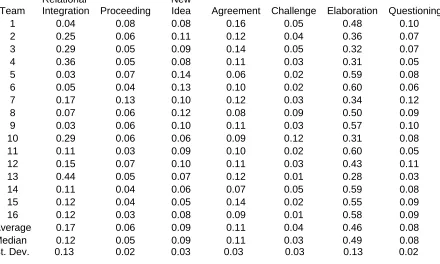
Counts of Utterance Types
The overall sum percentages of the teams’ discussion population utterance counts,
similar to Poole & Dobosh’s (2010) distributional structure construct, can be seen in their
Table 5.2: Percentage of Team Discussion by Utterance Count
St. Dev. 0.13 0.02 0.03 0.03 0.03 0.13 0.02
Conversational Variety Structure Constructs
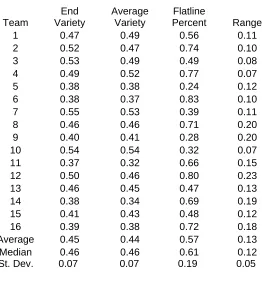
The variety calculations can be seen in their entirety in Table 5.3. The rolling,
sequential variety scores were also then plotted as a time series in order to create a set of
visualizations for qualitative assessments (discussed further in a subsequent section). Team
Relational
Integration Proceeding
New
Idea Agreement Challenge Elaboration Questioning
1 0.04 0.08 0.08 0.16 0.05 0.48 0.10
2 0.25 0.06 0.11 0.12 0.04 0.36 0.07
3 0.29 0.05 0.09 0.14 0.05 0.32 0.07
4 0.36 0.05 0.08 0.11 0.03 0.31 0.05
5 0.03 0.07 0.14 0.06 0.02 0.59 0.08
6 0.05 0.04 0.13 0.10 0.02 0.60 0.06
7 0.17 0.13 0.10 0.12 0.03 0.34 0.12
8 0.07 0.06 0.12 0.08 0.09 0.50 0.09
9 0.03 0.06 0.10 0.11 0.03 0.57 0.10
10 0.29 0.06 0.06 0.09 0.12 0.31 0.08
11 0.11 0.03 0.09 0.10 0.02 0.60 0.05
12 0.15 0.07 0.10 0.11 0.03 0.43 0.11
13 0.44 0.05 0.07 0.12 0.01 0.28 0.03
14 0.11 0.04 0.06 0.07 0.05 0.59 0.08
15 0.12 0.04 0.05 0.14 0.02 0.55 0.09
16 0.12 0.03 0.08 0.09 0.01 0.58 0.09
Average 0.17 0.06 0.09 0.11 0.04 0.46 0.08
Table 5.3: Variety Calculations
Team
End Variety
Average Variety
Flatline
Percent Range 1 0.47 0.49 0.56 0.11 2 0.52 0.47 0.74 0.10 3 0.53 0.49 0.49 0.08 4 0.49 0.52 0.77 0.07 5 0.38 0.38 0.24 0.12 6 0.38 0.37 0.83 0.10
7 0.55 0.53 0.39 0.11
8 0.46 0.46 0.71 0.20 9 0.40 0.41 0.28 0.20 10 0.54 0.54 0.32 0.07
11 0.37 0.32 0.66 0.15
12 0.50 0.46 0.80 0.23 13 0.46 0.45 0.47 0.13 14 0.38 0.34 0.69 0.19 15 0.41 0.43 0.48 0.12 16 0.39 0.38 0.72 0.18
Average 0.45 0.44 0.57 0.13
Median 0.46 0.46 0.61 0.12
St. Dev. 0.07 0.07 0.19 0.05
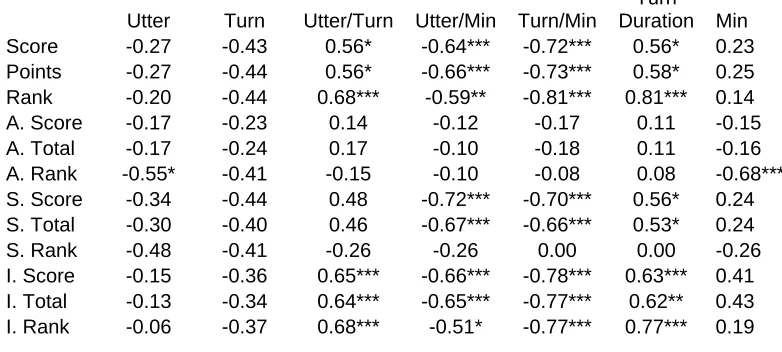
Quantitative Insights
From the variables of interest noted above, correlations with the assessed
performance ratings of score and ranking were run with each of the variables, in order to
see what metrics could be used to build an underlying theory of what conversational
processes and characteristics could be predictors of successful (higher quality, better rater
assessed performance) decision making. Given the iterative nature of the aforementioned
building blocks of conversational process, each of the team discussion descriptive
characteristics, the utterance type counts, and the conversation structure constructs were
compared to the performance assessments and all of the quantitative assessment types