1
A SYSTEMS FRAMEWORK FOR PROJECT-BASED
TRANDISCIPLINARY EDUCATION AND RESEARCH TRAINING
IN SUSTAINABLE DEVELOPMENT
Timothy Ehlinger1,3, Mirela Bucur2 and Lucica Tofan2
1Partnership for Sustainability and Peacebuilding, University of Wisconsin-Milwaukee,
Milwaukee Wisconsin, USA
2Department of Biology, Ecology & Geography, Ovidius University Constanta, Constanta, Romania
3contact: [email protected]
Abstract
Conceptualizations of sustainability have evolved from early ideas of steady-state resource management to embrace more complex approaches that incorporate dynamic models of social-ecological systems. This progression moves beyond consideration of practical interconnections among the “Three Pillars” (i.e. “People, Planet, Prosperity”), towards integrated research on social-ecological resilience and the capacity for systems to cope with uncertainty. However, addressing the problems of sustainability, resilience and vulnerability of the ecosystem services requires frameworks capable of bridging across traditional disciplines to foster functional literacy with the concepts, patterns, processes and feedbacks among biophysical, social and institutional domains. The need to train students to think across disciplines presents significant challenges for traditional academic departments, which often compete for limited resources that are allocated in direct proportion to the number of students they can recruit into their discipline.This paper presents an analysis of the effectiveness of an international university undergraduate study-abroad program in developing interdisciplinary thinking and trans-disciplinary competencies related to sustainable development. The International Research Experience (IRES) collaborative summer program between the University of Wisconsin-Milwaukee and Ovidius University-Constanta program brought together students from diverse disciplinary backgrounds to study Integrated Coastal Zone Management and planning along the Black Sea Coast. Students worked collectively during 6-week sessions to develop sustainable redevelopment plans for a coastal lake social-ecological system. Romanian and US students researched topics ranging from surveys of stakeholder values, traffic patterns, aquatic ecology and landuse, to ecotoxicology and biodiversity. Studies were formulated into an integrated management plan presented at an international conference at the end of each summer of the 4-year program. Student surveys, group concept and system mapping, reflective journals, team presentations, and interviews given before and after each summer were used to assess student achievement of specific learning goals and objectives related to sustainable development. The effectiveness of the IRES program in developing transdisciplinary thinking was examined and differences relative to disciplinary background and preparation were explored. On average student self-evaluation scores were significantly higher for students following their participation in the summer IRES program, and compared to students who participated in a course on sustainable development not involving study-abroad.
Introduction
As the pressures placed on limited resources by growing human populations combine with the unpredictability wrought by climate change, policy makers increasingly look to scientists for predictions on how the magnitude of environmental stressors will impact ecosystem health, human security, and socioeconomic systems. The challenge, in turn is for scientists to be able to incorporate into their research an awareness of the complex ways that biophysical domains interact with socio-cultural and institutional landscapes 1. Unfortunately, the disciplinary compartmentalization and epistemological barriers which characterize universities 2 present challenges for fostering opportunities for transdisciplinary educational and research training 3. The education of global environmental scientists requires building the capacity for cross-cultural sensitivity and collegiality that spans biological, social, and political sciences4-6. Global poverty, inequity
IJCC
S
EC Volum
e 2, Issu
e 2
2 and powerlessness are now recognized as crucial problems contributing to violence, terrorism and political instability around the world today, and the training of global scientists equipped with social science skills to participate in these projects, represents an investment in global security. For example, Sherren 7 identified four key areas in need of attention for improving sustainability education, including the need for students to be able to:
1. Span the range of spatial scales between diverse phenomena; 2. Account for both the temporal inertia and urgency of processes;
3. Deal with functional complexity such as multiple interacting environmental stressors;
4. Recognize the wide range of outlooks regarding what makes knowledge usable within both science and society.
The use of multidisciplinary project-based education has become a popular practice for promoting transdisciplinary thinking for sustainable development, particularly in engineering programs8-11. In addition, study abroad programs have increasingly incorporated sustainability as the conceptual basis for curriculum integration12-14. This paper presents the results of a multi-year project that integrated project-based sustainability education and research training with an international university undergraduate study-abroad program. The goal of the project was to develop interdisciplinary thinking and trans-disciplinary competencies related to sustainable development.
Program Framework: Transdisciplinary Concepts, Systems, Models and Risk
The International Research Experience (IRES) was a collaborative summer program between the University of Wisconsin-Milwaukee and Ovidius University-Constanta sponsored by the US National Science Foundation from 2006-2009. The program brought together U.S. and Romanian students from diverse disciplinary backgrounds to study coastal zone management and planning along the Black Sea Coast. The diverse issues involved in Integrated Coastal Zone Management (ICZM) provide an excellent heuristic for conducting international and cross-disciplinary research and education15. The dynamic environmental, social, political and economic systems of the Balkan region, combined with on-going institutional reforms associated with accession into the EU, create numerous opportunities for development and testing models of stressor-response relationships, risk assessment, and the integration of knowledge-based decision support systems into policy development and management. In preparation for each year of the IRES project, students were introduced to sustainable development as a “boundary concept” to foster transdisciplinary thinking16. Coastal zones served as the “boundary object” around which the diversity of perspectives could be engaged in discussion. ICZM
was engaged as the “boundary setting” for the process of transdisciplinary problem
formulation and research integration17,18.
Four concept themes were developed and carried through the course of the project, including: (1) Systems Mapping, (2) Risk Propagation Modelling, (3) Risk Perception, and (4) Stakeholder Participatory Research.
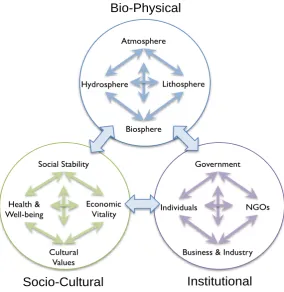
Systems Mapping: The social-ecological problems of coastal zones are not simple, having formed over the centuries by complex interactions among natural and anthropogenic processes (Figure 1)19. Society, economic forces, and institutional policies weave a
IJCC
S
EC Volum
e 2, Issu
e 2
3 complex pattern of cause and effect with the physical and biological environment within which cultures evolve, accentuating the need to develop new approaches to problem solving that are as responsive to culturally distinctive – and often competing – meanings and valuations as they are to the generalizable models of the sciences.
The learning goal for the IRES research program was for students to work together in interdisciplinary groups to develop frameworks to using the concepts of integrated risk assessment20. The specific objectives were to develop the skills required to interconnect information and knowledge from across disciplinary boundaries in order to both characterize and evaluate risk, and to understand how the assessment and perception of risk influences the utility of that knowledge to inform policy decisions.
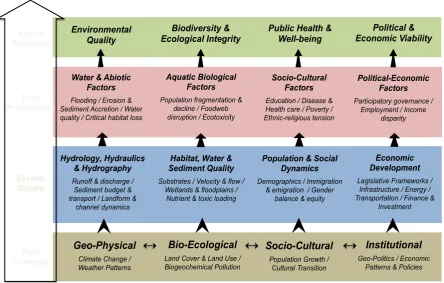
Risk Propagation Modeling (RPM): Education and research concepts were organized around the principles of Risk Propagation Modeling21. RPM provides an analytical framework through which impact endpoints are mapped to root stressors using a layered hierarchical model (Figure 2). The model assumes that the probabilistic relationships between layers are modified due to various anthropogenic and natural impacts. Propagation Models typically consists of 4 layers; (1) Root Stressors that act on a global, regional or local scale which may or may not be associated with human activity; (2) Drivers of change that create exposure to risk factors, which are often the target of management activities; (3) Risk Probabilities associated with exposures, which are typically expressed by numerical probabilities of undesirable hazards; and (4) Impact Endpoints that reflect measures of ecosystem-related goods and services of value to the public (i.e. indicators of valued environmental, economic and social-cultural assets).
Atmosphere
Hydrosphere Lithosphere
Biosphere
Social Stability
Health &
Well-being Economic Vitality
Cultural Values
Government
Individuals NGOs
Business & Industry
Bio-Physical
Socio-Cultural Institutional
Figure 1: Interacting systems that contribute to the complexity of issues relating to Integrated Coastal Zone Management
IJCC
S
EC Volum
e 2, Issu
e 2
4 As part of their work, multidisciplinary student teams were challenged to develop cognitive maps and systems models for cause, effect and feedback loops. They were challenged to critique the benefits and shortcomings RPM, and to expand their lists of factors included in the models. For example, would changes in economic and social impacts accrue only via risk propagated through environmental domains? Or would linkages in the socio-economic domains also link different root stressors to economic and social impact endpoints (e.g. Figure 1, bottom). This challenge is particularly important for coastal zones where the intensity and consequences of cause-effect relationships are intensified by increasing populations, political divisions & conflicting policies leading to poorly coordinated planning for investment and infrastructure, which in turn generate economic, social & environmental risk15.
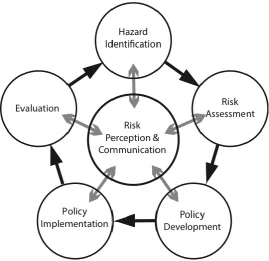
Risk Perception: The move towards using sustainability principles in decision making for policy and planning in coastal zones requires the incorporation of social and economic factors in risk assessment22,23 and has generated a need for research on how risk is perceived and communicated throughout the “Risk Management Cycle”(Figure 3)24. An understanding of how different stakeholders perceive, gather, process and communicate information about risk is central to all aspects of environmental management. The unique innovation the IRES program was the conceptual integration of risk propagation with risk perception and communication within a ICZM assessment framework.
Geo-Physical Climate Change / Weather Patterns
Bio-Ecological Land Cover & Land Use / Biogeochemical Pollution
Socio-Cultural Population Growth /
Cultural Transition
Institutional Geo-Politics / Economic
Patterns & Policies
Hydrology, Hydraulics & Hydrography
Runoff & discharge / Sediment budget & transport / Landform &
channel dynamics
Habitat, Water & Sediment Quality
Substrates / Velocity & flow / Wetlands & floodplains /
Nutrient & toxic loading
Population & Social Dynamics
Demographics / Immigration & emigration / Gender
balance & equity
Economic Development
Legislative Frameworks / Infrastructure / Energy / Transportation / Finance &
Investment
Water & Abiotic Factors
Flooding / Erosion & Sediment Accretion / Water quality / Critical habitat loss
Aquatic Biological Factors
Population fragmentation & decline / Foodweb disruption/ Ecotoxicity
Socio-Cultural Factors
Education / Disease & Health care / Poverty / Ethnic-religious tension
Political-Economic Factors
Participatory governance / Employment / Income
disparity
Environmental Quality
Biodiversity & Ecological Integrity
Public Health & Well-being Political & Economic Viability Risk Probabilities Impact Endpoints System Drivers Root Stressors
Figure 2: An example of layered hierarchical Risk Propagation Model (RPM) used for exploring ICZM processes for the Romanian Black Sea Coastal Zone
IJCC
S
EC Volum
e 2, Issu
e 2
5
Stakeholder Participatory Research: On average of 10 undergraduate students from the United States were selected to work with 6 Romanian students each summer. The IRES program consisted of three components: (1) Seminars and workshops on topics related to Romanian history, culture, language and research skills held in Milwaukee 2 weeks prior to departure; (2) Educational and project-based research activities in Romania; and (3) Post project presentations and reflections. Each summer, several potential locations were identified as potential project sites.
Over the 4 years of the IRES, projects included for example, (1) land use and water resources planning for sustainable ecotourism in the village of Sf. Gheorghe in the Danube Delta, (2) integrated watershed management for flood risk, nutrient runoff, groundwater protection and fisheries protection in the Casimceă River – Lake Tașaul Watershed; (3) Integrated planning for ecological restoration and socio-economic revitalization of Lake Tabacărie, Constanta on the Black Sea coast.
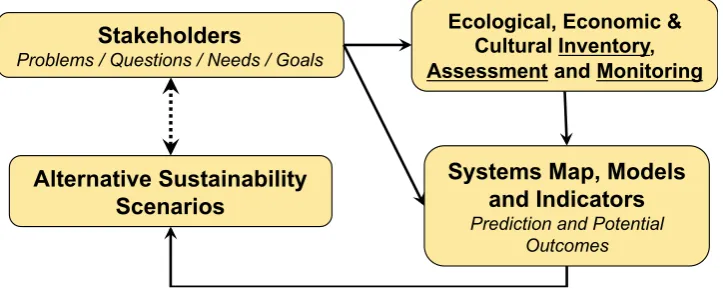
Once in Romania, students would conduct background investigations and interviews with local stakeholders to learn more about their issues (Figure 4). Based upon perceived stakeholder concerns, the students would work in research teams to design and conduct ecological, economic and social-cultural inventories and assessments pertaining to the issues and concerns raised by the stakeholders. These data would be used together with additional input from stakeholders to construct concept maps and systems models to identify key elements, factors and relationships. The system maps would in turn be used for examining possible stewardship scenarios. These scenarios iteratively discussed with the stakeholders throughout the research period (Figure 4), and presentenced formally at an end-of-session public conference.
Figure 3: Risk Pereception and Communication visualized at the center of the Risk Managment Cycle.
IJCC
S
EC Volum
e 2, Issu
e 2
6
Student Learning Goals and Assessment:
Across the full IRES experience, the overall student learning outcomes were: To consider the complexity of the environmental problems of the coastal zones as
hierarchical and linked systems --- physically, biologically, temporally, and socio-economically.
To experience first hand how the environment is a global resource, underpinning international economic relationships and that environmental governance requires perspectives that transcend both national borders and disciplines.
To develop social science skills necessary in the implementation of ecological monitoring and interpretation of ecosystem data for cross-cultural stakeholders.
For each individual research project, the overall student research expertise objectives were:
To identify and quantify spatial and temporal patterns across a gradient of key human-induced stressors that contributes to declines in environmental integrity; To gain a better understanding of the mechanisms that link stressors with social,
economic and ecological endpoints, and;
To examine how indicators can be used to monitor degradation and support scientific efforts for ecological restoration and policy development for sustainable development in coastal ecosystems.
Evaluation relied on a mixed-method approach including a combination of qualitative and quantitative data sources. Student surveys and interviews given before and after each summer, group concept and system mapping exercises, reflective journals, and evaluation of team presentations were used to assess student achievement of specific learning goals and objectives. Evaluation data were acquired from four sources:
(1) Evaluator observation of and input to the planning process, student selection process, and meetings prior the course itself (qualitative data);
(2) Surveys completed through SALG (Student Assessment of Learning Gains) before, during, and after completion of the program. (quantitative data);
(3) Evaluator interviews with each of the student participants in the program. (qualitative and/or quantitative data);
Stakeholders
Problems / Questions / Needs / Goals
Ecological, Economic & Cultural Inventory, Assessment and Monitoring
Alternative Sustainability Scenarios
Systems Map, Models and Indicators
Prediction and Potential Outcomes
Figure 4: Series of steps included in the IRES Projects, beginning with stakeholder interviews, followed by inventory assessments, system mapping, and scenario development. Communication and engagement with stakeholder continues through each phase of the process.
IJCC
S
EC Volum
e 2, Issu
e 2
7 (4) Evaluator observation of final student team meetings and student team
presentations, in the final week of the course. (qualitative and/or quantitative data).
Case Study
Ecological Restoration and Economic Revitalization of Lake Tabacărie
Geographical and Historical Context: Lake Tabacărie is a small coastal freshwater lake (99 ha area, 4.5 km perimeter shoreline) with an average depth approximately 2.2 meters (maximum depth of 4.3 meters) and a hydrographical drainage basin of approximately 9.5 km2 (Figure 5). The lake is located on the northern edge of the Black Sea port city of Constanta, with a history dating back to 600 B.C. when the Greek colony “Tomis” was founded and served commercial trade center. Today the Constanta metropolitan area has over 450,000 residents. Just north is the community of Mamaia, a resort area build on an isthmus separating the Black Sea from Lake Siutghiol, a larger lake (surface area 1960 ha, hydrographical basin of 89 km2). Lake Siutghiol is connected to Lake Tabacarie by a small channel. Surface water flows southward from Lake Siutghiol through the channel into Lake Tabacăie and then discharges through an outlet into the Black Sea.
Development of the resort area of Mamaia began in 1905 and was connected by a railway to the Constanta city center. Two periods of intensive development in Mamaia occurred during the Communist period. First, hotels were constructed the southern part of the isthmus from 1959-1965. The second development period creating the “Necklace of Resorts” in the northern region occurred from 1982-1985. The Mamaia resort area has continued to grow in popularity in the subsequent decades, catering largely to the Romanian nationals seeking nearby seaside vacations, creating an extremely important economic activity for the region. At the same time, the built density of the isthmus has reached close to full build out, and reconstruction on pre-existing building footprints and remodeling of hotels is common.
This combined with the increasing problems with coastal erosion and water quality have raised serious questions regarding the environmental sustainability of the Mamia resort area, and a growing awareness of the need to develop a more holistic plan for balancing economic and ecological factors in the tourism sector for the Constanta region. By virtue of it’s proximity to Mamaia resorts, Lake Tabacărie and the undeveloped land around the lake attracted significant interest from developers, in turn generating a conflict with stakeholders wanting to preserve undeveloped greenspace and ecological features. Students in the IRES Program worked with various stakeholder groups in the Tabacărie system to develop ecological restoration and economic revitalization plans. This paper provides a synopsis of the approaches developed by the students each year and a summary of the research strategies employed by student research. Results from specific research sub-projects are presented elsewhere (see for example 25,26). Here we focus on the contextualization of the student experience and it relationship to the IRES goals, and present consensus systems maps and an evaluative analysis of self-assessment of achievement of learning objectives. Because this sub-project was continued across 3 summers of the program, it allows us to examine both pre-post and year-to-year changes in the achievement of learning goals.
IJCC
S
EC Volum
e 2, Issu
e 2
8
Figure 5: Map showing the location of the Municipality of Constanta, Romania (Star) and the location of Lacul Tabacarie relative to the Black Sea and Mamaia Resort. Map data copyright ESRI, 2014.
IJCC
S
EC Volum
e 2, Issu
e 2
9
Year 1: NGO Public Awareness Campaign and Baseline Indicators
Each year, IRES students were provided an opportunity to explore the Lake Tabacărie - Mamaia region prior to meeting with stakeholders and initiating their research. During this time, they took initial observations on habitat and water quality, and observed significant ecological impairments manifested in algal and cyanobacterial blooms due to nutrient loading in the watershed.
During this first year, the primary stakeholder with whom students interacted was an environmental non-governmental organization (NGO) based in Constanta with a mission directed toward the protection of the Black Sea ecosystem. During the first meeting with the Students, the NGO described their ongoing public relations campaign criticizing the municipalities collaboration with developers to build a new shopping mall complex (City Park Mall) on the south west corner of Lake Tabacărie (Figure 5). The NGO was highly critical of the Mayor’s office, feeling that the government had sacrificed and given away a large portion of the Tăbăcărie Park in order to build the mall. Based upon interviews with the NGO, IRES students learned that their initiatives were directed toward drawing public attention to the non-responsive government that was sacrificing valuable green space in order to foster economic ventures, which would result in a degradation of Lake Tabacaărie Park and negatively impact the quality of Lake Tabacărie. The theory of change for the NGO was that a change in public awareness against the mall’s impact on the park could generate support for efforts to protect and restore the Park, as well as the Lake. The linear thinking the NGO’s model of change is illustrated in the central grey area of Figure 6 (central grey area). This model, a consensus summary of the students’ work conducted over the summer, shows a direct positive or negative consequence of a change in each model element (Figure 6). In this context, the NGO’s objective to rally public outrage by focusing on the linkages the government and the mall, and the subsequent impacts down the line. In a somewhat counter-intuitive manner, the NGO was utilizing the construction of the Mall as a forum to catalyze interest in
protecting the Park and Lake.
Based upon meetings and discussion with the NGO, the IRES Research Strategy (Figure 6 – lower grey area) was developed to focus on 3 general areas to focus on collecting baseline data. One group studied on the relationship of daily temperature
Figure 6: Year 1 consensus Systems Map for Lake Tabacărie, illustrating the dominant theory of change
(central grey area), stakeholder engagement (upper grey area), and IRES research strategy (lower grey area).
IJCC
S
EC Volum
e 2, Issu
e 2
10 fluctuations in and around the Park related to the loss of green space due to the Mall (i.e. the urban head island effect). A second group collected data on the demographic, spatial and temporal trends in human use of the park using traffic surveys. A third group continued collecting water quality and biomonitoring data to characterize the ecological health of the lake (Figure 6)
Year 2: Government Engagement and Public-Environment Connections
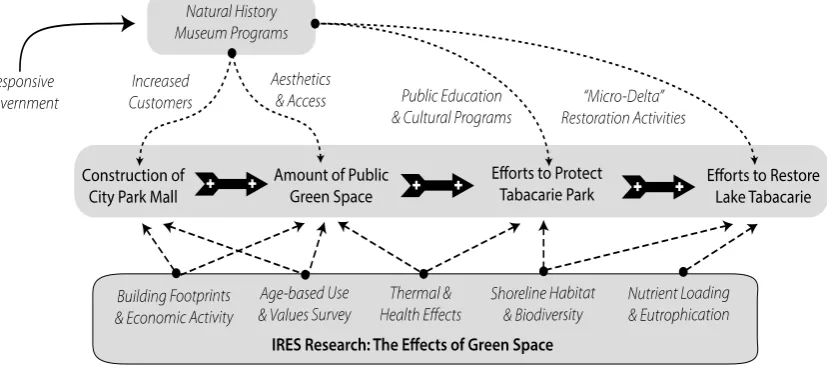
A significant change in stakeholder engagement occurred in the interim between the first and second year working on the Tabacărie System. The Natural History Museum, an educational institution located on the shores of the Lake and operated in close relationship with the Municipality raised the profile of its programs and efforts directed toward the restoration of the Lake Tabacărie system. During the second summer, IRES students met with frequently with Museum staff and discussed their efforts to engage the public “users” of the new City Mall and get them to become supporters of the value of the Park and Museum complex (Figure 7, upper area). The Museum’s model of change engaged the government as responsive to the needs of the Park, and focused on drawing the public’s attention to the value of the Park for educational and cultural benefits. In addition the Museum initiated a pilot restoration program on a portion of their property in an attempt to create a “Micro-Delta” patterned after the Danube Delta ecosystem. The fundamental change from Year 1 was from a confrontation model toward a model where the pubic education programs create demand in an economic sense for green spaces, the Park and the Lake. This, in turn, would generate the political will for funding to support restoration and revitalization activities.
The research programs designed and implemented in the second year were more in depth than the first year, due in part to the logistical and facilities support provided by the Museum. The research strategy involved five sub-project teams (Figure 7, bottom) that examined the relationships between the Park activities and the functional aspects of green spaces. One study used geographic information systems to map built environment footprints and economic activity with an eye toward redevelopment. A second team conducted interviews and surveys stratified age and gender of people using the Park
Figure 7: Year 2 consensus Systems Map for Lake Tabacărie, illustrating the dominant theory of change (middle grey area), stakeholder activity (upper grey area), and IRES research strategy (lower grey area).
IJCC
S
EC Volum
e 2, Issu
e 2
11 regarding their preferences and values related to the Park and Mall. A third team conducted a more detailed study of temperature patterns, expanded from the first year so as to examine correlations with human use patterns. A forth research team developed a shoreline development index to characterize and quantify the status of physical and aesthetic conditions around the Lake. The fifth group explored the relationships between vegetation, nutrient loading algal blooms, focusing on the feasibility of using phytoremediation to reduce phosphorus loadings from lake sediments.
One of the major changes in the consensus system model in year 2 was the explicit incorporation of feedback loops between the social, economic, ecological and structural components of the Lake Tabacărie system. In this way, for example the Mall could be seen as having a positive effect on green space preservation by creating greater public desire and demand for activities to protect and promote the Park. The IRES research strategy was concieved to attempt to document these connections in the system.
Year 3: Community Engagement and Social-Ecological-Economic Revitalization
Results from the work done during year 2 pointed to the great potential for revitalization of Lake Tabacărie that could be leveraged by finding ways to connect the Lake with the resort tourism from Mamaia. Numerous findings suggested that the congestion due to the growing numbers of people visiting Mamaia could increase the attractiveness of Tabacărie as place to walk, bike, shop, picnic and relax while vacationing at the seaside resorts.
During year 3, the IRES students worked from a base at the new Ovidius University Campus, located just to the north of Lake Tabacărie. This provided convenient access to merchants and business owners in the “Holiday Village” as well as vacationers moving to and from the beaches, resorts and Tabacărie Park. These discussions and interviews provided information on the perceived increasing demand for resort tourism, opportunities for public and private investments in the corridor connecting Mamaia with Tabacărie, as well as new marked opportunities for business development (Figure 8, top area). The dominant theory of change that emerged from these discussions was that improved government capacity to make informed land use decisions that effectively balance the competing demands of business, environment and public spaces could effectively promote jobs and overall well being (Figure 8, central grey area).
This model of social-ecological change was more interconnected with significantly more feedback loops than previous years. The students explicitly included elements for “public trust” and “participation” with respect to the land use decision process (Figure 8, lower area). In addition, the increasingly important role of climate change was included as explicit factor in planning for restoration and redevelopment
The greater number of feedback loops in the systems model reflected awareness on the part of the students that the long-term sustainability of the Tabacărie-Mamaia system required strengthening the connections between the economic, cultural and ecological systems. With this in mind, two research teams undertook a project to examine the feasibility and potential effects of creating a trail system around the perimeter of the Lake and connecting through the Holiday Park to Mamaia Resort. In addition to the trail system, the design included historically and ecologically relevant themes and wayfinding Kiosks to facilitate traffic patterns among various attractions.
IJCC
S
EC Volum
e 2, Issu
e 2
12
Conclusions: Assessment of Learning Goals
The results of the self-assessment of learning goals (SALG), analyzed for all years combined are presented in Figure 9. With respect to knowledge and understanding, the greatest changes pre and post IRES were observed in the areas of ethnography, cultural diversity and critical reflection (Figure 9A). With regards to skill and abilities, students perceived that they improved to the greatest extent in the areas of stakeholder engagement, project design, and problem identification (Figure 9B).
A comparison among years indicates that students from the first year felt that they improved the greatest in the area of skills and abilities, but less so in the areas of knowledge and understanding. In year two, students had an even stronger impression that they improved their skills base, but had a better sense that their knowledge and understanding had improved. Finally, students in the third year felt that their knowledge and understanding improved to the greatest extent, even greater than their improvement in skills and abilities.
The reasons for these differences between years are many and cannot be attributed to any single factor. Follow up interviews with students suggest that the availability of laboratory facilities and computer technology correlated to some degree wit the sense that they were acquiring skills. However, student journals indicated that the time spend interviewing stakeholders and discussing the issues of the community (e.g. ethnography and stakeholder engagement) often had the most lasting impacts on the students’ development on their ideas about sustainability.
It is interesting that the differences in the systems models among years correlated with the students’ SALG scores in critical knowledge and understanding. Generally speaking, the more complex feedback models in Year 2 and Year 3 were associated with students sense that they had a better understanding and knowledge of the systems.
Figure 8: Year 3 consensus System Map for Lake Tabacărie, illustrating dominant theory of change (central grey area), stakeholder activity (upper grey area), and IRES research strategy (lower grey area).
IJCC
S
EC Volum
e 2, Issu
e 2
13 Conversely the more linear models from the firs year were not as successful at fostering interdisciplinary thinking and understanding.
Figure 9: Mean (+ 1 SE) of Student Self Assessment of Learning Goals (SALG) from pre and post surveys uses in the IRES program. (A) Knowledge and Understanding (B) Skills and Abilities
IJCC
S
EC Volum
e 2, Issu
e 2
14
Acknowledgements
This work would not have been accomplished without the help of many people who supprorte numerous aspects of the research. The authors especially thank Danielle Vasile, Jesse Jensen and Richard Shaker for their support in working with projects during multiple years the program. Vanessa Torti and Christina Buffington developed and administered the SALG surveys. This research was funded by the National Science Foundation IRES award: Development of Indicators for Sustainable Development, Romania.
Bibliography
1. Chapin, F. S., III, Kofinas, G. P. & Folke, C. Principles of Ecosystem Stewardship: Resilience-Based Natural Resource Management in a Changing World. (Springer, 2009).
2. Miller, T. Epistemological pluralism: reorganizing interdisciplinary research. E&S 13, 46 (2008).
3. Tress, B., Tress, G. & Fry, G. in (Tress, B., Tress, G., Fry, G., 2005a. Defining concepts and process of knowledge production in integrative research. In: Tress, B., Tress, G., Fry, G., Opdam, P. (Eds.), From Landscape Research to Landscape Planning: Aspects of Integration, Education and Application. Spring- er, Heidelberg, pp. 13–26., 2006).
4. Rockström, J. Planetary Boundaries: Exploring the Safe Operating Space for
Humanity. Ecology and Society (2010).
at<http://www.ecologyandsociety.org/vol14/iss2/art32/>
5. Barth, M., Godemann, J., Rieckmann, M. & Stoltenberg, U. Developing key competencies for sustainable development in higher education. International Journal of Sustainability in Higher Education8, 416–430 (2007).
6. Clark, B. & Button, C. Sustainability transdisciplinary education model: interface of arts, science, and community (STEM). International Journal of Sustainability in Higher Education12, 41–54 (2011).
7. Sherren, K. A history of the future of higher education for sustainable development. Environmental Education Research14, 238–256 (2008).
8. Vaz, R., Quinn, P., Heinricher, A. & Rissmoiller, K. Gender Differences in the Long-Term Impacts of Project-Based Learning. in American Society for Engineering Education 1–18 (2013).
9. Terpenny, J. P., Goff, R. M., Lohani, V. K., Mullin, J. & Lo, J. Preparing globally and socially-conscious engineers: International and human-centred design projects and activities in the first year. Int. J. Eng. Educ24, 409–419 (2008).
10. Bhandari, A., Ong, S. K. & Steward, B. L. Student Learning in a Multidisciplinary Sustainable Engineering Course. J. Prof. Issues Eng. Educ. Pract. 137, 86–93 (2011).
11. Tate, D. et al. Transdisciplinary Approaches for Teaching and Assessing Sustainable Design. Int. J. Eng. Educ26, 418–429 (2010).
12. Farrell, T. A. & Ollervides, F. The School for Field Studies Centre for Coastal Studies: A case study of sustainable development education in México.
International Journal of Sustainability in Higher Education6, 122–133 (2005). 13. Cusick, J. Study abroad in support of education for sustainability: a New Zealand
case study. Environ Dev Sustain11, 801–813 (2009).
14. Rusinko, C. Integrating sustainability in higher education: a generic matrix. …
IJCC
S
EC Volum
e 2, Issu
e 2
15
Journal of Sustainability in Higher Education (2010).
15. Zou, L. & Thomalla, F. The causes of social vulnerability to coastal hazards in Southeast Asia. (Stockholm Environment Institute, 2008).
16. Mollinga, P. Complexity of natural resources management. Crop Science50, S–1– S–9 (2010).
17. Portman, M. E., Esteves, L. S., Le, X. Q. & Khan, A. Z. Improving integration for integrated coastal zone management: an eight country study. Sci. Total Environ. 439, 194–201 (2012).
18. Rasch, P. S., Ipsen, N., Malmgren-Hansen, A. & Mogensen, B. Linking integrated water resources management and integrated coastal zone management. Water Sci. Technol.51, 221–229 (2005).
19. Guo, Z., Xiao, X. & Li, D. An Assessment of Ecosystem Services: Water Flow Regulation and Hydroelectric Power Production. Ecological Applications10, 925– 936 (2000).
20. Suter, G. W., II. Ecological Risk Assessment, Second Edition. (CRC Press, 2006). 21. Novotny, V., Bartosová, A., O'Reilly, N. & Ehlinger, T. Unlocking the relationship of biotic integrity of impaired waters to anthropogenic stresses. Water Res. 39,
184–198 (2005).
22. Gorokhovich, Y., Leiserowitz, A. & Dugan, D. Integrating Coastal Vulnerability and Community-Based Subsistence Resource Mapping in Northwest Alaska. J Coastal Res293, 158–169 (2014).
23. Borja, A. et al. Ecological integrity assessment, ecosystem-based approach, and integrative methodologies: Are these concepts equivalent? Marine Pollution …
(2009).
24. Soby, B. A., Simpson, A. & Ives, D. P. Soby: Integrating public and scientific judgements.. Food Control (1993).
25. Paraschiv, G. et al. BENTHIC INVERTEBRATES SPECIES AS INDICATORS OF BENTHIC HABITATS HEALTH FROM SIUTGHIOL LAKE, ROMANIA.
Carpathian Journal of Earth and Environmental Sciences8, 185–194 (2013). 26. Shaker, R. et al. LAND COVER AND LANDSCAPE AS PREDICTORS OF
GROUNDWATER CONTAMINATION: A NEURAL-NETWORK
MODELLING APPROACH APPLIED TO DOBROGEA, ROMANIA. Journal of Environmental Protection and Ecology11, 337–348 (2010).
IJCC
S
EC Volum
e 2, Issu
e 2