R E S E A R C H
Open Access
Effects of 3 g of soluble fiber from oats on
lipid levels of Asian Indians - a randomized
controlled, parallel arm study
Seema Gulati
1,2,3, Anoop Misra
1,2,3,4,5*and Ravindra M Pandey
6Abstract
Background:Cardiovascular diseases are more prevalent and severe in Asian Indians. Simple diet-based strategies are important for prevention of cardiovascular diseases.The aim of the present study was to evaluate the effects of oats consumption on lipid parameters in mildly hypercholesterolemic Asian Indians living in India.
Methods:A short-term, prospective, open-labeled, randomized controlled, parallel group study was conducted. Mildly hypercholesterolemic (total cholesterol >200 mg/dL and <240 mg/dL) subjects (n= 80) were randomized into two groups: intervention (n= 40) and usual diet (n= 40). Sample size was calculated for a two-group parallel superiority randomized control trial. Out of 80 enrolled subjects 69 subjects completed the study; 33 in the control group and 36 in the intervention group. In the intervention group, patients were served 70 g of oats twice a day in the form of porridge andupma(A thick porridge from oats with seasonings and vegetables) under observation at the study site. Lipid parameters were assessed at baseline and after 4 weeks of intervention.
Results:There was a reduction of 3.1% in total cholesterol levels in the control group as against 8.1% reduction in the intervention group (p< 0.02). Greater reductions were also seen in low-density lipoprotein cholesterol in the intervention group (11.6%) as compared to control group (4.1%,p< 0.04) over a period of 28 days.
Conclusion:Daily consumption of 3 g of soluble fiber from 70 g of oats leads to beneficial effects on the lipid parameters, specifically total cholesterol and low-density lipoprotein cholesterol in hypercholesterolemic Asian Indians. Large scale studies over a longer period of intervention are required to further establish the cholesterol-lowering effect of oat fiber.
Trial registration:The study was retrospectively registered at clinicaltrials.gov (dated: 25th Februrary.2015) with registration number NCT02376660.
Background
Dyslipidemia is a major risk factor for cardiovascular disease (CVD). Importantly,1% increase in low-density lipoprotein cholesterol (LDL-C) levels can lead to 2% increase in CVD risk [1]. A review of ten large cohort studies reported that a decrease of 10.8 mg/dl in cholesterol concentration was associated with a decrease in risk of ischemic heart disease by 54% at age 40, 39% at age 50, 27% at age 60, 20% at age 70 and 19% at age 80 [2]. The INTERHEART study shows that, dyslipidemia appears to
be the strongest contributor of acute myocardial infarction in South Asians [3].
Limited information exists regarding the changing time-trends in lipid levels and the prevalence of dyslipidemia in Asian Indians. In 1961 Padmavati et al. [4] reported mean levels of total cholesterol levels across different socio-economic groups in Delhi. Chadha et al. [5] reported 44% prevalence of hypercholesterolemia among men and 50% prevalence among women in urban Delhi during 1984–87. Indian Council of Medical Research (ICMR) study reported prevalence of hypercholesterolemia as 36.8% and 39.8% in urban Delhi and rural Haryana re-spectively during 1991–94 [4]. The overall prevalence of dyslipidemia in India in various studies ranges from * Correspondence:[email protected]
1Diabetes Foundation (India), Safdarjung Development Area, New Delhi, India 2National Diabetes, Obesity, and Cholesterol Foundation (N-DOC), Safdarjung
Development Area, New Delhi, India
Full list of author information is available at the end of the article
10% to 73% [6], depending on area of residence (rural vs. urban), socio-economic strata (high vs. middle or low), diet and physical activity patterns and age. As per Indian Council of Medical Research-India Diabetes (ICMR-INDIAB) study, highest rates of hypercholester-olemia and high LDL-C were reported from the state of Tamil Nadu, 18.3%, and 15.8% respectively [6].
The importance of nutrition in modifying the risk of CVD has been repeatedly emphasized [7–9]. Since diet forms such an integral part of an individual’s lifestyle it becomes critical to suggest changes that are easy to implement in order to ensure compliance. The need for functional foods that promote cardiovascular health, including cholesterol lowering foods, is growing. One such functional food ingredient is oatβ-glucan.β-glucan is a highly viscous soluble fiber located primarily in the endosperm cell wall of oats. It is composed of glucose molecules with mixed β-(1 → 4) andβ-(1 → 3) bonds. This specific chemical structure is responsible for physical properties, such as viscosity and solubility. Studies have been conducted to assess the effect of different types of fibers including fiber from oats on lipid profile of hyper-cholesterolemic subjects. These studies have shown that daily consumption of at least 3 g of β- glucan from oats may result in as much as a 5 to 10% reduction in total cholesterol and LDL-C concentrations [10]. A recent systematic review of 64 studies further confirms that consumption of oats is associated with reduced risk of CVD and its associated risk factors. More than half of these studies (37/64) reported a significant reduction in total cholesterol (2–19% reduction) with about half of the studies (31/64) demonstrating significant reductions in LDL-cholesterol (4–23% reduction) over various inter-vention time periods [11]. In addition, Scandinavian stud-ies have shown that adding oats to an individual’s diet may enhance overall dietary nutritional value, particularly improving vitamins, minerals and antioxidants content of the diet. Specifically, consumption of oats for six months results in measurable increase in the intake of magnesium and vitamin B1 [12].
Health claims regarding the association between cholesterol lowering and soluble fiber from oats have been approved by food standards agencies globally [United States: U.S. Food and Drug Administration [13]; Canada: Health Canada [14] and Europe: European Food Safety Authority [15].
Indian diets are high in carbohydrates, fats and sugars, which may contribute to dyslipidemia and CVD. However, there are only a few dietary intervention studies from India that focus on the prevention of dyslipidemia and other CVD risk factors [16, 17]. Since there is evidence that the prevalence of blood lipid abnormalities and other CVD risk factors varies in different ethnic groups [18] and even LDL-C-lowering effect of statins differs by ethnicity
[19], hence we planned this study to understand the ef-fects of consumption of 3 g of oatβ-glucan on lipid profile of hypercholesterolemic subjects of Asian Indian ethnicity.
Methods
Subject population
A prospective, randomized, parallel, controlled study was approved by an independent ethics committee in accordance with the principles and requirements de-scribed in the US Code of Federal Regulations (21 CFR Part 56), Schedule Y (2005) of Indian Drugs and Cos-metic Act and Ethical Guideline for Biomedical Re-search on Human Participants by ICMR 2006. After obtaining informed consent eighty (80) apparently healthy, adult, male and female subjects, aged 20 to 50 years
with total cholesterol values ≥200 mg/dL and
<240 mg/dL were enrolled in the study. Subject fac-tors at screening that excluded participation included: current use of lipid lowering drugs, LDL-C > 190 mg/ dL or total cholesterol <200 mg/dL and >240 mg/dL or serum triglycerides >300 mg/dL, history of heavy smoking, alcoholism, pregnant or actively lactat-ing women, and current use of weight loss diets. The primary outcome of the study was reduction in total cholesterol concentration. Sixty nine of eighty subjects (69/80) completed the study. The study was retrospect-ively registered at clinicaltrials.gov with registration num-ber NCT02376660.
Study procedure
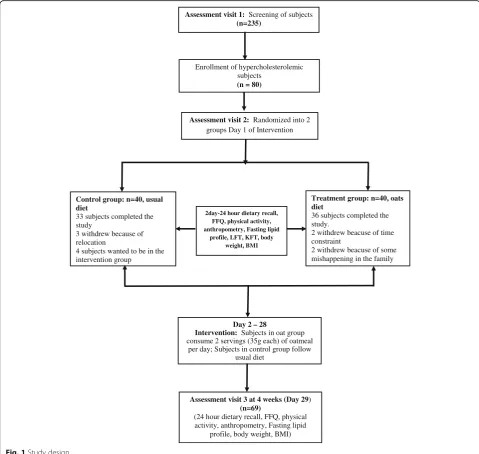
asked to continue their usual exercise habits. After the completion of the trial, subjects wereeducated about healthy lifestyle. Subjects were provided with oat packets as their weekend breakfast and lunch/snack. Additional packets of oats (35 g each) were given for holidays and for the family (10–15 packets) to ensure better compliance. Subjects were assessed for changes in lipid parameters and anthropometry at the end of the intervention. Weekly assessments were carried out for diet, exercise, and medical history etc. along with the anthropometric evaluation as shown (Fig. 1).
Assessment of Outcome Parameters:Blood pressure was measured via the right arm with each participant in a sitting position according to standard protocol [20]. All
assessments for anthropometry, glucose, and lipid param-eters were carried out as described previously [21].
Statistical analysis
The data were managed on an Excel 2010 spread sheet. Sample size was calculated for a two-group parallel superiority randomized control trial. A change in total cholesterol levels was taken as the primary outcome variable. Assuming mean ± SD reduction in total chol-esterol in the control group as 1 ± 0.5 mmol/L and corresponding anticipated decline in the test group (oats group) as 1.4 ± 0.5 mmol/L (at least 40% more than the control group) the number of subjects re-quired in each group to detect the above difference
Enrollment of hypercholesterolemic subjects
(n = 80)
Assessment visit 1: Screening of subjects
(n=235)
Assessment visit 2: Randomized into 2 groups Day 1 of Intervention
Treatment group: n=40, oats diet
36 subjects completed the study.
2 withdrew beacuse of time constraint
2 withdrew beacuse of some mishappening in the family
Control group: n=40, usual diet
33 subjects completed the study
3 withdrew because of relocation
4 subjects wanted to be in the intervention group
2day-24 hour dietary recall, FFQ, physical activity, anthropometry, Fasting lipid
profile, LFT, KFT, body weight, BMI
Day 2 – 28
Intervention: Subjects in oat group consume 2 servings (35g each) of oatmeal
per day; Subjects in control group follow usual diet
Assessment visit 3 at 4 weeks (Day 29)
(n=69)
(24 hour dietary recall, FFQ, physical activity, anthropometry, Fasting lipid
profile, body weight, BMI)
with 95% level of confidence and 90% power were 33 in each group. Considering a dropout rate of 20%, 40 subjects were enrolled in each arm.
Student’s t-test for quantitative variables was used to compare means between the two groups. Individual sub-ject percentage change in the cholesterol concentration from baseline was computed. Mean ± SD change in choles-terol level in the two groups and their difference (effect size) was computed. Data were analyzed following the prin-ciples of intention-to-treat and per protocol analysis. For intention-to-treat analysis all the randomized subjects were included in the analysis. For missing values at 4 weeks,‘last observation carried forward’was used to impute the values. Since baseline values were comparable for each of the lipid parameters, we used student’st-test to compare the differ-ence in the mean values at 4 weeks and reported mean dif-ference (95% CI). For Per Protocol analysis only those subjects were considered who had completed the study. STATA v12.0 software was used for analysis. Two-sided sig-nificance was assumed atp-value≤0.05.
Results
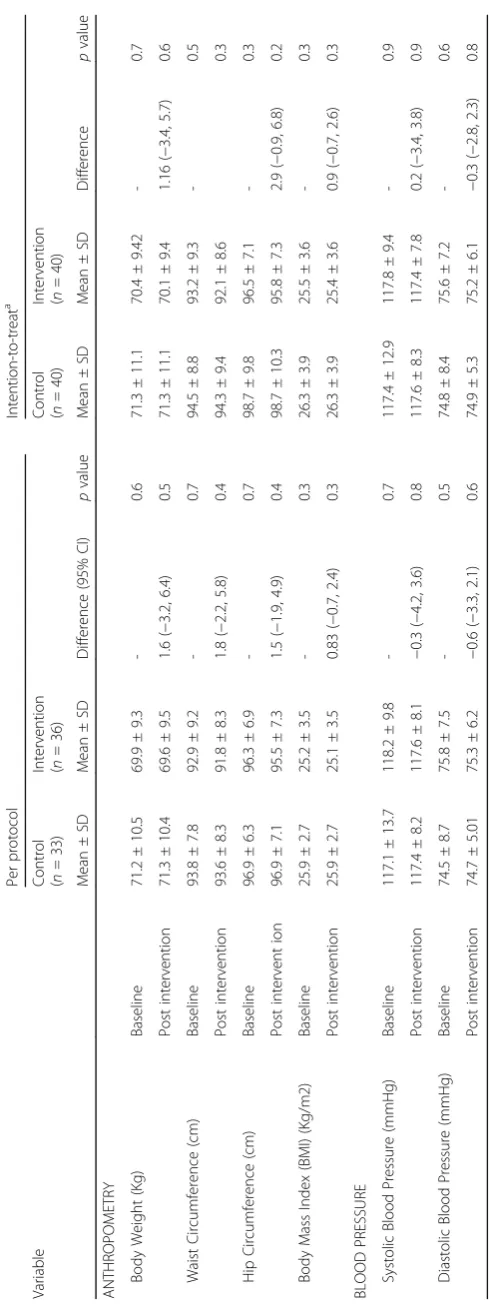
Eighty subjects were enrolled in the study of which 11 could not complete the study due to reasons not related to the trial. The mean age of participants recruited in the control group was 31.6 ± 6.9 years and in the inter-vention group was 30.8 ± 6.2 years. Mean body weight of 71.2 ± 10.5 kg and 69.9 ± 9.3 kg was observed in con-trol and intervention groups, respectively. There was no statistically significant difference between the two groups at baselines in age, gender, anthropometric, blood pres-sure and lipid parameters. (Tables 1 & 2) There was no significant change in body weight, body mass index (BMI), waist circumference and hip circumference, sys-tolic and diassys-tolic blood pressure between intrervention and control group post intervention (Table 1).
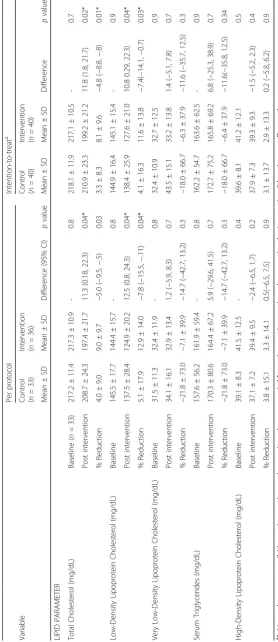
As per intention-to-treat analysis, there was a reduction in the mean total cholesterol levels from 218.1 ± 11.9 mg/ dL to 210.1 ± 11.9 mg/dL (3.3%) and 217.1 ± 10.5 mg/dL to 199.2 ± 21.2 mg/dL (8.1%) after intervention in the control and intervention groups, respectively. The differ-ence between the groups was statistically significant post intervention (p< 0.01).
Reductions in LDL-C levels exhibited a similar trend. A reduction in mean LDL-c from 144.9 ± 16.4 mg/dL to 138.4 ± 25.9 mg/dL (4.1%) and from 145.1 ± 15.4 mg/dL to 127.6 ± 21.0 mg/dL (11.6%) was observed in the con-trol and the intervention groups post intervention re-spectively. The reduction in LDL-C was significantly higher in the intervention group than the control group. (Table 2) There was no significant change in very low-density lipoprotein cholesterol (VLDL-C), serum triglycer-ides and high- density lipoprotein cholesterol (HDL-C) post intervention. However, the trends for serum triglycerides
and VLDL-C reduction were better in the intervention group than in the control group (Table 2). As per Per Protocol analysis the data of 69 subjects showed a signifi-cant reduction in mean total cholesterol levels (p < 0.04) and LDL-C levels (p< 0.04) post intervention as well. There was reduction of 4.0% in total cholesterol levels in the con-trol group as against 9% reduction in total cholesterol in the intervention group. The LDL-C reduction was also higher in intervention group; 12.9% as compared to control group; 5.1% (Table 2). There was no significant change in VLDL-C, serum triglycerides and HDL-C post intervention.
Discussion
The present study shows the cholesterol lowering property of dietary oats in the Asian Indians. To our knowledge this is the first study on oats conducted in Indian population.
A meta-analysis of 25 studies on oats shows that 1 g of soluble fibre from oats leads to 1.42 mg/dL and 1.23 mg/dL reductions in total cholesterol and LDL-C levels respectively [22]. Two possible mechanisms have been proposed to explain the decrease observed in total cholesterol. One hypothesis is that soluble fibre de-creases absorption of cholesterol and fatty acids and in-creases bile acid excretion. It has also been proposed that soluble fibres reduce cholesterol synthesis by production of short chain fatty acids that affect lipid metabolism [23]. In a published animal study an increased amount of bile acids was observed in the intestinal, caecal and colonic contents of the test groups [24]. Another recently conducted animal study hypothesized the possible up-regulation of CYP7A1 and CYP8B1 (bile acid producing hepatic enzymes) thus further supporting the bile acid related cholesterol redu-cing mechanism of oats [25].
12 out of 33 subjects (36.4%) had total cholesterol levels within the normal range. It has been observed that oats may be beneficial for insulin sensitivity and glycemic parameters, thus controlling serum triglycerides [27]. These actions may have resulted in stable serum triglycer-ide levels in the oats group vs. non-significant slight increase in the control group. A longer duration study is required to understand the effect of oats on triglycerides and VLDL-cholesterol.
Conclusion
The study findings show that a small lifestyle modification such as introduction of soluble fibre from oats can have a significant lowering effect on total cholesterol levels in hypercholesterolemic Asian Indian subjects. However, large scale studies over a longer period of intervention are required to further establish the cholesterol lowering effect of oat fiber.
Endnotes 1
A thick porridge from oats with seasonings and vegetables added to it during the cooking.
Abbreviations
CFR:Code of Federal Regulations; CVD: cardiovascular disease;
CYP7A1: Cholesterol 7-alpha-monooxygenase; CYP8B1: Cytochrome P450; HDL-C: High- density lipoprotein cholesterol; ICMR: Indian Council of Medical Research; ICMR-INDIAB: Indian Council of Medical Research-India Diabetes; LDL-C: low-density lipoprotein cholesterol; SD: Standard deviation; VLDL-C: Very low-density lipoprotein cholesterol
Acknowledgements
The study was fully supported by a grant from PepsiCo India. Quaker oats were supplied by PepsiCo India for the study. The views expressed in this manuscript are those of the authors and do not reflect the position or policy of PepsiCo, Inc. Authors are thankful to Ms. Ankita Marwaha and Nili Marom for their support. Authors are grateful to all the participants of the study for their cooperation.
Funding
The study was funded by PepsiCo India. Fundinmg agency has no role in in the design of the study and collection, analysis, and interpretation of data and in writing the manuscript.
Availability of data and materials
“Please contact author for data requests.”
Authors’contributions
SG Researched data, wrote manuscript, AM wrote manuscript, contributed to discussion, reviewed/edited manuscript, RMP reviewed/edited manuscript, performed statistical analysis. All authors read and approved the final manuscript.
Competing interests
Authors have no competing interest.
Consent for publication
“Not applicable”.
Ethics approval and consent to participate
An independent review committee,‘Ethics Committee for Human Research’ approved the study protocol with statement: The Ethics Committee hereby gives an approval to conduct the study at Fortis Flt. Lt. Rajan Dhall Hospital, Vasant Kunj, New Delhi. Written informed consent form, approved by the ethics committee was obtained from all the study participants. The study was retrospectively registered at clinicaltrials.gov with registration number NCT02376660.
Publisher’s note
Springer Nature remains neutral with regard to jurisdictional claims in published maps and institutional affiliations.
Author details
1Diabetes Foundation (India), Safdarjung Development Area, New Delhi,
India.2National Diabetes, Obesity, and Cholesterol Foundation (N-DOC), Safdarjung Development Area, New Delhi, India.3Center of Nutrition & Metabolic Research (C-NET), SDA, New Delhi, India.4Fortis C-DOC Center for Excellence for Diabetes, Metabolic Diseases and Endocrinology, B-16, Chirag Enclave, New Delhi -110048, India.5Fortis Flt. Lt. Rajan Dhall Hospital, Vasant Kunj, New Delhi, India.6All India Institute of Medical Sciences (AIIMS), New Delhi, India.
Received: 15 October 2016 Accepted: 21 March 2017
References
1. Davis CE, Rifkind BM, Brenner H, et al. A single cholesterol measurement underestimates the risk of coronary heart disease. An empirical example from the lipid research clinics mortality follow-up study. JAMA. 1990;264(23): 3044–6.
2. Law MR, Wald NJ, Thompson SG. By how much and how quickly does reduction in serum cholesterol concentration lower risk of ischaemic heart disease? BMJ. 1994;308(6925):367–72.
3. Yusuf S, Hawken S, Ounpuu S, et al. Effect of potentially modifiable risk factors associated with myocardial infarction in 52 countries (the INTERHEART study): case–control study. Lancet. 2004;364(9438):937–52. 4. Padmavati S, Gupta S, Pantulu G, et al. Epidemiologic studies in Faridabad.
Indian Heart J. 1961;13:275.
5. Chadha S, Gopinath N, Shekhawat S. Urban–rural differences in the prevalence of coronary heart disease and its risk factors in Delhi. Bull World Health Organ. 1997;75(1):31.
6. Joshi SR, Anjana RM, Deepa M, et al. Prevalence of dyslipidemia in urban and rural India: the ICMR–INDIAB study. PLoS One. 2014;9(5):e96808. 7. Chandra KS, Bansal M, Nair T, et al. Consensus statement on management
of dyslipidemia in Indian subjects. Indian Heart J. 2014;66(Suppl 3):S1–51. 8. Misra A, Khurana L. Obesity and the metabolic syndrome in developing
countries. J Clin Endocrinol Metab. 2008;93(11 Suppl 1):S9–30.
9. Misra A, Shrivastava U. Obesity and dyslipidemia in south Asians. Nutrients. 2013;5(7):2708–33.
10. Othman RA, Moghadasian MH, Jones PJ. Cholesterol-lowering effects of oat beta-glucan. Nutr Rev. 2011;69(6):299–309.
11. Thies F, Masson LF, Boffetta P, et al. Oats and CVD risk markers: a systematic literature review. Br J Nutr. 2014;112(Suppl 2):S19–30.
12. Kemppainen TA, Heikkinen MT, Ristikankare MK, et al. Nutrient intakes during diets including unkilned and large amounts of oats in celiac disease. Eur J Clin Nutr. 2010;64(1):62–7.
13. US Food and Drug Administration (FDA) Health claims: soluble fiber from certain foods and the risk of coronary heart disease (CHD) Code of Federal Regulations Title 21; Section 10181 [Internet] Silver Spring (MD): FDA 1997 [updated 2016 April 1; Available from:www.accessdata.fda.gov/scripts/cdrh/ cfdocs/cfcfr/CFRSearch.cfm?fr=101.81 (Accessed on 27 March 2017) 14. Bureau of Nutritional Sciences, Food Directorate, Health Products and Food
Branch, Health Canada. Oat products and blood cholesterol lowering: summary of assessment of a health claim about oat products and blood cholesterol lowering [internet]. Ottawa, Ontario: Health Canada; 2010. Available from: www.hc-sc.gc.ca/fn-an/label-etiquet/claims-reclam/assess-evalu/oat-avoine-eng.php. acessed on 10 April 2016
15. EFSA Panel on Dietetic Products, Nutrition and Allergies (NDA).Scientific opinion on the substantiation of a health claim related to oat beta-glucan and lowering blood cholesterol and reduced risk of (coronary) heart disease pursuant to Article 14 of Regulation (EC) No 1924/2006.EFSA J 2010;8:1885–1900.
16. Gulati S, Misra A, Pandey RM, et al. Effects of pistachio nuts on body composition, metabolic, inflammatory and oxidative stress parameters in Asian Indians with metabolic syndrome: a 24-wk, randomized control trial. Nutrition. 2014;30(2):192–7.
18. O'Meara JG, Kardia SL, Armon JJ, et al. Ethnic and sex differences in the prevalence, treatment, and control of dyslipidemia among hypertensive adults in the GENOA study. Arch Intern Med. 2004;164(12):1313–8. 19. Simon JA, Lin F, Hulley SB, et al. Phenotypic predictors of response to
simvastatin therapy among African-Americans and Caucasians: the cholesterol and Pharmacogenetics (CAP) study. Am J Cardiol. 2006;97(6):843–50. 20. Chobanian AV, Bakris GL, Black HR, et al. The seventh report of the joint
National Committee on prevention, detection, evaluation, and treatment of high blood pressure: the JNC 7 report. JAMA. 2003;289(19):2560–72. 21. Misra A, Alappan NK, Vikram NK, et al. Effect of supervised progressive
resistance-exercise training protocol on insulin sensitivity, glycemia, lipids, and body composition in Asian Indians with type 2 diabetes. Diabetes Care. 2008;31(7):1282–7.
22. Brown L, Rosner B, Willett WW, et al. Cholesterol-lowering effects of dietary fiber: a meta-analysis. Am J Clin Nutr. 1999;69(1):30–42.
23. Third Report of the National Cholesterol Education Program (NCEP). Expert Panel on detection, evaluation, and treatment of high blood cholesterol in adults (adult treatment Panel III) final report. Circulation. 2002;106(25):3143–421.
24. Drzikova B, Dongowski G, Gebhardt E. Dietary fibre-rich oat-based products affect serum lipids, microbiota, formation of short-chain fatty acids and steroids in rats. Br J Nutr. 2005;94(6):1012–25.
25. Andersson KE, Axling U, Xu J, et al. Diverse effects of oats on cholesterol metabolism in C57BL/6 mice correlate with expression of hepatic bile acid-producing enzymes. Eur J Nutr. 2013;52(7):1755–69.
26. Wolever TM, Gibbs AL, Brand-Miller J, et al. Bioactive oat beta-glucan reduces LDL cholesterol in Caucasians and non-Caucasians. Nutr J. 2011;10:130. 27. Hou Q, Li Y, Li L, Cheng G, Sun X, Li S, et al. The metabolic effects of oats
intake in patients with type 2 diabetes: a systematic review and meta-analysis. Nutrients. 2015 Dec 10;7(12):10369–87.
• We accept pre-submission inquiries
• Our selector tool helps you to find the most relevant journal
• We provide round the clock customer support
• Convenient online submission
• Thorough peer review
• Inclusion in PubMed and all major indexing services
• Maximum visibility for your research
Submit your manuscript at www.biomedcentral.com/submit