Open Access
Environmental Health: A Global Access Science Source2002,
1 x
Research
Maternal exposure to low-level air pollution and pregnancy
outcomes: a population-based study
Ligita Maroziene* and Regina Grazuleviciene
Address: Department of Environmental Science, Vytautas Magnus University, Vileikos 8, Kaunas, Lithuania E-mail: Ligita Maroziene* - [email protected]; Regina Grazuleviciene - [email protected] *Corresponding author
Abstract
Background: Recent reports have shown that air pollution may increase the risk of adverse birth outcomes. We have evaluated the relationship between ambient air pollution and the occurrence of low birth weight and preterm delivery using routinely collected data in Lithuania.
Methods: This epidemiological study comprised all singleton newborns (N = 3,988), born to women in 1998, who resided in the City of Kaunas. Birth data and information on maternal characteristics were obtained from the Lithuanian National Birth Register. To estimate residential exposure levels, we used measurements of ambient nitrogen dioxide (NO2) and formaldehyde, which were collected at 12 monitoring posts. Multivariate logistic regression was used to estimate the effect that each pollutant would have on low birth weight (LBW) and premature birth while controlling for potential confounders.
Results: Adjusted odds ratios (OR) for LBW increased with increasing formaldehyde exposure (OR2nd tertile = 1.86, 95% CI 1.10–3.16; OR3rd tertile = 1.84, 95% CI 1.12–3.03). Adjusted ORs of preterm birth for the medium and high NO2 tertile exposures were OR = 1.14 (95% CI 0.77–1.68) and OR = 1.68 (95% CI 1.15–2.46), respectively. The risk of preterm birth increased by 25% (adjusted OR = 1.25, 95% CI 1.07–1.46) per 10 µg/m3 increase in NO
2 concentrations. An analysis
by trimester showed that pregnancy outcomes were associated with first-trimester exposure to air pollutants. However, there were no significant relationships in other pregnancy periods between preterm birth and exposure to formaldehyde or between LBW and NO2 exposure.
Conclusion: Our findings suggest that in the City of Kaunas there might be a relationship between maternal exposure to ambient formaldehyde and the risk of LBW, as well as between NO2 exposure and the risk of preterm birth.
Background
Growing evidence of the adverse effect of air pollution on human health raises the question as to what extent this af-fects the foetus and the newborn, which are likely to be more vulnerable than adults to environmental toxicants [1]. Recent epidemiological studies, conducted in various
countries, have reported relationships between elevated levels of air pollutants (total suspended particles (TSP), sulfur dioxide (SO2), carbon monoxide (CO), nitrogen dioxide (NO2), polycyclic aromatic hydrocarbons (PAH))
and birth outcomes, such as low birth weight (LBW), pre-maturity, intrauterine retardation (IUGR) [2–16]. Howev-Published: 9 December 2002
Environmental Health: A Global Access Science Source 2002, 1:6
Received: 8 October 2002 Accepted: 9 December 2002
This article is available from: http://www.ehjournal.net/content/1/1/6
er, some studies produced non-positive findings [17–19]. Results differed between these studies in terms of number of pollutants examined, levels and time of exposure, con-founding factors that were present, as well as types of pregnancy outcomes, and magnitude of observed effects. Replication of findings in different populations is a part of establishing a convincing relationship between air pollu-tion and pregnancy outcomes [8].
The biological mechanisms by which air pollutants may interfere with the processes of prenatal development are still not clear. Several potential mechanisms have been hypothesised, including maternal susceptibility to infec-tion, oxidative stress [20], haematological factors (e.g., blood viscosity) [21,22] and the direct effect of specific pollutants on foetal development or on DNA and its tran-scription [23,24].
NO2 is capable of oxidising tissue components (e.g., pro-teins, lipids) and of suppressing the antioxidant protective systems of organism [25]. Increased lipid peroxidation in the maternal and/or foetal compartment has been found in preterm birth [26]. In experimental studies it was found that exposure to NO2 during gestation induced increased lipid peroxidation in the placenta, elevated postimplanta-tion embryonic lethality, and disturbances of postnatal development [27]. It was suggested that maternal expo-sure to NO2 can increase the risk of pregnancy
complica-tions through stimulation of the formation of cell-damaging lipid peroxides and from decrease in maternal antioxidant reserves [20].
Although there is an opinion that adverse reproductive and developmental effects related to formaldehyde are minimal [28], recent occupational studies have shown some evidence of increased risk of spontaneous abortions [29] and reduced fertility [30] among workers exposed to formaldehyde. Experimental studies demonstrated that formaldehyde crosses the placenta and enters foetal tis-sues, and the hypothesis was suggested that formaldehyde might cause birth defects through oxidative stress and mi-tochondrial damage [31].
Formaldehyde, as well as NO2, may have direct toxic effect
on the foetus, or serve as a proxy of other toxic chemicals from vehicle emission that could be related to the im-paired foetal development.
Limited monitoring data and emission information is the main barrier to conducting population-based epidemio-logical studies on formaldehyde. The Kaunas municipal ecological monitoring system that measures major air pol-lutants (SO2, NO2, TSP) and formaldehyde, provided us with the opportunity to investigate the relationship
be-tween maternal exposure to outdoor formaldehyde and NO2, and risk of having LBW or preterm newborns.
Methods
The study was conducted in Kaunas, the second largest city in Lithuania, which covers approximately 157.2 km2.
The city, with about 400,000 inhabitants and 4,000 births per year, is situated in a valley and a neighbouring plain. Air pollution in Kaunas, as well as in the whole of Lithua-nia, has actually decreased during its transformational pe-riod of economic decline. During the last decade, the concentration of SO2 decreased to almost one-tenth, NO2
and TSP decreased to one-half, while no essential change was noted for formaldehyde levels [32]. The major air pol-lution source in the city is exhaust emissions from vehi-cles, which account for over 70% of the total emissions.
We conducted a population-based study within the mu-nicipality of Kaunas. Data on pregnancy outcomes were obtained from the Lithuanian National Birth Register. These registration records include information obtained through maternal interviews during the first prenatal visit and at delivery. The following information was available: home address at delivery, date of birth, gender, birth weight, gestational age estimated by the last menstrual pe-riod, parity, maternal age, education, marital status, em-ployment status, past medical history including previous pregnancies, and maternal and paternal smoking status.
The study included all singleton births in the City of Kau-nas from January 1st, 1998 through December 31st, 1998.
The outcomes of interest were low birth weight (LBW, de-fined as birth weight of <2500 g), and premature birth (defined as birth at <37 weeks of gestation), according to Codes P07.0–3, International Classification of Diseases, 10th revision.
To assess exposure to ambient air pollution, we used Kau-nas' municipal ecological monitoring data. The measure-ments were taken from 12 municipal monitoring sites, one in each residential district. Monitors were located out-side reout-sidential quarters, mostly near schools and kinder-gartens. Out of four routinely monitored air pollutants (SO2, NO2, TSP and formaldehyde), we selected for
anal-ysis the two pollutants, which have essentially not de-creased during the most recent decade. We used all available daily measurements of NO2 (colorimetric
LBW and preterm birth [33] across different exposure cat-egories in order to identify potential confounders. Mater-nal age was divided into four age groups, i.e., ≤ 19, 20–29, 30–34, ≥ 35 years, with those aged 20–29 years being con-sidered the reference group. We classified marital status as married (reference), single, and divorced. We dichot-omised education as lower than secondary (<12 years of education) and secondary or higher (>12 years of educa-tion), with the latter being the reference group. Maternal and paternal smoking were categorised as 'yes' or 'no'. The other variables considered were gender of the child, pari-ty, season of birth.
The effect of ambient air pollution on pregnancy out-comes was estimated by logistic regression. We calculated crude odds ratios (OR) and their 95% confidence inter-vals (CIs) of LBW and pre-maturity across exposure cate-gories for each pollutant. We adjusted crude effects of air pollution for potential confounding factors (in categories described above): gestational age (LBW model only), par-ity, maternal age, marital status, education, maternal and paternal smoking, season of birth.
We grouped the pollutant concentrations into three cate-gories (tertiles) and applied the exposure variable as both categorical and continuous parameters. We used exposure levels in the 1st tertile as the reference category (low
expo-sure) for each pollutant and then also conducted an anal-ysis of continuous exposure parameters on the basis of an increase of 5 µg/m3 in formaldehyde concentrations and
an increase of 10 µg/m3 in NO
2 concentrations.
We used SPSS version 10.0 for the statistical analyses.
Results
Out of 4,067 births registered in Kaunas in 1998, we ex-cluded 70 (1.7%) twins. Additionally, we exex-cluded those whose birth registration records contained no valid infor-mation on gestational age (N = 1), birth weight (N = 2), maternal education (N = 2) and marital status (N = 6). These exclusions left 3,988 eligible subjects for study, and among them were 140 (3.5%) LBW and 203 (5.1%) pre-mature births.
The mean formaldehyde concentration during the study period was 3.14 µg/m3 [standard deviation (SD) = 2.36
µg/m3]. The mean NO
2 concentration was 11.69 µg/m3
(SD = 10.8µg/m3). Pearson's correlation coefficient (r) for
the averages of air pollutants during the whole pregnancy period showed that formaldehyde and NO2 were signifi-cantly associated (r = 0.53, p < 0.01). This correlation may reflect the fact that both pollutants are produced by the same vehicular sources.
The distribution of births and potential risk factors for LBW and premature birth by different exposure categories is presented in Table 1 (see Additional file 1: Table1.doc). There were distinct differences with respect to maternal age, marital status, parity, paternal smoking and season of birth. LBW prevalence increased with increasing pollutant level from 2.9% in the low tertile formaldehyde exposure category to 4.0% in the high exposure category, and from 3.2% to 4.3% for the NO2 exposure categories. Similar patterns were also observed for premature births; the prev-alence of pre-maturity increased from 4.9% to 5.6% for the formaldehyde exposure categories and from 4.5% to 6.2% for NO2 exposure categories.
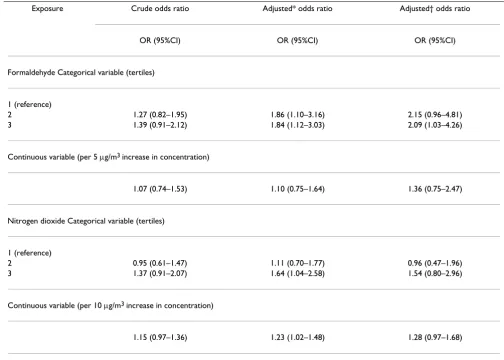
The crude odds ratios for LBW also increased with each tertile of formaldehyde exposure (Table 12). After adjust-ments for known LBW risk factors (maternal age, marital status, education, season of birth, and parental smoking), the risk of LBW remained significantly increased for those newborns whose mothers were exposed during pregnancy to medium and high levels of formaldehyde, OR = 1.86 (95% CI 1.10–3.16) and OR = 1.84 (95% CI 1.12–3.03), respectively. Further adjustment for gestational age slight-ly increased the ORs; however, this estimate remained sta-tistically significant only in the high exposure category. For NO2 we observed an increased LBW risk in the high exposure category, although the estimate lacked statistical significance when fully adjusted, OR = 1.54 (95% CI 0.80–2.96).
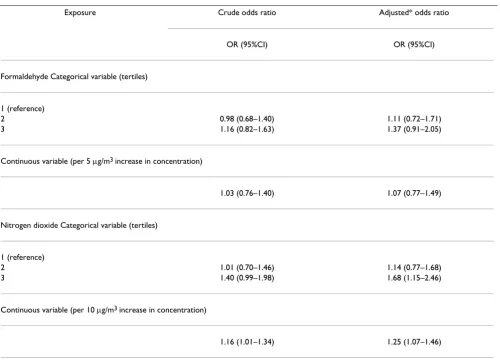
While analysing the effects of exposure to pollutants on pre-maturity, we observed a dose-response pattern for NO2; adjusted ORs for medium and high exposures were OR = 1.14 (95% CI 0.77–1.68) and OR = 1.68 (95% CI 1.15–2.46), respectively (Table 23). Using a continuous measure, we estimated that the risk of preterm birth in-creased by 25% (adjusted OR = 1.25; 95% CI 1.07–1.46) per 10 µg/m3 increase in NO
2 concentrations. There was
no significant association between preterm birth and ex-posure to formaldehyde.
Discussion
Our findings suggest a relationship between ambient air concentrations of formaldehyde during pregnancy, and the likelihood of having LBW newborns, taking into ac-count confounder adjustment for maternal age, marital status, education, season of birth and parental smoking. Further adjustment for gestational age attenuated the ef-fect of NO2, but not for formaldehyde. A relationship was noted between the highest level of NO2 exposure and
pre-mature birth; whereas for formaldehyde we observed no such relationship. Trimester-specific analyses revealed el-evated adjusted ORs for LBW in relation to formaldehyde exposure during the first trimester and likewise for pre-maturity in relation to NO2 exposure.
In our previous study we found a moderately increased LBW risk for formaldehyde exposures exceeding 3.50 µg/ m3 (adjusted OR = 1.37; 95% CI = 0.90–2.09) [16]. The
exposure levels in the earlier study were similar to the ones included in the present study (annual mean for for-maldehyde was 3.14 µg/m3, range 1.36–5.28). To our
knowledge, no other epidemiological study has examined exposure to outdoor formaldehyde as a risk factor for ad-verse pregnancy outcomes.
Our results on increased risk for preterm delivery in rela-tion to increasing levels of NO2 during pregnancy are
con-sistent with the findings of a Czech study [9]. These authors reported a relation between maternal exposure to NOx in the first trimester and a slightly increased risk of premature birth (adjusted OR 1.10; 95% CI = 1.00–1.21 per 50 µg/m3 increase in NO
x), but no association with
LBW risk. However, a study on births in Southern Califor-nia found no consistent effect of NO2 on preterm birth in regard to exposures during any of pregnancy trimesters
Table 2: Crude and adjusted odds ratios (OR) for low birth weight by pollution exposure
Exposure Crude odds ratio Adjusted* odds ratio Adjusted† odds ratio
OR (95%CI) OR (95%CI) OR (95%CI)
Formaldehyde Categorical variable (tertiles)
1 (reference)
2 1.27 (0.82–1.95) 1.86 (1.10–3.16) 2.15 (0.96–4.81)
3 1.39 (0.91–2.12) 1.84 (1.12–3.03) 2.09 (1.03–4.26)
Continuous variable (per 5 µg/m3 increase in concentration)
1.07 (0.74–1.53) 1.10 (0.75–1.64) 1.36 (0.75–2.47)
Nitrogen dioxide Categorical variable (tertiles)
1 (reference)
2 0.95 (0.61–1.47) 1.11 (0.70–1.77) 0.96 (0.47–1.96)
3 1.37 (0.91–2.07) 1.64 (1.04–2.58) 1.54 (0.80–2.96)
Continuous variable (per 10 µg/m3 increase in concentration)
1.15 (0.97–1.36) 1.23 (1.02–1.48) 1.28 (0.97–1.68)
[5]. A Seoul study found an association between first-tri-mester NO2 exposure and LBW for term births [14].
Our study has several strengths. The study population was homogeneous with respect to ethnic culture, unified pre-natal care, and health care system. Another strength of this study was the ability to adjust a number of potential con-founding factors for LBW and premature birth, including gestational age, maternal age, marital status, education, season of birth, maternal and paternal smoking.
We did not have any information on some known LBW risk factors, such as maternal nutrition, pre-pregnancy weight, and occupational exposures. However, the risk factors for which we had no information were likely to vary independently of the average ambient pollutant lev-els and so should not confound the relationships we ob-served.
Misclassification of LBW cases as non-cases and vice versa was not likely, as birth weight data, recorded in the birth register, are generally considered reliable. The estimation of gestational age, based on the date of the mother's last menstrual period, was of course less reliable; therefore, some misclassification of preterm birth cases may have occurred. However, the assignment of cases was inde-pendent of exposure assessment. Therefore, such classifi-cation errors were probably non-differential and might therefore have tended to underestimate the air pollution effects.
The most important source of error and possible bias in our study – as was the case in most studies in which expo-sure was based on place of residence – was the possible misclassification of exposure. We estimated maternal ex-posure to pollutants based on average measures for the entire residential district. True personal exposure depends upon a number of exposure pathways; for example, time spent indoors versus time spent outdoors, time spent at
Table 3: Crude and adjusted odds ratios (OR) and for premature birth by pollution exposure
Exposure Crude odds ratio Adjusted* odds ratio
OR (95%CI) OR (95%CI)
Formaldehyde Categorical variable (tertiles)
1 (reference)
2 0.98 (0.68–1.40) 1.11 (0.72–1.71)
3 1.16 (0.82–1.63) 1.37 (0.91–2.05)
Continuous variable (per 5 µg/m3 increase in concentration)
1.03 (0.76–1.40) 1.07 (0.77–1.49)
Nitrogen dioxide Categorical variable (tertiles)
1 (reference)
2 1.01 (0.70–1.46) 1.14 (0.77–1.68)
3 1.40 (0.99–1.98) 1.68 (1.15–2.46)
Continuous variable (per 10 µg/m3 increase in concentration)
1.16 (1.01–1.34) 1.25 (1.07–1.46)
specific locations such as at work or home, and migration into or out of a study area. Nevertheless, factors expected to contribute to differences between area-wide and indi-vidual exposures were most likely independent of expo-sure assessment, with a resulting underestimation of the effects of air pollution. Evidence has been provided that when area-wide measures of exposure to air pollution were used as proxies for personal exposures, then esti-mates of effects of pollutant effects were generally smaller than those based on exposure levels determined by per-sonal sampling [34].
A wide range of agents, including passive smoking [35] and occupational exposures [36] have been found to in-crease the risk of adverse pregnancy outcomes, and insuf-ficient control of other environmental risk factors could have influenced the observed associations. Because air pollution constitutes a complex exposure, the possibility exists that especially the formaldehyde measure may not only represent the toxic formaldehyde entity as such, but also several pollutants produced by the same sources.
Conclusions
Although the effects of unmeasured risk factors could not be excluded with certainty, our findings suggest that in the City of Kaunas there may be a relationship between ma-ternal exposure to ambient formaldehyde and the risk of
LBW, as well as between NO2 exposure and the risk of pre-term birth.
List of abbreviations
NO2 Nitrogen dioxide
OR Odds ratio
LBW Low birth weight
IUGR Intrauterine growth retardation
CO Carbon monoxide
SO2 Sulfur dioxide
TSP Total suspended particles
Competing interests
None declared.
Authors' contributions
RG conceived and designed the study, LM co-ordinated the study, performed statistical analysis and drafted the manuscript. Both authors read and approved the final manuscript.
Table 4: Trimester-specific odds ratios (OR)* of low birth weight and premature birth for pollution exposure
Pollutant Low birth weight Preterm birth
Single pollutant model Multiple pollutant model† Single pollutant model Multiple pollutant model†
OR (95% CI) OR (95% CI) OR 95% CI OR 95% CI
Formaldehyde(per 5 µg/m3 increase in concentration)
1st trimester 2.20 (1.00–4.85) 2.39 (1.07–5.32) 1.13 (0.64–1.97) 0.91 (0.49–1.68) 2nd trimester 1.48 (0.65–3.40) 1.57 (0.68–3.64) 0.46 (0.27–0.78) 0.38 (0.21–0.67) 3rd trimester 1.29 (0.62–2.73) 1.17 (0.52–2.65) 1.01 (0.64–1.59) 0.94 (0.57–1.53)
NO2 (per 10 µg/m3 increase in concentration)
1st trimester 0.91 (0.53–1.56) 0.79 (0.45–1.39) 1.67 (1.28–2.18) 1.69 (1.28–2.23) 2nd trimester 0.93 (0.61–1.41) 0.88 (0.57–1.36) 1.13 (0.90–1.40) 1.30 (1.03–1.64) 3rd trimester 1.34 (0.94–1.92) 1.32 (0.92–1.91) 1.19 (0.96–1.47) 1.19 (0.96–1.49)
References
1. Sram RJ: Impact of air pollution on reproductive health. Environ Health Perspect 1999, 107:A542
2. Williams L, Spence AM, Tideman SC: Implication of the observed effect of air pollution on low birth weight. Soc Biol 1977, 24:1-9 3. Alderman BW, Baron AE, Savitz DA: Maternal exposure to neigh-borhood carbon monoxide and risk of low infant birth weight. Public Health Rep 1987, 102:410-414
4. Ritz B, Yu F: The effect of ambient carbon monoxide on low birth weight among children born in southern California be-tween 1989 and 1993. Environ Health Perspect 1999, 107:17-25 5. Ritz B, Yu F, Chapa G, Fruin S: Effect of air pollution on preterm
birth among children born in southern California between 1989 and 1993. Epidemiology 2000, 11:502-511
6. Wang X, Ding H, Xu X: Association between air pollution and low birth weight: a community-based study. Environ Health Per-spect 1997, 105:514-520
7. Xu X, Ding H, Wang X: Acute effects of total suspended parti-cles and sulphur dioxides on preterm delivery: a community-based cohort study. Arch Environ Health 1995, 50:407-415 8. Bobak M, Leon DA: Pregnancy outcomes and outdoor air
pol-lution: an ecological study in districts of the Czech Republic 1986–8. Occup Environ Med 1999, 56:539-543
9. Bobak M: Outdoor air pollution, low birth weight and prema-turity. Environ Health Perspect 2000, 108:173-176
10. Dejmek J, Selevan SG, Benes I, Solansky I, Sram R: Fetal growth and maternal exposure to particulate matter during pregnancy. Environ Health Perspect 1999, 107:475-480
11. Dejmek J, Solansky I, Benes I, Lenicek J, Sram R: The impact of poly-cyclic aromatic hydrocarbons and fine particles on pregnan-cy outcome. Environ Health Perspect 2000, 108:1159-1164 12. Rogers JF, Thompson SJ, Addy CL, Mckeown RE, Cowen DJ, Decoufle
P: Association of very low birth weight with exposures to en-vironmental sulphur dioxide and total suspended particu-lates. Am J Epidemiol 2000, 151:602-613
13. Maisonet M, Bush T, Correa A, Jaakkola J: Relation between am-bient air pollution and low birth weight in the Northeastern United States. Environ Health Perspect 2001, 109(suppl 3):351-356 14. Ha E, Hong Y, Lee B, Woo B, Schwartz J, Christiani D: Is air pollu-tion a risk factor for low birth weight in Seoul? Epidemiology 2001, 12:643-648
15. Hansteen I, Kjuus H, Fandrem SI: Birth weight and environmen-tal pollution in the county of Telemark, Norway. Int J Occup En-viron Health 1998, 4:63-70
16. Grazuleviciene R, Dulskiene V, Vencloviene J: Formaldehyde expo-sure and low birth weight incidence. J Occup Health 1998, 40: 61-67
17. Landgren O: Environmental pollution and delivery outcome in southern Sweden: a study with central registries. Acta Paediatr 1996, 85:1361-1364
18. Bhopal RS, Phillimore P, Moffatt S, Foy C: Is living near coking works harmful to health? A study of industrial air pollution. J Epidemiol Comm Health 1994, 48:237-247
19. Dolk H, Pattenden S, Vrijheid M, Thakrar B, Armstrong B: Perinatal and infant mortality and low birth weight among residents near cokeworks in Great Britain. Arch Environ Health 2000, 55:26-30
20. Tabacova S, Baird DD, Balabaeva L: Exposure to oxidized nitro-gen: lipid peroxidation and neonatal health risk. Arch Environ Health 1998, 53:214-221
21. Peters A, Doering A, Wichmann HE, Koening W: Increased plasma viscosity during an air pollution episode: a link to mortality? Lancet 1997, 349:1582-1587
22. Zondervan HA, Oosting J, Hardeman MR, Smorenberg Schoorl ME, Treffers PE: The influence of maternal whole blood viscosity on fetal growth. Eur J Obstet Gynecol Reprod Biol 1987, 25:187-194 23. Sram RJ, Binkova B, Rossner P, Rubes J, Topinka J, Dejmek J: Adverse
reproductive outcomes from exposure to environmental mutagens. Mutat Res 1999, 428:203-215
24. Perera FP, Jedrychowski W, Rauh V, Whyatt RM: Molecular epide-miologic research on the effects of environmental pollutants on the fetus. Environ Health Perspect 1999, 107(suppl 3):451-460 25. Sagai M, Ichinose T: Experimental study on lipid peroxide
for-mation and tumor-promoting effects of nitrogen dioxide and ozone. In: Oxidative Damage and Repair (Edited by: Davies KTA) Oxford, UK: Pergamon 1991, 511-516
26. Moison RM, Palinckx JJ, Roest M, Houdkamp E, Berger HM: Induc-tion of lipid peroxidaInduc-tion of pulmonary surfactant by plasma of preterm babies. Lancet 1993, 341:79-82
27. Tabacova S, Nikiforov B, Balabaeva L: Postnatal effects of mater-nal exposure to nitrogen dioxide. Neurobehav Toxicol Teratol 1985, 7:785-789
28. World Health Organisation: Air Quality Guidelines for Europe WHO Reg Publ Eur Ser 2000, 91:87-91
29. Collins JJ, Ness R, Tyl RW, Krivanek N, Esmen NA, Hall TA: A re-view of adverse pregnancy outcomes and formaldehyde ex-posure in human and animal studies.Regul Toxicol Pharmacol 2001, 34:17-34
30. Taskinen HK, Kyyronen P, Sallmen M, Virtanen SV, Liukkonen TA, Huida O, Lindbohm ML, Anttila A: Reduced fertility among fe-male wood workers exposed to formaldehyde. Am J Ind Med 1999, 36:206-212
31. Trasher JD, Kilburn KH: Embryo toxicity and teratogenicity of formaldehyde. Arch Environ Health 2001, 56:300-311
32. Juknys R, Zukauskaite I: Pagrindines Kauno miesto oro kokybes pokyciu tendencijos.In: Kauno miesto ekologinis monitoringas' 99. Aplinkos tyrimai ir vertinimas (Edited by: Juknys R, Kameneckas J, Ki-likevièius G) Kaunas 2000, 7-15
33. Lang JM, Lieberman E, Cohen A: A comparison of risk factors for preterm labor and term small-for-gestational age birth. Epi-demiology 1996, 7:369-376
34. Navidi W, Lurmann F: Measurement error in air pollution expo-sure assessment. J Expo Anal Environ Epidemiol 1995, 5:111-124 35. Windham GC, Eaton A, Hopkins B: Evidence for an association
between environmental tobacco smoke exposure and birth-weight: a meta-analysis and new data. Paediatr Perinat Epidemiol 1999, 13:35-37
36. Savitz DA, Olshan AF, Gallagher K: Maternal occupation and pregnancy outcome. Epidemiology 1996, 7:269-274
Pre-publication history
The pre-publication history for this paper can be accessed here:
http://www.biomedcentral.com/content/backmatter/ 1476-069x-1-6-b1.pdf
Additional material
Additional File 1
Additional file contains Table 1. Distribution of potential risk factors for low birth weight and premature births by exposure categories.
Click here for file