The Thirty-Third AAAI Conference on Artificial Intelligence (AAAI-19)
On-Line Adaptative Curriculum Learning for GANs
Thang Doan,
1,8Jo˜ao Monteiro,
2Isabela Albuquerque,
2Bogdan Mazoure,
3Audrey Durand,
4,5Joelle Pineau,
4,5,6R Devon Hjelm
5,71Desautels Faculty of Management, McGill University
2INRS-EMT, Universit´e du Qu´ebec
3Department of Mathematics & Statistics, McGill University
4School of Computer Science, McGill University 5Mila – Quebec Artificial Intelligence Institute
6Facebook AI Research,7Microsoft Research Montreal
Abstract
Generative Adversarial Networks (GANs) can successfully approximate a probability distribution and produce realistic samples. However, open questions such as sufficient conver-gence conditions and mode collapse still persist. In this pa-per, we build on existing work in the area by proposing a novel framework for training the generator against an en-semble of discriminator networks, which can be seen as a one-student/multiple-teachers setting. We formalize this prob-lem within the full-information adversarial bandit framework, where we evaluate the capability of an algorithm to select mixtures of discriminators for providing the generator with feedback during learning. To this end, we propose a reward function which reflects the progress made by the generator and dynamically update the mixture weights allocated to each discriminator. We also draw connections between our algo-rithm and stochastic optimization methods and then show that existing approaches using multiple discriminators in literature can be recovered from our framework. We argue that less ex-pressive discriminators are smoother and have a general coarse grained view of the modes map, which enforces the generator to cover a wide portion of the data distribution support. On the other hand, highly expressive discriminators ensure samples quality. Finally, experimental results show that our approach improves samples quality and diversity over existing baselines by effectively learning a curriculum. These results also sup-port the claim that weaker discriminators have higher entropy improving modes coverage.
1
Introduction
Generative Adversarial Networks (GANs) (Goodfellow et al. 2014) have reshaped the state of machine learning in tasks that involve generating data. A GAN is an unsupervised method that consists of two neural networks, a generator and a discriminator, with opposing (oradversarial) objec-tives. The typical goal of the generator is to transform noise (e.g., drawn from a normal distribution) into samples whose statistical and structural characteristics match well those of
Copyright c2019, Association for the Advancement of Artificial Intelligence (www.aaai.org). All rights reserved.
an empirical target dataset (such as a collection of images). The discriminator, which acts as anadversaryto the gener-ator, needs to discriminate between (orclassify) samples as coming from the real data or the generator.
While GANs can achieve impressive qualitative perfor-mance (most notably with image data, e.g., see (Roth et al. 2017; Miyato et al. 2018; Karras et al. 2017)), the most successful methods depart from the original formulation to address various instabilities and other optimization difficul-ties (Arjovsky and Bottou 2017; Arjovsky, Chintala, and Bottou 2017). One such difficulty in training GANs occurs when the generator produces samples only from a small subset of the target distribution, a phenomenon known as
missing modes(a.k.a.,mode-dropping, e.g. see (Che et al. 2016)). Numerous works try to address the problem by mod-ifying the original objective, such as unrolling (Metz et al. 2016), aggregating samples (Lin et al. 2017), stacked architec-tures (Huang et al. 2016; Karras et al. 2017), mutual informa-tion / entopy maximizainforma-tion (Belghazi et al. 2018), multiple discriminators (Neyshabur, Bhojanapalli, and Chakrabarti 2017; Juefei-Xu, Boddeti, and Savvides 2017), or multi-ple generators (Tolstikhin et al. 2017; Hoang et al. 2017; Kwak and Zhang 2016).
Figure 1: Recovering dropped modes via multiple discrimi-nators. The weak discriminator provides feedback, allowing the generator to recover forgotten modes. The strong discrim-inator experiences vanishing gradient and cannot help the generator to recover modes.
a low capacity1 discriminator, it is ultimately undesirable given that the end goal is to generate samples that resemble well the target dataset. From now on, we will refer to such low capacity discriminators asweak and to high capacity discriminators asstrong. In order to ensure both high quality and mode coverage, we consider multiple discriminators (as in (Durugkar, Gemp, and Mahadevan 2016)) with different strengths to train the generator. We propose to train the gen-erator using a curriculum based on an on-line multi-armed bandit algorithm (Matiisen et al. 2017; Graves et al. 2017), dynamically changing the weight/resources allocated to each discriminator, which we show is crucial for achieving good results. Our primary contributions are:
1. We provide important insights into the missing mode prob-lem as demonstrated by the gradient signal available to the generator from the discriminator.
2. As a potential solution to the missing modes problem, we introduce a new framework based on adversarial ban-dits (Littlestone and Warmuth 1994; Auer et al. 1995; Freund and Schapire 1997) resource allocation, where the generator gets its training signal from a set of teacher networks with increasing capacity.
3. We show that the proposed approach leads to a curricu-lum learning characterized by successive phases of the generator prioritizing different discriminators.
The remainder of this paper is organized as follows. Pre-vious literature relevant to this work is briefly reviewed on Section 2. The proposed approach is formally introduced in Section 3, and an empirical analysis is reported in Section 4. Conclusions and future directions are finally presented in Section 5.
1
Throughout the paper, we refer tocapacityas the architecture size of a given neural network in terms of number of parameters.
2
Related Work
Mode coverage and data / model augmentation The
in-tuition that missing modes are due to vanishing gradients resonates with some successful approaches on stabilizing and improving GAN training through data and model aug-mentation. Instance noise (Arjovsky and Bottou 2017) has been shown to improve stability (see also (Roth et al. 2017)), which can be understood as smoothing the data modes in the pixel space. Progressively reducing the down-sampling through training (either by copying parameters or feeding low resolution samples into a larger generator) have also been considered previously (Huang et al. 2016; Karras et al. 2017) as solutions to increase mode overlap.
This is akin to a hand-crafted curriculum, progressively increasing the difficulty of the problem at a-priori chosen points in the complete training procedure.
Multiple discriminators and generators Several works
have also incorporated multiple generators or discrimina-tors in order to improve learning. Multiple-generator meth-ods (Tolstikhin et al. 2017; Hoang et al. 2017; Kwak and Zhang 2016) typically work by encouraging the genera-tors to divide the task of generating by modes in the target dataset (without additional supervision). Using multiple dis-criminators (Neyshabur, Bhojanapalli, and Chakrabarti 2017; Juefei-Xu, Boddeti, and Savvides 2017), on the other hand, is known to provide a better learning signal for the generator if said discriminators compositionally represent well the target datasets. Closest to our work, (Durugkar, Gemp, and Mahade-van 2016) consider discriminators of different complexity to provide varied signal. We will show that wisely designing the reward allows to track the progress made by the generator and encourages a curriculum learning.
Multi-armed bandit as a curriculum learning method for GANs Curriculum learning (Bengio et al. 2009) phrases a given machine learning problem as a set of tasks of increas-ing difficulty. GANs can also be said to share aspects with curriculum learning: the discriminator defines an objective of progressive difficulty,
thus allowing the generator to gradually learn to more faithfully mimic the target distribution. However, there is no explicit mechanism to encourage a sensible curriculum for either model. For example, if the discriminator learns to represent disjoint modes faster than the generator learns to cover them, this can lead to the generator missing modes with no gradient signal to recover.
3
Adaptative Curriculum GAN
Here we formulate the problem and approach for training a single generator on a target dataset using a curriculum over multiple discriminators, which we callAdaptative Cur-riculum GAN(acGAN). First, define a generator function,
G:Z 7→ X, which maps noise from a domainZto the
do-main of a target dataset,X (such as the space of images). Let
p(x)denote the target density2, and letp(z)denote the prior density defined onZused to draw noise samples for input into the generator. We wish to train this generator function usingN discriminators,D={Di:X 7→R}Ni=1, such that on each episodet, we select the mixture of discriminators that provides the best learning signal.
3.1
Mixing discriminators
This mixture-of-experts problem, where each discriminator plays the role of a teacher, can be tackled under the full-information adversarial bandit setting (Littlestone and War-muth 1994; Freund and Schapire 1997; Auer et al. 1995).
On each episodet, a bandit player associates normalized weights Π(t) = {πi(t)}Ni=1 with discriminators{Di}Ni=1. The generator is then trained based on the mixture described byΠ(t), and a rewardRi(t)is observed for each discrimi-natorDi, characterizing the generator’s improvement with respect toDi. LetR(t) =PN
i=1πiRi(t)denote the total ob-served reward at timet. The goal of the player is to learn the optimal policyΠ?(t) := argmax
Π∈∆(N−1)EΠ(t),p(z)[R(t)] that maximizes the expected total reward3.
The Hedge algorithm (Freund and Schapire 1997), also known as Boltzmann or Gibbs distribution, addresses this full-information game by maintaining probabilities
πi(t) =
expλQi(t) N
P
j=1
expλQj(t)
, λ≥0, (1)
for each discriminatorDi, whereQi(t)estimates the gain of
Di at episodet. In this case,λis a parameter of the distri-bution:λ= 0corresponds to a uniform distribution over all models. We found experimentally that using a moving aver-age on previous rewards (which also featured in (Matiisen et al. 2017)) stabilizes the training:
Qi(t) =αRi(t) + (1−α)Qi(t−1), (2) whereα∈(0,1)is the smoothing parameter.
To demonstrate how this can be used to train GANs, con-sider the usual value function (Goodfellow et al. 2014):
V(D, G) =Ep(x)[log(D(x))] +Ep(z)[log(1−D(G(z)))]. (3)
On each episodet, given the mixture of discriminatorsΠ(t), each discriminator is trained by taking a gradient step to increase the expected value function
EΠ(t)[V(Di, G)] =
X
j
πj(t)V(Dj, G), (4)
2
Here, we assume for the sake of notation that the target data admits a density.
3
∆(N−1)denotes the standard simplex onRN.
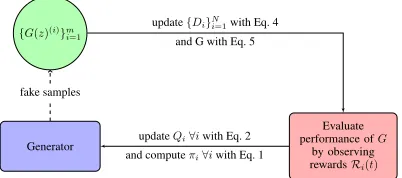
Generator fake samples
{G(z)(i)}m i=1
Evaluate performance ofG
by observing rewardsRi(t)
update{Di}N i=1with Eq. 4
and G with Eq. 5
updateQi∀iwith Eq. 2
and computeπi∀iwith Eq. 1
Figure 2: Proposed procedure for training the generator
and the generator is trained by taking a gradient step to in-crease
EΠ(t)[Ep(z)[log(D(G(z)))]]. (5)
The latter corresponds to the non-saturated version of Eq. 4 for the generator. The intuition is that training the genera-tor with all the discriminagenera-torssimultaneously(as a mixture) should force the generator to fool all discriminators at the same time (Durugkar, Gemp, and Mahadevan 2016). Since each discriminator has an increasing level view of the modes distribution, they should have a complementary role. While the weaker discriminator focuses on modes coverage, the stronger discriminator ensures samples quality (showed in Section 4.1). This should result into a better overall coverage of the modes in the input distribution.
Algorithm 1 describes our proposed acGAN procedure. We denote and parameterize this algorithm as acGAN(λ, α,Rr) whereλ≥0, α∈(0,1).
Algorithm 1Generic acGAN algorithm
1: Given:N: number of discriminators,Tmax: time steps,
Twarmup: warmup time,α: moving average coefficient,
λ: Boltzmann constant
2: Qi(0)←0,∀i= 1, . . . , N
3: fort= 1, . . . , Tmaxdo
4: Update all discriminators{Di}Ni=1using Eq. 4 5: Update the generatorGusing Eq. 5
6: ift≥Twarmupthen
7: Evaluate the performance ofGand observe a re-wardRi(t)for each discriminatori
8: Update all values{Qi(t)}Ni=1according to Eq. 2
9: πi(t)←expλQi(t)/ N
P
j=1
expλQj(t) ∀i= 1. . . N
10: end if
11: end for
Remark 1. At the beginning of the training, we define a
warm-up periodTwarmup, prior to which we trainDiandG
with a uniform probability, i.eπi = N1,∀i = 1, . . . , N. In
other words, we considerλ= 0,∀t≤Twarmup. This
guaran-tees that each discriminator is updated a minimum number of times (or provides feedback a minimum number of times to the generator) and prevents oneDjfrom dominating the
others (i.e,πjπi,∀i6=j) at the beginning of the training.
hardly recover a significant probability and the generator may never get informative gradient from the corresponding discriminator. Note that warm-ups are not uncommon either in bandits algorithm, e.g. for adding robustness to the tails of reward distributions (Baransi, Maillard, and Mannor 2014).
3.2
Reward shaping
In order to provide meaningful feedback for learning effi-cient mixtures of discriminators, we consider different re-ward functions to generate Ri(t). We argue that progress (i.e., the learning slope (Matiisen et al. 2017; Graves et al. 2017)) of the generator is a more sensible way to evaluate our policy. Letθ(t)be the generator parameters at episodet. We define the two following quantities for measuring generator progress:
RSi(t) =Ep(z)[Di(G(z;θ(t)))
−Di(G(z;θ(t−1)))], (6)
RVi(t) =Ep(z)[V(Di, G(z;θ(t)))
−V(Di, G(z;θ(t−1)))]. (7)
The former measures the progress of the generator with re-spect to the discriminatoriscoreDi(·), while the latter assess the change in the loss function (Eq. 3). Since the change in the quality sample (Eq .6) led to better performance than the change in the loss function (Eq .7), all our experiments (see Section. 4) use Eq .6.
3.3
Connection to existing methods
Interestingly, some existing methods in the GAN literature can be seen as a specific case of acGAN:
GMAN: The original GMAN (Durugkar, Gemp, and
Ma-hadevan 2016) algorithm can be recovered by settingα= 1
and taking the loss function to be the reward Ri(t) =
V(Di, G). Note how the authors of GMAN call their algo-rithm GMAN-λ, whereλis also the Boltzmann coefficient.
Uniform: The uniform case is defined by assigning a fixed
uniform probability for each discriminatorDi:
πi(t) =
1
N, ∀t∈N.
This corresponds to Eq. 1 withλ= 0.
To support the results of our theoretical work, we con-ducted a set of experiments which we describe below.
4
Experiments
In this section, we first give an understanding of how each discriminator provides informative feedback to the generator. We then compare our proposed approach (acGAN) against existing methods from the literature.
4.1
Retaining mode information through weaker
capacity discriminators and smoothness
We begin by analyzing the gradient norm of the discriminator networks and we show that weak capacity discriminators
aresmootherthan strong discriminators. This property corre-sponds to a ”coarse-grained” representation of the distribu-tion, which allows the generator to recover missing modes. We further show we can increase the smoothness of a weak discriminator by corrupting its inputs with white noise. This results in an increase of the discriminator’s entropy (see Sup-plementary Material for more details) and hence smoother gradient signal.
Weak Discriminators: a way to retain modes We now
highlight the role of weaker capacity discriminators. To this extent, we performed the following experiments on the 8 Gaussian synthetic dataset:
• We pretrained the generator (with3dense layers of400
units with ReLU activation layers except for the last layer) with one discriminator on only2of the original8modes.
• We trained a (vanilla) GAN on all 8 Gaussian compo-nents, initializing with the2-mode generator above. The discriminator had3dense layers of400units (ReLU hid-den activation layers).
• We trained acGAN with the generator initialized with the
2-mode generator (as with vanilla GAN). We considered3
discriminators, with1,2and3dense layers respectively (same activation scheme as previously applies here).
Figure 3: Modes used for pretraining the generator (left) and modes recovered by Vanilla GAN (middle) and acGAN (right). The more modes the better.
Figure 4: Gradient norm of each discriminator with respect to the input. We clipped the magnitude with respect to the weaker discriminator range. Since weaker discriminators are smoother by construction, they help the generator to recover missing modes. On the other hand, vanilla GAN can hardly recover modes due to its vanishing gradient.
Results (Fig. 3) show the Vanilla GAN could only retrieve
FD Modes Quality samples Vanilla GAN 7.28 17 88%
Uniform (3D) 6.64 20 93.4%
acGAN (3D) 6.65 25 92.9%
Table 1: Results on the Gaussian mixture synthetic data. Our method acGAN could cover allc 25 modes.
discriminator with respect to the input, i.e.,||∇XD(X)||2for
X ∈[−2,2]2. Observe that there is a clear progression from a stronger discriminator with more distinct, higher gradients to the weaker discriminator smoother gradients. Additionally, note that the discriminator from the vanilla GAN, which has very high gradient norm values, has gradients for modes not present in the generator: the discriminator has information useful for learning about these missing modes, but the gener-ator does not learn these modes due to vanishing gradients. Our results support both our original hypothesis that miss-ing modes are due to vanishmiss-ing gradients and that usmiss-ing a coarse-grain discriminator can be used to recover missing modes. To provide further insight, we show the evolution of the gradient norm of each discriminator at training time in the Supplementary Material. We also note that the dis-continuities in the gradients is due to the ReLU activation partitioning the subspace through overlapping half-planes, which contrasts the smooth decay of hyperbolic tangent and sigmoid4nonlinearities, and we further explore the effect of different nonlinear activation layers on the gradient norm of the weak discriminator in the Supplementary Material.
4.2
Performance of acGAN against existing
baselines
In this section, we evaluate the performance of our proposed method (acGAN), on various datasets. All experiments con-sider the reward shown in Eq. 6. We first conducted a sanity check on 2 mode-dropping datasets: synthetic data consisting of a mixture of 25 Gaussians and Stacked-MNIST with 1000 modes. We then tested it on CIFAR10 and finally show gener-ated samples on celebA dataset (see Supplementary Material). We aim to analyze specific properties such as diversity of generated samples and quality in terms of FID ( (Heusel et al. 2017)) score when available, along with convergence of the method (how fast it reaches its minimum FID score). Ad-ditionally, our results hint at the emergence of a curriculum during the training process.
All parameters used to obtain the results can be found in the Supplementary Material. We split the batch of inputs between discriminators. We abuse of language with the termepoch, which in the context of the current paper means that the gen-erator has been trained on a number of iterations equivalent to an epoch. For example, CIFAR-10 has 50,000 training im-ages and, assuming a batch size of 64, one epoch represents roughly 781 iterations for the generator.
Synthetic Gaussian mixture dataset The synthetic
dataset is composed of 25 bivariate Gaussian mixtures ar-ranged in a two-dimensional grid. We launched a single run
4
σ(y) = 1/1 +e−y
Figure 5: KDE plots of the modes recovered by each exam-ined approach with 3 discriminators.
Modes (max 1000) KL DCGAN (Radford, Metz, and Chintala 2015) 99.0 3.40
ALI (Dumoulin et al. 2016) 16.0 5.40
Unrolled GAN (Metz et al. 2016) 48.7 4.32
VEEGAN (Srivastava et al. 2017a) 150.0 2.95
PacGAN (Lin et al. 2017) 1000.0±0.00 0.06±1.0e−2 GAN+MINE (Belghazi et al. 2018) 1000.0±0.00 0.05±6.3e−3 acGAN (3D) 1000.0±0.00 7.4e−2±0.0 acGAN (5D) 1000.0±0.00 9.65e−2±0.0 Table 2: Number of modes covered and Kullback-Leiber divergence between the real and generated distributions on Stacked-MNIST. acGAN could recover the 1000 modes.
of 15 epochs for all methods with 3 discriminators. We re-port 3 measures in Table 1: the Fr´echet Distance (FD), the number of recovered modes and the proportion of high qual-ity samples (which is the proportion of samples covering a mode). More details on those metrics can be found in the Supplementary Material.
We compared the performance of our proposed methods to that of the Uniform algorithm and of the vanilla GAN (Good-fellow et al. 2014). Our proposed methods could cover the 25 modes. KDE plots for the 3 discriminators case are shown in Fig. 5.
Stacked-MNIST We use the Stacked-MNIST dataset
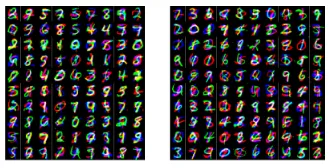
(Sri-vastava et al. 2017b) to measure the mode coverage of our proposed approach. The dataset is generated by stacking 3 randomly selected digits from the MNIST dataset: one on each RGB channel to produce a final28×28×3RGB tensor. The dataset has 128,000 training images and is assumed to have103 modes. Results of our experiments are shown in Table 2.
We report our results (averaged over 10 runs) in Table 2 and compare them with other existing baselines in the literature. Our method could recover all 1000 modes like PaCGAN (Lin
et al. 2017) and MINE (Belghazi et al. 2018); these two approaches either increase the dimensionality of the generator inputs either by packing multiple samples or by adding a latent code vector which helps overcoming mode collapse. Generated samples are shown in Fig. 6, our results further verify our hypothesis that acGAN is a sensible approach to ensuring good mode coverage and sample quality.
2 Discriminators
0.2 0.3 0.4 0.5 0.6 0.7 0.8
probability
Weak Disc. Strong Disc.
3 Discriminators
0.2 0.3 0.4 0.5
probability
Weak Disc. Intermediate Disc. Strong Disc.
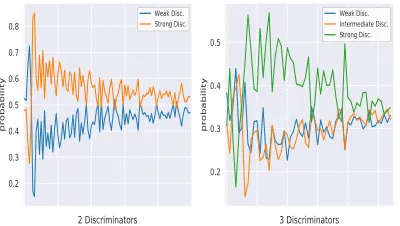
Figure 7: Weightπiof each discriminator over the training epochs. We can see phase switching at the beginning where each discriminator’s weight is dominating before eventually converging to a uniform distribution.
CIFAR-10 We conducted an in-depth study of acGAN’s
performance on CIFAR-10 by running experiments on 5 independent seeds for 50 epochs each.
We found a particular pattern in the acGAN’s learning pro-cess: it consists of distinct regimes where one discriminator’s weight πi dominates over the others. To illustrate this, we averaged the sampling probability of each discriminator over every 200 iterations and plotted results in Fig. 7 for2and3
discriminators, respectively. The reported curves suggest that, forN= 2discriminators, the weakest discriminator network is often sampled at the beginning until the generatorGlearns enough from it, at which point it begins to use the stronger discriminator more often. Note how the strong discrimina-tor is sampled more frequently than the weak one. In fact, because the generator needs to produce samples of higher quality to fool the strong discriminator, training with the latter might take longer as opposed to using weaker discriminators (which are more lenient). By the end of training, all discrim-inators are being used in equal proportions, meaning that every discriminator plays a complementary role from mode coverage to quality samples. A similar pattern is observed for the3-discriminators case.
To assess the quality of produced results, we report the minimum Fr´echet Inception Distance FID ( (Heusel et al. 2017)) (and corresponding epoch) reached in Table 3. The squared FID was computed every epoch with 1,000 held-out samples at training time. As in (Fedus et al. 2017), a ResNet pre-trained on CIFAR-10 was employed to obtain representations for FID computation rather than Inception V3. Proceeding this way yields a more informative score, given that our classifier was trained on the same data as the generative models. Details on the FID score can be found in the Supplementary Material.
We compared our results to (Durugkar, Gemp, and Ma-hadevan 2016). Since the authors reported that GMAN-1 (λ= 1) had an overall better performance, we used this ver-sion in our experiments and refer to it as GMAN. Previously, we observed that the feedback provided to the generator is shared between all the discriminators. Especially, not all gra-dient comes from the strong discriminator (unlike for the Vanilla GAN). One might be concerned by a degradation of the quality samples. We show that having more discrimina-tors leads to better mode coverage and samples quality (see the FID curves for an increasing number of discriminators in the Supplementary Material).
Overall, we noticed that acGAN achieved the best FID score when compared to the baseline as presented in Fig. 8 and 9 (plots are shown in a larger format in the Supplemen-tary Material). GMAN performed worse than expected and increasing the number of discriminators did not significantly improve its FID score. We suspect that the original loss func-tion of the GAN (which is equivalent to the Jensen-Shannon divergence minimization) is not a good signal to assess the progress ofG. Indeed, (Arjovsky, Chintala, and Bottou 2017) argued and introduced a toy example showing that this ver-sion of adversarial nets is not informative when there is little overlap between the supports of the true and approximate dis-tributions, as commonly seen at the beginning of the training process. Finally, not keeping a moving average via aQ-value can lead to high variance.
0 10 20 30 40 50
Epochs 5
10 15 20
FID
Uniform GMAN acGAN
Figure 8: FID scores computed with 1,000 samples at the end of each epoch for different methods with 3 discriminators. acGAN outperforms the baselines Uniform and GMAN.
Best FID(epoch) Mean Best FID Vanilla GAN 5.02 (20)-5.28 (27)-4.27 (30)-4.80 (34)-4.63 (41) 4.80
WGAN-GP5 4.29 (43)-4.24 (28)-3.98 (47)-3.99 (37)-3.93 (50) 4.08
3
Disc
Uniform 4.18 (20)-4.07 (39)-4.35 (45)-5.07 (30)-4.39 (47) 4.41
GMAN 3.87 (43)-4.05 (46)-5.24 (42)-5.71 (42)-4.10 (22) 4.59
acGAN 3.93 (39)-3.57 (38)-4.25 (42)-3.43 (40)-3.11 (43) 3.66
5
Disc
Uniform 3.42 (47)-3.69 (49)-4.37 (37)-3.64 (37)-3.47 (40) 3.72
GMAN 4.58 (44)-4.40 (20)-3.91 (47)-4.81 (25)-4.42 (38) 4.42
0 10 20 30 40 50
Epochs
5 10 15 20
FID
Uniform GMAN acGAN
Figure 9: FID curves with 5 discriminators. acGAN presented earlier convergence and reached lower FID values.
5
Conclusion
In this work, we model the training of the generator against discriminators of increasing complexity within a one-student/multiple-teachers paradigm. We address this mixture-of-experts problem under the adversarial bandit setting with full-information, where we rely on the Hedge algorithm to learn the weights assigned to each discriminator in the mix-ture. Since designing a suitable reward function is a key ingredient to control the shape of the learned policy, we ex-amined two sensible reward functions which relied on sample quality and the GAN loss function. We empirically found the high quality sample reward (Eq. 6) to yield the best results. Keeping a moving average on the rewards helped smooth-ing the weights put on discriminators and resulted in a more stable mixture.
Then, we demonstrated a complementary regulation mech-anism between weak and strong discriminators. While weaker discriminators enjoy smoother properties and provide more informative feedback to the generator, stronger discriminators focus one finer grain detail to ensure sample quality.
Finally, we conducted a series of experiments to show the emergence of a curriculum during the training process. That is, lower-capacity discriminators have higher weights at the beginning but, as the training progresses, higher weights are allocated to higher-capacity discriminators. We showed how existing algorithms could be recovered from our model via theQ-value. The performed experiments showed that our proposed approach leads to an earlier convergence and a better FID score compared to existing baselines in the field, i.e. Uniform and GMAN.
As a direction for future investigation, approaches not relying on the adversarial framework could be investigated to model the non-stationarity of the reward distributions. For example, finding a meaningful representation for the state of the generator could allow the use of contextual bandits algorithms.
5
We replaced the batch norm layer with instance norm
References
Arjovsky, M., and Bottou, L. 2017. Towards principled methods for training generative adversarial networks. In
International Conference on Learning Representations. Arjovsky, M.; Chintala, S.; and Bottou, L. 2017. Wasserstein GAN. CoRRabs/1701.07875.
Auer, P.; Cesa-Bianchi, N.; Freund, Y.; and Schapire, R. E. 1995. Gambling in a rigged casino: The adversarial multi-armed bandit problem. InIEEE Annual Symposium on Foun-dations of Computer Science (FOCS), 322.
Baransi, A.; Maillard, O.-A.; and Mannor, S. 2014. Sub-sampling for multi-armed bandits. InJoint European Con-ference on Machine Learning and Knowledge Discovery in Databases, 115–131. Springer.
Belghazi, I.; Rajeswar, S.; Baratin, A.; Hjelm, R. D.; and Courville, A. C. 2018. MINE: mutual information neural estimation. CoRRabs/1801.04062.
Bengio, Y.; Louradour, J.; Collobert, R.; and Weston, J. 2009. Curriculum learning. In Proceedings of the 26th Annual International Conference on Machine Learning, ICML ’09, 41–48. New York, NY, USA: ACM.
Che, T.; Li, Y.; Jacob, A. P.; Bengio, Y.; and Li, W. 2016. Mode regularized generative adversarial networks. arXiv preprint arXiv:1612.02136.
Dumoulin, V.; Belghazi, I.; Poole, B.; Mastropietro, O.; Lamb, A.; Arjovsky, M.; and Courville, A. 2016. Adversari-ally Learned Inference. ArXiv e-prints.
Durugkar, I. P.; Gemp, I.; and Mahadevan, S. 2016. Genera-tive multi-adversarial networks.CoRRabs/1611.01673. Fedus, W.; Rosca, M.; Lakshminarayanan, B.; Dai, A. M.; Mohamed, S.; and Goodfellow, I. 2017. Many paths to equilibrium: Gans do not need to decrease adivergence at every step. arXiv preprint arXiv:1710.08446.
Freund, Y., and Schapire, R. E. 1997. A decision-theoretic generalization of on-line learning and an application to boost-ing.Journal of computer and system sciences55(1):119–139. Goodfellow, I. J.; Pouget-Abadie, J.; Mirza, M.; Xu, B.; Warde-Farley, D.; Ozair, S.; Courville, A. C.; and Bengio, Y. 2014. Generative adversarial networks.CoRRabs/1406.2661. Graves, A.; Bellemare, M. G.; Menick, J.; Munos, R.; and Kavukcuoglu, K. 2017. Automated curriculum learning for neural networks. CoRRabs/1704.03003.
Heusel, M.; Ramsauer, H.; Unterthiner, T.; Nessler, B.; Klam-bauer, G.; and Hochreiter, S. 2017. Gans trained by a two time-scale update rule converge to a nash equilibrium. CoRR
abs/1706.08500.
Hoang, Q.; Nguyen, T. D.; Le, T.; and Phung, D. Q. 2017. Multi-generator generative adversarial nets. CoRR
abs/1708.02556.
Huang, X.; Li, Y.; Poursaeed, O.; Hopcroft, J. E.; and Be-longie, S. J. 2016. Stacked generative adversarial networks.
CoRRabs/1612.04357.
Karras, T.; Aila, T.; Laine, S.; and Lehtinen, J. 2017. Pro-gressive growing of gans for improved quality, stability, and variation.CoRRabs/1710.10196.
Kwak, H., and Zhang, B. 2016. Generating images part by part with composite generative adversarial networks.CoRR
abs/1607.05387.
Lin, Z.; Khetan, A.; Fanti, G. C.; and Oh, S. 2017. Pacgan: The power of two samples in generative adversarial networks.
CoRRabs/1712.04086.
Littlestone, N., and Warmuth, M. K. 1994. The weighted ma-jority algorithm.Information and computation108(2):212– 261.
Matiisen, T.; Oliver, A.; Cohen, T.; and Schulman, J. 2017. Teacher-student curriculum learning.CoRRabs/1707.00183. Metz, L.; Poole, B.; Pfau, D.; and Sohl-Dickstein, J. 2016. Unrolled generative adversarial networks. CoRR
abs/1611.02163.
Miyato, T.; Kataoka, T.; Koyama, M.; and Yoshida, Y. 2018. Spectral normalization for generative adversarial networks.
arXiv preprint arXiv:1802.05957.
Neyshabur, B.; Bhojanapalli, S.; and Chakrabarti, A. 2017. Stabilizing GAN training with multiple random projections.
CoRRabs/1705.07831.
Radford, A.; Metz, L.; and Chintala, S. 2015. Unsupervised representation learning with deep convolutional generative adversarial networks. CoRRabs/1511.06434.
Roth, K.; Lucchi, A.; Nowozin, S.; and Hofmann, T. 2017. Stabilizing training of generative adversarial networks through regularization.CoRRabs/1705.09367.
Srivastava, A.; Valkov, L.; Russell, C.; Gutmann, M. U.; and Sutton, C. 2017a. Veegan: Reducing mode collapse in gans using implicit variational learning. ArXiv e-prints.
Srivastava, A.; Valkoz, L.; Russell, C.; Gutmann, M. U.; and Sutton, C. 2017b. Veegan: Reducing mode collapse in gans using implicit variational learning. InAdvances in Neural Information Processing Systems, 3310–3320.