The Thirty-Third AAAI Conference on Artificial Intelligence (AAAI-19)
Talking Face Generation by Adversarially
Disentangled Audio-Visual Representation
Hang Zhou, Yu Liu, Ziwei Liu,
∗Ping Luo, Xiaogang Wang
The Chinese University of Hong Kong, Hong Kong, China
{zhouhang@link, yuliu@ee, zwliu@ie, xgwang@ee}.cuhk.edu.hk, [email protected]
Abstract
Talking face generation aims to synthesize a sequence of face images that correspond to a clip of speech. This is a chal-lenging task because face appearance variation and seman-tics of speech are coupled together in the subtle movements of the talking face regions. Existing works either construct specific face appearance model on specific subjects or model the transformation between lip motion and speech. In this work, we integrate both aspects and enable arbitrary-subject talking face generation by learning disentangled audio-visual representation. We find that the talking face sequence is ac-tually a composition of both subject-related information and speech-related information. These two spaces are then explic-itly disentangled through a novelassociative-and-adversarial
training process. This disentangled representation has an ad-vantage where both audio and video can serve as inputs for generation. Extensive experiments show that the proposed ap-proach generates realistic talking face sequences on arbitrary subjects with much clearer lip motion patterns than previous work. We also demonstrate the learned audio-visual repre-sentation is extremely useful for the tasks of automatic lip reading and audio-video retrieval.
1
Introduction
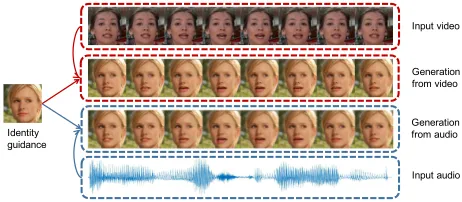
Understanding talking faces visually is of great importance to machine perception and communication. Humans can not only guess the semantic meaning of words by observing lip movement but also imagine the scenario when a specific subject talks (i.e. face generation). Recent advances have focused on automatic lip reading, which surpasses human-level performance in certain domains. Here, we explore gen-erating a video of arbitrary-subject speaking, which per-fectly syncs with a specific speech where the speech infor-mation can be represented by either a clip of audio or video. We refer this problem as arbitrary-subject talking face gen-eration, as shown in Fig. 1.
However, generating identity-preserving talking faces that clearly conveys certain speech information is a challenging task, since the continuous deformation of the face region relates to both intrinsic subject traits (Liu et al. 2015) and extrinsic speech vibrations. Previous efforts in this direc-tion are mainly from computer graphics (Xie and Liu 2007;
∗
Corresponding author.
Copyright c2019, Association for the Advancement of Artificial Intelligence (www.aaai.org). All rights reserved.
Identity guidance
Input audio Input video
Generation from video
Generation from audio
Figure 1: Problem description. Given a single face image of a target person, this work aims to generate the talking video based on the given speech information that is represented by either a clip of video or an audio.
Wang et al. 2010; Fan et al. 2015; Suwajanakorn, Seitz, and Kemelmacher-Shlizerman 2017; Thies et al. 2016). Re-searchers construct specific 3D face model for a chosen subject and the talking faces are animated by manipulating 3D meshes of the face model. However, these approaches strongly rely on the 3D face model and are hard to scale up to arbitrary identities. More recent attempts (Chung, Ja-maludin, and Zisserman 2017) leverage the power of deep generative model and learn to generate talking faces from scratch. Though the resulting models can be applied to an ar-bitrary subject, the generated face sequences are sometimes blurry and not temporally meaningful. One important reason is that the subject-related and speech-related information are coupled together such that the talking faces are difficult to learn in a purely data-driven manner.
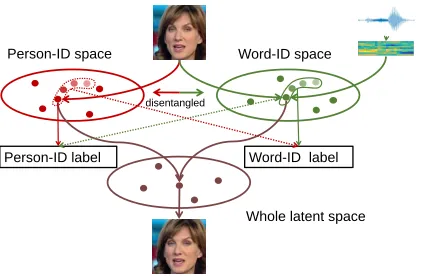
To address the aforementioned problems, we integrate the identity-related and speech-related information by learn-ing disentangled audio-visual representation, as illustrated in Fig. 2. We aim to disentangle a talking face sequence into two complementary representations, one containing identity information while the other containing speech information. However, directly separating these two parts is not a trivial task because the variations of face deformation can be ex-tremely large considering the diversity of potential subjects and speeches.
read-Person-ID space Word-ID space
Whole latent space
disentangled
Person-ID label Word-ID label
Figure 2: We propose to guide the information flow by using labels to ensure the spaces contain discriminative semantic information dispelling from each other. With the assumption that Word-ID space is shared between visual and audio in-formation, our model can reconstruct faces base on either video or audio.
ing) as a probe task forassociatingaudio-visual represen-tations, and then employingadversariallearning to disen-tangle the subject-related and speech-related information in-side them. Specifically, we first learn a joint audio-visual space where talking face sequence and its corresponding au-dio are embedded together. It is achieved by enforcing the lip reading result obtained from talking faces aligns with the speech recognition result obtained from audio. Next, we fur-ther utilize lip reading task to disentangle subject-related and speech-related information through adversarial learning (Liu et al. 2018b). Notably, we enforce one of the representations extracted from talking faces to fool the lip reading system, in the sense that it only contains subject-related information, but not speech-related information. Overall, with the aid ofassociative-and-adversarialtraining, we can jointly em-bed audio-visual inputs and disentangle subject and speech-related information of talking faces.
The contributions of this work can be summarized as follows. (1) A joint audio-visual representation is learned through audio-visual speech discrimination by associat-ing several supervisions. Experiments show that the joint-embedding improves the baseline of lip reading result on LRW dataset (Chung and Zisserman 2016a). (2) Thanks to the discriminative nature of our joint representation, we dis-entangle the person-identity and speech information through adversarial learning for better talking face generation. (3) By unifying audio-visual speech recognition and audio-visual synchronizing, we achieve arbitrary-identity talking face generation from either video or audio speech as inputs in an end-to-end framework, which synthesizes high-quality and temporally-accurate talking faces.
2
Related Work
Generating Talking Faces.The work of synthesizing lip motion from either audio (Xie and Liu 2007; Wang et al. 2010; Fan et al. 2015; 2016; Suwajanakorn, Seitz,
and Kemelmacher-Shlizerman 2017; Chung, Jamaludin, and Zisserman 2017) or generating moving faces from videos (Thies et al. 2016; Liu et al. 2017b; Wiles, Koepke, and Zisserman 2018) has long been a task of concern in both the community of computer vision and graphics. However, most synthesis works from audio require a large amount of video footage of the target person for training, modeling, or sampling. They could not transfer the speech information to an arbitrary photo in the wild.
Chung, Jamaludin, and Zisserman (2017) use a setting that is different from the traditional ones. They try to directly generate the whole face image with different lip motions in an image-to-image translation manner based on audios.
But their method base on data-driven training using an au-toencoder, which leads to blurry results and lacks continuity. More recently, Song et al. (2018) propose to use conditional RNN adversarial network, and Chen et al. (2018) propose to use correlation loss and three-stream GAN.
(Wiles, Koepke, and Zisserman 2018) use flow to gener-ate high precision arbitrary-identity talking face based on videos and claim to be able to produce videos based on audios, but with no results shown. However, as a common problem, without specific disentangling face and lip motion information, they all cannot generate high-quality results.
Learning Audio-Visual Representation.The task of audio-visual speech recognition is a recognition problem uses ei-ther one or both video and audio as inputs. Using visual information only for recognition is also referred to as Lip Reading. A review of traditional methods for tackling this task has been made in Zhou et al. (2014) thoroughly. In re-cent years, this field develop quickly with the usage of con-volutional neural networks (CNNs) and recurrent neural net-works (RNNs) for end-to-end word-level (Chung and Zisser-man 2016a; Stafylakis and Tzimiropoulos 2017), sentence-level (Assael et al. 2016; Chung et al. 2017), and multi-view (Chung and Zisserman 2017) lip reading. In the mean-time, the exploration of this topic has been greatly pushed forward by the build-up of large-scale word-level lip read-ing dataset (Chung and Zisserman 2016a), and the large sentence-level multi-view dataset (Chung and Zisserman 2017).
For the correspondence between human faces and audio clips, a number of works have been proposed to solve the problem of the audio-video synchronization between mouth motion and speech (McAllister et al. 1997; Chung and Zis-serman 2016b). Particularly, SyncNet (Chung and Zisser-man 2016b; 2017) used two stream CNNs to sync audio
mfcc with 5 consecutive frames. In Chung and Zisserman (2017), they further fixed the sync image feature as the pre-training for lip reading, but the two tasks are still separate from each other. Recently, works from (Nagrani, Albanie, and Zisserman 2018b; 2018a) also attempt to learn the asso-ciation between a human face and voice for identity recog-nition instead of semantic level synchronization.
3
Approach
genera-Word ID
Person ID
pid information
audio wid information
visual wid information wid information
wid adversarial against pid pid adversarial against wid wid
space
pid
space
Person ID
Generation Phase
Evp
E
vwE
awCp
Cw
Word ID
Person ID Word-ID label
Person-ID label Adversarial
Adversarial Classifiers Cp
w
Cw p
Temporal GAN
Cwp
Cw p 𝒇𝒘𝒗
𝒇𝒘𝒂
𝒇𝒑𝒗
𝒇𝒑𝒗
𝒇𝒘𝒂
𝒇𝒘𝒗
𝒇𝒑𝒗
D
seqG
G
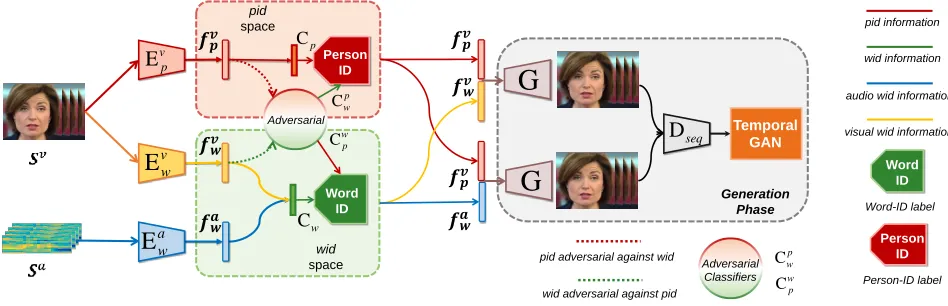
Figure 3: Illustration of our framework. Evp is the encoder that encodes Person-ID information fromvisualsource to thepid
space, Evw and Eaw are the Word-ID encoders that extract speech content information to widspace from videoand audio. Decoder G takes any combination of features inpidandwidspace to generate faces. Dseq is a discriminator used for GAN loss. The adversarial training part contains two extra classifiers Cwp and Cpw. The details of embedding the wid space and adversarial training are shown in Fig 4 and 5.
tion by learning disentangled audio-visual representations, as shown in Fig. 3.
We leverage both talking videoSvand its corresponding audio Sa as training inputs. For learning the disentangled audio-visual representations between Person-ID space (pid) and the Word-ID space (wid), there are three encoder net-works involved:
• Video to Word-ID space encoder (Evw): E v
w learns to embed the video frame sv into a visual representation
fwv which only contains speech-related information. It is achieved by learning a joint embedding space which asso-ciatesvideo and audio that correspond to the same word.
• AudiotoWord-IDspace encoder (Eaw): E a
wlearns to em-bed the speechsainto anaudiorepresentationfa
w, which resides in the shared space withfv
was introduced above.
• VideotoPerson-IDspace encoder (Evp): E v
plearns to em-bed the video frame sv into a representation fv
p which only contains subject-related information. It is achieved by theadversarialtraining process, forcing our target rep-resentationfv
p to fool the speech recognition system.
The whole idea of our pipeline is to first learn the dis-criminative audio-visual joint space wid, then disentangle it from thepidspace. Finally to combine features from the two spaces to get generation results. Specifically, for learn-ing thewidspace, we employ three supervisions: the super-vision of Word-ID labels with shared classifier Cw for as-sociating audio and visual signals with semantic meanings; contrastive lossLCfor pulling paired video and audio sam-ples closer; and an adversarial training supervision on au-dio and video features to make them indistinguishable. As for thepidspace, Person-ID labels from extra labeled face data are used. For disentanglingwidandpidspaces, adver-sarial training is employed. As for generation, we introduce
L1-norm reconstruction lossLL1 and temporal GAN loss
LGAN for sharpness and continuity.
3.1
Learning Joint Audio-Visual Representation
We learn a joint audio-visual space that associates represen-tations from both sources. We constrain the extracted audio representation to be close to its corresponding visual rep-resentation, forcing the embedded features to share a same distribution and restrictingfa
w 'fwv, so thatG(fpv, fwv) '
G(fpv, fwa)can be achieved. While requiring information of person facial identity flows from the pid space, the other space ofwidwould have to be person-ID invariant. The task of audio-visual speech recognition benefits us in achieving the shared latent space assumption and creating a discrim-inative space through mapping videos and audios to word labels. The implementation of learning the space is shown in Fig 4 (a). Then with the discriminative embedding, we can take the advantage of adversarial training for thoroughly information disentangling as described in Sec. 3.2
Sharing Classifier. After the embedded features are ex-tracted from the wid encoders Eaw, Evw to get Fv
w =
[fv
w(1),· · ·, f v
w(n)]andF a
w = [fwa(1),· · · , f a
w(n)], normally they would be fed into different classifiers for visual and au-dio speech recognition. Here we share the classifier for both the modalities to enforce them to share their distributions. As a classifier’s weightwjtend to fall into the center of the clustering of the features belonging to thej’th class, through sharing the weights, the features between both modalities are pulled towards the centroid of the class (Liu et al. 2018a). The supervision is denoted asLw.
Contrastive Loss. As the problem of mapping audio and visual together is very similar to feature mapping (Chopra, Hadsell, and LeCun 2005), retrieval and particularly the same as lip sync (Chung and Zisserman 2016b), we adopted the contrastive loss which aims at bringing closer paired data while dispelling unpaired as a baseline. During train-ing, for a batch ofN audio-video samples, themth andnth sample are drawn with labels lm=n = 1while the others
dis-Ev w Ev w Ev w Ev w Ev w v w F Ea w Ea w Ea w Ea w Ea w a w F Word
ID A / V
Contrastive
C
L Lw LDadv
Figure 4: Illustration of embedding the audio-visual shared spacewid. The encoded featuresFv
w = [fwv(1),· · ·, fwv(n)] andFwa = [fwa(1),· · · , f
a
w(n)]are constrained by contrastive lossLc, classification lossLwand domain adversarial train-ingLD
adv.
tance betweenFa
w(m)andF v
w(n)here is the euclidean norm dmn=kFwv(m)−F
a
w(n)k2. The objective can be written as:
LC= N,N X
n=1,m=1
(lmndmn+ (1−lmn) max(1−dmn,0))
(1)
During our implementation, all featuresFwv, Fwa used in this loss are normalized first.
Domain Adversarial Training.To further push the face and audio features to be in the same distribution, we apply a do-main adversarial training. An extra two-class dodo-main classi-fier is appended for distinguishing the source of the feature. The audio and face encoders are then trained to prevent the classifier from success. This is mostly a simple version of the adversarial training described in section 3.2. We refer to the objective of this method asLD
adv.
3.2
Adversarial Training for Latent Space
Disentangling
In this section, we describe how we disentangle the subject-related and speech-subject-related information in the joint embed-ding space usingadversarialtraining.
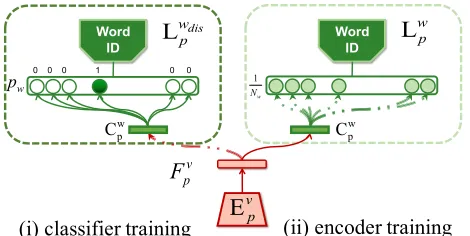
Specifically, we would like the Person-ID feature fv p to be free of Word-ID information. The discriminator could be formed to be a classifier Cwp to map the collection of
Fpv = [fpv(1),· · ·, fpv(n)] to theNwWord-ID classes. The objective function for training the classifier is the same as softmax cross-entropy loss. However, the parameter updat-ing is only performed on Cwp, wherepwjis the one-hot label of the identity classes:
Lwdis
p (C w p|E
v p) =−
Nw
X
j=1
pwjlog(softmax(Cwp(F v
p))j). (2)
Then we update the encoder while fixing the classifier. The way to ensure that the features have lost all information about speech information is that it produces the same predic-tion for all classes after being sent into Cwp. One way to form
Word ID Word
ID
0 0 0 1 0 0 1
w
N
(i) classifier training (ii) encoder training
w p C w p C v p
F
w pE
v p dis w pL
L
wpFigure 5: Procedure of adversarial training for dispelling
widinformation frompidspace. The training for classifier Cwp is illustrated on the left and encoder Evp on the right. The weights are updated on solid lines but not on the dashed lines.
this limitation is to assign the probabilities of each word-label to be N1
w in softmax cross-entropy loss. The problem
of this loss is that it would still backward gradient for updat-ing parameters even if it reaches the minimum, so we pro-pose to implement the loss using Euclidean distance:
Lw p(E
v p|C
w p) =
Nw
X
j=1
ksoftmax(Cwp(Fpv))j−
1
Nw
k2 2. (3)
The dual featurefv
wshould also be free ofpidinformation accordingly, so the loss for encodingpidinformation from eachfv
wusing classifier C p
wand loss forwidencoder E v wto dispelpidinformation can be formed as follows:
Lpdis
w (C p w|E
v w) =−
Np
X
j=1
ppjlog(softmax(Cpw(f v
w))j), (4)
Lp w(E
v w|C
p w) =
Np
X
j=1
ksoftmax(Cpw(fwv))j−
1 Np
k2 2. (5)
Npis the number of person identities in the training set for embeddingpid space. We summarize the adversarial train-ing procedure for classifier Cwp and encoder E
v
pas Fig. 5.
3.3
Inference: Arbitrary-Subject Talking Face
Generation
In this section, we describe how we generate arbitrary-subject talking faces using the disentangled representations learned above. Combiningpidfeaturefv
p with either of the
videowidfeaturefwv oraudiowidfeaturefwa, our system can generate a frame using the decoder G. The newly gener-ated frame can be expressed as G(fv
p, fwv), G(fpv, fwa). Here we take synthesizing talking faces from audio wid information as example. The genera-tion results can be expressed as G(fv
p(k), F a w) =
{G(fpv(k), fwa(1)),· · · ,G(f v
Full input audio: Input video:
Guidance input:
Generation from audio: Generation from video:
Guidance input:
Figure 6: Qualitative results. The guidance input image is on the left . The upper half is the generation from video and lower half is the generation from audio information.
as identity guidance. Our overall loss function consists of a L1 reconstruction loss and a temporal GAN loss, where a discriminator Dseq takes the generated sequence G(fv
p(k), F a
w)as input. These two terms can be formulated as follows:
LL1=kS
v
−G(fpv(k), F a
w)k1, (6)
LGAN =ESv[logDseq(Sv)] +
EFv
p,Fwa[log(1−Dseq(G(f
v
p(k), Fwa)] (7)
The overall reconstruction loss can be written asLRe,αis a hyper-parameter that leverages the two losses.
LRe=LGAN+αLL1. (8)
The same procedure can be applied to generation from video information by substitutingFwawithFwv. As the reconstruc-tion from audio and video can perform at the same time dur-ing traindur-ing, we useLReto denote the overall reconstruction loss function.
4
Experiments
Datasets.Our model is trained and evaluated on the LRW dataset (Chung and Zisserman 2016a), which is currently the largest word-level lip reading dataset with1-of-500diverse word labels. For each class, there are more than 800 train-ing samples and 50 validation/test samples. Each sample is a one-second video with the target word spoken. Besides,
the identity-preserving module of the network is trained on a subset of the MS-Celeb-1M dataset (Guo et al. 2016). All the talking faces in the videos are detected and aligned us-ing RSA algorithm (Liu et al. 2017a), and then resized to
256×256. For the audio stream, we follow the implemen-tation in (Chung and Zisserman 2016b) to extract themf cc
features at the sampling rate of 100Hz. Then we match each image with amf ccaudio input with the size of12∗20.
Network Architecture. We adopted a modified VGG-M (Chatfield et al. 2014) as the backbone for encoder Evp, and for encoder E
v
w, we modified a simple version of FAN (Bulat and Tzimiropoulos 2017). The encoder Eawhas a similar structure as that used in Chung and Zisserman (2016b). Meanwhile, our decoder contains 10 convolution layers with 6 bilinear upsampling layers to obtain a full-resolution output image. All the latent representations are set to be 256-dimensional.
Table 1: PSNR and SSIM scores for generation from audio and videowidinformation with and without GAN loss.
Approach\Score PSNR SSIM
Audio (LL1) 25.4 0.859
Video (LL1) 25.7 0.865
Audio (LRe) 26.7 0.883
Video (LRe) 26.8 0.884
Table 2: User study of our generation results and reproduced baseline. The results are averaged over person and time.
Method\Rate Realistic Lip-Audio Sync
Reproduced Baseline 44.1% 58.0%
Ours (Generation from Audio) 51.5% 72.3%
Ours (Generation from Video) 87.8% 88.4%
4.1
Results of Arbitrary-Subject Talking Face
Generation
At test time, the input identity guidancesvpto E v
pis any per-son’s face image and only one of the source for speech infor-mationSwv,Swa is needed to generate a sequence of images.
Quantitative Results. To verify the effectiveness of our GAN loss for improving image quality, we evaluate the PSNR and SSIM (Wang et al. 2004) score on the test set of LRW based on reconstruction. We compare the results with and without the GAN loss in Table 1. We can see that both the scores are improved by changingLL1 toLRe.
Qualitative Results. Video results can be found on our project page1. Here we show image results in Fig 6. The
in-put guidance photos are celebrities chosen randomly from the Internet. Our model is capable of generating talking faces based on both audios or videos. The focus of our work is to improve audio guided generation results by using joint audio-visual embedding, so we compare our work with Chung, Jamaludin, and Zisserman (2017) at Fig 7. It can be clearly seen that our results outperform theirs from both the perspective of identity preserving and image quality.
User Study.We also conduct user study to investigate the visual quality of our generated results comparing with a fair reproduction of Chung, Jamaludin, and Zisserman (2017) with our network structure. They are evaluatedw.r.ttwo dif-ferent criteria: whether participants could regard the gener-ated talking faces as realistic (true or false), and how much percent of the time steps the generated talking faces tempo-rally sync with the corresponding audio. We generate videos with the identity guidance to be 10 different celebrity pho-tos. As for speech content information, we use clips from the test set of LRW dataset and selections from the Voxceleb dataset (Nagrani, Chung, and Zisserman 2017), which is not used for training. There are overall10participants involved, and the results are average over persons and video time steps. The ground-truth is not included in the user study.
1
https://liuziwei7.github.io/projects/TalkingFace
(i) Input (ii) Chung et al. (iii) Ours
Figure 7: Qualitative results comparing with Chung et al. The mouth shapes are arbitrary.
Different subjects may behave different lip motion given the same audio clip and it is not desirable for the ground-truth to interfere with the participants’ perception. When conducting the user study for lip sync evaluation, we asked the partici-pants to only focus on whether the lip motion and given au-dio are temporally synchronized. Their ratings indicate that our generation results outperform the baseline by synchro-nizing rate and the extent of realistic, according to Table 2.
4.2
Effectiveness of Audio-Visual Representation
In order to inspect the quality of our embedded audio-visual representation, we evaluate the discriminative power and the closeness of our co-embedded features.
Word-level Audio-Visual Speech Recognition.We report audio-visual speech recognition accuracy on the test set of LRW dataset. Containing the task of visual recognition (lip reading) and audio recognition (speech recognition).
Our model structure for lip reading is similar to the Multiple-Towers method which reaches the highest lip read-ing results in Chung and Zisserman (2016a), so we con-sider it as a baseline. The difference is that the concatena-tion of features is performed at the spacial size of1×1in our setting. This would not be a reasonable choice for this task alone for the spatial information in images would be lost across time. However, as shown in Table 3, our results adding the contrastive loss alone outperforms the baseline. With the help of sharing classifier and domain adversarial training, the results improve a large margin.
Audio-Video Retrieval.To evaluate the closeness between the audio and face features, we borrow protocols used in the retrieval community. The retrieval experiments are con-ducted on the test set of LRW with 25000 samples, which means that given a test target video (audio), we try to find the closest audio (video) based on the distance ofwid fea-turesFv
w,Fwaamong all the test samples. Here we report the
R@1,R@10andM ed Rmeasurements which is the same
as Faghri et al. (2017). As we can see in Table 3, with all supervisions, the highest results can be achieved.
Table 3: Audio-Visual Speech Recognition and 1:25000 audio-video retrieval results with different supervisions. The first column is the supervisions, we useLCto represent contrastive loss, SC for sharing classifier,LDadvfor the adversarial training.
Audio-Visual Speech Recognition Video to Audio Retrieval Audio to Video Retrieval
Approach Visual acc. Audio acc. Combine acc. R@1 R@10 M ed R R@1 R@10 M ed R
(Chung and Zisserman 2016a) 61.1% - - -
-Ours (LC) 61.8% 81.7 90.8% 29.3 56.3 6.0 29.8 56.3 6.0
Ours (LC+ SC) 65.6% 91.6% 94.9% 38.8 66.4 3.0 44.5 70.9 2.0
Ours (LC+LDadv) 63.5% 88.1% 93.7% 39.3 67.9 3.0 42.2 69.2 2.0
Ours (LC+ SC +LDadv) 67.5% 91.8% 95.2% 64.2 84.7 1.0 67.7 85.8 1.0
Table 4: Ablation study on disentangle mechanism.
Audio Generation to Source Video Generation to Source
Experiment RetrievalR@1 LandmarkL2 ID SquaredL2 RetrievalR@1 LandmarkL2 ID SquaredL2
Direct Replication 2.5 4.27 - 2.5 4.31
-Without Disentanglement 53.8 3.94 0.212 90.8 3.60 0.194
With Disentanglement 60.5 3.48 0.188 95.3 2.85 0.174
above. We can observe from the figure that given the same clip of audio, the duration of the mouth opening and to what extent it is opened is affected by different supervisions. Shar-ing the classifier apparently lengthens the time and strength of the mouth opening to make the image closer to the ground truth. Combining with the adversarial training makes the im-age quality improves. Note that it is not a one-to-one map-ping between audio and lip motion; different subjects may behave different lip motion given the same audio clip so the final results may not perform the same as the ground truth.
4.3
Identity-Speech Disentanglement
To validate our adversarial training is able to disentangle speech information from ID branch, we use person-ID encoder on every frame of a video and concatenate them to get Fv
p = {fpv(1), ..., f v
p(n)}. Then we train an SVM to map training samples to theirwidlabels and test the results, which implies that we attempt to find thewidinformation left in thepidencoder. The whole procedure is repeated be-fore and after the feature disentanglement. Bebe-fore the disen-tanglement, 27.8% of the test set can be assigned to the right class, but only 9.7% left after, indicating that considerable speech content information within the encoder Evpis gone.
We then highlight the merits of adversarial disentangle-ment from two aspects,identity preserving andlip sync quality. For identity preserving, we use OpenFace’s squared L2 similarity score as an indicator and compare the iden-tity distance between the generated faces and the original ones (lower indicates more similar). For lip sync quality, we detect 20 landmarks using dlib library (King 2009) around the lips to characterize its deviation from ground truth, mea-sured by the averaged L2-norm (lower is better). Then we conduct retrieval experiments between all generated results and source videos based on extractedFv
widfeatures. Exper-iments are also conducted on a direct replication of every video clip, to prove that the retrieval results are affected by lip motion rather than appearance features. From Table 4, we
Full input audio:
Corresponding video:
Guidance Input
Supervision Generation from audio
Figure 8: Qualitative results for different types of supervi-sions. The left indicates different supervisupervi-sions. All the gen-erations are audio-based.
can observe that adversarial disentanglement indeed helps improves lip sync quality.
5
Conclusion
reading performance; (2) Audio-visual speech recognition and audio-visual synchronizing are unified in an end-to-end framework; (3) Most importantly, arbitrary-subject talking face generation with high-quality and temporal accuracy can be achieved by our framework; both audio and video speech information can be employed as input guidance.
Acknowledgements
We thank Yu Xiong for helpful discussions and his assis-tance with our video. This work is supported by Sense-Time Group Limited, the General Research Fund sponsored by the Research Grants Council of Hong Kong and the Hong Kong Innovation and Technology Support Program (No.ITS/121/15FX).
References
Assael, Y. M.; Shillingford, B.; Whiteson, S.; and de Freitas, N. 2016. Lipnet: Sentence-level lipreading. arXiv preprint arXiv:1611.01599.
Bulat, A., and Tzimiropoulos, G. 2017. How far are we from solving the 2d & 3d face alignment problem?(and a dataset of 230,000 3d facial landmarks). InICCV.
Chatfield, K.; Simonyan, K.; Vedaldi, A.; and Zisserman, A. 2014. Return of the devil in the details: Delving deep into convolutional nets. InBMVC.
Chen, L.; Li, Z.; Maddox, R. K.; Duan, Z.; and Xu, C. 2018. Lip movements generation at a glance. InECCV.
Chopra, S.; Hadsell, R.; and LeCun, Y. 2005. Learning a similarity metric discriminatively, with application to face verification. InCVPR.
Chung, J. S., and Zisserman, A. 2016a. Lip reading in the wild. InACCV.
Chung, J. S., and Zisserman, A. 2016b. Out of time: auto-mated lip sync in the wild. InACCV.
Chung, J. S., and Zisserman, A. 2017. Lip reading in profile. InBMVC.
Chung, J.; Senior, A.; Vinyals, O.; and Zisserman, A. 2017. Lip reading sentences in the wild. InCVPR.
Chung, J. S.; Jamaludin, A.; and Zisserman, A. 2017. You said that? InBMVC.
Faghri, F.; Fleet, D. J.; Kiros, J. R.; and Fidler, S. 2017. Vse++: Improved visual-semantic embeddings. arXiv preprint arXiv:1707.05612.
Fan, B.; Wang, L.; Soong, F. K.; and Xie, L. 2015. Photo-real talking head with deep bidirectional lstm. InICASSP. Fan, B.; Xie, L.; Yang, S.; Wang, L.; and Soong, F. K. 2016. A deep bidirectional lstm approach for video-realistic talk-ing head.Multimedia Tools and Applications.
Guo, Y.; Zhang, L.; Hu, Y.; He, X.; and Gao, J. 2016. Ms-celeb-1m: A dataset and benchmark for large-scale face recognition. InECCV.
King, D. E. 2009. Dlib-ml: A machine learning toolkit.
JMLR.
Liu, F.; Gleicher, M.; Wang, J.; Jin, H.; and Agarwala, A. 2011. Subspace video stabilization.TOG.
Liu, Z.; Luo, P.; Wang, X.; and Tang, X. 2015. Deep learning face attributes in the wild. InICCV.
Liu, Y.; Li, H.; Yan, J.; Wei, F.; Wang, X.; and Tang, X. 2017a. Recurrent scale approximation for object detection in cnn. InICCV.
Liu, Z.; Yeh, R.; Tang, X.; Liu, Y.; and Agarwala, A. 2017b. Video frame synthesis using deep voxel flow. InICCV, vol-ume 2.
Liu, Y.; Song, G.; Shao, J.; Jin, X.; and Wang, X. 2018a. Transductive centroid projection for semi-supervised large-scale recognition. InECCV.
Liu, Y.; Wei, F.; Shao, J.; Sheng, L.; Yan, J.; and Wang, X. 2018b. Exploring disentangled feature representation beyond face identification.CVPR.
McAllister, D. F.; Rodman, R. D.; Bitzer, D. L.; and Free-man, A. S. 1997. Lip synchronization of speech. In Audio-Visual Speech Processing: Computational & Cognitive Sci-ence Approaches.
Nagrani, A.; Albanie, S.; and Zisserman, A. 2018a. Learn-able pins: Cross-modal embeddings for person identity. In
ECCV.
Nagrani, A.; Albanie, S.; and Zisserman, A. 2018b. Seeing voices and hearing faces: Cross-modal biometric matching. InCVPR.
Nagrani, A.; Chung, J. S.; and Zisserman, A. 2017. Vox-celeb: a large-scale speaker identification dataset. In INTER-SPEECH.
Song, Y.; Zhu, J.; Wang, X.; and Qi, H. 2018. Talk-ing face generation by conditional recurrent adversarial net-work. arXiv preprint arXiv:1804.04786.
Stafylakis, T., and Tzimiropoulos, G. 2017. Combin-ing residual networks with lstms for lipreadCombin-ing. INTER-SPEECH.
Suwajanakorn, S.; Seitz, S. M.; and Kemelmacher-Shlizerman, I. 2017. Synthesizing obama: learning lip sync from audio.TOG.
Thies, J.; Zollh¨ofer, M.; Stamminger, M.; Theobalt, C.; and Nießner, M. 2016. Face2face: Real-time face capture and reenactment of rgb videos. InCVPR.
Wang, Z.; Bovik, A. C.; Sheikh, H. R.; and Simoncelli, E. P. 2004. Image quality assessment: from error visibility to structural similarity. TIP.
Wang, L.; Qian, X.; Han, W.; and Soong, F. K. 2010. Synthe-sizing photo-real talking head via trajectory-guided sample selection. In Eleventh Annual Conference of the Interna-tional Speech Communication Association.
Wiles, O.; Koepke, A.; and Zisserman, A. 2018. X2face: A network for controlling face generation by using images, audio, and pose codes. InECCV.
Xie, L., and Liu, Z.-Q. 2007. Realistic mouth-synching for speech-driven talking face using articulatory modelling.
IEEE Transactions on Multimedia.