*Corresponding author: Serkan ETİ
International Journal of
Current Multidisciplinary Studies
Available Online at http://www.journalijcms.com
Vol. 4, Issue,1(A), pp.859-863, January, 2018
RESEARCH ARTICLE
THE CHALLENGES IN THE PROCESS OF SOCIAL STATE IN TURKEY: A SAMPLE FROM
ISTANBUL
Orhan Koçak
1., Serkan ETİ
2*and Yunus Bayram
31Department of Social Work
2Medipol University, Computer Programming
3İstanbul University, Health Sciences Institution
A R T I C L E I N F O A B S T R A C T
Received 15th October, 2017 Received in revised form 25th November, 2017
Accepted 28th December, 2017 Published online 28th January, 2018
In today's world, not only developing also developed countries confront with economic and social challenges. These challenges create poverty in the end for societies. Poverty is the state of a person or people lack a usual or socially acceptable amount of money or required material for living seen in every society and it was common in the past and although it is not common, there is still poverty in today's modern world. However, globalization worked very well for the sake of the developed world and rich people became wealthier than before, it couldn't meet the needs of people are homeless, unhealthy, uneducated, can't reach labor market, stuck in poor conditions and in poverty. Poverty is the result of policies which is not giving equal opportunities from education and health to in reaching labor markets and business opportunities for everyone. Also, high immigration rates to cities, the lack of investments and infrastructure in a suburb and rural areas, increasing welfare payments which don't encourage people to work and the move of factories to countries where the labor is too cheap are another reasons the world have been facing.
Turkey is a developing country which increased its GDP 3 times, health services, education facilities; developed its infrastructure, social policies, social services and social aid in the last 15 years. The wealth which was created in the last 15 years couldn't be shared or distributed fairly among people. With these developments, metropolitan areas such as Istanbul and Ankara are getting more newcomers from small cities in Anatolia. This situation is producing a kind of poverty in some part of metropolitan cities. With this work, the effect of poverty on individuals and society will be evaluated. A survey with 120 people will be implemented in a suburb district of Istanbul. Their living conditions, expectations, education and income levels, and other data including demographic will be collected and analyzed with the regression and correlation methods. In the first part of the article, the literature is going to be reviewed, and in the second part, the results are going to be analyzed by using a statistical program.
Keywords:
Social Issues, Urbanization, Welfare State, Turkey
INTRODUCTION
The concept of globalization is a phenomenon that has been the subject of different approaches until the effects of its definition are revealed. Depending on the nature of the identification, it is often possible to come up with important approach differences in presenting the existing effects. In recent years, the world has experienced the process of integration called globalization, bringing great changes in all areas of life. Globalization is a phenomenon that accelerates technological developments, presents economic opportunities that have not existed before, and contains political reforms and cultural transformations.
It is a matter of intense debate whether the effects of the globalization process, which affects every aspect of social life, are positive or negative. Some of the researchers who try to explain globalization to their own perspective emphasize the positive effects of the process; while others focus on the threats that globalization poses. In this research, urban poverty, which is the negative consequence of globalization, is mentioned. It is possible to create a comprehensive list of possible effects of globalization, from employment, communication, cultural equality to poverty. The scope of the concept of globalization, along with positive, negative and hybrid approaches to existing
IJCMS
domains, is expanding the volume of academic and other work on the subject (Tireli, 2009:15).
Urban poverty is a field that has been updated in poverty studies as a result of the last 25 years of economic changes. With the abandonment of welfare state practices around the world in the 1980s, poor masses emerged in cities, called 'underclass' in the US, 'excluded' in France, and 'marginal' in Latin America (Güvenç 2002: 91). According to Ersoy and Şengül, with the growing gap between living conditions and income distribution, "third worlds" have been established around global cities, even in the middle of these cities. Post-Fordist mode of production, divided cities and new urban poverty define these 'third worlds' in urban spaces. The face of the new urban poverty is worrying and the spread of begging and homelessness, particularly high unemployment rates, which have become widespread among disadvantaged groups, and low wage, precarious employment, increased involvement of children, increased crime and violence by street gangs; the increase in the number of abandoned, mentally handicapped people circulating in the cities and the large areas in which the rude households are located indicate the new urban poverty (Ersoy ve Şengül 2002:22).
The most criticized social outcome of globalization is the social injustice or inequality that the world has created and the countries themselves have created. Indeed, inequality is a phenomenon that has emerged as a result of the historical, economic and social development of mankind; It is not just a new phenomenon that has emerged with globalization. However, the free competition caused by the globalization process has led to a widening of the already existing inequality, the gap between those with and without the competitive power (Özerkmen, 2004: 559).
Globalization - Urban Poverty Relation
After the Second World War, the period 1945-1975 was a time when economic growth was generally dominant, despite short stagnation. This economic growth has meant a continuity in the modernization and social change lines for countries like Turkey (Keyder 1996:6). When it came to the second half of the 1970s, as the production increased from one side, the deepening of the hunger from one side and the increase of production only spread the understanding that the increase of GNP was not identical with development. The difference in income between industrialized countries and developed countries is further increased (Başkaya, 2000:191).
At this point, unlike the optimistic anticipation of the early post-war years of 1950, at the end of the 1980s, the development gap between developed and underdeveloped countries seemed to open up. It is claimed that GNP increases are not identical to development, and there are two main objectives of development. The first of these is the continuation of economic growth and the other is the abolition of poverty. So it is stated that unless poverty is removed from the center, the real development can't be mentioned. Moreover, it has been stated that there must be a right relationship between the growth and the erosion of the root of the poverty. According to Başkaya, it is argued that only growth that can't solve the problem of poverty should not be regarded as identical with development and therefore focus on fair income
distribution (Başkaya, 2000:191). At the beginning of the 1980s, post-war conditions and concepts developed in accordance with these conditions which left the place to new conditions and new concepts. The post-war conjuncture became a major instrument, the national state, and a turning point in national boundaries and decision mechanisms was entered. With the expansion of capitalism on a global scale, non-state actors, that is, multinational corporations, have begun to penetrate the sovereignty of nation states. (De Rivero 2001: 26)
In today's world in which the discourses of globalization are increasingly intense, a transformation and restructuring at economic, cultural and political levels are being discussed on a global scale. At this point, it is possible to deal with various aspects of this transformation. In this period of intense concentration of globalization debates, international and regional imbalances are seen to increase even more. As a result, it is the undeniable facts of this era that the unfavorable and uncontrollable competition is experienced in this environment where economic relations become more intricate and inward, and the poverty is steadily increasing (Çeken, Ökten ve Ateşoğlu, 2008:89). Inequality in income distribution at the international level has deteriorated in the 1970-89 period. Countries with the richest 20% of the world's population have increased their share in global GNP from 73.9% to 80.7%. Countries with the world's poorest 20% of the world's GNP share fell from 2.3% to 1.4%. The redistribution of income distribution in favor of rich countries has not prevented the deterioration of income distribution in these countries or even the poverty rate in many countries (Ghia, 1994:56).
In the last quarter of the century, where neo-liberal policies find widespread application, the fact that the income gap between the wealthiest and poorest countries in the world is gradually opening up is clearly visible when considering the relevant figures. The share of countries with the richest 20% of the world population in global GNP rose from 73.9% to 82.7% in the period between 1970-1989. In another world income distribution table; the share of poor countries making up 85.2% of the world's population from world income is only 21.5%. The share of countries with the richest 14.8% share of the world income is 78.5%. (Chossodovsky,1999:20)
Since the 1980s, when globalization and the appropriate policies - except for the benefits provided by developed countries - have begun to be intensively implemented, the gap between rich and poor has grown, both internally and externally. As globalization and market economy cannot diminish poverty, it can be said that stability is also failing. Fear of the economic crisis has always been an important issue on the agenda, especially in all developing countries. "Globalization has destructive effects on developing countries, especially the poor living people in these countries." The competition is among equals, and there is more sovereignty relation between the unequal forces than the race (Stiglitz 2002:9).
by many people, especially in underdeveloped and developing countries. The growing gap between rich and poor countries pushes the growing number of people in Third World to poverty and has to live with less than a dollar a day. Despite the repeated promises of poverty reduction in the last decade of the twentieth century, the actual number of people living in poverty has increased by almost 100 million. Globalization has not succeeded in reducing poverty, nor has it succeeded in providing stability. Crises in Asia and Latin America threaten the economy and stability in all developing countries. There are fears of an outbreak of financial crisis spreading all over the world, and the worry that the collapse of a developing market can precipitate the markets of developing countries is happening all over the world (Stiglitz 2002: 28).
At this point, globalization is criticized by international bodies and one of them is the United Nations Conference on Trade and Development (UNCTAD). In this sense, some critics and recommendations are done by UNCTAD towards current poverty and challenges around the world (Aktan, 1999:263).
Despite some exceptions at the world level, the world economy is growing very slowly. With this growth rate, sufficient employment is not provided based on a satisfactory wage level and poverty is not alleviated. The difference between North and South is even greater.
In 1965 the world population the average per capita income of the richest 20% was over 30 times that of the poorest 20%. After 25 years, in 1990, this difference doubled.
The rich have been profitable everywhere. This has not happened only against the poorest segments of society. Another distinctive feature of transformations in the very majority of countries is the deterioration of the relative status of the middle classes.
Everywhere in the financial industry, investors in front of investors. In some developing countries, interest paid on public and private debt reached 15% of GDP. The exchange of existing securities has become a more profitable activity than the creation of new wealth through investment.
Dividends have developed both in developed and developing countries. When the beginning of the 1980's is compared today, it appears that the wage share of the industrial added value of developing countries has decreased significantly.
Work and income security has decreased almost everywhere. Increased interest costs erode corporate profits, and in response to this, both North and South companies are restructuring, choosing to keep employment and wages under pressure.
Wage inequalities become a general problem between qualified and unskilled labor. This tendency is a long one in developed countries. In the developing countries, the absolute - and sometimes in some cases 30% of the unemployed workers' wage levels - have become widespread.
THE METHOD AND FINDINGS
The study was conducted by 120 people. As data collection technique, a questionnaire method was preferred. Respondents were chosen randomly in the district. A questionnaire consisting of 20 questions was filled out. Some analysis was done by using a statistical computer program. First of all, frequency and then other such as cross table and chi square analysis were implemented.
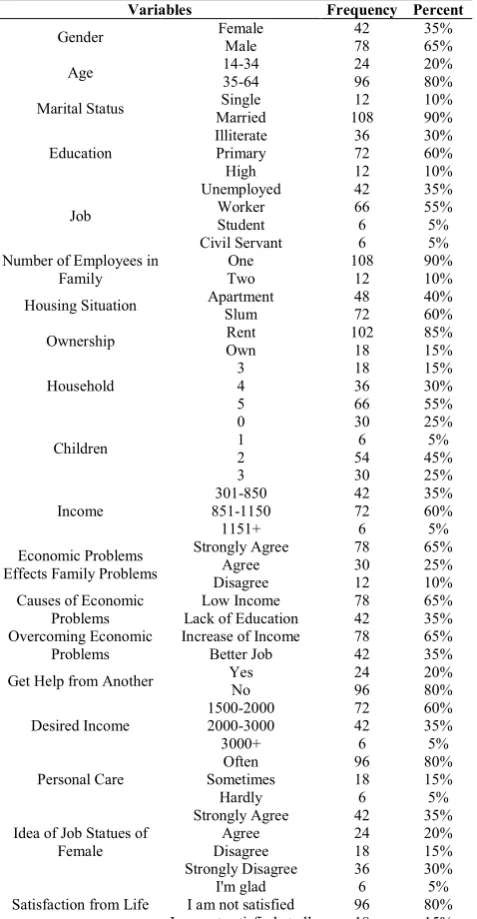
The frequency distribution of the questions in the questionnaire is given in the table. According to the table, 42 of the participants are female and 78 are male. While 24 of the participants were 14-34 years old, 96 of them were between 35-64 years old. 90% of the participants are married. While 36 of the respondents are illiterate, 72 of them have primary school level education, and 12 have the higher level education. In terms of employment situations, 42 of the participants are unemployed which is pretty higher than the average unemployment level and 66 of the respondents are workers, 6 of them are students and 6 of the participants are civil servants.
Given the number of employees in the family, the number of employees in 108 families is only 1. There are 2 individuals working in 12 families which are about 10% of total participants. While the number of the participants live in the apartment is 48, 72 of them live in slums. The number of the participants pay rent is pretty high with 102. While 30 of the participants have no children, 6 have one, 54 have two and 30 have three children. When income levels are examined, 42 people have income less than 850 TL and only 6 people have income more than 1150 TL.
As it is seen from above table 90% of respondents think that economic problems affect family problems. In fact, 78 of them strongly agree that economic problems affect family problems. Participants were asked about the reasons for economic problems. Participants think that 78 percent of the economic problems are due to low income and 42 percent of them are the lack of education. When asked how participants cope with economic problems, 78 respondents said that they preferred to increase their income. And 42 of them are in search of a better job. Although majority of respondents face challenges, 96 of them stated that they did not receive any help. Participants were also asked about the income they needed to live for economic problems and 72 of the participants stated that they wanted an income between 1500 TL and 2000 TL. Only 6 of them indicated that they need monthly income more than 3000 TL.
A question about personal care was also included in the questionnaire. According to the responses, 80% of the participants give the importance to personal care, while only 6 of them are not interested in personal care at all. 95% of the participants said they were not satisfied with their life.
A cross table was formed between causes of economic problems and overcoming economic problems. According to this table, those who suffer from economic difficulties due to low income are going to increase their incomes. Similarly, individuals suffering from lack of education are seen to seek a better job (Agresti, 1996).
A cross table was formed between the housing situation and the reasons for living with economic hardship. According to the table, 66 of the low-income people live in slums. 36 of those who had economic hardship due to lack of education were found to live in an apartment. In addition, this differentiation was found to be significant according to the result of the chi-square test.
If this value is greater than , the hypothesis
that
is rejected with 95% confidence. There is a significant relationship between these variables (Armutlulu, 2008).
DISCUSSION
What should be done in order to eradicate today's problems? First of all, social policy makers and social workers should intervene to the politics arena. Because, today's problems in social arena require joining the politics in order to increase the awareness of micro problems such as increasing drug abuse, technology addiction, homelessness, suicides, homicides and crimes in the daily life. With the capitalization and modernization, the social problems mentioned above in cities have been increasing not only in Turkey but also in the developed world.
Nowadays, Turkey is in the transition period especially in terms of social policies and social work. Turkey did pretty much state-of-the-art policies for disadvantaged groups such as women, people with disabilities, older people, unemployed and youth at risk at the macro and micro level. Woman, former convicted person and people with disabilities have positive discrimination legally in the labour markets. Unemployment insurance is paid for unemployed people about 15 years and active employment policies are implemented in every city of Turkey by state employment agency not only during the crises but also in other times. The employment of young people is encouraged with support by the government in the strategic sectors. That is why; the unemployment rate of Turkey is about 10 percent although 900.000 graduates enter to the labour markets every year. Services for older people at home are supported by state instead of institutional care. In this sense, mentality changed from institutional care to home or neighbourhood care. In home or neighbourhood care, economic, physiological, social, spiritual and health supports are given to the disadvantaged people whether by their children, relatives or paid carers. In spite of these improvements, there are still many things to do such as education, urbanization, social services and employment in the transition Turkey's welfare policies as they are seen in the study. Table 1 Frequency Analysis
Variables Frequency Percent
Gender Female 42 35%
Male 78 65%
Age 14-34 24 20%
35-64 96 80%
Marital Status Single 12 10% Married 108 90%
Education
Illiterate 36 30% Primary 72 60%
High 12 10%
Job
Unemployed 42 35%
Worker 66 55%
Student 6 5%
Civil Servant 6 5% Number of Employees in
Family
One 108 90%
Two 12 10%
Housing Situation Apartment 48 40%
Slum 72 60%
Ownership Rent 102 85%
Own 18 15%
Household
3 18 15%
4 36 30%
5 66 55%
Children
0 30 25%
1 6 5%
2 54 45%
3 30 25%
Income
301-850 42 35% 851-1150 72 60%
1151+ 6 5%
Economic Problems Effects Family Problems
Strongly Agree 78 65%
Agree 30 25%
Disagree 12 10% Causes of Economic
Problems
Low Income 78 65% Lack of Education 42 35% Overcoming Economic
Problems
Increase of Income 78 65% Better Job 42 35%
Get Help from Another Yes 24 20%
No 96 80%
Desired Income
1500-2000 72 60% 2000-3000 42 35%
3000+ 6 5%
Personal Care
Often 96 80%
Sometimes 18 15%
Hardly 6 5%
Idea of Job Statues of Female
Strongly Agree 42 35%
Agree 24 20%
Disagree 18 15% Strongly Disagree 36 30%
Satisfaction from Life
I'm glad 6 5%
I am not satisfied 96 80% I am not satisfied at all 18 15%
Table 2 Cross Analyses between Causes and Solutions of Problems
Causes of Economic Problems Low Income Lack of Education
Overcoming Economic
Problems
Increase of
Income 78 0
Better Job 0 42
Table 3 Cross Analyses between Causes of Economic Problems and Housing Situation
Housing Situation
Apartment Slum
Causes of Economic Problems
Low Income 12 66
CONCLUSION
The problems of today are based on not only one issue but also many issues and they are intertwined. So, a solution of a problem will solve other one or more than one problems. In this sense economic and social issues trigger each other. With the urbanization, both economic and social problems are seen together in developing and unplanned cities. People come from rural areas to the cities in order to find better living conditions. When this mobility becomes unplanned, it creates new problems such as infrastructure, employment, education and housing for both city administrators and people who came to the cities. Also, one of these problems is not separated from other problems in city life. While these issues are called big problems in developing cities, they were somehow being met in rural areas in advance the people came to the places where they have to deal with these. All of these challenges and issues give rise to the poverty of people who not only moved to the city and but also for already residents.
This study proves that there are big significant relations among these variables. In the study, it is seen that the needs of people differ according their situations such as housing situations, education levels, employment situations and income levels. First of all, there is a relation between the source of the problem and the way in dealing with the problem. For those who see the source of the problem in education, they look for the solution in better employment opportunities or jobs. However, the people who see the source of the problem in income, they look for extra or additional employment opportunities or second job. On the one hand, the people who live in the slums see the source of the problems in income; on the other hand, the people who live in the apartments see the source of the problems in education levels. Consequently, the challenges and problems of emerging modern cities will be complicated if it is not planned well in terms of infrastructure, economics and social. Also, each issue requires specific and integrative approach because each of the problems has their own characteristics. In this sense, a holistic approach should be considered in planning and tackling of the today's challenges and problems.
References
Agresti, A. (1996), An introduction to categorical data analysis(Vol. 135). New York: Wiley.
Aktan, Coşkun Can (1999), Gerçek Liberalizm Nedir?, İzmir: T-Yayınları.
Armutlulu, İ. H. (2008), Sayısal yöntemler I: işletmelerde uygulamalı istatistik. Alfa yayınları.
Başkaya, Fikret (2002), Küreselleşmenin Karanlık Bilançosu, Ankara: Maki Basın Yayın.
Chossudovsky, Michel, (2003), The Globalization of Poverty and New World Order, Montreal: Centre for Research on Globalization
Çeken, Hüseyin, Ökten, Şevket, Ateşoğlu, Levent (2008), Eşitsizliği Derinleştiren Bir Süreç Olarak Küreselleşme Ve Yoksulluk, C.Ü. İktisadi ve İdari Bilimler Dergisi, 2. De Rivero, (2001), The Myth of Development: Non-viable
Economies and the Crisis of Civilization, London: Zeed Books
Ersin, İ., & Eti, S. (2017). Measuring the Waste-Conscious and Saving Habits of the Youth in Turkey: The Sample of
Istanbul Medipol University. International Journal of
Islamic Economics and Finance Studies, 3(3).
Ersoy, Melih ve H. Şengül, Tarık (2002), Kente Göç ve Yoksulluk: Diyarbakır Örneği, Ankara: Ortadoğu Teknik Üniversitesi.
Ghia Nodia, (1994), Nationalism and Democracy : in Nationalism, Ethnic Conflict and Democracy, ed. Larry Diamond and Marc F. Plattner, Baltimore: John Hopkins University Press)
Özerkmen, N. (2004), “Küreselleşen Dünya’da ve Türkiye’de Eşitsizlikler”, IV Ulusal Sosyoloji Kongresi: Değişen Dünya ve Türkiye’de Eşitsizlikler, Sosyoloji Derneği Yayını No: 13, Sivas.
Stiglitz, Joseph E. (2002), Küreselleşeme: Büyük Hayal Kırıklığı, (Çev:A. Taşçıoğlı & D.Vural), İstanbul: Plan b Yayınları.
Tireli, Münir (2009), Küreselleşme ve Yoksulluk: Birleşmiş Milletler (UNDP) ve Dünya Bankası Göstergeleri Işığında Bir Analiz, Ankara: Nobel Akademik Yayınları.
Tunaya, K. B., & Yüksel, S. (2017). The relationship between corporate governance andforeign ownership of the banks
in developing countries. Contaduría y Administración,
62(5), 25-26.
How to cite this article:
Orhan Koçak., Serkan ETİ and Yunus Bayram (2018) ' The Challenges in the Process of Social State in Turkey: A Sample From Istanbul', International Journal of Current Multidisciplinary Studies, 04(1), pp. 859-863.