Klamath and Snake River Dam Removal:
Using Contextualism to Reevaluate an
Outdated Technology
Sandra Dorning
University of Oregon, Robert D. Clark Honors College, 1293 University of Oregon, Eugene, OR 97403-‐1293
Corresponding author: [email protected]
Keywords: Dam removal; environmental management; contextualism; Klamath River; Snake River
Executive Summary: Hydroelectric dam technology was widely implemented in the United States throughout the 20th century in an attempt to generate sustainable
energy and improve farm irrigation. In 2017, propositions to remove dams from river systems have generated debate over the relative merits and detriments of hydroelectric dam technology. Proponents of dam removal often cite the ecological threats dams pose to riverine ecosystems, namely impacts on salmon populations. Opponents of dam removal often argue that maintaining dams is economically important for energy and agricultural industries. Here, I use the proposed removal of dams in the Snake and Klamath rivers in the Pacific Northwest as case studies for exploring existing and necessary philosophical approaches in the debate surrounding dam removal.
Arguments both for and against dam removal follow a mechanistic worldview, but each perspective operates under a different mechanism for how the world works: ecology or the economy. The incompatibility of two different mechanisms renders unproductive any debate over dam removal or other environmental issues. The alternative worldview of contextualism allows for the incorporation of scientific, economic, and other information in a holistic manner for effective decision-‐making. Contextualism can incorporate a wide diversity of research approaches and disciplines, nonmarket economic values held in healthy riverine ecosystems, and the inclusion of diverse interest groups in the decision-‐making process, a management framework which can be applied to the Snake and Klamath river dam removal issues and other growing environmental problems facing society today.
I. Introduction
During the 20th century, hydroelectric dam
technology revolutionized energy generation and farm irrigation in the United States. Dams divert river paths, generate hydroelectric power, and enable irrigation of dry plains, allowing for human settlement in resource-‐ rich river valleys.1 However, in recent
decades dam removal has been proposed in many American river systems due to concerns surrounding aging dam
infrastructure and observable effects of dams on riverine ecology (of greatest public concern: the blockage of salmon runs). Two such river systems are currently under consideration in the Pacific Northwest. PacifiCorp power company has filed for approval to remove dams in the Klamath River in southern Oregon and northern California, and if approved would be the largest dam removal project in the U.S.2 The
are the focus of a recent U.S. District Court ruling calling for the re-‐evaluation of the federal government’s river management program to potentially include dam removal.3
Dam removal is a complex, contentious issue. Interest groups clash over competing information and values regarding the ecological impacts of dams, the economic costs associated with removal or maintenance of dam structures, and the impacts of both on the fishing, hydropower, and farming industries and the rights of Native American tribes. These conflicting arguments for and against dam removal epitomize the debates surrounding the greatest environmental problems facing society today, and illustrate that multiple types of information and differing worldviews must be considered in order for productive environmental decision-‐making to occur.
In this paper, I use the specific issue of dam removal to frame my argument for a holistic approach to environmental management and technological assessment. I begin by discussing the Snake and Klamath river dam removal proposals, using these two systems as case studies to highlight the politics and rationale behind this issue. I detail the prevailing arguments surrounding riverine ecology related to these dams and their removal, as well as the leading economic concerns for and against dam removal, in order to provide a full treatment of the complexities of this environmental problem. I then use dam removal as an example by which to illustrate the principles put forth by Stephen Pepper in his 1942 book, World Hypotheses, and how the application of these principles may improve our approaches to finding solutions for environmental problems. Through my exploration and application of Pepper’s work, I argue that a contextualistic approach, rather than a mechanistic one, can foster productive environmental debates, including those surrounding dam removal, between advocates of fundamentally incompatible
values and worldviews.
II. Dams in America
The political and economic context of early 20th century America provides insight into the
rationale behind implementing dam technology. Early dams in the U.S. were built to generate sustainable hydropower and irrigation for farmers settling in the West. Furthermore, the diversion of river flows minimized dangers posed to human settlement near rivers while maximizing capitalization on resources provided by land in river valleys.4,5 In the early 1900s,
hydropower accounted for nearly 40% of electricity production in the West and Pacific Northwest, and that only increased as two World Wars demanded greater energy production and wartime revenue. By the 1940s, widespread dam construction increased the proportion of hydropower electricity in the region to 75%.1 The impacts
of dams on biological communities in riverine ecosystems played little role in the decision to construct dams, and was insufficiently studied prior to the implementation of dam technology during the 20th century.5 In 2017,
the Federal Energy Regulation Commission (FERC), which is responsible for issuing licenses for dam operation, is required to give “equal consideration” to all factors involved in new dam installation, including biological impacts, power production, and river recreation.6 As the lifespan of dam
infrastructure is limited to around 50 years,7
it is now necessary in many river systems to reassess this technology, taking into account previously neglected environmental factors in decisions to remove or restore dams.
III. Proposed dam removals Snake River
Four large dams occupy the Snake River in southern Washington (Figure 1). Constructed between 1962 and 1975 to enable barging and irrigation, the dams are operated by the Federal Columbia River Power System (FCRPS).8 Management of the Snake River
National Marine Fisheries Service (NMFS), and has been the focus of lawsuits for over two decades, contributing to current proposals for dam removal.3,9
Fig. 1: The Snake River, in Washington, highlighted in blue. Snake River dams indicated by white circles.10
Every four years, NMFS issues a new Biological Opinion, a report on the state of the Snake River ecosystem intended to guide necessary management practices. For years, these reports claimed that FCRPS dams on the Snake River did not threaten salmon species protected under the Endangered Species Act (ESA). However, in 1993, the U.S. District Court for the District of Oregon ruled that NMFS acted arbitrarily and capriciously in these reports, as they failed to document the threats that dams posed to salmon. With each new Biological Opinion, the courts continued to rule these reports as inaccurate in their representation of the impacts of the Columbia and Snake River dams on an increasing number of endangered species. According to the court’s assessment of the existing scientific literature, there is “ample evidence” that FCRPS dam operations harm salmon, which NMFS management of the Snake River ecosystem neglected to address.
NMFS has since acknowledged the potential necessity of dam breaching (partial removal) to alleviate stress that salmon experience as they navigate dams. In 2016, U.S. District Judge of the United States District Court for the District of Oregon Michael Simon ruled that a new approach to managing the Snake
River is needed, which includes the possibility of removing dams. For over 20 years, Simon’s court order states, federal agencies “have continued to focus essentially on the same approach to saving the [ESA] listed species—hydro-‐mitigation efforts that minimize the effect on hydropower generation operations with a predominant focus on habitat restoration. These efforts have already cost billions of dollars, yet they are failing. Many populations of the listed species continue to be in a perilous state”.3 As
a result, dam removal is on the table as a potential solution to these failed management plans. However, several members of the U.S. Congress have recently sponsored a bill that would delay any potential breaching of Snake River dams until 2022.11
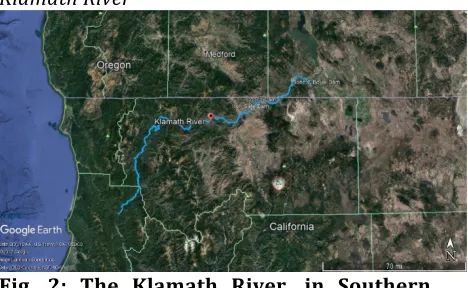
Klamath River
Fig. 2: The Klamath River, in Southern
Oregon and Northern California,
highlighted in blue. Klamath River dams indicated by white circles.12
Between 1902 and 1962, the then California-‐ Oregon Power Company constructed five dam systems on the Klamath River, the second-‐ largest river in California (Figure 2). Now, PacifiCorp power company operates these dams and has formally proposed their removal.13,14 In contrast to the Snake River
native Klamath River tribes who rely upon salmon as a mainstay of their diets, and who have observed drastic declines in salmon availability in recent years.15
PacifiCorp recognized the high cost of making necessary improvements to dam infrastructure, and as a result, signed the Klamath Hydroelectric Settlement Agreement to establish a framework for the removal of four of the five dams.2,14,16 The agreement, in
its submission to the FERC, was stalled in Congress despite efforts by Senator Jeff Merkley (D-‐OR) to approve and appropriate funding for the removal. Dam removal was ultimately delayed because “the Department of the Interior lacked authority to take title of the dams and carry out their removal absent congressional action”.16 In 2016, PacifiCorp
submitted a new proposal, the Klamath Power and Facilities Agreement, to the FERC, which would transfer dam operation to the Klamath River Renewal Corporation (KRRC) for dam removal in 2020.14,17 The KRRC is a
private non-‐profit led by 13 board members appointed by the states of Oregon and California, the Karuk and Yurok Tribes, and an array of organizations including the Salmon River Restoration Council, American Rivers, Sustainable Northwest, Pacific Coast Federation of Fishermen’s Associations, and Flyfishers International.18
IV. Dam ecology
Given the complicated process and politics surrounding the Snake and Klamath dam removal proposals, it is important to understand the primary arguments put forth on either side of this debate, beginning with the ecological perspective. Dams inherently modify natural river ecosystems, shaping and controlling river flow to generate power and create consistent water availability for human use. The ecological results of these modifications have long been the focus of scientific research, particularly due to the importance of rivers for commercially-‐ important salmon runs. Poff and Hart categorize the ecological effects of dams into
three main categories: the alteration of downstream water and sediment flux (geomorphological changes), changes in water temperature, and the formation of barriers to upstream-‐downstream organismal flow.19
Sediment and water flux
A great deal of research surrounding the impacts of dams on river systems addresses the geomorphological changes of rivers downstream from dams, i.e. the flux of water and sediment. Some scientists claim studies of these effects can better explain ecological changes in rivers than short-‐term biological studies since the build-‐up or clearing of sediment in portions of a river can have significant implications for the biological health of the system.20 Reservoirs created by
the damming of rivers trap sediment as well as water flowing in the system, and coastal deltas or estuaries may experience sediment deprivation as a result.20,21
Dams are typically intended to reduce flooding in river systems, but flooding can still occur in dammed systems and the changed timing of these floods can impact the reproduction and feeding patterns of river species.5 In fact, while flooding may be
reduced, flow in dammed rivers may fluctuate more frequently due to human control of water for optimal hydropower generation and water consumption.22 When water
volume increases in river portions upstream from dams, this can inundate riparian areas to the detriment of species occupying the bottoms of river valleys, and can create new riparian zones with much lower species diversity than before dam implementation.5
New soil flooding can release nutrients and cause dramatic plant overgrowth and poor water quality.5
upstream, causing increased turbidity that can damage salmon spawning grounds and limit food quality, suffocate organisms,21 and
change river channel morphology, potentially eroding downstream river channels.20 The
intensity of this sediment release event and resulting impacts vary depending on the size of the dam, the sediment size in the riverbed, the river channel size, and the method of dam.23,24 In a dam removal in Wisconsin, the
large size of the river channel allowed relatively rapid recovery of the macroinvertebrate community, such that upstream and downstream river sites were nearly comparable within a year of dam removal.25 Other studies have shown the
opposite effect, finding simplified downstream river habitats and decreased grain size for many years after dam removals.26,27 Still other studies have shown
that removal of dams storing larger sediment added complexity to downstream riverbeds, a positive effect for salmon who prefer particular grain sizes for spawning activity.24
In the case of the removal of the Brownsville Dam from the Calapooia River in Oregon, removal added gravel and cobble substrate to the riverbeds downstream, creating pools that were cooler and more favorable to salmon species than warmer exposed river water with simpler substrate before removal.24 Many rivers have shown resilience
in large sedimentation events that occur as a result of dam removal.28,29 Sedimentation
events also led to the deposition of large pieces of wood and small organic particles, important sources of carbon and nutrients for downstream river passages.30 Clearly,
geomorphological results following dam removal vary widely across different river systems.
Upstream-‐downstream barriers
Perhaps the most publicized impact of dams is their detrimental effects on salmon populations, diadromous fish which hatch in rivers, mature in the ocean, and swim back upstream in rivers to spawn. Dam barriers reduce connectivity in rivers, preventing
natural flow of both fish and essential nutrients for healthy ecosystems, reducing the ability of river systems to support biological diversity.19,31,32 However, just as
dams block the passage of native species, they also block the spread of invasive species, raising concerns about invasion upon dam removal.33 Dams physically prevent the
anadromous migration of salmon to the ocean for reproduction and their subsequent return to lay eggs in river sediments, as hydropower turbines in dams can harm fish attempting to pass through and can block tidal water surges that bring salmon up the river at the ocean-‐ river mouth.21,34,35,36 Many dams have fish
ladders designed to ease salmon passage through these barriers, but these are not always sufficient to permit natural levels of migration and successful spawning for salmon populations.37 Furthermore,
restricted water flow facilitates increases in salmon predators,36 and reduces water
mixing, creating temperature stratification in the water that can serve as an additional barrier to fish migration.22 As a result of these
barriers and the geomorphological changes described above, salmon populations in dammed rivers experience alteration to their life-‐history diversity and shifts in timing of reproduction and feeding—often the physiological timing of salmon reproduction no longer times up with physical timing of successful opportunities to migrate.5,21,38,39
Salmon populations have markedly declined in dammed rivers across the U.S., a major concern in the Pacific Northwest due to the economic and cultural interest in these species. In the Snake River system, it has been evident since the 1970s that the stress of dam passage increases salmon mortality and alters the timing of salmon smolt (an intermediate life stage) entry into the ocean.40,41,42 That
change in timing also threatens the health of other species in the system, such as endangered orcas who feed on salmon that reach the Pacific Ocean.43,44 Those
interest in the region fuel the primary arguments in favor of dam removal in the Snake River. Concerns are similar in the Klamath River system; removing the Klamath River dams is expected to restore the natural thermal cycle of the river and optimize cold water conditions for Chinook salmon spawning during the fall. However, this would likely also increase water temperatures during the spring and summer, which is less ideal for Chinook salmon rearing.45 Chinook
salmon can tolerate warmer rivers if they are able to reach the cold ocean water during their migration, and increased salmon escapement from the river is the second major impact expected from removal of the Klamath.46,47
Complicating attempts to successfully manage salmon populations in dammed rivers are the many growing effects of climate change on salmon. While these effects cannot be predicted entirely, and may vary significantly among different species, climate change projections suggest that major hydrological changes will take place in salmon-‐bearing rivers, stemming from drier summers and wetter winters.48 As a result,
threats currently facing salmon in dammed rivers as described above (warming river temperatures, changes in salmon development and migration timing, etc.) will only be exacerbated over the coming years.48,49 Current management of many
declining salmon species takes place under the framework of the Endangered Species Act (administered by the National Marine Fisheries Service), which only recently has begun to incorporate climate change factors as threats to endangered species.50,51,52 The
growing threat of climate change on salmon populations traditionally managed in dammed systems adds an important component to the debate regarding dam removal.
The Elwha River as a model for Pacific Northwest dam removal
In addition to the broad-‐scale ecological
research on dams, their removal, and the status of the Klamath and Snake rivers specifically, it is also useful to assess studies of a recent large dam removal in the Pacific Northwest. The removal of the Elwha dam in Washington’s Olympic National Park provides an opportunity to assess the actual impacts of dam removal on a Pacific Northwest riverine ecosystem and estimate the responses of the Snake and Klamath rivers to dam removal. Like most dams in America, the Elwha dam was built (from 1910 to 1913) without consideration of impacts on salmon and other species that reside in the Elwha River system.6 As a result, the dam did not have a
fish passage structure, which was detrimental to pink and chum salmon.6,16,53 Salmon
showed increased survival in the Elwha dam system during periods of decreased hydropower generation and greater river flow through a spillway that allowed fish passage. Understanding of that process, coupled with the dam’s need for many modifications, led to the dam’s ultimate removal in 2011.6 Observed biological effects
of the dam removal are preliminary and will continue to be documented for years to come. However, the existing literature shows many biological benefits of the dam’s removal: most prominently, large areas of high-‐quality fish habitat have been reconnected to the river mouth, allowing for salmon migration to and from the Pacific Ocean.54 As a result, nutrient-‐
enriched salmon have been found in greater concentrations in the stomachs of predatory birds, suggesting the return of salmon to the river, much to the benefit of species in higher trophic levels.55
Dam ecology outlook
According to a recent review of the established science of dam removals, only 9% of all dams that have been removed in the U.S. have been scientifically evaluated, and most of these have assessments limited to short-‐ term responses, often without comparisons to pre-‐removal conditions.33 While debates
measures as indicators of riverine ecosystem health, the status of salmon populations is often cited as the most obvious evidence that dams are detrimental to, in particular, Pacific Northwest river systems. The massive and highly-‐publicized removal of the Elwha River dams in Washington have provided an unprecedented case study for dam removal in the Pacific Northwest, but the precise balance of ecological effects of dams and their potential removal fundamentally depends on the river system and various features of the dams in question.
V. Dam economics
In addition to the ecological arguments for and against dam removal, a major collection of arguments in the dam removal debate surround the economic importance and impacts of dams. Whitelaw and MacMullan, in their assessment of dam removal cost-‐benefit analyses, argue that dam removal decisions have two major economic effects: effects on environmental goods and services that dams impact, and effects on jobs, incomes, and communities.9 In some cases, such as the case
of the Klamath River dams, dam removal is motivated by economic concerns, to avoid expensive structural repairs necessary to relicense the dam for continued use.56 In
other cases where dam removal is more ecologically motivated, such as in the case of the Snake River dams, removal threatens to eliminate important services, including hydropower, flood control, water control for irrigation, and recreation,56 as well as impact
tax revenues and housing values.57 In all
cases, it is necessary to consider the costs of the physical removal of the dam itself, plus potential economic losses as a result of reduced industry and potential economic gains from restored fish stocks and recreation areas.58
Hydropower
Since the generation of electricity via hydropower was one of the primary reasons for building dams in the first place, the loss of this energy when a dam is removed is a major
concern of many opposed to dam removal.6,56
In the Pacific Northwest specifically, hydropower is an important source of electricity, supplying over 50% of the energy in the region as a cheaper, more sustainable form than coal or gas.56,59,60 While proponents
of dam removal may argue that lost hydropower could be replaced by other sources of sustainable energy, such as wind and solar power, hydropower already supplements existing sustainable sources and makes up 90% of the region’s renewable energy.61 In the Snake River, the Bonneville
Power Administration (which operates the dam) adjusts hydropower generation in dams to meet energy loads not met by wind power, reducing energy generation emissions by an estimated 4.4 million metric tons of CO2
annually.8 However, detailed analyses of the
impacts of dam removal on CO2 emissions is
necessary to better understand this value in the context of economic trade-‐offs and potential alternative energy sources.61 In the
meantime, concerns about costs resulting from reduced hydropower fuel much of the concerns regarding dam removal, as the cost of replacing lost hydropower electricity is expected to fall on the consumer in the form of higher utility costs and taxes.61
Hydropower contributes to low electricity costs in Washington and throughout the Pacific Northwest: before removal of dams in the Elwha River in Washington, dams produced electricity at less than 50% of the local utility rate,62 and as of 2014,
Washington had the lowest residential electricity prices in the nation.63 As the U.S.
Department of Energy pushes for a nationwide 50% increase in hydropower capacity by the year 2050,64 concerns about
eliminating electricity sources via dam removal are all the more relevant.
Costs of dam removal vs. costs of dam upkeep As structures, dams have a limited life expectancy; after about 50 years, dams may become structurally hazardous or inefficient due to river sedimentation.7,65 At the end of
whether or not to invest in continued maintenance and repairs to dam structures in order to complete the FERC relicensing process, and for many dams the costs associated with this process exceed the income they produce through hydropower production and other industries.65,66 These
economic and safety rationales have motivated the removal of many large dams, particularly in the Midwest, taking precedent over ecological concerns.65 In the Pacific
Northwest too, removal of the Condit dam on the White Salmon river proved the most economically appealing choice for the PacifiCorp power company.16 Of course, dams
with high hydropower production may justify dam maintenance if costs are less than hydropower revenue. However, the costs associated with dam removal and decisions about who will pay for removal play a significant role in decisions to remove dams. In the planning process for proposed removal of the Klamath River dams, the Hydroelectric Agreement passed in 2009 established a plan in which PacifiCorp electricity rates would increase for Oregon and California consumers in order to fund the removal of the dams, and would be supplemented by California bond measures and later by the federal government if dam removal costs exceeded $450 million. This agreement “placed the primary fiscal responsibility for dam removal on the citizens who [would] benefit most from a restored river ecosystem.”16
Other river industries
In addition to the hydropower industry, many other economic endeavors rely on river resources and may be impacted, positively or negatively, by the removal of dams from these systems. The first, of course, is the fishing (salmon) industry, which depends on rivers not only for recreational fishing but as breeding habitat for salmon stocks critical for commercial fishing. This industry is the clearest example of how the ecological impacts of dams may have economic implications that operate at a rapid time scale; for example, in the Klamath River, dams
caused low flows and toxic water in the river over a period of just seven days in 2002, and this led to one of the largest salmon die-‐off events ever, resulting in over $100 million in lost fishing revenues due to salmon fishery closures in the subsequent years.16 One
economic analysis predicted $30.1 million in commercial fishery gains and $4.5 million in sport fishery gains as a result of Washington’s Elwha Dam removal and subsequent salmon recovery.67 It is also expected that while dam
removal may eliminate jobs in the hydropower industry, fishing and recreation tourism jobs may be created in the long-‐term if salmon stocks can recover.61,68
Furthermore, recovery of salmon populations stands to greatly benefit the Native American tribes that depend on salmon for subsistence fishing, cultural practices, and a source of income for many. Bland15 reports that due to
small salmon populations in the Klamath River, fisheries closures have limited the Yoruk tribe’s subsistence catch to zero in 2017, and their ceremonial catch to only 650 fish. As salmon and other fisheries are so integral to the traditions of tribes throughout California and the Pacific,69 many Native
Americans advocate for the removal of dams as a means to restore their livelihood, reflecting both a local market value for the tribes’ commercial salmon fishing, and a nonmarket cultural value not reflected in economic analyses of dam removal.
Also beyond the tangible market values of restored salmon fisheries as a result of dam removal, the recreation industry stakes a significant claim in the undamming of rivers. Recreational anglers, boaters, and other river visitors value two major components of these ecosystems: the presence of healthy salmon, and the presence of instream river flow.9,70
to their ‘existence’ value from knowing that the species will continue to exist in its natural habitat and a ‘bequest’ value from knowing that preservation today provides future generations with these species.”70 These
nonmarket values of “ecosystem services” provided by river ecosystems are significant and many studies have attempted to estimate their value for consideration in the dam removal debate.9,58,70 “Willingness to pay” is
one economic measure of this value; assessments of how much more money the public is willing to contribute in their water bills, electricity bills, and taxes for river conservation, extrapolated to the millions of households potentially impacted, can be directly compared to assessments of how much, for example, farmers are willing to pay to keep dams for irrigation purposes.70 In the
Snake River specifically, Loomis estimated that recreation use values by citizens of California and the Pacific Northwest were 6-‐ 10 times higher under a dam removal scheme than values under the dammed reservoir scheme.58 However, this collective value was
still far surpassed by dam removal costs and lost barge transportation if dams were removed.58 Even 20 years ago, national
willingness-‐to-‐pay estimates for passive use values ranged from $486 million to $1.3 billion on a national scale,9,70 and one
economic analysis has predicted an estimated nonmarket value of $3.5 billion annually for ten years as a result of Elwha Dam removal.71
Economic outlook
The many economic factors related to the presence of dams in rivers make for a complex debate surrounding the merits of dam removal, and as in assessments of the ecological impacts of dam removal, dam economics should be considered on a system-‐ specific basis in the context of local economies.9 Job creation and loss is another
major point of concern in dam removal discussions, as some industries may stand to gain (fishing, recreation, rail/trucking, dam deconstruction, etc.) and others may stand to lose (hydropower, farming, barging, etc.).9,68
It is difficult to truly estimate the impact of dam removal on jobs in general because of the wide array of industries and work tied to dams and rivers and the challenges of predicting how the real economy will responds dam removal based on job snapshots at single points in time.9 Other
economic effects of dams exist as well, including impacts of removed irrigation sources for agricultural production, and the reduction of taxpayer subsidies to the many corporate industries involved in barging and irrigation on dammed rivers.9,72 Adequately
assessing these complex and intertwining economic factors is a tall order for those involved in deciding whether or not to remove dams, and in this section I have attempted to summarize the major economic arguments presented in current dam removal debates.
VI. The dam removal debate
Proponents of dam removal argue that to remove dams will restore threatened or endangered salmon populations, improve river water quality, restore ecosystems for use by Native American tribes, and reduce taxpayer costs to dam-‐reliant industries. Opponents of dam removal argue that to remove dams will prove costly to the economy, particular in the Pacific Northwest, minimizing jobs and reducing sustainable and cheap electricity production.9 Since both of
these arguments could be true, the question becomes: how can these two opposing sides come to any satisfying decision about dam removal?
As strong as the arguments made by either side may seem, debate over the relative costs and benefits of dam removal is fundamentally unproductive in that it is an argument between two groups, broadly, with
incompatible perspectives.
health as a necessary cost for generating sustainable power. As a result of these differing values, it is difficult to sway either side away from their point of view. In a case like the Klamath River dams, both sides may end up agreeing that removing the dam is necessary, but for completely different reasons. PacifiCorp may win economically by eliminating the cost of maintaining dam infrastructure, and those concerned with fisheries may win by improving river connectivity and improving habitat for salmon. However, even in this win-‐win scenario, no effective cost-‐benefit comparison or assessment of values was necessary, so it should not be hailed as a victory for resolving complex river management decisions. Conducting a cost-‐benefit analysis of dam removal is impossible when the same information regarding ecological health and economic impacts are valued differently by different people. In order to improve decision-‐making regarding dam removal and other complex environmental issues, it is necessary to implement a new approach to understanding all of the factors at play. In the following section, I will introduce the concept of contextualism and its current alternative, mechanism, world hypotheses coined by philosopher Stephen Pepper. I will then detail the ways in which a contextualistic approach to viewing environmental problems can improve discourse and productive decision-‐ making.
VII. World hypotheses
In 1942, Stephen Pepper published his seminal work World Hypotheses: A Study in Evidence.73 In this book, Pepper describes
four world hypotheses that explain the ways people operate and understand the world around them. Since its publication, World Hypotheses and the arguments Pepper put forth have been applied to many fields of research, including behavioral analysis74
cultural psychology, international political science,75 human development and learning,76
study of public scientific discourse and education77 and the philosophy of science.78
Pepper’s philosophy likely contributed to Thomas S. Kuhn’s famous work, The Structure of Scientific Revolutions in 1962,74,79 in which
Kuhn presented the nature of scientific research and how revolutions have occurred through shifting research paradigms.80
Though abstract in many senses, Pepper’s work is broad enough to be applied to a variety of research fields,74 and in the
proceeding section I will argue that understanding two of Pepper’s world hypotheses can elucidate the challenges facing intense debates surrounding environmental issues. Pepper’s contextualism presents a solution for improving the dialogue between proponents and opponents of dam removal and other complex environmental issues.
World hypothesis #1: mechanism
One of Pepper’s world hypotheses is mechanism, based on the root metaphor that the world operates like a machine and can be understood if one can identify and explain all the cogs that make it up.73 Pepper describes
the mechanistic metaphor as a bar on a fulcrum, forming a lever that can be pressed upon to generate an effect, demonstrating the “push-‐and-‐pull efficacy of nature.”73 As such,
the mechanism hypothesis adequately describes science, as scientific research aims to identify cogs in the machine of nature and understand the causal relationships between them. Studies of the practice of science itself have demonstrated that scientists tend to operate under the mechanistic hypothesis: in Laboratory Life, Bruno Latour and Steve Woolgar describe science as a process of “literary inscription,” through which scientists aim to create statements of fact about different aspects of the universe, with the goal of fundamentally explaining how it works.81
scientists operate when they present information linking the implementation or removal of dams to subsequent impacts on the natural environment, and as a result, the environmentalist stance on dam removal issues subscribes to this same machine. However, mechanism can similarly describe the worldview of non-‐scientists who understand the world as a different machine. Pepper describes different “species of mechanisms,” which “develop on the basis of the type of machine that is regarded as fundamental.”73 Rather than working to
understand the machine of nature, others may understand the economy as the world machine—driven by the flow of money—and economic research works to understand the cogs in national and international markets.
As popular as mechanism is as a perspective on the world, there are two key problems with this worldview that limit its ability to permit productive discourse and environmental decision-‐making. Firstly, both proponents and opponents of dam-‐removal are mechanists, and each offer a different machine that they believe drives the function of the world. For scientists and environmentalists, the machine is the natural world. For dam operators and other opponents of dam removal who prioritize hydropower or agricultural output, the machine is the economy. To subscribers of the mechanistic economy hypothesis, the economic costs and benefits in any given situation will take precedence over other issues that do not fit into the machine they believe explains the world, and the same can be said for those whose machine is nature, and who prioritize ecological impacts over economic repercussions. Thus, subscribers to different machines within the mechanistic viewpoint will struggle to understand and embrace arguments that seem compelling to those operating under the other metaphorical machine. This gives rise to a debate surrounding dam removal made up primarily of two opposing sides approaching the issue from incompatible perspectives. It is not
simply that dam removal proponents and opponents disagree on values; it is that their arguments stem from sets of values shaped by entirely different conceptions of the world.
The second problem with mechanism is that it lacks scope. Within any given machine taken to be the operational method for how the world works, mechanists will always encounter phenomena that their mechanism cannot explain. For scientists, such phenomena might include the form of certain microscopic features of the fundamental building block of Earth, the information about which is restricted based on our mathematical capability. For economists, mechanism cannot easily incorporate non-‐ market values such as ecosystem services, and these are rarely considered in cost assessments of actions that damage the environment.82 As a result of the inability of a
mechanistic approach to explain all phenomena, mechanism proves to be ineffective when the ecological and economic worlds meet, such as in the debate over dam removal. Because there are aspects on both sides that cannot be effectively explained by mechanism, neither side is able to effectively sway the other, and mechanism alone cannot be used to convince subscribers of alternate world hypotheses. Doing so would require a complete upending of a person’s understanding of how the world works.
World hypothesis #2: contextualism
Though Pepper describes three other world hypotheses, contextualism is the best suited for reconciling environmental and economic interests and effectively managing natural systems. According to Pepper, the contextualist worldview is the understanding that everything in the world is made up of “intrinsically complex” and “interconnected” events that are constantly changing.73 Using
permits the incorporation of mechanistic theories and information in order to serve a contextualistic agenda, i.e. the consideration of a wide array of research approaches and fields to understand a complex issue.74 As
Tebes describes:78
Ultimately, the implications of contextualism for scientific inquiry and understanding is the validation of a pluralism of theories and methods, all of which provide a legitimate basis for advancing scientific knowledge (Jaeger & Rosnow, 1988; Tebes et al., 2003). These may include qualitative methods, such as epidemiology, experimental designs, and behavior analysis. Narrative approaches, for example, may be better able to identify human intention and developmental life structures than traditional scientific methods; whereas the latter may be better able to specify general conditions, such as risk or protective factors, that empirically precede certain types of human behavior. The combination of both methods is likely to yield more knowledge than either alone.
As a result, the contextualist worldview permits productive discourse regarding the potential removal of dams in the Snake and Klamath rivers. Instead of the mechanistic understanding of dams and rivers as cogs in an unchanging system, contextualism allows the definition of habitat to encompass “the effects of dams and diversions, as well as changes in watersheds as expressed in acute, chronic, or cumulative responses in aquatic environments.”82 Furthermore, contextualism
allows for a broadened understanding of the economic costs and benefits of dam removal and their interconnected nature, the value of ecosystem services, and the cultural importance of local and tribal knowledge about the impacts of dams.82,83 According to
Frissell et al., “the prevalence of mechanistic thinking has marginalized or excluded critical ecological and cultural functions that sustain the resource and embody much of what humans value about it.”82 By utilizing
contextualism, economic, ecological, and other social factors can be effectively reconciled in a way that is severely limited by a solely mechanistic approach.
Contextualism is useful in that it resolves a common criticism of science-‐based dam removal decision-‐making: that present scientific knowledge about the impacts of dams on riverine ecosystems is incomplete. Some opponents of dam removal claim that action should not be taken to change the status quo until there is undeniable evidence to prove that a specific dam is truly harmful to the natural environment. There are two major flaws in such an argument. For one, it is purely mechanistic, stemming from the perceived lack of complete understanding of the cogs that make up the world. To economically-‐driven mechanists, ecological solidarity on an issue (like the widely-‐ accepted knowledge of how dams impact river systems) is insufficient to justify action. Scientists must first have complete understanding of the mechanism’s cogs. Not only is the acquisition of that amount of information typically unfeasible due to financial or time constraints, but such a mechanistic argument for complete scientific understanding assumes 1) that ecological findings will not change over time, and 2) that there is a tangible level of scientific understanding possible and necessary for taking action. This ignores the basic process of scientific discovery as described by philosopher Thomas S. Kuhn.
According to Kuhn, science repeatedly undergoes a process of shifting paradigms, or the sets of schema, questions, and methods science uses. Each new paradigm better explains the world than the paradigm before. During periods of normal science, when the current paradigm is not challenged, Kuhn argues that science can seem cumulative, and that progress can seem “both obvious and assured.”80 It is that perception of science that
study shift as well, until scientists “see nature in a different way.”80 Under Kuhn’s
description of the scientific process, it becomes apparent that scientific facts are not sturdy, perpetually true pieces of information on which all decisions should be based, as mechanists understand them. Rather, facts change with time, context, and scientific understanding, as contextualism tells us. The best that can be achieved, then, is scientific solidarity, or the unforced consensus of scientists on an issue according to the current context and scientific paradigm.84
Mechanism limits understanding of the way scientific information inherently changes, and it prevents mechanists from accepting the large body of scientific literature that provides the best possible understanding of natural processes. In contrast, contextualism provides support for scientific phenomena which cannot be adequately explained by mechanism by providing the scope, but not necessarily the precision, necessary to establish scientific facts. Contrary to mechanism, which assumes that “any object or event can be analyzed completely and finally into its constituents,” contextualism recognizes the circumstances surrounding an event which are necessary to understand it, and thus embraces the scientific process of shifting paradigms.73,80 Contextualism allows
for the acceptance of scientific solidarity on the threats facing the Snake and Klamath River ecosystems in ever-‐changing environments (particularly in light of climate change) and enables the use of the information to guide decision-‐making on the removal of dams from both systems.
VIII. Contextualism in practice
How can contextualism be translated into practice in environmental management and decision-‐making? Traditional natural resource management strategies have been largely ineffective due to their mechanistic approach to conservation. In their 1997 paper calling for contextualist management of salmon in Pacific Northwest river systems,
Frissell et al. argue that mechanism not only prevents individuals following different mechanistic systems from reconciling scientific findings with economic values, but scientific findings generated using a mechanistic approach are themselves restrictive and only serve an economic approach to resource management.82 In the
case of dams, scientific focus on stock assessments and attempts to subsidize declining salmon populations with hatchery fish are prime examples of mechanistic science and management at work. Those efforts are solely focused on population sizes of commercially viable species and methods not of improving the health of the ecosystem, but of simply increasing the size of salmon stock. According to Lichatowich, Mobrand, and Lestelle,85
The machine is a particularly appealing model for a management framework that depends heavily on artificial propagation. Hatcheries were already designed to resemble factories (Lichatowich, 1988) and the machine model is consistent with the primary aim of controlling and simplifying the production process. The machine model converted rivers like the Columbia to effective systems for transportation, hydroelectric production, irrigation, and flood control.
It is these very mechanistic management approaches, rooted in the post-‐World War II belief in the power of engineering, that have proved futile in managing salmon in the Snake River dams, leading to their proposed removal.