UDK:634.3/635.2
INFLUENCE AMELIORATIVE CONDITION OF IRRIGATED LANDS
OF THE KHOREZM REGION ON COTTON FERTILITY
1 Mardiev Sh., 2 Isaev S.,
1 Basic doctoral student, Tashkent Institute of Engineers of Irrigation and
Mechanization of Agriculture, Tashkent, Uzbekistan
2 Dr. habil., Tashkent institute of irrigation and agricultural
Mechanization engineers, Tashkent, Uzbekistan
1. INTRODUCTION:
Under the conditions of ancient irrigated meadow-alluvial soils of the Khorezm region, under conditions of weak, medium and highly saline soils, the level of soil reclamation is calculated on the basis of the amount of salt ions and production justification is an actual problem.
2. LITERATURE REVIEW:
Obtaining sustainably high yields of agricultural crops is connected with the development of the most promising agro technical methods, further improvement of the existing technologies for their cultivation, taking into account the biological characteristics and soil and climatic conditions of each individual zone, which would be based on the maximum quantitative and qualitative use of all factors of plant life (light, heat, air, nutrients, water).
One of the most important elements underlying modern agro technology and meeting these requirements is tillage, in which the basic processes of plant activity take place and the main supply of nutrients and moisture is concentrated.
The accumulation and availability of nutrients and moisture in the soil depends largely on the thickness of the cultivated part of the soil and the physical properties of the treated layer. The more powerful and deeper the cultivated arable layer, the larger and small capillary and non-cassimous gaps, where moisture accumulates in the interests of the cultivated plant. Consequently, on the day of accumulation of moisture and easily accessible batteries, it is necessary to have the deeper cultivated arable layer possible. The deep arable layer is a powerful reservoir for moisture accumulation in the autumn-spring period.
The importance of soil cultivation in the last century was pointed out by many prominent representatives of the national agronomic science. CM. Usov scientifically substantiated the advantage of deep tillage for better plant development. D.I. Mendeleev showed the enormous importance of increasing the productivity of crops by deepening the arable layer of podzolic and chernozem soils. He wrote: "The deepening of the arable layer to a possible depth improves the mechanical properties of the soil, it introduces into circulation a large mass of soil reserves, reduces the harmful effects of drought and excess moisture."
Indications of the usefulness of deep plowing were contained even in the most ancient (first century of our era) agronomic guides. Lucius Junius, a great connoisseur of agronomy from the times of ancient Rome, noted that "deep plowing benefits all kinds of growth."
The idea of deepening the arable layer began to be embodied in practice with the advent of conditions — the
growth of industry producing the appropriate processing tools and powerful tractors.
Deep tillage has become even more important now. It is an important reserve for increasing yields for the most diverse areas of agriculture in the country, especially in the irrigated area of cotton growing.
Abstract: In this article, according to the scientists of the Cotton Breeding, Seed Production and Agrotechnologies Research Institute and Research Institute of Irrigation and Water Problems, in poor saline soils, it is said that in the case of non-saline soil, the yield of cotton is reduced to 15-20 degrees Celsius, 30-50 at medium salinity, and 70-80% in strong saline.Based on the above information that the reclamation status of irrigated lands in Khorezm region, increase of soil fertility, efficient use of available water resources in the conditions of water deficit, irrigated area, groundwater level, mineralization of ground water, soil salinity and during the years under irrigated lands of the region from 1991 to 2017 cotton fertilizer data were analyzed.
The deepening of the arable layer of the soil of the cotton zone of the country is extremely important in view of the need to destroy the so-called plow sole from time to time. On irrigated lands of serozem type, dense layers are not limited to the so-called plow sole, but extend to lower horizons under the influence of intensive processing and irrigation, causing poor and superficial root system development.
Deep processing on sierozems is also necessary to improve the physical properties of subsurface horizons and the water regime in order to enhance the biological activity of the soil and the growth and development of plants.
3. MATERIALS, METHODS:
Research studies are weak, medium and strongly saline soils of irrigated meadow-alluvial soils of the Khorezm region.
Studying the level of soil salinity in terms of the number of salt ions in a leaf on weak, medium and strongly saline soils on pasture alluvial soils of the Khorezm region.
Field experiments and field practice was based on the methodological guidelines adopted by the Research Institute
for Breeding and Agro technologies for Cotton Crop “Methods of Agrochemical, Agrophysical and Microbiological Research in the Cotton Soil Areas” (PSUEAITI, 1963), “Methods of Field Experiments with cotton”(PSUAAITI, 1981)
4. RESULT:
Khorezm region is located in the north-east of Uzbekistan, the lower reaches of the Amudarya River are 600-610 m to the east. Khorezm region is located in the northern part of the Turon Plateau, part of the left bank of the ancient Amudarya delta and a small part of Kyzyl Kum on the right bank. It borders with the Republic of Karakalpakstan in the west, the Bukhara region in the south-west and south, and the Karakum sands of Turkmenistan, the Tashauz region, in the north-west and north-west.
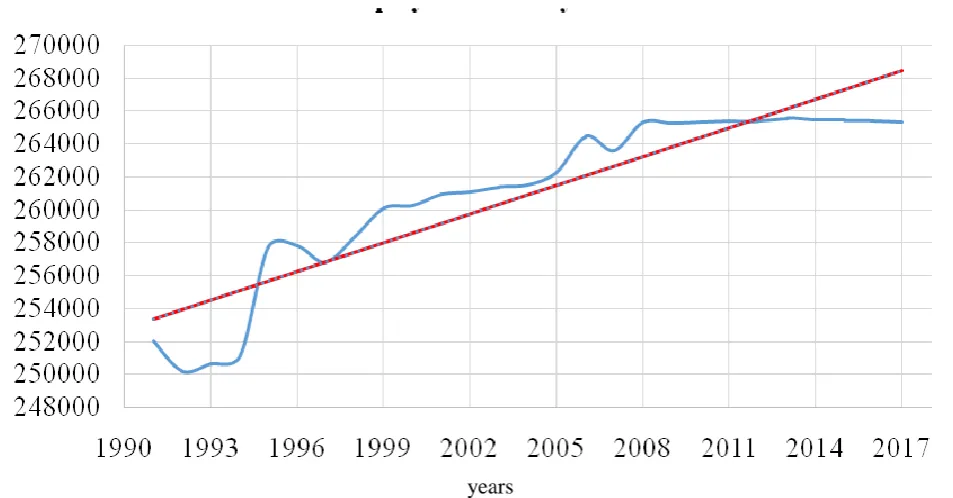
The main goal is to improve the ameliorative status of irrigated land in the Khorezm region, increase soil fertility, and efficiently use available water resources in the event of a water shortage. Between 1990 and 2017, irrigated land, surface water levels, salinity, soil salinity, and cotton fertility changed over the years. According to the results of the analysis, the soils according to the mechanical composition of the region are divided into: heavy 17.3%, average 40.3%, light 29.1% and 13.3%; According to the mechanical composition of irrigated soils of the Koshkupir district, 15.2%, 32.5 %, light 35.5% and 16.7%, the mechanical composition of the irrigated soils of the Shovot district is 26.3%, medium - 47.0%, light - 12.4% and 14.3% of sandy areas.
According to the information provided, the annual increase in irrigated land in Khorezm is increasing. In these areas, efficient use of water resources and increasing soil fertility to improve the soil amelioration condition can be achieved as a processed crop of winter wheat and improvement of soil reclamation through soybean sowing.
ir
ri
ga
ted
ar
ea
years
Figure 1: Area of irrigated land for 1990-2017, hectares
G
round
w
a
ter
l
ev
el
years
Figure 2: Water level for 1990-2017, cm
In Khorezm, the area of the total area of 276,500 hectares of irrigated land of 223,800 hectares is the area with mineralization from 1.0 g / l to 3.0 g / l or 80.9%. It is advisable to use sub-irrigation for efficient use of water in such areas.
G
roundw
at
er
m
inr
al
iza
ti
o
n
years
Figure 3: Mineralization of wastewater for the years 1990-2017, g / l.
At the same time, the total area of irrigated land is 276.5 thousand hectares, of which lightly saline lands 51.9%, salt marshes - 13.1%.
Ir
ri
ga
ted
ar
ea
, h
a
Years
Figure 4. Soil salinity in the region for 1990-2017, ha.
According to the data, the fertility of cotton in the region decreased from year to year, and it is necessary to improve the ameliorative condition of irrigated lands in order to improve the fertility of cotton. Reclamation activities should be timely implemented.
fer
ti
li
ty,
tsa
/
h
a
Years
Figure 5: The fecundity of cotton in the area for the years 1990-2017.
Based on the above, observations were carried out in areas with low, medium and strong salinization in the Khorezm region. The observations were recorded in farms with low mineralization "Kiyotli Asadbek Asalai" in the Khiva district, "Khoja Rakhimboy" in the Kushkupir district and "Matyusuf Anorgul" in the Shovat district. Scientific studies were conducted in areas with high salinity.
Seasonal irrigation rate of the farm “Kiyotli Asadbek Asalay” on seasonal irrigated lands is 3580 m3 / ha, the
height of cotton is 137.3 cm, the yield is 16.7, the number of bolls is 16.1 units, the weight of cotton seed in dry weight is 45, 4 g, yield was 31.1 centers per hectare.
The seasonal irrigation rate on the Khoja Rakhimbo medium-saline field is 3,750 m3 / ha, the height of the cotton is 102.7 cm, and the bushes are 14.5 units. 14.5 units of cotton fiber, 35.7 grams of dry cotton sheet, 29.4 centners per hectare of productivity, the seasonal irrigation rate for the highly saline Matyusuf-Anorgul field is 3,970 m3 / ha, the height of cotton is 93.7 cm, the number of boxes is 11 4, the amount of fiber is 12.2, 30.2 g of cotton fiber and 26.2 centners per hectare. In less saline fields compared to strong salinization, the cotton yield was 4.9 centners per hectare and 3.2 centners per hectare higher than the average salinity.
5. CONCLUSION:
Improvement of the ameliorative condition of the ancient irrigated lands in the Khorezm region, improvement of soil fertility, proper organization of efficient use of water resources as a result of proper organization of salinization washing in the autumn months, regulation of crops, reduction of wastewater entering the collector, prevention of soil erosion, secondary soil salinity and the achievement of high yields of agricultural crops is a major factor in the development of agriculture n your republic.
REFERENCES:
1. Methods of field experiments. Tashkent 2007. 176-b.
2. Norkulov U. Coastal flushing. Cotton information guide. Type of ownership. 2016, 33 pp.
3. Pankov MA — Meliorative soil science. – Tashkent, 1974. p. 30–36 pp.
4. Isaev S.Kh., Khaidarov B.A. –Use of collector-drainage waters for cotton irrigation // Science and Practice
Bulletin, –T. 2018., 4, No. 9, pp. 109–113.
5. Isaev S., Zhumanov A. –Mathematic modeling of the processes of accumulation of sediments and their irrigation
of mountain and foothill lands. // Bulletin of science and practice, 2018. T., 4, No. 7, pp. 160–165.
6. Karimov A.Kh., Mirzazhanov KM, Isaev S.Kh. –Increase of efficiency of use of water resources at the level of
farms. // Water conservation: technologies and socio – economic aspects. Taraz, 2002. - 162 p.
7. Ramazanov O., Khalmirzaeva M., Nasonov V. - “Deconciliundsvantisisligi: Muammovaechim”, the scientific
8. Isaev S.Kh., Khaidarov B. –– Influence of cotton irrigation order Andijon – 36 on its yield // Irrigation va
amelioration Journal. –Toshkent, №1 (11) .2018. -with. 9–13.
9. Ramazanov A., Buriev S. About the irrigation regime of agricultural crops - // Irrigation, amelioration magazine.
–Toshkent, №1 (11) .2018. -with. 13–18.
10. Ramazanov A. –About the depth of drainage on saline lands // Irrigation, amelioration Journal. –Toshkent, №1
(11) .2018. -with. 5–9.
11. Isaev, S.Kh., Radjabov, TT, Dolidudko, A.A., Effect of inorganic fertilizers on cotton yields on saline soils, Bulletin of Science and Practice, 2018. T., 4, No. 10, pp.198-202.
12. Isaev S.Kh., Akhmedov S., Mardiev Sh. - Cotton yield in takyr soils subject to wind erosion- / Bulletin of Science and Practice, 2018. T., 4, No. 10, pp. 1778-184.
13. Дурманов А.Ш. «Развитие предпринимательства и социального партнерства в Узбекистане».
«Ижтимоий ҳамкорлик-иқтисодий муносабатларни эркинлаштириш омили» мавзусидаги илмий-амалий
конференция Тошкент-2014 йил.135-138 бетлар.
14. Дурманов А.Ш. «Инвестиционная политика и ее реализация в сельском хозяйстве Республики
Узбекистан». «Ўзбекистон агросаноат мажмуасининг рақобатбардошлигини ошириш ва экспорт
салоҳиятини юксалтириш»мавзусидаги республика анъанавий илмий-амалий конференция Тошкент
-2014 йил.271-274 бетлар.
15. Durmanov A. Sh. Cooperation as a basis for increasing the economic efficiency of production of open ground
vegetables. «Бюллетень науки и практики» в № 8 (августь) 2018 г.
16. Durmanov A. Sh. Foreign experience the organizational-economic mechanisms of improving the activities of
greenhouse farms. Economics and Finance. 2018. № 7
17. Umarov S.R. Innovative development and main directions of water management. Scientific Electronic Journal
"Economics and Innovative Technologies". No. 1, January-February 2017.
http://www.iqtisodiyot.uz/sites/default/files/maqolalar/6_S_Umarov.pdf
18. Durmanov A.Sh. // SAARJ Journal on Banking & Insurance Research (SJBIR). Vol 6, Issue 5, September 2017. DOI: 10.5958 / 2319-1422.2017.00021.2
19. Durmanov A.Sh., Yakhyaev MM, Measures to increase the volume of exports of fruit and vegetables // No. 4, November 2017. Herald of the Caspian.
20. Дурманов А.Ш. Инновационные технологии и методы обучения в прфессиональном образования. “Фан,
таълим ва ишлаб чиқариш интеграциясини ахборот коммуникация технологиялари асосида
ривожлантириш муаммолари” Республика илмий-амалий анжуман материаллари тўплами. Қарши, 2012
йил. 97-99-бет.
21. Дурманов А.Ш. “Формирование инновационной стратегии аутсорсинга”. “Иқтисодиётни
модернизациялаш шароитида хизмат кўрсатиш соҳаси самарадорлигини ошириш ва инновацион
фаолиятни такомиллаштириш муаммолари” мавзусидаги республика анъанавий илмий-амалий
конференция. Самарқанд-2014, 219-221 бетлар.