Volume 15, Issue 4, Autumn 2016
Editorial in Charge
Hossein Pakdaman, M.D.
Professor of Neurology, Shahid Beheshti
University of Medical Sciences,
Tehran, Iran
Editor-in-Chief
Shahriar Nafissi, M.D.
Associate Professor of Neurology,
Neurology Department, Tehran University of
Medical Sciences, Tehran, Iran
Deputy Editor
Farzad Fatehi, M.D.
Assistant Professor of Neurology, Neurology Department, Tehran University of
Medical Sciences, Tehran, Iran
Section Editors
Headache: Mansooreh Togha
, M.D.
,
Tehran
University of Medical Sciences
, Tehran, Iran
Multiple
Sclerosis:
Mohammad
Ali
Sahraian
, M.D., Neurology Department,
Tehran
University of Medical Sciences
, Tehran, Iran
Stroke: Afshin Borhanin Haghighi
, M.D.,
Shiraz University of Medical Sciences, Shiraz,
Iran
Movement Disorders: Mohammad Rohani
,
M.D., Iran University of Medical Sciences,
Tehran, Iran
Associate Editors
Shahin
Akhondzadeh,
Pharm.D.,
Ph.D,
Tehran University of Medical Sciences,
Tehran, Iran
Majid Ghafarpour,
M.D., Tehran University of
Medical Sciences, Tehran, Iran
Massoud Nabavi,
M.D., Shahed University of
Medical Sciences, Tehran, Iran
Scientific Assistant Editor
Ali Amini-Harandi
, M.D., Shahid Beheshti University of Medical Sciences, Tehran, Iran
Editorial Board
Shahram Attarian
, M.D., Centre de Référence
des Maladies Neuromusculaires et de la SLA,
France
Mahmoud R. Azarpazhooh
, M.D., Mashhad
University of Medical Sciences, Mashhad, Iran
Keivan Basiri
, M.D., Isfahan University of
Medical Sciences, Isfahan, Iran
Ahmad R. Dehpour
, Pharm.D., Ph.D., Tehran
University of Medical Sciences, Tehran, Iran
Masoud Etemadifar
, M.D., Isfahan University
of Medical Sciences, Isfahan, Iran
Kavian
Ghandehari
,
M.D.,
Mashhad
University of Medical Sciences, Mashhad, Iran
Kurosh Gharagozli
, M.D., Shahid Beheshti
University of Medical Sciences, Tehran, Iran
Mohammad H. Harirchian
, M.D., Tehran
University of Medical Sciences, Tehran, Iran
Payam Kabiri
, M.D., Ph.D., Tehran University
of Medical Sciences, Tehran, Iran
Hossein Kalani
, M.D., Shahid Beheshti
University of Medical Sciences, Tehran, Iran
Jamshid Lotfi
, M.D., Tehran University of
Medical Sciences, Tehran, Iran
Alireza Minagar
, M.D., Louisiana State
University
Health Sciences Center, USA
Ali Moghtaderi
, M.D., Zahedan University of
Medical Sciences, Zahedan, Iran
Mahmood Motamedi
, M.D., Tehran University
of Medical Sciences, Tehran, Iran
Alireza Nikseresht
, M.D., Shiraz University of
Medical Sciences, Shiraz, Iran
Abdolmohamad M. Rostami
, M.D., Thomas
Jefferson University Hospitals, USA
Mohammad
Saadatnia
,
M.D.,
Isfahan
University of Medical Sciences, Isfahan, Iran
Mohammad K. Salajegheh
, M.D., Brigham and
Women's Hospital and Harvard Medical School,
USA
Gholam A. Shahidi
, M.D., Tehran University
of Medical Sciences, Tehran, Iran
Vahid
Shaygannejad
,
M.D.,
Isfahan
University of Medical Sciences, Isfahan, Iran
Akbar Soltanzadeh
, M.D., Tehran University
of Medical Sciences, Tehran, Iran
Amir A. Zamani
, M.D., Brigham and Women's
Hospital and Harvard Medical School, USA
Babak Zamani
, M.D., Tehran University of
Medical Sciences, Tehran, Iran
Secretary:
Samaneh Bahraminejad, BSc
Email: [email protected]
http://ijnl.tums.ac.ir
Copy edit, Layout edit, Proof Reading, Design, Print and Online Support: Farzanegan Radandish Publications
http://www.farapub.com Email: [email protected]
Indexed in
PubMed,
PubMed Central,
Academic Keys,
Cite Factor (Directory Indexing of International Research Journals),
Directory of Open Access Journals (DOAJ),
Directory of Research Journal Indexing (DRJI),
Ebsco,
Electronic Journals Library,
Google Scholar,
InfoBase Index,
Islamic World Science Citation Center (ISC),
LocatorPlus,
Scientific Information Database (SID),
Ulrichsweb Global Serials Directory,
Universal Impact Factor,
WorldCat
Iranian Journal of Neurology © 2016 2016
II Iran J Neurol 2016; 15(4)
Aim and Scope
Iranian Journal of Neurology
INFORMATION FOR AUTHORS
The submission file is in Microsoft Word document file format.
The Iranian Journal of Neurology is dedicated to the Iranian Neurological Association. The journal is a peer- reviewed journal published quarterly and publishes neurological experiences in basic or clinical fields in
English Language. The Iranian Journal of Neurology aims to publish manuscripts of a high scientific quality representing original clinical, diagnostic or experimental works or observations in neurological sciences. Papers in
English are welcomed, particularly those which bring novel information and researches in clinical or basic fields from the neurological disorders. All received manuscripts coving the scope of the journal will be evaluated by properly competent referees.
Submission Cover Letter:
Submissions should be accompanied by a cover letter including a declaration by the first author on behalf of the others to the effect that
(1) The paper has not been published to date (except for abstracts of conference materials).
(2) The paper has not been accepted for publication elsewhere.
(3) All persons listed as the authors have read it and approved it for publication. The cover letters should be submitted in section "Comments for the Editor".
Articles must be written in accurate scientific English appropriate for publication. The articles are subject to review and editing; however, the authors are responsible for the correctness the manuscript's English language.
The articles must be submitted only online: ijnl.tums.ac.ir
Policies
The Editorial Board reserves the right to reject a paper without seeking reviewers’ opinion provide the content or the form of the paper does not meet minimum acceptance criteria or if the subject of the paper is beyond the aims and scope of the journal.
Everyone listed as the author of a paper is responsible for the reliability and completeness of data presented in the paper.
Do not submit papers that copy fully or partially previously published papers.
Indicate that this submission is ready to be considered by this journal by checking off the following:
The submission has not been previously published, nor is it before another journal for consideration (or an explanation has been provided in Comments to the Editor).
Where available, URLs for the references have been provided.
The text is double-spaced; uses an Arial 12-point font; and all illustrations, figures, and tables are placed within the text at the appropriate points, rather than at the end.
The text adheres to the stylistic and bibliographic requirements outlined in the Author Guidelines, which is found in About the Journal.
If the Editorial Board is not notified in advance and the paper is found to have been copied during editorial work, the paper shall be rejected.
We expect that all studies reported in the journal conform to the requirements of the Declaration of Helsinki (1989). Information on the consent of a relevant ethics committee to perform the trial and the informed consent of the patients to participate in the trial should be given in the Material and methods section of each paper in which diagnostic or therapeutic intervention does not follow from the standard procedure. Authors of case reports must not disclose personal data of patients described.
Manuscripts
The journal publishes: Original Article Review Article Case Report
Short Communication Clinical Notes Editorial Letters to Editor Neurological Images Neurological Videos Iranian Neurological Events Clinical Quiz
Details
Original and review papers: The maximum length of
original and review papers (including tables and figures materials) is 3000 words.
Case reports: Case reports will be accepted only as Letter
to the Editor.
Short communications: The maximum word number of
short communications should be below 1200 words with maximum one table or figure and 10 references. The manuscript should be structured including introduction, materials and methods, results, discussion, and conclusion with a structured abstracts as original articles.
Iranian Journal of Neurology © 2016 2016
Iran J Neurol 2016; 15(4) III
http://ijnl.tums.ac.ir 7 October
neurological images or videos are welcome. They should
be maximally 400 words with legends without abstract and unstructured. The videos should be uploaded as supplementary files.
Letter to the Editor: May concern short scientific reports
and comments. The maximum number of words should be below 800 words with maximum 5 references, no abstract, no table or figure, and unstructured.
Clinical notes: Refer to important interesting observations
which are imperative for reminders in clinical practice. The maximum number is 1000 words with maximum 5 references, 1 table and 1 figure with no abstract.
Iranian neurological events: Include the brief description
of major regional events (congresses or seminar) implemented in Iran.
Structure of Articles
Manuscripts should be submitted in 12 points, Arial font, with double line spacing and sufficient margins of 2.5 cm.
The text should not be formatted.
Each section of the paper should begin on a new page
The manuscript must include:
Page 1: Title Page
Page 2: Abstract and Key Words
Page 3 and subsequent pages: manuscript body including Introduction, Materials and Methods, Results, Discussion, Conclusion, References, Tables, Figures
1. Title page:
Title page should contain paper title, full names of authors,
authors’ place of work, full name and address of the corresponding author (including e-mail address and telephone number), given in that order.
2. Abstract page:
The length of the abstract should be at least 200 and not more than 250 words for original papers and not more than 150 words for review papers and case reports. Abstracts of original papers should be structured to include the background, methods, results and conclusion.
Below the abstract authors should provide between three and six keywords conforming to Medical Subject Headings (Index Medicus).
3. Page three and subsequent pages of the original paper
and short communication should include the text arranged in the following order (for other manuscript type, see above):
1. Introduction: The introduction should be as concise
as possible and introduce the context of the paper to the reader; the paper should clearly state the research hypothesis and the objective of the study.
2. Materials and Methods: Description of the studied
population or material should be detailed and include all information necessary to assess the reliability of results obtained in the study and/or allow the experiment to be repeated by other researchers; the section related to statistical analysis should have information on
applied statistical tests and programs.
3. Results: Present results directly related to the topic
of the paper only; tables and/or figures are recommended.
4. Discussion
5. Conclusions: These should be brief, follow directly
from results presented above and correspond to the aim of the paper outlined in the introduction.
6. Acknowledgements: Should comprise information
on sources of funding (grant numbers); acknowledgements should concern those who made a significant contribution to the paper, but who did not meet the criteria to be listed as authors.
7. References: References should be listed in the order
quoted in the paper. Please cite source and major papers that offer interested readers an opportunity to obtain more detailed information. Avoid citing review papers and conference reports, if they are not the only materials on a given topic.
References
In the paper references should be given in superscripts
with no space between the comma and the consecutive number.
Authors are advised to carefully verify citation details. Give names of first six authors; if there are more authors, add “et al.“. Use Index Medicus abbreviations for journal titles. Then mention the volume and the issue of the journal.
The recommended style for journal references is as follows:
[Reference number][Authors]. [Article title]. [Journal Name] [Year of publication]; [volume](issue): [Pages range].
For Journal Example:
1. Janghorbani M, Amini M, Willett WC, Mehdi Gouya M, Delavari A, Alikhani S, et al. First nationwide survey of prevalence of overweight, underweight, and abdominal obesity in Iranian adults. Obesity (Silver Spring) 2007; 15(11): 2797-808.
For Books Example:
2. Ropper AH, Brown RJ. Adams and Victors principles of neurology. 8th ed. New York, NY: McGraw Hill Professional; 2005. p. 271.
Tables: Each table should be placed on a separate page.
Tables should be numbered with Arabic numerals in the order in which they appear in the text. Authors should indicate the position of tables in the paper. Titles and headings of tables should be given in English. Information given in tables should not be repeated in the body of the text. Explanations concerning tables, e.g. full names of abbreviations should be given in footers below tables and should be consecutively marked: “*”,“**”,“***” etc.
Figures: Figures and photographs should be numbered
with Arabic numerals and attached as separate printouts (in the electronic version, as separate files). Figures should be saved in one of the following formats: .jpg.
Iranian Journal of Neurology © 2016
IV Iran J Neurol 2016; 15(4)
http://ijnl.tums.ac.ir 7 October
of 300 dpi and in the .tif or .jpg format. Figures and photographs are placed in the paper in the form delivered, so they must be prepared carefully. Please indicate where they should be placed in the text.
Abbreviations should be always clarified when used for
the first time in the text (including the abstract). Abbreviations should not be used in paper titles, unless in exceptional circumstances.
Review process: All papers submitted for publication in
the journal are assessed by two independent reviewers with the mutual anonymity rule as to the names of
reviewers and authors observed.
Plagiarism policy: According to the plagiarism policy
of Iranian Journal of Neurology, plagiarism is defined as a paper which replicates another publication with as a minimum 25% resemblance and devoid of citation. In any time the evidence of plagiarism is detected, the manuscript will be withdrawn and the author will be sanctioned from publishing papers permanently.
Proofs: The proofs will be sent via email and must be
Iranian Journal of Neurology © 2016 Iran J Neurol 2016; 15(4) V
Table of Contents
Original Article(s)
Developing Azeri aphasia screening test and preliminary validity and reliability
Sousan Salehi, Ali Jahan, Najva Mousavi, Mazyar Hashemilar, Zohreh Razaghi,
Maryam Moghadam-Salimi ... 183-188
Modification of the Persian version of Hermans Achievement Motivation Questionnaire
to develop an adapted scale for measuring motivation of post-stroke survivors in Iran
Seyed Alireza Derakhshanrad, Emily Piven ... 189-194
Outcome of acute ischemic stroke after intra-arterial thrombolysis: A study from India
Jaydip Ray Chaudhuri, Randhir Kumar, Matapathi Umamahesh, Kandadai Rukmini Mridula,
Suvarnal Alladi, Srinivasarao Bandaru ... 195-201
Evaluation of complete functional status of patients with stroke by Functional
Independence Measure scale on admission, discharge, and six months poststroke
Seyed Mansoor Rayegani, Seyed Ahmad Raeissadat, Ebrahim Alikhani, Masume Bayat,
Mohammad Hasan Bahrami, Afshin Karimzadeh ... 202-208
Prognostic value of hemoglobin A1c in nondiabetic and diabetic patients with acute
ischemic stroke
Mohammad Ali Shafa, Hosseinali Ebrahimi, Farhad Iranmanesh, Mojtaba Sasaie ... 209-213
Association of insulin-like growth factor-I with the severity and outcomes of acute
ischemic stroke
Masoud Mehrpour, Hessam Rahatlou, Negar Hamzehpur, Sahand Kia, Mahdi Safdarian .... 214-218
Review Article
The impact of Kinesio taping technique on children with cerebral palsy
Alireza Shamsoddini, Zabihallah Rasti, Minoo Kalantari, Mohammad Taghi Hollisaz,
Vahid Sobhani, Hamid Dalvand, Mohammad Kazem Bakhshandeh-Bali ... 219-227
Short Communication
Anatomical considerations for insertion of pedicular screw in cervicothoracic junction
Morteza
Faghih-Jouibari,
Keisan
Moazzeni,
Amir
Amini-Navai,
Sara
Hanaei,
Sina Abdollahzadeh, Ramin Khanmohammadi ... 228-231
Letter to editor(s)
Neuromyelitis optica in a pregnant woman with systemic lupus erythematous: A
case report
Fariborz
Khorvash,
Nafiseh
Esmaeil,
Omid
Mirmosayyeb,
Nahid
Eskandari,
Homayoon Salimian ………232-234
Treatment of restless legs syndrome/Willis-Ekbom disease with selenium
VI Iran J Neurol 2016; 15(4) Iranian Journal of Neurology © 2016
Neurological Image/Video
A diagnosis of stroke-like migraine attacks after radiation therapy (SMART) as severe
headache with stroke-like presentation
Aileen O’Shea, Sinead Culleton, Hamed Asadi, Hong Kuan Kok, Alan O’Hare, John
Thornton, Paul Brennan, Seamus Looby
……….237-239
Special Article
The effectiveness of Orem's self-care program on headache-related disability in
migraine patients
Fatemeh
Mahmoudzadeh-Zarandi,
Farahrooz
Hamedanizadeh,
Abbas
Ebadi,
Iranian Journal of Neurology © 2016 Corresponding Author: Ali Jahan
Email: [email protected] Email: [email protected]
Original Paper
Iran J Neurol 2016; 15(4): 183-188
Developing Azeri aphasia
screening test and preliminary
validity and reliability
Sousan Salehi1, Ali Jahan2, Najva Mousavi3, Mazyar Hashemilar4, Zohreh Razaghi5, Maryam Moghadam-Salimi3
1
Department of Speech Therapy, School of Rehabilitation, Tehran University of Medical Sciences, Tehran, Iran
2
Department of Speech Therapy, School of Rehabilitation, Tabriz University of Medical Sciences, Tabriz, Iran
3Department of Psychology, School of Education and Psychology, University of Tabriz, Tabriz, Iran 4
Department of Neurology, School of Medicine, Tabriz University of Medical Sciences, Tabriz, Iran
5
Endocrine Research Center, Tabriz University of Medical Sciences, Tabriz, Iran
Keywords
Screening Test; Aphasia; Azeri Language; Brain Injury; Iran
Abstract
Background: As there is no standard aphasia
screening tool for Azeri language yet, the aim of this study was to develop an aphasia screening test with acceptable validity and reliability.
Methods: The present study was conducted in
two phases. In the first phase, by literature search, the screening test was designed and to obtain validity it was peer reviewed by expert panel. After collecting experts’ ratings and comments, appropriate modifications were applied. For test-retest reliability in the second phase, edited test was administered in 32 patients with brain injuries, then the retest was performed two weeks later.
Results: The developed test had eight subscales including: A) picture description, B) syntax, C) linguistic reasoning, D) descriptive naming, E) perception of minimal pairs, F) comprehensive vocabulary, G) expressive vocabulary, H) verbal
fluency. Each section had five questions except verbal fluency which had 3 items. Content validity ratio (CVR) according to Lawshe’s approach, was 82% for the whole test. Intraclass correlation for all subscales were more than 0.8. Cronbach’s alpha coefficient for internal reliability was 0.901.
Conclusion: This aphasia screening test seems to have acceptable psychometric properties. This test can probably be used in clinical setting by specialists.
Introduction
Aphasia is an acquired neurogenic language disorder.1 Stroke is the most common cause of
aphasia.2 Aphasia incidence and prevalence is
often estimated based on the incidence and prevalence of stroke.3 The incidence of ischemic
stroke in Iranian population was reported to be 43.2 cases per 100,000 person-year. Frequency of aphasia among people who have experienced stroke is 33.3%.4
Aphasia screening measures are commonly concise. These tests are helpful in the early stages of recovery, when the patient still cannot complete long aphasia tests.5 There are several widely used
Iranian Journal
of Neurology
184 Iran J Neurol 2016; 15(4) Salehi et al.
tools for screening aphasia in other languages, some of them are being described as follows:
Aphasia Language Performance Scale (ALPS): this tool includes four aspects of language (listening, speaking, reading, and writing) and each aspect has ten-item scale that their difficulty is gradually increased.6 ALPS is comprehensive in
aspects of language but it has limitations for use in research projects.7
Acute Aphasia Screening Protocol (AASP): this test has four sub-scales including attention/orientation to communication (five items), auditory comprehension (15 items), expressive abilities (20 items), and conversational style (four items). Although it is short and easily can be done in clinical setting but it has subjective rating system in some sub-scales.8
Bedside Evaluation and Screening Test for Aphasia: this tool assesses language ability in three communicative modalities including auditory comprehension, speaking, and reading.9
It ignores writing which is an important modality in aphasia assessment in English language.
Frenchay Aphasia Screening Test (FAST): it evaluates language in four language areas of comprehension, verbal expression, reading, and writing. Although this test is the most widely used screening tool,8 but it has limitations. It only
applies visual materials, then any visual deficits such as neglect has adverse impact on patient’s score.10
Mississippi Aphasia Screening Test (MAST): MAST includes nine subscales comprising of naming, automatic speech, repetition, yes/no accuracy, object recognition, following verbal instructions, reading instructions, verbal fluency, and writing/spelling to dictation. It measures receptive and expressive language.11
Language Aphasia Screening Test (LAST): this test has two main indexes, receptive and expressive. Receptive index includes naming, repetition and automatic speech; expressive index includes recognition and verbal instructions.12
Mini-Mental State Examination (MMSE), Raven’s Colored Progressive Matrices (RCPM), and Sheffield Screening Test (SST) are short tests easily implemented, so can be suitable as screening tool13 but none of them is
comprehensive language assessment. In Iran, MAST has recently been translated with cross-cultural adaptation for Persian language.14
The lack of valid and reliable test for clinical diagnosis and practice is a worldwide problem.15
These tests are needed for early detection and intervention. Early detection of language impairments and synergy between intervention and neuroplasticity can maximize the benefits of treatment.13
Nevertheless, there is no Azeri Turkish aphasia screening test yet whereas we require a valid and reliable test in accordance with Azeri Turkish language structure and culture for clinical and research application. Azeri language in Iran do not have reading and writing, which can be considered as the most important feature of this language in developing the test. Then, the purpose of present study was developing the screening test of aphasia for Azeri speakers in Iranian population by minimizing limitations in other screening tests and obtaining preliminary validity and reliability as the first step toward standardization.
Materials and Methods Development of the test
The first section of this study was creating a new test for aphasia screening in Azeri language. Textbooks in linguistics and, language disorders and available screening tests for aphasia were reviewed. In general view, a suitable aphasia test should compromise content expression and comprehension (semantics), form (phonology, morphology and syntax) and pragmatic.2 With
respect to these guides and other literature, eight important domains of language were selected as follows:
1) Picture description (content production): this sub-test helps to assess the semantic and syntactic abilities by evaluating the retrieval of content and function words, and the arrangement of words in the sentence (grammar).16
2) Syntax: syntactic processing is damaged in fluent aphasia.17 Additionally, asyntactic
comprehension is one of the high level processing problems in aphasia.2 Asyntactic comprehension,
negative forms, and prepositions are included in this part.
3) Verbal reasoning (pragmatic): in view of the fact that screening test should be sensitive to subtle deficit in cognition and communication, verbal reasoning was selected as part of the test. Verbal reasoning is higher level function that integrate several processes.18
Azeri aphasia screening test Iran J Neurol 2016; 15(4) 185 verbal description. This task is sensitive to left
lobe injuries.19 It needs language comprehension
and word retrieval ability without visual processing involvement.
5) Minimal pairs (phonology): this task taps the auditory input processing without oral production. It can illustrate any problem in auditory analysis level.20
6) Receptive vocabulary (single word comprehension): a basic task which assesses semantic input at single word level. Single word comprehension is not seriously disrupted in mild aphasia.21 Accordingly, Low frequency words
were used in various semantic categories in the developed test to rise probability of error.
7) Expressive vocabulary (picture naming): it is reported that there is deficits in picture naming in all types of aphasia.22 Similar to receptive
vocabulary, low frequency words in different semantic categories were included.
8) Verbal fluency (semantic verbal fluency by naming animals): Verbal fluency refer to the number of words which is produced in one minute in specific semantic category; it can be included in aphasia assessment tests.23
As Iranian branch of Azeri language does not have writing form and is an oral language, then our screening test was not designed to include reading and writing parts. As mentioned before, the developed test had eight subscales, each subscale had five items except verbal fluency.
Scoring system was 0 or 1 for each item (correct or incorrect answer); then range of score of each part was 0 to 5 except verbal fluency which had a score range of 0-3 (Table 1).
Validity
At the second phase, content validity was determined. First, all the items were included in a questionnaire to verify their relevancy to the content and structure of the test. Then, the sheet with written explanation of our investigation was given to experts including nine experienced speech language pathologists and one linguist. Afterwards, according to expert’s opinions the test’s materials were modified or unacceptable items were deleted. Finally, ultimate form was obtained (appendix 1). Lawshe’s approach was used for determining content validity ratio (CVR) in quantitative way.24
Reliability
The reliability was obtained by test-retest and internal consistency evaluation. The test was
administered in brain injury and stroke patients who were at risk of aphasia according to neurologist’s diagnosis, who were in the early stage of their injury or stroke. Participants included 32 brain injury and stroke patients, 11 female and 21 male with a mean age of 64 years [range: 43-86 and Standard deviation (SD) = 10.0[, who were referred to Imam Reza and Razi Hospitals in Tabriz, Iran. All of them were under medication and were native Azeri speakers. Informed consent was taken according to ethical committee of Tabriz University of Medical Sciences. Participants were assessed for the second time after two weeks.
Results
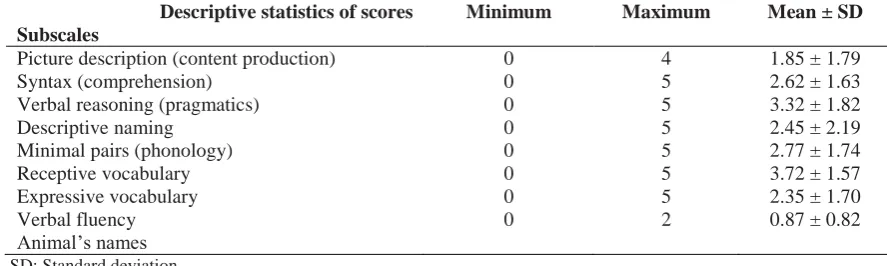
The patients’ scores are shown in each subscale in table 2. Content validity coefficients were calculated for each item in subscales; there were totally 38 items. Content validity coefficient was 40% for four items, 62% for eight items, 80% for seventeen items and 100% for nine items. Since the acceptable CVR is 62%, four items which had CVR less than 62% were modified. Then, the average of the rest of the items was calculated as the content validity indicator. Thus, the whole content validity coefficient was obtained as 82%.
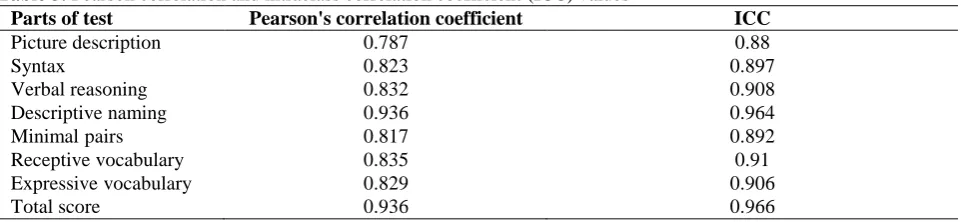
In the second phase of the study, intraclass correlation coefficient (ICC) was calculated for each subscale. Pearson's correlation coefficients of subscales are also presented in table 3.
As for verbal fluency, it was analyzed by the Spearmen's correlation coefficient. The coefficient of 0.899 was obtained for verbal fluency which is well above 0.7. The ICC for this subscale was 0.928.
High Pearson's correlation coefficient between test-retest scores as well as high ICC (above 0.75) showed the acceptable level of test-retest reliability.25 Cronbach's alpha was used to
determine internal consistency of the test. For eight subscales, Cronbach' alpha was obtained as 0.91, indicating a high reliability for Azeri aphasia screening test.
Discussion
186 Iran J Neurol 2016; 15(4) Salehi et al.
Table 1. The subscales and items
Test’s subscales
Picture description (content production)
Syntax (comprehension)
Verbal reasoning (pragmatic)
Descriptive naming
Minimal pairs (phonology)
Receptive vocabulary
Expressive vocabulary
Verbal fluency animal’s names
Item 1 Father plays with toys The large glass which is broken
Watermelon skin is red and its inside is green. Is it right?
Wash hands with what?
Dog, rope Barrel Flag No name
Item 2 Mother saw it The broken flower which is under the
table
We can brush our teeth with spoon
instead of tooth brush. Is it right?
Children draw with what?
Tongue, teeth Loudspeaker Lantern 5 names
Item 3 Son cooks the food Father of kids who do not say goodbye.
It is possible to put the pen in the pot. Is
it right?
What is the name of person who drives airplane?
Park, pitcher Urceolate (bell)
Funnel More than 5 names
Item 4 Daughter read the newspaper
The cat that looks the boy
We have breakfast between lunch and dinner. Is it right?
What does the fan exactly do?
King, scarf Boat Feather
Item 5 It is expected that the patient point to relationship between
them.
The girls who do not look the boy
It’s snowing in the summer. Is it right?
What does the cat eat?
Stone, head Button Scale
Table 2. Descriptive statistics of scores in various subscales of test
Descriptive statistics of scores Subscales
Minimum Maximum Mean ± SD
Picture description (content production) 0 4 1.85 ± 1.79
Syntax (comprehension) 0 5 2.62 ± 1.63
Verbal reasoning (pragmatics) 0 5 3.32 ± 1.82
Descriptive naming 0 5 2.45 ± 2.19
Minimal pairs (phonology) 0 5 2.77 ± 1.74
Receptive vocabulary 0 5 3.72 ± 1.57
Expressive vocabulary 0 5 2.35 ± 1.70
Verbal fluency Animal’s names
0 2 0.87 ± 0.82
Azeri aphasia screening test Iran J Neurol 2016; 15(4) 187
Table 3. Pearson correlation and intraclass correlation coefficient (ICC) values
Parts of test Pearson's correlation coefficient ICC
Picture description 0.787 0.88
Syntax 0.823 0.897
Verbal reasoning 0.832 0.908
Descriptive naming 0.936 0.964
Minimal pairs 0.817 0.892
Receptive vocabulary 0.835 0.91
Expressive vocabulary 0.829 0.906
Total score 0.936 0.966
ICC: Intraclass correlation coefficient
other items, stimulus was visual and it is suitable for patients who has auditory deficit. As mentioned, all language domains including phonology, syntax, semantic and pragmatic were presented in various items. Patient response had two main categories, expressive and receptive, which is similar to screening tests like LAST and FAST. The developed test did not have reading and writing subscales, because of special Azeri Turkish feature, which is a verbal language. The highest score in intraclass correlation in eight subscale was descriptive naming, then verbal fluency, receptive vocabulary, and verbal reasoning. All of these items were present in auditory modality. After these four items, there was expressive vocabulary, picture description, syntax, and finally minimal pairs. These items were presented visually.
Inter-item correlation was utilized to specify the internal reliability. It was the highest in all items for descriptive naming item, then verbal fluency, verbal reasoning and receptive vocabulary, expressive vocabulary, syntax, minimal pairs, and picture description, respectively. This is nearly similar to intraclass correlation. Thus the first four items that all of them were auditory (descriptive naming, verbal fluency, verbal reasoning, and receptive vocabulary) were appropriate for aphasia screening. In the next four items, minimal pairs and picture description, were not proper to this evaluation. Minimal pairs was not in reviewed aphasia screening tests for assessing phonology. However, the expressive vocabulary (picture naming) and syntax sub-tests were apparently more suitable for screening aphasia.
Test-retest reliability was a common approach in determining test reliability. The reliability coefficient for ALPS was reported from 0.83 to 0.94 for aphasic patients; retest was from 3 to 5 weeks after the beginning test.26 For
AASP, another aphasia screening test, test-retest
greater than 0.7 was reported.27 Reliability
coefficient ranged from 0.93 to 0.99 for all subscales of Bedsides Evaluation and Screening Test of Aphasia.9 Criterion validity and
test-retest reliability to FAST was reported 0.96 and 0.97, respectively.10 There was not any report on
reliability of MAST.12 Interrater reliability was
obtained for LAST instead of test-retest reliability, thus we cannot compare it with our results. Our aphasia screening test had a 0.93 test-retest reliability, suggesting that the developed test has high temporal stability. It seems acceptable compared to the reliability of other screening test.
ICC of LAST was 0.96, indicating good internal validity and Chronbach’s alpha was 0.88, indicating good internal cohesion.13 Total CVR of
the developed test was 0.82 according to Lawshe’s content validity table which is acceptable compared to other tests (> 0.62). Therefore, the content validity of this test seems to be appropriate. In this study, we did not calculate criterion validity.
Conclusion
The results of this preliminary study suggested that the developed aphasia screening test for Turkish Azeri language had similar validity and reliability to other screening test in other languages. It seems this test has acceptable psychometric values and it can be used in clinic and research for early diagnosis of aphasia. For further investigation, it is recommended that other types of validity and reliability should be calculated and the test also can be performed in normal population to obtain norm scores of the test.
Conflict of Interests
188 Iran J Neurol 2016; 15(4) Salehi et al.
Acknowledgments
This research was supported by a grant from Clinical Psychiatric Research Center for Sousan Salehi in Tabriz University of Medical Sciences. We wish to thank to staff of Razi Hospital, patients, Ms. Nazari and Ms. Hamidnezhad for their participation in data collection.
How to cite this article: Salehi S, Jahan A,
Mousavi N, Hashemilar M, Razaghi Z, Moghadam-Salimi M. Developing Azeri aphasia screening test and preliminary validity and reliability. Iran J Neurol 2016; 15(4): 183-8.
References
1. Murdoch BE. Acquired speech and language disorders. 2nd ed. New York,
NY: John Wiley & Sons; 2010. p. 48. 2. Chapey R. Language intervention
strategies in aphasia and related neurogenic communication disorders. Philadelphia, PA: Wolters Kluwer Health/Lippincott Williams & Wilkins; 2008. p. 47-334.
3. Damico JS, Müller N, Ball MJ. The handbook of language and speech disorders. New York, NY: John Wiley & Sons, 2010. p. 318.
4. Ghandehari K, Moud ZI. Incidence and etiology of ischemic stroke in Persian young adults. Acta Neurol Scand 2006; 113(2): 121-4.
5. El Hachioui H, Visch-Brink EG, de Lau LM, van de Sandt-Koenderman MW, Nouwens F, Koudstaal PJ, et al. Screening tests for aphasia in patients with stroke: a systematic review. J Neurol 2016. 6. Golden CJ, Goldstein C, Incagnoli TM.
Clinical application of neuropsychological test batteries. New York, NY: Springer Science & Business Media; 2013. p. 353.
7. Lezak MD. Neuropsychological assessment. New York, NY: Oxford University Press, USA; 1995. p. 525. 8. Salter K, Jutai J, Foley N, Hellings C,
Teasell R. Identification of aphasia post stroke: a review of screening assessment tools. Brain Inj 2006; 20(6): 559-68. 9. Spreen O, Risser AH. Assessment of
aphasia. New York, NY: Oxford University Press, USA; 2003. p. 54. 10. Enderby PM, Wood VA, Wade DT,
Hewer RL. The frenchay aphasia screening test: a short, simple test for aphasia appropriate for non-specialists.
Int Rehabil Med 1987; 8(4): 166-70. 11. Nakase-Thompson R, Manning E, Sherer
M, Yablon SA, Gontkovsky SL, Vickery C. Brief assessment of severe language impairments: initial validation of the Mississippi aphasia screening test. Brain Inj 2005; 19(9): 685-91.
12. Flamand-Roze C, Falissard B, Roze E, Maintigneux L, Beziz J, Chacon A, et al. Validation of a new language screening tool for patients with acute stroke: the Language Screening Test (LAST). Stroke 2011; 42(5): 1224-9.
13. Blake H, McKinney M, Treece K, Lee E, Lincoln NB. An evaluation of screening measures for cognitive impairment after stroke. Age Ageing 2002; 31(6): 451-6. 14. Khatoonabadi AR, Nakhostin-Ansari N,
Piran A, Tahmasian H. Development, cross-cultural adaptation, and validation of the Persian Mississippi Aphasia Screening Test in patients with post-stroke aphasia. Iran J Neurol 2015; 14(2): 101-7.
15. Ivanova MV, Hallowell B. A tutorial on aphasia test development in any language: Key substantive and psychometric considerations. Aphasiology 2013; 27(8): 891-920. 16. Gordon JK. Measuring the lexical
semantics of picture description in aphasia. Aphasiology 2008; 22(7-8): 839-52. 17. Newhart M, Trupe LA, Gomez Y,
Cloutman L, Molitoris JJ, Davis C, et al. Asyntactic comprehension, working memory, and acute ischemia in Broca's area versus angular gyrus. Cortex 2012; 48(10): 1288-97.
18. MacDonald S, Johnson CJ. Assessment of subtle cognitive-communication deficits following acquired brain injury:
A normative study of the Functional Assessment of Verbal Reasoning and Executive Strategies (FAVRES). Brain Inj 2005; 19(11): 895-902.
19. Loring DW, Meador KJ, Lee GP. Effects of temporal lobectomy on generative fluency and other language functions. Arch Clin Neuropsychol 1994; 9(3): 229-38. 20. Papathanasiou I, Coppens P, Potagas C.
Aphasia and related neurogenic communication disorders. Burlington, MA: Jones & Bartlett Publishers; 2016. p. 157. 21. Moineau S, Dronkers NF, Bates E.
Exploring the processing continuum of single-word comprehension in aphasia. J Speech Lang Hear Res 2005; 48(4): 884-96. 22. Kohn SE, Goodglass H. Picture-naming
in aphasia. Brain Lang 1985; 24(2): 266-83.
23. Benson DF, Ardila A. Aphasia: A clinical perspective. New York, MY: Oxford University Press; 1996. p. 101.
24. Polit DF, Beck CT, Owen SV. Is the CVI an acceptable indicator of content validity? Appraisal and recommendations. Res Nurs Health 2007; 30(4): 459-67.
25. Van Ness PH, Towle VR, Juthani-Mehta M. Testing measurement reliability in older populations: methods for informed discrimination in instrument selection and application. J Aging Health 2008; 20(2): 183-97.
26. Skenes LL, McCauley RJ. Psychometric review of nine aphasia tests. J Commun Disord 1985; 18(6): 461-74.
Iranian Journal of Neurology © 2016 Corresponding Author: Seyed Alireza Derakhshanrad
Email: [email protected] Email: [email protected]
Original Paper
Iran J Neurol 2016; 15(4): 189-194
Modification of the Persian version
of Hermans Achievement
Motivation Questionnaire to
develop an adapted scale for
measuring motivation of
post-stroke survivors in Iran
Seyed Alireza Derakhshanrad1, Emily Piven2
1
Department of Occupational Therapy, School of Rehabilitation Sciences AND Rehabilitation Sciences Research Center, Shiraz University of Medical Sciences, Shiraz, Iran
2
University of Texas at El Paso, El Paso, Texas AND Health Matters First of Florida, Inc., Oakland, FL, USA
Keywords
Rehabilitation; Motivation; Cerebrovascular Accident
Abstract
Background: Research has shown that in order
for recovery from a stroke to occur, motivation for recovery has been essential component of rehabilitation. Researchers and clinicians have tended to categorize stroke survivors subjectively into two groups: those who have been motivated or unmotivated, perhaps due to the paucity of objective measures that distinguish the groups. Since classification of clients based on subjective inference would be prone to bias, this pilot study aimed to establish a regionally validated scale that was adequately standardized for measuring motivation of adult post-stroke survivors in Iran.
Methods: The Persian version of Hermans
Achievement Motivation Questionnaire (PHAMQ) was identified as the best test for the purposes of
this study. A multistep process was undertaken to create an adapted scale from the PHAMQ that focused on functional behaviors, often seen in the process of rehabilitation. Thus, the Adapted Achievement Motivation Questionnaire (AAMQ) was examined for reliability and validity. Cronbach’s alpha was used for measuring internal consistency and expert panel opinions were sought to analyze the content validity of AAMQ. Results: A convenience sample of 25 stroke subjects comprised of 10 males and 15 females participated in this study with the mean age [(± standard deviation (SD)] 58.3 ± 9.8 years and range of 35-72 years. Expert opinion regarding the relevance of AAMQ items led to provide compelling evidence for a 28-item AAMQ. Cronbach’s alpha of 0.946 showed a perfect internal consistency for test items.
Conclusion: This pilot study suggested that AAMQ could be utilized as a regionally validated scale for examining the motivational level of patients who have sustained strokes in Iran. Further research are recommended.
Iranian Journal
of Neurology
190 Iran J Neurol 2016; 15(4) Derakhshanrad and Piven
Introduction
Cerebrovascular accidents referred to as strokes, have been a common healthcare problem globally.1 The highest incidence of disabilities that
affect everyday activities have been reported among stroke survivors (SS) compared to other common long term health problems such as musculoskeletal disorders and heart conditions.2
Rehabilitation, a multifaceted time-consuming process, has included behavioral goal-setting and therapeutic intervention aimed to reduce the disability and improve function of SS.3
Rehabilitation practitioners strive to find validation of outcomes in evidence-based practice4 for reimbursement. However, the
outcome of rehabilitation interventions is depended on how much the client demonstrates that he/she wants to recover. Accordingly, if the client expresses desire to pursue rehabilitation goals, he/she would be considered a motivated client.5 One correlational study with 200 subjects
quantitatively determined that motivation towards treatment played a role in achieving favorable outcomes and predicted the likely functional outcomes of SS.6
The World Health Organization described motivation as “a driving force for action” and an essential element of mental function (p.51).7 While
being embedded in the rehabilitation realm, motivation provided a “framework by which rehabilitation professionals and their clients can work together to enhance the client’s physical independence and psychological well-being” (p.7).8 This client-practitioner framework averted
clients becoming disappointed while participating in rehabilitation process.9
There has been consensus among researchers and practitioners that people who have had strokes fit subjectively into motivated and unmotivated categories.6,10,11 Categorizing
motivation as simply black or white has suggested the bias of subjectivity, perhaps due to the paucity of objective measures. There were only two quantitative studies suggesting some questionnaires that could be utilized for measuring the motivational level of stroke survivors.12,13
Hallams and Baker warned the professionals that subjectively assessing the clients’ motivation could result in unreal inference about the construct of motivation.12 Using search words for
both motivation and rehabilitation, they developed a two-part questionnaire with 30 items
to assess motivation in Australian subjects with strokes. Three experts and three clients with strokes participated in the study to give their opinions, in order for the researchers to determine the content validity of the questionnaire. All the items that were included in the questionnaire were scored a Cronbach’s value greater than 0.9, showing that all the items measured the construct of motivation in the field of rehabilitation.
Emphasizing the necessity of developing an instrument for objectively measuring the motivation of subjects with strokes, White et al.13
devised a 28-item assessment tool, which was adapted from the Sports Motivation Scale (SMS) and re-named the Stroke Rehabilitation Motivation Scale (SRMS). The SRMS, comprised of 7 sets of questions, was tested on 31 Australian participants with acute post-stroke conditions. Based on standardization statistical results such as intra-class correlation coefficients, Cronbach’s alpha, and item-to-total correlation coefficients, a final 7-item SRMS was proved to have good reliability among the rest of 28 items, but validity of the questionnaire was not established.13
The authors of this paper found no other validated instruments to measure motivation of clients who have had strokes. This gap in the literature justified the specific aim of this study, which was to establish a regionally validated motivational scale that was adequately standardized to measure the motivational level of Iranian SS towards rehabilitation. Thus, our primary objective in this paper was to conduct preliminary research with a number of expert panelists and a sample of SS to provide a Farsi version of a motivation questionnaire, the findings of which could be utilized for future investigations so that the rehabilitation clinical care might be improved by using such questionnaire.
Materials and Methods
To this end, the Hermans Achievement Motivation Questionnaire (HAMQ),14 was identified as the
best test for the purposes of this pilot study because the Persian version of this scale had been developed through forward and backward translation of the scale into Persian with questions adapted to the Iranian culture, and then validated for an Iranian population of students.15
Modification of PHAMQ Iran J Neurol 2016; 15(4) 191 behavioral domains under one construct, the
“achievement motive”.14 Secondly, this scale had
been widely used in studies in Iran. The questionnaire contained 29 incomplete statements along with four-choice items for each statement, whereby the responder was allowed to choose one to complete the incomplete sentence. The item choices were scored on a four-point numerical Likert scale from 1 to 4. The scale was used to screen individuals quantitatively for different motivational levels. The scale covered 10 aspects of behavior in order to measure the “achievement-oriented” situation of students when they express specific patterns of academic demeanor such as: being achievement-motivated, persistent, and diligent in doing their academic tasks. The rich quality of the initial item pool with 92 items was the chief importance in construction of this scale.14 PHAMQ was standardized on 1073
(560 females and 513 males) high school students of city of Saveh, Iran. The test was confirmed to have high reliability with a Cronbach’s alpha of 0.803. The validity of the test was also confirmed by performing the construct validity procedure.15
Creation of a modified scale from PHAMQ was a four step process, in order to assess the same construct for Iranian adults who had experienced strokes. Firstly, permission was granted for the first author to adapt the HAMQ from its originator. Secondly, the PHAMQ
underwent several purposive amendments by the first author, who substituted its academic-oriented performance orientation for a therapeutic task-oriented performance orientation, in order to change the construct to have a rehabilitation focus. Table 1 below shows several examples of some amended items and their corresponding items in PHAMQ. A full version of the adapted scale in Farsi may be obtained from the first author.
Thirdly, a five-person expert panel, comprised of three experienced occupational therapists and two physiotherapists who worked in rehabilitation settings, was created to review the adapted questionnaire for its suitability for stroke survivors. The content validation procedure led to removal of one item, resulting in a new questionnaire with 28 items. The new questionnaire, named the Adapted Achievement Motivation Questionnaire (AAMQ), has a total score of 28 to 112, whereby the higher scores indicated the higher achievement motivation.
The fourth step was to design an observational descriptive study, so that the reliability of the AAMQ could be examined by the means of calculating Cronbach’s alpha coefficient for investigating internal consistency. An internal consistency is one type of reliability that determines whether test items of a questionnaire all measure the same behavior or construct. Coefficients higher than 0.7 are considered to be optimal.16
Table 1. Examples of amended items and their correspondence
Amended items for the AAMQ Corresponding items from PHAMQ
“While performing therapeutic exercises, I think
perseverance is ______.” “At university, I think perseverance is ______.”
Very unimportant Very unimportant
Rather unimportant Rather unimportant
Important Important
Very important Very important
“My physicians and therapists think I am ______.” “At university, they think I am ______.”
Very diligent Very diligent
Diligent Diligent
Rather easy-going Rather easy-going
Very easy-going Very easy-going
“Good relations with my physicians and therapists ______.” “Good relations with my teachers at university ______.”
Are appreciated very much Are appreciated very much
Are appreciated Are appreciated
Are not to be so important Are not to be so important
Are completely unimportant Are completely unimportant
“I found patients who make more effort are ______.” “At university I found classmates who study very hard are ______.”
Very successful Very nice
Successful Nice
Not successful Not nice
Not successful at all Not nice at all
192 Iran J Neurol 2016; 15(4) Derakhshanrad and Piven
The research project was approved by the Research and Ethics Committee of Shiraz University of Medical Sciences, Iran. Separate consent forms were obtained from the five rehabilitation professionals and participants who had suffered strokes and met the inclusion criteria: willingness to participate, 18-75 years old, sub-acute ictus between 3 to 12 months post-stroke, and presentation of sufficient cognitive and communicative capability to participate in the study. Participants were recruited through a convenience sampling from four rehabilitation centers, which were well-known for offering rehabilitation services to stroke subjects. Molazade et al.17 study provided sample size
guidelines, to calculate the minimum required sample size of 25 subjects, using the sample size
equation ⁄ , where α = 0.05, β = 0.2, d = 4, and mean ± SD of PHAMQ for their population study were 72.8 ± 7.2.
Results
The content validity of the 28-item AAMQ was approved by an expert panel. A convenience sample of 25 subjects who sustained strokes and included 10 males and 15 females was enrolled in this study. The sample mean age was 58.3 ± 9.8 years. The minimum and maximum age of participants was 35 and 72 years, respectively. From the age-related point of view, there was no statistically significant difference between males (59.6 ± 10.2 years) and females (57.4 ± 9.8 years).
The total scale mean was 74.3 (SD 8.1, range 57–94). There was no statistically significant difference between the total score of males (74 ± 6.7) and females (74.5 ± 9.2). Cronbach’s alpha of 0.946 showed a perfect internal consistency for test items indicated that all items measure the same construct. Table 2 below shows item-to total correlation that indicated the acceptable correlation between each test item and the total test score. All items seemed to be worthy of retention because they all correlated with the total scale to a good degree (the lowest r = 0.3).
Discussion
The present pilot study examined the statistical psychometric qualities of the AAMQ using a small sample of Iranian subjects who were post-stroke. The content validity and internal consistency demonstrated perfect values. Despite its preliminary character, the research reported here
would seem to indicate that AAMQ could be used with some confidence to screen the achievement motivation trait of SS residing in Iran.
Table 2. Item to total correlation between test items
and total test score
Item number (Question)
Item-total correlation
Cronbach's alpha if item deleted
1 0.83 0.941
2 0.81 0.941
3 0.83 0.941
4 0.51 0.945
5 0.61 0.944
6 0.85 0.941
7 0.30 0.947
8 0.54 0.944
9 0.87 0.940
10 0.44 0.945
11 0.34 0.946
12 0.76 0.942
13 0.64 0.944
14 0.43 0.945
15 0.45 0.945
16 0.56 0.945
17 0.78 0.942
18 0.69 0.944
19 0.82 0.942
20 0.58 0.944
21 0.43 0.945
22 0.36 0.946
23 0.31 0.946
24 0.62 0.944
25 0.51 0.945
26 0.74 0.943
27 0.44 0.945
28 0.77 0.942
Maclean and Pound10 argued that motivation
was a highly subjective concept with a lack of clinical consensus regarding its definition. They alluded to some sort of “acceptable modes of patient behavior in rehabilitation” (p.497), as an indication of the inferences made by the rehabilitation professionals about the demeanor of clients, with regard to their willingness or unwillingness to participate in rehabilitation interventions.10 Having considered the
disadvantages of subjectively categorizing the stroke survivors’ motivation into high and low level terms, it can be argued that the scale developed in this study provided preliminary supportive evidence for quantitatively classifying subjects with strokes by levels on a motivation continuum.
Modification of PHAMQ Iran J Neurol 2016; 15(4) 193 content validity was only considered in this
study. The other two parts are criterion-related validity and construct validity which lead to gathering further supportive evidence about the validity of a test.18
Comparing the scores obtained from an instrument with the scores of a measure of interest, which is called criterion or gold-standard, is the method of determining the criterion-related validity of an instrument.19 It
was not possible to determine criterion validity of AAMQ because there was no regionally standardized measure for comparison at the time of the study. However, one suggestion for future studies would be to design correlational research in order to evaluate the statistical relationships between the AAMQ and other scales, such as Connor-Davidson Resilience Scale (CR-RISC), which was standardized on a sample of Iranian subjects who had experienced strokes.20 CR-RISC
was also originally reported to measure achievement motivation as its latent construct factor in a sample of Iranian students.21
Factorial analysis, one of the most frequently used statistical strategy for evaluating the construct validity,16 was also impossible to
perform in the present study due to the small sample size. However, as Hoomon and Asgari argued, there were 7 factors that described the latent construct of the PHAMQ.15 The factors
were perseverance, self-esteem, time-perception, seeking opportunities, diligence, competency, high ambition, and foresight. There is, perhaps, some truth in the idea of yielding the same factors from the adapted scale standardized in the present study.
This pilot study addressed the need to develop a Farsi version of a motivation questionnaire and examined whether the questionnaire had a minimum acceptable level of validity and reliability. This study allowed the authors to examine the content validity and internal consistency (reliability) of the AAMQ. Further research should be accomplished with a larger sample population to determine the other
types of validity and reliability. In addition, conducting research on a larger sample size for statistical comparison to other rehabilitation outcome measure questionnaires would be required to determine the usefulness or clinical utility of AAMQ in classifying the subjects into different kinds of motivational groups.
Conclusion
The findings of this pilot study were promising. The AAMQ could be utilized by researchers and clinicians as an objective measure to examine the motivational level of Iranian patients who have experienced strokes. Rehabilitation professionals could use the tool to classify levels of motivation of clients and recognize need for re-motivation treatment early in the process of recovery. Further, the capacity to quantify motivational levels has implications for identifying those patients that may improve faster with early treatment of post-stroke depression. Having a tool that objectively measures change in levels of motivation can also provide opportunity for Iranian clinicians to measure outcomes of interventions that provide evidence for practice.
Conflict of Interests
The authors declare no conflict of interest in this study.
Acknowledgments
This research represents the findings of the pilot study from an approved research project with the grant number of 94-01-06-9879 in Shiraz University of Medical Sciences. We would like to thank Naeimeh Rasooli for her cooperation in data gathering.
How to cite this article: Derakhshanrad SA,
Piven E. Modification of the Persian version of Hermans Achievement Motivation Questionnaire to develop an adapted scale for measuring motivation of post-stroke survivors in Iran. Iran J Neurol 2016; 15(4): 189-94.
References
1. Bonita R. Epidemiology of stroke. Lancet 1992; 339(8789): 342-4.
2. Adamson J, Beswick A, Ebrahim S. Is stroke the most common cause of disability? J Stroke Cerebrovasc Dis 2004; 13(4): 171-7.
3. Langhorne P, Bernhardt J, Kwakkel G.
Stroke rehabilitation. Lancet 2011; 377(9778): 1693-702.
4. Langhorne P, Sandercock P, Prasad K. Evidence-based practice for stroke. Lancet Neurol 2009; 8(4): 308-309. 5. Becker G, Kaufman SR. Managing an
uncertain illness trajectory in old age:
patients' and physicians' views of stroke. Med Anthropol Q 1995; 9(2): 165-87. 6. Tupper A, Henley S. Predictive factors in
stroke outcome and implications for intervention. Int J Rehabil Res 1987; 10(4 Suppl 5): 119-22.
194 Iran J Neurol 2016; 15(4) Derakhshanrad and Piven
classification of functioning, disability and health. Geneva, Switzerland: World Health Organization; 2001.
8. Siegert RJ, Taylor WJ. Theoretical aspects of goal-setting and motivation in rehabilitation. Disabil Rehabil 2004; 26(1): 1-8.
9. Wiles R, Ashburn A, Payne S, Murphy C. Patients' expectations of recovery following stroke: a qualitative study. Disabil Rehabil 2002; 24(16): 841-50. 10. Maclean N, Pound P. A critical review of
the concept of patient motivation in the literature on physical rehabilitation. Soc Sci Med 2000; 50(4): 495-506.
11. Maclean N, Pound P, Wolfe C, Rudd A. Qualitative analysis of stroke patients' motivation for rehabilitation. BMJ 2000; 321(7268): 1051-4.
12. Hallams S, Baker K. The development of a questionnaire to assess motivation in stroke survivors: a pilot study. New Zealand Journal of Physiotherapy 2009; 37(2): 55-60.
13. White GN, Cordato DJ, O'Rourke F, Mendis RL, Ghia D, Chan DK. Validation of the Stroke Rehabilitation Motivation Scale: a pilot study. Asian J Gerontol Geriatr 2012; 7(2): 80-7. 14. Hermans HJ. A questionnaire measure of
achievement motivation. J Appl Psychol 1970; 54(4): 353-63.
15. Hoomon HA, Asgari A. Developing and standardization of achievement motivation test (AMT). Psychological Research 2000; 6(1-2): 9-32. [In Persian]. 16. Fawcett AJ. Standardization and test development. In: Fawcett AL, Editor. Principles of assessment and outcome measurement for occupational therapists and physiotherapists: theory, skills and application. New York, NY: Wiley; 2007. p. 199.
17. Molazade AR, Gholami NS, Hamayeli Mehrabani H, Dowlatkhah HR, Darvishi A, Ghodsi R. Relationship between the spiritual intelligence, academic achievement, and achievement motivation
among the students. Community Health Journal 2013; 7(2-3): 56-64. [In Persian]. 18. Cohen RJ, Swerdlik M. Psychological
testing and assessment. 7th ed. New York, NY: McGraw-Hill Companies, Incorporated; 2009.
19. De Vet H, Beurskens A. Clinimetrics. In: Henly SJ, editor. Routledge international handbook of advanced quantitative methods in nursing research. New York, NY: Routledge; 2015.
20. Derakhshan Rad SA, Piven E, Rassafiani M, Hosseini SA, Mohammadi Shahbolaghi F. Standardization of connor-davidson resilience scale in iranian subjects with cerebrovascular accident. Journals of Rehabilitation Sciences and Research 2014; 1(4): 73-7. [In Persian].