ISSN 2473-8336 | jcel-pub.org
Volume 3, Issue 3
Academic Special Collections and the Myths of Copyright
Teresa Auch Schultz & Dana Miller
Schultz, T. A., and Miller, D. (2019). Academic Special Collections and the Myths of Copyright. Journal of Copyright in Education and Librarianship, 3(3), 1-19.
https://doi.org/10.17161/jcel.v3i3.7887
Academic Special Collections and the Myths of Copyright
Teresa Auch Schultz University of Nevada, Reno
Dana Miller
Oregon Historical Society
Correspondence regarding this article should be addressed to Teresa Auch Schultz, social sciences librarian, University of Nevada, Reno, Mail Stop 322, 1664 N. Virginia St., Reno,
NV 89557, [email protected].
Abstract
This study compares the copyright and use policy statements posted on the websites of the special collections of Association of Research Libraries member libraries. In spring 2018, 99 academic special collections websites were viewed, and data was collected based on the following: 1) presence and content of a general copyright statement; 2) mention of copyright owners besides the special collections; 3) presence and accuracy of statements regarding fair use and public domain; 4) policies for patron-made copies; 5) whether the special collections required its permission and/or the copyright owner’s permission to publish; 6) whether any use or license fees were charged and how clearly fees were presented. Authors analyzed whether these policies reflect copyright law or went beyond it, unnecessarily restricting the use of materials or imposing fees where rights are in question. A majority of the sites included general copyright statements, mentioned other copyright owners, and mentioned fair use, but only a minority mentioned the public domain. Just more than half restricted how patrons could use patron-made copies. About half required the special collections’ permission to publish a copy, and a fifth said any third-party owner’s permission was also required for
publication.
Academic Special Collections and the Myths of Copyright
Over the past decade archival digital collections professionals have delved into copyright law out of necessity—posting materials online creates a direct interaction with copyright law and increases the likelihood of potential consequences for violators.
Meanwhile, special collections and archives lag in how they think about copyright for their physical collections and in how they present it to patrons, even though those physical collections have existed far longer than digital collections. Some archivists and copyright experts have argued that special collections have often gone beyond what copyright law calls for, sometimes to the detriment of patrons.
These critics have called for a change in how special collections approach
copyright in relation to their physical collections, but it is unclear how many, if any, have changed their practices in this area. Only a few voices have addressed this issue outside of digital collections, and, to date, no known study has systematically documented and analyzed the copyright policy trends of US academic special collections and archives. This study sought to determine those trends through data collection and analysis in order to better understand what education and advocacy is needed.
The authors define special collections as the unit or units of an academic library that house rare books or documents and sometimes items focused on a special topic (Purdue University Libraries, 2019).
Copyright Law
The Society of American Archivists states as part of its core values that “archivists seek to promote open access and use when possible” (2011, para. 6) and calls access “essential.” Copyright law does limit how patrons can use some of the material in special collections, but it also gives them the right to use the material in certain ways. Because of this, it is important to know how the law works and who has the right to control what so that special collections do not needlessly place restrictions on their patrons’ use of materials.
Although special collections often own the items in their collections, they do not always own the copyright to those items, which includes the right to make copies. They gain those rights only if the owner has signed an agreement to transfer them (Hirtle, 2003). In some cases a third party might own the copyright (for example, when a letter is donated by the recipient rather than the writer).
It is also likely that at least some of the items in a special collections are no longer protected by copyright and its restrictions. Although copyright law is often viewed in terms of helping creators, the law’s purpose is to benefit the public by promoting “the progress of science and useful arts” (US Const. art. I, § 8). To serve this end the law limits the length of copyright, and works enter the public domain once copyright protection ends.
exception and defined by Stim (n.d.) as “any copying of copyrighted material done for a limited and ‘transformative’ purpose, such as to comment upon, criticize, or parody a copyrighted work.” However, Section 108 of the law (17 U.S.C. § 108) includes specific exceptions for libraries and archives that allow them to make copies without liability. These exceptions include the following:
• Making and distributing one copy.
• Making three copies of an unpublished work for preservation.
• Making three copies of a published work to replace if it is lost, stolen, damaged, or the format is becoming obsolete.
• Making a copy of a work requested by a patron through interlibrary loan. Section 108(f) also protects libraries and archives from liability for copies made by patrons so long as they place a copyright notice near any copying equipment. Section 108 provides powerful exceptions, but it does come with limits. For instance, to be protected by Section 108, libraries and archives must not know how patrons will use copies and may not profit from the creation of copies. Also, some of the exemptions do not apply to certain formats of works, such as audiovisual.
It is illegal to claim copyright for an item if the organization does not actually own the copyright to that item (Mazzone, 2006). However, special collections are allowed to require patrons to agree to restrictions and limitations on use of items in the collection as part of a license to access the items. Such licenses trump copyright law, meaning that if a patron agrees to a contract that includes stricter provisions than the law specifies, they are bound by the terms of the agreement (Brown & Crews, 2009; Mazzone, 2006).
Literature Review
Archives and Restricting Use
The move by special collections to place restrictions on how patrons can use items in their collections is a newer phenomenon. Until recently, special collections might ask only for recognition in any published work or for a copy of the work, according to
Browar, Henderson, North, and Wenger (2002). However, the advent of the internet and the opportunity it provides to easily copy and sell original material, cuts to special
collections’ budgets, and the rise of for-profit academic publishers changed the
environment, making usage restrictions and fees normal (Browar et al., 2002). By the early 2000s, the Association of College and Research Libraries had created an ad hoc committee to provide guidance on usage fees (Browar et al., 2002).
No study has attempted to quantify how common the practice of placing restrictions has become, although several studies have noted that “many” do this
(Blackwell & Blackwell, 2013; Brown & Crews, 2009; Crews, 2015; Hirtle, 2003; Mazzone, 2006). Some, however, have looked at specific cases of restrictions. For instance,
Crews (2015) detailed the types of use restrictions that special collections employ. These include the following:
• Denying the existence of the public domain, such as by including broad “all works copyrighted” statements.
• Asserting rights the special collections does not hold, such as claiming it holds the copyright when someone else does.
• Asserting rights beyond copyright by requiring usage fees and limiting how much an item can be used, among others.
• Asserting moral rights such as requiring acknowledgment when an item is used or banning alterations to a work.
Special collections have also placed restrictions on how patrons use copies they make themselves, or patron-made copies, an action covered by Section 108(f). Miller, Galbraith, and the Research Libraries Group Partnership Working Group on Streamlining Photography and Scanning (2010) studied 35 personal digital camera policies at different types of special collections and found that most required patrons to agree that patron-made copies would be only for personal use. Some of these limit the number of shots patrons could take, require a copyright notice included in any copies made, and charge a fee (Miller et al., 2010).
Pros and Cons of Use Restrictions
Special collections have made several arguments for these restrictions, saying the limitations help them keep track of how their items are used (Light, 2015), ensure the items are not misused (Brown & Crews, 2009), and help generate revenue during a time of decreased budgets (Hirtle, 2003; Brown & Crews, 2009; Light, 2015). They also
contend it is archivists’ responsibility to protect the intellectual property of copyright owners (Somers, 2006).
However, other scholars have refuted these arguments and brought other concerns to the fore. One such problem is copyfraud, which Mazzone defined as “claiming falsely a copyright in a public domain work” (2006, p. 1028). Mazzone (2006) argued that
copyfraud upsets the purpose of copyright law to benefit the public and stifles free
speech by scaring others from using these works because of fear over a potential lawsuit. Butler wrote that the practice “is troubling because it thwarts the principle of the public domain by preventing the public from freely reproducing, adapting, and publicly
displaying images that now belong to everyone” (1998, p. 57).
Imposing restrictions, such as requiring the special collections’ permission to publish and/or charging a publishing fee, can also place a special collections beyond the liability protections of Section 108 (Hirtle, 2014). This is because Section 108 does not apply if a library profits from making a copy, and parts of it do not apply if a library knows a patron plans on using the copy for anything other than private study,
Similar restrictions on patron-made copies could also limit the protections of Section 108 because libraries and archives are not liable so long as they place a copyright notice near any copying equipment. Miller et al. found that fees on patron-made copies would likely have the same problems as those on library-made copies, noting that
“ironically, supervised use of reproduction equipment, such as requiring patrons to seek permission before making any copies, increases the repository’s risk of liability” (2010, p. 5).
Studies have also shown that restrictions create roadblocks for scholars. In one study researchers discussed the problems created by publishing fees, which led some of them to look elsewhere or to abandon an item altogether (Dryden, 2012). Another study of Australian creators found that some would either ignore copyright issues or abandon their projects rather than deal with the hassle of negotiating a contract (Pappalardo, Aufderheide, Stevens, & Suzor, 2017). Anxiety about copyright was common, and one author avoided quoting works as much as possible because of it (Pappalardo et al., 2017). Crews (2015) argued that although one museum’s fees and restrictions might not be too much, scholars often need to deal with multiple organizations, and the costs can add up.
Finally, Light (2015) argued that usage fees do not generate enough financial help. At the University of Nevada, Las Vegas, the combined reproduction and usage fees paid for half of one position, and the person in that position often spent her own time helping to solve disputes over the fees (Light, 2015). The special collections at the University of Nevada, Las Vegas has since discontinued usage fees, which allowed staff to focus on other projects (Light, 2015). Light questioned the belief that it is bad to let people profit off items in special collections: “Perhaps we should think instead of the potential reach to new audiences or the opportunity to demonstrate our institution’s economic impact” (2015, p. 55). Light (2015) suggested alternatives such as making deals with companies to sell collectibles featuring collection items.
Call to Action against Use Restrictions
A growing number of voices has fought usage restrictions since the early 2000s, when Hirtle (2003) questioned the practice in his keynote speech at the Society of
American Archivists' conference. While acknowledging the need for special collections to find new forms of revenue, Hirtle (2003) argued that special collections still need to serve the public’s right to public domain works. “Museums (and archives) that seek perpetual control over the use of a work are in effect saying that stewardship of a work is more important than the act of creation,” Hirtle said (2003, p. 243).
It is unclear whether Hirtle’s early call to action had much immediate impact. Hirtle’s own institution, Cornell University, did change its policy to require permission only if it owned the copyright to a work (Hirtle, 2009). Hirtle expressed that he thought other institutions would follow, although he recognized that issues—the need to control, easy revenue, and third-party agreements—remained. Anderson (2014) later
documented similar changes at the University of Virginia, Harvard Law, and the
by policy shifts at Cornell, the University of Virginia, Yale University, and the University of North Carolina (Light, 2015).
A few studies have tried to quantify how common usage restrictions still are in special collections. Light (2015) conducted an informal count of 125 special collections in the United States and found that 70% still required their permission to publish, even for public domain items, while just 15% required permission only when they owned the copyright. A majority (55%) also required a usage fee (Light, 2015). Dryden (2016) surveyed the websites of 13 government archives in Canada, finding that five of them mentioned fair dealing, which is similar to fair use, and three provided incorrect
information about fair dealing. Eight required their permission for nonpersonal use, and only one of those made it clear that it did not own the copyright to all items in its
collection (Dryden, 2016). In a study of digital collections and the policies affecting them, Schlosser (2009) studied 29 websites and found 12 had a copyright policy at the
institutional level; of those, seven mentioned fair use and three mentioned the public domain. She also noted themes in the copyright policies such as vague copyright
ownership statements and requirements for use like acknowledgment and fees (2009).
Research Questions
This study set out to study systematically three broad areas concerning copyright and special collections:
1. What information about copyright do special collections provide to patrons on their general websites?
2. What policies and restrictions do special collections have in place regarding patron-made copies?
3. What policies and fees do special collections have in place regarding library-made copies?
Methodology
Sample
The final study sample included 99 member libraries of the Association of
Research Libraries (ARL). The original proposed sample included members of both the ARL and the Oberlin Group of Libraries, which is made up of 80 libraries at liberal arts colleges across the country (English & Bridegam, 2017). The original sample was intended to offer balanced representation of academic special collections copyright policies in the United States among larger research universities as well as smaller private colleges. The authors reasoned that ARL membership generally reflects better-funded and more robustly staffed special collections and thus includes leaders in the profession, while the Oberlin Group represents a consortium of liberal arts college libraries with far smaller staffs and collections that might have less opportunity to address copyright.
often included unclear language. Early testing also showed that several of the special collections in the Oberlin Group did not have websites or webpages distinct from their parent university libraries and/or lacked online policy statements, and what was
available was so scattered and disparate that any meaningful data collection did not seem feasible. Thus, the authors decided that an analysis of the ARL special collections’
copyright policies would be instructive enough for the purposes of the study. The 125 members of the ARL include “comprehensive, research institutions in Canada and the US” (ARL, n.d., para. 1). Because copyright laws vary internationally, the authors removed the Canadian member libraries. Government and public libraries and consortiums were also removed from the sample in order to focus the study on academic special collections. The final sample consisted of 99 US academic special collections (Schultz & Miller, 2019). The authors each independently analyzed all 99 websites and compiled data into an Excel spreadsheet. They then later compared data and notes for all 99 websites, reconciling the final data entered for each policy through discussion. This removed the need for inter-rater reliability as the authors instead relied on the single rate of their compromise. The authors reviewed websites and gathered data in March and April 2018.
Collecting the Data on Copyright Policy
Initial data collection gathered the URL for each special collections website. For those libraries with multiple special collections websites or websites without a clear home page, one researcher selected a main URL to use. For these cases the authors attempted to use the main or central manuscript special collections rather than one housing a special topic or format, or the university archives that largely hold works created by or for the university itself. The study analyzed all pages within the special collections website, including any forms containing policy. If links went to pages outside that website, such as a parent library’s general copyright guide, the study did not include them. As these general guides are often created by librarians outside of a special
collections who have advanced copyright knowledge, the authors decided these would not necessarily reflect the special collections’ own policies and thus were outside the scope of the study.
Regarding general copyright information, the authors recorded the following: • The presence of a general copyright statement: any policy or general mention of
copyright laws that might apply to special collections items.
• The mention of copyright holders other than the special collections or library. • Statements on fair use: counted if the phrase “fair use” was found anywhere on
the site.
• Whether any incorrect fair use information was included: only counted if blatantly incorrect, such as saying fair use was limited to a specific amount of copying.
Next the authors documented stated policies for patron-made copies as covered in Section 108(f). These included the following:
• Policies regarding whether patrons could make their own copies.
• Any stated restrictions on the making and use of copies. If a policy specifically said there were restrictions, it was counted as a “yes”; if a policy specifically said there were no restrictions, it was counted as a “no.” If it did not mention restrictions, the study counted it as a “not mentioned.”
• The study did not count restrictions related to the safety and preservation of items and the work area, such as bans on flash photography.
Authors also collected information on permission to publish in general and any associated fees. These included the following:
• Whether patrons were required to request permission to publish for any materials from special collections holdings regardless of copyright status or only when they owned the copyright.
• Whether fees were required for nonprofit and commercial uses. • Whether those uses were made distinct.
• Whether the price of the fees was listed.
• Whether the special collections required a patron to obtain permission from a third-party copyright owner (i.e., not the special collections) with no mention of possible exceptions. If a website mentioned that permission might be needed, the site was counted as “not requiring permission,” and if the site did not mention permission as related to a third-party owner, it was marked as “not mentioned.”
• Whether the special collections included any other non-fee requirements for publication, such as giving credit to the holding special collections or providing the special collections with a copy of the publication.
Limitations
Because this study is based on ARL members, it cannot be considered wholly representative of all US special collections. The brief review of policies among Oberlin Group libraries in the early testing portion of the study indicated that ARL members are at least somewhat more compliant and communicative regarding copyright than other categories of special collections. Thus, these results might paint a rosier picture than actually exists. It is also possible that policy information posted on special collections websites was not complete or up-to-date and thus not reflective of current practice. However, because the websites serve as the public face for many special collections, they reflect the policy information that patrons would encounter and expect to abide by.
General Copyright Information
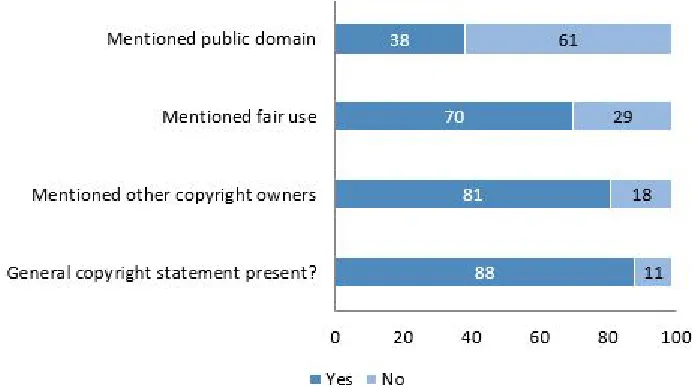
Out of 99 ARL special collections websites reviewed, 88 provided a general copyright policy statement (Figure 1). An overwhelming majority of 81 in some way mentioned the existence of other copyright owners besides the library. Seventy special collections mentioned fair use on their websites, while only 38 mentioned public domain.
Figure 1. Did the special collections website provide basic information about copyright? Left section “yes,” right section “no.”
Notably, 15 special collections that did mention fair use, or about 20%, included incorrect information. The most common fallacy (seven occurrences) was claiming a specific limitation on how much could be copied under fair use (examples include 10%, no multiple copies, not the entire work, 32 pages regardless of page length, and one chapter). Other incorrect information included the following:
• Statements that fair use is limited to personal use only/no commercial uses allowed (six).
• Claims that fair use does not apply to certain types of materials such as images, sculptures, etc. (one).
• Assertions that attribution is required (one).
Some policies included multiple fallacies in their fair use statements.
Although incorrect statements about other aspects of copyright were not among the initial categories, the authors attempted to track them and found at least seven. These included:
• Copyfraud: overly broad statements that say all works are copyrighted (four occurrences).
• Incorrect length of copyright term (one).
• Implication that authors/heirs do not own copyright if a work was not published (one).
Patron-Made Copies
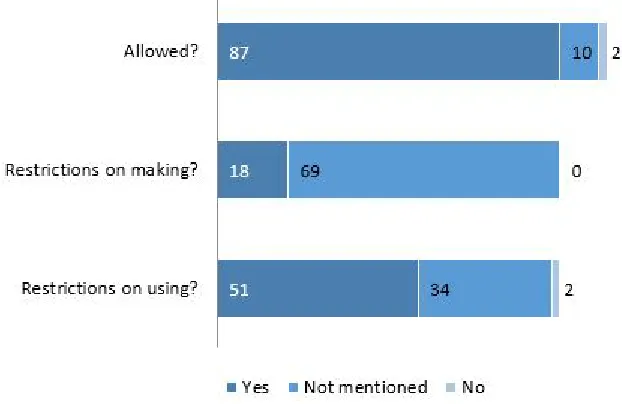
Most special collections presented a policy on copying done by patrons; these policies most often fell under the umbrella of “reading room policies.” Of all 99 websites surveyed, 87 explicitly allow patrons to make their own copies (Figure 2). Almost all of these policies were focused on digital camera use, and some indicated that in addition to personal digital cameras, patrons could make their own copies with a photocopier or scanner provided in the reading room (where mentioned, most policies did not allow patrons to bring their own scanners). Two special collections had posted policies stating that patrons were not allowed to make their own copies, including with digital cameras. Ten websites had no information on patrons making copies.
Figure 2. Does the special collections allow patrons to make their own copies and, if so, are there restrictions on making and using the copies? Left section “yes,” middle section “not mentioned,” and right section “no.”
Twenty-one percent of special collections that allowed patron-made copies placed some sort of restriction on the process of making those copies (18 with restrictions versus 69 without restrictions). The use of a watermark was the most common (nine occurrences), followed closely by the following:
• Restrictions on either the number of copies made or percentage of the work copied (eight).
• Charging a fee (two).
• Permission from the copyright holder to make copies (two).
It was far more common for special collections to restrict the use of patron-made copies. Of the 87 policies that allowed patron-made copies, 51 restricted the use of these copies, 45 did not mention restrictions, and three explicitly stated they do not restrict the use of patron-made copies. The prevailing stated restriction on use was to designate the patron-made copies as only for “personal” or “research use.”
Permission to Publish
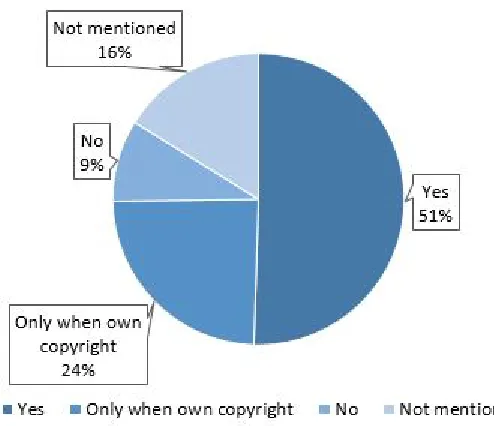
Fifty, or half of all ARL special collections websites reviewed, stated that their permission is always required for any publication (Figure 3). About a quarter of the websites, 24, only required their permission to publish when the special collection holds the copyright, and nine others explicitly stated their permission is not needed for
publication. Sixteen did not mention permission to publish at all (including the 11 websites with no general copyright policy posted). Some special collections expressed their requirement for permission through an acknowledgment form or a notice of intent to publish rather than calling it a permission form, but where those acknowledgments and intents are required, the effective result is the same and was counted as such. In only one instance did a special collection state that it requested but did not require
notification so it can keep abreast of the uses of its collections.
Figure 3. Does the special collection require patrons to ask for its permission if they want to use or publish a copy of an item from the collection?
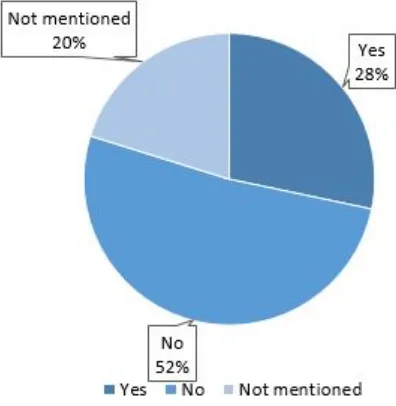
of all the sites reviewed indicated that permission from a third-party copyright holder might be but was not necessarily required to publish, leaving room for exceptions.
Figure 4. Does the special collection say that patrons must, with no exceptions, get permission from a third-party copyright owner to reuse a copy of an image from the collection?
While 46, or just under half of policies reviewed, did not impose additional requirements, 53 policies did state other requirements beyond permissions for patrons seeking to publish. Of the special collections that had some requirement:
• 26 required credit or attribution as the source special collection. • 21 required both attribution and a copy of the publication.
• 11 policies forbade alterations to images (this was always paired with at least one other requirement).
• 2 policies imposed dots per inch limits on potential publications.
• 2 demanded that any negatives created for publication remain the property of the special collection.
• 1 required patrons to agree not to give copies made for publication to other special collections.
Fees
On the commercial side of use fees, 30 special collections stated that they did charge use fees, and 24 stated that they might. Of these, 37 posted their commercial use fees online, while 17 did not. Eight stated that they did not charge use fees, and 37 did not mention commercial use fees.
Figure 5. Did the special collections charge fees for non-commercial and commercial uses? Left bar non-commercial, right bar commercial.
Figure 6. If the special collections charges fees, does it make those fees clear? Top bar commercial fees, lower bar non-commercial.
General Copyright Information
A vast majority of the special collections websites included some kind of copyright statement and mentioned other possible copyright owners. A majority mentioned fair use, but almost a third—30%—did not. It is important to note again that this study tracked only whether the phrase “fair use” was mentioned somewhere on a website, not the amount of information provided about it. Many of the sites that mentioned fair use did so briefly, with few providing more information about it.
While not mentioning fair use at all is concerning, providing incorrect information about it is even more so. Fair use is flexible, which allows it to be used in new and
unanticipated situations and with emerging technologies. To claim that fair use comes with exact restrictions, such as the amount of a work that can be copied or the type of materials to which it applies, prohibits patrons from creating new works and knowledge and is counter to the purpose of copyright law in the United States. The other incorrect statements about copyright can hinder creation in a similar manner.
The public domain proved to be the area where special collections provided the weakest information. This does not necessarily mean they are committing copyfraud, as it is possible that public domain status could be included in the metadata for individual items. However, the lack of information about public domain shows that most of the special collections included in this study are not broadly informing patrons about the possibility of public domain items in their collection. Furthermore, at least four did appear to commit copyfraud by making overly broad copyright ownership statements. Again, as noted with fair use, this study tracked only whether public domain was mentioned, not whether the website provided detailed information about it.
All but three of the websites that mentioned public domain also mentioned fair use, whereas those that did not mention fair use were less likely to mention public domain. However, nine (or 26%) of the sites that mentioned both fair use and public domain also included incorrect information about fair use.
Patron-Made Copies
Patron-made digital copies have clearly become common, with 87% of the policies surveyed allowing them, while requirements on how patrons could make those copies were in the minority. At the same time, a majority of those that allowed them did restrict how patrons could use these copies, most commonly by restricting them to personal use only. This goes beyond what special collections are required to do to protect themselves from liability in regards to patron-made copies; Sims (2016) has argued that
organizations can actually face increased liability when trying to control patron behavior too much.
Permissions and Fees
Although half of special collections required their permission to use works in their collections in any case, few if any claimed copyright as the reason for requiring the
necessary to access items, although what legal standings these policies would have was not studied. A third of policies either required permission only when they own the copyright (24) or not at all (nine). This shows progress in the relaxation of such requirements since Light’s informal count in 2015, which found 70% of the 125 US
research library special collections she studied still requiring permission in all situations. Requiring permission only when a special collections owns the copyright or not requiring permission at all aligns with copyright law and the values of the Society of American Archivists (SAA). At the same time, it remains rare for special collections to specifically allow for exceptions such as fair use, even among those that require permission only when they own copyright. Some contradictions of this new openness were also evident: six of the special collections that required permission only when they owned copyright to an item restricted the ways patrons can use patron-made copies, a requirement that appeared to conflict with their broader policy. Five that do not mention whether their permission is required also placed usage restrictions on patron-made copies.
Fees continue to be common, with almost half of the special collections reviewed (44) requiring or possibly requiring a fee for non-commercial use and just over half (54) requiring or possibly requiring one for commercial use. Most of the fees listed were by special collections that require their permission in all cases, but some that require permission only when they own the copyright may also charge fees. While this is within their right, it would help these special collections to consider how much they benefit from the fees versus how onerous they are to researchers. The existence of unstated fees is also concerning in that it opens the door for special collections to charge patrons differently, creating a potential ethical issue.
It is concerning that more than a quarter (28) of the special collections claimed that the copyright owner’s permission was required in any situation to publish an item. This requirement restricts fair use and free speech by possibly allowing copyright
owners to refuse publication if they do not like how their work is being used or to charge a fee the patron cannot afford. It is possible this requirement stems partially from the notion that archivists should bear responsibility for protecting an owner’s intellectual property (Somers, 2006). However, special collections should be interested in protecting the rights of both owners and users; they do a great disservice to their patrons if they give undue protection to the rights of owners, especially if these rights are not actually part of the law. Of these special collections websites, all but three also require their own permission to publish in any case, which inhibits fair use in a similar manner.
Although a majority (53%) of the websites mentioned other requirements for publishing, most of those requirements concern giving the special collections credit and providing a copy. While these do go beyond copyright law, they are less of a burden for researchers than some of the other requirements, such as not allowing alterations to images. The issue of altering images posed an interesting challenge for this study’s
the need for fair use. From a special collections’ perspective, image alterations could open the possibility that some people might accept an altered image as the original, which potentially distorts the historical record.
Proposed Best Practices
This study considered the following criteria to be the minimum best practices for copyright information provided on a special collections website:
• Include a general copyright statement. • Mention fair use and public domain.
• Ensure accuracy of information about fair use.
• Allow patron-made copies with no restrictions on making or using those copies. • Either require the special collection’s permission to use an item only when it owns
the copyright or do not require permission at all.
• Indicate that permission from other copyright holders might be necessary but not in all cases.
These should be seen as a starting point for special collections and not the ideal— more can be done than the recommendations above. For instance, special collections can provide thorough and meaningful information on fair use and public domain to help patrons understand what they are.
Just two special collection websites met all these criteria. Only one of those also did not charge any fees and specifically said it does not restrict the use of patron-made copies.
The study found 14 special collections met all but one of the criteria. Nine of these did not mention or specifically did not require any fees. In total, this means just 16% of the
websites studied either met or were close to meeting the best practices. It should be noted that because the study did not track the inaccuracies of public domain information separately from other generally incorrect copyright information, the authors were not able to filter libraries for this factor.
On the other end, three websites did not meet any of the criteria, and one site included just one of them, meaning all but 4% of the websites met at least two of the above measures. Thus, the majority of special collections policies surveyed, 80%, were somewhere in the middle. While it is unlikely that the professionals working at these institutions intended to create or enforce barriers, it is undeniable that improvements could be made with better understanding of copyright law and more comprehensive and intentionally worded policies.
Contradictory Information
Although it was not common in this study, contradictory information hindered the authors in deciding how to best categorize the websites. The most common type of
It is possible that some or even all of these examples occurred because parts of a website were not updated to reflect new, more progressive policies. However, it is likely that at least some researchers will err on the side of caution and ask for permission even if it is not actually needed. This can yet again needlessly hamper researchers’ work, especially if a special collections does not require permission or a fee.
On Sharing Copies with Other Institutions
Several policies stated that patrons may not give copies to other archives. This is likely due to the confusion, collection management, and authenticity problems it would cause to archivists, but the restriction is not actually rooted in copyright law. Hirtle, Hudson, and Kenyon explain: “A copy made for a patron under Section 108 is a legal copy of the copyrighted work, however. This means that all of the rights found in Section 109 that are available to the owner of a legal copy of a work are available to the patron who requested the copy from the library. This includes the right to give a copy of the work to another library or archives. Legally made copies, even in digital form, can be given to another institution by the patron of the first institution” (2009, pp. 122–123).
Thus, special collections may create policies that allow patrons to make copies on the condition that they will not gift the copy to another archive, but copyright law does not actually bar patrons from doing so, and, in fact, allows it.
Conclusion
It is an essential responsibility of special collections and archives to provide access to the materials they hold. Users in the digital age expect more access to more material, and archives professionals have put tremendous effort toward meeting those
expectations. Individual special collections have grappled with new processing
procedures and workflows, such as extensible processing, as the profession embraces new approaches to processing. However, the impact of decades of effort to provide access is dampened if copyright and use policies remain unclear or are more restrictive than the law requires. Archivists owe it to themselves, to their patrons, and to new knowledge creation to learn about copyright law as it applies to our holdings and to create and communicate clear policies when it comes to use of archives and manuscripts. Librarians who specialize in copyright could help archivists review their policies and consider progressive changes.
References
Anderson, R. (2014, August). Asserting rights we don’t have. Library Journal, 139(15), 12– 12. Retrieved from
https://www.libraryjournal.com/?detailStory=asserting-rights-we-dont-have-libraries-and-permission-to-publish-peer-to-peer-review Association of Research Libraries. (n.d.). Who we are [Webpage]. Retrieved from
http://www.arl.org/about#.W0ooLtJKg2x
Blackwell, A. H., & Blackwell, C. W. (2013). Hijacking shared heritage: Cultural artifacts and intellectual property rights. Chicago-Kent Journal of Intellectual Property, 13(1), 137–164. Retrieved from
https://scholarship.kentlaw.iit.edu/ckjip/vol13/iss1/6
Browar, L., Henderson, C., North, M., & Wenger, T. (2002). Licensing the use of special collections materials. RBM, 3(2), 124–143. https://doi.org/10.5860/rbm.3.2.211 Brown, M. A., & Crews, K. D. (2009, September). Control of museum art images: The reach
and limits of copyright and licensing. Paper presented at the Proceedings of the Annual Congress of the International Association for the Advancement of Teaching and Research in Intellectual Property, Vilnius, Lithuania. Retrieved from
https://papers.ssrn.com/abstract=1542070
Butler, K. C. (1998). Keeping the world safe from naked-chicks-in-art refrigerator
magnets: The plot to control art images in the public domain through copyrights in photographic and digital reproductions. Communications and Entertainment Law Journal, 21(1), 55–127.
Copyrights, 17 U.S.C. §§ 107–108 (2016.)
Crews, K. D. (2015). Museum policies and art images: Conflicting objectives and copyright overreaching symposium article. Fordham Intellectual Property, Media &
Entertainment Law Journal, 22(4), 795–834. Retrieved from https://ir.lawnet.fordham.edu/iplj/vol22/iss4/1/
Dryden, J. (2012). Cavalier or careful? How users approach the rights management practices of archival repositories. Journal of Archival Organization, 10(3–4), 191– 206. https://doi.org/10.1080/15332748.2012.787847
Dryden, J. (2016). Risky business? Issues in licensing copies of archival holdings.
Archivaria, 82(1), 111–136. Retrieved from https://muse.jhu.edu/article/687084 English, R., & Bridegam, W. (2017). A brief history of the Oberlin Group [Webpage].
Retrieved from http://www.oberlingroup.org/brief-history-oberlin-group
Hirtle, P. (2003). Archives or assets? The American Archivist, 66(2), 235–247. https://doi-org.unr.idm.oclc.org/10.17723/aarc.66.2.h0mn427675783n5l
Hirtle, P. (2009). Removing all restrictions: Cornell’s new policy on use of public domain reproductions. Research Library Issues, 266. Retrieved from
https://ecommons.cornell.edu/bitstream/handle/1813/14149/rli-266-cornell.pdf;sequence=2
http://blog.librarylaw.com/librarylaw/2014/07/arkansas-and-archival-permission-practices.html
Hirtle, P., Hudson, E., & Kenyon, A. (2009). Copyright and cultural institutions: Guidelines for digitization for U.S. libraries, archives, and museums [PDF version]. Retrieved from https://ecommons.cornell.edu/handle/1813/14142
Light, M. (2015). Controlling goods or promoting the public good: Choices for special collections in the marketplace. RBM, 16(1), 48–63.
https://doi.org/10.5860/rbm.16.1.435
Mazzone, J. (2006). CopyFraud. New York University Law Review, 81(3), 1026–1100. Miller, L., Galbraith, S. K., & Research Libraries Group Partnership Working Group on
Streamlining Photography and Scanning. (2010). “Capture and release”: Digital cameras in the reading room. Retrieved from
http://www.oclc.org/research/publications/library/2010/2010-05.pdf
Pappalardo, K., Aufderheide, P., Stevens, J., & Suzor, N. (2017). Imagination foregone: A qualitative study of the reuse practices of Australian creators. Brisbane: Australian Digital Alliance. Retrieved from: https://eprints.qut.edu.au/115940/2/QUT-print.pdf
Purdue University Libraries. (2019). What is a special collection? [Webpage]. Retrieved from http://guides.lib.purdue.edu/c.php?g=352889&p=2378065
Schlosser, M. (2009). Unless otherwise indicated: A survey of copyright statements on digital library collections. College & Research Libraries, 70(4), 371–285.
https://doi.org/10.5860/0700371
Schultz, T., & Miller, D. (2019). U.S. academic special collections websites and copyright information and policies [Data file and codebook]. Retrieved from
https://doi.org/10.17605/OSF.IO/X8MPB
Sims, N. (2016). We’re not the ©ops—copyright, “compliance” and communications [Blog post]. Retrieved from http://simsjd.com/copyrightlibn/2016/05/31/were-not-the-cops/
Society of American Archivists. (2011). SAA core values statement and code of ethics [Webpage]. Retrieved from https://www2.archivists.org/statements/saa-core-values-statement-and-code-of-ethics
Somers, N. S. (2006). An investigation into the digital scanning of photographs in archival collections (Doctoral thesis, Durban University of Technology, KwaZulu Natal, South Africa). Retrieved from http://ir.dut.ac.za/handle/10321/113
Stim, R. (n.d.). What is fair use? [Blog post]. Retrieved from