Exchange Rate Forecasting Using Non-linear Threshold
Models
Akintunde Mutairu Oyewale1,*, Chigozie Kelechi Acha2, Agunloye Oluokun Kasali3, Eriobu Nkiru Obioma4, Oyekunle Janet Olufunmike1, Abdulazeez Ismail Adeyinka1
1
Department of Statistics, School of Applied Sciences the Federal Polytechnic, Ede, Osun State, Nigeria 2
Michael Okpara University of Agriculture, Umudike, Abia State, Nigeria 3
Department of Mathematics, Faculty of Science Obafemi Awolowo University, Ile-Ife, Osun State, Nigeria 4
Department of Statistics, Faculty of Physical Science, Nnamdi Azikiwe University, Awka, Anambra State
Abstract
Foreign exchange is one of the most important financial instruments very volatile and chaotic in nature. Nowadays, the role of the foreign exchange market is becoming more and more important in the financial markets around the world; it remains the only instruments worldwide to measure the standard of living, Economic performance and country standing among the committee of nations. The foreign exchange market which is an over-the-counter market is used for the trading of currencies. It makes the foreign exchange market the largest and most liquid market among the financial markets. Necessary mathematical frame work was put in place, this was illustrated with data from record of Central Bank of Nigeria through their official website. Through this the performance of nonlinear threshold models in forecasting the exchange rate of Nigeria in relation to United States of American dollar as bench mark. The software used for the analysis was Econometrics View (E-view). Stationarity tests were carried out before the analysis, (the original data was not stationary, but at first difference it was stationary, thereafter comprehensive data analysis was performed). The forecasting results indicate that SETAR models did not outperform Random Walk in any period. TAR models offered promising results in the period. This study supports the general belief that the exchange rates are chaotic, volatile and very difficult to forecast and this applies to Exchange rate system of Nigeria as it is the case in the developed world.Keywords
Forecasting, Stationarity test, Exchange rate, Nonlinearity, SETAR, TAR1. Introduction
Foreign exchange is one of the most important financial instruments. Nowadays, the role of the foreign exchange market is becoming more and more important in the financial markets around the world. The foreign exchange market which is an over-the-counter market is used for the trading of currencies. The trading is happening 24 hours a day around the world and a great number of currencies is being transacted every hour. It makes the foreign exchange market the largest and most liquid market among the financial markets.
There are so many studies on exchange rate forecasting carried out worldwide. Until now, there are a lot of forecasting models, each having its point of strengths and weaknesses used in exchange rate forecasting, such study
* Corresponding author:
[email protected] (Akintunde Mutairu Oyewale) Published online at http://journal.sapub.org/ijps
Copyright©2019The Author(s).PublishedbyScientific&AcademicPublishing This work is licensed under the Creative Commons Attribution International License (CC BY). http://creativecommons.org/licenses/by/4.0/
include ARIMA model (Tseng, 2001), [19], Least Squared model [10] or Purchasing Power Parity model and [3]. [13] used ARIMA model for forecasting inflation in Irish, [14] used Arima model for forecasting stock price. ARIMA is also used for predicting stock price in the research of [12], [11]. It is also used for forecasting the price of gold [8].
According to [1] Triennial Survey, turnover in global foreign exchange markets averaged $5.1 trillion per day. This is down from $5.4 trillion in April 2013, a month which had seen heightened activity in Japanese yen against the background of monetary policy developments at that time. In addition, exchange rate movements are used to compare influence of the previous surveys on the current year. In particular, the appreciation of the US dollar between 2013 compared with 2016. When valued at constant (April 2016) exchange rates, turnover increased slightly, by about 4% between April 2016 and April 2013. Nevertheless, the latest developments contrast with the strong growth in turnover observed between Triennial Surveys since 2001.
provides the speculation and expedites the carry trade, in which there are substantial profits available. However, there
also exists high risk in the speculation.
Figure 1. Foreign Echange Market Turnover by Currency Pairs
The figure 1 above summarizes the exchange rate relative to some selected currencies in the world market.
2. Review of Relevant Literature
So many Empirical econometric modeling works in Agricultural Economics, finance and economic data assume that relationships are linear. Economic theory plays a passive role on this issue, and thus most applied research finds it convenient to assume linearity. In the 2000's, some researchers try to challenge the empirical theory ―the random walk model predicts the exchange rate best‖. They used different methods and chose different models. For examples, data from Central and Eastern European countries was used to compare the forecasting models in transition economies [2]. Intraday foreign exchange rates were used as observations [9]. They found that some sophisticated time series models such as the Markov regime-switching model have better performance than the random walk models under the condition of intensive time period. Thus, the empirical theory ―the random walk model predicts the exchange rate best‖ does not work well sometimes. The thought expressed began to change based on irregularities observed in economic and financial data, that non-linear specifications
is gradually becoming a more realistic representation of data generation processes. In finance, for instance, stock returns tend to be more correlated when there is low volatility than when volatility is high. A similar behavior has been observed in exchange rate mechanisms where the exchange rate may be constrained to lie within a pre-defined target zone [4]. To accommodate this kind of dynamic behavior using time series data, regime-switching models (RSM) have been introduced ([15] & [16]; [7]). Threshold autoregressive (TAR) model begins to be regularly appears in the agricultural economics literature as a model that is popularly used [18], and extensively discussed in Tong [17].
3. Mathematical Preliminaries of TAR
and SETAR Models
3.1. SETAR Models
The SETAR model is a convenient way to specify a TAR model because qt is defined simply as the dependent variable
t
y . In this case, the process can be formally written as
0,1 1,1 1 2,1 2 1,1 1 1
0,2 1,2 1 2,2 2 2,1 2 1
y
y
t t p t p t t
t
t t p t p t t
y y y if c
y
y y y if c
It is interesting to highlight that the estimation of SETAR models requires the application of least squares procedures only, more specifically, sequential conditional least squares. For the two-regime SETAR model, the steps can be outlined as follows:
Step 1: Set P1P2 P for simplicity and estimate the AR coefficients conditional on the value of the threshold (c).
Step 2: Calculate conditional residuals ˆt and estimated variances ˆt from the coefficients in step 1.
Step 3: Obtain least squares estimates of c by minimizing the residual variance ˆ
c over all possible values of the threshold coefficient c, that is,
2 ˆ arg minˆ
C c c
This minimization requires a direct search over the ordered values of yt [6] provides an approach free of nuisance parameters that are involved in estimation. Also note that in more complex models, the direct search may be over values of c and d, and thus, the estimate of the variance in Step 3 would be conditional on values of c and d (e.g., [6]).
Step 4: Obtain final estimates of ˆ and ˆ2 from results in Step 3.
The estimation of the threshold values in Step 3 requires that each regime contains enough observations for reliable estimation of the AR coefficients. About fifteen percent (15%) of the observations on each regime seems to work well.
3.2. TAR Models
1 1
2 1 1
0 0
i t t t
ut
t t t
u if
u if
If the above sequence is stationary, the least squares estimates of P1 and P2 have an asymptotic multivariate normal distribution. The process is formally specified as:
1 2 1
ut It i tu I It ut t
1
1
1 0
0 0
t
if u I
if u
4. Description and Data Anaysis
The exchange rate data used in the study was extracted from Central Bank of Nigeria Bulletin of 2017. The data was obtained for 1996 to 2018.
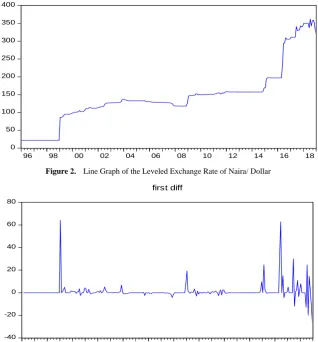
Figure 2. Line Graph of the Leveled Exchange Rate of Naira/ Dollar
Figure 3. Line Graph of the First Difference Exchange Rate of Naira/Dollar
0 50 100 150 200 250 300 350 400
96 98 00 02 04 06 08 10 12 14 16 18
ORIGINAL DATA
-40 -20 0 20 40 60 80
96 98 00 02 04 06 08 10 12 14 16 18
4.1. Identification of a Stationary Condition of the Series
The line graph of the series Figure 2 indicates the non-stationarity of the series. There is evidence of volatility as the values do not fluctuate around a constant mean. The first differences of the series were taken (figure 3) and the graphs seem to fluctuate around a constant mean of zero value.
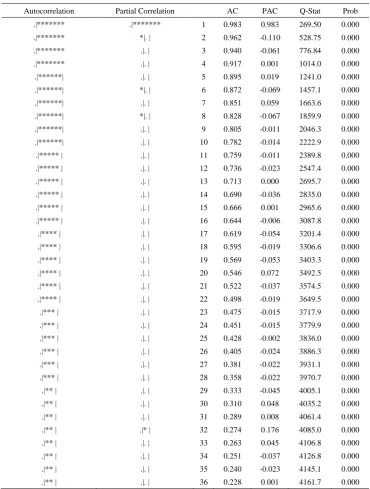
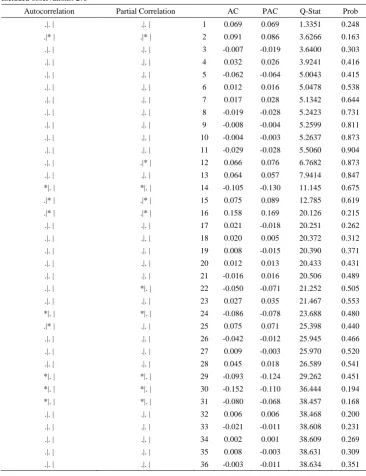
The results on the correlogram of the leveled for the series shows stronger evidence of non-stationarity since its autocorrelation coefficient function (ACF) of the residuals does not quickly decay to zero. On the other hand, the correlogram of the first difference shows that it is consistent with mean stationarity because most of the values promptly decay to zero. Tables 1 and 2 below show both the correlgrams for level and first difference.
Table 1. Correlogram for Level
Date: 11/10/19 Time: 17:20 Sample: 1996M01 2018M12 Included observations: 276
Autocorrelation Partial Correlation AC PAC Q-Stat Prob
.|******* .|******* 1 0.983 0.983 269.50 0.000
.|******* *|. | 2 0.962 -0.110 528.75 0.000
.|******* .|. | 3 0.940 -0.061 776.84 0.000
.|******* .|. | 4 0.917 0.001 1014.0 0.000
.|******| .|. | 5 0.895 0.019 1241.0 0.000
.|******| *|. | 6 0.872 -0.069 1457.1 0.000
.|******| .|. | 7 0.851 0.059 1663.6 0.000
.|******| *|. | 8 0.828 -0.067 1859.9 0.000
.|******| .|. | 9 0.805 -0.011 2046.3 0.000
.|******| .|. | 10 0.782 -0.014 2222.9 0.000
.|***** | .|. | 11 0.759 -0.011 2389.8 0.000
.|***** | .|. | 12 0.736 -0.023 2547.4 0.000
.|***** | .|. | 13 0.713 0.000 2695.7 0.000
.|***** | .|. | 14 0.690 -0.036 2835.0 0.000
.|***** | .|. | 15 0.666 0.001 2965.6 0.000
.|***** | .|. | 16 0.644 -0.006 3087.8 0.000
.|**** | .|. | 17 0.619 -0.054 3201.4 0.000
.|**** | .|. | 18 0.595 -0.019 3306.6 0.000
.|**** | .|. | 19 0.569 -0.053 3403.3 0.000
.|**** | .|. | 20 0.546 0.072 3492.5 0.000
.|**** | .|. | 21 0.522 -0.037 3574.5 0.000
.|**** | .|. | 22 0.498 -0.019 3649.5 0.000
.|*** | .|. | 23 0.475 -0.015 3717.9 0.000
.|*** | .|. | 24 0.451 -0.015 3779.9 0.000
.|*** | .|. | 25 0.428 -0.002 3836.0 0.000
.|*** | .|. | 26 0.405 -0.024 3886.3 0.000
.|*** | .|. | 27 0.381 -0.022 3931.1 0.000
.|*** | .|. | 28 0.358 -0.022 3970.7 0.000
.|** | .|. | 29 0.333 -0.045 4005.1 0.000
.|** | .|. | 30 0.310 0.048 4035.2 0.000
.|** | .|. | 31 0.289 0.008 4061.4 0.000
.|** | .|* | 32 0.274 0.176 4085.0 0.000
.|** | .|. | 33 0.263 0.045 4106.8 0.000
.|** | .|. | 34 0.251 -0.037 4126.8 0.000
.|** | .|. | 35 0.240 -0.023 4145.1 0.000
Table 2. Correlogram for First Difference
Date: 11/10/19 Time: 17:15 Sample: 1996M01 2018M12 Included observations: 275
Autocorrelation Partial Correlation AC PAC Q-Stat Prob
.|. | .|. | 1 0.069 0.069 1.3351 0.248
.|* | .|* | 2 0.091 0.086 3.6266 0.163
.|. | .|. | 3 -0.007 -0.019 3.6400 0.303
.|. | .|. | 4 0.032 0.026 3.9241 0.416
.|. | .|. | 5 -0.062 -0.064 5.0043 0.415
.|. | .|. | 6 0.012 0.016 5.0478 0.538
.|. | .|. | 7 0.017 0.028 5.1342 0.644
.|. | .|. | 8 -0.019 -0.028 5.2423 0.731
.|. | .|. | 9 -0.008 -0.004 5.2599 0.811
.|. | .|. | 10 -0.004 -0.003 5.2637 0.873
.|. | .|. | 11 -0.029 -0.028 5.5060 0.904
.|. | .|* | 12 0.066 0.076 6.7682 0.873
.|. | .|. | 13 0.064 0.057 7.9414 0.847
*|. | *|. | 14 -0.105 -0.130 11.145 0.675
.|* | .|* | 15 0.075 0.089 12.785 0.619
.|* | .|* | 16 0.158 0.169 20.126 0.215
.|. | .|. | 17 0.021 -0.018 20.251 0.262
.|. | .|. | 18 0.020 0.005 20.372 0.312
.|. | .|. | 19 0.008 -0.015 20.390 0.371
.|. | .|. | 20 0.012 0.013 20.433 0.431
.|. | .|. | 21 -0.016 0.016 20.506 0.489
.|. | *|. | 22 -0.050 -0.071 21.252 0.505
.|. | .|. | 23 0.027 0.035 21.467 0.553
*|. | *|. | 24 -0.086 -0.078 23.688 0.480
.|* | .|. | 25 0.075 0.071 25.398 0.440
.|. | .|. | 26 -0.042 -0.012 25.945 0.466
.|. | .|. | 27 0.009 -0.003 25.970 0.520
.|. | .|. | 28 0.045 0.018 26.589 0.541
*|. | *|. | 29 -0.093 -0.124 29.262 0.451
*|. | *|. | 30 -0.152 -0.110 36.444 0.194
*|. | *|. | 31 -0.080 -0.068 38.457 0.168
.|. | .|. | 32 0.006 0.006 38.468 0.200
.|. | .|. | 33 -0.021 -0.011 38.608 0.231
.|. | .|. | 34 0.002 0.001 38.609 0.269
.|. | .|. | 35 0.008 -0.003 38.631 0.309
.|. | .|. | 36 -0.003 -0.011 38.634 0.351
The stationary conditions of the series were formally verified by using Unit Root test (URT) for the leveled and first differences of the series. We tested for a unit root using the augmented Dickey-Fuller (ADF) statistic. At level, (table 3) all the series are not stationary but at first difference (table 4) all series appeared stationary as shown in the tables below:-
Table 3. Original Data
Null Hypothesis: VALUES has a unit root Exogenous: Constant
Lag Length: 0 (Automatic - based on SIC, maxlag=15)
t-Statistic Prob.*
Augmented Dickey-Fuller test statistic 0.117358 0.9666
Test critical values: 1% level -3.453997
5% level -2.871845
10% level -2.572334
Table 4. First Difference
Null Hypothesis: D(VALUES) has a unit root Exogenous: Constant
Lag Length: 0 (Automatic - based on SIC, maxlag=15)
t-Statistic Prob.*
Augmented Dickey-Fuller test statistic -14.89460 0.0000
Test critical values: 1% level -3.454085
5% level -2.871883
10% level -2.572354
*MacKinnon (1996) one-sided p-values.
4.2. Results of ARIMA Model Selection
To identify the appropriate model parameter of ARIMA (p, d, q), AIC is adopted. From the unit root test, we obtain d to be 1. As to parameters p and q, we run the regression through the combinations of from p = 1 to p = 10 and from
q = 1 to q = 10. For sake of saving space, we just list the top 10 with higher AIC values here. As shown in Table 5 below the model with the smallest value (9.14334) of AIC is the optimal ARIMA (6, 1, 9) chosen.
Table 5. Arima Model Results
RANK MODELS AIC
1 ARIMA ( 6,1, 9) 9.14340 2 ARIMA ( 9,1,7) 9.14403
3 ARIMA ( 9,1,9) 9.14545 4 ARIMA ( 9,1,6) 9.14505 5 ARIMA ( 8,1,9) 9.14871
6 ARIMA ( 10,1,9) 9.14879 7 ARIMA ( 6,1,6) 9.14978
8 ARIMA ( 9,1,8) 9.15125 9 ARIMA ( 6,1,5) 9.15178
10 ARIMA ( 6,1,10) 9.15368
4.3. Results of SETAR Model
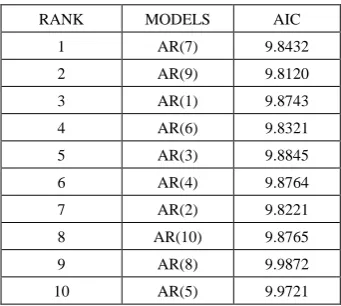
Table 6. Panel A Regime 1 Observations Included 764
RANK MODELS AIC
1 AR(7) 9.8432
2 AR(9) 9.8120
3 AR(1) 9.8743
4 AR(6) 9.8321
5 AR(3) 9.8845
6 AR(4) 9.8764
7 AR(2) 9.8221
8 AR(10) 9.8765
9 AR(8) 9.9872
10 AR(5) 9.9721
In our self-exciting threshold autoregressive (SETAR) model, we assume that a variable Naira is a linear autoregression within a regime. As there are two regimes in the study, the model could be written as SETAR (2, p, p).
Panel A (table 6) is regime 1 of the two-regime SETAR and panel B (table 7) is regime 2. We select the most appropriate model by minimizing value of AIC. We build up a two-regime SETAR model, SETAR (2, 7, 4).
Table 7. Panel B Regime 2 Observations Included 308
RANK MODELS AIC
1 AR(4) 9.0982
2 AR(10) 9.0021
3 AR(3) 9.0882
4 AR(9) 9.0071
5 AR(7) 9.0765
6 AR(4) 9.0974
7 AR(5) 9.0053
8 AR(1) 9.0642
9 AR(2) 9.0523
10 AR(6) 9.7432
4.4. Results Out-of-sample Forecasting Performance
In this section, we check out-of-sample forecast performance of the two models. By checking multi-criteria (MSE, MAE, AMPE, and MAPE) on ARIMA and SETAR, we can compare the residual of these two models. For the mean squared error (MSE), SETAR is smaller than ARIMA with 4479.28 and 5744.65. This means SETAR has a fewer errors in the standard of MSE. For the mean absolute error (MAE), the adjusted mean absolute property error (AMAPE) and mean absolute property error (MAPE), SETAR is also smaller than ARIMA with fewer errors. According to our result shown in the table 8 below, the SETAR model is better than the ARIMA model over the sample period (second regime).
Comparison of Forecasting Power.
Table 8. Comarison of Forecasting Power by Models
MSE MAE AMAPE(%) MAPE (%)
SETAR 4479.28 45.51 90.68 89.02
ARIMA 5744,65 58.32 304.20 190.91
5. Conclusions
has a stronger predicting power than ARIMA. The results also support previous assumptions of this thesis. Non-linear SETAR model is better than linear ARIMA model in Nigeria exchange rate market.
REFERENCES
[1] Bank for International Settlements 2016. Triennial Central Bank Survey of Foreign Exchange and Derivatives Market Activity in April 2010: Preliminary Global Results. Bank for International Settlement, September.
[2] Cuaresma, J. C., B. _Egert, & R. MacDonald (2005): \Non-linear exchangerate dynamics in target zones: A bumpy road towards a honeymoon."Working Paper 771, William Davidson Institute.
[3] David, H., Lee, J., & Takizawa, H. (2010). In which exchange rate models do forecastters trust?: IMF Working Paper. [4] Franses, P. H. and D van Dijk. Non-linear time series models
in empirical economics. NewYork, Cambridge University Press, 2000.
[5] Hansen, B. E. (1996): “Inference when a Nuisance Parameter is not Identified under the Null Hypothesis,” Econometrica, 64, 413-430.
[6] Hansen, B. E. (2000): “Sample Splitting and Threshold Estimation,” Econometrica, 68, 575-603.
[7] Granger, C. W. J., and Terasvirta, T. (1993): Modeling Nonlinear Economic Relationships, Oxford, U.K. Oxford University Press.
[8] Guha, B., & Bandyopadhyay, G. (2016). Gold Price Forecasting Using Arima Model. Journal of Advanced Management Science, Vol.4 (No.2).
[9] Hong, Y. and Lee, T.H., (2003). Inference on predictability of foreign exchange rates via generalized spectrum and non-linear time series models. Review of Economics and Statistics, 85, 1048-1062.
[10] Hongxing, L., Zhaoben, F., & Dongming, Z. (2007). GBP/USD Currency Exchange Rate Time Series Forecasting Using Regularized Least-Squares Regression Model. Proceeding of the World Congresson Engineering, Vol 2. [11] Isenah, G. M. O., Olusanya E. (2014). Forecasting Nigerian
Stock Market Returns Using ARIMA and Artificial Neural Network Models. CBN Journal of Applied Statistics, Vol.5 (No.2).
[12] Jarrett, J. E. K., Eric (2011). Arima modeling with intervention to forecast and analyze Chinese stock prices. International Journal of Engineering Business Management, Vol.3.
[13] Meyler, A., Kenny, G., & Quinn, T. (1998). Forecasting Irish Inflation Using Arima Model (Vol. Vol. 1998, pp. 1-48): Ireland: Central Bank and Financial Services.
[14] Mondal, P. S., Labani & Goswami, Saptarsi (2014). Study on Effectiveness of Time Series Modelling (Arima) in Forecasting Stock Prices. International Journal of Computer Science, Vol4 (No.2).
[15] Priestly, E. (1980) “Using Threshold Cointegration to Estimate Asymmetric Price Transmission in the Swiss Pork Market,” Applied Economics: 679-87.
[16] Priestly, E. (1988): “Threshold-Autoregressive, Median-Unbiased, and Cointegration Tests of Purchasing Power Parity,” International Journal of Forecasting, 14, 171-186.
[17] Tong, H. (1990) Threshold Models in Non-Linear Time Series Analysis. New York: Springer Verlag.
[18] Tong, H., & Lim, K. S. (1980). Threshold autoregressive, limit cycles and cyclical data. Journal of the Royal Statistical Society Series B, 42(3), 245–292.