Open Access
Research
A novel tool for individual haplotype inference using mixed data
Chen-Pang Lin
1and Cathy SJ Fann*
1,2Address: 1Institute of Public Health, National Yang-Ming University, Taipei, Taiwan and 2Institute of Biomedical Sciences, Academia Sinica, Taipei,
Taiwan
Email: Chen-Pang Lin - [email protected]; Cathy SJ Fann* - [email protected] * Corresponding author
Abstract
Background: In many studies, researchers may recruit samples consisting of independent trios and unrelated individuals. However, most of the currently available haplotype inference methods do not cope well with these kinds of mixed data sets.
Methods: We propose a general and simple methodology using a mixture of weighted multinomial (MIXMUL) approach that combines separate haplotype information from unrelated individuals and independent trios for haplotype inference to the individual level.
Results: The new MIXMUL procedure improves over existing methods in that it can accurately estimate haplotype frequencies from mixed data sets and output probable haplotype pairs in optimized reconstruction outcomes for all subjects that have contributed to estimation. Simulation results showed that this new MIXMUL procedure competes well with the EM-based method, i.e. FAMHAP, under a few assumed scenarios.
Conclusion: The results showed that MIXMUL can provide accurate estimates similar to those haplotype frequencies obtained from FAMHAP and output the probable haplotype pairs in the most optimal reconstruction outcome for all subjects that have contributed to estimation. If available data consist of combinations of unrelated individuals and independent trios, the MIXMUL procedure can be used to estimate the haplotype frequencies accurately and output the most likely reconstructed haplotype pairs of each subject in the estimation.
Background
Since the completion of the International HapMap Project, millions of single nucleotide polymorphisms (SNPs) and haplotype information have been deposited into public databases for studies in the fields of popula-tion genetics, evolupopula-tionary genetics, and complex disease gene mapping. Several studies have demonstrated that haplotypes can provide more power than single markers in detecting associations [1]. However, haplotype infor-mation cannot usually be obtained directly from unphased genotype data. It is possible to determine
hap-lotypes using molecular experimental techniques, but such approaches are still expensive and labor intensive. Therefore, haplotype determination from genotype data by statistical methods is used if the estimation is done accurately.
The population-based case-control design is a commonly used design in genetic association studies, in which unre-lated cases and controls are collected and compared with respect to the frequencies of some haplotypes. An advan-tage of this study design is that the implementation is very Published: 2 June 2009
Journal of Biomedical Science 2009, 16:52 doi:10.1186/1423-0127-16-52
Received: 23 February 2009 Accepted: 2 June 2009
This article is available from: http://www.jbiomedsci.com/content/16/1/52
© 2009 Lin and Fann; licensee BioMed Central Ltd.
convenient, since recruiting unrelated individuals is both time- and cost-effective.
One potential disadvantage for the population-based study is due to population stratification which may make an excess of false-positive results. To avoid a deceptive association confounded by population stratification, the family-based designs using relatives of the cases as con-trols have been proposed. The trio design is the simplest family design, where both parents of the affected subjects are included as family controls. When genotype data for parents are not available, such as in the study of late onset diseases, the unaffected siblings can be included instead. Recruitment, which is the primary disadvantage of family design, usually requires more resources in terms of time and money [2].
A few studies have drawn attention to the association study using both family-based and population-based con-trols [3,4]. One motivation for this type of study is the supplementation of case-parent trios with additional unrelated controls, if available, to ensure sufficient power to detect association, since parental controls may be hard to recruit, especially for late-onset diseases.
Several statistical and computational approaches have been developed for the inference of haplotype phase from genotype data of unrelated individuals or independent trios, but most programs cannot deal with family-based and population-based controls at the same time. Becker and Knapp [5] proposed a program FAMHAP, which cal-culates maximum likelihood estimates of haplotype fre-quencies from general nuclear families via the EM-algorithm. One feature of this program is the possibility of estimating haplotype frequencies from data sets consist-ing of a combination of unrelated individuals and nuclear families. Nevertheless, this program cannot output the most likely haplotypes pairs of each subject.
In this work, using a MIXture of weighted MULtinomial (MIXMUL) approach, a new procedure based on PHASE [6,7] is proposed for dealing with mixed data sets to esti-mate the haplotype frequencies and to reconstruct the most likely haplotype pairs of each subject contributed into estimation. We evaluated the MIXMUL procedure with respect to the accuracy of haplotype frequency esti-mation for the combination data sets. We also considered a few factors, including genotyping error and extent of linkage disequilibrium. The new MIXMUL procedure competes well with the likelihood-based method FAM-HAP of Becker & Knapp, which is also applicable to mixed data sets. While FAMHAP can only output haplotype fre-quency estimates, the MIXMUL procedure can further pro-vide a list of the most probable haplotype pairs for every subject in the mixed data sets.
Methods
MIXture of weighted MULtinomial (MIXMUL) approach
We assumed Hardy-Weinberg equilibrium for haplotypes in all subjects and throughout this study and considered a sample consisting of n1 unrelated individuals and n2 inde-pendent trios. For each subject in the mixed sample, we observed q SNPs with alleles 1 and 2 in a specific region of the genome, and Q possible haplotypes, with Q ≤ 2q. Let
H = H1, H2, 傼, HQ denote the Q possible haplotypes, and
a vector was used to describe the
unknown haplotype frequencies, with .
Assuming that the haplotypes from the n1 unrelated indi-viduals followed a multinomial distribution, the multino-mial distribution model was defined as
Let xi be the number of times that haplotype Hi occurs, and
the vector be the vector of counts for
all haplotypes, with being the total number of
haplotypes. Let αi be the mean haplotype frequency for
haplotype i, and be the vector of
hap-lotype frequencies.
Because only parents of each trio would contribute to the estimation, the haplotypes from the founders of the n2
independent trios also followed a multinomial distribu-tion defined as
Where βj is the mean haplotype frequency for haplotype j,
and is the vector of haplotype
fre-quencies. Let yi be the number of times haplotype Hi
occurs within the n2 trios, and the vector
be the vector of counts for all
haplo-types.
θ θ θ θ
~=( ,1 2,", Q)
θj j Q = =
∑
1 1P x n
xi i Q i x i Q i ( | ) ( )! ! . α = α = ∏
∏
= 2 1 1 1 "x=( ,x x1 2, ,xQ)
xi n
i Q =
∑
= 1 1 2 α α α α~ =( 1, 2,", Q)
P x n
x j j Q j x j Q j ( | ) ( )! ! , β = β = ∏
∏
= 4 2 1 1 "β =(β β1, 2, ,βQ)
"
With a weight parameter λ, we combined these two sets of haplotype frequencies, and . Thus, the distribution
specified by the mixture of weighted multinomial model is
where zi is the total number of times haplotype Hi occurs,
and the vector is the vector of counts
for all haplotypes. Thus, we obtained zi as the sum of the number of times that haplotype Hi occurs in n1 unrelated individuals and n2 independent trios i.e. zi = xi + yi. Clearly, the multinomial with haplotype frequency vector
specified the same distribution [8].
Simulation study
We examined the performance of the proposed MIXMUL procedure via simulation studies. The simulations were conducted under settings where the combining of the data is suitable. We generated three dense multi-locus geno-type data sets using the program SNaP [9] based on the different haplotype frequency distributions provided from three authentic data sets. The first simulated data set was based on the five SNPs within the N-acetyltransferase 2 gene (NAT2) described by Xu et al [10]. The haplotype frequencies of the five SNPs were over the 850-bp frag-ment of NAT2 sequenced from each of the 81 individuals to resolve the haplotypes for both chromosomes of each individual. The second simulated data set was the eight SNP haplotype frequencies within the gene ARHGDIB on chromosome 12, which were identified from 44 unrelated individuals [11]. The third haplotype frequency distribu-tion was based on the ten SNPs from the original Oxford ACE data described by Zhang et al [12]. The ACE data set contained genotypes of 666 individuals with ten SNPs in strong linkage disequilibrium (LD), spanning a very short region (26 kb) within the gene ACE.
First, we used PHASE to obtain the count of each haplo-type in the "best" reconstruction for the unrelated
individ-uals, i.e. . Then we could obtain an
estimated haplotype frequency vector
by . Separately, we used
PHASE to obtain the count of each haplotype for the inde-pendent trios to form the vector of counts for all
haplo-types in these trio families, . A vector of
estimated haplotype frequencies can
be obtained by . We then used our proposed
MIXMUL procedure to calculate the estimated mixture
haplotype frequency vector as
The weight parameter λwas estimated by the maximum
likelihood method to obtain the estimator . Given a
weight parameter estimate of , a set of estimated haplo-type frequencies were obtained by MIXMUL. Based on the set of estimated frequencies for the mixed data set, the MIXMUL procedure can further output the best recon-structed haplotype pairs of each subject contributed into estimation.
Comparing MIXMUL with FAMHAP
The MIXMUL procedure was developed to deal with mixed data sets consisting of unrelated individuals and independent trios for haplotype frequency estimation and haplotype inference. Using the MIXMUL approach, the
weight parameter was obtained by maximizing the likelihood function of a mixture of two independent multinomial distributions in order to perform haplotype frequency estimation for the mixed data sets. We exam-ined the accuracy for haplotype frequency estimation of the proposed MIXMUL procedure and compared the per-formance with that of the EM-based FAMHAP proposed by Becker & Knapp, which can also estimate haplotype fre-quencies for mixed data sets. We set the mixed data sets consisting of 20 unrelated individuals and 5, 10, 15, 20, 25, or 30 independent trios, respectively. Because only parents of each trio would contribute to the estimation, these combinations correspond to a total number of sub-jects in estimation of 30, 40, 50, 60, 70, and 80, respec-tively.
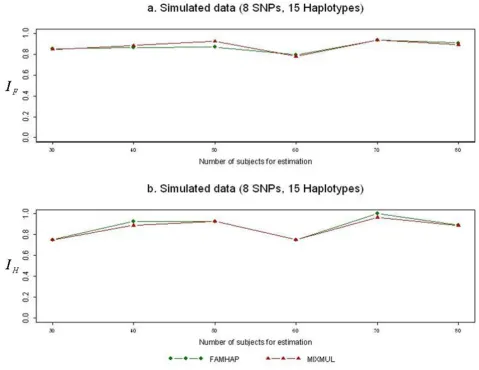
To evaluate the performance of MIXMUL and FAMHAP in the presence of genotyping error, we used the ARHGDIB data to generate the simulated data in the existence of gen-otyping error at the levels of the 0.025, 0.05, and 0.1. The error rates range from 0.025 to 0.1 as suggested by Tintle et al. [13] and Cheng and Lin [14]. To assess the perform-ance of MIXMUL with weak LD extent, we simulated a data set based on eight SNPs with 15 equally frequent haplotypes and average D' = 0.3782 for comparing with FAMHAP. On the other hand, we used the ARHGDIB data
α
β
P z i i z
i Q i ( | , , ) [( ) ] , λ α β ∝ −λ α +λβ =
∏
1 1 "z=( ,z z1 2, ,zQ)
(1−λ α λβ) +
"
x=( ,x x1 2, ,xQ)
ˆ ( ˆ , ˆ , , ˆ )
"
α = α α1 2 αQ αˆi xi
xi i Q = = ∑ 1 "
y=( ,y y1 2, ,yQ)
ˆ ( ˆ , ˆ , , ˆ )
"
β = β β1 2 βQ ˆ
βi yi yi i Q = = ∑ 1 ˆ ( ˆ , ˆ , , ˆ ) "
θ = θ θ1 2 θQ
ˆ ˆ ( ) ˆ.
θ λα= + −1 λ β
(average D' = 0.9051) and simulated 30 unrelated indi-viduals and 10 independent trios, respectively, to evaluate the estimation accuracy of rare haplotype frequencies (haplotype frequency < 10%) contingent on the same number of subjects utilized.
Measurement of accuracy
To evaluate the quality of haplotype frequency estima-tion, the indices IF and IH proposed by Excoffier and Slat-kin [15] were used. The first was a similarity measure IF
which describes how close the estimated haplotype fre-quencies are to the actual frefre-quencies and is defined as one minus half of the sum of absolute differences between the true and estimated haplotype frequencies, i.e.,
where is the estimated frequency of the i-th haplotype, and θi is the true haplotype frequency. IF ranges between 0 and 1 (a value of 1 indicates that the actual and estimated frequencies are identical).
Another measurement IH was used to quantify the effec-tiveness of computational algorithms for haplotype reconstruction. IH compares the number of haplotypes in a sample and the number of haplotypes detected by an algorithm. In a sample with N subjects, the minimum fre-quency of every true haplotype has to be greater than or
equal to , which could be used as a lower bound
threshold value for determining the existence of a haplo-type. Based on this,
where ktrue is the number of true haplotypes, kfound is the number of identified haplotypes with frequencies above the threshold value, and kmissed is the number of true hap-lotypes not identified. The measure IH also varies between 0 (when none of the true haplotypes is identified) and 1 (when the haplotypes identified are exactly the same as the true haplotypes).
Results
The plots in Figure 1 show accuracy comparison of haplo-type frequency estimations between MIXMUL and FAM-HAP using NAT2 data (panels a and b), ARHGDIB data (panels c and d), and ACE data (panels e and f). Com-pared to the EM-based program FAMHAP, results were consistent with the notion that MIXMUL has comparable
accuracy for haplotype frequency estimation with FAM-HAP. Moreover, MIXMUL can output the most likely reconstructed haplotype pairs for every subject into esti-mation, while FAMHAP only output overall estimated haplotype frequencies.
It is known that genotyping error can severely affect the performance of haplotype frequency estimation algo-rithms. Because these results were similar for each level of the genotyping error rate, Figure 2 only shows the results for genotyping error rate of 0.05. They indicated that in most cases, the accuracy using MIXMUL was slightly better than that obtained from using FAMHAP.
The extent of linkage disequilibrium (LD) between SNP markers also has an important effect on haplotype-infer-ence accuracy. We evaluated the performance of MIXMUL under a scenario of weak LD extent. Plots of the accuracy measures for the simulated data set were shown in Figure 3. It can be seen that MIXMUL performed well with FAM-HAP even when the LD extent was weak.
Most haplotype inference methods can estimate common haplotypes (haplotype frequency > 10%) very accurately when the LD content across the constituent loci is strong, but the performances were lower in estimating rare haplo-types (haplotype frequency <10%). Thus, we used the ARHGDIB data and focused on the estimation accuracy of rare haplotype frequencies contingent on the same number of subjects utilized. Our results showed that the measure IF of 30 unrelated individuals and 10 independ-ent trios were 0.9217 and 0.9720, respectively. Indeed, for rare haplotypes inference, taking family information into account will increase the frequency estimation accuracy.
Discussion
Haplotype inference for a large number of tightly linked markers through close relatives has drawn much attention in recent years. Several novel methods and programs have been developed. However, it's likely that researchers col-lected samples consisting of independent trios and unre-lated individuals. The MIXMUL procedure proposed here can be conveniently and efficiently utilized to deal with such data sets for haplotype inference. The MIXMUL pro-cedure will also output the most likely reconstructed hap-lotype pairs of each subject contributed into the estimation.
The current version of the PHASE program (version 2.1) can reconstruct haplotypes from population-based or trio-based genotype data respectively, but it cannot handle mixed data sets consisting of both. On the other hand, the FAMHAP program is able to deal with mixed data sets, however, this program does not provide haplotype infer-ence to the individual level; it only provides overall
hap-IF i i
i Q
= − −
=
∑
1 1
2
1
ˆ ,
θ θ
ˆ θi
1 2N
I ktrue kmissed ktrue k found
H = +−
1( )
lotype frequencies. Based on the outputs of the PHASE program, we proposed the MIXMUL procedure that deals with mixed data sets and infer most probable haplotypes to the individual level by using a weighted function.
Becker and Knapp proposed a program FAMHAP, which calculates maximum likelihood estimates of haplotype frequencies from general nuclear families with an arbi-trary number of children via the EM-algorithm. This pro-gram can estimate haplotype frequencies from data sets consisting of a combination of unrelated individuals and nuclear families. However, in our simulation, we com-pared some factors that would affect haplotype frequency estimation, including number of SNP markers, genotyp-ing error rates, and extent of LD. On the basis of our
results, the accuracy of haplotype frequency estimation for MIXMUL competes well with FAMHAP when considering all these factors. Furthermore, MIXMUL can provide not only the accurate haplotype frequency estimates, but also the most likely reconstructed haplotype pairs of each sub-ject.
As suggested by other studies [5,16,17], including family information improved the accuracy of haplotype estima-tion. We examined whether adding families to unrelated individual data could improve the accuracy of haplotype frequency estimation by using MIXMUL. On the basis of our results, the accuracy of haplotype frequency estima-tion by MIXMUL showed that taking family informaestima-tion or partial family information into account did improve
Performance comparisons of MIXMUL and FAMHAP Figure 1
the accuracy of haplotype frequency estimation. However, the accuracy of using more than 60 unrelated individuals for haplotype inference was almost the same as those from using trio or mixed data.
A systematic approach was not used in this study to address the issues because the true haplotype frequencies (derived from experiments) were more suitable for com-parison purposes with inferred haplotype frequencies using IF and IH calculated from MIXMUL and FAMHAP. Thus, we selected three published data sets available online where the true haplotype frequencies were derived from experiments. We carried out simulations based on these known frequencies and the number of SNPs ranged from 5 ~10 with linkage disequilibrium coefficient (D') ranged from 0.8522 ~0.9341. The levels of genotyping error rates were 0.025, 0.05 and 0.1 as suggested by other
studies [13,14]. By using this approach, we obtained approximate information about the impact of these fac-tors in assessing accuracy in comparison between MIX-MUL and FAMHAP.
Incomplete trios (1 parent, one child) in mixed data sets can be analyzed by MIXMUL by setting one parent in a trio as missing. We used the ARHGDIB data to conduct 100 simulations to evaluate the impact of using incom-plete trios. The results showed that when using only incomplete trios in the mixed data sets, the accuracy of haplotype frequencies estimation was lower than that obtained from using complete trios (2 parents, one child) because the degree of family information was deficient. For example, given 10 unrelated individuals and 5 incom-plete trios, IF was 0.769 and it was 0.825 if these trios were complete. IH was 0.805 for the former and 0.825 for the
Performance comparison when genotyping error rate is 0.05 Figure 2
later. Given 5 unrelated individuals and 40 incomplete trios, IF was 0.925 and it was 0.958 if these trios were com-plete; IH was 0.928 for the former and 0.985 for the later. The differences of accuracy measurements between using incomplete and complete trios were smaller when the number of subjects used in estimation increased.
Conclusion
Haplotypes capture LD information in chromosomal regions descended from ancestral chromosomes. Such information is of considerable interest in population genetics and genetic epidemiology studies. With wide-spread applications of new generations of genotyping techniques, especially high-density SNP arrays, the human genome will eventually be unlocked by linking haplotype information to biomarker and phenotypic data. In current association studies, it is likely that
researchers may recruit mixed samples consisting of inde-pendent trios and unrelated individuals. However, most existing methods for haplotype inference and frequency estimation cannot cope with these kinds of mixed data sets. Although the EM-based FAMHAP of Becker & Knapp can deal with such kind of data, it cannot reconstruct the haplotype pairs of the individual level. Therefore, in this study we developed the MIXMUL procedure based on the program PHASE to deal with mixed data sets. According to our results, MIXMUL can provide accurate estimates for haplotype frequencies as FAMHAP and further output the probable haplotype pairs in the most optimal reconstruc-tion outcome for every subject that have contributed to estimation. If available data consist of combinations of unrelated individuals and independent trios, the pro-posed MIXMUL procedure can be used to perform haplo-type frequency estimation to obtain accurate haplohaplo-type
Performance comparison when LD extent is weak Figure 3
Publish with BioMed Central and every scientist can read your work free of charge
"BioMed Central will be the most significant development for disseminating the results of biomedical researc h in our lifetime."
Sir Paul Nurse, Cancer Research UK
Your research papers will be:
available free of charge to the entire biomedical community
peer reviewed and published immediately upon acceptance
cited in PubMed and archived on PubMed Central
yours — you keep the copyright
Submit your manuscript here:
http://www.biomedcentral.com/info/publishing_adv.asp
BioMedcentral frequency estimates in the mixed sample as well as to
out-put the most likely reconstructed haplotype pairs of each subject into the estimation for further haplotype level association analysis. The MIXMUL procedure is available for download from http://www.csj fann.ibms.sinica.edu.tw/EAG/program/programlist.htm
Competing interests
The authors declare that they have no competing interests.
Authors' contributions
CL carried out this study and drafted the manuscript. CSJF conceived of the study, and participated in its design and coordination and helped to draft the manuscript. All authors read and approved the final manuscript.
Acknowledgements
This project was partially funded by two grants from the Taiwan National Science Council (NSC 94-2314-B-001-009 and NSC 96-2628-B-001-015-MY2).
References
1. Browning BL, Browning SR: Efficient multilocus association mapping for whole genome association studies using local-ized haplotype clustering. Genet Epidemiol 2007, 31:365-375. 2. Laird NM, Lange C: Family-based designs in the age of
large-scale gene-association studies. Nat Rev Genet 2006,
7(5):385-394.
3. Nagelkerke NJ, Hoebee B, Teunis P, Kimman TG: Combining the transmission disequilibrium test and case-control methodol-ogy using generalized logistic regression. Eur J Hum Genet 2004,
12(11):964-70.
4. Kazeem GR, Farrall M: Integrating case-control and TDT stud-ies. Ann Hum Genet 2005, 69:329-35.
5. Becker T, Knapp M: Maximum-likelihood estimation of haplo-type frequencies in nuclear families. Genet Epidemiol 2004,
27:21-32.
6. Stephens M, Smith NJ, Donnelly P: A new statistical method for haplotype reconstruction from population data. Am J Hum Genet 2001, 68:978-989.
7. Stephens M, Scheet P: Accounting for decay of linkage disequi-librium in haplotype inference and missing data imputation.
Am J Hum Genet 2005, 76:449-462.
8. Yantis S, Meyer DE, Smith JE: Analyses of multinomial mixture distributions: new tests for stochastic of cognition and action. Psychol Bull 1991, 110(2):350-374.
9. Nothnagel M: Simulation of LD block-structured SNP haplo-type data and its use for the analysis of case-control data by supervised learning methods. Am J Hum Genet 2002, 71(Suppl 4):A2363.
10. Xu CF, Lewis K, Cantone KL, Khan P, Donnelly C, White N, Crocker N, Boyd PR, Zaykin DV, Purvis IJ: Effectiveness of computational methods in haplotype prediction. Hum Genet 2002,
110:148-156.
11. Reich DE, Cargill M, Bolk S, Ireland J, Sabeti PC, Richter DJ, Lavery T, Kouyoumjian R, Farhadian SF, Ward R, Lander ES: Linkage disequi-librium in the human genome. Nature 2001, 411:199-204. 12. Zhang K, Zhao H: A comparison of several methods for
haplo-type frequency estimation and haplohaplo-type reconstruction for tightly linked markers from general pedigrees. Genet Epide-miol. 2006, 30(5):423-437.
13. Tintle NL, Ahn K, Mendell NR, Gordon D, Finch SJ: Characteristics of replicated single-nucleotide polymorphism genotypes from COGA: Affymetrix and Center for Inherited Disease Research. BMC Genet 2005, 30(6 Suppl 1):S154.
14. Cheng KF, Lin WJ: Simultaneously correcting for population stratification and for genotyping error in case-control associ-ation studies. Am J Hum Genet 2007, 81(4):726-43.
15. Excoffier L, Slatkin M: Maximum-likelihood estimation of molecular haplotype frequencies in a diploid population. Mol Biol Evol 1995, 12:921-927.
16. Becker T, Knapp M: Efficiency of haplotype frequency estima-tion when nuclear family informaestima-tion is included. Hum Hered 2002, 54:45-53.