A b s t r a c t. A research was carried out into the extrusion process of corn semolina and oat bran mixtures with single- and twin-screw extrusion-cooking. The effect of an extruder used, of the concentration of oat bran, of the moisture content of raw material, and of the barrel temperature profile on the course of the process and physical properties of the extrudates was investigated. Attention was paid to relationships between radial expansion, specific density and microstructure of the product. The research indicated that at the oat bran concentration of up to 20%, the extrudate demonstrates cellular structure, low density and excep-tionally high expansion. With oat bran concentration reaching 20-30%, the cellular structure of the extrudate disappears, however it is still compact. Higher proportions of oat bran (over 30%) definitely exclude the cellular structure of the extrudate which takes the form of crumble. Subsequent increase in oat bran concentration, over 60%, leads to a product of more loose structure with semolina-like microstructure. Wide ranges of raw material moisture content and process temperature enabled obtaining a compact product with the oat bran concentration over 30%. Thus, the product’s quality is determined by its microstructure which in this case depends on concentrations of lipids and dietary fibre. A com-parative analysis of yellow lupine var. Topaz also indicated that, despite a high content of protein, microstructure of the product is determined by the concentration of lipids. Such a remarkable impact of lipids is observed regardless of their extensive binding in the extrusion process, the samples examined demonstrated even 60% of bound lipids.
K e y w o r d s: microstructure, physical properties, extrudate, cereals, extrusion-cooking
INTRODUCTION
Civilisational progress of the XX century brought about not only remarkable technological advance but also a variety of health problems. Changes of nutritional and dietary habits, an increased intake of food of animal origin, and constant stress triggered an epidemic of the so-called
‘civilization diseases’. Cardiovascular diseases, cancer, diabetes and obesity are the main assassins of modern populations of the developed North (Aldoori et al., 1997; Rowland, 2001; Kritchevsky, 2001; Burkitt, 1995). The turn of the millennia has posed great challenges to food technologists, since designing food products that would minimise the effects of the civilisation diseases has become a necessity. High-fibre foods, rich in soluble fractions of dietary fibre and biologically-active compounds, serve this purpose well (Gibney, 2001). Their most valuable compo-nent is oat and its products. Nevertheless, introduction of oat components into food products has been encountering multiple difficulties (Rzedzicki, 1999; Rzedzicki et al., 2000). A high lipid content hinders technological processing (Rzedzicki and Fornal, 1998), especially at the production of breakfast cereals. The effect of oat component concentration on the physical properties of extrudates and the role of microstructure in modelling their properties were therefore explored in this study.
MATERIALS AND METHODS
The experimental material used included: commer-cially-available maize semolina, oat bran originating from dehulled oat, and meal of yellow lupine var. Topaz. Chemical composition of the raw materials and fractional composition of dietary fibre are presented in Table 1. Mixtures were prepared from the above-mentioned raw materials according to the experimental models elaborated, presented in Table 2. The mixtures were adjusted to a re-quired moisture content, mixed in a drum mixer, and conditioned for 12 h to provide uniform water diffusion in the raw material.
Int. Agrophysics, 2005, 19, 175-186
Impact of microstructure in modelling physical properties of cereal extrudates
Z. Rzedzicki
1* and W. B³aszczak
21Department for the Design of Production Processes, University of Agriculture, Skromna 8, 20-704 Lublin, Poland 2
Institute of Animal Reproduction and Food Research, Polish Academy of Sciences, Tuwima 10, 10-747 Olsztyn, Poland
Received April 23, 2004; accepted October15, 2004
© 2005 Institute of Agrophysics, Polish Academy of Sciences *Corresponding author’s e-mail: [email protected]
I I
INNNTTTEEERRRNNNAATATTIIIOOONNNAAALLL A
A
Agggrrroooppphhyhyysssiiicccsss w
w
The extrusion process was carried out in an S-45 single-screw extrusion-cooker and a 2S 9-5 twin-screw extrusion-cooker made by Metalchem Gliwice. The later comprised two counter-rotating conical screws with a rota-tion speed of 72 r.p.m. The process parameters were chosen according to model of experiments presented in Table 2. The extrusion die size was 3.2 and 6 mm. The variable parame-ters of the twin-screw extrusion-cooking included: moisture content in the range of 15-33% and process temperature in the range of 120-220°C. Raw materials and extrudates were subjected to chemical analysis: crude protein (AACC, Method 46-08), crude fat (AACC, Method 30-10), ash (AACC, Method 08-01), crude fiber (AACC, Method 32-10). From differences of the above, N-free extract was calculated. In raw materials and in extrudates changes in dietary fiber fractions due to extrusion cooking were also analyzed. The detergent method of Van Soest (1963a,b) was applied. According to these methods the following were analyzed: neutral detergent fiber (NDF), acid detergent fiber (ADF), acid detergent lignin (ADL), cellulose (CEL) and hemicelluloses (HCEL).
The extrudates obtained were examined for their major physical properties,iethe radial expansion ratio and specific density (Rzedzicki, 1999). Further analyses were performed into the effect of the variable process parameters and raw material characteristics of the macro- and microstructure of the products obtained. Microstructural analyses were carried out on the most representative extrudates of each sample. Fragments of extrudates were cut off, pasted on the preparation blocks with silver paste, then coated with carbon and gold in a JEOL JEE 4X vacuum sputter. Analyses of microstructure were carried out with a JSM 5200 scanning microscope at the Institute of Animal Reproduction and Food Research of the Polish Academy of Sciences in Olsztyn, using accelerating voltage of 10 KV.
RESULTS AND DISCUSSION Single screw extrusion
In moderate amounts, oat components may be used in the production of extrudates even with single-screw extrusion-cooking. With highly-experienced extruder operators, the concentration of the oat component (oat meal,
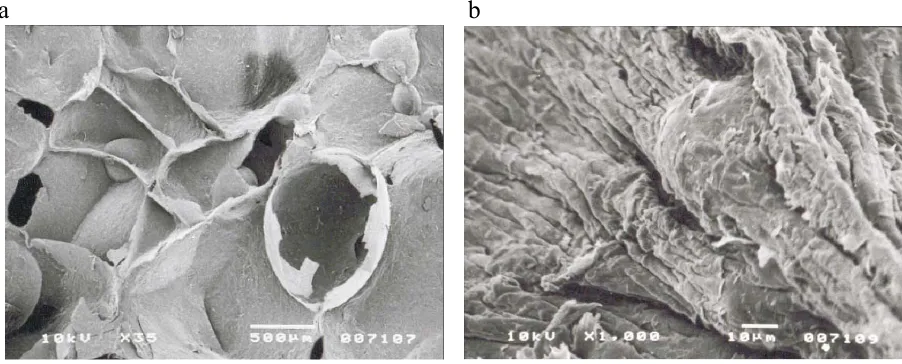
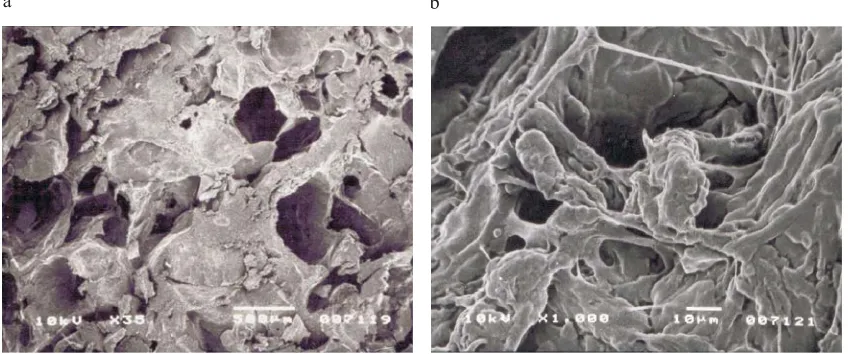
oat bran) may reach even up to 20%. With little-experienced staff, the oat components may be easily introduced at a level approximating 10%. Such extrudates, with 9% oat bran con-tent, are characterised by very low density ofca. 50 kg m-3 and excellent radial expansion (Rzedzicki, 1999; Rzedzicki et al., 2000). Such a low density and very good expansion result from the product’s microstructure formed (Figs 1 and 2). These products demonstrate a typical structure of a ‘honey comb’, visible in photos at x35 magnification (Figs 1a and 2a). Walls of the air cells display laminar structure and are made of flat fragmentsca.1mm thick, which is perfectly visible at x1000 magnification (Figs 1b and 2b). On the other hand, those products are devoid of small air pores typical of other cereal extrudates. It may be assumed that the specific structure of oat extrudates results from the activity of oat lipids and 1-3, 1-4 g-D-glucans present in oat bran; fortunately, at this mixture composition their rate and their influence are low. A careful analysis of microscopic pictures of the extrudates (Figs 1a,b and 2a,b) confirms the significant impact of process temperature on the product structure. An increase in extrusion temperature from 120°C (Fig. 1b) to 180°C (Fig. 2b) results in visible unfolding of the folded structures of air cell walls. Extrudates obtained at higher process temperatures demonstrate typical walls of the air cells built of thin ‘hulls’ merged together (Fig. 2b). Hence, the structure of those products attains a fragile and very crisp character determining excellent physical properties, including low density and remarkable crispness. Air pores demonstrate regular oval shapes and their size approximates 1000mm. Similar results for cereal extrudates have also been reported by Cohenet al. (1987), Colonaet al. (1989), and Salgoet al. (1989) and Smith (1992).
Twin screw extrusion – influence of bran rate
The processing of mixtures with oat bran concentration exceeding 20% requires the application of a twin-screw extruder. The extrudates obtained in a 2S 9-5 extruder are characterised by diverse forms and structures and extremely different physical properties compared to the extrudates presented in Figs 1 and 2, depending on the oat component content, process parameters applied, and as a result of such factors as chemical composition of the extrudate and particularly the fractional composition of dietary fibre Raw material
N-free extract
Protein Fat Ash Crude
fibre
NDF ADF HCEL CEL ADL
(% d.b.)
Maize semolina Oat bran Lupine meal
86.01 68.68 30.50
11.11 16.96 44.37
1.01 7.94 4.27
1.32 3.54 4.72
0.45 2.88 16.14
3.62 18.11 26.43
0.83 3.37 21.14
2.79 14.74 5.29
0.66 1.48 19.76
0.17 1.89 1.47
No. sample Rate (%) Moisture (%) Temp.* (°C) Die diam. (mm) N-free extract Protein Total fat Free fat Ash Crude fibre
NDF ADF HCEL CEL ADL
Maize semolina Oat bran (% d.b.) 1 2 3 4 5 6 7 8 9 10 11 12 13 14 15 16 17 18 19 20 21 80 70 60 50 40 30 20 70 70 70 70 70 70 70 70 70 70 70 70 70 70 20 30 40 50 60 70 80 30 30 30 30 30 30 30 30 30 30 30 30 30 30 15 15 15 15 15 15 15 15 18 21 24 27 30 33 36 24 24 24 24 24 24 180 180 180 180 180 180 180 180 180 180 180 180 180 180 180 120 140 160 180 200 220 3.2 3.2 3.2 3.2 3.2 3.2 3.2 3.2 3.2 3.2 3.2 3.2 3.2 3.2 3.2 3.2 3.2 3.2 3.2 3.2 3.2 82.69 81.08 79.11 78.22 77.08 75.25 73.78 81.08 81.84 81.68 82.26 81.52 81.42 81.58 82.12 81.58 81.89 81.83 81.36 81.83 81.72 12.72 13.41 14.32 14.28 14.51 15.32 15.79 13.41 12.56 12.61 12.13 12.62 12.80 12.69 12.17 12.68 12.28 12.25 12.72 12.38 12.51 2.40 3.09 3.78 4.47 5.17 5.86 6.55 3.09 3.09 3.09 3.09 3.09 3.09 3.09 3.09 3.09 3.09 3.09 3.09 3.09 3.09 0.67 1.88 2.29 4.26 4.92 5.69 6.52 1.88 2.49 2.06 1.35 0.84 0.68 0.84 1.05 1.43 1.29 1.15 0.97 1.06 1.2 1.95 2.09 2.38 2.60 2.75 2.91 3.14 2.09 2.20 2.18 2.15 2.26 2.26 2.19 2.12 2.12 2.20 2.25 2.28 2.12 2.10 0.23 0.33 0.41 0.43 0.49 0.66 0.74 0.41 0.31 0.44 0.37 0.51 0.43 0.45 0.50 0.53 0.54 0.58 0.55 0.58 0.58 2.34 3.18 3.60 4.10 4.91 6.30 7.75 3.18 3.94 4.12 4.69 4.74 4.82 4.98 5.48 4.80 4.78 5.09 5.11 5.07 5.15 0.72 0.83 1.16 1.47 1.35 1.50 1.77 0.83 1.12 0.99 0.92 1.25 1.04 1.02 1.29 1.08 1.09 1.10 1.13 1.34 1.41 1.62 2.35 2.43 2.63 3.56 4.80 5.98 2.35 2.82 3.13 3.77 3.48 3.78 3.95 4.19 3.72 3.69 3.99 3.98 3.73 3.75 0.56 0.63 0.84 1.09 0.95 0.99 1.08 0.63 0.88 0.73 0.67 0.98 0.77 0.74 0.96 0.90 0.79 0.67 0.71 0.90 0.84 0.16 0.20 0.33 0.38 0.40 0.51 0.69 0.20 0.24 0.26 0.25 0.28 0.26 0.29 0.33 0.18 0.30 0.43 0.42 0.44 0.56
*In that column was presented temperature of third section of the barrel. T a b l e 1.Chemical composition of the raw materials
MICROSTRUCTURE
OF
CEREAL
EXTRUDATES
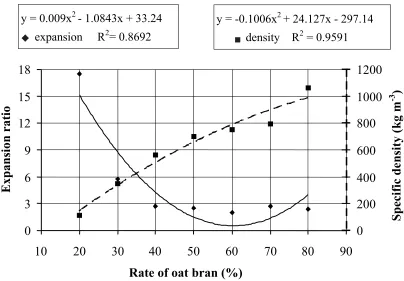
(Table 2). In addition, the application of a 20-30% rate of oat bran enables obtaining ready-to-eat snacks. Such extrudates are also characterised by porous structure (typical of snacks) and a rapidly decreasing, from 17.5 to 5.75, radial expansion ratio at oat bran concentration of 20 and 30%, respectively. In contrast, their specific density is observed to highly increase and reach 111.72 kg m-3and 345.12 kg m-3at 20 and 30% oat bran addition, respectively (Fig. 3). Those products still maintain the structure similar to a honey comb – typical of snacks - (Fig. 4a), however with very thick walls of their air cells. The air cells are differentiated appearing as pores with ca. 500mm in size and numerous small cells with the size of severalmm. These changes are accompanied by tangible thickening of the air cell walls responsible for diminished expansion and increasing density. Structure of
the product deteriorates. At x1000 magnification, the hull-like structure of the air cell walls is observed to disappear, and irregular structures coated with fused mass begin to appear.
With oat bran concentration increasing successively from 40 to 80%, the products obtained attain the form of extruded, compact and pressed material. They are characte-rised by an extremely low radial expansion ratio not ex-ceeding 2.68, and by a remarkably high specific density reaching even 1063.53 kg m-3(Fig. 3). A key role in mo-delling the structure of these products is played by increasing contents of lipids and soluble fractions of dietary fibre – hemicelluloses soluble in acid detergent (Table 2). The appearance of the extrudate is so divergent that, despite extrusion temperature of 180°C, the processing of the extrudates obtained seems insufficient (Fig. 5). A careful
a
b
Fig. 1.Macro- (a) and microstructure (b) of the single screw extrudate: 9% rate of oat bran, extrusion-cooker S 45, extrusion temperature 120°C, moisture content 13.5%, die diameter 3 mm.
a
b
analysis of the macrostructure (Fig. 5a) may indicate inappropriate processing of the product. Still, x1000 magnification (Fig. 5b) dispels those doubts. An analysis of this picture indicates that, despite 40% concentration of oat bran, the material extruded is subject to complete liquefaction. Dual microstructure of the product is visible, smooth fragments turn into fluffy unordered forms. The ex-trudate losses the characteristic porous structure of a ‘honey comb’, that could have been observed in Fig. 4. The air cells
disappear and the product takes the form of non-expanded grouts-like crumble.
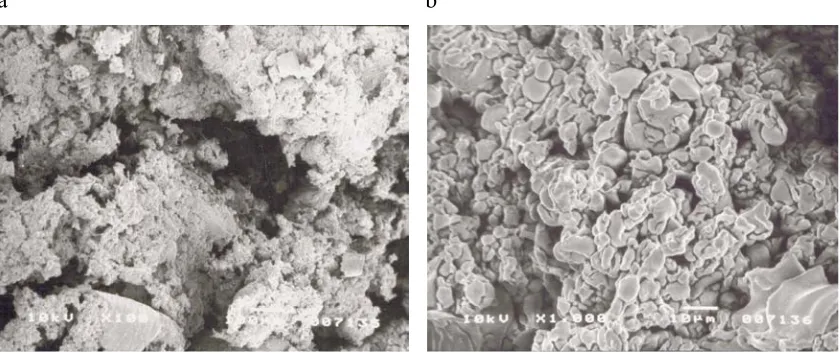
A further increase in oat bran concentration to 80% intensifies the changes in the product structure observed in Fig. 5. The product attains the semolina-like structure (Fig. 6a), becomes very weakly compacted and susceptible to crushing. Visual evaluation of the product and a photo of its macrostructure at x100 magnification (Fig. 6a) may produce an illusion of completely thermally-untreated
MICROSTRUCTURE OF CEREAL EXTRUDATES 179
y = 0.009x
2- 1.0843x + 33.24
expansion
R
2= 0.8692
y = -0.1006x
2+ 24.127x - 297.14
density R
2= 0.9591
0
3
6
9
12
15
18
10
20
30
40
50
60
70
80
90
Rate of oat bran (%)
Expansi
o
n
r
atio
0
200
400
600
800
1000
1200
Specific
d
e
n
sity
(k
g
m
-3
)
Fig. 3.The influence of the rate of oat bran on the expansion ratio and specific density of the extrudate.
u n
a
b
Fig. 4.The influence of oat bran rate on the macro- (a) and microstructure (b) of the twin screw extrudate: 20% rate of oat bran,
material. However, the microscopic picture analysed at x1000 magnification indicates that this is an extrudate made of densely-packed, slightly merged granules (Fig. 6b). The aerial spaces do not exceed 10mm in size and do not form regular structures. The extrudate demonstrates granular structure, similar to that of raw material (Fig. 7). It should be assumed that, at such a high oat bran concentration, both fat and soluble fractions of dietary fibre exert a very strong ‘smearing’ effect on an extruder, thus reducing both the viscosity and reverse flow. The raw material being processed is not completely liquefied. Figure 6b presents visible not-liquefied granular particles of bran and larger starch granules ‘coated’ with fused starch-protein mass. It results from heterogeneity of the extruded mass and different susceptibility of components to liquefaction. Easily liquefying fragments of maize endosperm constitute
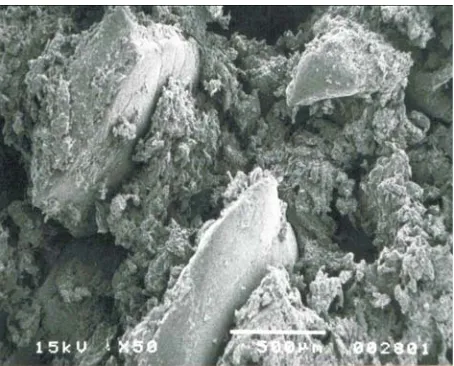
a binding agent for hardly liquefying fragments of the seed coat and endosperm of oat. Considerable contents of lipids (ca. 7%) and soluble dietary fibre (ca. 7%) hinder the merging of the liquefied material into compact structures of air cells, thus the fused mass ‘covers’ only the hardly liquefying fragments of the material and preserves the grouts-like character of the end product. In this case, the specificity of oat starch is also of key importance (Fig. 7). Small starch granules, merged into aggregates, form brittle mealy endosperm of kernel. In the grinding process, such endosperm disintegrates without breaking the structure of starch granules, and thus does not cause any damage to starch. In the extrusion-cooking, within a dozen or so seconds of thermoplastic treatment, the intact structures of starch granules covered with a lamina of lipids and 1-3, 1-4
b-D-glucans are hardly to liquefy and are not capable of
a
b
Fig. 5.The influence of oat bran rate on the macro-(a) and microstructure (b) of the twin screw extrudate: 40% rate of oat bran, extrusion-cooker 2S 9/5, extrusion temperature 180°C, moisture content 15%, die diameter 3.2 mm.
a
b
producing the structure of air cells. Of significance is also a high protein content of oat bran, reachingca. 16%. Herein, protein is undoubtedly a component of the covering mass which is too stiff and too hard to expand to produce typical air cells. A similar structure was observed by Salgoet al. (1989) in extrudates with the inclusion of rice germs. As low as 20% addition of rice germs to corn semolina, wheat flour or rice flour resulted in the disappearance of the cellular
structure of the extrudate. Such a structure of the low expanded extrudate has its drawbacks and benefits. Traditionally, extrudates are comprehended as very well expanded snacks with very low specific density. It is forgotten, however, that such an expanded product with density ca 50 kg m-3 is highly hygroscopic, with very developed specific surface witch is in contact with the air, thus very susceptible to oxidation chemical reactions, espe-cially lipids oxidation. That problem should be very care-fully analysed, because abrasive wear of screws and barrel are main reason of high contamination of metallic micro-elements, especially iron. A high density product, even with the semolina-like structure (Figs 4-6), but with compact microstructure, is less susceptible to those reactions.
Twin screw extrusion – influence of barrel temperature
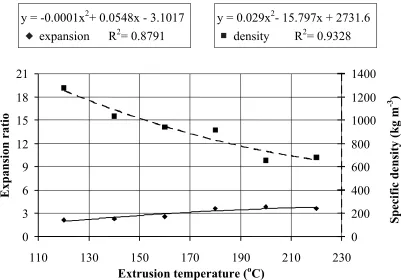
Studies have indicated that macro- and microstructure of extrudates and their physical properties are determined, to a high extent, by the process temperature. An increase in temperature from 120 to 220°C remarkably decreases the specific density of extrudates and increases their radial expansion ratio (Fig. 8). Similar relations were reported by many authors (Balandran-Quintanaet al., 1998). Figure 9 presents corn extrudates with 30% concentration of oat components, processed at a temperature of 120°C. Sporadic large air cells with the size of a few hundreds of mm,
MICROSTRUCTURE OF CEREAL EXTRUDATES 181
Fig. 7.Microstructure of the oat bran.
y = 0.029x
2- 15.797x + 2731.6
density
R
2= 0.9328
y = -0.0001x
2+ 0.0548x - 3.1017
expansion
R
2= 0.8791
0
3
6
9
12
15
18
21
110
130
150
170
190
210
230
Extrusion temperature (
oC)
Expansi
o
n
r
atio
0
200
400
600
800
1000
1200
1400
Specific
d
e
n
sity
(k
g
m
-3
)
Fig. 8.The influence of the extrusion temperature on expansion ratio and specific density of the extrudate. n
confined in thick walls with hardly porous character are observed (Fig. 9a). Products obtained at a temperature of 120°C seem to be not processed enough, as they contain visible fragments of not-liquefied endosperm. At the magni-fication of x1000 (Fig. 9b), large starch granules sealed into liquefied mass can be observed, their collapsed character, however, indicates starch efflux.
An increase in process temperature up to 220°C results in higher lipids binding (Table 2) and enables obtaining a pro-duct with more porous structure. Air pores are more regular and their walls are thinner (Fig. 10a). Figure 10b (x1000 magnification) indicates that, despite 30% concentration of oat bran, the raw material treated is subject to complete liquefaction. Its microstructure is homogenous and com-pletely fused. Typical starch-protein bridges, responsible for hardness and compact structure of a product, are visible. It should be emphasised, however, that an increase in
extrusion temperature even up to 220°C neither brings considerable improvement of product structure nor enables the obtaining an extrudate with structure typical of the air cells.
Twin screw extrusion – influence of moisture content
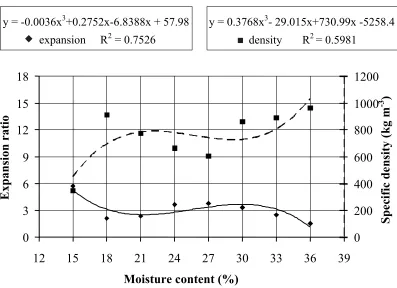
Microstructure of extrudates may also be modelled through changes of raw material moisture content. An increase from 15 to 33% in the moisture content of the extruded mixture containing 30% of oat bran decreases the radial expansion ratio of the extrudates from 5.75 to 1.56, respectively, and increases their specific density from 345.12 to 964. 26 kg m-3, respectively (Fig. 11). The extrudates obtained at low 15% moisture content of the raw material are characterised by a more porous expanded structure resembling the structure
a
b
Fig. 9.The influence of extrusion temperature on the macro- (a) and microstructure (b) of the twin screw extrudate: 30% rate of oat bran, extrusion-cooker 2S 9/5, extrusion temperature 120°C, moisture content 24%, die diameter 3.2 mm.
a
b
Fig. 10.The influence of extrusion temperature on the macro- (a) and microstructure (b) of the twin screw extrudate: 30% rate of oat bran, extrusion-cooker 2S 9/5, extrusion temperature 220°C, moisture content 24%, die diameter 3.2 mm.
a b
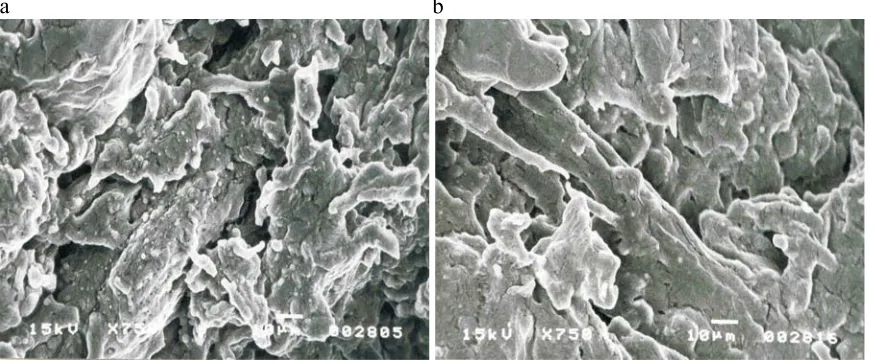
of a honey comb. The size of air pores is differentiated and ranges from several to few hundredsmm (Fig. 12a,b). The air cells are surrounded by porous but relatively thick wall, which results in considerable hardness of these products.
A diametrically different structure is observed in products obtained from raw material with the moisture content of 33%. Their porous structure disappears, they become densely-packed, compact and with hard texture
(Fig. 13a, b). The cellular structure of the extrudates disappears completely. Few pores with the size of a several or somm occur, still single large areas with the size of several dozensmm are also observed. A partly granular structure of the product, typical of raw material and products with a high content of oat components, can be observed in Fig. 13b. Hence it may be concluded that, despite relatively high moisture content, the extruded material is completely
MICROSTRUCTURE OF CEREAL EXTRUDATES 183
a
b
Fig. 12.The influence of moisture content on the macro- (a) and microstructure (b) of the twin screw extrudate: 30% rate of oat bran, extrusion-cooker 2S 9/5, extrusion temperature 180°C, moisture content 15%, die diameter 3.2 mm.
y = 0.3768x
3- 29.015x+730.99x -5258.4
density
R
2= 0.5981
y = -0.0036x
3+0.2752x-6.8388x + 57.98
expansion
R
2= 0.7526
0
3
6
9
12
15
18
12
15
18
21
24
27
30
33
36
39
Moisture content (%)
Expansi
o
n
r
atio
0
200
400
600
800
1000
1200
Specific
d
e
n
sity
(k
g
m
-3
)
Fig. 11.The influence of the moisture content of the raw material on the expansion ratio and specific density of the extrudate.
liquefied. However, a short cylinder of a 2S 9-5 extrusion-cooker hinders the formation of an appropriate structure of the extrudate. Similar observations were reported by Frame (1994). Thus, as result of a wide range of moisture content, serious changes of lipids binding and hemicelluloses content are observed as well. Guzmanet al. (1992) observed lipid binding in maize extrudates up to 75%. Similar results were reported by Chi-Tang Hoet al. (1992). Those changes did not allow to produce an extrudate with low specific density and cellular structure. In this case, the concentration of oat component and chemical changes of the ekstrudate was found dominating as it imposes the product’s structure.
Comparison to high protein materials
Such microstructure is typical of not only oat-supple-mented extrudates. A comparative analysis of yellow lupine extrudates was also performed. This raw material contains
ca. 4.3% of fat and as much as 45% of protein. The external appearance of lupine extrudate may resemble that of oat extrudates. Irrespective of process parameters, the extrudate demonstrates semolina-like structure breaking off at slight pressure. The raw material seems, therefore, completely unprocessed (Fig. 14). A careful microstructural analysis indicates, however, that the extruded mass underwent transformation. The extrudates obtained at a temperature of 120°C (Fig. 15a) are characterised by fibre-like structure. Spherical thickened areas of fibres point to the occurrence of protein bodies covered with a mixture of coating protein and carbohydrates. This, as it could be expected, firm structure is a fragile body incapable of creating cellular structure. The moisture content increase to 30% alters only the micro-structure. As a result of increased moisture content, protein bodies are observed to swell, and when coated with the protein-carbohydrate mass they form a brittle grouts-like structure (Fig. 15b). The application of drastic process
parameters, iea temperature of 220°C, does not provoke changes in the product character. The extrudate is still brittle grouts. The fibrous structure, observed in Fig. 15a, disappeared. The same phenomenon was observed for oval structures of protein bodies which were replaced by appearing flat structures, constituting shapeless forms responsible for crispness/tenderness/brittleness of the product (Fig. 16a). Despite so high a protein content, there are no favourable conditions for the formation of protein bridges binding the product structure. Not-liquefied single protein bodies are still observed herein. An increase in the moisture content to 30% (Fig. 16b) does not result in any substantial changes in the character of the product. Single fibrous bands with thickness ofca. 10mm are still observed, however they are too brittle to lend the cellular structure to
Fig. 14.Macrostructure of the lupine extrudate: extrusion-cooker S 45, extrusion temperature 180°C, moisture content 15%, die diameter 3 mm.
a
b
Fig. 13.The influence of moisture content on the macro- (a) and microstructure (b) of the twin screw extrudate: 30% rate of oat bran, extrusion-cooker 2S 9/5, extrusion temperature 180°C, moisture content 33%, die diameter 3.2 mm.
a product. Thus the semolina-grouts-like structure of the extrudate is not only the characteristics of oat components. Despite a high protein content (ca. 45%), fat concentration is dominating and determines the extrudate quality. Gwiazda et al.(1987) observed fat in the soya extrudates even in a form of small drops. Undoubtedly the structure is also affected by a high concentration of dietary fibre (ca. 25% of NDF, including 17% of CEL) which is not liquefied in the extrusion process. These results are consistent with our previous observations (Rzedzicki and Fornal, 1998) for yellow lupine var. Iryd.
Analyses of microstructure and physical properties indicate that both raw material composition of the extruded
mixture and process parameters afford great opportunities for modifying the quality of extrudates. Thus, extrusion technology enables the obtaining of a variety of products -from fragile light snacks suitable for direct consumption, through semolina-like grits for breakfast cereals, to compact, hard extrudates to be used for the production of pastes or breakfast cereals. It should be emphasised that it is not density and expansion that determine the microstructure, but the microstructure itself affects the major physical properties of an extrudate and hence should be carefully analysed according to lipids binding and fractional fibre changes at each attempt at modelling product properties. MICROSTRUCTURE OF CEREAL EXTRUDATES 185
a
b
Fig. 16.Microstructure of the lupine extrudate: extrusion-cooker S 45; a) extrusion temperature 220°C, moisture content 15%, die diameter 3 mm; b) extrusion temperature 220°C, moisture content 30%, die diameter 3 mm.
a
b
CONCLUSIONS
1. The concentration of oat components up to 20% enables obtaining an extrudate with a very fragile, crisp and cellular structure even at the application of single-screw extrusion-cooking.
2. Higher contents of oat bran require the application of twin-screw extrusion-cooking. At 30% oat bran addition, it is still possible to obtain a compact extrudate with cellular structure but thick walls, high density, and low expansion.
3. With oat bran concentration increasing over 30%, a fra-gile extrudate is obtained, demonstrating grouts-like struc-ture and complete disappearance of cellular strucstruc-ture.
4. Grouts- or semolina-like character of the extrudate does not indicate inappropriate processing of raw material; microstructural images confirm that is a completely processed product.
5. A comparative analysis of lupine extrudates indicate also that a factor dominating in determination of micro-structure is the content of lipids; their activity is not hindered even by a high degree of their binding.
6. The research conducted demonstrated a highly sig-nificant role of microstructural analyses in modelling new products and elaborating technologies of their production.
REFERENCES
Aldoori W.H., GioVannucci E.L., Rockett H.R.H., Sampson L., Rimm E.B., and Willett W.C., 1997.A prospective study of dietary fiber types and symptomic diverticular disease in men. J. Nutr., 127, 5, 714-719.
Approved methods of the American Association of Cereal Chemists (AACC),1995. St. Paul, Minesota, USA. Balandran-Quintana R.R., Barbosa-Canovas G.V.,
Zazueta-Morales J.J., Anzaldua-Zazueta-Morales A., and Quintero-Ramos A., 1998.Functional and nutritional properties of extruded whole pinto bean meal (Phaseolus Vulgaris L.). J. Food Sci., 1, 113-117.
Burkitt D., 1995.Historical aspects. In: Dietary Fiber in Health and Disease. Eagan Press, St. Paul, Minnesota, 3-10. Chi-Tang Ho and Izzo M.T., 1992. Lipid-protein and
lipid-carbohydrate interactions during extrusion cooking. In: Food Extrusion Science and Technology, Marcel Dekker, Inc., New York, 415-425.
Cohen S.H. and Voyle C.A., 1987. Internal porosity of corn extrudate air cell wall. Food Microstructure, 6, 209-211. Colonna P., Tayeb J., and Mercier C., 1989.Extrusion cooking
of starch and starchy products. In: Extrusion Cooking, AACC Inc., St. Paul, Minesota, USA, 247-320.
Frame N.D., 1994.The Technology of Extrusion-Cooking. Blajie Academic and Professional Press, London.
Gibney M.J., 2001. Nutrition and diet for healthy life styles in Europe. In: Advanced Dietary Fibre Technology, Blackwell Science Press, London, 3-12.
Guzman L.B., Lee T.C., and Chichester C.O., 1992.Lipid binding during extrusion cooking. In: Food Extrusion Science and Technology. Marcel Dekker Inc., New York, 427-436. Gwiazda S., Nogohi A., and Saio K., 1987.Microstructural studies
of texturised vegetable protein products: effects of oil addition and transformatiomn of raw materials in various sections of a twin screw extruder. Food Microstructure, 6, 57-61. Kritchevsky D., 2001. Dietary fiber in health and disease. In:
Advanced Dietary Fibre Technology, Blackwell Science Press, London, 149-161.
Rowland I., 2001.Non-digestible carbohydrates and gut function: implications for carcinogenesis. In: Advanced Dietary Fibre Technology. Blackwell Science Press, London, 226-231. Rzedzicki Z., 1999.Physical properties of corn - oat bran snacks.
Int. Agrophysics, 13, 38-385.
Rzedzicki Z. and Fornal J., 1997.Studies of the microstructure of lupine extrudate. Int. Agrophysics, 12, 119-125.
Rzedzicki Z. and Fornal J., 1999.Influence of process parame-ters on the physical properties and microstructure of ever-lasting pea (Lathyrus sativus) extrudate. Int. Agrophysics, 13, 109-117.
Rzedzicki Z., Szpryngiel B., and Sobota A., 2000.Estimation of some chosen physical properties of extrudates obtained from corn semolina and oat bran mixtures. Int. Agrophysics, 14, 233-239. Salgo A., Torok Sz., and Szandor Sz., 1989.Microstucture of
extruded mixtures of cereal and oil seed processing residues. Food Microstructure, 8, 245-252.
Smith A.C., 1992.Studies on the physical structure of starch based materials in the extrusion cooking process. Food Extrusion Science and Technology. Marcel Dekker Inc., New York, 573-619.
Van Soest P., 1963a.Use of detergents in the analisis of fibrous feeds. I: Preparation of fiber residues of low nitrogen content. J. Offic. Agric. Chem., 46, 825-829.