*Corresponding author:Monika Gracia Serepina ISSN: 0976-3031
Research Article
ANALYSIS ON THE IMPLEMENTATION OF CUSTOMER RELATIONSHIP MANAGEMENT
AND MARKETING PUBLIC RELATIONS ON CUSTOMER VALUE AND ITS IMPACT
ON CUSTOMER LOYALTY
Monika Gracia Serepina*, Irainsani Purba and Aditia Prayogo
Faculty of Economy and Business, Persada Indonesia University Yai, Jakarta, Indonesia
DOI: http://dx.doi.org/10.24327/ijrsr.2019.1009.3934
ARTICLE INFO ABSTRACT
The objective of this study is to analyze the implementation of Customer Relationship Management (CRM) and Marketing Public Relations (MPR) programs on Customer Value and Its Impact on Customer Loyalty. It is suggested that Marketing Public Relations program is reviewed and improved because it had less influence on the formation of Customer Loyalty. Less effective CRM and MPR programs need to be increased. Complaint handling needs to be improved because Hotel Guest’s complaints are deemed to be lacking in response and good handling. It is also important to analyze and develop other factors that can influence Customer Value and Customer Loyalty because Customer Relationship Management and Marketing Public Relations affect Customer Value by 65.8% which there are still other factors 34.2% that affect Customer Value. In addition, Customer Relationship Management, Public Relations, and Customer Value Affect Customer Loyalty by 61.7% and there are 38.3% other factors that influence Customer Loyalty
INTRODUCTION
In the era of globalization, the level of dependency between nations is unavoidable. The development of science, technology and information encourages the enactment of free trade which leads to seemingly unlimited world activities. This will give rise to a borderless world paradigm. It is a world that has no territorial boundaries of national and state sovereignty. The service sector is a business sector that is increasingly experienced as a result of globalization. This is indicated among others by changes in sectoral contributions to national output. That is the result of a shift in the national workforce from the agricultural sector to the industrial sector and then to the service sector.
According to data obtained from the Central Bureau of Statistics, the Hotel Industry itself experienced a fairly high increase around 2002. However, a quite drastic decline in the Hotel industry occurred due to various kinds of problems; for instance, cases of bombings in various parts of Indonesia (especially Jakarta and Bali). Therefore, business people must continue to maintain their continuity and try to find opportunities by utilizing the advantages they have. One way that can be taken is to build customer loyalty by maintaining
existing customers; thus, they are loyal and do not move to other competitors. Therefore, it is important for companies to create superior value for customers. One way to create customer value is to implement a Customer Relationship Management program. It is a strategy to pamper customers so they do not move to other competitors. Moreover, another way is to provide enough information about the company to create a good image about it. Later, hotel customers will give positive word of mouth to others.
The case study in this research is the Customer Relationship Management and Marketing Public Relations program conducted by ABC Hotels to create superior value from customers. The superior value is expected to influence customers to be loyal to the hotel. Since in the hospitality industry Customer Relationship Management and Marketing Public Relations is very important to build customer value that will have an impact on customer loyalty, this research will discuss about it in more depth. Identification of the problems in this research is to address issues related to how much the contribution of Customer Relationship Management and Marketing Public Relations simultaneously to Customer Value and how much contribution Customer Relationship
Available Online at http://www.recentscientific.com
International Journal of
Recent Scientific
Research
International Journal of Recent Scientific Research
Vol. 10, Issue, 09(B), pp. 34618-34623, September, 2019
Copyright © Monika Gracia Serepina, Irainsani Purba and Aditia Prayogo, 2019, this is an open-access article distributed under the terms of the Creative Commons Attribution License, which permits unrestricted use, distribution and reproduction in any medium, provided the original work is properly cited.
DOI: 10.24327/IJRSR
CODEN: IJRSFP (USA)
Article History: Received 4th June, 2019
Received in revised form 25th July, 2019 Accepted 23rd August, 2019
Published online 28th September, 2019
Key Words:
International Journal of Recent Scientific Research
Management, Marketing Public Relations, and Customer Value simultaneously to Customer Loyalty.
LITERATURE REVIEW
CRM stands for Customer Relationship Management. It is an integrated strategy and process of getting, maintaining and establishing friendships with customers. There are three types of CRM programs that include Continuity Marketing, one one marketing, and partnering programs (
2005).
In addition, MPR stands for Marketing Public Relations. It is public relations that is designed to support marketing objectives (Kotler et al., 2005). MPR can contribute to various marketing objectives such as raising awareness, building credibility, stimulating salespeople and intermediary channels, and reducing promotional costs. Effective Public Relations Marketing is the result of a process in whi
integrated with the company’s marketing strategy. The MPR process consists of several research steps which include shaping marketing objectives, setting a target audience, selecting messages and public relations tools, implementing public relations plans, and evaluating results. There are several components in Public Relations in Marketing (Marketing Public Relations). According to Kotler et al.,
publications, events, news, social activities, and media identity. Customer value/ PERVAL (perceived value scale) is a measurement of the value received which is then applied to measure tangible products. Wahyuningsih (2004) developed a model regarding components of customer value consisting of benefits and costs. The formation of loyalty can be carried out by creating the value that the customer receives. It is the difference between evaluating prospective customers for all the benefits and all the costs of certain offers and other alternatives they think of (Kotler, 2007). It can be seen in the following equation:
Description: V = Value
B = Benefits that customers experience (Product, Service, Employee, and Company Image)
C = Cost (Costs of Monetary, Time, Energy, and Psychology) Total customer value is a set of benefits that custo
from certain products or services that they consume. Customer total cost is a set of costs from customers who are sacrificed to evaluate, obtain, use, and dispose of a particular product or service. In addition, the benefits perceived by custo
of the benefits of products, services, employees, and image. Meanwhile, customer perceived costs consist of monetary and non-monetary costs, i.e. time, energy, and psychological aspect.
Customer loyalty is a commitment to persevere deeply to repurchase or re-subscribe to selected products or services consistently in the future despite the influence of the situation and marketing efforts have the potential to cause behavioral changes. Another concept of customer loyalty states that the concept of loyalty is more directed towards behavior than
International Journal of Recent Scientific Research Vol. 10, Issue, 09(B), pp. 34618-34623, September, 2019
Management, Marketing Public Relations, and Customer Value
CRM stands for Customer Relationship Management. It is an integrated strategy and process of getting, maintaining and ps with customers. There are three types of CRM programs that include Continuity Marketing,
one-to-(Shainesh, &Sheth,
In addition, MPR stands for Marketing Public Relations. It is gned to support marketing objectives ). MPR can contribute to various marketing objectives such as raising awareness, building credibility, stimulating salespeople and intermediary channels, and reducing promotional costs. Effective Public Relations Marketing is the result of a process in which it must be integrated with the company’s marketing strategy. The MPR process consists of several research steps which include shaping marketing objectives, setting a target audience, selecting messages and public relations tools, implementing ations plans, and evaluating results. There are several components in Public Relations in Marketing (Marketing et al., (2005) includes publications, events, news, social activities, and media identity. PERVAL (perceived value scale) is a measurement of the value received which is then applied to measure tangible products. Wahyuningsih (2004) developed a model regarding components of customer value consisting of ty can be carried out by creating the value that the customer receives. It is the difference between evaluating prospective customers for all the benefits and all the costs of certain offers and other alternatives en in the following
B = Benefits that customers experience (Product, Service, C = Cost (Costs of Monetary, Time, Energy, and Psychology) Total customer value is a set of benefits that customers receive from certain products or services that they consume. Customer total cost is a set of costs from customers who are sacrificed to evaluate, obtain, use, and dispose of a particular product or service. In addition, the benefits perceived by customers consist of the benefits of products, services, employees, and image. Meanwhile, customer perceived costs consist of monetary and monetary costs, i.e. time, energy, and psychological
Customer loyalty is a commitment to persevere deeply to subscribe to selected products or services consistently in the future despite the influence of the situation and marketing efforts have the potential to cause behavioral her concept of customer loyalty states that the concept of loyalty is more directed towards behavior than
attitude. A loyal customer will show good buying behavior. It is defined as a regular and long
carried out by decision-making units (Griffin, 2002). Customer loyalty is usually not caused by just one aspect of the company. Commonly, customers become loyal because it refers to packages offered such as products, services, and prices. In identifying customer loyalty, there ar
including: (1) having a desire to buy a product or service from a company and paying less attention to products or services offered by competing companies, (2) recommending companies, products, company services by mouth word of mouth to others, (3) buying more when companies introduce new products and update existing products, (4) talking about good things about the company and its products, and (5) are less sensitive to prices and proactive action to provide product or service advice to the company.
METHODOLOGY
This is an associative research design that aims to determine the correlation between two or more variables. The unit of analysis examined here is the individual (Hotel ABC Guest). It uses the Time Horizon of One
information is collected only at certain times.
It uses interval scale as a variable scale. It is a scale that has a numeric distance on a scale that represents the same distance on the character being measured. There is a constant/ equal interval between the scale values. The data were obtained from the Hotel Guest’s assessment of CRM and MPR programs through filling out a questionnaire that has been provided by using a Likert scale that is useful to determine the degree of disapproval and customer approval of the questions listed in the questionnaire.
To obtain data that will later be processed in this study, the authors use data collection techniques as follows: (1) field research which is an observation, direct observation in the field to help identify consumer behavior, and a questionnaire containing the format questions that use scale; (2) literature research/ library research which is a study conducted by studying compulsory books (textbooks), supplementary or reference books, magazines, jo
companies and lecture notes relevant to the problem will be examined. This library research is intended to obtain secondary data and theoretical basis as material for comparative studies. The sampling technique in this study i
represent the value of a population. The population in this study are customers who use ABC Hotel services. The sampling technique was carried out using a formula developed by Taro Yamane as follows:
Description:
n = number of samples N = total population
d2 = precision (it is set at 10% with a confidence level of 95%) Based on the collected data, the average of ABC hotel visitor population was 3904 rooms sold during the period from January 2008 to September 2008. Thus, by using t
34623, September, 2019
attitude. A loyal customer will show good buying behavior. It is defined as a regular and long-term purchase pattern which is making units (Griffin, 2002). Customer loyalty is usually not caused by just one aspect of the company. Commonly, customers become loyal because it refers to packages offered such as products, services, and prices. In identifying customer loyalty, there are several criteria including: (1) having a desire to buy a product or service from a company and paying less attention to products or services offered by competing companies, (2) recommending companies, products, company services by mouth word of others, (3) buying more when companies introduce new products and update existing products, (4) talking about good things about the company and its products, and (5) are less sensitive to prices and proactive action to provide product
the company.
This is an associative research design that aims to determine the correlation between two or more variables. The unit of analysis examined here is the individual (Hotel ABC Guest). It uses the Time Horizon of One-Shoot Cross Section where information is collected only at certain times.
It uses interval scale as a variable scale. It is a scale that has a numeric distance on a scale that represents the same distance on the character being measured. There is a constant/ equal al between the scale values. The data were obtained from the Hotel Guest’s assessment of CRM and MPR programs through filling out a questionnaire that has been provided by using a Likert scale that is useful to determine the degree of mer approval of the questions listed in the
To obtain data that will later be processed in this study, the authors use data collection techniques as follows: (1) field research which is an observation, direct observation in the field p identify consumer behavior, and a questionnaire containing the format questions that use scale; (2) literature research/ library research which is a study conducted by studying compulsory books (textbooks), supplementary or reference books, magazines, journals, official reports from companies and lecture notes relevant to the problem will be examined. This library research is intended to obtain secondary data and theoretical basis as material for comparative studies. The sampling technique in this study is intended to estimate/ represent the value of a population. The population in this study are customers who use ABC Hotel services. The sampling technique was carried out using a formula developed
Monika Gracia Serepina, Irainsani Purba and Aditia Prayogo Relations on Customer Value and its Impact on Customer Loyalty
formula, the following is the minimum number of samples for this study:
n = 97.5 ≈ 100 people
Path analysis was first developed in the 1920s by a geneticist, Sewall Wright (Joreskog&Sorbom, 1996; Johnson & Wichern, 1992). Path analysis is a technique for estimating the effect of a set of independent variables on a dependent variable from a set of observed correlations, given a set of hypothesized causal asymmetric relation among the variables (Edwards & Lambert,
2007). Meanwhile, the main purpose of path analysis is a
method of measuring the direct influence along each separate path in such a system and thus of finding the degree to which variation of a given effect is determined by each particular cause. The method depends on the combinatio
on the degree of correlation among the variables in a system with such knowledge as may possessed of the causal relations (Lleras, 2005).
Table 1 Analysis Method Based on Research Objectives
The Purpose of Analysis Instrument
The Purpose Instrument
T-1 Path Analysis T-1 Path Analysis T-2 Path Analysis T-2 Path Analysis
Thus, the path analysis model is used to analyze the pattern of correlations between variables with the aim of finding out the direct and indirect effects of a set of independent (exogenous) variables on a dependent (endogenous) variable.
Hypothesis Testing
The hypotheses tested in this study are as follows: For T - 1
Ha: There is a significant correlation between Customer Relationship Management and Marketing Public Relations to Customer Value
For T- 2
Ha: There is a significant correlation between Customer Relationship Management, Marketing Public Relations and Customer Value on Customer Loyalty
Implication Design of Research Results
After all data and analysis results have been collected, the results of the questionnaire distributed to Hotels ABC Guest will then be used to illustrate how the correlation between the implementation of Customer Relationship Management (CRM) and Marketing Public Relations (MPR) programs on Customer Value and its impact on loyalty from the Guest to the ABC Hotel.
Based on the above analysis, if there is a strong influence and correlation between the implementation of Customer Relationship Management and Marketing Public
Customer Value, the programs run by ABC Hotel are already good because they are able to create good value to customers. If the customer value is good or high, the customer, or in this case is the Guest of ABC Hotels, should be loyal to the ho Guest will not hesitate to return to stay and even use the
, Irainsani Purba and Aditia Prayogo., Analysis on the Implementation of Customer Relationship Management and Marketing public Relations on Customer Value and its Impact on Customer Loyalty
formula, the following is the minimum number of samples for
Path analysis was first developed in the 1920s by a geneticist, Sewall Wright (Joreskog&Sorbom, 1996; Johnson & Wichern, a technique for estimating the effect of a set of independent variables on a dependent variable from a set of observed correlations, given a set of hypothesized causal
Edwards & Lambert,
urpose of path analysis is a method of measuring the direct influence along each separate path in such a system and thus of finding the degree to which variation of a given effect is determined by each particular cause. The method depends on the combination of knowledge on the degree of correlation among the variables in a system with such knowledge as may possessed of the causal relations
Analysis Method Based on Research Objectives
The Purpose of Analysis Instrument
1 Path Analysis 2 Path Analysis
Thus, the path analysis model is used to analyze the pattern of correlations between variables with the aim of finding out the a set of independent (exogenous) variables on a dependent (endogenous) variable.
The hypotheses tested in this study are as follows:
Ha: There is a significant correlation between Customer Marketing Public Relations to
Ha: There is a significant correlation between Customer Relationship Management, Marketing Public Relations and
a and analysis results have been collected, the results of the questionnaire distributed to Hotels ABC Guest will then be used to illustrate how the correlation between the implementation of Customer Relationship Management (CRM) ions (MPR) programs on Customer Value and its impact on loyalty from the Guest to the ABC Based on the above analysis, if there is a strong influence and correlation between the implementation of Customer Relationship Management and Marketing Public Relations on Customer Value, the programs run by ABC Hotel are already good because they are able to create good value to customers. If the customer value is good or high, the customer, or in this case is the Guest of ABC Hotels, should be loyal to the hotel. Guest will not hesitate to return to stay and even use the
facilities provided by the hotel or participate in programs organized by the hotel. If customer relationship management and marketing public relations program are good and the customer value is high, but that does not make customers loyal to the hotel, it means there are other factors that cause this to happen and vice versa.
RESULTS AND DISCUSSION
Validity and Reliability Tests
Validity test for each instrument is carried out by first looki for the value of correlation between the parts of the measuring instrument as a whole by correlating each item of measuring instrument with a total score which is the sum of each item score. To calculate the validity of measuring instruments, the Pearson Product Moment formula is used. Validity test uses a 95% confidence level where df = n
many as 100 answers to the questionnaire so the value of df = 98. Therefore, it obtains the value of t
by using the rtable formula, it obtains the value of r
The basis for decision making in this validity test is as follows: If the rcount is positive, and the r
If the rcount is not positive, and the r
invalid.
The rcount value is obtained from the calculation of the Pearson
Product Moment correlation between the score of each question with a total score. The basis for decision making on the reliability test is as follows:
If Cronbach Alpha >rtable, it is considered reliable.
If Cronbach Alpha <rtable, it is considered unreliable.
Table 2 The Results of Validity Test
Variables Invalid Questions
Customer Relationship Management
Question No. 3 Question No. 7 Question No. 8 Marketing Public
Relations
Customer Value Question No. 20 Question No. 38 Customer Loyalty
Table 3 The of Results Reliability Test
Variables
Customer Relationship Management Marketing Public Relations
Customer Value Customer Loyalty
Correlational Analysis of Customer Relationship Management and Marketing Public Relations on Value
Table 4 Model 1: ANOVA
Model Sum of
Squares
1
Regression 13.314 Residual 6.916
Total 20.230
a. Predictors: (Constant), MPR, CRM b. Dependent Variable: Customer Value
Analysis on the Implementation of Customer Relationship Management and Marketing public
facilities provided by the hotel or participate in programs organized by the hotel. If customer relationship management and marketing public relations program are good and the s high, but that does not make customers loyal to the hotel, it means there are other factors that cause this to
RESULTS AND DISCUSSION
Validity test for each instrument is carried out by first looking for the value of correlation between the parts of the measuring instrument as a whole by correlating each item of measuring instrument with a total score which is the sum of each item score. To calculate the validity of measuring instruments, the n Product Moment formula is used. Validity test uses a 95% confidence level where df = n-2. Value of n uses data as many as 100 answers to the questionnaire so the value of df = 98. Therefore, it obtains the value of ttable = 1.66. Furthermore,
formula, it obtains the value of rtable = 0.1654.
The basis for decision making in this validity test is as follows: is positive, and the rcount> 0.1654, the item is valid.
is not positive, and the rcount<0.1654, the item is
value is obtained from the calculation of the Pearson Product Moment correlation between the score of each question with a total score. The basis for decision making on the
, it is considered reliable. , it is considered unreliable. The Results of Validity Test
Invalid Questions Rcount Description
Question No. 3 0.074 Invalid Question No. 7 0.120 Invalid Question No. 8 0.062 Invalid
- - -
Question No. 20 0.134 Invalid Question No. 38 0.143 Invalid
- - -
The of Results Reliability Test
Rcount Description
Customer Relationship
0.570 Reliable Marketing Public Relations 0.731 Reliable 0.804 Reliable 0.704 Reliable
Correlational Analysis of Customer Relationship
Management and Marketing Public Relations on Customer
Model 1: ANOVA
df Mean
Square F Sig.
2 6.657 93.364 .000a
97 .071 99
International Journal of Recent Scientific Research Vol. 10, Issue, 09(B), pp. 34618-34623, September, 2019
Before conducting path analysis on variables X1, X2, and Y, the
linearity of the correlation between the three variables must be tested. The test is carried out by looking at Table 8 which is known that Sig = 0,000. Compared to α = 0.05, the Sig value is smaller than α which means that Ho is rejected and Ha is accepted. Thus, it was concluded that the correlation between the independent variables X1 and X2 to the dependent variable
Y is linear with a confidence level of 95%. Thus, the assumptions regarding the linearity of the correlation in the path analysis are fulfilled.
Table 5 Model 1: Model Summary
Model R R Square Adjusted R Square Std. Error of the Estimate
1 .811a .658 .651 .26702
a. Predictors: (Constant), MPR, CRM b. Dependent Variable: Customer Value
Summary of Path Coefficient of Model 1
Table 7 Summary of Path Coefficient of Model 1
Influence Between Variables
Path Coefficient
(beta)
Sig Value
Testing Results
X1on Y 0.019 0.754
Ho is accepted X2on Y 0.809 0.000 Ho is rejected
Since there is no significant influence between variables (Ho is accepted), trimming will be carried out on model 1 by removing the insignificant variable.
Table 9 Model 2: Model Summaryb
Model R R
Square
Adjusted R Square
Std. Error of the Estimate
Change Statistics R Square
Change F
Change df1 df2
Sig. F Change
2 .811a .658 .654 .26579 .658 188.360 1 98 .000
a. Predictors: (Constant), MPR b. Dependent Variable: Customer Value
Table 10 Model 2: Coefficientsa
Model
Unstandardized Coefficients
Standardized
Coefficients t Sig.
B Std. Error Beta
2 (Constant) 1.071 .166 6.450 .000 MPR .692 .050 .811 13.724 .000 a. Dependent Variable: Customer Value
Based on the analysis results in Table 14, the path coefficient value X2 to Y is ρYX2 = 0.811 by looking at the R-square value
in the Model Summary table where the value of R2 = 0.658 = 65.8%. So, Variable X2 influences Variable Y by 65.8% and
the remaining 34.2% is influenced by other variables outside this study. Meanwhile, the magnitude of the path coefficient for other variables outside the study that affects the value of the variable Y is (ρY) =√1 − = √1 − 0.658= 0.5848.
Figure 1 Substructure 1 along with the path coefficient
Thus, here is the structural equation for sub-structure 1: Y = ρX2YX2 + ρyε1
Y = 0.811 X2 + 0.5848 ε1 in which R2 = 0.658
Based on structural equation in sub-structure 1, it was found that: (1) customer value (Y) is influenced by Marketing Public Relations (X2) of 65.8% and the remaining 34.2% is influenced
by other variables outside this study and (2) each increase in the value of Marketing Public Relations (X2) by one, Customer
Value (Y) will also increase by 0.811. Vice versa, each decrease in Marketing Public Relations (X2) by one, Customer
Value (Y) will also decrease by 0.811.
Correlational Analysis of Customer Relationship Management, Marketing Public Relations and Customer Value on Customer Loyalty
Table 11 Model 1: ANOVA
Model Sum of
Squares df Mean Square F Sig.
1
Regression 12.955 3 4.318 51.577 .000a
Residual 8.037 96 .084 Total 20.992 99
a. Predictors: (Constant), Customer Value, CRM, MPR b. Dependent Variable: Customer Loyalty
Before conducting path analysis on variables X1, X2, Y, and Z,
the linearity of the relationships between the four variables must be tested. The test is carried out by looking at Table 15 which is known that Sig = 0.000. Compared to α = 0.05, the Sig value is smaller than α which means that Ho is rejected and Ha is accepted. So, it was concluded that the relationship between the independent variables X1, X2, and Y to the
dependent variable Z is linear with a 95% confidence level. Therefore, the assumptions regarding the linearity of the relationship in the path analysis are fulfilled.
Table 12 Model 1: Model Summary
Model R R Square Adjusted R
Square
Std. Error of the Estimate
1 .786a .617 .605 .28935
a. Predictors: (Constant), Customer Value, CRM, MPR b. Dependent Variable: Customer Loyalty
Table 13 Model 1: Coefficients
Model
Unstandardized Coefficients
Standardized
Coefficients t Sig.
B Std. Error Beta
1
(Constant) .366 .261 1.401 .165 CRM .371 .054 .440 6.912 .000 MPR -.029 .094 -.033 -.307 .759 Customer Value .639 .110 .627 5.807 .000 a. Dependent Variable: Customer Loyalty
Table 6 Model 1: Coefficients
Model
Unstandardized Coefficients
Standardized
Coefficients t Sig.
B Std. Error Beta
1
(Constant) 1.028 .217 4.730 .000 CRM .016 .050 .019 .315 .754 MPR .690 .051 .809 13.515 .000 a. Dependent Variable: Customer Value
Table 8 Model 2: ANOVAb
Model Sum of
Squares df
Mean
Square F Sig.
2
Regression 13.307 1 13.307 188.360 .000a
Residual 6.923 98 .071 Total 20.230 99
Monika Gracia Serepina, Irainsani Purba and Aditia Prayogo., Analysis on the Implementation of Customer Relationship Management and Marketing public Relations on Customer Value and its Impact on Customer Loyalty
Summary of Path Coefficient Results of Model 1
Table 14 Summary of Path Coefficient Results of Model 1
Influence between Variables
Path Coefficient
(beta)
Sig
Value Testing Results
X1on Z 0.440 0.000 Hais rejected
X2on Z -0.033 0.759 Hais accepted
Y on Z 0.627 0.000 Hais rejected
Since there is an influence between the insignificant variables (Ho is accepted), the trimming of model 1 will be carried out by removing the insignificant variable.
Table 15 Model 2: Model Summaryb
Model R R
Square
Adjusted R Square
Std. Error of the Estimate
Change Statistics R Square
Change F
Change df1 df2
Sig. F Change
2 .785a .617 .609 .28800 .617 78.047 2 97 .000
a. Predictors: (Constant), CRM, Customer Value
b. Dependent Variable: Customer Loyalty
Table 16 Model 2: ANOVAb
Model Sum of
Squares df
Mean
Square F Sig.
2
Regression 12.947 2 6.473 78.047 .000a
Residual 8.045 97 .083 Total 20.992 99
a. Predictors: (Constant), CRM, Customer Value b. Dependent Variable: Customer Loyalty
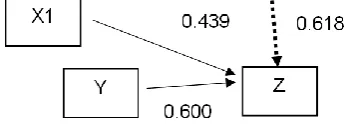
The magnitude of the effect of variables X1 and Y on Z can be
identified simultaneously by looking at the value of R-square in the Model Summary table, where the value of R2 = 0.617 =
61.7%. Thus, Variables X1 and Y affect Variable Z by 61.7%
and the remaining 38.3% are influenced by other variables outside this study. Meanwhile, the magnitude of the path coefficient for other variables outside the study that influences the value of the variable is Z (ρZ) =√1 − = √1 − 0.617= 0.6189.
Figure 2 Sub-structure 2 along with the Path Coefficient
Based on the structural equation in sub-structure 2, it was found that: (1) Customer Loyalty (Z) is influenced by Customer Relationship Management (X1) and Customer Value
(Y) simultaneously by 61.7% and the remaining 38.3% is influenced by variables outside of this study, (2) each increase in the value of Customer Relationship Management (X1) by
one, then Customer Loyalty (Z) will also increase by 0.439.
Vice versa, each decrease in Customer Relationship Management (X1) by one, Customer Loyalty (Z) will also
decrease by 0.439, and (3) each increase in Customer Value (Y) by one, then Customer Loyalty (Z) will also increase by 0.600. Vice versa, each decrease in Customer Value (Y) by one, Customer Loyalty (Z) will also decrease by 0.600.
Thus, the overall causal influence of Customer Relationship Management (X1) and Marketing Public Relations (X2)
variables on Customer Value (Y) and its impact on Customer Loyalty (Z) can be described in the complete structural model as follows:
Figure 3 Complete Structure along with the Path Coefficient
CONCLUSION
Customer Relationship Management and Marketing Public Relations simultaneously influence the Customer Value by 65.8%. Marketing Public Relations gives a very strong and direct influence on Customer Value. In this case, each increase in one unit of Marketing Public Relations, Customer Value will increase by 0.811 and every decrease in one unit of Marketing Public Relations, Customer Value will also decrease by 0.811. Customer Relationship Management, Marketing Public Relations, and Customer Value together give an influence on Customer Loyalty of 61.7%. Customer Value provides a strong and direct influence on Customer Loyalty. In this case, each increase in one unit of customer value, Customer Loyalty will increase by 0.600 and each decrease in one unit of customer value, Customer Loyalty will also decrease by 0.600. Customer Relationship Management provides a strong and direct influence on Customer Loyalty. In this case, each increase in one unit of Customer Relationship Management, Customer Loyalty will increase by 0.439 and each decrease of one unit of Customer Relationship Management, Customer Loyalty will also decrease by 0.439.
By paying attention to the results of the analysis and discussion above, the suggestions that can be given to ABC Hotel are as follows:
It is better to further enhance Customer Relationship Management program because it provides quite effective results on the formation of Customer Loyalty. It is suggested that Marketing Public Relations program is reviewed and improved because it had less influence on the formation of Customer Loyalty. The intensity of the activities of Marketing Public Relations should be further increased; for instance, through articles, hotel magazines, printed media and electronics. It is suggested to design a new program to increase Customer Value since the correlation between Customer Value Table 17 Model 2: Coefficientsa
Model
Unstandardized Coefficients
Standardized
Coefficients t Sig.
B Std. Error Beta
2
(Constant) .365 .260 1.405 .163 Customer
Value .612 .064 .600 9.483 .000 CRM .370 .053 .439 6.938 .000
International Journal of Recent Scientific Research Vol. 10, Issue, 09(B), pp. 34618-34623, September, 2019
and Customer Loyalty looks strong. In addition, creating superior customer value can increase loyalty. Less effective CRM and MPR programs, such as Continuity Marketing and Press Release, need to be increased. Complaint handling needs to be improved because Hotel Guest’s complaints are deemed to be lacking in response and good handling. It is also important to analyze and develop other factors that can influence Customer Value and Customer Loyalty because Customer Relationship Management and Marketing Public Relations affect Customer Value by 65.8% which there are still other factors 34.2% that affect Customer Value. In addition, Customer Relationship Management, Public Relations, and Customer Value affect Customer Loyalty by 61.7% and there are still 38.3% other factors that influence Customer Loyalty.
References
Edwards, J. R., & Lambert, L. S. (2007). Methods for integrating moderation and mediation: a general analytical framework using moderated path analysis. Psychological methods, 12(1), 1.
Griffin J. (2002). Customer loyalty: How to earn it, how to keep it. Kentucky, USA: McGraw-Hill.
Johnson, R. A., & Wichern, D. W. (1992). Discrimination and classification. In Applied multivariate statistical analysis (Vol. 4). Prentice-Hall.
Joreskog, K. G., &Sorbom, D. (1996). LISREL 8: Structural equation modeling. Chicago: Scientific Software International.
Kotler P. (2007). Marketing management. New Jersey: Prentice Hall.
Kotler P., Bowen J., & Makens J. (2005). Marketing for hospitality and tourism. New Jersey:
Lleras, C. (2005). Path analysis. Encyclopedia of social measurement, 3(1), 25-30.
Prentice Hall.
Shainesh, G., &Sheth, J. N. (2005). Customer Relationship Management: A Strategic Perspective. Macmillan. Wahyuningsih. (2004). Customer value: Concept,
operationalization, and outcome. Usahawan. Agustus, No.8 TH XXXIII.
How to cite this article:
Monika Gracia Serepina, Irainsani Purba and Aditia Prayogo.2019, Analysis on the Implementation of Customer Relationship Management and Marketing public Relations on Customer Value and its Impact on Customer Loyalty. Int J Recent Sci Res. 10(09), pp.34618-34623. DOI: http://dx.doi.org/10.24327/ijrsr.2019.1009.3934