Polar Code decoder exploration framework
Claus Kestel, Stefan Weithoffer, and Norbert Wehn
Microelectronic Systems Design Research Group, Technische Universität Kaiserslautern, Kaiserslautern, Germany Correspondence:Claus Kestel ([email protected])
Received: 25 January 2018 – Revised: 19 March 2018 – Accepted: 6 May 2018 – Published: 4 September 2018
Abstract.The increasing demand for fast wireless commu-nications requires sophisticated baseband signal processing. One of the computational intense tasks here is advanced Forward Error Correction (FEC), especially the decoding. Finding efficient hardware implementations for sophisticated FEC decoding algorithms that fulfill throughput demands un-der strict implementation constraints is an active research topic due to increasing throughput, low latency, and high en-ergy efficiency requirements.
This paper focuses on the interesting class of Polar Codes that are currently a hot topic. We present a modular frame-work to automatically generate and evaluate a wide range of Polar Code decoders, with emphasis on design space ex-ploration for efficient hardware architectures. To demonstrate the efficiency of our framework a very high throughput Soft Cancellation (SCAN) Polar Code decoder is shown that was automatically generated. This decoder is, to the best of our knowledge, the fastest SCAN Polar Code decoder published so far.
1 Introduction
Over the last decades, digital communication systems be-came an essential part of our lives. We consume, produce, and store an ever increasing amount of data. Their trans-port requires fast networks and advanced baseband signal processing to handle the growing amount of wireless traffic. Here, the demand for high energy efficiency, low latency, and high throughput is increasing. One crucial and challenging part of communication systems is channel coding, or FEC, that copes with transmission errors in noisy environments (Weithoffer et al., 2017).
A class of codes, that gained much interest in the last years for achieving the channel capacity (Shannon, 1948) for spe-cific channels, are Polar Codes. This property and their
sub-sequent adoption for the next generation mobile networks (5G) has put Polar Codes in the focus of many investigations. In this paper we only focus on the decoding because it’s the most computationally intense part.
Various hardware implementations for Polar Code de-coders have been proposed in recent years. They cover pipelined high-throughput architectures (Giard et al., 2017), flexible (Dizdar and Arıkan, 2016), and iterative decoder im-plementations (Park et al., 2014) to name but a few of them. These decoders are generally optimized only for one specific target, e.g., throughput, area or code rate flexibility, and es-pecially for only one specific decoding algorithm. Moreover, a thorough analysis and comparison of the various architec-tures with respect to trade-offs is missing from literature.
2 Contribution and outline
In this paper, we present a framework for fast exploration of the design space for Polar Code decoder hardware im-plementations. The framework also allows the fast adaption to changing requirements, i.e., the code structure during the standardization of 5G.
The contributions are as follows: First, we propose Polar Factor Trees as a generalized model of Polar Code decod-ing. Based on the Polar Factor Tree, we present an archi-tectural template for high-throughput Polar Code decoders. The Polar Factor Tree and the architectural template are the basis of our framework. Second, we present a framework that allows fast exploration of the Polar Code decoder design space. Output are detailed design metrics (throughput, area, etc.). And third, as a proof-of-concept of our framework, we present the first high-throughput SCAN Polar Code decoder that achieves more than 100 Gbps on a 28 nm technology.
de-Figure 1.Polarization of two channels.
Figure 2.Polar Factor Graph, encoding and decoding.
coder architectures. In Sect. 5 the proposed framework and the generated SCAN Polar Code decoder are presented.
3 Polar Codes
Polar Codes, invented 2009 by Erdal Arikan, are the first codes proven to achieve channel capacity (Arikan, 2009) for Binary Symmetric Memoryless Channels (BSMC). Po-lar Codes are block codes and belong to the class of multi-level concatenated codes, but, in contrast to the similar Reed-Muller-Codes, they use the phenomenon of channel polariza-tion to maximize coding efficiency. As a candidate for the FEC of the next generation mobile networks (5G) they play an important role in the ongoing standardization process.
3.1 Channel polarization
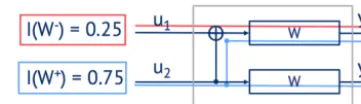
Channel polarization is a transformation of N independent copies of a channelW into a new set ofN channels{WN(i): 1≤i≤N}, where, for largeN, the symmetric channel ca-pacityI (WN(i))approaches either 0 (completely noisy) or 1 (completely error-free). Figure 1 shows an example for a set of two channels before and after the polarization. The chan-nel with decreased capacity is calledW−(red), and the other with the improved capacity is calledW+(blue).
3.2 Code construction
The butterfly structure in Fig. 1b represents the smallest pos-sible Polar Code withN=2. Larger codes can be built by re-cursively combining two codes of lengthN/2 to a new code of lengthN. Therefore, to create a code of lengthN, 2log2N
steps of combining are necessary. The code rateN/Kis then selected by setting the least reliable channels to fixed known values, e.g., 0 (called frozen bits), and using the more reliable channels to transmit the information bits. Figure 2 shows the structure of a Polar Code of lengthN=8 andK=4 infor-mation bitsu1...4. The frozen bits are set to 0.
Polar Codes are defined with a generator matrix GN
that is built by using the Kronecker power F⊗log2N
2 of
F2=
1 0 1 1
. Note thatF2represents the butterfly structure
of Fig. 1b, and the Kronecker power equals the combination of smaller codes into bigger ones.
3.3 Encoding
The encoding is shown in Fig. 2a for aN=8/K=4 Polar Code. A sequence of information bitsu1...4 and frozen bits
is passed through the code structure from left to right to get a codewordx1...8 of length N=8. Formally, the encoding
isx=uGN withGN being the generator matrix and uthe
information vector that includes the frozen bits. 3.4 Decoding
The decoding of Polar Codes can be seen as the reversal of the encoding. Thus, decoding passes the received channel valuesyfrom left to right as shown in Fig. 2b.
received channel values from left to right over the Polar Fac-tor Graph in Fig. 2b. Four types of operations have to be performed for every butterfly structure (see Sect. 4.1). The decoding of the individual bits is performed in a recursive manner on the Polar Factor Graph.
An extension of SC is the Successive Cancellation List (SCL) algorithm. In this algorithm a list of Lmost proba-ble decisions are considered, i.e.,Lcodewords are decoded. The final codeword is selected out of the list by, e.g., the highest overall probability or by other checks like a Cyclic Redundancy Check (CRC). The SC and SCL are sequential algorithms.
An inherently parallel decoding algorithm is the Belief Propagation (BP) algorithm for Polar Codes. It iterates from left to right and reverse over the Polar Code Factor Graph from Fig. 2b. Thus, the bits are decoded in an iterative man-ner similar to the BP for Low Density Parity Check (LDPC) codes. However, Abbas et al. (2017) showed that up to 100 iterations are necessary to match the error correcting perfor-mance of the SC algorithm.
The SCAN algorithm (Fayyaz and Barry, 2014) uses the general processing order of the SC algorithm in combination with the exchange of soft values from the BP algorithm. The SCAN decoding algorithm is highly parameterizable in terms of processing order of the nodes and allows various trade-offs.
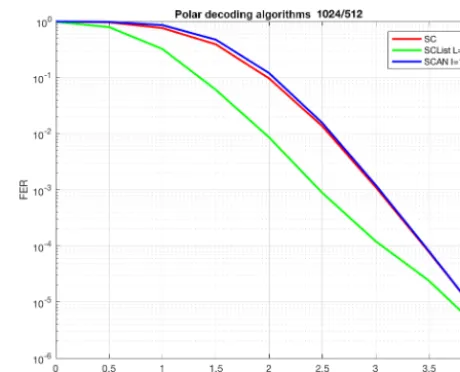
Figure 3 shows the communications performance of the SC, SCL, and SCAN algorithms, respectively. While SC and SCAN provide similar communications performance and mostly differ in the hard or soft output, the SCL algorithm performs significantly better, but at the cost of increased de-coding complexity. The SCL was simulated with list size
L=4 and the SCAN algorithm with one iterationI =1 for a code of N=1024, K=512 over an AWGN channel and floating-point arithmetic. The Polar Code was constructed by using the gaussian approximation method (Vangala et al., 2015) for a design Signal-to-Noise Ratio (SNR) of 0 dB.
4 Modeling of high-throughput architectures
In Sect. 3 we used the Polar Factor Graph to explain decod-ing. A compressed version of this graph is the Polar Factor Tree (see Fig. 4a, b). For that, groups of concurrent calcula-tion steps are combined and represented as a single node in the tree. A row of operations is mapped on the same tree level. Leaf nodes, which are frozen, are marked white (in Fig. 4b), leaf nodes containing information bits blue. Non-leaf nodes containing only frozen or information bits as child
Figure 3.Error Correction Performance in Frame Error Rate (FER) over the SNR inEb/N0for a Polar Code ofN=1024/K=512.
nodes are marked white and blue, respectively. Nodes with mixed leaf nodes are colored half white and half blue.
SC, SCL, and SCAN decoding can be modeled by a depth-first search on this tree. Whenever during search a node is visited, a corresponding operation has to be performed. BP corresponds to a breadth-first search on the same tree.
The factor tree is a better representation than the graph representation and used in many approaches: Alamdar-Yazdi and Kschischang (2011), Sarkis et al. (2014), Sarkis et al. (2016), and Lin et al. (2017). We use the Polar Factor Tree as central data structure for our framework.
4.1 Node operations
As said, all decoding algorithms can be mapped onto a depth-(SC, SCL, SCAN) or breadth-first search (BP) on this Polar Factor Tree. Here we focus on the first class of algorithms. The differences in the three decoding algorithm is in the node operations while the tree is traversed.
Figure 4c and d show the performed operations of one but-terfly unit and one node, respectively.αv,βl, andβr denote vectors that are input to a node (marked in gray).αl,αr, and
βvare corresponding vectors calculated by the node (marked red). The notationαvi with i=0, . . ., N is used to address
one element of the corresponding vector. The dimensions of the vectors depend on the tree levelt, starting witht=0 for the root node. For the vectorsαvandβvthe length isN/2t and forαl,βl,αr, andβr the length isN/2t+1.
Figure 4.Polar Code Representations.
Table 1.Node operations of different decoding algorithms
i=0, . . ., N/2t+1 SC SCL SCAN
αli f
αvi, αvi+N/2 L×fαvi, αvi+N/2 fαvi, αvi+N/2
αri f
αvi, βli⊕αvi+N/2
L×fαvi, βli⊕αvi+N/2
fαvi, βli+αvi+N/2
βvi βli⊕βri L×βli⊕βri f
βli, βri+αvi+N/2
βvi+N/2 βri L×βri f
βli, αvi+N/2
+βri
(Sort and Prune List)
f (a, b)≈sign(a)sign(b)min(|a|,|b|)(Leroux et al., 2011).
Table 2.Optimized pipeline stages for different codes
CodeN/K Node Visits/ Optimized Pipeline Stages
32/16 125 17
128/64 253 65
1024/512 4093 385
1024/768 4093 273
Figure 5.Architectural template for unrolled tree traversals.
of the vectors αl,αr, andβv for the SC, SCL, and SCAN decoding algorithms, respectively.⊕denotes the binary ad-dition and×implying that the operation has to be performed
Ltimes.
Please note that for SCL decoding algorithm, additional effort has to be spent within the nodes for the list manage-ment, in particular the sorting and pruning of the list accord-ing to path metrics which are not shown here for simplicity. Also, the leaf operations differ slightly between SC, SCL, and SCAN. While SC and SCL decide for either 1 or 0 in the leaf node, the SCAN decoding algorithm follows the BP ap-proach for Polar Codes and propagates constants, i.e., infinity for frozen bits and zero for information bits.
4.2 Unrolling the tree traversal
To build high-throughput decoders, pipelining is the most efficient way to gain maximal parallelism and at the same time maximized data locality. For iterative decoding algo-rithms like the BP, pipelining can be achieved by unrolling the iterations and pipelining the different stages. The number of pipelining stages corresponds to the number of iterations. Such an architecture was for the first time demonstrated for LDPC decoding by Schläfer et al. (2013). In their paper, a min-sum LDPC decoding algorithm was unrolled over 9 iter-ations for anN=672,Rate=13/16 LDPC code, achieving an outstanding throughput and energy efficiency, but at the cost of flexibility.
Figure 6.Pipeline Optimization through tree minimization for a Polar Code ofN=16, K=8.
Figure 7.Design Space (red: focus in this paper).
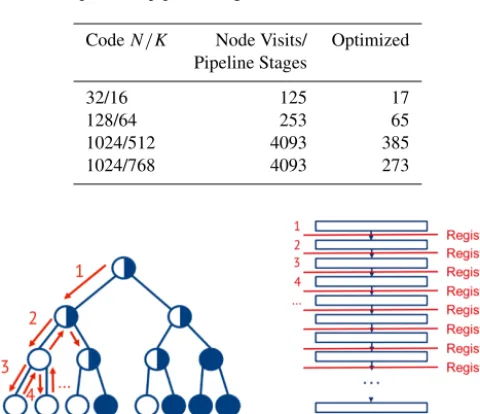
traversal, a corresponding pipeline stage is instantiated. The resulting generic architectural template is shown in Fig. 5: Panel a shows the tree traversal and panel b the correspond-ing pipeline stages. This model serves as a generic model for all decoding algorithms that traverse the tree, i.e., SC, SCL, and SCAN. The only difference between decoders for differ-ent algorithms is in the node operations in the pipeline stages. For a binary balanced tree withNleaf nodes, 2·(2N−2)
node-visits are performed during the depth-first traversal which results in 2·(2N−2)pipeline stages, respectively.
Giard et al. (2015) have first published this concept of un-rolling for Polar Codes and the SC algorithm. Later it was presented by Giard et al. (2016) also for the SCL algorithm. Our approach presented in this paper is a generalized model and valid for all decoding algorithms based on the traversal of the Polar Factor Tree.
4.3 Pipeline optimization
Since the number of traversed nodes’ visits directly maps into the amount of pipeline stages, minimizing the tree cor-responds to minimizing the number of pipeline stages. A smaller tree therefore leads to less pipeline stages, thus lower latency, improved area, and energy efficiency. Sarkis et al. (2014) have proposed some techniques to reduce the size of the Polar Factor Tree without a loss in error correction per-formance.
A reduction is achieved by first replacing complete sub-trees with a single node that can decode the subtree in one step. Two possible subtree optimizations are shown in Fig. 6:
Figure 8.Polar Code decoder exploration framework.
A 4 bit subtree with three frozen and one information bit as leaves, equaling a repetition code, is replaced by a new spe-cialized node (marked red). Similar a 4 bit subtree with only one frozen bit and three information bits as leaves, acting like a simple parity check code, is likewise replaced by a new spe-cialized node (marked green).
The tree can be further reduced by optimizing homoge-neous subtrees (composed of either completely frozen or completely information nodes) and merging them into their parent node. This is valid because a subtree with only frozen bit leaves (marked white in Fig. 6) equals a Rate-0 code, that doesn’t carry any information but only noise. Accordingly a subtree with only information bits as leaves (marked blue) equals a Rate-1 code that consists of only information and no redundancy, therefore has no error correction capabilities. Table 2 shows the number of node visits, or pipeline stages, for selected Polar Codes with different code lengths and code rates, respectively, before and after the optimization for the SCAN decoding algorithm. The numbers for the op-timized pipeline stages are created by traversing the reduced tree described in this section. While the improvement in the number of pipeline stages and therefore also latency and area are significant, it also becomes obvious, that every change in the code length or code rate results in a different tree and, thus, a different architecture.
5 Framework for design space exploration
de-Figure 9.Pipeline architectures.
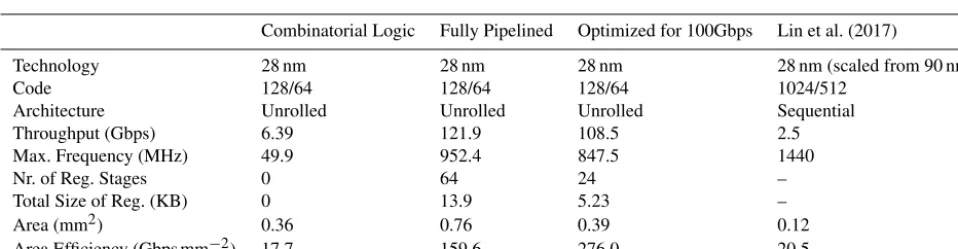
Table 3.Implementation results for a SCAN decoder withN=128/K=64 for different architectures on a 28 nm FD-SOI technology
Combinatorial Logic Fully Pipelined Optimized for 100Gbps Lin et al. (2017)
Technology 28 nm 28 nm 28 nm 28 nm (scaled from 90 nm)
Code 128/64 128/64 128/64 1024/512
Architecture Unrolled Unrolled Unrolled Sequential
Throughput (Gbps) 6.39 121.9 108.5 2.5
Max. Frequency (MHz) 49.9 952.4 847.5 1440
Nr. of Reg. Stages 0 64 24 –
Total Size of Reg. (KB) 0 13.9 5.23 –
Area (mm2) 0.36 0.76 0.39 0.12
Area Efficiency (Gbps mm−2) 17.7 159.6 276.0 20.5
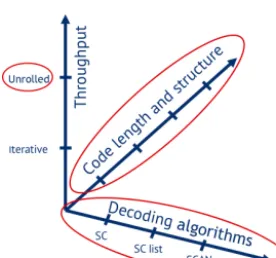
sign space (Fig. 7) of possible architectures. This space is too large for manual investigation and can only be explored by automating the hardware decoder generation.
We developed a framework to explore this design space. Input are a Polar Code, a specific decoding algorithm, and further parameters, e.g., approximations, quantization, etc. Output are simulation results to evaluate the error correction performance and VHDL code of decoder architectures that can be synthesized, placed&routed. This information is fed back into the framework for further optimization. The frame-work consists of a number of different components that are modular and interact as shown in Fig. 8. Their functionality is as follows:
Node Operations: In this block, the node functionality is selected according to the decoding algorithm. The node func-tionality is defined on C++ level for simulation and on VHDL level for architecture generation (Table 1).
TheSimulation Modelgenerates the error correction per-formance for the specified decoding algorithms, approxima-tions, quantization etc., and generates FER/Bit Error Rate plots as shown in Fig. 3.
The Polar Factor Treefrom Sect. 4 represents the main data structure of the framework and uses a Polar Code as input. The tree is then traversed to generate aPipelined Ar-chitecture(see Sect. 4.2). This pipelined architecture uses the sequence of operations from the tree traversal and the VHDL blocks to assemble a fully synthesizable Polar Code decoder in VHDL.
Both the Polar Factor Tree and the pipelined architec-ture are subject to Optimizationbased on results from the simulation model and synthesis/place&route. For the Polar Factor Tree this can be, e.g., optimizations on the tree (see Sect. 4.3). For pipeline optimizations we refer to the next section.
5.1 Case study
To show the performance of our framework we present as a case study, an unrolled SCAN Polar Code decoder with one iteration. We further show various design trade-offs. There are two extreme cases. We can remove all registers from the pipeline stages. This results in a pure combinatorial circuit (Fig. 9a). Advantages are low area, low power, and low latency. Main disadvantage is low throughput. The other extreme is to have a pipeline register between each stage (Fig. 9b). Advantage is high-throughput, disadvantages are high area, high power, and a high latency. Our framework al-lows to balance the register count between the two extrema using its internal timing engine. So, for a given through-put constraint, the number and optimum position of registers can be automatically calculated (Fig. 9c). Table 3 shows the various trade-offs. Results are after place&route and worst case Process-Voltage-Temperature (PVT) on a 28 nm FD-SOI technology. Throughput refers to coded bits.
than 40 times faster and shows a much better area efficiency, To the best of our knowledge, this fully pipelined archi-tecture is the fastest SCAN Polar Code decoder, while the partially pipelined architecture is the most area efficient pub-lished so far.
6 Conclusion and outlook
Based on the works of Sarkis et al. (2014), Giard et al. (2015), and Lin et al. (2017) we proposed a generalized model for the decoding of Polar Codes with the SC, SCL, and SCAN algorithms. This model is used to provide a generic ar-chitectural template for unrolled high-throughput decoders. We further presented a framework to evaluate the error cor-rection performance of Polar Codes, automate the unrolling and generate a fully functional and synthesizable VHDL im-plementation of a Polar Code decoder.
Further, we presented an optimization of pipeline stages to improve the area and energy efficiency. To demonstrate the performance of our framework we presented a high through-put SCAN decoder. With a throughthrough-put of over 100 Gbps it is to our knowledge the fastest published SCAN decoder.
Data availability. All data are represented in the text and functions. The raw data is not meaningfully interpretable without the use of special simulation/synthesis tools which are not publicly available.
Competing interests. The authors declare that they have no conflict of interest.
Special issue statement. This article is part of the special issue “Kleinheubacher Berichte 2017”. It is a result of the Klein-heubacher Tagung 2017, Miltenberg, Germany, 25–27 September 2017.
Acknowledgements. We gratefully acknowledge financial support by the DFG (project-ID: 2442/8-1) and the EU (project-ID: 760150-EPIC).
Edited by: Jens Anders
Reviewed by: two anonymous referees
https://doi.org/10.1109/TVLSI.2016.2620998, 2017.
Alamdar-Yazdi, A. and Kschischang, F. R.: A Sim-plified Successive-Cancellation Decoder for Po-lar Codes, IEEE Commun. Lett., 15, 1378–1380, https://doi.org/10.1109/LCOMM.2011.101811.111480, 2011. Arikan, E.: Channel Polarization: A Method for Constructing
Capacity-Achieving Codes for Symmetric Binary-Input Mem-oryless Channels, IEEE T. Inform. Theory, 55, 3051–3073, https://doi.org/10.1109/TIT.2009.2021379, 2009.
Dizdar, O. and Arıkan, E.: A High-Throughput Energy-Efficient Implementation of Successive Cancellation Decoder for Polar Codes Using Combinational Logic, IEEE T. Circuit. S.-I, 63, 436–447, https://doi.org/10.1109/TCSI.2016.2525020, 2016. Fayyaz, U. U. and Barry, J. R.: Low-Complexity Soft-Output
De-coding of Polar Codes, IEEE J. Sel. Area. Comm., 32, 958–966, https://doi.org/10.1109/JSAC.2014.140515, 2014.
Giard, P., Sarkis, G., Thibeault, C., and Gross, W. J.: 237 Gbit/s unrolled hardware polar decoder, Electron. Lett., 51, 762–763, https://doi.org/10.1049/el.2014.4432, 2015.
Giard, P., Balatsoukas-Stimming, A., Müller, T. C., Burg, A., Thibeault, C., and Gross, W. J.: A multi-Gbps unrolled hard-ware list decoder for a systematic polar code, 50th Asilomar Conference on Signals, Systems and Computers, 1194–1198, https://doi.org/10.1109/ACSSC.2016.7869561, 2016.
Giard, P., Balatsoukas-Stimming, A., Müller, T. C., Bonetti, A., Thibeault, C., Gross, W. J., Flatresse, P., and Burg, A.: PolarBear: A 28-nm FD-SOI ASIC for Decoding of Polar Codes, IEEE J. Em. Sel. Top. C., 7, 616–629, https://doi.org/10.1109/JETCAS.2017.2745704, 2017.
Leroux, C., Tal, I., Vardy, A., and Gross, W. J.: Hard-ware architectures for successive cancellation decoding of polar codes, Int. Conf. Acoust. Spee., 1665–1668, https://doi.org/10.1109/ICASSP.2011.5946819, 2011.
Lin, J., Yan, Z., and Wang, Z.: Efficient Soft Cancelation Decoder Architectures for Polar Codes, IEEE T. VLSI Syst., 25, 87–99, https://doi.org/10.1109/TVLSI.2016.2577883, 2017.
Park, Y. S., Tao, Y., Sun, S., and Zhang, Z.: A 4.68Gb/s be-lief propagation polar decoder with bit-splitting register file, Symposium on VLSI Circuits Digest of Technical Papers, 1–2, https://doi.org/10.1109/VLSIC.2014.6858413, 2014.
Sarkis, G., Giard, P., Vardy, A., Thibeault, C., and Gross, W. J.: Fast Polar Decoders: Algorithm and Imple-mentation, IEEE J. Sel. Area. Comm., 32, 946–957, https://doi.org/10.1109/JSAC.2014.140514, 2014.
Sarkis, G., Giard, P., Vardy, A., Thibeault, C., and Gross, W. J.: Fast List Decoders for Polar Codes, IEEE J. Sel. Area. Comm., 34, 318–328, https://doi.org/10.1109/JSAC.2015.2504299, 2016. Schläfer, P., Wehn, N., Alles, M., and Lehnigk-Emden,
T.: A new dimension of parallelism in ultra high throughput LDPC decoding, SiPS Proceedings, 153–158, https://doi.org/10.1109/SiPS.2013.6674497, 2013.
Vangala, H., Viterbo, E., and Hong, Y.: A Comparative Study of Polar Code Constructions for the AWGN Channel, CoRR, abs/1501.02473, available at: http://arxiv.org/abs/1501.02473 (last access: 24 January 2018), 2015.