DOI10.1186/2190-5983-1-4
R E S E A R C H Open Access
Geometric computing for freeform architecture
Johannes Wallner·Helmut Pottmann
Received: 8 December 2010 / Accepted: 3 June 2011 / Published online: 3 June 2011
© 2011 Wallner, Pottmann; licensee Springer. This is an Open Access article distributed under the terms of the Creative Commons Attribution License
Abstract Geometric computing has recently found a new field of applications, namely the various geometric problems which lie at the heart of rationalization and construction-aware design processes of freeform architecture. We report on our work in this area, dealing with meshes with planar faces and meshes which allow multilayer constructions (which is related to discrete surfaces and their curvatures), triangles meshes with circle-packing properties (which is related to conformal uniformiza-tion), and with the paneling problem. We emphasize the combination of numerical optimization and geometric knowledge.
1 Background
The time of writing this survey paper coincides with the summing up of a six-year so-called national research network entitledIndustrial geometrywhich was funded by the Austrian Science Fund (FWF). By serendipity at the same point in time where the first Ph.D. students started their work in this project, a whole new direction of re-search in applied geometry turned up: meshes and three-dimensional geometric struc-tures which are relevant for rationalization and construction-aware design in freeform architecture. It turned out to be fruitful and rewarding, and of course it is also a topic which perfectly fits the heading of ‘Industrial Geometry’.
J Wallner (
)TU Graz, Kopernikusgasse 24, 8010, Graz, Austria e-mail:[email protected]
J Wallner·H Pottmann
TU Wien, Wiedner Hauptstr. 8-10, 1040, Wien, Austria H Pottmann
It seems that everybody who is in the business of actually realizing freeform archi-tectural designs as a steel-glass construction, or in concrete, or by means of a wooden paneling, quickly encounters the limits of the tools which are commercially available. Some of the problems whose solutions are on top of the list of desiderata are in fact very hard. As a consequence there is great demand for a systematic approach and, most importantly, a full understanding of the geometric possibilities and obstructions inherent in obstacles which present themselves.
We were able to expand knowledge in this direction by applying geometry, differ-ential geometry, and geometric algorithms to some of those problems. Cooperation with industry was essential here. We were fortunate to work with with Waagner-Biro Stahlbau (Vienna), RFR (Paris), and Evolute (Vienna), who provided much-need val-idation, information on actual problems, and real-world data. Remarkably the process of applying he known theory to practical problems also worked in reverse: applica-tions have directly led to research in pure mathematics. In this paper we survey some developments which we see as significant:
- The discrete differential geometry of quadrilateral meshes and the sphere geome-tries of Möbius, Laguerre, and Lie, are closely related to the realization of freeform shapes as steel-glass constructions with so-called torsion free nodes.
- Conformal uniformization appears in connection with circle-packing meshes and derived triangle and hexagonal meshes.
- Optimization using various ideas ranging from combinatorial optimization to image processing is instrumental in solving the paneling problem, that is, the rationaliza-tion of freeform shapesviadecomposition into simple and repetitive elements.
Our research is part of the emerging interdisciplinary field ofarchitectural geom-etry. The interested reader is referred to the proceedings volume [1] which collects recent contributions from different areas (mathematics, engineering, architecture), the textbook [2], and the articles [3–5]. Our aim is to convince the reader that many issues in freeform architecture can be dealt with by meshes or other geometric struc-tures with certainlocalproperties. Further, that we are capable of formulating target functionals for optimization which - if successful - achieve these properties. It is how-ever important to know that in many cases optimization without additional geometric knowledge (utilized, for example, by way of initialization) does not succeed.
2 Multilayer structures
In this section we deal with the remarkable interrelation between the discrete dif-ferential geometry of polyhedral surfaces on the one hand, and problems regarding multilayer structures and torsion-free nodes in steel-glass constructions on the other hand.
2.1 Torsion-free nodes
Fig. 1 Node with torsion. Manufacturing a vertex where symmetry planes of incoming beams do not intersect properly is demanding, especially the central part (image courtesy Waagner-Biro Stahlbau).
follow the edges of this mesh, with glass panels covering the faces. This is in fact a very common method. Experience shows that here often the manufacturing ofnodes
is more complex than one would wish (see Figures1 and2), which is caused by the phenomenon that the symmetry planes of beams which run into a vertex do not intersect nicely in a common node axis. The basic underlying geometric question is phrased in the following terms:
Definition Assume that all edges of a mesh are equipped with a plane which contains that edge.A vertex where the intersection of planes associated with adjacent edges is a straight line is called a node without torsion,and that line is called the node axis.
Problem Is it possible to find meshes(and associated planes)such that vertices do not exhibit torsion,possibly by minimally changing an existing mesh?
Fig. 3 Mesh design. Top: In order to achieve a mesh which follows the architects’ design one can employ an iterative procedure which consists of a subdivision process [6], a switch to diagonals, and mesh opti-mization such that the resulting mesh can be equipped with beams without node torsion (image courtesy Evolute GmbH). Bottom: final mesh corresponding to Figure4(image courtesy Waagner-Biro Stahlbau, cf. [7]).
The answer for triangle meshes is no, there are not enough degrees of freedom available. For a quadrilateral mesh this is different, and we demonstrate an example which has actually been built: The outer skin of the Yas Island hotel in Abu Dhabi which was completed in 2009 exhibits a quadrilateral mesh with non-planar faces which are not covered by glass in a watertight way. Figure3illustrates the tools from Geometric Modeling (subdivision) employed in generating the mesh, the final result is illustrated by Figure4.
2.2 Meshes with planar faces
Fig. 4 Yas Island Hotel during construction. At bottom left one can see a detail of the outer skin which exhibits torsion-free nodes (images courtesy Waagner-Biro Stahlbau).
Problem Approximate a given surface by a quad mesh v:Z2→R3 with planar faces. The same question is asked for slightly more general combinatorics( quad-dominant meshes).
We call such meshes PQ meshes. R. Sauer (see the monograph [10]) has already remarked that a discrete surface’s PQ property is analogous to theconjugateproperty of a smooth surfacex(u, v), which reads
In [11] the convergence of PQ meshes towards smooth conjugate surfaces is treated in a rigorous way. Numerical optimization of a mesh towards the PQ property has been done by [12]. Meanwhile it has turned out that from the viewpoint of numerics, planarity of quads is best achieved if we employ a target functional which penalizes non-intersecting diagonals of quadrilaterals:
facesv1v2v3v4
dist(v1∨v3, v1∨v4), (2)
where the symbol ‘∨’ means the straight line spanned by two points. In practice this target functional has to be augmented by terms which penalize deviation from the reference surface and by a regularization term (for example, one which penalizes deviation of 2nd order differences from their previous values).
Since (2) - like any other equivalent target functional whose minimization ex-presses planarity - is highly nonlinear and non-convex, proper initialization is impor-tant. Essential information on how to initialize is provided by (1): A mesh covering a given surface can be successfully optimized to become PQ only if the mesh polylines follow the parameter lines of a conjugate parametrization of the surface. One example of such a curve network is the network of principal curvature lines, as demonstrated by Figure5.
Caveat. Design of freeform architecture does not work such that an amorphous ‘shape’ is created, and this shape is subsequently approximated by a PQ mesh for the purpose of making a steel-glass structure. The edges of such a decomposition into planar parts are highly visible and therefore must be part of the original design process. Nowadays it is possible to incorporate the PQ property already in the design phase, for instance by a plugin for the widely used softwareRhino(see [13]).
2.3 Meshes with offsets
For multilayer constructions the following question is relevant:
Problem Find an offset pairM,Mof PQ meshes which approximate a given surface
(meaning these meshes are at constant distance from each other).
The distance referred to here can be measured between planes (which are then par-allel), leading to aface offset pairof meshes; or it can be measured between edges (an edge offset pair, implying the same parallelity) or between vertices (if corresponding edges are parallel, we call this a vertex offset pair). For a systematic treatment of this topic we refer to [15]. A weaker requirement is the existence of aparallel mesh
M which is combinatorially equivalent toM but whose edges are parallel to their respective corresponding edge inM(here translated and scaled copies ofMdo not count).
There are several nice relations and characterizations of the various properties of meshes mentioned above. We use the term ‘polyhedral surface’ to emphasize that the faces of a mesh are planar.
Fig. 5 Surface analysis - Islamic Art Museum in the Louvre, Paris (Bellini Architects). Top: A quad-dom-inant mesh which follows a so-called network of conjugate curves can be made such that faces are planar. Unfortunately this surface geometry does not leave us sufficient degrees of freedom to achieve a satisfac-tory quad mesh [14]. Bottom: Hybrid tri/quad mesh solutions with planar faces posses more degrees of freedom (images courtesy A. Schiftner). The one at bottom right has been realized.
- A polyhedral surface has a face/edge/vertex offset if and only if there is a parallel mesh whose faces/edges/vertices are tangent to the unit sphere.
- A PQ mesh has a face offset if and only if in each vertex the two sums of opposite angles between edges are equal. Optimization of a quadrilateral mesh such that its faces become planar, and such that in addition it has a face-offset, is done by
Fig. 6 Relation torsion-free nodes - multilayer structures. This image shows an ‘outer’ layer in front and an ‘inner’ layer behind it; these two layes are based on parallel meshes. One can clearly observe that the planes which connect
Fig. 7 This mesh which possesses a face-face offset at constant distance has been created by an iterative design process which employs subdivision and optimization using both (2) and (3) in an alternating way (image courtesy B. Schneider).
augmenting (2) further by the functional (see Figure7):
anglesω1,...,ω4at vertex
(ω1−ω2+ω3−ω4)2. (3)
- Similarly, a PQ mesh with convex faces has a vertex offset if and only if in each face the sums of opposite angles are equal (these sums then equalπ).
- Any surface can be approximated by a PQ mesh which has vertex offsets, and the same for face offsets: initialize optimization from the network of principal curves. The class of meshes with edge offsets is more restricted. For more details see [12,15].
2.4 Curvatures of polyhedral surfaces
A pair of parallel meshesM,M which are thought to be at distanced can be used to definecurvaturesof the faces ofM. Note that the set of meshes combinatorially equivalent toM is a linear space, and the meshes parallel toM constitute a linear subspace. Consider the vertex-wise linear combinationMr=(1−dr)M+drMand the areaA(fr)of a face ofMr asrchanges: it is not difficult to see that we have
Afd=A(f )1−2dHf +d2Kf
. (4)
The coefficientsHf,Kf are expressibleviaareas and so-called mixed areas of
by the surface integral
Ad=
1−2dH (x)+d2K(x)dω(x), (5)
whereH,Kare Gaussian and mean curvatures, respectively. It therefore makes sense to call Hf, Kf in (4) the mean curvature and Gaussian curvature of the face f
(w.r.t. to the offsetM).
This definition is remarkable in so far as notable constructions of discrete minimal surfaces such as [16] turn out to have zero mean curvature in this sense. For details and further developments we refer to [11,17,18].
3 Conformal uniformization
Uniformization in general refers to finding a list of model domains and model surfaces such that ‘all’ domains/surfaces under consideration can be conformally mapped to one of the models. The unit disk and the unit sphere serve this purpose for the simply connected surfaces with boundary and for the simply connected closed surfaces without boundary, respectively.
Surfaces which are topologically equivalent to an annulus are conformally equiv-alent to a special annulus of the form{z∈C|r1<|z|< r2}, but the ratior1:r2is
a conformal invariant, and there is a continuum of annuli which are mutually non-equivalentviaconformal mappings. A classical theorem states that planar domains withnholes are conformally equivalent to a circular domain withncircular holes, and that domain is unique up to Möbius transformations. A similar result, whose statement requires the concept of Riemann surface, is true for surfaces of higher genus with finitely many boundary components.
3.1 Circle-packing meshes
It is very interesting how the previous paragraph is related to the following question, which for designers of freeform architecture is interesting to know the answer to:
Problem Find a covering(within tolerance)of a surface by a circle pattern of mainly regular-hexagonal combinatorics.
It turns out that this and similar questions can be answered if one can solve the following:
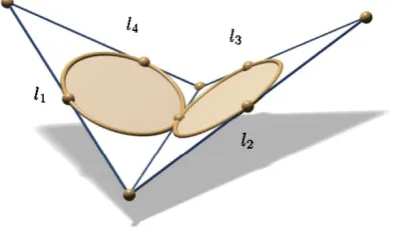
Problem Given is a triangle meshM.Find a triangle meshM such that all pairs of neighbouring incircles of M have a common point, but such that M approxi-matesM.
Fig. 8 Optimization of an irregular triangle mesh towards the circle-packing (CP) property.
a target functional for optimization of a meshMwhich approximates a surface:
F (M)=
lengthsl1,...,l4
of triangle pair
(l1+l3−l2−l4)2
+
verticesv
t-dist(v, )2 (6)
+
bdry verticesv
t-dist(v, ∂)2.
The distances are measured to the tangent plane in the closest-point projection onto
; and similarly for the boundary curve’s tangent.
We can further see from Figure9 that a vertex has the same distance from all incircle contact points on adjacent edges: It follows that the CP property is equivalent to the existence a packing of vertex-centered balls: balls touch each other if and only if the corresponding vertices are connected by an edge (see Figure10).
In [19] we discuss the relevance of these meshes for freeform architecture which is mainly due to the fact that we can cover surfaces with approximate circle patterns of hexagonal combinatorics, with hybrid tri-hex structures with excellent statics, and other derived constructions (see Figures11and12).
Numerical experiments show that optimizing a triangle mesh towards the CP prop-erty works in exactly those cases where topological equivalence implies conformal
Fig. 10 The CP property is equivalent to the existence of a ball packing with centers in the vertices. Here red balls correspond to vertices with valence=6.
Fig. 11 Structures derived from CP meshes: approximate circle packing with hexagonal combinatorics which covers a freeform design.
Fig. 12 Structures derived from CP meshes: hybrid tri-hex structure with planar facets and support structure derived from a CP mesh [19].
Fig. 13 CP-optimization. Top: Great Court Roof, British Museum, London. Triangle mesh by Chris Williams (as built). Bottom: Combinatorially equivalent mesh with the CP property which approximates the same surface and its outer boundary. The inner boundary could move freely during optimization.
3.2 Discrete conformal mappings
If we had optimized triangular subdivisions of planar domains instead of spatial trian-gle meshes, the reason for the behaviour of numerical optimization mentioned in the previous paragraph would be clear. This is because in the planar case the CP meshes and associated ball packings are the same as the circle packings as studied by [20], and for these much is known: Two combinatorially equivalent circle packings con-stitute a discrete-conformal mapping of domains, and one can show convergence to the classical conformal mappings when packings are refined (in fact, this approach to conformal mappings was used in the proof of an extension of the Koebe normal form theorem to more general domains by He and Schramm in [21]).
Problem Show that the natural correspondence between combinatorially equivalent CP meshes approximates a conformal mapping of surfaces(and make this statement precise by using an appropriate notion of refinement).
Unfortunately this problem - the only one in this paper which involves mathemat-ics and not applications - is currently unsolved. There is, however, strong numerical evidence for an affirmative answer, and there is the known analogous planar case.
4 The paneling problem
An important part of the realization process of free-form skins is their decomposition into smaller parts (calledpanels) such that the entire cost of manufacturing and han-dling is as small as possible, and such that the numerous side-conditions concerning dimensions, overall smoothness, and so on are satisfied. In addition any resolution of the given design into panels must not visibly deviate from the original architect’s design (see Figures14and15).
4.1 Global panel optimization
A simple decomposition of a freeform facade typically leads to individual panels with no two of them being identical: in the worst case, their manufacturing is possible only by first manufacturing a mold for each. [22] presents a procedure which combines both combinatorial and continuous optimization in an effort to reduce the total cost, and which is based on the concept ofmold reuse. The idea is that a guiding curve
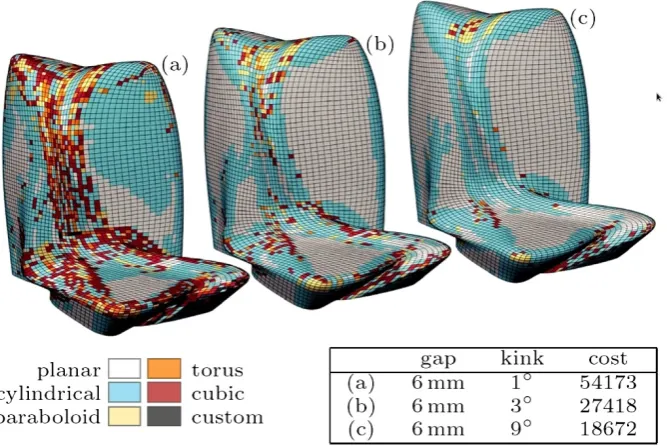
Fig. 15 Optimal decomposition into panels. Top: the design of Figure14is cut into panels along a given network of curves. Panels are of various types (planar, cylindrical, and so on). The total cost depends on the required quality.
network is given. Such guiding curves are highly visible on the finished building so it is safe to assume the architect has firm ideas on their shape! We seek a decomposition of the facade into pieces which are easily manufacturable.
The production processes employed here may be of different kinds: Flat pieces are easily made by cutting them out from readily available panels; cylinder-shaped pieces have to be bent by a machine which is not cheap; truly freeform pieces have to be shaped by hot bending, using a mold which has to be specially made and which is far from cheap. Note that once a mold is available, we can use it to manufacture any surface which by a Euclidean congruence transformation can be moved so as to be a subset of the mold surface. Using the word ‘mold’ for all kinds of production processes, we state:
Problem Find out how the given panels may be replaced by other panels which can be produced by a small number of molds,thereby minimizing production cost under the side condition that the overall surface does not change visibly.
A more precise problem statement is the following: Given a network of curves on a freeform surface which is thereby dissected into a collectionP of panels,
(1) specify a setM of admissible molds. Each moldmhas an integer typei(m)
and a shape σ (m)which typically is some n-tuple of reals. There are costsαi of
Fig. 16 Reflection lines help in visually inspecting the achieved surface quality for the three examples (a)–(c) shown by Figure15.
(2) find an assignmentμ:P →Mof molds to panels, such that the total cost
m∈μ(P )
αi(m)+
p∈P
βi(μ(p))
is minimal, under the side-conditions of bounded deviation from the curve network and bounded kink angles.
An implication of this simple cost model is that one should favour cheap pro-duction processes/molds, and if an expensive one is necessary it should be used to produce more than just one panel. Optimization contains a discrete part similar toset cover(the mold type assignment) and a continuous part (choosing the mold shapes). An example is shown by Figures14–16.
The high complexity of this optimization task is caused by the sheer number of panels (thousands) and the coupling of different panels if they are assigned to the same mold. It turns out that it contains an NP hard subproblem. Several devices for acceleration are employed, for example, fast estimates from above of the distance of molds in shape space. For details we refer to [22,23].
4.2 Wooden panels: level set methods
If a bendable rectangle is forced to lie on a surface, it roughly follows a geodesic curve on that surface (see, for example, [25]). These geodesics are defined by having zero geodesic curvature, and at the same time they are the shortest paths on the sur-face. The covering of a surface by such panels requires the solution of the following geometric problem:
Problem Find a layout of a pattern of geodesics which are(within tolerance)at equal distance from each other.
The literature contains suggestions for experimental solutions of this problem (see Figure17). Firstly it must be said that very few surfaces possess patterns of geodesics which run parallel at constant distance: They exist precisely on the intrinsically flat surfaces with vanishing Gaussian curvature. For infinitesimally close geodesics, the distance has the form ·w(s), where 1,sis an arc length parameter, andw(s)
Fig. 17 Experimental geodesic pattern [24].
a zero ofw(s), so it is not even possible that two geodesics run side by side without intersection [26].
In [27,28] we have shown how to algorithmically approach the problem of laying out a pattern of near-geodesics which have approximately constant distance from each other. Alevel set methodturns out to be useful: It is well known that equidistant curves may be seen as level sets of a functionφfor which
∇φ −1 (7)
vanishes (that is,φfulfills theeikonal equation). The geodesic property of level sets is expressed by vanishing of
div
∇φ
∇φ
(8)
(see [26, p. 142]). We accordingly minimize a target functional which combines the competingL2norms of both (7) and (8) together withφL2 and additional terms
which penalize deviation from other desired properties like prescribed directions, and so on.
This is numerically done by describing the underlying surface as a triangle mesh with typically <106 vertices, and considering φ as function on the vertices, with piecewise-linear interpolation in the faces of the mesh. The gradient of such a func-tion is then piecewise constant, and for any vector fieldXand vertexv, we evaluate
(divX)(v)from the flux ofXthrough the boundary ofv’s intrinsic Voronoi cell. The resulting optimization problem is solved by standard Gauss-Newton methods (similar to the other problems of numerical optimization we considered above), augmented by CHOLMODfor sparse Cholesky factorization [29].
4.3 Segmentation: image processing methods
In general it is not possible to cover a surface by a smooth pattern of panels which in their un-bent state are rectangular or at least cut from rectangles. It is necessary to perform segmentation into panelizable parts. This can be formulated as follows:
Problem Decompose a given surface into a finite number of domains with piecewise-smooth boundaries each of which may be covered by a(within tolerance)
Fig. 18 Piecewise-geodesic vector fields. Left: A design vector fieldW. Right: A piecewise-geodesic vector fieldV which approximatesWand whose discontinuities lead to segmentation of the underlying surface [27].
For that purpose we describe families of curves asintegral curvesof a unit vector field. It turns out that the geodesic property can be characterized by the symmetry of the covariant derivative mappingX→ ∇XV, which is linear within each tangent
space:
γV ,p(X, Y )= ∇XV , Yp− X,∇YVp=0. (9)
The dependence on the point p∈ is indicated by the subscript to the scalar products. The normγV ,pmeasures how farV deviates from the geodesic property
locally around the pointp.
Any unit vector fieldW, and in particular one which has been created interac-tively by a designer, can now be approximated by apiecewise geodesicvector fieldV
which occurs as a minimizer of a target functional suitable constructed from weighted integrals of the functions
ργV ,p
, where ρ(x)= x
2
1+αx2,
V−W2
together with regularizing terms. For details we refer to [27]. The functionρ could be any of the heavy-tailed functions used in image sharpening (cf. [30]), we used the Geman-McClure estimator [31]. This causes high values of ρp,V to be
con-centrated along curve-like regions which become the boundaries of domains. For the actual segmentation we employed the method of [32]. An example is shown by Fig-ures18and19.
Competing interests
Fig. 19 A design with bent rectangular panels based on segmentation of the surface of Figure18. The underlying patterns of geodesics have been found by a further method not described in this paper (see [27]).
Acknowledgements This article surveys results obtained within the framework oft the National Re-search Network ‘Industrial Geometry’ (grants No. S9206, S9209, Austrian Science Fund). It was partly supported by the 7th framework programme of EU (grant agreement ‘ARC’ No. 230520) and by grant No. 813391 of the Austrian Science Promotion Agency (FFG). We are grateful to coauthors of all papers referenced in the paper for the use of figures, and to Waagner Biro Stahlbau, Vienna, to Zaha Hadid Ar-chitects, London, to RFR, Paris, and to Evolute GmbH, Vienna, for making geometry data available to us.
References
1. Ceccato, C., Hesselgren, P., Pauly, M., Pottmann, H., Wallner, J.: Advances in Architectural Geometry 2010. Springer, New York (2010)
2. Pottmann, H., Asperl, A., Hofer, M., Kilian, A.: Architectural Geometry. Bentley Institute Press, Exton, PA.http://www.architecturalgeometry.at(2007)
3. Pottmann, H.: Geometry and new and future spatial patterns. Archit. Des.79(6), 60–65 (2009) 4. Pottmann, H.: Architectural geometry as design knowledge. Archit. Des.80(4), 72–77 (2010) 5. Pottmann, H., Wallner, J.: Freiformarchitektur und Mathematik. Mitt. DMV18(2), 88–95 (2010) 6. Warren, J., Weimer, H.: Subdivision Methods for Geometric Design: A Constructive Approach.
Mor-gan Kaufmann, San Francisco (2001)
7. Frey, H., Reiser, B., Ziegler, R.: Yas Island Marina-Hotel – Pole position in Abu Dhabi. Stahlbau
78(10), 758–763 (2009)
8. Glymph, J., Shelden, D., Ceccato, C., Mussel, J., Schober, H.: A parametric strategy for freeform glass structures using quadrilateral planar facets. In: Proc. Acadia, pp. 303–321 (2002)
9. Schober, H.: Freeform Glass Structures. In: Glass Processing Days, pp. 46–50 (2003) 10. Sauer, R.: Differenzengeometrie. Springer, Berlin (1970)
11. Bobenko, A., Suris, Y.: Discrete Differential Geometry: Integrable Structure. American Math. Soc., Providence, RI (2008)
12. Liu, Y., Pottmann, H., Wallner, J., Yang, Y.L., Wang, W.: Geometric modeling with conical meshes and developable surfaces. ACM Trans. Graph.25(3), 681–689 (2006)
13. Evolute GmbH: Evolutetools for Rhino.http://www.evolute.at(2010)
14. Zadravec, M., Schiftner, A., Wallner, J.: Designing quad-dominant meshes with planar faces. Comput. Graph. Forum29(5), 1671–1679 (2010)
15. Pottmann, H., Liu, Y., Wallner, J., Bobenko, A., Wang, W.: Geometry of multi-layer freeform struc-tures for architecture. ACM Trans. Graph.26(3), 65 (2007)
16. Bobenko, A., Hoffmann, T., Springborn, B.: Minimal surfaces from circle patterns: geometry from combinatorics. Ann. Math.164, 231–264 (2006)
17. Bobenko, A., Pottmann, H., Wallner, J.: A curvature theory for discrete surfaces based on mesh par-allelity. Math. Ann.348, 1–24 (2010)
18. Müller, C., Wallner, J.: Oriented mixed area and discrete minimal surfaces. Discrete Comput. Geom.
19. Schiftner, A., Höbinger, M., Wallner, J., Pottmann, H.: Packing circles and spheres on surfaces. ACM Trans. Graph.28(5), 139 (2009)
20. Stephenson, K.: Introduction to Circle Packing. Univ. Press, Cambridge (2005)
21. He, Z.X., Schramm, O.: Fixed points, Koebe uniformization and circle packings. Ann. Math.137, 369–406 (1993)
22. Eigensatz, M., Kilian, M., Schiftner, A., Mitra, N., Pottmann, H., Pauly, M.: Paneling architectural freeform surfaces. ACM Trans. Graph.29(4), 45 (2010)
23. Eigensatz, M., Deuss, M., Schiftner, A., Kilian, M., Mitra, N.J., Pottmann, H., Pauly, M.: Case stud-ies in cost-optimized paneling of architectural freeform surfaces. In: Ceccato, C., Hesselgren, P., Pauly, M., Pottmann, H., Wallner, J. (eds.) Advances in Architectural Geometry 2010, pp. 49–72. Springer, New York (2010)
24. Spuybroek, L.: NOX: Machining Architecture. Thames & Hudson, London (2004)
25. Pirazzi, C., Weinand, Y.: Geodesic lines on free-form surfaces: optimized grids for timber rib shells. In: Proc. World Conference on Timber Engineering, p. 7 (2006)
26. do Carmo, M.P.: Riemannian Geometry, 2nd edn. Birkäuser, Boston (1992)
27. Pottmann, H., Huang, Q., Deng, B., Schiftner, A., Kilian, M., Guibas, L., Wallner, J.: Geodesic pat-terns. ACM Trans. Graph.29(4), 43 (2010)
28. Wallner, J., Schiftner, A., Kilian, M., Flöry, S., Höbinger, M., Deng, B., Huang, Q., Pottmann, H.: Tiling freeform shapes with straight panels: algorithmic methods. In: Ceccato, C., Hesselgren, P., Pauly, M., Pottmann, H., Wallner, J. (eds.) Advances in Architectural Geometry 2010, pp. 73–86. Springer, New York (2010)
29. Chen, Y., Davis, T.A., Hager, W.W., Rajamanickam, S.: Algorithm 887: CHOLMOD, supernodal sparse Cholesky factorization and update/downdate. ACM Trans. Math. Softw.35(3), 22 (2008) 30. Levin, A., Fergus, R., Durand, F., Freeman, W.T.: Image and depth from a conventional camera with
a coded aperture. ACM Trans. Graph.26(3), 70 (2007)
31. Geman, S., McClure, D.E.: Statistical methods for tomographic image reconstruction. Bull. Inst. In-ternat. Stat.52(4), 5–21 (1987)

![Fig. 3 Mesh design. Top: In order to achieve a mesh which follows the architects’ design one can employan iterative procedure which consists of a subdivision process [6], a switch to diagonals, and mesh opti-mization such that the resulting mesh can be equ](https://thumb-us.123doks.com/thumbv2/123dok_us/9612811.1943558/4.439.67.378.44.311/architects-iterative-procedure-consists-subdivision-diagonals-mization-resulting.webp)