Open Access
Commentary
New perspectives in human stem cell therapeutic research
Alan Trounson
Address: California Institute for Regenerative Medicine, 210 King Street, San Francisco, CA, 94107, USA
Email: Alan Trounson - [email protected]
Abstract
Human stem cells are in evaluation in clinical stem cell trials, primarily as autologous bone marrow studies, autologous and allogenic mesenchymal stem cell trials, and some allogenic neural stem cell transplantation projects. Safety and efficacy are being addressed for a number of disease state applications. There is considerable data supporting safety of bone marrow and mesenchymal stem cell transplants but the efficacy data are variable and of mixed benefit. Mechanisms of action of many of these cells are unknown and this raises the concern of unpredictable results in the future. Nevertheless there is considerable optimism that immune suppression and anti-inflammatory properties of mesenchymal stem cells will be of benefit for many conditions such as graft versus host disease, solid organ transplants and pulmonary fibrosis. Where bone marrow and mesenchymal stem cells are being studied for heart disease, stroke and other neurodegenerative disorders, again progress is mixed and mostly without significant benefit. However, correction of multiple sclerosis, at least in the short term is encouraging. Clinical trials on the use of embryonic stem cell derivatives for spinal injury and macular degeneration are beginning and a raft of other clinical trials can be expected soon, for example, the use of neural stem cells for killing inoperable glioma and embryonic stem cells for regenerating β islet cells for diabetes. The change in attitude to embryonic stem cell research with the incoming Obama administration heralds a new co-operative environment for study and evaluation of stem cell therapies. The Californian stem cell initiative (California Institute for Regenerative Medicine) has engendered global collaboration for this new medicine that will now also be supported by the US Federal Government. The active participation of governments, academia, biotechnology, pharmaceutical companies, and private investment is a powerful consortium for advances in health.
Commentary
There are some major changes happening in stem cell therapies that are setting a new paradigm for regenerative medicine. The opportunity to repair and regenerate tissues injured by disease and trauma is opening the way to new optimistic treatments that need to be carefully evaluated in early clinical trials. These developments are building on the successes of bone marrow hematopoietic stem cell (HSCs) transplants that have more than 30 years of patient applications in blood diseases and cancer. The
bulk of applications of the new stem cell therapies follow the expected route of autologous transplants, to avoid severe immune suppression that commonly applies to all-ogenic cell transplantation. However, autologous thera-pies require the recovery of the patient's own hematopoietic, endothelial or mesenchymal stem cells by bone marrow biopsy, mobilization of bone marrow stem cell types by administration of recombinant growth fac-tors, and isolation of multipotent stem cells from adipose tissue.
Published: 11 June 2009
BMC Medicine 2009, 7:29 doi:10.1186/1741-7015-7-29
Received: 26 May 2009 Accepted: 11 June 2009
This article is available from: http://www.biomedcentral.com/1741-7015/7/29 © 2009 Trounson; licensee BioMed Central Ltd.
These autologous stem cell therapies are in widespread clinical trials with varying reported clinical benefits to patients. Reports on the use of granulocyte-colony stimu-lating factor mobilization of bone marrow stem cells and the intracoronary administration of leukapheretically iso-lated HSCs, show a few subjective benefits but overall no real objective benefit in refractory ischemic heart disease [1]. Some consistency in benefit in left ventricular func-tion and remodeling has been observed in studies of intra-coronary administration of the patient's own bone marrow preparations for severe myocardial infarction [2]. There is also evidence in the few comparative clinical stud-ies available that the endothelial (CD34+) fraction of mononuclear bone marrow cells is the potent cell type responsible for vascular growth and regeneration and the clinical improvements observed in cardiac repair [3].
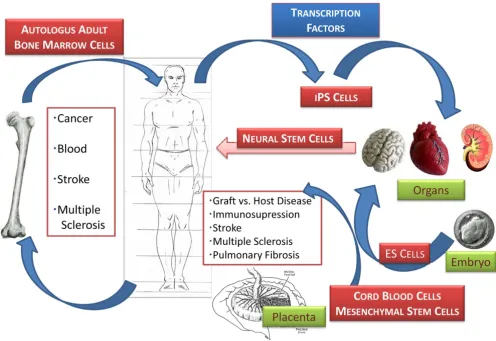
Aside from autologous adult stem transplants that are based mainly on the use of bone marrow, where is the field moving (Figure 1)? There is an increasing interest in allogenic stem cell therapies and advantage is being taken of cell therapies using mesenchymal (bone marrow stro-mal) stem cells (MSCs), which have both multipotential (by definition are capable of forming bone, adipose, and cartilage tissue), and immunosuppressive properties. The latter enables their grafting without the need for severe immunosupression and selection for histocompatibilty. These clinical trials are being led by the biotechnology companies, Osiris (Columbia, MD, USA) and Angioblast (New York, USA)/Mesoblast (Melbourne, Australia) for primary applications in preventing graft versus host ease (GvH) and treatment of cardiovascular and bone dis-eases. Cartilage repair using MSCs is still in preclinical and phase I studies with no detailed comparative data in humans [4]. Other very accessible sources of MSCs with
Human stem cell transplants Figure 1
apparently equivalent biological function have been iden-tified, including the placenta [5] and Wharton's jelly of the human umbilical cord [6]. The use of cord blood cells in adults may be often accompanied by central nervous complications [7] and the need for enhancement of adap-tive immunity without GvH. These conditions may be improved clinically by co-infusion of MSCs with cord blood cells [8].
Perhaps more challenging is the use of bone marrow derivatives for neural degenerative disorders. Autologous non-myeloablative HSC transplantation (mononucleo-cytes and platelets) has been undertaken, for example in 21 patients with relapsing-remitting multiple sclerosis to reverse neurological deficits [9]. The benefits are derived presumably from the MSC-induced immune suppression and inhibition of the proliferation of alloreactive T cells observed both in vitro and in vivo [10]. Similarly, benefits have been observed for steroid resistant GvH disease using MSCs [11,12], and also severe inflammatory diseases such as idiopathic pulmonary fibrosis [13]. While these reports are encouraging, further development and improvement of efficacy is needed because the use of MSCs for GvH and inflammatory disease is not as yet able to completely replace more conventional approaches that limit their severity [14]. Likewise, solid organ transplantation accompanied by MSC administration limits the prolifera-tion of alloactivated T cells as shown in studies with kid-ney transplantation [15]. Concerns remain that while MSC administration is safe and potentially effective, the mixed results, that is, lack of demonstrated functionality and absence of long-term integration of MSC derivatives, are distinctly of issue [16].
It is also proposed that bone marrow stem cell mobiliza-tion be used to treat stroke despite little understanding of the possible mechanisms that may be involved. Clinical trials are underway and there is optimism that benefits will be clearly demonstrated [17]. Some attempts are being made to coordinate and standardize methods and assessments to enable a better determination of clinical benefit across trials, an issue that has been a constant dif-ficulty for interpreting benefit in stem cell trials [18]. Neural stem cells (NSCs) are being explored for the treat-ment of lysosomal storage diseases in very young patients. The biotechnology company California Stem Cells Inc. (Irvine, CA, USA) is using transplantation of fetal NSCs for children with Batten's disease. This is an important study that addresses a very difficult genetic disease. While some benefits are reported for pharmacological enzyme replacement therapy for lysosomal storage diseases [19], long-term therapy is likely to be restricted to cell-based approaches. It is also of interest that NSCs have a remark-able tropism for malignant gliomas. Consequently, NSCs
are a very likely vector to deliver oncolytic agents such as the intra-tumoral herpes simplex virus thymidine kinase [20]. There is strong interest in targeting inoperable glio-balatomas using this strategy with a range of engineered NSCs that will be seeking clinical trial approval in the near future. Some concern was raised by the report of solid multifocal brain tumor in a child with ataxia telangiecta-sia treated with intracerebellar and intrathecal injections of fetal NSCs in a clinic in Russia [21]. The glioneuronal neoplasm was of donor origin. There is little known of the methods used in this clinic and no reports in a large number of fetal brain tissue transplants in studies from other clinics. Nevertheless, continued vigilance in clinical trials is needed to ensure safety in all types of stem cell transplantation.
Clinical studies on the use of pluripotential stem cells are beginning. The first approved clinical trial by the Food and Drug Administration (FDA) using embryonic stem cell-derived products is for complete spinal cord injury involving low lumbar injection of glial oligodendrocytes by the biotechnology company Geron (Menlo Park, CA, USA) [22]. Their trial is in phase I testing for safety and will involve a small number of patients [23]. The Interna-tional Society of Stem Cell Research has released guide-lines for translational and preclinical research to ensure the global scientific community has a benchmark for the scientific and ethical principles involved in applying pluripotential stem cells for clinical treatments in regener-ative medicine [24]. Many other applications are expected to enter clinical trial from embryonic stem cells (ESCs) or the new induced pluripotential stem cells (iPSCs) that are reprogrammed from mature adult cells by transduction with transcription factor DNA [25] or recombinant tran-scription factor proteins [26].
(Sand-wich, UK) has joined the British group pioneering these studies and both Pfiza and Johnson & Johnson (Lang-horne, PA) have links to the Californian biotechnology company Novocell (Irvine, CA) who are developing β islet cells derived from human ESCs for correction of diabetes. Clinical trial approval may be expected to be sought from the FDA by Novocell in the near future.
The changes that have just occurred in the US Federal Administration following the election of President Obama are substantial and important. The removal of the presidential proclamation that hindered the support of human ESC research through the US National Institutes of Health (NIH) has galvanized the scientific and biotech-nology communities to accelerate progress on basic research and to stimulate translational work for regulatory approval. The Californian Institute for Regenerative Med-icine (CIRM), charged with directing the US$3 billion of research funding on stem cell research, has just announced US$68 million for translational projects to complement the very substantial support of basic research, training and facilities (>US$600 million) awarded over the last 3 years. CIRM is also in the process of previewing responses for the call for preclinical 'disease team' projects that will be each funded up to US$20 mil-lion for 4 years. These projects are expected to submit for regulatory approval for clinical trials within the next 4 years. It is expected that with encouragement from CIRM, NIH, and the FDA, given the new federal administrative backing, there will be an escalation of clinical trial sub-missions involving pluripotent ESCs and iPSCs, multipo-tent placental, and adult and fetal stem cells. The challenge will remain to evaluate their effectiveness and safety, compared with any other treatments that are cur-rently available. The need for investment for clinical trial support will be limiting unless the government and health insurance industry joins pharmaceutical and biotechnol-ogy industries to carry out the large variety of trials expected. Academic and medical research centers are also expected to be involved in the translation and clinical trial processes which heralds new opportunities for teamwork approaches for these new cell therapies.
There are also changes in interest for collaborations nationally and internationally. CIRM has collaborative agreements for joint funding of research projects with the UK, Spain, Canada, the State of Victoria in Australia, and Japan. The State of Victoria has been successful in the award of joint funding with CIRM for early translational grants, and the UK, Canada, and Spain are participating in the disease team applications. CIRM expects to work together with the NIH to promote national collaborations in stem cell research and has formulated a program of loans to support Californian companies working in stem cell science. The amalgamation of all these interests
pro-vides an extremely healthy environment for the global endeavor to deliver cell and related therapies to patients. In conclusion, the field of stem cell sciences is rapidly integrating as new clinical trials of adult bone marrow, MSCs and NSCs for treatment of a variety of pathologies that build on more than 30 years of experience of treating blood diseases and cancer with HSCs. These new trials include many allogenic cell therapies that are more chal-lenging than the autologous cell therapies, but within the next 10 years these will be the platform for the newly evolving pluripotential stem cell therapeutics. The latter presently involves ESCs differentiated to NSCs, glial and neuronal lineages, retinal epithelium, β islet cells, cardio-myocytes, hepatocytes, blood cells, and many other cell types and engineered tissue. Since the initial trials with patients will be phase I studies, which address safety issues, it is expected that useful clinical data on cell thera-peutic effectiveness will not really be available for 5 to 10 years. While this may sound to be a long time, it is the established processes for trials that developments from discovery to clinical acceptance are generally 20 years or more. The therapies that will emerge first are likely to address neural repair, macular degeneration, cancer tar-geting, problems of immunity, and cardiovascular dis-ease. However, the validity of these predictions will depend on the benefits obtained in the human phase II and III clinical trials that are still some time away. In the meantime, new candidate small molecules and bioactives are being identified using stem cell assays in high throughput screening that will impact on stem cell mobi-lization and expansion for regenerative medicine. Person-alized medicine will also undergo a revolution with the use of iPSCs for analyzing disease heterogeneity and vari-able drug response.
Abbreviations
CIRM: Californian Institute for Regenerative Medicine; ESC: embryonic stem cells; FDA: Food and Drug Admin-istration; GvH: graft versus host disease; HSC: hematopoi-etic stem cell; iPSC: induced pluripotential stem cells; MSC: mesenchymal stem cells; NIH: US National Insti-tutes of Health; NSC: neural stem cell.
Competing interests
The author declares that they have no competing interests.
References
1. Kovacic JC, Macdonald P, Feneley MP, Muller DW, Freund J, Dodds A, Milliken S, Tao H, Itescu S, Moore J, Ma D, Graham RM: Safety and efficacy of consecutive cycles of granulocyte-colony stimulating factor, and an intracoronary CD133+ cell infu-sion in patients with chronic refractory ischemic heart dis-ease: the G-CSF in angina patients with IHD to stimulate neovascularization (GAIN I) trial. Am Heart J 2008,
156:954-963.
adminis-tration of bone marrow-derived progenitor cells improves left ventricular function in patients at risk for adverse remodeling after acute ST-segment elevation myocardial infarction: results of the Reinfusion of Enriched Progenitor cells And Infarct Remodeling in Acute Myocardial Infarction study (REPAIR-AMI) cardiac magnetic resonance imaging substudy. Am Heart J 2009, 157:541-547.
3. Sekiguchi H, Ii M, Losordo DW: The relative potency and safety of endothelial progenitor cells and unselected mononuclear cells for recovery from myocardial infarction and ischemia.
Am J Physiol Cell Physiol 2009, 219:235-242.
4. Koga H, Engebretsen L, Brinchmann JE, Muneta T, Sekiya I: Mesen-chymal stem cell-based therapy for cartilage repair: a review. Knee Surg Sports Traumatol Arthrosc 2009 in press. 5. Brooke G, Rossetti T, Pelekanos R, Ilic N, Murray P, Hancock S,
Anto-nenas V, Huang G, Gottlieb D, Bradstock K, Atkinson K: Manufac-turing of human placenta-derived mesenchymal stem cells for clinical trials. Br J Haematol 2009, 144:571-579.
6. Moodley Y, Atienza D, Manuelpillai U, Tchongue J, Samuel CS, Ilancheran S, Boyd R, Trounson A: Human umbilical cord mesen-chymal stem cells reduce fibrosis of bleomycin-induced lung injury. Am J Path 2009 in press.
7. Narimatsu H, Miyamura K, Iida H, Hamaguchi M, Uchida T, Morishita Y, Nagoya Blood and Marrow Transplantation Group (NBMTG):
Early central nervous complications after umbilical cord blood transplantation for adults. Biol Blood Marrow Transplant
2009, 15:92-100.
8. Gonzalo-Daganzo R, Regidor C, Martín-Donaire T, Rico MA, Bautista G, Krsnik I, Forés R, Ojeda E, Sanjuán I, García-Marco JA, Navarro B, Gil S, Sánchez R, Panadero N, Gutiérrez Y, García-Berciano M, Pérez N, Millán I, Cabrera R, Fernández MN: Results of a pilot study on the use of third-party donor mesenchymal stromal cells in cord blood transplantation in adults. Cytotherapy 2009,
11:278-288.
9. Burt RK, Loh Y, Cohen B, Stefoski D, Balabanov R, Katsamakis G, Oyama Y, Russell EJ, Stern J, Muraro P, Rose J, Testori A, Bucha J, Jovanovic B, Milanetti F, Storek J, Voltarelli JC, Burns WH: Autolo-gous non-myeloablative haemopoietic stem cell transplanta-tion in relapsing-remitting multiple sclerosis: a phase I/II study. Lancet Neurol 2009, 8:244-253.
10. Nasef A, Ashammakhi N, Fouillard L: Immunomodulatory effect of mesenchymal stromal cells: possible mechanisms. Int J Lab Hematol 2009, 31:9-19.
11. Troeger A, Meisel R, Moritz T, Dilloo D: Immunotherapy in allo-geneic hematopoietic stem cell transplantation – not just a case for effector cells. Bone Marrow Transplant 2005:S59-S64. 12. Le Blanc K, Frassoni F, Ball L, Locatelli F, Roelofs H, Lewis I, Lanino E,
Sundberg B, Bernardo ME, Remberger M, Dini G, Egeler RM, Baciga-lupo A, Fibbe W, Ringdén O, Developmental Committee of the Euro-pean Group for Blood and Marrow Transplantation: Mesenchymal stem cells for treatment of steroid-resistant, severe, acute graft-versus-host disease: a phase II study. Lancet 2008,
371:1579-1586.
13. Iyer SS, Co C, Rojas M: Mesenchymal stem cells and inflamma-tory lung diseases. Panminerva Med 2009, 51:5-16.
14. Li M, Sun K, Welniak LA, Murphy WJ: Immunomodulation and pharmacological strategies in the treatment of graft-versus-host disease. Expert Opin Pharmacother 2008, 9:2305-2316. 15. Crop MJ, Baan CC, Korevaar SS, Ijzermans JN, Alwayn IP, Weimar W,
Hoogduijn MJ: Donor-derived mesenchymal stem cells sup-press alloreactivity of kidney transplant patients. Transplanta-tion 2009, 87:896-906.
16. Torrente Y, Polli E: Mesenchymal stem cell transplantation for neurodegenerative diseases. Cell Transplant 2008, 17:1103-1113. 17. England T, Martin P, Bath PMW: Stem cells for enhancing
recov-ery after stroke: a review. Int J Stroke 2009, 4:101-110. 18. Wechsler L, Steindler D, Borlongan C, Chopp M, Savitz S, Deans R,
Caplan L, Hess D, Mays RW, Boltze J, Boncoraglio G, Borlongan CV, Caplan LR, Carmichael ST, Chopp M, Davidoff AW, Deans RJ, Fisher M, Hess DC, Kondziolka D, Mays RW, Norrving B, Parati E, Parent J, Reynolds BA, Gonzalez-Rothi LJ, Savitz S, Sanberg P, Schneider D, Sinden JD, et al.: Stem Cell Therapies as an Emerging Para-digm in Stroke (STEPS): bridging basic and clinical science for cellular and neurogenic factor therapy in treating stroke.
Stroke 2009, 40:510-515.
19. Wynn RF, Wraith JE, Mercer J, O'Meara A, Tylee K, Thornley M, Church HJ, Bigger BW: Improved metabolic correction in patients with lysosomal storage disease treated with hemat-opoietic stem cell transplant compared with enzyme replacement therapy. J Pediatr 2009, 154:609-611.
20. Rath P, Shi H, Maruniak JA, Litofsky NS, Maria BL, Kirk MD: Stem cells as vectors to deliver HSV/tk gene therapy for malignant gliomas. Curr Stem Cell Res Ther 2009, 4:44-49.
21. Amariglio N, Hirshberg A, Scheithauer BW, Cohen Y, Loewenthal R, Trakhtenbrot L, Paz N, Koren-Michowitz M, Waldman D, Leider-Trejo L, Toren A, Constantini S, Rechavi G: Donor-derived brain tumor following neural stem cell transplantation in an ataxia telangiectasia patient. PLoS Med 2009, 6:e1000029.
22. Couzin J: Biotechnology. Celebration and concern over US trial of embryonic stem cells. Science 2009, 323:568.
23. Barde Y: Caution urged in trial of stem cells to treat spinal-cord injury. Nature 2009, 457:516.
24. Hyun I, Lindvall O, Ahrlund-Richter L, Cattaneo E, Cavazzana-Calvo M, Cossu G, De Luca M, Fox IJ, Gerstle C, Goldstein RA, Hermerén G, High KA, Kim HO, Lee HP, Levy-Lahad E, Li L, Lo B, Marshak DR, McNab A, Munsie M, Nakauchi H, Rao M, Rooke HM, Valles CS, Srivastava A, Sugarman J, Taylor PL, Veiga A, Wong AL, Zoloth L, et al.: New ISSCR guidelines underscore major principles for responsible translational stem cell research. Cell Stem Cell
2008, 3:607-609.
25. Yamanaka S: A fresh look at iPS cells. Cell 2009, 137:13-17. 26. Zhou H, Wu S, Joo JY, Zhu S, Han DW, Lin T, Trauger S, Bien G, Yao
S, Zhu Y, Siuzdak G, Schöler HR, Duan L, Ding S: Generation of induced pluripotent stem cells using recombinant protein.
Cell Stem Cell 2009, 4:381-4.
27. Kroon E, Martinson LA, Kadoya K, Bang AG, Kelly OG, Eliazer S, Young H, Richardson M, Smart NG, Cunningham J, Agulnick AD, D'Amour KA, Carpenter MK, Baetge EE: Pancreatic endoderm derived from human embryonic stem cells generates glu-cose-responsive insulin-secreting cells in vivo. Nat Biotechnol
2008, 26:397-398.
28. Pal R: Embryonic stem (ES) cell-derived cardiomyocytes: a good candidate for cell therapy applications. Cell Biol Int 2009,
33:325-326.
29. Lindvall O, Kokaia Z: Prospects of stem cell therapy for replac-ing dopamine neurons in Parkinson's disease. Trends Pharmacol Sci 2009, 30:260-267.
30. Basma H, Soto-Gutiérrez A, Yannam GR, Liu L, Ito R, Yamamoto T, Ellis E, Carson SD, Sato S, Chen Y, Muirhead D, Navarro-Alvarez N, Wong RJ, Roy-Chowdhury J, Platt JL, Mercer DF, Miller JD, Strom SC, Kobayashi N, Fox IJ: Differentiation and transplantation of human embryonic stem cell-derived hepatocytes. Gastroenter-ology 2009, 136:990-999.
31. Vugler A, Carr AJ, Lawrence J, Chen LL, Burrell K, Wright A, Lundh P, Semo M, Ahmado A, Gias C, da Cruz L, Moore H, Andrews P, Walsh J, Coffey P: Elucidating the phenomenon of HESC-derived RPE: anatomy of cell genesis, expansion and retinal transplantation. Exp Neurol 2008, 214:347-361.
Pre-publication history
The pre-publication history for this paper can be accessed here: