VRLAB: an interactive 3D Learning Environment
KONSTANTINOS BARBATSIS, PANAGIOTIS FOTARIS, THEODOROS MASTORAS,
ATHANASIOS MANITSARIS
Applied informatics Dep.
University of Macedonia, Economic and Social Studies
156 Egnatias str. 54006 Thessaloniki
GREECE
{barbatsi, paf, mastoras, manits}@uom.gr
Abstract: - The recent information and networks explosion has greatly affected the fields of education and distance learning, leading to the development of educational material that provides support for interactive communication between trainers and learners. Web technology in particular stands as a medium with great educational value, mainly due to its ability to grant access to training material without any spatial or temporal constraints, thus motivating and attracting new users to experience this novel form of learning. As the Internet constantly evolves, new technologies tend to influence the domains of e-learning. The combination of the Web, multimedia and 3D graphics has resulted to the implementation of new training tools bearing advanced navigational and interactive functionalities along with appealing user interfaces that encourage learners to actively participate in the learning process. Moreover, 3D Virtual Worlds have surfaced making available new forms of visualization, distribution and presentation of training material. The objectives of the present paper are to discuss the educational value of 3D virtual worlds and the emerging challenges regarding the analysis, design and development of these innovative user interfaces. VRLAB is an e-learning system created solely to address the aforementioned issues. It offers a three dimensional multimedia user interface with extended interactivity, permitting learners to participate virtually in studying and performing simulated lab experiments for a course in Computer Graphics.
Key-Words: - E-Learning, 3D virtual worlds, 3D virtual environments, virtual reality, multimedia.
1 Introduction
During the last fifteen years, the field of computer science has bared witness to a continuously increasing pace in computer networks advancement and the constant evolution of the Internet and the World Wide Web (WWW).
These new achievements have made a reality what numerous communication theorists had envisioned in the past: synchronous and asynchronous communication between people regardless time and space limitations. Information has finally become accessible to all, thus transforming the way it is organized, transmitted and presented.
Inevitably these changes have influenced the field of education. The Internet was introduced to trainers and learners as a new medium with great educational value mainly due to its ability to grant access to training material without any spatial or temporal constraints. More particular, the presence of the learning process participants at the same time and place is no longer a necessity [6]. Trainers are now capable of attending lectures at their own convenience and following a pace that suits their needs [2].
Advancements in information and telecommu-nication technologies are also fostering a shift from a teaching to a learning paradigm, contributing to the development of new training methods and mechanisms. Additionally, e-learning owes a great deal of its success to the enhancement of existing training material with multimedia elements (hypertext, images, audio, video, 3D graphics, animation etc.). The multimedia nature of the Web has eventually led to the design of new and effective learning environments that were met with great enthusiasm by the academic community [13] [14]. When combined with interactive 3D virtual worlds or environments, multimedia and Internet technologies seem to extend the development limits of new training tools and e-learning techniques. For example, instead of teaching, these technologies promote learning experiences based upon a variety of interactions, the use of new means of knowledge representation and the participation of learners in the learning process.
Following modern pedagogical approaches such as constructivism and collaborative learning, these synchronous or asynchronous interactions within the participants can occur at any time or place providing a 24x7 hours learning environment [6][2]. The trainer is no longer a knowledge repository but has undertaken the role of the guiding instructor. At the same time learners are transformed from passive participants to active contributors to the learning process, encouraged to explore more so as to obtain the knowledge they seek [1][10].
On the other hand “entering” a 3D virtual world creates an illusion of being present in an artificial world or in a remote part of the real world created by a computer, where learners can navigate within this virtual environment and “alter” it [16].
This paper addresses the issue of utilizing three dimensional virtual worlds for the implementation of learning activities through the web. Particular emphasis is placed on the features of this kind of applications especially designed for learning environments. Finally VRLAB, a similar system aiming at the delivery of a course in Computer Graphics, is elaborately proposed.
2 3D Virtual Worlds
The emergence of new programming tools (Java3D, VRML) throughout the years has led to the development of web-based 3-dimensional virtual worlds. These 3D virtual worlds can be described as applications that effectively combine virtual reality with interactive multimedia. The incorporation of these heterogeneous characteristics into a single Internet application has set new standards in e-learning and information transmission in general. In a system of this kind first-person experiences are adopted and similarly applied in a virtual environment [5]. With their involvement in a virtual world learners can experience innovative situations for themselves [17], therefore acquiring knowledge through first hand experience not available in a traditional classroom. By participating in a virtual environment, learners can also have full control of time and physical laws, thus perceiving the world in various ways, from a different point of view, resulting in their becoming more adept at observing the same set of situations through different perspectives [4]. In this way, learning in a three dimensional virtual environment appears more engaging, turning out to be a most interesting and entertaining experience.
Additionally, the most distinguishing feature of these systems is that they use the technology to
provide learners with new tools and facilitate their learning in an alternative, more dynamic and direct way, offering them the element of personal exploration [11] and communicating a continuous sensation of challenge.
Virtual worlds can be private and shared at the same time. In particular, Internet 3D virtual environments can be a common sharing experience promoting multiple collaboration and simultaneous interaction within the same audiovisual environment.
In addition to the advantages traditional and successful e-learning systems offer in promoting the fundamental goals of learning procedures, 3D virtual worlds seem to be able to enhance the learning process provided that they face the issue of user interface design in an effective way [15]. Having taken this into account, the proposed multimedia e-learning system bearing the name VRLAB was designed.
3 The VRLAB system
3.1 VRLAB Architecture
VRLAB is a platform which effectively combines Internet, multimedia and 3D graphics technologies so as to create an interactive e-learning environment. Additional effort was put into conceiving a user interface that was both alluring and usable in order to present the learning material in a way that would attract the users’ attention.
Aiming to confront design issues several parts of an academic course in Computer Graphics were visualized, enabling learners to virtually participate in courseware study and perform various laboratory exercises.
As a result of VRLAB’s object-oriented design, the system follows an open architecture thus inheriting all of its benefits [4]. VRLAB consists of three layers (Figure 1):
Support Layer: This layer is responsible for managing the participants’ personal data and securing their transactions with the system. Existing users are prompted to authenticate their identity by entering a username and a password in order to gain access to the training material, while new users can create an account by filling in a form.
communicate with each other or the instructors throughout the whole learning process by using the available communication tools (“chat”, “forum”).
Figure1. Architecture of the VRLAB System.
Database Layer: The storage of multimedia content used during the learning process by the learning layer takes place in this particular layer. Various data emanating from the support layer such as user profiles and participating parameters for various class users are also stored there.
Learning Layer: The learning process through extended use of hypermedia and interactive 3D graphics occurs in this layer. Learning material is presented in two complementary ways; Learners can study the provided course material in either hypertext or multimedia form (text, animation, images, video). Additionally, they can exploit the 3D virtual worlds technology in order to visit four distinct virtual spaces: virtual lobby, virtual classroom, virtual lab and virtual library.
3.2 User Interface Design
It is commonly accepted that a poorly designed interface becomes a barrier to effective learning as forcing learners to spend longer time understanding
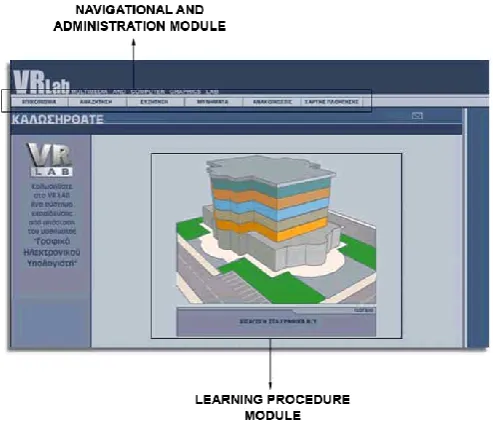
poorly usable interfaces than understanding learning content disturbs accommodation of new concepts and overall retention of what is being learnt [9]. Hence the VRLAB user interface was designed to provide learners with knowledge in a more efficient and flexible way while at the same time remaining attractive and engaging. This design was based on a pedagogical approach where the instructor designs, observes, evaluates and intervenes while learners are being taught, act on their own and experiment. Special emphasis was placed upon giving users a clear idea of content organization and system functionalities through VRLAB’s navigational model. Therefore, the user interface structure remained the same throughout the application providing a consistent visual conceptual map for easy navigation. The user interface environment consists of two functional modules (Figure 2):
Figure 2. VRLAB’s functional modules.
gather their personal information (i.e. address, telephone or fax numbers) for a more direct approach. For a quick and easy search of a specific topic within the educational material to study, users can take advantage of either the “search” or the “index” function. “Chat” provides for synchronous communication, enabling participants to exchange text messages in real time, while “forum” can be utilized so as to discuss various topics about the studied course. Information regarding exam dates, assignment submission dates etc. can be accessed through the “announcements” option. Finally, the “navigation map” supports easy movement among the course subjects (course curriculum).
Figure 3. Navigation layout.
2. Learning procedure module: A metaphor of a 3D six-floor building is used in order to represent the Computer Graphics course. The hierarchical structure of course subjects is highlighted in this way as each floor corresponds to a didactic unit, accompanied by a brief description which appears below the 3D building (Figure 4).
Hypermediality allows the presentation of learning material through different channels (audio, video, textual) wherever applicable, while user interface consistency helps learners to easily adjust in each course section.
Figure 4. 3D ground plan.
3.3 Virtual environment of VRLAB
The VRLAB system was implemented in HTML, VRML and JavaScript. The combination of these programming tools has successfully led to the development of a virtual environment that amalgamates hypermedia technologies with interactive 3D graphics. Additionally, this conjunction has made Virtual Reality available to a broader audience.
As previously mentioned, the virtual environment portrays a 3D six-floor building that can be explored by learners, thus enabling them to actively participate in the learning process. Every floor consists of four distinct virtual spaces, with each one having a unique role.
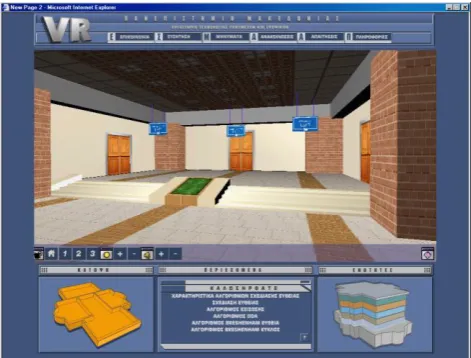
Virtual Lobby (Figure 5) depicts a corridor that provides learners with information regarding the contents of their visiting section. At the end of this corridor appear three entrances which lead to the floor’s remaining virtual spaces.
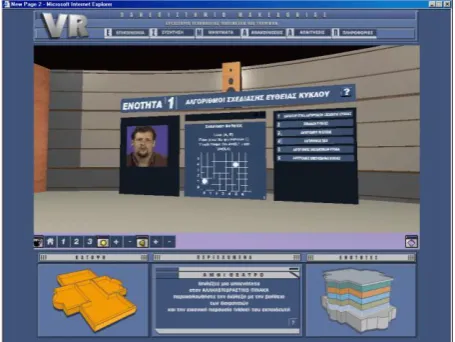
The presentation of the course theory takes place in the Virtual Classroom. Learners enter a space resembling a lecture hall in order to attend a virtual lecture that utilizes slides and multimedia objects (animation, images, audio and video) to present the course material (Figure 6).
Figure 6. Virtual Classroom.
Virtual Library (Figure 7) is comprised of a number of 3D objects representing furniture, books, personal computers etc. In this virtual space learners can seek information regarding the entire course or a specific subject. Moreover, they can follow relevant web hyperlinks and locate bibliographical references.
Figure 7. Virtual Library.
Finally, in order to comprehend more meticulously the course content, learners can perform laboratory exercises in the Virtual Lab (Figure 8). Through their interaction with the system, learners can actively affect the outcome of an experiment.
Figure 8. Virtual Lab.
Administration of virtual environment settings is available at all times through a series of setting tools (“camera selection”, “lighting adjustment”, “volume control”, “navigation help”) (Figure 9).
Figure 9. Virtual environment settings panel.
Navigation between virtual spaces occurs through the use of the control panel (Figure 10). Each course subject is represented by a ground plan of the virtual building’s corresponding floor alongside a description of its contents. Navigation on different subjects can be performed by clicking on the appropriate floor.
4 Conclusions and future work
Learning environments based on the exploitation of 3D graphics should not be seen as yet another alternative form of communication between learners and computers, but rather as a new “vehicle” for education; it provides an easy and flexible interaction suited to catch learners’ interest by giving them an active role in a dynamic learning environment based on exploration and constructing knowledge.
Nevertheless, designing an educational 3D virtual environment should focus on visualizing course material in a way that satisfies learning needs instead of becoming a burden. The latter could occur if sensory channels are overloaded or hypermedia links are overused, also considering that the student is not expert of the learning domain. Additionally, both maintenance and enhancement of administration, security and control mechanisms constitute a substantial factor in ensuring the support of learning procedures.
Finally, another important issue arises from the available network infrastructure which still does not permit development of complex internet virtual reality and multimedia e-learning applications due to bandwidth limitations. However, regarding the recent growth of broadband connections, it is almost certain that in the near future the exploitation of virtual reality and multimedia technologies will change completely the way training is performed with the use of e-learning systems.
VRLAB has acted as a pilot in order to study the educational value of 3D virtual worlds and the emerging challenges regarding the analysis, design and development of these innovative user interfaces. Due to its gaining popularity among students, future work is already underway. These plans include further extension of the system with the addition of more functions, followed by the conduction of an evaluation and usability inspection of the proposed system.
References:
[1] Berge, Z., and M. Collins, “Computer-Mediated Communication and the Online Classroom in Higher Education”, Computer-Mediated Communication Magazine, Volume 2, Number 4, 1994.
[2] Berge, Z., and M. Collins, “Computer-Mediated Communication and the Online Classroom in Distance Learning”, Computer-Mediated Communication Magazine, 2(4), 1995.
[3] Bricken, W., “Learning in virtual reality”,
Technical Memorandum M-90-5, University of Washington, 1990.
[4] Bruner, J., “Actual Minds, Possible Worlds”. Cambridge, MA: Harvard University Press, 1986.
[5] Cronin, P., “Report on the applications of virtual reality technology to education”, University of Edinburgh, HCRC, http://www.cogsci.ed.ac.uk/
~paulus/vr.html, 1997.
[6] Dwyer, F. M., “One dimension of visual research: A paradigm and its implementation”, in D.M. Moore & F.M. Dwyer (Eds.), Visual literacy: A spectrum of visual learning. New Jersey: Educational Technology Publications Inc., 1994
[7] Lave, J., & Wenger, E., “Situated learning: Legitimate peripheral participation”, Cambridge University Press, 1991.
[8] Manitsaris, A., Kargidis, T., Barbatsis, K., “Design and Development of a Dynamic Hypermedia Educational System”, Journal of Information Technology Impact, Vol. 3, Number 3, 2001.
[9] Mastoras T., Fotaris P., Politis A., Manitsaris A., “Designing simplicity: usability perspectives on Learning Management Systems”, WSEAS Transactions on Information Science and Applications, Issue 10, Volume 2, October 2005, pp.1731-1738.
[10] Matray, P. and Proulx, S., “Integrating Computer /Multimedia Technology in a High School Biology Curriculum”, The American Biology Teacher, Vol. 57, 1995, pp. 511-521. [11] McLellan, H., “Virtual realities”. In The
Handbook of Research for Educational Communications and Technologies, D. H. Jonassen (Eds), Macmillan New York, 1996. [12] Peraya, D., “Distance Education and the
WWW”, http://tecfa.unige.ch/edu-s94/contrib/ peraya.fm.html#HDR0, 1994.
[13] Spiro, R. J., Feltovich, R. J., Jacobson, M. J., & Coulson, R. L., “Cognitive flexibility, constructivism, and hypertext: Random access instruction for advanced knowledge acquisition in ill-structured domains”, In T. M. Duffy & D. H. Jonassen (Eds.), Constructivism and the technology of instruction, Hillsdale, NJ: Lawrence Erlbaum, 1992, pp. 57-75.
cognitive flexibility theory and hypertext”, in T. M. Duffy & D. H. Jonassen (Eds.),
Constructivism and the technology of instruction, Hillsdale, NJ: Lawrence Erlbaum, 1992, pp. 121-128.
[15] Gustav Taxén, Ambjörn Naeve, “A system for exploring open issues in VR-based education”,
Computers & Graphics, 26(4), 2002, pp.593-598.
[16] Rheingold, H.,“Virtual Reality”, Summit Books, 1991.