VOLUME 38, ARTICLE 41, PAGES 1241
−
1276
PUBLISHED 5 APRIL 2018
http://www.demographic-research.org/Volumes/Vol38/41/ DOI: 10.4054/DemRes.2018.38.41
Research Article
Why does women’s education stabilize
marriages? The role of marital attraction and
barriers to divorce
Diederik Boertien
Juho Härkönen
© 2018 Diederik Boertien and Juho Härkönen.
This open-access work is published under the terms of the Creative Commons Attribution 3.0 Germany (CC BY 3.0 DE), which permits use, reproduction, and distribution in any medium, provided the original author(s) and source are given credit.
1 Introduction 1242 2 Previous theory and research on female education and divorce 1243 3 Social exchange theory, female education, and divorce 1244 3.1 Education, marital attraction, and divorce 1245 3.2 Education, alternatives to the marriage, and divorce 1246 3.3 Education, barriers, and divorce 1246
4 This study 1248
5 Data and method 1249
5.1 Variables 1250
5.2 Analysis 1253
6 Results 1254
6.1 Descriptive analysis 1254
6.2 Discrete-time event history analysis 1255 6.3 Female education and divorce: A path analysis 1258
7 Discussion 1260
8 Acknowledgments 1262
References 1264
Why does women’s education stabilize marriages?
The role of marital attraction and barriers to divorce
Diederik Boertien1
Juho Härkönen2
Abstract
BACKGROUND
Despite widespread attention paid to the negative correlation between female education and divorce, we lack an explanation for it. In this study we use social exchange theory to assess two broad groups of explanations. According to the ‘marital attraction’ explanation, educated women’s marriages have higher marital quality and marital satisfaction. According to the ‘barriers to divorce’ explanation, educated women’s marriages include factors that raise the cost of divorcing. Many previous studies have referred to variants of the former explanation, whereas the latter has been less prominent. Our objective is to investigate the explanatory power of these two explanations.
METHODS
We use discrete-time event history models to document the educational gradient of divorce from first marriages using the British Household Panel Survey (N = 1,263) for the years 1996–2009. We subsequently perform a mediation analysis to explain the educational gradient in divorce and a path analysis to distinguish which factors shape marital attraction and barriers to divorce.
RESULTS
Female education is positively related to marital stability, but this association is only partly explained by educational differences in marital satisfaction and variables that shape attractions. Variables interpreted as affecting barriers to divorce, such as home ownership and having divorced parents, provide an at least equally important explanation of the educational gradient in divorce.
CONTRIBUTION
This paper shows that the negative female educational gradient of divorce is shaped not
1
Centre d’Estudis Demogràfics, Barcelona, Spain. Email:[email protected].
2
only by educational differences in marital attraction, but also by differences in barriers to divorce.
1. Introduction
Educated women divorce less than women with lower levels of education in several societies today (Härkönen and Dronkers 2006; Kalmijn 2013; Martin 2006; Matysiak, Styrc, and Vignoli 2014; Park, Raymo, and Creighton 2009; Raymo, Fukuda, and Iwasawa 2013). Because divorce can have negative effects on adults’ and children’s well-being, the negative educational gradient of divorce is a key component of the social stratification of family demography (e.g., Heckman 2008; McLanahan 2004; Putnam 2015).
However, we know little about the reasons for educated women’s higher marital stability (Amato 2010: 661). This pattern is theoretically intriguing. Women’s education can have ambiguous effects on divorce (Becker, Landes, and Michael 1977), but established accounts generally predict that it destabilizes – rather than stablizes – marriages or provides women with resources to exit unsatisfactory marriages (cf. Kreager et al. 2013; Lyngstad and Jalovaara 2010). As discussed below, interpretations of educated women’s higher marital stability have focused on specific economic, demographic, and psychological factors. Many of these have been weakly grounded in evidence. Others have focused on estimating the contributions of specific variables, rather than attempting to understand the more general generative mechanisms underlying the association. This has limited our theoretical understanding of the negative female educational gradient of divorce.
The aim of this study is to contribute to the theoretical understanding of why educated women have more stable marriages than less-educated women. We build on social exchange theory (Levinger 1976; Lewis and Spanier 1979), which as a middle-range theory can be used to consolidate the hitherto disparate explanations of the negative educational gradient of divorce (cf. Merton 1957). Social exchange theory has been used in several studies to theorize the predictors of divorce (e.g., Amato 1996; Kreager et al. 2013; Sayer et al. 2011), but not, to our knowledge, to understand educated women’s current marital stability.
(Goode 1963; Härkönen and Dronkers 2006; Kreager et al. 2013; Goldscheider, Bernhardt, and Lappegård 2015; McLanahan and Jacobsen 2015). We evaluate these arguments and propose complementary ones that build on educational differences in barriers to divorce.
We assess these explanatory models with data from the United Kingdom, using discrete-time event history data on 1,263 women’s first marriages from the 1996–2009 waves of the British Household Panel Survey (BHPS). Based on the previous literature and available data, we operationalize measures of marital attraction and barriers to divorce and assess how much these attenuate the relationship between the wife’s education and divorce. The United Kingdom is one of the countries in which educated women currently have more stable marriages than those with less education (Chan and Halpin 2005). We find that educated women’s higher marital attraction can to some extent explain their higher marital stability. However, we also find that variables affecting the barriers to divorce form an at least equally important explanation.
2. Previous theory and research on female education and divorce
Women’s education can affect divorce through economic as well as noneconomic mechanisms, and either stabilize or destabilize marriages (Becker, Landes, and Michael 1977). Education as human capital should have a similar effect on marital stability as other economic factors such as income and (un)employment. Husbands’ economic resources stabilize marriage, but whether wives’ resources have a similar effect has been long debated (Lyngstad and Jalovaara 2010; White and Rogers 2000). Indeed, female human capital can destabilize marriages by lowering returns to a gendered division of labor (Becker, Landes, and Michael 1977) or by reducing wives’ financial dependence on their husbands and allowing them to exit troubled marriages (Kreager et al. 2013; Sayer et al. 2011; Schoen et al. 2002).
Others have made the opposite argument, namely that because wives’ economic resources improve the family living standard and economic security, they should stabilize marriages in the same way as husbands’ resources do (e.g., Oppenheimer 1997). The evidence on how wives’ resources, such as her employment and income, affect divorce is inconsistent (Özcan and Breen 2012; White and Rogers 2000). Nevertheless, some studies on education and divorce have found that they explain part of the educational difference in divorce (Jalovaara 2001; Raymo, Fukuda, and Iwasawa 2013).
generally marry at an older age (for Britain: Berrington and Diamond 2000), which predicts marital stability (Lampard 2013). In some countries (but not all; cf., e.g., Goldstein and Kenney 2001) educated women marry less, and it has been suggested that those who do are more committed to marriage (cf. Bernardi and Martínez-Pastor 2011). Less-educated women are also more likely to have children before marriage (Perelli-Harris et al. 2010), another predictor of marital instability. These factors can provide a partial explanation, but a negative educational gradient of divorce persists net of demographic and life course variables (Bernardi and Martínez-Pastor 2011; Härkönen and Dronkers 2006; Jalovaara 2001; Martin 2006; Schwartz and Han 2014).
Scholars have also proposed psychological and social explanations for the negative educational gradient of divorce. Many authors have speculated that education is related to better interpersonal skills (e.g., Blossfeld et al. 1995; Härkönen and Dronkers 2006; Kreager et al. 2013; Castro-Martin and Bumpass 1989), but evidence for this explanation is sparse (Amato 1996; Amato and Rogers 1997; Orbuch et al. 2002; Boertien, Von Scheve, and Park 2017). The highly educated can experience starker social costs of divorce (cf. Goode 1963). Raymo, Fukuda, and Iwasawa (2013) made a related argument when studying education and divorce in Japan, but their measure of “losing face” did not account for the negative relationship.
In short, the existing literature does not provide conclusive explanations for the negative educational gradient of divorce. Many influential theories predict that educated women’s economic resources destabilize marriages. Many existing explanations for the negative correlation between women’s education and divorce are weakly grounded in theory, evidence, or both, which limit the possibility of interpreting the findings in more general terms. Below, we use social exchange theory to organize our discussion of the mechanisms that can account for educated women’s higher marital stability.
3. Social exchange theory, female education, and divorce
3.1 Education, marital attraction, and divorce
‘Marital attraction’ refers to the relative balance of the rewards and costs of a specific marriage (Levinger 1976: 35). Rewards can be material or symbolic, or derived directly from interaction with the partner. Costs include time investments, conflicts, and verbal and physical abuse (Levinger 1976). These rewards and costs affect marital satisfaction, which is the overall evaluation of the marriage and a commonly used summary measure of marital attraction (e.g., Conger, Conger, and Martin 2010; Fincham and Rogge 2010; Funk and Rogge 2007; White and Booth 1991).
Several scholars have suggested that educated women’s higher marital quality (attractions) explains their currently higher marital stability (e.g., Härkönen and Dronkers 2006; Kalmijn 2013; Kreager et al. 2013; Matysiak, Styrc, and Vignoli 2014; McLanahan and Jacobsen 2015). This should be reflected in educational differences in marital satisfactions, and consequently leads to the expectation that marital satisfactions explain the negative educational gradient of divorce.
Perhaps the most likely reason why educated women’s marriages would have higher marital satisfactions is that their families have fewer economic stressors and less economic insecurity. The family stress model (e.g., Conger, Conger, and Martin 2010) provides a social psychological account of how these stressors translate into lower marital quality and stability through emotional distress, more negative spousal interactions, and fewer positive interactions. Accordingly, unemployment (especially of the husband) and other forms of economic hardship negatively affect marital satisfaction (Halliday Hardie and Lucas 2010) and predict divorce (e.g., Jalovaara 2001; Raymo, Fukuda, and Iwasawa 2013). Another potential source of current educational differences in marital satisfaction is gender egalitarianism in the domestic sphere, which has gained attention as a predictor of divorce (Esping-Andersen and Billari 2015; Goldscheider, Bernhardt, and Lappegård 2015; Kalmijn 2013). Educated women are able to bargain for a more even distribution of childcare and housework (Bonke and Esping-Andersen 2011), which improves marital satisfaction and marital stability (e.g., Cooke 2006; Oláh and Gähler 2014).
Educational assortative mating can strengthen the relevance of these mechanisms. Higher-educated husbands can provide more economic security, be more gender egalitarian (Bonke and Esping-Andersen 2011), and provide noneconomic benefits that increase the quality of the marriage (Becker, Landes, and Michael 1977).
intuitive appeal, there is no evidence of the kind of stark educational gradients in marital satisfaction that one would expect based on such arguments (cf. Conger, Conger, and Martin 2010; Halliday Hardie and Lucas 2010; Isen and Stevenson 2010; Karney and Bradbury 1995). This suggests that educated women’s higher marital stability may instead, or in addition, be due to alternatives to the marriage being unattractive or higher barriers to divorce.
3.2 Education, alternatives to the marriage, and divorce
The attractiveness of the alternatives to the current marriage is generally conceptualized as alternative partners or as remaining single and can affect divorce independently of marital satisfactions (Lyngstad and Jalovaara 2010). Alternative attractions are usually difficult to measure, and our study is no exception. Nevertheless, it is unlikely that alternative attractions explain why female education is associated with higher marital stability. First, education improves women’s chances of independently supporting themselves and their children. Second, educated women are more likely to work and thus meet alternative partners at work (Svarer 2007). Third, there is no evidence that educated women are less attractive in the repartnering market (Sweeney 2010). For these reasons, we do not expect that alternatives to the marriage explain the negative educational gradient in divorce.
3.3 Education, barriers, and divorce
Barriers to divorce refer to the perceived psychological, legal, social, or economic costs that an individual expects to incur in the event of divorce. Importantly, barriers are conceptualized as constraints that operate independently of the quality of the couple’s relationship and marital satisfactions (Levinger 1976). Barriers can deter marital dissolution when marital satisfaction is low. Conversely, marriages of relatively high quality may dissolve if barriers are low (Amato and Hohmann-Marriott 2007). Barriers to divorce can be partner- or partnership-specific, such as emotional and material costs incurred due to the violation of internalized moral codes or costs related to the loss of joint investments in assets and marriage-specific goods, or external to the couple, such as strict divorce legislation or social sanctions (Johnson, Caughlin, and Huston 1999; Lewis and Spanier 1979).
(Kreager et al. 2013; Sayer et al. 2011; Schoen et al. 2002), and resources can enable divorce when it is socially and legally difficult (Blossfeld et al. 1995; Goode 1963; Härkönen and Dronkers 2006; Matysiak, Styrc, and Vignoli 2014). Therefore, it is perhaps unsurprising that previous scholars have not considered educated women’s higher barriers to divorce as an explanation of their marital stability.
Although educated women’s resources can help them exit the types of marriages that women with less education may unhappily remain in, educated women’s marriages may also have higher barriers that are especially important in holding together marriages with at least moderate levels of marital satisfaction. A considerable share of divorces end such marriages (Amato and Hohmann-Marriott 2007), and whether or not at least one of the partners considers that they would be even better off outside the marriage can depend on the barriers to divorce. Barriers might therefore play an important role in creating the educational gradient in divorce.
Economic barriers to divorce are clear candidates for shaping the educational gradients of divorce. Examples are long-term investments that can affect barriers to divorce by raising the financial costs of divorcing. Better-educated women and their husbands have more financial assets than the less educated. Divorcing often leads to a decrease in net worth, which acts as a deterrent (Dew 2009). Recent scholarship on family demography has analyzed the effects of various assets on marital transitions (Dew 2009; Schneider 2011). Of these, homeownership has been the most often considered determinant of barriers to divorce (South and Spitze 1985; White and Booth 1991; Jalovaara 2001). In Britain, as elsewhere, educated couples are more likely to own their homes (Ermisch and Halpin 2005).
Noneconomic determinants of barriers to divorce include factors such as marital commitment and attitudes to divorce (Johnson, Caughlin, and Huston 1999), which can increase the emotional and social costs of breaking a marital bond. It is a priori unclear whether these differ according to women’s education.
However, some family demographic experiences that can reflect individuals’ relatively low perceived emotional or social costs of divorce do vary by education and can thus produce educational differences in noneconomic barriers to divorce. First, higher-order marriages are less stable than first marriages, partly due to the relatively low perceived emotional or social costs of divorce in these marriages (Lyngstad and Jalovaara 2010). Although we analyze women’s first marriages, educational differences in husbands’ previous divorce experiences can shape differences in barriers to divorce in these marriages.
translate into a lower prevalence of divorced family backgrounds among those with higher levels of education. Compared to children of divorce, those from an intact family background are less likely to consider divorce as a reasonable alternative to an unsatisfactory marriage, increasing the perceived emotional cost of a divorce (Wolfinger 2005).
Third, because educated women are less likely to have children outside marriage or with men they do not end up marrying (Perelli-Harris et al. 2010), they are less likely to bring stepchildren to their first marriages. Even though common children are normally seen as increasing the emotional costs of divorce (Knoester and Booth 2000), stepfamilies are often considered “incomplete institutions” to which partners are less committed (Cherlin 1978).
4. This study
Marital attraction and barriers to divorce are theoretical constructs, which lack direct and comprehensive measures (Levinger 1976: 44). Assessment of the explanatory power of marital attraction and barriers to divorce thus requires a combination of theoretically motivated proxy variables and an analytical design that allows drawing appropriate theoretical conclusions regarding their relative role.
Marital satisfaction is the single best summary measure of marital attraction (e.g., Conger, Conger, and Martin 2010; Fincham and Rogge 2010; Funk and Rogge 2007; White and Booth 1991), and if marital attraction explains the negative educational gradient of divorce, the association should be considerably attenuated by measures of her and his marital satisfactions. Barriers to divorce are theorized to stabilize marriages independently of marital attraction. This suggests that an eventual remaining residual association between her education and divorce, net of marital satisfactions, can reflect higher barriers to divorce in women’s marriages. However, our measure of marital satisfaction is unlikely to be perfect, and a residual association can reflect aspects of marital attraction not captured by this variable alone.
Therefore, we draw on additional information to strengthen our interpretations. First, we include measures of economic conditions and the division of housework as factors that have been theorized to shape marital attraction. Second, we include measures that have been argued to shape the barriers to divorce: home ownership, his education, childhood family structure, and the absence of stepchildren and of remarried husbands.
We study these questions in the United Kingdom, one of the countries where educated women currently have more stable marriages than those with less education (Chan and Halpin 2005). In some aspects the British context differs to other countries. The stability of marital and cohabiting relationships is relatively low (Andersson et al. 2017), income inequality is high, and welfare support is more often means-tested and not as generous as in many other European countries (Esping-Andersen 2005). Economic stress among lower-educated individuals could therefore be more pronounced in Britain. Couple behavior in Britain is not yet as egalitarian as in some other European countries and the United States. While few households operate according to a traditional division of labor, few couples divide both paid and unpaid labor equally (Esping-Andersen et al. 2013). This reflects both lower levels of full-time labor force participation by women, and less participation in domestic work by men.
5. Data and method
We used data from the British Household Panel Survey (BHPS), a representative longitudinal household survey of the British population, which annually interviewed all adult members of a sample of households. All members of the households sampled in 1991 became panel members and were followed over time, even if they had left the original household. We restricted our sample to these permanent sample members in order to safeguard the representativeness of the sample. After thirteen waves, 66% of those sampled for the first wave were still part of the study (for more information on the BHPS, see Lynn 2006).
Our analytical sample included the marriages of all women who either married for the first time between 1996 and 2009, or who were in their first marriages when interviewed in 1996. The starting year (1996) in our observation window was the first time when respondents were asked about their marital satisfaction and 2009 was the last year the BHPS was collected. Only the first fifteen years of the marriage were included to avoid the marriages becoming too selective due to divorce. In total, we observed 1,263 couples for 6,293 couple-years.
5.1 Variables
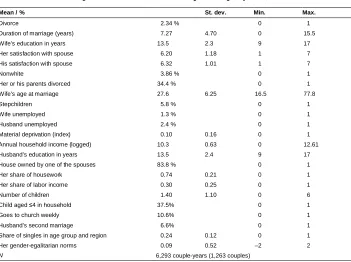
Descriptive information on the dependent and independent variables is provided in Table 1. Our dependent variable ‘divorce’ was operationalized as one partner moving out due to separation and measured att, whereas all independent variables are measured att – 1. Twelve percent (147 couples) of the couples in our analytical sample divorced during the observation period, and survival curves predicted that 27% of first marriages ended after 15 years. This is in line with official statistics on the cumulative dissolution probability of all marriages (Wilson and Smallwood 2008).
Table 1: Descriptive statistics for the sample (couple-years)
Mean / % St. dev. Min. Max.
Divorce 2.34 % 0 1
Duration of marriage (years) 7.27 4.70 0 15.5
Wife’s education in years 13.5 2.3 9 17
Her satisfaction with spouse 6.20 1.18 1 7
His satisfaction with spouse 6.32 1.01 1 7
Nonwhite 3.86 % 0 1
Her or his parents divorced 34.4 % 0 1
Wife’s age at marriage 27.6 6.25 16.5 77.8
Stepchildren 5.8 % 0 1
Wife unemployed 1.3 % 0 1
Husband unemployed 2.4 % 0 1
Material deprivation (index) 0.10 0.16 0 1
Annual household income (logged) 10.3 0.63 0 12.61
Husband’s education in years 13.5 2.4 9 17
House owned by one of the spouses 83.8 % 0 1
Her share of housework 0.74 0.21 0 1
Her share of labor income 0.30 0.25 0 1
Number of children 1.40 1.10 0 6
Child aged ≤4 in household 37.5% 0 1
Goes to church weekly 10.6% 0 1
Husband’s second marriage 6.6% 0 1
Share of singles in age group and region 0.24 0.12 0 1
Her gender-egalitarian norms 0.09 0.52 –2 2
N 6,293 couple-years (1,263 couples)
Source: Authors’ calculations using the British Household Panel Survey, 1996–2009.
attainment fits the data better (assessed using the Akaike and Bayesian Information Criteria) than a categorical specification, which we nevertheless used in the descriptive analyses due to its informative value. The categorical measure of educational attainment differentiated between low (GCSE grade A–C or less; ISCED 0–2), middle (A-levels; ISCED 3–4), and high education (tertiary degrees; NVQ-level 3; ISCED 5–6). Our regression results were robust to the specifications.
The first set of explanations presented above suggested that marital satisfaction strongly attenuates the negative educational gradient of divorce. We measured marital satisfaction using the question “How satisfied are you with your spouse/partner?” with responses ranging from 1 = “not satisfied at all” to 7 = “completely satisfied.” The question was asked in each wave, individually of both partners (using a self-completion questionnaire after the face-to-face interview). In line with many earlier studies (e.g., Amato and Hohmann-Marriot 2007; Schoen, Rogers, and Amato 2006), we treated the variable as continuous. Robustness checks using alternative specifications (i.e., a logged version and a dummy of values 6 and 7 versus the rest) or lagged measures did not change the results. This measure is the closest to the concept of marital satisfaction as the overall evaluation of the relationship (Fincham and Rogge 2010; Funk and Rogge 2007) and similar measures have been employed in research on relationship dissolution (Amato and Hohmann-Marriot 2007; Schoen, Rogers, and Amato 2006). However, the use of a single measure lowers measurement reliability and can hide the multidimensionality of marital satisfaction (Bradbury et al. 2000), which can lead to an underestimation of its importance in explaining the educational gaps in divorce. To monitor this possibility we included additional mediating variables that capture processes that have been hypothesized to connect education to dimensions of marital satisfaction and quality and, subsequently, divorce.
We argued that educational differences in divorce risk that are not explained by marital satisfaction can reflect educational differences in barriers to divorce. As a more direct assessment of the role of these barriers we include the following measures. Home ownership, an indicator of economic barriers, was a dummy variable. Additional analyses (not shown) revealed that whether or not the ownership was shared between the spouses was irrelevant to divorce. In addition, differences in divorce risk between owners with and without a mortgage were small and not statistically significant. Her church attendance on a weekly basis might indicate values oriented toward relationship stability. We also discussed demographic variables, which can shape the barriers to divorce: parental divorce (of his or her parents; dummy), the presence of step-children (dummy), whether the husband had been previously married (dummy), the number of children, and the presence of a child aged 4 or less. In addition, we included age at marriage (continuous) and ethnicity as variables, which can vary by education and predict divorce, but without having expectations about whether they operate through marital satisfaction or barriers to divorce. Age at marriage has often been included in previous studies on the educational gradient of divorce, but could affect divorce through a variety of processes including outside alternatives (younger spouses being more attractive) or better matches due to older spouses’ maturity (Lampard 2013). Ethnicity was measured by a dummy variable indicating whether the respondent was white or not; small cell sizes prevented more detailed classification.
Finally, we included the share of opposite-sex singles in a person’s region (based on a classification of 19 regions such as East Midlands, Inner London, and Merseyside) and age group (everyone up to seven years older and up to three years younger for women, and the opposite for men) as a crude measure of marriage market conditions and thus of alternative partners. A measure of her share of household labor income is used as an indicator of the relative attractiveness of being single compared to remaining in the marriage.
request). We used calendar year instead of marriage cohort because period effects on divorce dominate over cohort effects (Härkönen 2014; using marriage cohort dummies instead of period generated practically identical results).
Missing values on all variables but education and divorce were multiply imputed using 20 datasets (using the ‘mi’ commands in Stata 13). Table 1 displays the characteristics of the original sample used in this study before imputation. 16.8% of couple-years had one or more values imputed on the independent variables used in the final models of the paper. The dependent variable and all independent variables were included in the equation used for imputation.
5.2 Analysis
Our analysis followed three main stages. The first stage consisted of describing divorce risks by her educational attainment using Kaplan-Meier survival curves.
In the second stage we used mediation analysis to assess the mechanisms generating the educational differences in divorce. We began by estimating discrete-time event history models (using logistic regression) with each independent variable entered separately, controlling for marital duration, region, and calendar year. We used the Karlson-Holm-Breen (KHB) method for mediation analysis with nonlinear probability models (Breen, Karlson, and Holm 2013) to estimate how much of the educational difference is explained by each individual variable. At that stage we discussed the results and excluded from further consideration all variables that (a) mediated less than 5% of the educational difference in divorce, and (b) were not significant mediators at the 5% statistical significance level, in order for the remainder of the analysis to be more parsimonious. In subsequent analyses we estimated event history models to assess to what extent marital satisfaction, the variables expected to influence it (‘satisfiers’), and barriers to divorce mediate educational difference in divorce, by including them as blocks of variables.
The exogenous variables in this model were parental divorce, region, duration, and calendar year.
6. Results
6.1 Descriptive analysis
Figure 1 shows the survival curves of first marriages by educational attainment. The graph shows what previous British studies have already found: educated women have more stable first marriages. The survival curves show that 43% of low and 20% of highly educated women had divorced from their first marriage after 15 years. The differences in survival curves were statistically significant at the 0.1% level (both using the Wilcoxon and log-rank tests).
Figure 1: Survival curves for divorce by wife’s education
Source:Based on 1,263 couples and 6,293 couple-years from the British Household Panel Survey 1996–2009.
small case numbers at higher durations we estimated cumulative probabilities of divorce by seven years after the wedding. After this period, 8% of highly educated and 29% of low-educated women in the restricted sample had divorced; the corresponding figures for all cases were 9% and 27% respectively.
6.2 Discrete-time event history analysis
The second step was to perform a mediation analysis to assess which variables explain the educational gradient of divorce. In Table 2 we first estimated the extent to which each variable mediates the educational gradient individually. Column 1 displays the association between each independent variable and divorce (adjusting for duration, year, and region). Column 2 shows the coefficient of education in an event history model that includes the mediating variable and controls for duration, year, and region. Column 3 shows the share of the association between education and divorce that is mediated by the individual variable, and the significance level of this mediation. The variables are presented in descending order of importance, judged by the share of the educational gradient that was mediated.
Table 2: Mediation analysis of the educational gradient of divorce, odds ratios (OR) and their standard errors (SE)
Mediating variable (Med) Association of Med with divorce
Education on divorce after including Med
% of educational gradient explained by Med
OR SE OR SE
(empty) 0.85** 0.03
Home ownership 0.37 ** 0.07 0.88 ** 0.03 19 **
His education 0.89 ** 0.03 0.87 ** 0.04 17
Her marital satisfaction 0.52 ** 0.03 0.88 ** 0.03 14 **
Household income (logged) 0.74 ** 0.07 0.86 ** 0.03 11 *
Material deprivation 4.98 ** 2.10 0.86 ** 0.03 10 **
His marital satisfaction 0.58 ** 0.04 0.87 ** 0.03 9 **
His or her parental divorce 1.99 ** 0.37 0.86 ** 0.03 6 **
His unemployment 4.05 ** 1.31 0.86 ** 0.03 6 **
Stepchild in household 2.20 ** 0.59 0.85 ** 0.03 5 *
Church attendance 0.46 * 0.17 0.85 ** 0.03 5
Number of children 1.12 0.10 0.85 ** 0.03 2
Having a child aged ≤4 0.74 0.13 0.85 ** 0.03 2
Nonwhite 0.71 0.37 0.85 ** 0.03 1
Her unemployment 2.03 1.06 0.85 ** 0.03 1
Singles in age group/region 3.61 2.59 0.85 ** 0.03 0
Her share of housework1 0.79 0.36 0.84 ** 0.03 –3
Husband’s second marriage 0.85 0.32 0.84 ** 0.03 –3
Age at marriage 0.96* 0.02 0.84 ** 0.03 –3*
Her gender-egalitarian norms 1.74 ** 0.29 0.84 ** 0.03 –5 **
Her labor income share2 1.94 0.70 0.85 ** 0.03 –11 *
Note: N = 6,293 couple-years (1,263 couples). Covariates ordered in descending order of the share mediated. Column 1: Odds Ratios taken from Logistic Regression explaining divorce controlling for duration, region, and year. Column 2: Odds Ratio for education in a logistic regression explaining divorce controlling for duration, region, and year. Column 3: Percentage of coefficient for education explained by mediator, usingkhbmethod on multiply imputed data, based on logistic regression models explaining divorce by education, with and without the mediator, and controlling for duration, region, and year, adjusted for rescaling.
1Robustness checks controlling for the total hours of housework gave similar results (not shown)2Controlled for household income.
* p < 0.05. ** p < 0.01.
Several variables did not substantially mediate the educational gradient of divorce and were therefore excluded from the subsequent analysis. Interestingly, age at marriage and her share of labor income actually strengthened the negative gradient in our sample and were therefore dropped from the remainder of the analysis, together with ethnicity, her unemployment, his education, marriage market conditions, her gender norms, number of children, and his second marriage. His education appeared to mediate part of the relationship between her education and divorce, but this mediation was not statistically significant. In a robustness check we included his education in the remainder of the analysis; this did not change the conclusions, as his education was no longer an important mediator once the other relevant covariates were controlled for.
(parental divorce and stepchildren) and four economic (home ownership, his unemployment, household income, and material deprivation) variables.
We proceeded by including these remaining variables block by block into an event history model explaining divorce in Table 3. The grouping of the variables reflected our theorizing as to which variables can primarily be seen as shaping marital attraction, and which reflect factors shaping the barriers to divorce.
The first model in Table 3 estimated the baseline association between the wife’s education and divorce, and controlled only for duration, region, and calendar year. Each additional year of her education predicted a 15% lower divorce risk. The next three models assessed to what extent marital attractions mediate the educational gradient of divorce. Model 2 included both his and her marital satisfaction and the results confirmed that these variables explain a small part of the educational gradient of divorce: together, his and her satisfaction accounted for 16% of the educational gradient (last row in the table). An additional year of her education still predicted an 11% lower risk of divorce, net of marital satisfaction. In Model 3 we included the variables that measure economic conditions (household income, his unemployment, and material deprivation), which we expected to shape marital attraction. Material deprivation and his unemployment predict divorce, but household income did not significantly predict divorce when adjusting for the other two economic variables. Together, these variables mediated 19% of the educational gradient of divorce.
Table 3: Discrete-time event history models explaining divorce by satisfiers and barriers to divorce, odds ratios (OR) and their standard errors (SE). N = 6,293 couple-years (1,263 couples)
Model 1 Model 2 Model 3 Model 4 Model 5 Model 6 OR SE OR SE OR SE OR SE OR SE OR SE
Wife’s education in years 0.85 ** 0.03 0.89 ** 0.03 0.88 ** 0.03 0.90 * 0.04 0.90 ** 0.04 0.92 0.04
Duration 0.99 0.02 0.96 * 0.02 1.00 0.02 0.96 * 0.02 1.01 0.02 0.97 0.02
Calendar year (0=1996) 0.96 0.02 0.96 0.02 0.97 0.03 0.96 0.03 0.95 0.02 0.95 0.03
Mediators
Her marital satisfaction 0.58 ** 0.03 0.59 ** 0.03 0.60 ** 0.03
His marital satisfaction 0.78 ** 0.06 0.78 ** 0.06 0.79 ** 0.06
Household income (logged) 0.89 0.11 0.94 0.13 0.99 0.15
Material deprivation 2.59 * 1.20 1.16 0.58 0.89 0.46
He unemployed 2.49 ** 0.88 1.83 0.70 1.70 0.65
His or her parents divorced 1.69 ** 0.32 1.56 * 0.31
Stepchildren 1.45 0.40 1.39 0.40
Home ownership 0.49 ** 0.09 0.70 0.16
Constant 0.06 ** 0.01 5.77 ** 2.69 0.12 0.15 8.37 12.43 0.06 ** 0.02 4.16 6.54
% of education mediated 16 ** 19 ** 25 ** 27 ** 39 **
Note:Controls included for region (coefficients not shown). % of coefficient of education mediated based on khb program run on multiply imputed data for the block of mediators included in the column.
Model 4 adds her and his marital satisfaction, and is thus the most comprehensive model for assessing the role of marital attractions. Both marital satisfaction variables remain statistically significant predictors of divorce, whereas unemployment and material deprivation cease to be so (although the odds ratio for his unemployment remains at 1.83). Altogether, these variables mediate 25% of the educational gradient of divorce.
The fifth model included the measures that we expected to affect divorce risk through their influence on barriers to divorce. This block mediated 27% of the educational gradient. The presence of stepchildren was no longer a statistically significant predictor, even though the odds ratio remained at 1.45. Home ownership and parental divorce were strongly associated with marital stability: Home ownership halved and parental divorce doubled the divorce risk.
Taken together, these analyses suggest that the educational gradient of divorce results both from the higher attractions in these women’s marriages, as well as factors interpreted as shaping barriers to divorce. The final model included all variables from the previous models. Together, the model mediated 39% of the educational gradient of divorce. Results from additional analyses, which excluded the left-truncated cases, are presented and discussed in Appendix B, Table B-1. These results suggest that it is unlikely that our inclusion of left-truncated cases led to underestimating the importance of marital satisfaction in producing the educational gradient of divorce.
6.3 Female education and divorce: A path analysis
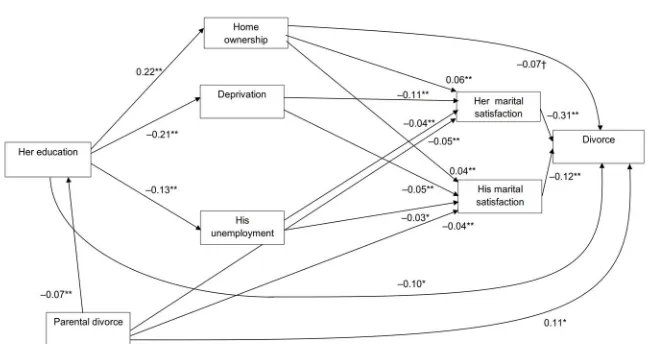
In the final stage of our analysis we assessed whether the variables expected to affect barriers to divorce indeed operate independently of marital satisfaction, and whether factors expected to reflect attractions affect divorce through marital satisfaction. We included the statistically significant (at the 5% level) predictors of divorce from Models 3 and 5 – parental divorce, home ownership, his unemployment, and material deprivation – as well as her and his marital satisfaction. Parental divorce is included as an exogenous variable in the path model, as it precedes own education in time.
Figure 2: Structural equations model explaining divorce with discrete-time event history data (x and y-standardized coefficients). N = 6,239 couple-years (1,263 couples).
Note: Only statistically significant paths shown. Controls included for region, year, and duration. Model ran in Mplus accounting for dichotomous nature of dependent variables, and missing data. †< 0.10; *p<0.05; **p<0.01.
Second, we performed an additional mediation analysis to compare the relative importance of these variables’ indirect (through marital satisfaction) and direct effect on divorce (see Table C-1 in Appendix C). Of the four variables, material deprivation is the clearest example of a divorce predictor that shapes marital attraction, as its effect on divorce is completely mediated by marital satisfaction. At the other end, parental divorce comes closest to a factor that shapes (lowers) barriers to divorce, as only 12% of its effect operates through marital satisfaction. As expected and suggested by the path analysis, home ownership is another divorce predictor that suppresses marital dissolution primarily by shaping the barriers to divorce (22% mediated by marital satisfaction). More unexpectedly, in light of our expectations and the earlier results, the effect of his unemployment is only partially mediated by marital satisfaction. This suggests that his unemployment can also lower the barriers to divorcing.
7. Discussion
The socioeconomic divergence in family demography has gained increasing attention (Heckman 2008; McLanahan 2004; Putnam 2015), yet we have not understood the reasons for one of its key components: the negative association between female education and divorce. We used social exchange theory to formulate a middle-range framework for understanding why educated women currently have more stable marriages than less-educated women.
From a social exchange theory perspective, educated women’s marital stability should result from higher marital attraction, poorer alternatives to the marriage, or higher barriers to divorce. Much scholarship has implied that educated women have higher quality marriages, which translate into their higher marital stability (Härkönen and Dronkers 2006; Kreager et al. 2013; McLanahan and Jacobsen 2015). Our analysis of event history data from the British Household Panel Survey for the years 1996 to 2009 shows that marital satisfaction and other theorized measures of marital attractions explain part – but definitely not all – of the negative educational gradient of divorce.
This suggests that additional mechanisms are important for explaining educated women’s marital stability. The limited availability of measures of alternatives to the existing marriage is a shortcoming of this study. However, we argued that it is unlikely that education reduces marital alternatives. Educated women are better able to support themselves and are attractive candidates in the (re-)partnering market. In addition, our available measure of marital alternatives – the share of opposite-sex singles in a woman’s region and age group and her share of labor income – did not predict divorce.
This led us to expect that educated women have higher barriers to divorce, which stabilizes their marriages. This explanation has seldom been considered in the previous literature, where education and related resources are generally regarded as providing means to overcome barriers to divorce and to exit unsatisfactory marriages (Blossfeld et al. 1995; Härkönen and Dronkers 2006; Kreager et al. 2013; Sayer et al. 2011; Schoen et al. 2002). As more direct evidence for the importance of barriers to divorce, we analyzed a number of predictors that in the earlier literature have been considered as affecting barriers to divorce (Amato 1996; Jalovaara 2001; South and Spitze 1985; White and Booth 1991). Of these, coming from an intact rather than divorced family and in particular home ownership were the most robust and important predictors of divorce and explained a fourth of the educational gradient of divorce. They predicted lower divorce net of marital satisfaction, and can therefore be interpreted as shaping the barriers to divorce. Altogether, this result was evidence for our argument that educated women’s higher barriers to divorce are part of the reason for their lower divorce rates.
educational differences in marital satisfaction and marital quality, or unmeasured barriers to divorce (or possibly, unmeasured differences in alternative attractions). First, as discussed above, one single and unidimensional measure of marital satisfaction can underestimate its role in accounting for the educational gradient of divorce. We sought to reduce this possibility by controlling for variables that capture dimensions of marital satisfaction and quality, but we leave it for future research to assess whether multiple measures of marital satisfaction explain more of the divorce gradient than our approach. Second, other dimensions of wealth besides owned homes are potential candidates for additional barriers to divorce. Wealth has been pointed out as an important predictor of entry into marriage – both for its use and its symbolic value (Edin and Kefalas 2005; Schneider 2013) – and our findings point to its potential importance for educational differences in marital stability. Educated women’s marriages can also be characterized by higher marital commitment due to other factors than those captured by our demographic variables. Education can provide higher predictability in the life course, which can foster marital stability and other long-term projects.
Although our proposed explanations of negative educational gradients of divorce resemble other economic and noneconomic accounts, our finding suggesting that they also operate as barriers to divorce sets them apart from earlier interpretations. This has implications for theorizing the dramatic changes in the association between female education and divorce (often from positive to negative) in many societies, including the United Kingdom (Chan and Halpin 2005; Härkönen and Dronkers 2006; Matysiak, Styrc, and Vignoli 2014).
Goode’s (1963) prediction of a reversal in the class gradient of divorce once its approval makes it a viable option for the lower classes rested on an argument of lower marital quality down the class ladder, and findings of educational reversals in divorce have been interpreted accordingly (e.g., Härkönen and Dronkers 2006; Matysiak, Styrc, and Vignoli 2014). Our results suggest that although Goode correctly predicted the reversal in the class gradient of divorce, it may not have been entirely for the right reasons.
Alternatively, the importance of barriers to divorce may have changed. Many scholars have argued that the foundations of marriage have changed toward higher expectations for marital happiness and personal gratification (Cherlin 1992; Coontz 2005). This has meant that a considerable share of current divorces end marriages where marital satisfaction was at a moderate but not a high level (Amato and Hohmann-Marriott 2007). In such a regime, barriers are important for holding together marriages with at least moderate levels of satisfaction, whereas most dysfunctional marriages will end up dissolving in any case (Schumm and Bughaighis 1985). The situation was probably different some decades ago, when divorce was socially and legally more strictly sanctioned and couples divorced mainly for serious faults or other severe reasons (e.g., De Graaf and Kalmijn 2006). Even such couples required resources such as education to overcome the societally erected barriers to divorce (Goode 1963). Today, even if education still helps to enable breaking away from disruptive marriages (Kreager et al. 2013), at the same time it can be associated with other barriers – such as those discussed in this study – that increase the perceived costs of dissolving at least moderately well-functioning marriages.
Future research should test whether this hypothesis explains the changing stratification in divorce. Future studies should also test whether our result of barriers as a key explanation to the educational gradient of divorce can be reproduced with other data, from the United Kingdom and elsewhere. Furthermore, questions of causality remain open. Our interest has not been the causal effects of education, but rather to understand why social groups characterized by different levels of education differ in marital stability. The limitations of causal claims also apply to the explanatory factors. For example, home ownership is endogenous, as dysfunctional couples are less likely to purchase homes. Nonetheless, our analysis has pointed to the channels through which education is connected to divorce risk, allowing a more focused look at individual variables in future research.
8. Acknowledgments
References
Amato, P.R. (1996). Explaining the intergenerational transmission of divorce.Journal of Marriage and Family58(3): 628–640.doi:10.2307/353723.
Amato, P.R. (2010). Research on divorce: Continuing trends and new developments.
Journal of Marriage and Family 72(3): 650–666.doi:10.1111/j.1741-3737.2010. 00723.x.
Amato, P.R. and Hohmann-Marriott, B. (2007). A comparison of high- and low-distress marriages that end in divorce. Journal of Marriage and Family 69(4): 621–638.
doi:10.1111/j.1741-3737.2007.00396.x.
Amato, P.R. and Rogers, S.J. (1997). A longitudinal study of marital problems and subsequent divorce. Journal of Marriage and the Family 59(3): 612–624.
doi:10.2307/353949.
Andersson, G., Elizabeth, E., and Duntava, A. (2017). Life-table representations of family dynamics in the 21st century.Demographic Research 37(35): 1081–1230.
doi:10.4054/DemRes.2017.37.35.
Becker, G.S., Landes, E.M., and Michael, R.T. (1977). An economic analysis of marital instability. Journal of Political Economy 85(6): 1141–1187. doi:10.1086/ 260631.
Bernardi, F. and Martínez-Pastor, J. (2011). Female education and marital dissolution: Is it a selection effect?European Sociological Review 27(6): 693–707.doi:10. 1093/esr/jcq031.
Berrington, A. and Diamond, I. (2000). Marriage or cohabitation: A competing risks analysis of first-partnership formation among the 1958 British birth cohort.
Journal of the Royal Statistical Association: Series A (Statistics in Society)
163(2): 127–151.doi:10.1111/1467-985X.00162.
Blossfeld, H., de Rose, A., Hoem, J.M., and Rohwer, G. (1995). Education, modernization and the risk of marriage disruption in Sweden, West Germany, and Italy. In: Oppenheim Mason, K. and Jensen, A. (eds.). Gender and family change in industrialized countries. Oxford: Clarendon Press: 200–222.
Bonke, J. and Esping-Andersen, G. (2011). Family investments in children: Productivities, preferences, and parental childcare. European Sociological Review 27(1): 43–55.doi:10.1093/esr/jcp054.
Bradbury, T.N., Fincham, F.D., and Beach, S.R.H. (2000). Research on the nature and determinants of marital satisfaction: A decade in review. Journal of Marriage and Family 62(4): 964–980.doi:10.1111/j.1741-3737.2000.00964.x.
Breen, R., Karlson, K.B., and Holm, A. (2013). Total, direct, and indirect effects in logit and probit models. Sociological Methods and Research 42(2): 164–191.
doi:10.1177/0049124113494572.
Castro-Martin, T. and Bumpass, L.L. (1989). Recent trends in marital disruption.
Demography 26(1): 37–51.doi:10.2307/2061492.
Chan, T.W. and Halpin, B. (2005). The instability of divorce risk factors in the UK. Oxford: University of Oxford (working paper).
Cherlin, A. (1978). Remarriage as an incomplete institution. American Journal of Sociology 84(3): 634–650.doi:10.1086/226830.
Cherlin, A. (1992). Marriage, divorce, remarriage. Cambridge: Harvard University Press.
Conger, R.D., Conger, K.J., and Martin, M.J. (2010). Socioeconomic status, family processes, and individual development. Journal of Marriage and Family72(3): 685–704.doi:10.1111/j.1741-3737.2010.00725.x.
Cooke, L.P. (2006). Doing gender in context: Household bargaining and risk of divorce in Germany and the United States.American Journal of Sociology 112(2): 442– 472.doi:10.1086/506417.
Coontz, S. (2005).A history of marriage: From obedience to intimacy, or how love conquered marriage. New York: Viking.
De Graaf, P.M. and Kalmijn, M. (2006). Divorce motives in a period of rising divorce: Evidence from a Dutch life-history survey.Journal of Family Issues27(4): 483– 505.doi:10.1177/0192513X05283982.
Dew, J. (2009). The gendered meanings of assets for divorce. Journal of Family and Economic Issues 30(1): 20–31.doi:10.1007/s10834-008-9138-3.
Ermisch, J. and Halpin, B. (2004). Home ownership and social inequality in Britain. In: Kurz, K. and Blossfeld, H. (eds.). Home ownership and social inequality in a comparative perspective. Palo Alto: Stanford University Press: 255–280.
Erola, J., Härkönen, J., and Dronkers, J. (2012). More careful or less marriageable? Parental divorce, spouse selection, and entry into marriage.Social Forces 90(4): 1323–1345.doi:10.1093/sf/sos073.
Esping-Andersen, G. (2005). Inequalities of income and opportunities. In: Giddens, A. and Diamond, P. (eds.).The new egalitarianism. Cambridge: Polity: 8–38.
Esping-Andersen, G. and Billari, F.C. (2015). Re-theorizing family demographics.
Population and Development Review 41(1): 1–31. doi:10.1111/j.1728-4457. 2015.00024.x.
Esping-Andersen, G., Boertien, D., Bonke, J., and Gracia, P. (2013). Couple specialization in multiple equilibria.European Sociological Review 29(6): 1280– 1294.doi:10.1093/esr/jct004.
Fincham, F.D. and Rogge, R.D. (2010). Understanding relationship quality: Theoretical challenges and new tools for assessment. Journal of Family Theory and Review
2(4): 227–242.doi:10.1111/j.1756-2589.2010.00059.x.
Funk, J.L. and Rogge, R.D. (2007). Testing the ruler with item response theory: Increasing precision of measurement for relationship satisfaction with the Couples Satisfaction Index. Journal of Family Psychology 21(4): 527–583.
doi:10.1037/0893-3200.21.4.572.
Goldscheider, F., Bernhardt, E., and Lappegård, T. (2015). The gender revolution: A framework for understanding changing family and demographic behavior.
Population and Development Review 41(2): 207–239.doi:10.1111/j.1728-4457. 2015.00045.x.
Goldstein, J.R. and Kenney, C.T. (2001). Marriage delayed or marriage forgone? New cohort forecasts of first marriage for U.S. women. American Sociological Review66(4): 506–519.doi:10.2307/3088920.
Goode, W.J. (1963).World revolution and family patterns. New York: The Free Press.
Guo, G. (1993). Left-truncated data for event history analyses. Sociological Methodology 23(1): 217–243.doi:10.2307/271011.
Marriage and Family 72(5): 1141–1154. doi:10.1111/j.1741-3737.2010. 00755.x.
Heckman, J.J. (2008). Schools, skills, and synapses.Economic Inquiry 46(3): 289–324.
doi:10.3386/w14064.
Härkönen, J. (2014). Divorce: Trends, patterns, causes, consequences. In: Treas, J.K., Scott, J., and Richards, M. (eds.). The Wiley–Blackwell companion to the sociology of families. Chichester: John Wiley: 303–322. doi:10.1002/ 9781118374085.ch15.
Härkönen, J., Bernardi, F., and Boertien, D. (2017). Family dynamics and child outcomes: An overview of research and open questions. European Journal of Population 33(2): 163–184.doi:10.1007/s10680-017-9424-6.
Härkönen, J. and Dronkers, J. (2006). Stability and change in the educational gradients of divorce: A comparison of 17 countries.European Sociological Review 22(5): 501–517.doi:10.1093/esr/jcl011.
Isen, A. and Stevenson, B. (2010).Women’s education and family behavior: Trends in marriage, divorce and fertility. Cambridge: National Bureau of Economic Research (NBER Working Paper 15725).
Jalovaara, M. (2001). Socio-economic status and divorce in first marriages in Finland, 1991–93.Population Studies 55(2): 119–133.doi:10.1080/00324720127685.
Johnson, M.P., Caughlin, J.P., and Huston, T.L. (1999). The tripartite nature of marital commitment: Personal, moral, structural reasons to stay married. Journal of Marriage and the Family 61(1): 160–177.doi:10.2307/353891.
Kalmijn, M. (2013). The educational gradient in marriage: A comparison of 25 European countries. Demography 50(4): 1499–1520. doi:10.1007/s13524-013-0229-x.
Karney, B.R. and Bradbury, T.N. (1995). The longitudinal course of marital quality and stability: A review of theory, method, and research. Psychological Bulletin
118(1): 3–34.doi:10.1037/0033-2909.118.1.3.
Kreager, D.A., Felson, R.B., Warner, C., and Wenger, M.R. (2013). Women’s education, marital violence, and divorce: A social exchange perspective.Journal of Marriage and Family 75(3): 565–581.doi:10.1111/jomf.12018.
Lampard, R. (2013). Age at marriage and the risk of divorce in England and Wales.
Demographic Research 29(7): 167–202.doi:10.4054/DemRes.2013.29.7.
Levinger, G. (1976). A social psychological perspective on marital dissolution.Journal of Social Issues 32(1): 21–47.doi:10.1111/j.1540-4560.1976.tb02478.x.
Lewis, R.A. and Spanier, G.B. (1979). Theorizing about the quality and stability of marriage. In: Burr, W.R., Hill, F.R., Nye, I., and Reiss, I.L. (eds.).
Contemporary theories about the family: Volume I: Research-based theories. New York: The Free Press: 268–294.
Lyngstad, T.H. and Jalovaara, M. (2010). A review of the antecedents of union dissolution. Demographic Research 23(10): 257–292. doi:10.4054/DemRes. 2010.23.10.
Lynn, P. (2006).Quality Profile British Household Panel Survey: Version 2.0: Waves 1–13: 1991–2003. Colchester: Institute for Social and Economic Research.
Martin, S.P. (2006). Trends in marital dissolution by women’s education in the United States. Demographic Research 15(20): 537–560. doi:10.4054/DemRes.2006. 15.20.
Matysiak, A., Styrc, M., and Vignoli, D. (2014). The changing educational gradient in marital disruption: A meta-analysis of European research findings. Population Studies 68(2): 197–215.doi:10.1080/00324728.2013.856459.
McLanahan, S.S. (2004). Diverging destinies: How children are faring under the second demographic transition. Demography 41(4): 607–627. doi:10.1353/dem.2004. 0033.
McLanahan, S.S. and Jacobsen, W. (2015). Diverging destinies revisited. In: Amato, P.R., Booth, A., McHale, S.M., and Van Hook, J. (eds.). Families in an era of increasing inequalities. Cham: Springer: 3–23. doi:10.1007/978-3-319-08308-7_1.
Merton, R.K. (1957).Social theory and social structure. Glencoe: Free Press.
Murphy, M. (2000). The evolution of cohabitation in Britain, 1960–95. Population Studies 54(1): 43–56.doi:10.1080/713779062.
Oppenheimer, V.K. (1997). Women’s employment and the gain to marriage: The specialization and trading model. Annual Review of Sociology 23: 431–453.
doi:10.1146/annurev.soc.23.1.431.
Orbuch, T.L., Veroff, J., Hassan, H., and Horrocks, J. (2002). Who will divorce: A 14 year longitudinal study of black couples and white couples. Journal of Social and Personal Relationships 19(2): 179–202.doi:10.1177/0265407502192002.
Özcan, B. and Breen, R. (2012). Marital instability and female labor supply. Annual Review of Sociology 38: 463–481.doi:10.1146/annurev-soc-071811-145457.
Park, H., Raymo, J., and Creighton, M. (2009). Educational differences in the risk of divorce and their trends across marriage cohorts of Korean women. Gender Studies and Policy Review2(1): 6–17.
Perelli-Harris, B., Sigle-Rushton, W., Kreyenfeld, M., Lappegård, T., Keizer, R., and Berghammer, C. (2010). The educational gradient of childbearing within cohabitation in Europe. Population and Development Review 36(4): 775–801.
doi:10.1111/j.1728-4457.2010.00357.x.
Putnam, R.D. (2015).Our kids: The American dream in crisis. New York: Simon and Schuster.
Raymo, J.M., Fukuda, S., and Iwasawa, M. (2013). Educational differences in divorce in Japan. Demographic Research 28(6): 177–206. doi:10.4054/DemRes.2013. 28.6.
Sayer, L.C., England, P., Allison, P., and Kangas, N. (2011). She left, he left: How employment and satisfaction affect men’s and women’s decisions to leave marriages. American Journal of Sociology 116(6): 1982–2018. doi:10.1086/ 658173.
Schneider, D. (2011). Wealth and the marital divide. American Journal of Sociology
117(2): 627–667.doi:10.1086/661594.
Schoen, R., Astone, N.M., Kim, Y.J., Rothert, K., and Standish, N.J. (2002). Women’s employment, marital happiness, and divorce. Social Forces 81(2): 643–662.
doi:10.1353/sof.2003.0019.
Schumm, W.R. and Bugaighis, M.A. (1985). Marital quality and marital stability: Resolving a controversy. Journal of Divorce 9(1): 73–77. doi:10.1300/ J279v09n01_06.
Schwartz, C.R. and Han, H. (2014). The reversal of the gender gap in education and trends in marital dissolution. American Sociological Review 79(4): 605–629.
doi:10.1177/0003122414539682.
Sigle-Rushton, W., Hobcraft, J., and Kiernan, K. (2005). Parental divorce and subsequent disadvantage: A cross-cohort comparison.Demography 42(3): 427– 446.doi:10.1353/dem.2005.0026.
South, J.S. and Spitze, G. (1986). Determinants of divorce over the marital life course.
American Sociological Review 51(4): 583–590.doi:10.2307/2095590.
Svarer, M. (2007). Working late: Do workplace sex ratios affect partnership formation and dissolution?Journal of Human Resources 42(3): 582–595.doi:10.3368/jhr. XLII.3.582.
Sweeney, M.M. (2010). Remarriage and stepfamilies: Strategic sites for family scholarship in the 21st century.Journal of Marriage and Family 72(3): 667–684.
doi:10.1111/j.1741-3737.2010.00724.x.
Wilson, B. and Smallwood, S. (2008). The proportion of marriages ending in divorce.
Population Trends 131(Spring): 28–36.
White, L.K. and Booth, A. (1991). Divorce over the life course: The role of marital happiness. Journal of Family Issues 12(1): 5–12. doi:10.1177/ 019251391012001002.
White, L.K. and Rogers, S.J. (2000). Economic circumstances and family outcomes: Review of the 1990s. Journal of Marriage and the Family 62(5): 1035–1051.
doi:10.1111/j.1741-3737.2000.01035.x.
Winship, C. and Mare, R.D. (1983). Structural equations and path analysis for discrete data.American Journal of Sociology 89(1): 54–110.doi:10.1086/227834.
Appendix A: Her and his marital satisfaction trajectories
Appendix B: Exclusion of left truncated cases
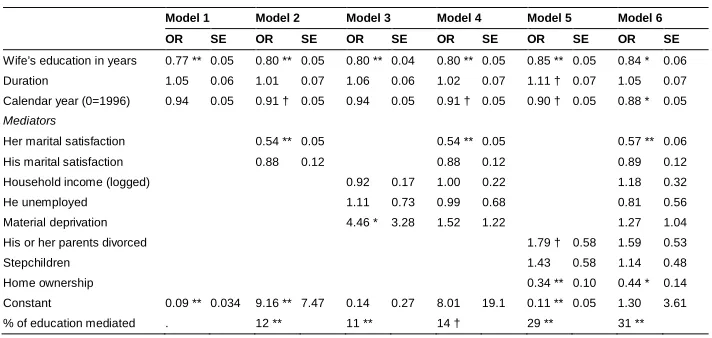
Table B-1: Discrete-time event history models explaining divorce by satisfiers and barriers to divorce, excluding left-truncated cases, odds ratios (OR) and their standard errors (SE). N = 2,581 (couple-years from 599 couples)
Model 1 Model 2 Model 3 Model 4 Model 5 Model 6 OR SE OR SE OR SE OR SE OR SE OR SE
Wife’s education in years 0.77 ** 0.05 0.80 ** 0.05 0.80 ** 0.04 0.80 ** 0.05 0.85 ** 0.05 0.84 * 0.06
Duration 1.05 0.06 1.01 0.07 1.06 0.06 1.02 0.07 1.11 † 0.07 1.05 0.07
Calendar year (0=1996) 0.94 0.05 0.91 † 0.05 0.94 0.05 0.91 † 0.05 0.90 † 0.05 0.88 * 0.05
Mediators
Her marital satisfaction 0.54 ** 0.05 0.54 ** 0.05 0.57 ** 0.06
His marital satisfaction 0.88 0.12 0.88 0.12 0.89 0.12
Household income (logged) 0.92 0.17 1.00 0.22 1.18 0.32
He unemployed 1.11 0.73 0.99 0.68 0.81 0.56
Material deprivation 4.46 * 3.28 1.52 1.22 1.27 1.04
His or her parents divorced 1.79 † 0.58 1.59 0.53
Stepchildren 1.43 0.58 1.14 0.48
Home ownership 0.34 ** 0.10 0.44 * 0.14
Constant 0.09 ** 0.034 9.16 ** 7.47 0.14 0.27 8.01 19.1 0.11 ** 0.05 1.30 3.61
% of education mediated . 12 ** 11 ** 14 † 29 ** 31 **
Appendix C: Decomposition of direct and indirect effects from the
path analysis
Table C-1: Mediation of the association between the explanatory variables and divorce by marital satisfaction, logit coefficients and their standard errors (SE). N = 6,293 couple-years (1,263 couples)
Explanatory variable Reduced model Full model Difference % Mediated by marital satisfactions Coef. S.E. Coef. S.E. Coef. S.E.
Home ownership –0.62 ** 0.21 –0.48 * 0.21 –0.13 ** 0.03 22
Deprivation 0.53 0.49 –0.00 0.50 0.53 ** 0.08 100
His unemployment 0.85 * 0.37 0.62 0.38 0.24 ** 0.07 28
Parental divorce 0.57 ** 0.20 0.49 * 0.20 0.08 ** 0.02 12