Open Access
Research
Capreomycin is active against non-replicating
M. tuberculosis
Leonid Heifets*
1, Julie Simon
2and Van Pham
1Address: 1National Jewish Medical and Research Center, Denver, Colorado 80206, USA and 26955 S.W. Larkspur Pl., Beaverton, OR 97008, USA
Email: Leonid Heifets* - [email protected]; Julie Simon - [email protected]; Van Pham - [email protected] * Corresponding author
latent tuberculosis infectiondormant tubercle bacillicapreomycin
Abstract
Background: Latent tuberculosis infection (LTBI) is affecting one-third of the world population, and activation of LTBI is a substantial source of new cases of tuberculosis. LTBI is caused by tubercle bacilli in a state of non-replicating persistence (NRP), and the goal of this study was to evaluate the activity in vitro of various antimicrobial agents against non-replicating M. tuberculosis.
Methods: To achieve a state of NRP we placed broth cultures of M. tuberculosis (three strains) in anaerobic conditions, and in this model tested all known anti-TB drugs and some other antimicrobial agents (a total of 32 drugs). The potential effect was evaluated by plating samples from broth cultures for determining the number of viable bacteria (CFU/ml) during a prolonged period of cultivation. Besides drug-free controls we used metronidazole for positive controls, the only drug known so far to be effective against tubercle bacilli in anaerobic setting.
Results: On a background of non-replicating conditions in drug-free cultures and clear bactericidal effect of metronidazole none of the antimicrobial agents tested produced effect similar to that of metronidazole except capreomycin, which was as bactericidal at the same level as metronidazole.
Conclusion: The unique ability of capreomycin to be bactericidal in vitro among the anti-TB drugs against non-replicating tubercle bacilli may justify the search for other drugs among peptide antibiotics with similar activity. This phenomenon requires further studies on the mechanism of action of capreomycin, and evaluation of its activity in appropriate animal models.
Background
Latent tuberculosis infection (LTBI) is defined as a clinical condition without clinical or radiological signs of active disease, and it is manifested only by a positive tuberculin skin test [1]. Approximately two billion people, or one-third of the world's population, have LTBI, and approxi-mately 10% of them will develop active TB during their lifetime. It is also estimated that one-third of all new cases of active TB (about 2.5 million cases reported annually in
the world), results from activation of LTBI. The role of LTBI is even greater in persons co-infected with HIV. Cur-rently, 11 million people in this category are registered throughout the world, and at least 10% of them develop active TB every year. All these facts have placed the prob-lem of diagnosis and effective treatment of LTBI in the frontier of current TB research agenda.
Published: 01 April 2005
Annals of Clinical Microbiology and Antimicrobials 2005, 4:6 doi:10.1186/1476-0711-4-6
Received: 01 February 2005 Accepted: 01 April 2005
This article is available from: http://www.ann-clinmicrob.com/content/4/1/6
© 2005 Heifets et al; licensee BioMed Central Ltd.
There is plenty of evidence that the basis for LTBI in humans is persistence of tubercle bacilli in vivo for long periods of time. This status is currently defined as dor-mancy or non-replicating persistence (NRP) emphasizing that each of these terms is only descriptive, regardless of the mechanisms involved [2]. An important element of this definition is that the suggested terms indicate not only the constant number of tubercle bacilli over time (stationary phase of growth in vitro), but actual lack of multiplication. Besides LTBI, a part of bacterial popula-tion in patients with active disease also persists in a non-replicating state, and there is an obvious need for a drug affecting this sub-population – a drug that would be con-sidered for incorporation into treatment regimens.
The in vivo factors that may induce NRP include depletion of nutrients, shifts in pH, accumulation of growth inhib-iting products, and depletion of oxygen. Discovery of effective drugs against non-replicating tubercle bacilli requires appropriate in vitro models of dormancy. In the past, the following in vitro models were suggested: cultiva-tion at 8°C for 31 days [3], nutrient deplecultiva-tion [4], deple-tion of oxygen in vigorously shaken broth cultures [5], anaerobic model in submerged broth cultures [6], and cultivation at pH 4.8–5.0 in broth for six weeks [7]. Not all of these models fully comply with the above definition of dormancy, and the most popular among them became the anaerobic model by Wayne [6]. The physiological parameters of NRP of M. tuberculosis in this model were studied intensively [8-12], which makes the anaerobic conditions the most attractive tool for further studies of NRP.
The aim of this study was to analyze the activity of all available anti-tuberculosis drugs in broth cultures in in vitro anaerobic conditions. Only capreomycin was found to be bactericidal in these conditions, and the activity of this drug was at the same level as that of metronidazole.
Methods
Antimicrobial agents
Metronidazole was obtained from Searle (Skokie, IL). All other drugs and reagents were obtained from Sigma (St. Louis, MO). Stock solutions of rifampin were made in methanol, ethionamide – in DMSO, and all other drugs – in distilled water. Working solutions were prepared from stock solution in 7H9 broth.
Test-strains
Three drug-susceptible strains of M. tuberculosis, H37Rv, Erdmann, and Atencio, were kept in aliquots of 7H9 broth culture frozen at -70°C. The inocula were prepared by 5– 7 days of sub-cultivation in fresh 7H9 broth tubes (4.5 ml) placed in a roller drum for better aeration. These cul-tures were used as inocula when the turbidity became
equal to the optical McFarland standard #1, which corre-sponded to about 108 CFU/ml.
Inoculum for hypoxia in vitro model
The so-called "anaerobic inoculum" of tubercle bacilli was prepared according to the original description [6,13]. According to these reports, with conditions of gradually decreased supply of oxygen, the tubercle bacilli undergo an orderly metabolic down-shift into a state of dormancy when the bacteria accumulate in the bottom of the unshaken tubes (20 × 125 mm) containing 10 ml of broth. In our experiments, a bacterial suspension (optical density at #1 McFarland standard) was made from 10–14 day-old 7H11 agar culture. After homogenization with glass beads, the suspension was placed into 25 × 125 mm tubes, 4 ml in each, and an additional 6.0 ml of fresh 7H9 broth was added. After cultivation at 37°C for 19 days in an undisturbed upright position, the caps were loosened by 1/2 turn, and the tubes were placed into an anaerobic jar for another nine days of cultivation. The jars contained indicator strips and GasPackPlus envelopes filled with 10 ml of sterile water. Sediments were removed from tubes by inserting pipettes through supernatants, and then com-bined into one tube, approximately 8 ml from each four tubes set.
Medium for anaerobic cultivation
Standard 7H12 broth in 12B Bactec vials (4.0 ml) was supplemented with three aqueous filter-sterilized reagent solutions, each added in a volume of 0.1 ml per vial. Two of them were oxygen-reducing reagents: Sodium thiogly-colate and L-cysteine hydrochlorate. The third was meth-ylene blue, a color indicator of oxygen presence. The final concentration was 0.5 mg/ml of each of these reagents in the medium.
Hypoxia in vitro model: experiments with drugs
for plating appropriate dilutions on 7H11 agar plates. The results were expressed in CFU/ml at each time-point.
Statistical analyses
We have determined the regression coefficients for each of the curves of decline in bacterial counts (CFU/ml) in the presence of all drugs, as well as in the drug-free controls. For each coefficient we determined confidence limits for the 0.95 probability, as well as its level of statistical signif-icance (difference from the "no-decline") expressed in the
p value. In addition, we determined the statistical differ-ence between the regression coefficients for each drug, on one hand, and the same values found for drug-free con-trols, also expressed as a p value.
Results
Model validation
We evaluated the kinetics of GI and CFU/ml in three pre-liminary experiments (with three strains) using vials with-out any drugs added and in the presence of metronidazole. Cultivation in these preliminary experi-ments continued up to 29 days, and samples for CFU/ml determination were taken from alternate vials on days 0, 4, 8, 11, 15, 18, 22, 25, and 29. During this period of time, production of CO2 in cultures remained at a steady low level (with daily GIs less than 10), when cumulative four-day readings on the Bactec-460 machine did not exceed GI = 40. The number of CFU/ml in drug-free vials remained relatively steady during this period, with only a small decline within the first 18 days. The kinetics of CFU/ml in vials containing metranidazole was different: a decline could have been detected at day 8, but it became more evi-dent (by one-to-two log10) at day 15. This decline in the number of CFU/ml was more significant in the presence of 32 µg/ml of metronidazole than at 8.0 µg/ml. This dif-ference compared to the drug-free medium and between the effects of two drug concentrations became greater dur-ing the subsequent period. Nevertheless, we found these differences within the first 15 days of cultivation quite suf-ficient and less laborious for the subsequent 15 validation
experiments (five with each of the test-strains), in which the number of CFU/ml was determined on days 0, 8, and 15. In addition, we incorporated two more agents along with metronidazole (rifampin 0.5 µg/ml and isoniazid 0.5 µg/ml) into these experiments. The summary of these experiments, presented in Table 1, demonstrated results similar to that in the original report regarding activity of these agents in anaerobic conditions (13): clear dose-dependent bactericidal effect of metronidazole, very slight effect of rifampin, and no effect of isoniazid. The results of one of these experiments is also shown in Fig. 1.
Table 1: Antimicrobial Effect of Metronidazole (Met), Rifampin (RMP) and Isoniazid (INH)Against Three Strains of M. tuberculosis
Drug/ Conc. (µg/ml) Log10 of CFU/ml on days 0, 8 and 15
H37Rv Atencio Erdman
0 8 15 0 8 15 0 8 15
Control 6.76 6.30 6.04 7.26 7.49 7.34 7.08 6.63 6.30 Met. 32.0 6.76 5.18 4.20 7.26 5.73 5.76 7.08 4.70 4.18 Met. 8.0 6.76 5.70 5.72 7.26 6.49 6.20 7.08 5.88 5.18 RMP 0.5 6.76 6.11 5.91 7.26 6.50 6.50 7.08 5.76 5.59 INH 0.5 6.76 6.00 5.30 7.26 7.00 7.00 7.08 6.00 5.87
One of experiments confirming the validity of the anaerobic model: kinetics of CFU/ml of M. tuberculosis on days 0, 8, and 15 in 7H12 broth in anaerobic conditions: in drug-free con-trol, in the presence of metronidazole (Met, 32 and 8 µg/ml), rifampin (RMP, 0.5 µg/ml), and isoniazid (INH, 0.5 µg/ml) Figure 1
Screening of other drugs
In subsequent experiments, each drug was tested in three concentrations (µg/ml): amikacin (8, 4, 2), capreomycin (8, 4, 2), ciprofloxacin (4, 2, 1), clarithromycin (32, 8, 2), ethambutol (8, 4, 2), ethionamide (4, 2, 1), gatifloxacin (2, 0.5, 0.12), isoniazid (2.5, 0.5, 0.1), levofloxacin (2, 1, 0.5), PAS (25 and 6.25), pyrazinamide at pH 6.0 (900, 300, 100), morphazinamide (300 and 100), rifabutin (0.5, 0.25, 0.12), rifampin (0.5, 0.25, 0.12), rifapentine (0.12, 0.06, 0.03), streptomycin (8, 4, 2), sparfloxacin (2, 1, 0.5), thiacetazone (1.2, 0.3, 0.075). Other drugs were tested in single concentrations: amoxicillin, augmentin, clindomycin, ceftriaxone, dapsone, doxycycline, erythro-mycin, cefoxitin, gentaerythro-mycin, imipenem, minocycline, pristomycin, sulfamethoxazole, tetracycline, trimetho-prim. Each experiment for testing two or three of the above listed drugs always included a drug-free control and metronidazole. The analyses included only those experi-ments in which clear difference in the kinetics of CFU/ml
between drug-free controls and metronidazole have been observed.
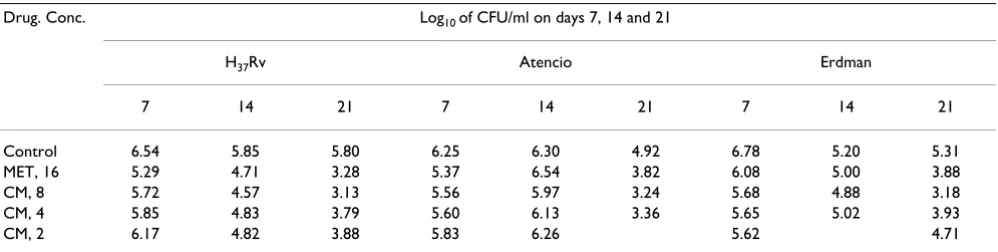
Other criteria for inclusion were: no appearance of blue color in the media, and no greater than GI = 50 cumula-tive readings at days 7–8, 14–15, and 21. These screening experiments clearly demonstrated that none of the above listed agents, except capreomycin (see below), could pro-duce any antimicrobial activity in the model used, con-trasting with clear bactericidal activity of metronidazole. The results of some of these experiments are shown in Table 2 and Fig. 2.
Activity of capreomycin in anaerobic cultures
A series of 29 experiments (six of which included capreo-mycin) were conducted with assessment of the number of CFU/ml at four time-points: days 0, 7, 14, and 21. Some decline in the number of viable bacteria, at one log10 or less, occurred in drug-free controls during this period.
Table 2: Kinetics of the Number of Viable Bacteria (Log10 CFU/ml). Initial CFU/ml Contents: H37Rv – 6.32, Atencio – 6.75, Erdman – 6.52.
Drug/ Conc. (µg/ml) Log10 of CFU/ml on days 7, 14 and 21
H37Rv Atencio Erdman
7 14 21 7 14 21 7 14 21
Control 6.04 5.49 4.91 5.30 5.62 4.86 5.90 5.32 4.91 MET, 16 4.43 4.46 3.12 4.54 3.84 3.15 4.04 3.67 3.28 EMB, 8 5.86 5.39 4.91 6.17 5.30 4.71 5.82 5.28 4.72 SM, 8 6.06 5.12 4.67 6.07 5.20 4.31 5.75 5.16 4.46 PZA, 900* 5.96 5.23 4.45 5.96 5.08 4.16 5.59 5.17 4.50
*At pH 6.2
Table 3: Antimicrobial Effect of Capreomycin (CM) at Concentrations of 8, 4, and 2 µg/ml Initial CFU/ml Content: H37Rv – 7.28, Atencio – 6.31, Erdman – 6.88
Drug. Conc. Log10 of CFU/ml on days 7, 14 and 21
H37Rv Atencio Erdman
7 14 21 7 14 21 7 14 21
Control 6.54 5.85 5.80 6.25 6.30 4.92 6.78 5.20 5.31 MET, 16 5.29 4.71 3.28 5.37 6.54 3.82 6.08 5.00 3.88 CM, 8 5.72 4.57 3.13 5.56 5.97 3.24 5.68 4.88 3.18 CM, 4 5.85 4.83 3.79 5.60 6.13 3.36 5.65 5.02 3.93
Metronidazole used in a concentration of 16 µg/ml in these experiments produced a more significant effect, with a difference of 1–2 log10 or more compared with the number of CFU/ml in drug-free controls at day 21 of cul-tivation (Table 3). The effect of capreomycin at a concen-tration of 8.0 µg/ml in these experiments was similar to that of metronidazole, and clear dose-response relations was seen for this effect (Table 3 and Fig. 3).
Statistical significance
Decline in the number of viable bacteria in drug-free con-trols was not significant, with the exception being for the strain Erdman in experiments presented in Table 1 and 2 (p < 0.05). Decline in the number of viable bacteria in the presence of RMP and INH (Table 1) and EMB and SM (Table 2) was not significant in experiments with strains H37Rv and Atencio (p > 0.05). Decline in CFU/ml in the presence of metranidazole 32.0 and 16.0 µg/ml was statis-tically significant (p < 0.05) in all experiments, with best results in experiments with the H37Rv strain, showing most significant difference from decline in controls. Capreomycin (Table 3) was most active against strain H37Rv at concentrations of 8.0 and 4.0 µg/ml (p = 0.002 and p = 0.004, correspondingly) with definitive difference from the curve of decline in the control (p = 0.003 and p
= 0.009, correspondingly).
Discussion
We examined the antimicrobial activity of all anti-TB drugs and of other antimicrobial agents against M. tuber-culosis in anaerobic conditions. For this purpose, we used an anaerobic in vitro model based on the same principles suggested by Wayne for submerged broth culture cultiva-tion (6,13). Preparacultiva-tion of the "anaerobic inoculum" of
M. tuberculosis was identical to the procedure described in these reports. On the other hand, to evaluate the activity of various drugs, we used a different technology (the Bactec-460 system) for subsequent cultivation in anaero-bic conditions. One of the advantages of this system is that it is less laborious for testing a large number of drugs than the original technique. Running the culture vials through the Bactec-460 anaerobic system with a nitrogen gas flow effectively provided anaerobic conditions, enforced by oxygen-reducing agents and controlled by the color indicator present in each vial. In the past, it was established that daily release of CO2, which was automat-ically recorded in this system as radiometric Growth Index (daily GI), correlates well with the increase in the number of viable bacteria. Therefore, detection of any significant amount of CO2 released in cultures in any of the vials pro-vided an instant indication of possible growth, and such vials could have been immediately removed from the experiment. The validity of this system was confirmed in a series of experiments to test the activity of metronida-zole, rifampin, and isoniazid. Results obtained in these Kinetics of CFU/ml of M. tuberculosis in anaerobic conditions
on days 0, 7, 14, and 21 in one of experiments with conven-tional anti-TB drugs compared to that of the drug-free con-trol and effect of metronidazole (Met. 16 µg/ml): ethambutol (EMB, 8 µg/ml), streptomycin (SM, 8 µg/ml), and pyrazina-mide (PZA, 900 µg/ml, at pH 6.0)
Figure 2
Kinetics of CFU/ml of M. tuberculosis in anaerobic conditions on days 0, 7, 14, and 21 in one of experiments with conven-tional anti-TB drugs compared to that of the drug-free con-trol and effect of metronidazole (Met. 16 µg/ml): ethambutol (EMB, 8 µg/ml), streptomycin (SM, 8 µg/ml), and pyrazina-mide (PZA, 900 µg/ml, at pH 6.0).
Effect of capreomycin (CM, at 8, 4, and 2 µg/ml) in one of experiments against M. tuberculosis (H37Rv) in anaerobic conditions compared to that of metronidazole (Met, 16 µg/ ml)
Figure 3
experiments were identical to those reported by Wayne and Sramek [13].
Among all drugs listed in the Methods section, only capre-omycin exhibited a clear bactericidal effect similar to that of metronidazole against non-replicating M. tuberculosis in anaerobic conditions, and this finding was confirmed in six experiments with three M. tuberculosis strains.
We previously reported that the MICs of capreomycin in aerobic conditions against actively multiplying M. tuberculosis were within the range of 1.25–2.5 µg/ml in either liquid or solid (7H11 agar) medium, and the MBC/ MIC ratio was equal to 2, similar to that of streptomycin, amikacin, and kanamycin [14,15]. New findings that capreomycin can be active against non-replicating M. tuberculosis require further investigation, particularly in appropriate animal models. The unusual phenomenon of such activity also requires further studies in regard to the mode of action of this drug in anaerobic conditions. It is well known that M. tuberculosis in NRP state represent a problem of LTBI, but also can be a part of the bacterial population in new patients with active tuberculosis [16]. Therefore, it is quite possible that capreomycin may not only be effective in patients with LTBI, but also may play an important role as an element of an initial treatment regimen in new patients with active tuberculosis. Either of these possibilities should be investigated in various animal models and subsequently considered for confir-mation in clinical trials. Setting up and conducting a large-scale trial with LTBI patients would require a sub-stantial period of observation and can be quite expensive. Therefore, before addressing the issue of treatment of LTBI patients, another option that can be considered is evalua-tion of the potential effect of capreomycin (in a combina-tion with other drugs) for newly diagnosed patients. This can be achieved in pilot clinical trials using various surro-gate markers to determine bactericidal and sterilizing activity of drugs or drug combination [17-19]. It is prema-ture to define the exact avenues of clinical studies until the needed information on the effect of capreomycin in appropriate animal models becomes available.
Conclusion
Among the known anti-TB drugs and other tested agents, only capreomycin exhibited a bactericidal effect against non-replicating M. tuberculosis in anaerobic conditions in vitro. Further studies are needed to investigate the mode of action of this drug in such a setting, as well as the efficacy in appropriate animal models, and, perhaps, in pilot clin-ical trials. Testing in an anaerobic dormancy model of some other polypeptides may lead to the discovery of other drugs effective against non-replicating M. tuberculosis.
Authors' contributions
LH directed the study, analyzed and interpreted the results, drafted the manuscript. JC contributed to the design of the model, and performed experiments with anti-TB drugs. VP contributed to the standardization of the procedures, especially for quality controls of anaero-bic conditions, standardized CFU/ml quantitation, repeated a series of experiments with anti-TB drugs and conducted experiment with other antimicrobials.
Acknowledgements
This work was supported by NIH Grant No. U19-AI40917. We thank Andrew J. Kittelson for the statistical analyses of the experimental data.
References
1. Nuermberger E, Bishai WR, Grosset JH: Latent tuberculosis infection.Sem Resp Crit Care Med 2004, 25(3):317-336.
2. Wayne LG, Sohaskey CD: Nonreplicating persistence of Myco-bacterium tuberculosis.Annu Rev Microbiol 2001, 55:139-193. 3. Dickinson JM, Mitchison DA: Experimental models to explain
the high sterilizing activity of rifampin in the chemotherapy of tuberculosis.Am Rev Respir Dis 1981, 123:367-371.
4. Yuan Y, Crane DD, Barry CE: Stationary phase-associated pro-tein expression of Mycobacterium tuberculosis : function of the mycobacterial alpha-chrystallin homolog.J Bacteriol 1996,
178:4484-4492.
5. Lyon RH, Lichstein HC, Hall WH: Factors affecting growth of
Mycobacterium tuberculosis in aerobic and stationary
cultures.Am Rev Respir Dis 1961, 83:255-260.
6. Wayne LG: Dynamics of submerged growth of Mycobacterium tuberculosis under anaerobic and microaerophilic conditions.
Am Rev Respir Dis 1976, 114:807-811.
7. Heifets L, Lindholm-Levy P: Pyrazinamide sterilizing activity in vitro against semidormant Mycobacterium tuberculosis bacte-rial populations.Am Rev Respir Dis 1992, 145:1223-1225. 8. Wayne LG, Lin KY: Glyoxylate metabolism and adaptation of
Mycobacterium truberculosis to survival under anaerobic conditions.Infect Immun 1982, 37:1042-1049.
9. Boon C, Li R, Qi R, Dick T: Proteins of Mycobacterium bovis
BCG induced in the Wayne dormancy model.J Bacteriol 2001,
183:2672-2676.
10. Sherman DR, Voskuil M, Schnappinger D, Liao R, Harrel MI, Schoolnik GK: Regulation of the Mycobacterium tuberculosis hypoxic response gene encoding alpha-chrystallin.Proc Natl Acad Sci USA 2001, 98:7534-7539.
11. Voskuil MI, Schnappinger D, Visconti KC, et al.: Inhibition of respi-ration by nitric oxide induces a Mycobacterium tuberculosis
dormancy program.J Exp Med 2003, 198:705-711.
12. Park HD, Guinn KM, Harrel MI, et al.: Rv3133c/dosR is a transcrip-tion factor that mediates the hypoxic response of Mycobac-terium tuberculosis.Mol Microbiol 2003, 48:833-843.
13. Wayne LG, Sramek HA: Metronidazole is bactericidal to dor-mant cells of Mycobacterium tuberculosis. Antimicrob Agents Chemother 1994, 38:2054-2058.
14. Heifets L: MIC as a quantitative measurement of susceptibility of M. avium to seven antituberculosis drugs.Antimicrob Agents Chemother 1988, 32(8):1131-1136.
15. Heifets L, Lindholm-Levy PA: Comparison of bactericidal activi-ties of streptomycin, amikacin, kanamycin, and capreomycin against M. avium and M. tuberculosis.Antimicrob Agents Chemother 1989, 33(8):1298-1303.
16. Mitchison DA: The action of antituberculosis drugs in short-course chemotherapy.Tubercle 1985, 66:219-225.
17. Bridle R, Odhiambo J, Mitchison D: Serial counts of Mycobacte-rium tuberculosis in sputum as surrogate markers of the ster-ilizing activity of rifampicin and pyrazinamide in treating pulmonary tuberculosis.BMC Pulm Med 2001, 1(1):2.
Publish with BioMed Central and every scientist can read your work free of charge "BioMed Central will be the most significant development for disseminating the results of biomedical researc h in our lifetime."
Sir Paul Nurse, Cancer Research UK
Your research papers will be:
available free of charge to the entire biomedical community
peer reviewed and published immediately upon acceptance
cited in PubMed and archived on PubMed Central
yours — you keep the copyright
Submit your manuscript here:
http://www.biomedcentral.com/info/publishing_adv.asp
BioMedcentral
19. Gosling RD, Heifets L, Gillespie SH: A multicentre comparison of novel surrogare marker for determining the specific potency of antituberculosis drugs. J Antimicrob Chemother 2003,