AUT J. Elec. Eng., 50(2) (2018) 135-140 DOI: 10.22060/eej.2018.13697.5182
A Thinning Method of Linear And Planar Array Antennas To Reduce SLL of Radiation
Pattern By GWO And ICA Algorithms
H. Rezagholizadeh1, D. Gharavian2*
1 Department of Electrical Engineering, Islamic Azad University, South Tehran Branch, Tehran, Iran 2 Department of Electrical Engineering, Shahid Beheshti University, Tehran, Iran
ABSTRACT: In the recent years, the optimization techniques using evolutionary algorithms have been widely used to solve electromagnetic problems. These algorithms use thinning the antenna arrays with the aim of reducing the complexity and thus achieving the optimal solution and decreasing the side lobe level. To obtain the optimal solution, thinning is performed by removing some elements in an array through stimulating the zero state or setting off those elements. In this paper, a 100-elements linear array and a 100-elements planar array with isotropic elements are investigated. Thinning is performed using Genetic, Particle Swarm, Imperialist Competitive and Grey Wolf algorithms. The Imperialist Competitive and Grey Wolf algorithms have been suggested in this paper for thinning a full array in order to compare their performance with the performance of other evolutionary algorithms suggested in previous studies. The results show that the Grey Wolf algorithm has a better performance in terms of reaching the lowest side lobe level. It is also found that by using Grey Wolf algorithm, it would be possible to reach a level of -19.31 dB side lobe for a linear array and a level of -48.96 dB side lobe for a planar array.
Review History:
Received: 17 November 2017 Revised: 18 August 2018 Accepted: 25 August 2018 Available Online: 11 September 2018
Keywords: Array Thinning SLL
GA PSO ICA GWO
Optimization Algorithm
1- Introduction
Antenna arrays consist of a set of antenna elements that are fed coherently. These antennas search the desired direction in the space by using a variable phase or controlling the excitation delay line or feeding every element. Array thinning is exploited with the aim of removing some elements of the array and getting the appropriate radiation pattern with low side lobe level and thus achieving the desired goal in the shortest time. There are several methods for thinning arrays. Iterative FFT techniques [1-3], dynamic programming [4-5] and statistical techniques [6] are used to decrease the side lobe level. One way to design arrays with non-uniform spacing elements is to investigate all forms of placement of elements in the phased array apertures. By this method, all possible combinations of elements are examined, the radiation pattern is calculated for each element and, finally, the combination led to the best radiation pattern is selected. However, this method is not practical for the real conditions except for very simple combinations. If there is an array of N elements where each element may be located in M places, then various combinations must be considered. Even for the case of small number of elements where each element has a limited number of places, the number of cases that needs to be examined is very large due to the exponential relationship [4]. A proposal for creating a non-uniform array is to thin a uniform array by turning off some elements of the array without losing the advantages of the radiation pattern and reducing the side lobe level. Evolutionary algorithms can be used to reduce the computational burden to find the best solution randomly regardless of the number or position of the elements. The main
linear arrays with low side lobe levels [11]. The genetic algorithm was used to thin the array elements of the typical conformal arrays (i.e. curved surface arrays), with the working states of elements as the optimizing variables [12]. Khalid, Sheikh, Shah and Khan (2015) dealt with the linear inequality constraint on array factor to get maximum response in look direction and reduced side lobe levels in a specified stop band region [13]. Gangwar, Singh, Patidar and Singh (2016) proposed an optimistic design of thinned planar antenna (TPA) array that provided radiation pattern with reduced peak, RMS and average side lobe levels (SLLs) required for radar operating scenarios [14]. Deb, Gupta and Roy (2015) used particle swarm algorithm to thin a 100-elements array and reached a level of -17 dB for side lobe [15]. An elliptical array antenna was also optimized by this algorithm [16]. PSO technique was used to estimate the optimum combination of on and off elements corresponding to lowest possible peak SLL [17]. In the present study, two new algorithms, named Imperialist Competitive [18-20] and Grey Wolf [21], are used for thinning the linear and planar arrays. The purpose of this study is to investigate the performance of different algorithms in reaching lower side lobe levels and to compare their results based on fair input parameters and similar population size. In section II, some algorithms and their rules are described and Equation (2), which was derived for particle swarm algorithm, is used to discrete the new algorithms as a new suggested method. In section III, the linear and planar arrays are introduced and the radiation pattern of the array is considered as a cost function. In section IV, performances of the proposed algorithms are compared. We will see that, in comparison with other algorithms, Grey Wolf algorithm achieves lower side lobe levels and the computational burden of Imperialist Competitive algorithm is much more than the other three algorithms. Finally, conclusion of the algorithms simulation will be provided in section V.
2- An Overview of Evolutionary Algorithms
Genetic Algorithm (GA) is one of the most popular optimization algorithms that has been widely used in electromagnetic problems. Based on Darwin’s theory of evolution and the concept of survival of the fittest, the genetic algorithm has been suggested as an ideal solution for similar process [22]. Particle Swarm Optimization (PSO) is a social search algorithm inspired by the social behavior of birds. In many problems, this algorithm is used for optimization of the solution [23]. Imperialist Competitive Algorithm (ICA) is an evolutionary computation algorithm based on social and political transformation of human. The algorithm begins by initializing the initial population called the population of country. The most powerful countries of the population are called the empires and the rest are called the imperials’ colonies [18].
The modifications and changes in the movement of the colonies vary in different discrete problems. Equation (1), which was derived for particle swarm algorithm, is used to discrete the ICA algorithm. According to Equation (1), ‘on’ or ‘off’ state of the elements will be compared with a random number ‘r’ within the interval [0, 1]. xn is the movement
value of the colonies and pn is the value of each element in
discrete state [24].
(1)
1 1
1 1 0
1
n
n
x n
x r
e p
r e
−
−
>
+
=
≤
+
Grey Wolf Optimizer (GWO) is based on hierarchical leadership in wolves’ hunting mechanism. Four groups of grey wolves named Alpha, Beta, Delta and Omega are considered to simulate the hierarchical behavior of wolves [21].
3- Array Thinning
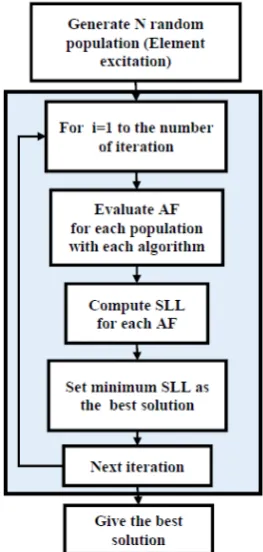
Array thinning means to turn off a number of elements of an array to get the desired orientation of the main beam and to reduce the side lobe level without loss of the performance of an array. All on elements are fed with the same value of 1 and off elements are fed with 0. In Fig. 1. the flowchart of array thinning is indicated.
3- 1- Linear Array Thinning
Array thinning can be applied to a linear array (see Fig. 2). The synthesis of an array can be done using the different techniques, including advanced optimization techniques and methods of Dolph-Chebyshev’s weighting [25] or Taylor [26-28]. Among these various methods, it is more desirable to use array-thinning method. The position of elements is fixed in the aperture, however they may radiate or they may play no role in creating the pattern. Therefore, we consider two modes for each element and avoid controlling the amplitude and phase. In this way, the feeding procedure becomes simple. If we assume that all elements are isotropic, the equation for the radiation pattern, i.e. the array factor (AF), is obtained from equation (2) [29].
(2)
(
)
exp 0.5
N n N
AF A j d nβ u α
−
=
∑
− + In the above equation, An is the excitation amplitude of
array elements (In this case one or zero). β represents the wavenumber, d is the distance between the elements, α
represents the progressive phase shift between elements (assumed to be zero) and u=cosφ where φ is the beam-scanning angle.
3- 2- Planar Array Thinning
Elements of antenna array can be placed on a single plane. Design of a planar array is shown in Fig.3.
Similar to the linear array, the elements are assumed to be isotropic in the x-y plane (see Fig. 3). In both directions of the x-axis and y-axis, there are N elements, therefore the array contains N×N elements. The positions of the elements are symmetric with respect to x- axis and y- axis. Under these conditions, the equation of the array factor can be defined as follows.
(3)
)] sin cos ( sin exp[ ) , ( )
,
(θϕ N θ n ϕ n ϕ
N x
N
N y
n n
n x y jk x y
A AF
n n
+
=
∑ ∑
−
= =−
In the equation (3), k is wavenumber, An (xn , yn ) is the excitation amplitude of the elements and x and y are places of the nth element in the x-y plane. The radiation pattern in
two dimensions, φ as the azimuth angle and θ as the elevation angle, can be obtained from equation (3) [30].
In the evolutionary algorithms, the goal is to optimize a cost function. Optimization here means to find the minimum or maximum of a function with N variables. Equations (2) and (3) are selected as a cost function. As discussed in equations (2) and (3), An is the excitation amplitude of each element
that may take values of zero or one. Now, the algorithms determine which elements stay in on and which ones stay in off state. By finding the best order of elements together and, then, comparing radiation pattern of excitations, the best mode, which is the lowest side lobe level, can be achieved. With the help of these algorithms, the side lobe level reaches the lowest level with a few iterations. It is noteworthy that one can compare these algorithms and check their convergence time to achieve the best answer. In the following, for each
antennas is considered.
4- Analysis of Results
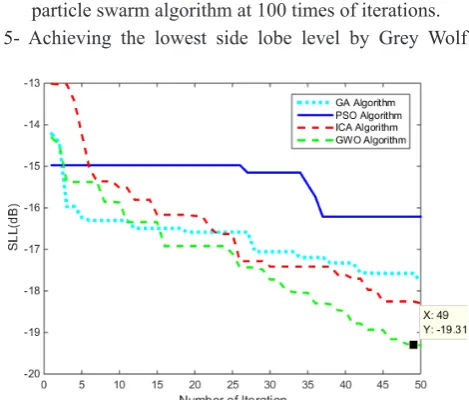
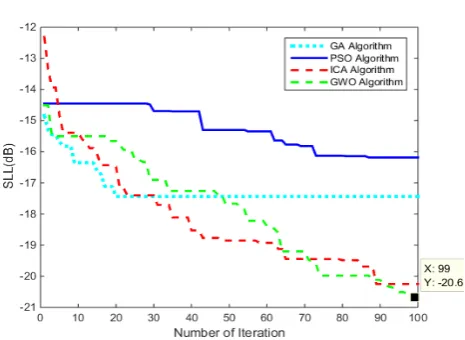
Evolutionary algorithms form a computational approach to optimize a problem in which the solution is continually improved based on the iterations. These methods have the ability to search in a large space of solutions. However, they give no guarantee that the answers are optimal. In the following, the results of the algorithms simulation on a sample of a linear and a planar array are presented. Then, the results obtained from these algorithms are compared. For example, a linear array with 100 symmetric elements relative to the y-axis is considered. All elements in this array are assumed to be isotropic and similar conditions are considered for all algorithms. The iteration in each algorithm is 50, the number of genes in the genetic algorithm, the number of particles in particle swarm algorithm, the number of wolves in grey wolf algorithm and the number of countries in ICA, representing elements in the array, are considered to be 100. The cost function is considered to be the array factor and the best answer is the lowest side lobe levels. Fig. 4 shows changes of the side lobe level of each algorithm when the number of iteration increases. Fig. 5 shows the radiation pattern resulted from the array thinned by using Grey Wolf Algorithm. To check the results, the algorithms with the iteration of 100 are implemented in Fig. 6. The results show that by increasing the number of algorithms iteration, the side lobe level slightly decreases. Therefore, a thinned array can offer essentially more beam width with less directivity and fewer elements. Directivity is approximately equal to the number of elements, N. Gain have been reduced because it depends on number of ON elements G < N. According to the figures and the discussions, the following results can be found:
1- Higher rate of reduction of side lobe in Grey Wolf algorithm and ICA, respectively.
2- More computational load in ICA by calculating average time required for iteration of each algorithm.
3- Faster convergence of genetic algorithm at 100 times of iteration
4- Reduction of side lobe level in genetic algorithm and particle swarm algorithm at 100 times of iterations. 5- Achieving the lowest side lobe level by Grey Wolf Fig. 2. A Linear array
Fig. 3. A planar array
algorithm, -19.31 dB at 50 times and -20.6 dB at 100 times according to Fig. 4 and Fig. 6.
6- Increasing the width of main beam by reducing the side lobe level (Fig. 8, the lowest side lobe level has the highest beam width).
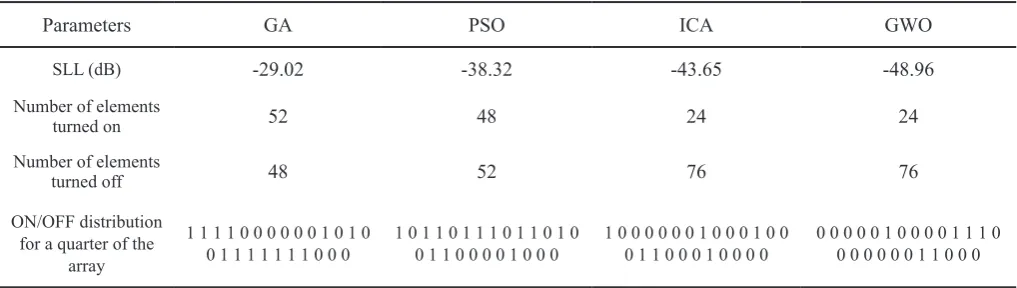
7- It is possible to achieve lower side lobe levels at less iteration using grey wolf algorithm according to Fig. 4 The results of thinning are provided in Table 1. ON/OFF distribution of thinned linear array and SLL are considered. Another example is the simulation of a planar array using those algorithms. This array is symmetric with respect to x-axes and y-axes. In this array, the same conditions are considered for the four algorithms and elements are assumed to be as isotropic. The number of iteration in each algorithm is 10 times, the number of genes in the genetic algorithm, the number of particles in particle swarm algorithm, the number of wolves in grey wolf algorithm and the number of countries in ICA, which represent elements in the array, are considered to be 100. Fig. 7 shows side lobe level versus the iteration number of the algorithms. Fig. 8 shows radiation pattern from the planar array in the cut φ=0. This figure also shows the radiation pattern of a uniform array with identical excitation and compares its results with other algorithms. By comparing the radiation patterns, one can see that a uniform array of the antennas has the highest side lobe level, but smaller main beam width and also the Grey Wolf algorithm has the lowest
level of the side lob and maximum beam width. Therefore, the side lobes are reduced but the main lobe is wider. Directivity is approximately equal to the number of elements, N. Gain is reduced because it depends on the number of ON elements G < N. Although the reduction of the side lobe level is the main objective of the radiation pattern, the excessive increase of the width of main beam is not desirable. Low side lobes, which might be roughly defined as -30 to -60 dB, are of interest for several reasons: reduction of radar and communications intercept probability, reduction of radar clutter and jammer vulnerability, and increasing spectrum congestion in satellite transmissions. Therefore, there must be a tradeoff between the low side lobe level and the main beam width. The followings are the results of the algorithms according to Fig. 7:
1- Further reduction rate in the side lobe level for Grey Wolf algorithm and ICA, respectively.
2- More computational load in ICA by calculating average time required for iteration of each algorithm.
3- Faster convergence of genetic algorithm in 10 iterations. 4- Achieving the lowest side lobe levels -48.96 dB with
the iteration of 10 times using the grey wolf algorithm. 5- Increasing the width of main beam by reducing the side
lobe levels (As shown in Fig. 8, Grey Wolf algorithm with minimum side lobe level has the maximum width of the main beam).
6- It is possible to achieve lower side lobe levels at less
Fig. 5. Radiation pattern of a linear thinned array using grey wolf algorithm in 100 iterations
Fig. 6. Changes in the cost function (side lobe levels according to the number of the iteration of genetic algorithm, particle swarm algorithm, ICA and grey wolf algorithm at 100 times iteration Table 1. Results of thinned linear array with 50 iteration
Parameters GA PSO ICA GWO Fully populated array (uniform array)
SLL (dB) -17.7 -16.21 -18.2 -19.31 -13.5
Number of elements
turned on 66 68 76 76 100
Number of elements
turned off 34 32 24 24 0
ON/OFF distribution for half the array (right
to center of the array)
0 1 1 1 0 1 0 1 1 0 0 0 1 1 1 0 0 1 1 1 1 0 1 0 1 0 0 1 1 1 1 1 1 1 0 0 1 0 1 1 1 0 1 1 1 1 1 1 1 0
1 1 1 0 1 1 1 0 0 1 0 1 0 1 1 0 1 0 1 1 1 1 1 0 1 1 0 0 1 1 1 1 1 1 1 1 0 1 1 0 1 0 1 1 1 1 0 1 0 0
1 1 0 0 1 1 0 1 0 0 0 1 0 1 1 1 1 1 0 1 1 0 1 1 1 1 1 1 0 1 0 1 1 1 1 1 1 1 1 1 1 1 1 0 1 1 1 1 1 1
1 1 1 0 0 0 1 0 1 0 1 1 1 1 0 1 0 1 1 1 1 0 1 0 1 1 0 0 1 1 1 1 1 1 1 1 1 1 1 1 1 1 0 1 1 1 1 1 1 1
iteration using Grey Wolf algorithm according to Fig. 7. 7- Faster convergence of all algorithms in a planar array
relative to a linear array.
The thinning results are shown in Table 2. ON/OFF distribution of thinned planar array and SLL are considered. These excitation amplitudes can be used in isotropic antennas to reduce the SLL. Radiation pattern of a planar array in cut φ=0 with these excitation amplitudes is shown in Fig. 8.
5- Conclusion
Important issue is that the computational burden and CPU time of ICA algorithm is three times more than Grey Wolf algorithm for a specified computer with AMD Dual core processor and 2 GB RAM. This is a disadvantage for this algorithm. Genetic, Particle Swarm and Grey Wolf algorithms converge faster in comparison with ICA. However, the reduction rate of the side lobe level for Grey Wolf and ICA is more than other algorithms, so they will achieve the desired result with less iteration. The orientation and gain of antenna is increased with increasing the number of elements. Low side lobes are of interest for several reasons: Reduction of radar and communications intercept probability, reduction of radar clutter and jammer vulnerability, and increasing spectrum congestion in satellite transmissions. In the thinned array gain G < N (N: The number of elements), if it has been tried to maximize the array gain, a fully populated array is optimum. In addition, the best resolution achieved by reducing the main
beam width that proportions of 1N, increases with decreasing
the number of ON elements. Better orientation, gain and resolution and sensitivity reduction are the main goals of an array, which can be achieved by increasing the number of the elements of array. To improve the behavior of the side lobe, the thinned arrays are used as non-uniform arrays, and this is a compromise between the side lobe level and other parameters.
References
[1] W.P.J.I.T.o.A. Keizer, “Linear array thinning using iterative FFT techniques”, IEEE Transactions on Antennas and Propagation, 56(8) (2008) 2757-2760. [2] W.P.J.I.T.o.A. Keizer, “Large planar array thinning
using iterative FFT techniques”, IEEE Transactions on Antennas and Propagation, 57(10) (2009) 3359-3362. [3] W.P.J.I.A. Keizer, P. Magazine, “Low-sidelobe pattern
synthesis using iterative Fourier techniques coded in MATLAB [EM programmer’s notebook]”, IEEE Transactions on Antennas and Propagation, 51(2) (2009). [4] M. Skolnik, G. Nemhauser, J.J.I.T.o.A. Sherman,
“Dynamic programming applied to unequally spaced arrays”, IEEE Transactions on Antennas and Propagation, 12(1) (1964) 35-43.
Fig. 7. Changes in the cost function (side lobe levels) in terms of number of occurrences of genetic algorithm, particle swarm
algorithm, ICA and grey wolf algorithm Fig. 8. Radiation pattern of a planar array in cut φ=0 , comparison of genetic algorithm, particle swarm algorithm, ICA and grey wolves algorithm and uniform array
Table 2. Results of thinned planar array with 10 iteration
Parameters GA PSO ICA GWO
SLL (dB) -29.02 -38.32 -43.65 -48.96
Number of elements
turned on 52 48 24 24
Number of elements
turned off 48 52 76 76
ON/OFF distribution
[5] R. Arora, N.J.I.T.o.A. Krisnamacharyulu, “Synthesis of unequally spaced arrays using dynamic programming”, IEEE Transactions on Antennas and Propagation, 16(5) (1968) 593-595.
[6] R.J. Mailloux, E.J.I.T.o.A. Cohen, “Statistically thinned arrays with quantized element weights”, IEEE Transactions on Antennas and Propagation, 39(4) (1991) 436-447.
[7] L.H. Abderrahmane, B.J.A.-I.J.o.E. Boussouar, Communications, “New optimisation algorithm for planar antenna array synthesis”, 66(9) (2012) 752-757. [8] R.L.J.I.T.o.A. Haupt, “Thinned arrays using genetic
algorithms”, IEEE Transactions on Antennas and Propagation, 42(7) (1994) 993-999.
[9] P. Rocca, L. Poli, G. Oliveri, A. Massa, “GA-based adaptive thinning strategy for pattern nulling in linear arrays”, in: Antennas and Propagation (EUCAP), 2012 6th European Conference on, IEEE, 2012, pp. 1526-1527.
[10] Y. Hou, J. Kang, Y. Shen, C. Hou, “A thinning method of conformal non-concentric circular array using genetic algorithm”, in: Antennas, Propagation & EM Theory (ISAPE), 2012 10th International Symposium on, IEEE, 2012, pp. 19-22.
[11] G. Oliveri, A.J.I.M. Massa, Antennas, “Genetic algorithm (GA)-enhanced almost difference set (ADS)-based approach for array thinning”, IEEE Transactions on Antennas and Propagation, 5(3) (2011) 305-315. [12] Z. Bao, J. Yu, “Thinning curved surface arrays:
application of the genetic algorithm (GA)”, (2015). [13] A. Khalid, S.A. Sheikh, I.U.H. Shah, Q.U. Khan,
“Synthesis of linear antenna array using genetic algorithm to reduce peak sidelobe level”, in: Electrical and Electronics Engineering (ELECO), 2015 9th International Conference on, IEEE, 2015, pp. 346-350. [14] V. Gangwar, A. Singh, H. Patidar, S. Singh, “Optimistic
design of thinned planar antenna array for radar operating scenarios”, in: Microelectronics, Computing and Communications (MicroCom), 2016 International Conference on, IEEE, 2016, pp. 1-4.
[15] A. Deb, B. Gupta, J.S. Roy, “Design of thinned arrays using Particle Swarm Optimization with differentially perturbed velocity”, in: Communications, Devices and Intelligent Systems (CODIS), 2012 International Conference on, IEEE, 2012, pp. 531-534.
[16] R. Bera, J.S. Roy, “Optimization of thinned elliptical antenna arrays using particle swarm optimization”, in: Communications, Devices and Intelligent Systems (CODIS), 2012 International Conference on, IEEE, 2012, pp. 527-530.
[17] V. Gangwar, A. Singh, E. Thomas, S. Singh, “Side lobe level suppression in a thinned linear antenna array
using particle swarm optimization”, in: Applied and Theoretical Computing and Communication Technology (iCATccT), 2015 International Conference on, IEEE, 2015, pp. 787-790.
[18] E. Atashpaz-Gargari, C. Lucas, “Imperialist competitive algorithm: an algorithm for optimization inspired by imperialistic competition”, in: Evolutionary computation, 2007. CEC 2007. IEEE Congress on, IEEE, 2007, pp. 4661-4667.
[19] A. Kaveh, S.J.C. Talatahari, structures, “Optimum design of skeletal structures using imperialist competitive algorithm”, 88(21-22) (2010) 1220-1229.
[20] M.M. Hadji, B.J.I.T.o.P.S. Vahidi, “A solution to the unit commitment problem using imperialistic competition algorithm”, 27(1) (2012) 117-124.
[21] S. Mirjalili, S.M. Mirjalili, A.J.A.i.e.s. Lewis, “Grey wolf optimizer”, 69 (2014) 46-61.
[22] J.M. Johnson, V.J.I.A. Rahmat-Samii, p. Magazine, “Genetic algorithms in engineering electromagnetics”, 39(4) (1997) 7-21.
[23] J. Kennedy, R.C. Eberhart, “A discrete binary version of the particle swarm algorithm”, in: Systems, Man, and Cybernetics, 1997. Computational Cybernetics and Simulation., 1997 IEEE International Conference on, IEEE, 1997, pp. 4104-4108.
[24] D. Cao, A. Modiri, G. Sureka, K.J.I.a. Kiasaleh, w.p. letters, “DSP implementation of the particle swarm and genetic algorithms for real-time design of thinned array antennas”, 11 (2012) 1170-1173.
[25] C.J.P.o.t.I. Dolph, “A current distribution for broadside arrays which optimizes the relationship between beam width and side-lobe level”, 34(6) (1946) 335-348. [26] A.J.I.T.o.A. Villeneuve, Propagation, “Taylor patterns
for discrete arrays”, 32(10) (1984) 1089-1093.
[27] T.T.J.T.o.t.I.P.G.o.A. Taylor, “Design of line-source antennas for narrow beamwidth and low side lobes” IEEE Transactions on Antennas and Propagation, 3(1) (1955) 16-28.
[28] T.J.I.T.o.A. Taylor, “Design of circular apertures for narrow beamwidth and low sidelobes”, IEEE Transactions on Antennas and Propagation, 8(1) (1960) 17-22.
[29] M. Mangoud, M. Aboul-Dahab, M. Sabry, “Optimum null steering techniques for linear and planar antenna arrays using genetic algorithm”, in: Radio Science Conference, 2003. NRSC 2003. Proceedings of the Twentieth National, IEEE, 2003, pp. B7-1.
[30] Y.U. Kim, J.D. Nespor, “Shaped beam synthesis and conditional thinning for planar phased array”, in: Antennas and Propagation Society International Symposium, 1996. AP-S. Digest, IEEE, 1996, pp. 802-805.
Pleasecitethisarticleusing:
H. Rezagholizadeh, D. Gharavian, A Thinning Method of Linear And Planar Array Antennas To Reduce SLL of Radiation Pattern By GWO And ICA Algorithms, AUT J. Elec. Eng., 50(2) (2018) 135-140.