Vol. 3, No. 1, pp. 1-10, jan (2020)
Quantum Genetic LMI-based H
∞
Control with
Time Delay
Farnaz Sabahi
1,†1 Department of Electrical Engineering, Faculty of Electrical and Computer Engineering, Urmia University, Urmia,
Iran.
One of the main problems underlying most optimization theories is a local optimum. When time delays are presented, this issue becomes much more problematic. In such conditions, evolutionary optimization algorithms are proven to be helpful. In this paper, the quantum genetic algorithm (QGA) has been used to tackle the stated problem in the framework of
delay-dependent linear matrix inequality (LMI) robust H∞ control. QGA is employed to find suitable feedback gains and
delay-dependent LMI solvers are concerned to resolve stability issues. In addition, to provide more balance between exploration and exploitation, to increase convergence rate as well as to prevent premature convergence, it is proposed that particle swarm optimization (PSO) is augmented with QGA. Simulation is dealt with LMI-based H∞ control scheme of the
QGA and QGA-PSO optimization space from the design point of one-degree freedom single link scara robot. The whole controller satisfies the desired properties for the uncertain-but-known constant bounded time delay. Furthermore, one of the drawbacks found in tests of most hybrid global-local strategies, i.e., premature convergence, has been canceled by the proposed scheme of QGA and PSO.
Article Info
Keywords:
H∞ control, Linear matrix inequality (LMI),
Quantum genetic algorithm (QGA), Time Delay
Article History:
Received 2018-08-04
Accepted 2019-04-20
I.
INTRODUCTION
The idea of H∞ optimization goes back to the early days of
robust control theory as early as 1979 [1]. The principal objective of robust control is considering plant uncertainty explicitly to achieve the specified level of performance in which a trade-off is sought between robustness and optimality. Various works have been made in this area. Some consider a range of operating points with representing a variety of uncertainty structure such as μ synthesis and LMI-based H∞
control. The μ synthesis is suitable when uncertainty is in diagonal block structure of variables, and the latter uses a map of the operating points into the uncertainty space in the controller to minimize an upper bound of the robust performance index. LMI-based methods offer a formation for a large variety of control problems; including H∞ [2], the
mixed H2/H∞ [3], the gain-scheduling [4] and so forth. Yet,
the success of all these methods hinges on characterizing the global minimum of the index norm and the problem of stability. Many researchers have focused on this subject [5]. Considering the bilinear aspect of constraints in the resulting optimization problem leads to the idea of integrating evolutionary algorithms, where the well-known one is genetic algorithms [6]. In [7], genetic algorithm manages the PI controller subject to the H∞ index in terms of LMI. In [8], the
fitness function of genetic algorithm is computed by linear matrix inequality solver in the framework of H2/H∞ robust
control. The method proposed in [9] retains GA to linearize a nonlinear channel and exploits LMI to resolve the estimated error.
Additionally, a method suggested in [10] that hosts output feedback using H∞ control problem in continuous-time linear
systems subject to time domain constraints. The combined GA and LMI in low order suboptimal H∞ control by
considering the matrix rank minimization problem is proposed in [11]. Other attempts can be found in [12]-[14], where a hybrid approach is used to solve non-convex optimization in the mixed H2/H∞ control domain. Some
†Corresponding Author: [email protected], [email protected]
Tel: +98-44-32752741-,Fax: +98-44 32752746, Urmia University Faculty of Electrical and Computer Engineering, Urmia University, Urmia, Iran
A
B
S
T
R
A
C
researchers tried to solve the time delay problem associated with the H∞ control with hybrid approach [15]. In [16], mixed
H2/H∞ control is proposed for Two-Time-Scale Markovian
Switching Production-Inventory Systems.
However, time delay restricts the controller functioning, which may be led to the instability of the whole system. Consequently, it is imperative to analyze time-delay effects for control systems. Using Type-II fuzzy logic to deal with time delay is proposed in [17]. In [18], a robust genetic control design is proposed that applied for a class of uncertain neutral delay system. In [19], H∞ control is used for an
uncertain mechanical system with input time delay. The asymptotic stability analysis problem in [20] is considered where each subsystem of large-scale linear systems has time delay as well as the delay interconnections of subsystems is also considered. In [21], H∞ performance for building
structures is described by the delay-dependent feedback control, using a hybrid of GA and LMI.
GA, the simplest random-based approaches, is effective in a situation with little knowledge about the search space and is best for those problems with a clear way to evaluate fitness such as in our situation. In GA, we evolve solutions over the iterations/generations. However, there are shortages associated with GA such as slow convergence rate and premature convergence. Dealing with these deficiencies is an interesting field of research.
Some recent works have addressed approaches requiring genetic algorithm runs several times [6, 22], while more interesting techniques aim to find properly tuned parameters of GA during any attempt of search [22]-[24]. Another insight is using the heuristic approaches to improve the performance of genetic algorithm such as those are done in [25] where particle swarm optimization (PSO) is applied to enhance GA’s individuals. Over the last decade, the possibility to emulate a quantum computing has led to a new class of GAs known as “Quantum Genetic Algorithms” (QGAs) [26]. In the comparison of QGA with GA, it has been shown that QGA is described by less population size, higher convergence rate, and strong global search capability [27]. From the recent successful application of QGA, one can mention task sequence planning [28] that the efficiency, stableness, and cost of a complex assembly system depends on it. An improved version of quantum genetic algorithm is suggested by considering frog-leaping algorithm, simulated annealing, and the quantum variation [29].
Here, we investigate a method consist of quantum genetic algorithm (QGA) and linear matrix inequality (LMI) in H∞
control framework, to explore the bilinear relation between the controller gain and lyapunove matrix. In our method, the stability conditions in the presence of input time delay are formulated by linear matrix inequalities; performance index is regarded as optimization objective and searching for output feedback gain, the optimal result, is done by QGA. Specifically, we propose a framework of quantum genetic LMI-based H∞ control. We also suggest a new combination
QGA and PSO applied it to LMI-based H∞ control. According
to the obtained results, it has been provided outstanding performance. We provide two flowcharts for the proposed structure as well as its combination with PSO. This framework uses different update rules, advanced techniques like combination with local search, and a new generational
scheme. Indeed, the proposed approach here is rather a practical one to overcome the deficiencies of GA. Specifically, one of the problems associated with many hybrid global-local strategies including GA is premature convergence. Simulation results show that this issue has been extensively canceled by the proposed scheme of QGA and PSO.
The arrangement of this paper after this introduction is as follows, and the second section is dedicated to preliminary assumptions about the system and the formulation of the H∞
control problem in linear matrix inequality framework. A brief explanation about QGA is drawn in Section III. The proposed method allows computing a control law by output feedback gain which genetic algorithm globally searches it and implicitly involving stability conditions in the presence of time delay with taking advantage of linear matrix inequalities is described in the fourth section. The hybrid algorithm of QGA with particle swarm optimization for the proposed LMI-based H∞ control scheme is also explained in
Section IV. Section V illustrates simulation results of the proposed frameworks that are done by Matlab. Finally, the conclusion appears in Section VI.
II.
PROBLEM STATEMENT
Consider a linear time-invariant plant P(s) which is termed by:
(1)
( )
( ) = ( ) ( )
( )
where w is exogenous input u is control input, z is controlled output, and y is measured output subject to physical constraints. H∞ control problem finds the output feedback
control law, u=ky such that for a given scalar γ>0 the closed-loop transfer function from w to z follows as:
(2) ‖ ‖ <
where
denotes the H∞ norm. The framework of
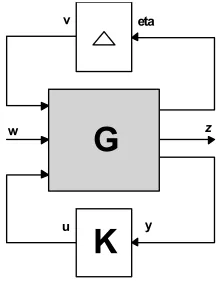
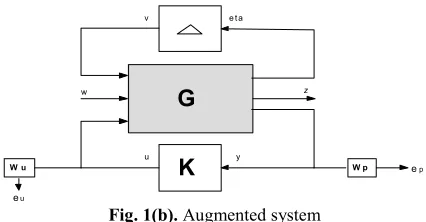
the plant and controller are shown in Fig. 1-A and the block diagram of the augmented system reflecting the uncertainty of the model is shown in Fig. 1-B.
K
w z
u y
v eta
G
G
K
w z
u y
v e t a
W u W p
eu
ep
Fig. 1(b). Augmented system
Consider the minimal realization of plant P(s) as follows [30]:
We assume: i) (A,B2) is stablizable and (A,C2) is detectable ii)D22=0
By defining the following controller k(s):
(4)
( ) = + ( − )
The closed transfer function from w to z is:
(5)
= + ( − ) ,
= +
= + , = [ + ] ,
= +
With taking advantage of the bounded real lemma (BRL)
[31], the H∞ norm constraint ‖ ‖ < , can be
convinced by the feasibility of the following matrix inequality:
(6)
+
∗ −
∗ ∗ −
< 0
The notation * indicates terms that can be induced by symmetry.
Matrix inequality (6) is LMI if the controller parameters
, , , are known. Now, let us consider the state space description of time-invariant system with an input time delay as:
(7)
= + + ( − )
̇ = + + ( − ) = + ( −
)
where x is the state.
Consider the control signal as follows:
(8) u Fy FCx
The following theorem affords sufficient conditions in the presence of delay for feedback LMI-based H∞ control.
Theorem 1[21]."Given a scalar τ1 the closed-loop system is asymptotically stable with H∞ performance index, γ>0, for
any constant time-delay satisfying 0<τ<τ1, if there exist matrices F,P>0,Q>0 , Z>0, X and Y satisfying the matrix inequalities Equ. (9).
This theorem states that the stability within maximum practicable delay bound is guaranteed and designing a delay-dependent feedback controller based on LMI is promising.
To prove this theorem, we choose the following Lyapunov function [21] ( ( )) = + ∫ ∫ ̇ ̇ + ∫ ∫ , where = > 0 , = > 0, = > 0 are need to be chosen first. By taking the derivative of this Lyapunov function along the state trajectory and using Leibniz-Newton formula, we found that to guarantee stability and convergence, Equ. (9) must be satisfied. Therefore, for any gain we need to examine Equ. (9). Note that LMI Equ. (9) is said to be convex if the output feedback gain F is given.
III.
QUANTUM GENETIC ALGORITHM
Genetic algorithms (GAs) are popular heuristic optimization methods inspired by Darwinian natural selection that are based on mutation, crossover, selection, etc. The possibility to emulate a quantum computing has led to a new class of GAs known as “Quantum Genetic Algorithms” (QGAs) [26]. Quantum Genetic Algorithm (QGA) uses quantum bit coding and quantum gate as operators to complete the evolution process.
Based on quantum mechanics, the evolution of an isolated quantum system is engaged by the Schrödinger equation: ℏ | ( ) > = ( )| ( ) > , where i presents the imaginary number √−1 and ℏ a Planck constant. The smallest unit of information in quantum computing is addressed in a two-state is called a qubit that may be in the “1” state, in the “0” state, or in any superposition of the two as follows:
(3)
( ) = + ( − ) ( , )
∈ × ∈ × , ∈ ×
(9)
⎣ ⎢ ⎢ ⎢
⎡ + + + + +
∗
− −
0 ( ) ( )
∗ ∗ − 0
∗ ∗
∗ ∗
∗ ∗
−
∗ 0
− ⎦
⎥ ⎥ ⎥ ⎤
< 0
> 0 ,
(10) |Ψ >= α|0 > +β|1 >
where α and β are complex numbers that specify the probability amplitudes of the corresponding states. |α|² and |β|² gives the probability that the qubit is in the “0” state and in the “1” state, respectively. Normalization of the state to unity guarantees |α|² + |β|² = 1. Based on Dirac notation
we have |Ψ >= , and therefore the qubit states would be
|0 >= 1
0 , |1 >= 0
1 . Quantum gates (Q-gates) manage
qubits based on unitary transformations. Two useful Q-gates are the Hadamard (H gate) and rotation gate. Quantum evolutionary algorithm is a probabilistic algorithm that maintains a population of Q-bit individuals ( ) = { , , … , }, at generation , where is the size of population, and is a Q-bit individual defined as
(11) =
…
… = (1,2, . . . , )
where is the number of Q-bits. To update a Q-bit individual ( , ) of ℎ Q-bit, a rotation gate (∆ )
is used as follows:
(12) =
cos (∆ ) −sin (∆ )
(∆ ) (∆ )
The plot of the rotation gate and Hadamard gate are depicted in Fig.2.
Fig.2. Polar plot of the rotation gate for Q-bit individuals [26] (left) and Hadamard gate (right)[32].
Q-bit representation has the advantage that it is able to represent a linear superposition of states. If there is, for instance, a three-Q-bit system with three pairs of amplitudes such as (13) = ⎣ ⎢ ⎢ ⎢ ⎡1 √2 1 √2 1 2 1 √2 −1 √2 √2 2 ⎦⎥
⎥ ⎥ ⎤
then the states of the system can be represented as
(14)
1
4|000 > + √3
4 001 > − 1
4|010 > − √3
4 |011
> +1
4|100 > + √3
4 101
> −1
4|110 > − √3
4 |111 >.
It should be noted that the probabilities of
|000 >،001 >،|010 >،011 >، 100 >، 101 >
،110 >،|111 > are 1/16, 3/16, 1/16, 3/16, 1/16, 3/16, 1/16, and 3/16, respectively. As a result, the three-Q-bit system contains information of eight states. Evolutionary computing with Q-bit representation has a higher population diversity in comparison. Only one Q-bit individual is enough to represent eight states; however, in binary representation, we need eight strings, (000), (001), (010), (011), (100), (101), (110), and (111) to do it.
A chromosome is simply a string of qubits that forms a quantum register. A typical quantum chromosome is shown in Fig. 3.
Fig.3. A typical quantum chromosome.
IV.
QUANTUM GENETIC ALGORITHM
A. Convex formulation
When feedback gain F is unknown, the convex algorithms could not be applied. QGA cannot give a solution for F and
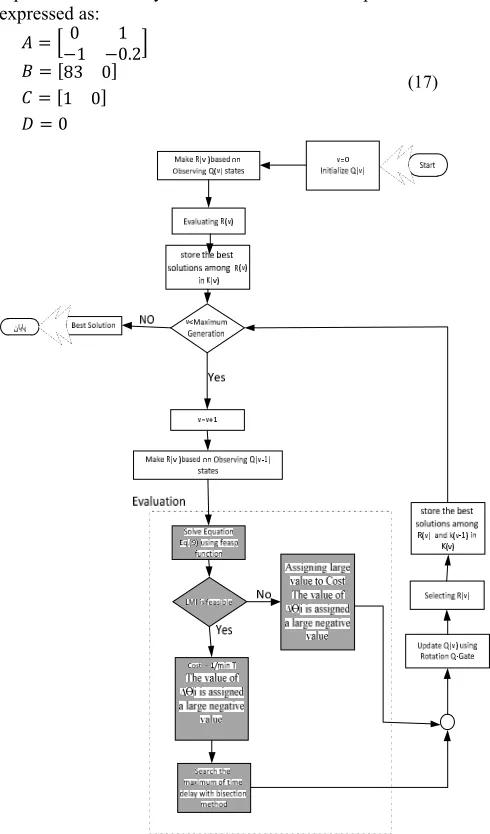
P at the same time of Equ. (9). But if F has been given, Equ. (9) would be convex and LMI solver can find P from Equ. (9). The proposed approach takes advantages of QGA to search F and then use LMI solver to solve P to preserve stability in the presence of time delay.
B. Proposed QGA-LMI
The QGA –LMI approach in the present steps is considered.
Step 1: Encoding: Each feedback gain vector F that QGA searches it, is considered as an individual. The range of gain is limited.
Step 2: Initialization: set = 0 and initialize ( )
to 1/√2 , N individuals, R(v)s, are generated randomly.
Step 3: Producing binary quantum ( ) by observing ( ) states: a binary chromosome is a solution of length n. Making a binary chromosome is done by observing ( ) states and we use the following equation:
(15)
= 0 (0,1) <
1 ℎ
where (. , . ) is a function that produces random numbers uniformly.
Step 4: Cost assignment and Evaluation of ( ): The cost is defined as inthe verse of minimum T that T is obtained by
feasp function. The function feasp solves the following auxiliary convex program[33]:
Minimize T subject to ( ) − ( ) < ,
where is the vector of (scalar) decision variables and Tmin
is the minimized value of . Evaluation process is a little different and divided in two cases.
value of ∆ is assigned a large negative value to increase the probability of state |0 >. In this case, the cost value corresponds to it will be assigned large enough in order to have a chance to discard this feedback gain.
Case II: When ( )is feasible, i.e., it does fulfill Equ. (9): The maximum admissible time delay, τ1, would be computed by the bisection method. The value of ∆ is assigned a large positive value to increase the probability of state |1 >. The cost of ( )is determined according to its cost value. This step is repeated for the number of individuals.
Step 5: Update ( ) : This updating is done based on rotation Q-gate by finding a probabilistic value of α and β.
Step 6: selecting the best solution among ( − 1) and ( ) and store it in ( ).
These steps go on until the number of generation is reached. The diagram of the algorithm is shown in Fig.4 in details.
C. co-Evolutionary QGA-LMI with Particle Swarm Optimization
Exploration and exploitation are two challenging objectives of global search procedures. In the lack of prior knowledge, knowledge about the problem is gathered by uniform measurements over the solution domain. Exploration assures that searching to find a consistent estimate of the optimum is done appropriately. Exploitation searches around the best solution. In order to balance between exploration and exploitation, search methods are combined with each other. Particle swarm optimization [34] is one of the population-based algorithms to find global optimum, it employs social interaction. Particle trajectories regulate social rules. At each time step, fitness function demonstrating a quality measure is computed by the position of each particle, as input. Changing velocity explores solution space. Current location of each particle is defined by the best fitness that particle has achieved in its velocity vector. In fact, solutions do not change straight in PSO algorithm. Each solution is changed over time based on its velocity vector. A swarm of particles moves across the problem space with the velocity update rule. Information distribution and merging the advantages of both QGA and PSO can lead to finding better solutions.
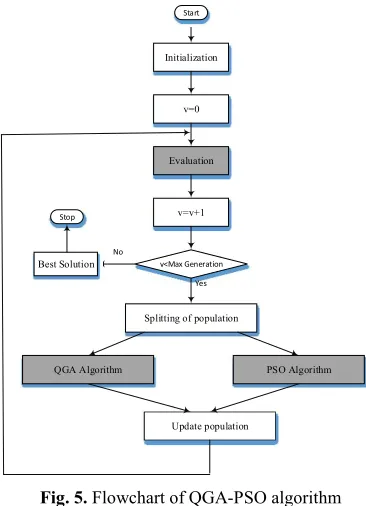
The cooperation of QGA and PSO can lead to a hybrid model. In that, each of QGA and PSO may be used as an optimizer of a part of solution space or pre optimizer of another. In the hybrid algorithm used here, the first population is divided into two parts randomly, next half of the population of the next generation is evolved by the PSO and the remainder by QGA. These two parts in the resulting population recombined. In the next generation, the recombined population divided into another two parts randomly and again each part evolved by PSO or QGA. Fig.5 shows the flow diagram of the described algorithm.
V.
NUMERICAL RESULTS
The proposed approach is examined for a one-link scara robot that described by the following second order differential equation using Newton’s second law:
(16)
̈ + ̇ + g = , = 5(1 + ),
g = 5 1 +
where represents uncertainty. The stat space representation of system without uncertain parameters is expressed as:
(17)
= 0 1
−1 −0.2
= [83 0] = [1 0] = 0
Initialization
v=0
Evaluation
v=v+1
v<Max Generation
Splitting of population
PSO Algorithm QGA Algorithm
Update population
Stop
Start
Yes No
Best Solution
Fig. 5. Flowchart of QGA-PSO algorithm
The uncertain behavior of the original system can be described by an upper linear fractional transformation (LTF):
(18) = ( , ∆)
The views of nominal open and closed loop behavior of the system without considering time delay and frequency behavior of its controller are shown in Figures 6 and 7, respectively. We define, H∞ performance, as γ=0.1. The feedback gain is
obtained by QGA as [−78.94, −47.72] in the presence of time delay input. It should be noted that the controller is feasible for the maximum time delay τ1 means that the designed controller can stabilize the system with H∞ index,
γ=0.1, for any delay belonging to interval [0 1]. Rate of convergence with and without time delay is depicted in Fig. 8. The rate represents a normalized mean of the reduction ratio of the fitness difference per generation. As seen, in the presence of delay the system is still stable.
Fig.6. Closed –open loop behavior of the system.
Fig.6.( Continued) Closed –open loop behavior of the system.
The peak control input ratio, i.e. ( ) (0) is depicted in Fig. 9. As seen, the more the ratio increases, the more the amount of time delay is. The system is stable and have a reasonable step output when the delay τ is about 137
while the maximum estimated delay obtained 90.7562. From these results, the applicability of the proposed procedure can be concluded such that the procedure validity may remain out of the range found for delay time. Fig. 10 shows the convergence rate of cost function with the number of generation in QGA-PSO.
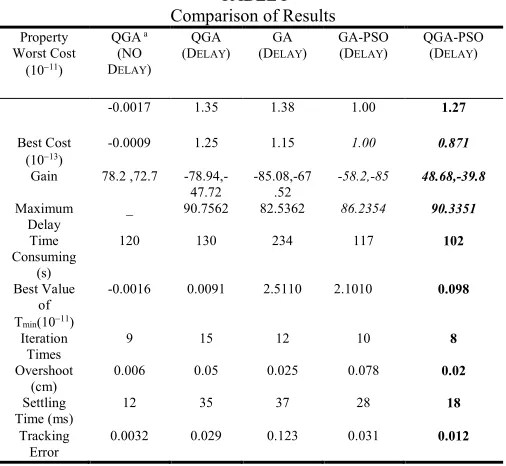
Table I illustrates the results of the proposed methods based on maximum delay, time-consuming, gain found, tracking error, etc. The fifth row makes a comparison of the four algorithms in term of required time to implement the algorithm. The first row indicates the worst cost of performance. These results show that QGA-PSO algorithm finds a higher maximum delay amount with less worst cost in comparison. Time-consuming for GA-PSO is better than QGA while QGA’s better than of GA. However, the complexity of QGA is less than that of GA-PSO. Results obtained by GA-PSO show that GA-PSO is better than those of GA and QGA but still the best results obtained by QGA-PSO.
Fig.7.( Continued) Frequency behavior of the controller.
Fig.8. Rate of convergence of QGA.
It should be noted that since the control law is stemmed from the output, more time is required for the model to converge to the desired output, so tracking error exists. The limited error shows the convergence and stability of the whole system. The last row in Table I shows the comparison of different algorithms in error tracking term. These results confirm the priority of QGA-PSO’s performance.
Fig.9. Ratio of control signal vs. time delay
Fig. 10. Convergence rate of the cost function in QGA-PSO (Vertical axis multiplied by 10e-11).
Moreover, the optimal solution, performance, and robust stability depend on the searching range of output feedback gain. Therefore, we can use a larger solution space for the first execution of the algorithm and after we get the early solution, change the range around the values obtained in the first execution. Table II provides the results within initial rang of [−100, 100]. As seen, not only the results is
improved especially the amount of running time in the second times of execution algorithms.
TABLEI Comparison of Results
Property Worst Cost
(1011)
QGA a (NO DELAY)
QGA (DELAY)
GA (DELAY)
GA-PSO (DELAY)
QGA-PSO (DELAY)
-0.0017 1.35 1.38 1.00 1.27
Best Cost (1013)
-0.0009 1.25 1.15 1.00 0.871
Gain 78.2 ,72.7 -78.94,-47.72
-85.08,-67 .52
-58.2,-85 48.68,-39.8
Maximum Delay
_ 90.7562 82.5362 86.2354 90.3351
Time Consuming
(s)
120 130 234 117 102
Best Value of Tmin(1011)
-0.0016 0.0091 2.5110 2.1010 0.098
Iteration Times
9 15 12 10 8
Overshoot (cm)
0.006 0.05 0.025 0.078 0.02
Settling Time (ms)
12 35 37 28 18
Tracking Error
0.0032 0.029 0.123 0.031 0.012
VI.
CONCLUSIONS
Little prior knowledge for modeling system when the time delay is main concern leads to a poor controller. Evolutionary algorithms can help in handling this issue. In this paper, an approach is proposed that employs quantum genetic algorithm (QGA) as a searching tool to seek feedback gain and render controller capable of non-convex optimization using LMI solver. Simulation results verify the practicality of the proposed methodology in comparison to alternative approaches. The proposed approach provides larger admissible input time delay without occurring instability. Besides, in this paper, to accelerate convergence speed without damaging the global optimum, the combination of QGA with PSO is suggested. Results show that QGA-PSO gives better solution in different terms comparing to QGA, GA, and GA-PSO. Furthermore, based on the results the effective meta-heuristic algorithm of QGA-PSO has provided an appropriate balance between two competing of exploration and exploitation at the same time. The results of this work can also be readily extended to the state feedback case.
TABLEII
Results related to Shorten Range
Algorithm Worst Cost (1011)
Best Cost (1014)
Tracking Error
Time(s)
GA 1.2 6.22 0.121 184 QGA 0.09 4.15 0.027 170 GA-PSO 0.324 4.07 0.030 78 QGA-PSO 0.024 2.56 0.01 67
20 40 60 80 100 120 140
0 1 2 3 4 5 6 7 8 9 10
R
EFERENCES[1] G. Zames, "Feedback and optimal sensitivity: Model reference transformations, multiplicative seminorms, and approximate inverses," Automatic Control, IEEE Transactions on, vol. 26, pp. 301-320, 1981.
[2] T. S. Iwasaki, R.E., "All controllers for the general H∞ control problem:LMI existence conditions and state space formulas," Automatica, vol. 36, pp. 824–837, 1994.
[3] P. P. Khargonekar and M. A. Rotea, "Mixed H2/ H∞ control: a convex optimization approach " Automatic Control, IEEE Transactions on, vol. 36, pp. 824-837, 1991.
[4] P. Apkarian and P. Gahinet, "A convex characterization of gain-scheduled H<sub>∞</sub> controllers,"
Automatic Control, IEEE Transactions on, vol. 40, pp. 853-864, 1995.
[5] H. Y. Chung, S. M. Wu, F. M. Yu, and W. J. Chang, "Evolutionary design of static output feedback controller for Takagi-Sugeno fuzzy systems," Control Theory & Applications, IET, vol. 1, pp. 1096-1103, 2007.
[6] D. E. Goldberg, "Genetic algorithms in search, optimization and machine learning " 1989.
[7] Z. S. El-Razaz, M. E. D. Mandor, and E. S. Ali, "Damping controller design for power systems using LMI and GA Techniques," in Power Systems Conference, 2006. MEPCON 2006. Eleventh International Middle East, 2006, pp. 297-301.
[8] S.-M. W. H.-Y. Chung, F.-M. Yu and W.-J. Chang, "H2/ H∞ Robust static output feedback control Design via Mixed genetic algorithms and linear matrix inequlity," Journal of dynamic systems , Measurement and Control, ASME vol. 127, pp. 715-722, 2005.
[9] S. Te-Jen, W. Cian-Pin, and J. Gwo-Jia, "FIR equalization for nonlinear communication channels," in American Control Conference, 2006, 2006, p. 6 pp.
[10] H. X. de Araujo and C. Garbin Langner, "H∞ Control for uncertain systems under time domain constraints," in
Decision and Control, 2005 and 2005 European Control Conference. CDC-ECC '05. 44th IEEE Conference on, 2005, pp. 1325-1330.
[11] D. Haiping and S. Xizhi, "Low-Order H∞Controller Design Using LMI and Genetic Algorithm," in American Control Conference, 2002. Proceedings of the 2002, 2002, pp. 511-512 vol.1.
[12] H. Jui-Chung and C. Bor-Sen, "Genetic algorithm approach to fixed-order mixed mixed H2/ H∞ optimal deconvolution filter designs," Signal Processing, IEEE Transactions on, vol. 48, pp. 3451-3461, 2000.
[13] G. K. M. Pedersen, Langballe , A. S . and Wisniewski,R., "Synthesizing multiobective H2/ H∞ dynamic controller using evolutionary algorithms," 2002.
[14] G. J. Pereira and H. X. de Araujo, "Robust Output Feedback Controller Design via Genetic Algorithms and LMIs: The Mixed H2/ H∞ Problem," in American Control Conference, 2004. Proceedings of the 2004, 2004, pp. 3309-3314 vol.4. [15] D. Yue, S. Won, and O. Kwon, "Delay dependent stability
of neutral systems with time delay: an LMI approach,"
Control Theory and Applications, IEE Proceedings -, vol. 150, pp. 23-27, 2003.
[16] Q. K. Li, Y. G. Li, and H. Lin, "H∞ Control of Two-Time-Scale Markovian Switching Production-Inventory Systems," IEEE Transactions on Control Systems Technology, vol. PP, pp. 1-9, 2017.
[17] T. Zhao and S. Dian, "State Feedback Control for Interval Type-2 Fuzzy Systems with Time-Varying Delay and
Unreliable Communication Links," IEEE Transactions on Fuzzy Systems, vol. PP, pp. 1-1, 2017.
[18] J. Dyn, "LMI Based to Robust Genetic Control Design for a Class of Uncertain Neutral Systems With State and Input Delay," Journal of Dynamic Systems, Measurement, and Control vol. 128, pp. 675-681, 2006.
[19] H. Du, Lam.J,Sze.K.Y., "H∞ disturbance attenuation for uncertain mechanical systems with input delay,"
Transactions of the Institute of Measurement and Control pp. 37-55, 2005.
[20] J. D. Chen, "Stability criteria for large-scale time-delay systems: the LMI approach and the Genetic Algorithms," vol. 35, 2006.
[21] H. Du and N. Zhang, "control for buildings with time delay in control via linear matrix inequalities and genetic algorithms," Engineering Structures, vol. 30, pp. 81-92, 2008.
[22] Z. Fanggeng, D. Jinyan, L. Sujian, and S. Jiangsheng, "An improved ant colony optimization algorithm with embedded genetic algorithm for the traveling salesman problem," in
Intelligent Control and Automation, 2008. WCICA 2008. 7th World Congress on, 2008, pp. 7902-7906.
[23] Z.-J. Lee, S.-F. Su, C.-C. Chuang, and K.-H. Liu, "Genetic algorithm with ant colony optimization (GA-ACO) for multiple sequence alignment," Applied Soft Computing, vol. 8, pp. 55-78, 2008.
[24] X. W. S. W. T. Li, and L. Xu, "Improved GA and PSO culled hybrid algorithm for antenna array pattern synthesis,"
Electromagnetics Research, pp. 461–476, 2008.
[25] F. Sabahi and M.-R. Akbarzadeh-T, "Soft LMI-Based H∞ Control with Time Delay " in In: Ane B., Cakravastia A., Diawati L. (eds) Proceedings of the 18th Online World Conference on Soft Computing in Industrial Applications (WSC18). WSC 2014. Advances in Intelligent Systems and Computing, vol 864. Springer, Cham ed, 2019.
[26] K.-H. Han and J.-H. Kim, "Quantum-Inspired Evolutionary Algorithm for a Class of Combinatorial Optimization," IEEE TRANSACTIONS ON EVOLUTIONARY COMPUTATION,,
vol. 6, pp. 580-593, 2002.
[27] H. Miao, H. Wang, and Z. Deng, "Quantum Genetic Algorithm and its Application in Power System Reactive Power Optimization," in 2009 International Conference on Computational Intelligence and Security, 2009, pp. 107-111. [28] L. Zhang, H. Lv, D. Tan, F. Xu, J. Chen, G. Bao, et al.,
"Adaptive quantum genetic algorithm for task sequence planning of complex assembly systems," Electronics Letters,
vol. 54, pp. 870-872, 2018.
[29] X. Na, Z. Li, C. Xiaolong, and D. Yumin, "An improved quantum genetic algorithm for grouping strategy," in 2017 IEEE 17th International Conference on Nanotechnology (IEEE-NANO), 2017, pp. 657-662.
[30] P. Gahinet, "Explicit controller formulas for LMI-based H∞ synthesis," in American Control Conference, 1994, 1994, pp. 2396-2400 vol.3.
[31] K. Zhou, Doyle,J., "Robust and Optimal Control," 1996. [32] R. Lahoz-Beltra, "Quantum Genetic Algorithms for
Computer Scientists," Computers 2016, 5(4), 24, vol. 5, p. 131, 2016.
[33] C. P. Gahinet , Nemirovski , .A, Laub.A.J and Chilali.M, "LMI Control Toolbox," The MathWorks, Inc 2008.
[34] M. Clerc and J. Kennedy, "The particle swarm - explosion, stability, and convergence in a multidimensional complex space," Evolutionary Computation, IEEE Transactions on,