STUDENTS’ ATTITUDE TOWARDS
MATHEMATICS: DOES CLASSROOM
LEARNING ENVIRONMENT OF
SINGLE-GENDER CLASSES MAKE ANY DIFFERENCE?
Muhammad Afzal* Khalid Saleem** Mobeen ul Islam***
Abstract
Mathematics is an important subject as it supports most of the social sciences and almost all natural sciences. Both the teaching and teaching and learning aspects of Mathematics are quite different from other subjects of the social sciences as well as the natural sciences. Therefore, teaching and learning process of Mathematics demands specific learning environment and Mathematics related attitudes both of the teachers and the students. Studying these aspects in single-gender classroom becomes even more significant. The study at hand focuses on exploring the relationship between these two variables on the basis of gender. The 11th grade male and female Mathematics students enrolled during academic year 2012-2013 in public sector colleges of Punjab province of Pakistan constituted the population of the study. The sample of the study included randomly selected 1717 students from the public sector colleges located in six randomly selected districts of the Punjab province. In order to collect data, two Urdu translated questionnaires namely, What Is Happening in This Class (WIHIC), and Questionnaire of Mathematics-Related Attitude (QOMRA) were used. The data was collected in the last month of the academic year so that the attitude of students in real sense may be determined. Research findings revealed that male and female students’
* PhD Education Scholar, University of Management and Technology, Lahore,
Pakistan
**
Director, University of Education Lahore, Okara Campus, Pakistan
perception about their classroom learning environment significantly differs from each other. The male students perceived more supportive learning environment in Mathematics classroom than the female learners. Moreover, it was also found out that classroom learning environment has a feeble effect on students’ attitude towards Mathematics. However, it was found that the male students showed relatively more positive attitude towards Mathematics than the female students.
Keywords: Classroom learning environment, attitude towards Mathematics, single-gender classroom.
Introduction
Single-gender classrooms are preferred in most of the indigenous as well as religious societies like Pakistan. But in the recent years, it has been preferred over the Co-education system even in the advanced countries like United States of America (Novotney, 2011). Major differences, such as religious prohibition, cultural traditions, and social setup requirements are taken as evidence for the single-gender education.
Teaching of Mathematics in single-gender classroom requires certain types of specific roles and responsibilities of the teachers resulting in a particular learning environment. Such learning environment may shape attitudes which can differ from that of Co-ed situation. The present study aims at determining the relationship of single-gender classroom learning environment with the students’ attitude towards Mathematics.
Classroom is a place where students and teachers interact with one another and use different instructional tools, information and sources for learning activities (Wilson, 1996). Like many other aspects of social sciences, it is difficult to define the term ‘learning environment’ precisely and accurately because it may vary according to prevailing contexts, demographic situation and social norms. Learning environment usually consists of some observable characteristics such as school buildings, instructional tools, learning attitude of the students, teaching aptitude of the teachers and interactions among the learners and instructors (Brophy, 1999; Fraser & Walberg, 1991; Moos, 1979). Dorman (2002) defines it as “atmosphere, ambience, tone, or climate” whereas, Henderson, Fisher, and Fraser (2000) confine it to only one aspect i.e. psycho-social classroom learning environment. Similarly, Galbraith (1989, 1990) describes two types of classroom environment; physical environment and the psycho-social classroom environment. Both components significantly influence the learning outcomes of students (Rawnsley & Fisher, 1998).
Mathematics has acquired the status of a compulsory subject up to a certain academic levels in almost every nation of the word. The need of people for reckoning in everyday life has caused a change in their attitude towards Mathematics. In the Pakistani perspective no research study is available which may describe how male and female students differ in their attitude towards Mathematics. The study in hand is an effort to determine whether there exists any difference in the male and female students’ attitude towards Mathematics. In the same way the study also explored the nature of Mathematics classroom environment persisting in Pakistani secondary schools for boys and girls. Finally gender based comparison of the effect of classroom learning environment on the students’ Mathematics related attitude was also made. The objectives of the study were as under:
1. To investigate Mathematics classroom learning environment in a single-gender class.
2. To assess the students’ attitude towards Mathematics.
To judge the level of achievement of the above stated objectives following hypotheses were tested;
1. There is no significant difference in male and female students’ perceptions about classroom learning environment
2. There is no significant difference in male and female students’ perceptions about their attitude towards Mathematics.
3. There is no significant relationship between classroom learning environment and students’ attitude towards Mathematics.
Theoretical Background
The study at hand is based on the assumption that learning environment affects students’ attitude towards Mathematics in one way or the other. So, an attempt has been made to explore the relationship of Mathematics class learning environment and the Mathematics related students’ attitude at college level in Pakistani perspective.
Mathematics Classroom Environment
In the present study, two aspects i.e. learning environment of Mathematics class and students’ Mathematics related attitude were explored. Gender is a demographic component which was also examined in relation to these aspects. Classroom learning environment refers to the prevailing circumstances of a particular classroom. It is observed that students perform better when their perception about classroom environment is positive.
Classroom learning environment is not a single entity but a combination of different aspects. Some important aspects like teacher support, student cohesiveness, involvement, co-operation, task orientation, and equity may help in developing positive classroom learning environment (Fraser, 2002a).
Gender Differences and Mathematics Classroom Environment
Needs and interests of females and males differ significantly in almost all the spheres of life. The same is the case with the perceptions of male and female students about learning environment of the classroom. Researches in the past had also supported the fact. According to Goh and Fraser (1998) females perceive more favorable classroom environments than males although Mathematics achievement favors the males.
Students’ cohesiveness is the degree of students’ familiarity, sociality and cooperation with one another. Vacha (1977) insists that in cohesive classrooms students value their peers, try to help and care about each other. In addition, Moos (1974) conclude that Mathematics achievement and class cohesion is highly associated at school level. Similarly, Anderson and Walberg (1974) found that cohesiveness is positively associated with student learning. Moreover, Lawrenz (1987) reported that the girls exhibit more cohesiveness in their classes than boys.
Kim, Fraser, and Fisher (2000) observed that boys perceived their teachers to be more supportive as compared to girls.
Involvement is the major component of classroom environment. It is the degree of participation of the students in discussions for enhancing their work capacity and enjoyment. Huang and Waxman (1995b) contend that females show more favorable perceptions than males. Moreover, in single-sex classrooms female show more involvement, attentiveness, affiliation with their peers, and enjoy their Mathematics class more than males. While on the other hand, Kim, Fraser, and Fisher (2000) found that male show more Involvement in classroom activities than females. Similarly, Khoo and Fraser (1998) reported that the males perceived greater involvement than females. Similarly, Task Orientation is another aspect of classroom environment. It is the degree to complete planned activities by sticking to the subject matter. Mobeen-ul-Islam (2012) claims that the task oriented classroom learning environment is positively correlated with students’ attitude towards mathematics. In another study Kim, Fraser, and Fisher (2000) affirm that the boys perceived their classrooms more Task Oriented than girls.
Co-operation also plays vital role in classroom environment. It is the degree of students’ support to one another to complete the learning tasks. According to Mobeen-ul-Islam (2012) cooperative and equity based classroom learning environment is positively correlated with students’ attitude towards Mathematics. This shows that students’ achievements in Mathematics may be enhanced by cooperation and equity. Similarly, Bono (1991) reported that girls show more enjoyment and positive attitude towards mathematics if they were taught in a cooperative setting. Moreover, female show more cohesiveness and cooperation in classroom than males (Rawnsley & Fisher, 1997). In another study, Baker and Jacobs (1999) indicate that girls feel more supportive to each other, more enthusiastic to participate in the single-sex classroom and show less self-conscious attitude without the boys.
Students’ Attitude towards Mathematics
Different aspects of attitude are defined by different researchers. Ramsden (1998) states that the researchers use the words like attitude, interest and motivation for different emotional states of human mind. Salta and Tzougraki (2004) defined an attitude as the inspirational power to think, feel, and act or react positively or negatively towards various objects existing in environment. Similarly, students’ attitude towards a certain subject can motivate them to perform and behave well in the classroom. There are different factors that affect the students’ attitude towards Mathematics. Some of these factor are parental and teacher support, societal factors, and the students’ stimulus in general. In the same way, attitude is also described as the positive or negative degree of effect which is related to a specific subject. It means that students’ Mathematics related attitude is positive or negative emotional disposition (Haladyna, Shaughnessy & Shaughnessy, 1983; McLeod, 1992).
Students’ attitude towards Mathematics is not a single entity but a combination of different aspects, like attitude towards Mathematics inquiry, enjoyment of Mathematics lessons and adoption of Mathematics attitude. Attitude towards Mathematics inquiry evaluate one’s preference towards using inquiry in Mathematics. Moreover, adoption of Mathematics attitude measures one’s readiness to change opinion built on empirical data. Furthermore, enjoyment of Mathematics lessons judges one’s level of enjoyment during study of classroom Mathematics lessons (Mobeen-ul-Islam, 2012).
Gender Differences in Mathematics Related Attitude
Different studies point out that Mathematics has always been a male domain and there is strong evidence that girls show less confidence in Mathematical work as compared to the boys (Hyde, Fennema, Ryan, Frost, & Hopp, 1990; Odell & Schumacher, 1998; Meelissen & Luyten, 2008). However, in many other researches, it has been shown that there is no significant gender based difference about attitude towards Mathematics (Mohd, Mahmood, &Ismail, 2011; Köğce, et al., 2009; Nicolaidou & Philippou, 2003). Gill (1994) also concludes that girls at elementary and secondary level show positive attitude towards schools but negative attitude towards Mathematics. In addition, Swetman (1995) describes that girls show more positive attitude towards Mathematics as compared to the boys during their early education but they lose their interest level in Mathematics as they grow older. He suggests that the teachers should facilitate the girls to develop a positive attitude towards Mathematics for their better performance in Mathematics.
It is generally believed that girls are relatively weaker in Mathematics than boys. Different studies have been carried out on the present topic in different cultures but, in Pakistani perspectives there are few such studies. In fact, parents and teachers may be responsible for low achievement of females in Mathematics. Many teachers, particularly females, actively motivate and encourage male students to continue in their Mathematics studies more than they encourage girls. Similarly, parents also feel that females show less interest in Mathematics. Females never come up to the standard level of competence in Mathematics because it requires extra devotion, determinations and intelligence.
Relationship of Classroom Environment with Students’
Attitude towards Mathematics
achievement. Finally Reynolds and Walberg (1992) conclude that students’ positive perceptions about the environment of classroom contribute in developing a positive attitude towards Mathematics.
According to Midgely, Feldlaufer, and Eccles (1989) the Mathematics classroom environment including the teacher’s self-efficacy beliefs, significantly influence the students’ motivation, confidence, and overall disposition towards Mathematics. Various researches (Fisher & Khine, 2006; Fraser, 2007) show variations in perceptions of students about classroom environment based on their age and gender, teacher’s gender and grade level etc. Huang (2003) investigated that females students show more positive attitude towards learning than boys. The results of the study reveal that outcomes regarding affective and cognitive aspects are affected by learning environment of the class.
Methodology
This study is descriptive in nature and to conduct this study, survey method was used. Following procedural steps were adopted to accomplish the goal.
Participants: The accessible population of the study comprised of 11th grade Mathematics students enrolled in public sector male and female colleges during academic year 2012-2013 located in six randomly selected districts of Punjab province. In order to ensure adequateness and representation of the population, multistage sampling technique was used to draw the sample of 11th grade 1717 (male (839 male and 878 female) Mathematics students. From each district eight colleges, including four boys and four women colleges, were randomly selected. From each of the selected college, two sections of grade 11 were again randomly selected.
factors namely attitude towards mathematics inquiry, adoption of mathematics attitude and enjoyment of mathematics lessons having seven items in the first factor and ten each in the last two. Finally, both the Questionnaires were translated in Urdu and validated by Mobeen-ul-Islam (2012).The reliability coefficient i.e. Cronbach Alpha for the questionnaires was 0.805 and 0.798 respectively.
As far as the data collection is concerned, the researcher collected data personally and also with the help of research associates. The research associates were trained about carrying out the whole procedure of data collection. The respondents were given orientation by the researcher and research associates guided them about how to respond to different statements.
Results
The collected data was tabulated and analyzed using the software named Statistical Package for Social Sciences (Version 21). Findings drawn on the basis of data analysis are as under:
Table 1
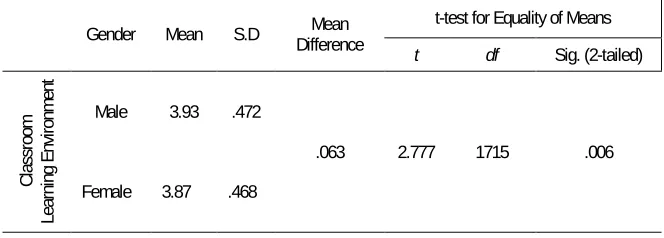
Male and Female Students’ Perception about Classroom Learning Environment
Gender Mean S.D Difference Mean t-test for Equality of Means
t df Sig. (2-tailed)
Cl
as
sr
oom
Lear
ning E
nv
ironment Male 3.93 .472
.063 2.777 1715 .006
Female 3.87 .468
Table 2
Factor Wise Comparison of Classroom Learning Environment
Gender Mean S.D Difference Mean t-test for Equality of Means
t df (2-tailed) Sig.
Student Cohesiveness
Male 4.10 .554
.033 1.221 1715 .222
Female 4.06 .575
Teacher Support Male 3.76 .751 .066 1.864 1715 .062
Female 3.70 .709
Involvement Male 3.40 .706 .013 .384 1715 .701
Female 3.39 .707
Task Orientation Male 4.32 .633 .058 1.865 1715 .062
Female 4.26 .649
Cooperation Male 3.79 .715 .078 2.267 1715 .024
Female 3.72 .703
Equity Male 4.20 .747 .131 3.426 1.708E3 .001
Female 4.07 .834
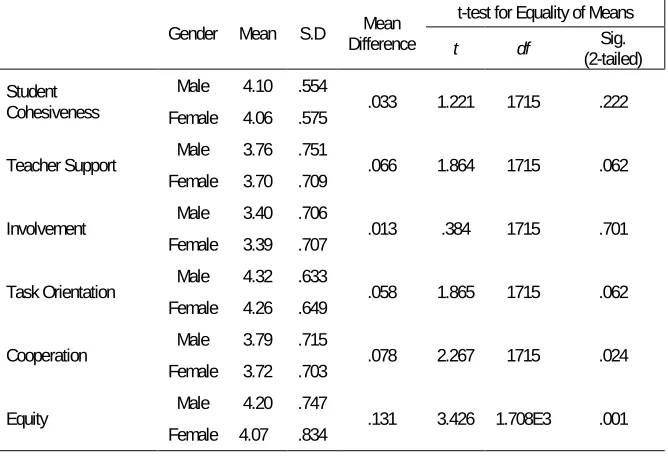
Analysis of data show that difference between male and female students’ cohesiveness (p=.222>.05), teacher support (p=.062>.05), involvement (p=.701>.05), and task orientation (p=.062>.05), is not significant, whereas, difference in cooperation (p=.024<.05) and equity (p=.001<.05) among male and female students is significant. The mean score of equity for male students (x̅=4.20) is more than the mean score for females (x̅=4.07).
Table 3
Comparison of Male and Female Students’ Attitude towards Mathematics
Gender Mean S.D Difference Mean t-test for Equality of Means
t df Sig. (2-tailed)
At
titude t
ow
ar
ds
mat
hema
tic
s Male 3.28 .485
.09172 3.993 1715 .000
Analysis of data indicates that there exist significant difference (p=.000<.05) between male and female students ‘attitude towards mathematics. Therefore, the null hypothesis “There is no significant difference between male and female students’ attitude towards mathematics is rejected. The mean score for attitude towards mathematics of male students (x̅=3.28) is more than the mean score for females (x̅=3.19).
Table 4
Factor Wise Comparison of Attitude towards Mathematics of Male and Female Students
Gender Mean S.D Difference Mean t-test for Equality of Means
t df (2-tailed) Sig.
Attitude towards Mathematics Inquiry
Male 3.45 .610
.070 2.374 1715 .018 Female 3.38 .612
Adoption of
Mathematics Attitude Female 3.12 .598 Male 3.23 .599 .113 3.910 1715 .000 Enjoyment of
Mathematics Lessons Female 3.06 .546 Male 3.15 .576 .092 3.404 1715 .001
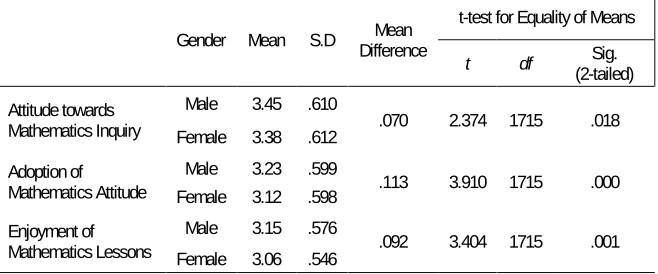
Table 4 shows that the difference between male and female students’ attitude towards Mathematics inquiry (p=.018<.05), adoption of Mathematics attitude (p=.000<.05), and enjoyment of Mathematics lessons is significant (p=.001<.05).Mean score for attitude towards Mathematics inquiry of male students (x̅=3.45) is more than that of females (x̅=3.38). Similarly, mean score for adoption of Mathematics attitude of male students (x̅=3.23) is again more than the mean score of females (x̅=3.12). The same is the case for mean score for enjoyment of Mathematics lessons (x̅=3.15>x̅=3.06).
Table 5
Gender Wise Relationship of Classroom Learning Environment with Students’ Attitude towards Mathematics
Classroom Learning
Environment N
Students’ Attitude towards mathematics Pearson Correlation r Sig. (2-tailed)
Male 839 .113** .001
Table 5 reveals the gender wise relationship between classroom learning environment and students’ attitude towards Mathematics. Analysis of data reflects that females show significant positive (r=.129, p=.000) relationship between classroom learning environment and attitude towards Mathematics than males (r=.113, p=.001). Null hypothesis “There is no significant relationship between classroom learning environment and students’ attitude towards Mathematics.” is rejected (p=.000<0.05).
Table 6
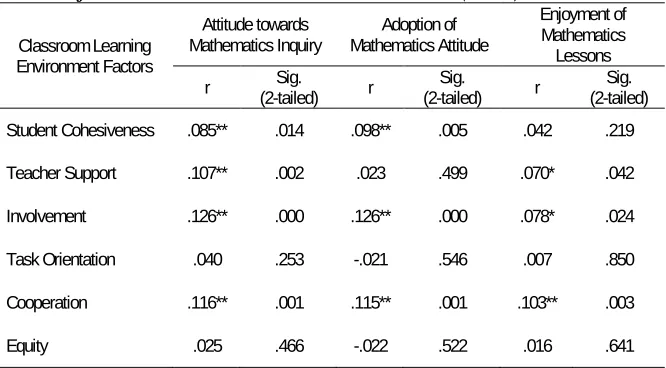
Relationship of Classroom Learning Environment Factors with Sub Scales of Students’ Attitude towards Mathematics (Male)
Classroom Learning Environment Factors
Attitude towards
Mathematics Inquiry Mathematics Attitude Adoption of
Enjoyment of Mathematics Lessons r (2-tailed) Sig. r (2-tailed) Sig. r (2-tailed) Sig.
Student Cohesiveness .085** .014 .098** .005 .042 .219
Teacher Support .107** .002 .023 .499 .070* .042
Involvement .126** .000 .126** .000 .078* .024
Task Orientation .040 .253 -.021 .546 .007 .850
Cooperation .116** .001 .115** .001 .103** .003
Equity .025 .466 -.022 .522 .016 .641
Table 7
Relationship of Classroom Learning Environment Factors with Sub Scales of Students’ Attitude towards Mathematics (Female)
Classroom Learning Environment Factors
Attitude towards
mathematics Inquiry mathematics Attitude Adoption of
Enjoyment of mathematics Lessons r (2-tailed) Sig. r (2-tailed) Sig. r (2-tailed) Sig.
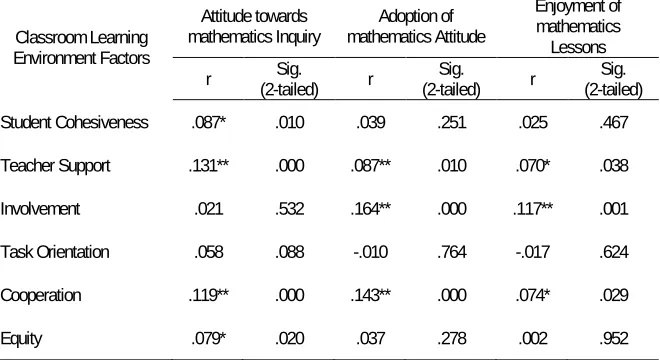
Student Cohesiveness .087* .010 .039 .251 .025 .467
Teacher Support .131** .000 .087** .010 .070* .038
Involvement .021 .532 .164** .000 .117** .001
Task Orientation .058 .088 -.010 .764 -.017 .624
Cooperation .119** .000 .143** .000 .074* .029
Equity .079* .020 .037 .278 .002 .952
The table 7 shows that student cohesiveness and equity of female students are significantly correlated with attitude towards Mathematics inquiry. Moreover, teacher support and cooperation are significantly correlated with all the sub factors of attitude for female students. Furthermore, involvement is significantly correlated with adoption of Mathematics attitude and enjoyment of Mathematics lessons for female students.
Table 8
Relationship between Classroom Learning Environment and Students’ Attitude towards Mathematics
Classroom Learning Environment Pearson Correlation r Sig. (2-tailed) Students’ Attitude towards
mathematics .119** .000
Table 9
Impact of Classroom Learning Environment on Students’ Attitude towards Mathematics
Factors
Attitude towards
Mathematics Inquiry Adoption of Mathematics Attitude Mathematics Lessons Enjoyment of r Sig. Β Sig. r Sig. Β Sig. r Sig. β Sig. Student
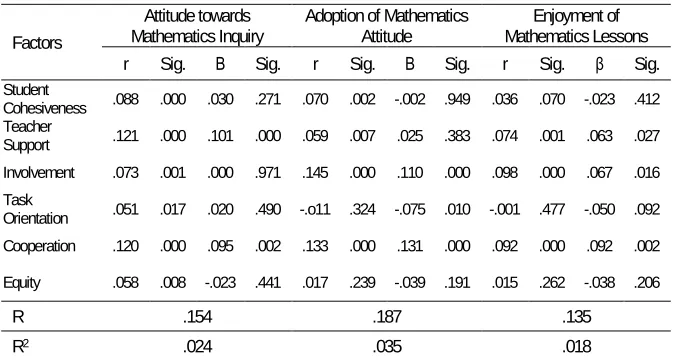
Cohesiveness .088 .000 .030 .271 .070 .002 -.002 .949 .036 .070 -.023 .412
Teacher
Support .121 .000 .101 .000 .059 .007 .025 .383 .074 .001 .063 .027
Involvement .073 .001 .000 .971 .145 .000 .110 .000 .098 .000 .067 .016
Task
Orientation .051 .017 .020 .490 -.o11 .324 -.075 .010 -.001 .477 -.050 .092
Cooperation .120 .000 .095 .002 .133 .000 .131 .000 .092 .000 .092 .002
Equity .058 .008 -.023 .441 .017 .239 -.039 .191 .015 .262 -.038 .206
R .154 .187 .135
R2 .024 .035 .018
The values of standard beta weights showed that teacher support has significant effect on attitude towards Mathematics inquiry (β=.101, p<.05) and enjoyment of Mathematics lessons (β=.063, p<.05). Similarly, the values of standard beta weights showed that involvement has significant effect on adoption of Mathematics attitude (β=.110, p<.05) and enjoyment of Mathematics lessons (β=.067, p<.05).
Likewise, the values of standard beta weights showed that task orientation has significant effect on adoption of Mathematics attitude
(β=-.075, p<.05). Similarly, the values of standard beta weights showed that cooperation has significant effect on attitude towards Mathematics inquiry (β=.095, p<.05), adoption of Mathematics attitude (β=.131, p<.05) and enjoyment of Mathematics lessons (β=.092, p<.05).
Mathematics lessons. Hence, it may be stated that classroom learning environment has a feeble effect on attitude towards Mathematics.
Conclusions
Both the male and female students show significant difference in their attitudes about learning environment of classroom. The male students perceived more supportive Mathematics classroom learning environment than females. As far as the factors of classroom learning environment are concerned there exists a significant difference in equity and cooperation among male and female students. The male students perceived more equity and cooperation in Mathematics classroom than females.
It is observed that the difference in male and female students’ Mathematics related attitude is also significant. The mean score for attitude towards Mathematics of male students is more than the mean score for females. As far as the sub factors of attitude towards Mathematics are concerned, there existed significant difference in male and female students’ attitude towards adoption of Mathematics attitude, Mathematics inquiry, and enjoyment of Mathematics lessons.
High level of Mathematics classroom learning environment helps the students to develop the positive attitude towards Mathematics. Moreover, there exists significant relationship between male and female students’ perceptions about the relationship of classroom learning environment with their attitude towards Mathematics.
For the male students, cohesiveness may improve attitude towards Mathematics inquiry and adoption of Mathematics attitude. Moreover, teacher support helps to develop positive attitude towards Mathematics inquiry and enjoyment of Mathematics lessons. Furthermore, students’ involvement in their class work and cooperation with one another to complete the learning tasks boosts their attitude towards adoption of Mathematics attitude, Mathematics inquiry and enjoyment of Mathematics lessons.
lessons. Furthermore, students’ involvement in their class work boosts up their adoption of Mathematics attitude and enjoyment of Mathematics lessons. On the whole, it may be concluded that classroom learning environment has a feeble effect on attitude towards mathematics.
Discussion
The present study aimed at exploring the relationship between classroom learning environment and students’ attitude towards Mathematics. It reveals that mathematics classroom learning environment helps the students to develop the positive attitude towards Mathematics. Moreover, there exist gender based difference to some extent regarding the relationship between classroom learning environment and attitude towards Mathematics in Pakistan. Furthermore, student cohesiveness, teachers’ support, involvement and cooperation of the students are significantly correlated with attitudinal outcomes. The reason is that most of the male and female students of Pakistani colleges are facing similar conditions such as curriculum, pedagogical practices and mode of assessment and evaluation within the same premises of the colleges. The findings of the study supports Fraser’s (1994) view that classroom learning environment strongly influences students’ affective outcomes. In the same way, the results of the study are consistent with the previous studies (Fraser, 1998; Mobeen-ul-Islam, 2012). In order to enhance the students’ attitude towards Mathematics, practical strategies should be implemented for the improvement of classroom learning environment. Similarly, high level of student cohesiveness, task orientation, teacher support, involvement and cooperation in classrooms both for male and female students may help in shaping positive attitude towards Mathematics inquiry, adoption of Mathematics attitude and enjoyment of mathematics lessons. Moreover, these factors predict the students’ attitude towards Mathematics in higher secondary level Mathematics students. The study at hand supports the results of the study conducted by Mobeen-ul-Islam (2012) in Pakistan. Similarly, the results of the study are in accordance with the previous studies carried out in other regions like Turkey, India, Korea and Australia (Kim, Fisher, &Fraser, 2000; Okan, 2008).
Mathematics classroom learning environment is more supportive than that of females (Fraser &Mcrobbie, 1995; Rawnsley&Fisher, 1997). Additionally, there exists significant difference in equity and cooperation among male and female students. In Pakistani perspective, the male students perceived more equity and cooperation in Mathematics classroom than that of females. Kim, Fisher and Fraser (2000), indicate the same results in case of equity while on the other hand, in terms of cooperation the results contradict with the results reported by Rawnsleyand Fisher (1997).
There exists significant difference between male and female students’ attitude towards Mathematics. Attitude towards Mathematics of male students is better than that of females. The results of the study are consistent with the previous studies that boys show more positive attitude towards Mathematics than girls (Mahanta & Islam, 2012). In addition, several studies indicate that boys show more positive attitude towards Mathematics than girls (Hyde, Fennema, Ryan, Frost, & Hopp, 1990; Odell &Schumacher, 1998; Meelissen & Luyten, 2008). However, different studies indicate no significant difference among male and female students’ attitude towards Mathematics (Nicolaidou &
Philippou, 2003; Köğce, Yildiz, Aydin, &Altindağ, 2009; Mohd,
Mahmood, &Ismail, 2011). Similarly, the results of the study reported by Anwer and Iqbal (2012) support the findings of the present study that attitude towards Mathematics inquiry, adoption of Mathematics attitude, and enjoyment of Mathematics lessons of males is better than that of females.
Recommendations
The following recommendations are offered based on the results of the study:
1. Mathematics classroom learning environment may be made conducive for females by improving the student cohesiveness, involvement, cooperation and teacher support.
3. For developing a conducive and psycho-social learning environment, the teachers may be provided with refresher courses and training workshops arranged by the department of Education. 4. Such studies may also be carried out in other parts of Pakistan to
highlight the issues brought to light via the current research. Moreover, this research may also be replicated for the Mathematics teachers and students at others level i.e. for higher education level and the elementary level.
5. The similar study may be carried in different disciplines like Chemistry, Biology, Physics, and English etc.
6. Cross-cultural studies may be conducted to explore the relationship among these variables.
REFERENCES
Akey, (2006).School context, students’ attitudes and behavior and academic achievement: an exploratory analysis, Tech. Rep., MDRC.
Ames, C. A.(1992). Classrooms: Goals, structures, and student motivation.
Journal of Educational Psychology, 84, 261-271.
Anderson, G., & Walberg, H. (1974).Evaluating educational performance. In H. J. Walberg (Ed.), Evaluating educational performance: A sourcebook of methods, instruments, and examples (pp. 81-98). Berkley, CA: McCutchan.
Anwer & Iqbal, (2012). Students’ attitude towards science: A case of Pakistan.
Pakistan Journal of Social and Clinical Psychology 2012, Vol. 9, No. 2, 3-9.
Baker, D., & Jacobs, K. (1999).Winners and losers in single-sex science and mathematics classrooms. Rep. Boston
Bono, D. (1991). The impact of cooperative learning on suzy and janie’s attitude about math. Research report in Virginia, 137-167.
Brock, L. L., Nishida, T. K., Chiong, C., Grimm, K. J. & Rimm, Kaufman, S. E. (2008).Children's perceptions of the classroom environment and social and academic performance: A longitudinal analysis of the contribution of the Responsive Classroom approach, Journal of School Psychology, 46,
Brophy, J. (1999). Teaching. Brussels: International Academy of Education.
Church, M. A., Elliot, A. J. & Gable, S. L. (2001).Perceptions of classroom environment, achievement goals, and achievement outcomes, Journal of Educational Psychology, 93, 43-54.
Condition of Education.(1998). Climate and diversity of educational institutions.
Dorman, J.P. (2002). Classroom environment research: Progress and
possibilities. Retrieved from
Fisher, D. L., & Khine, M. S. (2006). Contemporary approaches to research on learning environments: Worldviews. Singapore: World Scientific.
Fisher, D., & Rickards, T. (1998).Associations between teacher-student interpersonal behavior and student attitude towards mathematics.
mathematics Education Research Journal, 10(1), 3-15.
Fraser, B. J. (1994). Research on classroom and school climate. In D. L. Gabel (Ed.), Handbook of research on science teaching and learning (pp.493-541). New York: Macmillan.
Fraser, B. J. (1998). Science learning environments: Assessment, effects and determinants. In B. J. Fraser & K. G. Tob (Eds.), The international handbook of science education (pp. 527-564). Dordrecht: Kluwer Academic Publishers.
Fraser, B. J. (2002a). Learning environments research: yesterday, today and tomorrow. In s. C. Goh& M. S. Khine (Eds.), Studies in educational learning environments: an interpersonal perspective (pp. 1-27). Singapore: World Scientific Publishers.
Fraser, B. J. (2007). Classroom learning environments In S. K. Abell & N. G. Lederman (Eds.), Handbook of research on science education (pp.103-124). Mahwah, NJ Lawrence Erlbaum.
Fraser, B. J., & Walberg, H. J. (1991). Educational environments: Evaluation, antecedents and consequences. Oxford, GB: Pergamon.
Fraser, B. J., & McRobbie, C. J. (1995). Science laboratory classroom environments at schools and universities: A cross-national study.
Fraser, B.J. (1998). Science Learning Environments: Assessments, Effects and Determinants. In B.J. Fraser & K. Tobin (Eds.) International Handbook of Science Education, 527-564. Dordrecht, The Netherlands: Kluwer.
Galbraith, M. W. (1989). Essential Skills for the Facilitator of Adult Learning. Lifelong Learning: An Omnibus of Practice and Research, 12(6), 10-13.
Galbraith, M. W. (1990). Attributes and skills of an adult educator. In M. W. Galbraith (Ed.), Adult Learning Methods, Fla: Robert E. Krieger.
Gill, (1994).Shedding some new light on old truths: Student attitudes to school in terms of year level and Gender, Annual meeting of the American Educational Research association, New Orleans, LA. pp. 4-9.
Goh, S. C., & Fraser, B. J. (1998).Teacher interpersonal behaviour, classroom environment and student outcomes in primary mathematics in Singapore.
Learning Environments Research, 1, 199-229.
Haladyna, T., Shaughnessy, J., Shaughnessy, M. (1983). A causal analysis of attitude toward mathematics. Journal for Research in mathematics Education, 14 (1), 19-29.
Halimah Awang & Noor Azina Ismail.(2006). Gender differences in mathematics learning in Malaysia. Mlaysia: University of Malaya.
Henderson, D., Fisher, D., & Fraser, B. (2000).Interpersonal behaviour, Laboratory learning environments, and student outcomes in senior biology classes. Journal of Research in Science Teaching, 37(1), 26-43. DOI: 10.1002/ (SICI) 1098-2736 (200001).
Herbert, K. (1978). The new book of popular science daribury, Connecticut: Grolier Inc.
Huang, S. L. (2003). Antecedents to psychosocial environments in middle school classrooms in Taiwan. Learning Environments Research 6, 119–135. Integrated Science. Unpublished Ph. D Thesis, University of Ibadan.
Hyde, J.S., Fennema, E., Ryan, M., Frost, L.A., & Hopp, C. (1990). Gender comparisons of mathematics attitudes and affect: A meta-analysis.
Psychology of Women Quarterly, 14(3), 299-324.
Khoo, H., & Fraser, B. J. (1998).Using classroom environment dimensions in the evaluation of adult computer courses. Paper presented at the annual meeting of the National Association for Research in Science Teaching, San Diego, CA.
Kim, H. B., Fisher, D. L., & Fraser, B. J. (2000).Classroom environment and teacher interpersonal behaviour in secondary science classes in Korea.Evaluation and Research in Education, 14, 3-22.
Köğce, D., Yıldız, C., Aydın, M. &Altındağ, R., (2009).Examining elementary school students’ attitudes towards mathematics in terms of some variables,
Procedia Social and Behavioral Sciences, 1(1), 291-295.
Koul, R.B., & Fisher, D. (2004).A study of students’ perceptions of science classroom learning environment and teacher-student interaction in Jammu: A cultural perspective. Perth: Curtin University of Technology, Western Australia.
Lawrenz, F. (1987). Sex effects for student perception of the classroom psychosocial environment. Journal of Research in Science Teaching 24, 689–97.
Maat and E. Zakaria, (2010).The learning environment, teacher’s factor and student’s attitudes towards mathematics amongst engineering technology students. International Journal of Academic Research, vol. 2, no. 2, pp. 16–20.
Mahanta, S. & Islam, M. (2012).Attitude of secondary students towards mathematics and its relationship to achievement in mathematics. International Journal Computer Technology & Applications, 3(2), 713-715.
McLeod, D. B. (1992).Research on affect in mathematics education: A reconceptualization. In handbook of research on mathematics teaching and learning, edited by D. A. Grouws. New York: Macmillan.
Midgely, C., Feldlaufer, H., &Eccles, J. (1989). Change in teacher efficacy and student self- and task-related beliefs in mathematics during the transition to junior high school. Journal of Educational Psychology, 81, 247-258.
Mobeenul Islam, (2012). Impact of students’ perceptions about teacher interaction and classroom learning environment on attitude towards mathematics and achievement. Unpublished Doctoral Thesis. Lahore: IER, University of the Punjab.
Mohd, N., Mahmood, T. F. P. T., & Ismail, M. N. (2011). Factors that influence students in mathematics achievement. International Journal of Academic Research, 3(3), 49-54.
Moos, R. (1974). The social climate scales: An overview. Palo Alto, CA: Consulting Psychologists Press.
Moos, R. H. (1979).Evaluating environments: Measures, procedures, findings and policy implications. San Francisco, CA: Jossey-Bass.
Mullis, I. V. S., M. O. Martin, E. J. Gonzalez, K. M. Conner, S. J. Chrostowski, K. D. Gregory, R. A. Garden and T. A. Smith (2001), mathematics benchmarking report.
Nicolaidou, M. & Philippou, G. (2003).Attitudes towards mathematics, self-efficacy and achievement in problem solving. European Research in mathematics III.
Novotney, A. (2011). Coed verses single-sex education. American Psychological Association. 42(2).
Odell, P. M. & Schumacher, P. (1998). Attitudes towards mathematics and predictors of college mathematics grades: gender difference in a 4-year business college. Journal of Education for Business, 74(1), 34-38.
Okan, Z. (2008).Computing laboratory classes as language learning environments. Learning Environments Research, 11, 31-48.Doi: 10.1007/s10984-007-9035-y
Pajares, F., & Graham, L. (1999). Self-Efficacy, motivation constructs and mathematics performance of entering middle school students.
Contemporary Educational Psychology, 24, 124-139.
Rawnsley, D. & Fisher, D. (1998).Learning environments in mathematics classrooms and their associations with students’ attitudes and learning. Paper presented at the Australian Association for Research in Education Conference, Adelaide, Australia. Retrieved from
Rawnsley, D. & Fisher, D. L. (1997). Using personal and class forms of a learning environment questionnaire in mathematics classroom. In D. L. Fisher & T. Rickard (Eds.), Science, mathematics and Technology Education and National Development: Proceedings of the Vietnam Conference (pp. 52-63). Hanoi: Vietnam.
Reynolds, A. J., & Walberg, H.J. (1992).A structural model of high school mathematics outcomes. Journal of Educational Research, 85(3), 150-158.
Salta, K. & Tzougraki, C. (2004). Attitudes toward Chemistry among 11th grade students in High schools in Greece. Science Education, 88, 535-547.
Simpson, R. D., & Oliver J. S. (1990).A summary of major influences on attitude and achievement in science among adolescent students. Science Education, 74, 1-18.
Swetman, D., (1995). Rural elementary students’ attitudes toward mathematics.
Rural Educator, 16 (3) Springer pp. 20-22.
Vacha, E. (1977). Improving the classroom social climate. Orcutt, CA: Holt, Rinehart & Winston.
Wentzel, K. (1998). Social relationships and motivation in middle school: The role of parents, teachers, and peers, Journal of Educational Psychology, 90,
202-209.
Wilson, B. G. (1996). Introduction: What is a constructivist learning environment? In B. G. Wilson (Ed.).Constructivist Learning Environment
(pp. 38). Englewood Cliffs, N.J: Educational Technology Publications.
Received on: June 30th Revised on: October 18
2015
th
Accepted on: November 11 2015