This work is licensed under the Creative Commons Attribution 4.0 International Licence. To view a copy o this licence, visit https://creativecommons.org/licenses/by/4.0/
A Reliable Routing Algorithm for Delay Sensitive
Data in Body Area Networks
Mojgan ShariatmadariSerkani1 ,Javad Mohammadzadeh2 ,Mahdi Mollamotalebi3 1 Department of Computer Engineering, Karaj Branch, Islamic Azad University, karaj, Iran. ([email protected])
2 Department of Computer Engineering, Karaj Branch, Islamic Azad University, Karaj, Iran. 3 Department of Computer Engineering, bouyinzahra Branch, Islamic Azad University, Karaj, Iran.
Received (2018-03-04) Accepted (2018-10-30)
Abstract: the Wireless body Area networks (WBANs) include a number of sensor nodes placed
inside or on the human body to improve patient health and quality of life. Ensuring the transfer and receipt of data in sensitive data is a very important issue. Routing algorithms should support a variety of service quality such as reliability and delay in sending and receiving data. Loss of information or excessive data delay can lead to loss of human life. A proper routing algorithm in WBAN networks provides an efficient route with minimum delay and higher reliability for sensitive data. In this context, a routing algorithm, as it is proposed, categorizes patient data into sensitive and non-sensitive. Sensitive packets are transmitted to the destination through the shortest route to have less delay and non-sensitive packets are transmitted from other routes. Simulation shows that the proposed algorithm performs better, in terms of the throughput than the DMQoS and RL-QRP this superiority; as a result, decreases the latency of the end.
Keywords: WBAN, routing, end-to-end latency
I. INTRODUCTION
W
orking on Wireless sensor networks started with military goals and applications at first, but it resulted in many other applications [1]. Technological wireless advances created a new generation of wireless sensor networks called WBAN [2]. WBAN is a limited version of wireless networks. WBAN and sensor wireless networks differ in coverage field, the number of nodes, correlation, missing data, security, communication, end- to-end latency, substitution node, node life time, wireless technology [3].The WBAN includes various medical sensors, a controller, and a sink. Different medical sensors [4] like heart and brain beats sensors are capable of measuring human vital
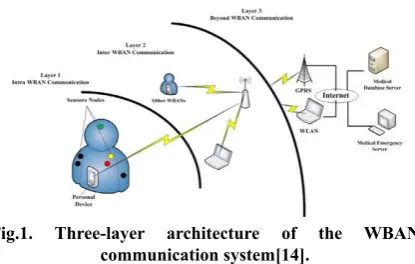
signs, processing a sensed data and providing data for treating medical server [5] through wearing and implanting methods [6]. Applied applications of WBAN are classified into two medical and non-medical ones [7]. Intelligent medical care provides help for improving elders' lives, emergency responses, and the games applied in WBAN as applications [8]. First, small sensors placed in body, measure vital signs such as blood pressure, glucose level, and heartbeat. Then, these data are sent to a doctor's site or to a medical database via Bluetooth or WLAN connection to diagnose a disease and to keep records. Considering the characteristics of WBAN, the alert system facilitates the patient’s movement. It means there is no need for the patients to present in hospital full time. The three-layer general architecture of WBAN has been illustrated in How to cite this article:
230 J. ADV COMP ENG TECHNOL, 4(4) Autumn 2018 Figure 1.
The first level of the WBAN architecture is the sensor body with one or more sensors placed inside or on the human body. The sensor receives information from the human body and sends it wirelessly to the next layer. Both types of sensors can measure different data and transfer them to a controller such as personal digital assistants and cellular phones [9]. The Second layer is called central unit. This unit comprises personal servers, which receive data from sensors and calculate and manage them to get necessary results. The layer may be a mobile or a system that supports GPS or a route system that is capable of administrating the received data. Third layer is final user including services provided for physicians and the unit that may be a PC or mobile. The unit collects necessary data from the second layer and informs the final users of the patient’s situation. Recognizing emergency condition of the patient, the unit warns the final user and provides fast response to the patient in order to receive suitable care [10].
Routing algorithms is required to route daily data of the patient to the destination even when the patient is transmitted [11]. Ideal transmission of a node happens when a node sends the received data to the destination considering the services. The quality of the suitable services is a significant section in medical plans [12]. For various data, vital signs of the patients as well as the different types of the service quality such as latency and reliability are required [13]. Providing reliability and latency reduction in routing is the most essential issue that should be considered in WBAN networks.
Quality of service (QoS), from one perspective, is a quality that is recognized with a user or a plan. Not being able to manage networks to provide service quality, plans and users only worry about the services and the data provided by those networks or systems [15]. On the contrary, the network is a service quality that a network provides for a plan. The perspective of a Service quality considers the quality of the system services in which, network or system that provides the service quality takes the advantages of maximum efficiency. Two examples of key needs are reliability and latency.
Fig.1. Three-layer architecture of the WBAN communication system[14].
Latency and reliability exist in all networks, and provider layers exist in WBAN. The network parameter is used for sensing the latency, processing and relying on the received data respectively. The aim of the paper is to present an algorithm for latency reduction and to increase the reliability. Second section studies the literature. Third section investigates the suggested protocol. Section four is allocated to simulation and the results have been provided in section five.
II. RELATED WORKS
WBAN routing algorithms are classified into four types according to utilized routing type, which is based on QoS-based, thermal-based routing, cluster thermal-based routing and cross layer routing [16]. In this study we investigate WBAN routing algorithms in QoS type. Reliable algorithms assure delivering maximum data to the destination. Transmission latency is not an issue for packet delivery. Routing latency-based algorithms engaged with packets that should be delivered in allocated time is one type of routing, and routing for video transmission is another. Researchers have suggested numerous algorithms in this field. Some important QoS algorithms include RL-QRP, DMQoS, and LOCALMOR [17], [18].
J. ADV COMP ENG TECHNOL, 4(4) Autumn 2018 231 designed for communicating with coordinator. In
this method, the collected data is sent to the sink. DMQoS is a node-to-node method to determine nodding and many sinks which are used.
DMQoS architecture Includes five modules dynamic packet classifier, energy-aware geographic forwarding module, reliability control module, delay control module, and multi-objectives QoS aware queuing module. A reliable module and the latency introduced in this method, result in reduction of bit fault rate, better operation in traffic load, and more energy utilization. Disadvantage of the node-to-node routing suggested in DMQoS is that the source node satisfies the relying and the latency information of the neighbor node. If the neighbor node, or next node latencies cannot provide required reliance, data packets will be lost. In this case, the packet does not reach the destination but the node assumes that the packet has reached successfully. Although, node- to- node solution of DMQoS increases end-to-end latency, necessary reliability is not satisfactory.
In RL-QRP[19], learning enhanced-based routing, which is based on QoS supporting, distributes the learning enhanced algorithm to approach the route selection based on QoS of a node that routes specifically to calculate and choose the service quality in routing network. The goal of RL-QRP is to increase packet delivery rate and decrease end-to-end latency. Routing criterion of RL-QRP uses geographical and distributed comprehensive learning algorithm. In WBAN, generally, a node approaches data packets to other nodes which are closer to sink, through the lack of reliability and buffer situation. The challenges are considered in the protocol. One disadvantage of the method is increasing end-to-end latency average by increasing network throughput.
LOCALMOR [20] algorithm is based on modularity and scalability which categorizes distributed operations, localization, computation, and efficient memory. Data traffic is divided into different categories according to Quality-of-Service metrics, various routing criteria and techniques. In this mechanism, data is divided into Delay-sensitive data, Reliability Sensitive data, Ordinary data and Critical data. The data is sent to the sink node after collection. In this method two types of sink nodes are used that
include primary sink node and secondary sink node; each sink receives the copy of data separately. This issue makes the difference with DMQoS algorithm.
The function of this algorithm is to carry out each packet by choosing Quality-of-Service requirements, and location-aware energy with the best event selection. The reliable-sensitive module calculates the route of reliability and the route of the packets that show sensitivity to the best path.
III. THE PROPOSED ALGORITHM
In this research, the proposed routing algorithm is an approach based on multipath data that avoids congestion and reduces delays, which is a suitable method for medical applications. This algorithm uses multiple routes and supports several types of traffic with different priorities. In general, this algorithm initially creates several routes between origin and destination. The shortest path is considered for high-priority and delay-sensitive traffic while other routes are used for the remained traffic.
1. First Step: Sending Out a Request
This part of the routing algorithm begins with the sink, and the request for the required data, such as patient’s physiological measurements and vital signs, is sent by the sink to all nodes in the network. In fact, sink requirement broadcasts on the network as a request. In the packet structure, at this stage, the following cases should be considered:
Time: It may be a patient's condition in different time periods.
Priority: In medical applications, the packets have different priorities, so when sending a request, the patient type and priority must be specified.
Response mode: How to respond to requests should be specified in the nodes.
2. Second Step: Reporting Events
J. ADV COMP ENG TECHNOL, 4(4) Autumn 2018 232 via the neighboring nodes. In this algorithm,
since sensors are aware of their location, each of the sensors computes the distance between themselves and the sender to the sink. Then the node that is closer to the sink is selected as the sender node.
2.1 First Phase
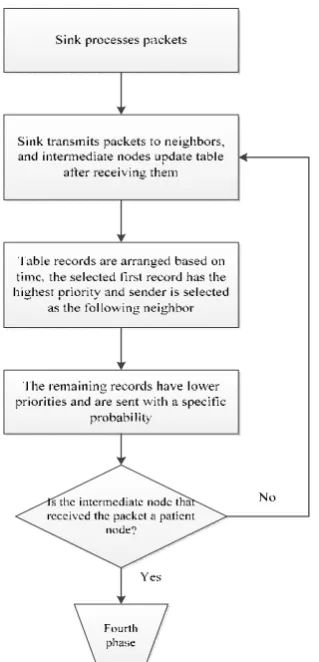
In this phase, the information requested by the medical practitioner or the medical staff, such as checking the patient’s vital signs, is sent by the sink. The next step is to check if the destination exists in the route cache.
Fig.2. Flowchart of the first phase of the algorithm
If the destination was in the cache, it means that a packet has already been forwarded for that and this path has been stored. Therefore, the packet will be forwarded through the same path to the destination. Otherwise, it enters the second phase of the algorithm.
2.2 Second Phase
If in the first phase there is no route to forward the packet to the destination, the algorithm enters the second phase. In this phase, the intermediate nodes receive the packet and send it to the patient's sensor. These sensors prepare a report using the received information and embed it in the packet.
Fig.3. Flowchart of the second phase of the algorithm
Then, given that the data is sensitive or non-sensitive, its priority will be determined. Afterwards, the packet is sent to the sink and received by the neighbors. Upon receiving a packet, a node checks if it is the packet’s final destination or not. If this node is not the destination node, it updates its routing table and calculates the neighbors' distance to the sink and forwards the packet to the neighbor closest to the sink. Otherwise, if the node receiving the packet at this stage is the destination node, the algorithm enters the third phase.
2.3 Third Phase
233 J. ADV COMP ENG TECHNOL, 4(4) Autumn 2018 provides higher priority to the patient with acute
conditions and sends out the confirmation packet first to the patient in critical state.
In fact, this belongs to the sensitive traffic category. Afterwards, the sink sends out the confirmation packet to the normal patient, which is considered to be non-sensitive and normal traffic. These confirmation packets move along the route to reach the sender. The transmission of confirmation packets is in this way that the sink arranges the routing table according to the packets’ arrival time. At the end of this phase, routing tables are created for sensitive and non-sensitive traffic on the source-to-sink path of each intermediate node, which allows the senders to use multipath routing in the network when sending the data. However, in cases when a patient is in bad condition, for example, there is a severe increase or decrease in blood glucose level or a sudden rise or fall in blood pressure; the traffic generated in the sensors is of sensitive traffic. For this kind of traffic in intermediate nodes, the sensitive routing table is used.
Fig.4. Flowchart of the third phase of the algorithm
2.4 Fourth Phase
In this phase, the patient begins to send data, and then in the intermediate nodes on receiving each packet, firstly, the packet header determines the type of the packet. If the packet is of a sensitive type, it chooses the highest priority of the table otherwise selects the next hop as the next priority.
IV. SIMULATION SCENARIO
1. Simulation Environments
Simulation of this paper is done by OMNET++ and Mixim simulators. The area of simulation is 9 meters by 9 meters. The Initial node energy is 100 Jules and values of -25dBM are measured for transmission power. The application layer type for this simulation is of event-based type, and the maximum packet size is considered to be 32 bytes. The traffic type is Constant Bit Rate (CBR), meaning that constant transfer rate is considered for the data. The standard parameters and default values of IEEE802.15.4 have been used in this simulation.
2. Simulation Parameters
The simulation parameters are the number of packets sent by throughput and end-to-end delay. The configuration of network parameters is shown in Table 1.
Table 1. Configuration of Parameters.
9m*9m Area
Deployment
100 J Initial node energy
32packets Buffer size
250 Kbps Link layer
trans.Rate
-25dbm Transmit power
7dbm Reception power
Event-driven Application type
32 Bytes Packet size
MAC Traffic type CBR (Constant Bit Rate)
Default values IEEE 802.15.4
4000 Second Time
Simulation
3. Simulation result
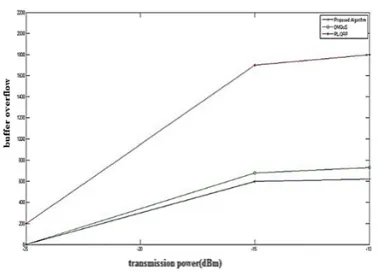
234 J. ADV COMP ENG TECHNOL, 4(4) Autumn 2018 to the DMQoS and RL-QRP algorithms, in the
proposed algorithm a fewer number of packets are lost in the buffer, which is 34% and 22.3% better than the DMQoS and RL-QRP algorithms.
Fig.5. the number of packets lost due to buffer overflow
Figure 6 shows the throughput of the three considered algorithms in this study when transmit power is -25dBm. Figure 6 indicates that by increasing the number of transmitted packets, the successful sending rate increases negligibly in all three algorithms.
For the RL-QRP algorithm, the rate of successful packet transmission when sending 1000 packets is 41.4% while the rate of successful packet transmission for this algorithm, when sending 80000 packets, is equal to 46.1%. The successful packet sending rate for the DMQoS algorithm when sending 1000 packets is 63.3%, which reaches 64.5% when sending 80,000 packets.
Figure 7 shows the number of successfully transmitted packets with the transmission power of -25dBm for the proposed algorithm, as well as the DMQoS and the RL-QRP algorithms. Figure 7 indicates that in different time periods, the number of packets sent by the proposed algorithm is greater than the other two algorithms, which means reducing the end-to-end latency.
Fig.6. Throughput with transmission power of -25dBm
Fig.7. Delay for 4000 packets sent with transmission power -25dBm
V. CONCLUSIONS AND FUTURE RESEARCH
The objective of this paper is to reduce the delay in sending out packets and prevent the congestion. In the proposed algorithm, in addition to reducing the delay, packet loss is also prevented. The proposed algorithm consists of two main phases. The first phase was designed to disseminate the medical center’s requests and the subsequent phases were for the sink.
235 J. ADV COMP ENG TECHNOL, 4(4) Autumn 2018 other routes. The simulation results showed that
the proposed algorithm has better performance in terms of packet loss rate, throughput and end-to-end delay. The proposed algorithm by reducing packet loss for sensitive traffic offer high reliability for these types of traffic.
236 J. ADV COMP ENG TECHNOL, 4(4) Autumn 2018 REFERENCES
1. Masdari, M., Ahmadzadeh, S. and Bidaki, M., 2017. Key management in wireless Body Area Network: Challenges and issues. Journal of Network and Computer Applications, 91, pp.36-51.
2. Sindhu, S., Vashiath, S. and Chakarvarti, S.K., 2016. A Review on Wireless Body Area Network (WBAN) for Health Monitoring System, Implementation Protocol. Communication on Applied Electronics, Foundation of Computer Science, Newyork, USA, 4(7).
3. Kumari, R. and Nand, P., 2016, April. Performance Comparison of various Routing Protocols in WSN and WBAN. In Computing, Communication and Automation (ICCCA), 2016 International Conference on (pp. 427-431). IEEE.
4. Jovanov, E., Milenkovic, A., Otto, C. and De Groen, P.C., 2005. A wireless body area network of intelligent motion sensors for computer assisted physical rehabilitation. Journal of NeuroEngineering and rehabilitation, 2(1), p.6.
5. Yousaf, S., Javaid, N., Qasim, U., Alrajeh, N., Khan, Z.A. and Ahmed, M., 2016. Towards reliable and energy-efficient incremental cooperative communication for wireless body area networks. Sensors, 16(3), p.284.
6. Ko, J., Lu, C., Srivastava, M.B., Stankovic, J.A., Terzis, A. and Welsh, M., 2010. Wireless sensor networks for healthcare. Proceedings of the IEEE, 98(11), pp.1947-1960.
7. Masdari, M., Ahmadzadeh, S. and Bidaki, M., 2017. Key management in wireless Body Area Network: Challenges and issues. Journal of Network and Computer Applications, 91, pp.36-51.
8. Patel, M. and Wang, J., 2010. Applications, challenges, and prospective in emerging body area networking technologies. IEEE Wireless communications, 17(1).
9. Shankar, S.K. and Tomar, A.S., 2016, May. A survey on wireless body area network and electronic-healthcare. In Recent Trends in Electronics, Information & Communication Technology (RTEICT), IEEE International Conference on (pp. 598-603). IEEE.
10. Asif, A. and Sumra, I.A., 2017. Applications of Wireless Body Area Network (WBAN): A Survey. Engineering science and technology international research journal, pp.64-71.
11. Razzaque, M.A., Hong, C.S. and Lee, S., 2011. Data-centric multiobjective QoS-aware routing protocol for body sensor networks. Sensors, 11(1), pp.917-937.
12. Raja, K.S. and Kiruthika, U., 2015. An energy efficient method for secure and reliable data transmission in wireless body area networks using RelAODV. Wireless Personal Communications, 83(4), pp.2975-2997.
13. Negra, R., Jemili, I. and Belghith, A., 2016. Wireless body area networks: Applications and technologies. Procedia Computer Science, 83, pp.1274-1281.
14. Negra, R., Jemili, I. and Belghith, A., 2016. Wireless body area networks: Applications and technologies. Procedia
Computer Science, 83, pp.1274-1281.
15. Razzaque, M.A., Hira, M.T. and Dira, M., 2017. QoS in Body Area Networks: A Survey. ACM Transactions on Sensor Networks (TOSN), 13(3), p.25.
16. Anand, J. and Sethi, D., 2017, February. Comparative analysis of energy efficient routing in WBAN. In Computational Intelligence & Communication Technology (CICT), 2017 3rd International Conference on (pp. 1-6). IEEE.
17. Bangash, J.I., Abdullah, A.H., Anisi, M.H. and Khan, A.W., 2014. A survey of routing protocols in wireless body sensor networks. Sensors, 14(1), pp.1322-1357.
18. Jijesh, J.J., 2017, January. A survey on Wireless Body Sensor Network routing protocol classification. In Intelligent Systems and Control (ISCO), 2017 11th International Conference on(pp. 489-494). IEEE.
19. Liang, X., Balasingham, I. and Byun, S.S., 2008, October. A reinforcement learning based routing protocol with QoS support for biomedical sensor networks. In Applied Sciences on Biomedical and Communication Technologies, 2008. ISABEL'08. First International Symposium on (pp. 1-5). IEEE.