Geosci. Instrum. Method. Data Syst., 2, 113–120, 2013 www.geosci-instrum-method-data-syst.net/2/113/2013/ doi:10.5194/gi-2-113-2013
© Author(s) 2013. CC Attribution 3.0 License.
EGU Journal Logos (RGB)
Advances in
Geosciences
Open Access
Natural Hazards
and Earth System
Sciences
Open AccessAnnales
Geophysicae
Open AccessNonlinear Processes
in Geophysics
Open AccessAtmospheric
Chemistry
and Physics
Open AccessAtmospheric
Chemistry
and Physics
Open Access DiscussionsAtmospheric
Measurement
Techniques
Open AccessAtmospheric
Measurement
Techniques
Open Access DiscussionsBiogeosciences
Open Access Open Access
Biogeosciences
DiscussionsClimate
of the Past
Open Access Open Access
Climate
of the Past
Discussions
Earth System
Dynamics
Open Access Open Access
Earth System
Dynamics
DiscussionsGeoscientific
Instrumentation
Methods and
Data Systems
Open Access
Geoscientific
Instrumentation
Methods and
Data Systems
Open Access DiscussionsGeoscientific
Model Development
Open Access Open Access
Geoscientific
Model Development
DiscussionsHydrology and
Earth System
Sciences
Open AccessHydrology and
Earth System
Sciences
Open Access DiscussionsOcean Science
Open Access Open Access
Ocean Science
DiscussionsSolid Earth
Open Access Open Access
Solid Earth
DiscussionsThe Cryosphere
Open Access Open Access
The Cryosphere
DiscussionsNatural Hazards
and Earth System
Sciences
Open Access
Discussions
Potential soil moisture products from the aquarius radiometer and
scatterometer using an observing system simulation experiment
Y. Luo1, X. Feng2, P. Houser2, V. Anantharaj3, X. Fan4, G. De Lannoy5, X. Zhan6, and L. Dabbiru3 1I. M. Systems Group, Inc. at NOAA/NCEP/EMC, Camp Springs, MD 20746, USA
2Department of Geography and Geoinformation Science, George Mason University, Fairfax, VA 22030, USA 3Geosystems Research Institute, Mississippi State University, MS 39762, USA
4Department of Geography and Geology, Western Kentucky University, Bowling Green, KY 42101, USA 5Laboratory of Hydrology and Water Management, Ghent University, Ghent, Belgium
6NOAA/NESDIS Center for Satellite Applications and Research, Camp Springs, MD 20746, USA
Correspondence to: X. Feng ([email protected])
Received: 21 June 2012 – Published in Geosci. Instrum. Method. Data Syst. Discuss.: 13 July 2012 Revised: 1 February 2013 – Accepted: 1 February 2013 – Published: 20 February 2013
Abstract. Using an observing system simulation experiment
(OSSE), we investigate the potential soil moisture retrieval capability of the National Aeronautics and Space Admin-istration (NASA) Aquarius radiometer (L-band 1.413 GHz) and scatterometer (L-band, 1.260 GHz). We estimate poten-tial errors in soil moisture retrievals and identify the sources that could cause those errors. The OSSE system includes (i) a land surface model in the NASA Land Information System, (ii) a radiative transfer and backscatter model, (iii) a realis-tic orbital sampling model, and (iv) an inverse soil moisture retrieval model.
We execute the OSSE over a 1000×2200 km2 region in the central United States, including the Red and Arkansas river basins. Spatial distributions of soil moisture retrieved from the radiometer and scatterometer are close to the syn-thetic truth. High root mean square errors (RMSEs) of ra-diometer retrievals are found over the heavily vegetated re-gions, while large RMSEs of scatterometer retrievals are scattered over the entire domain. The temporal variations of soil moisture are realistically captured over a sparely veg-etated region with correlations 0.98 and 0.63, and RMSEs 1.28 % and 8.23 % vol/vol for radiometer and scatterom-eter, respectively. Over the densely vegetated region, soil moisture exhibits larger temporal variation than the truth, leading to correlation 0.70 and 0.67, respectively, and RM-SEs 9.49 % and 6.09 % vol/vol respectively. The domain-averaged correlations and RMSEs suggest that radiometer is more accurate than scatterometer in retrieving soil moisture.
The analysis also demonstrates that the accuracy of the re-trieved soil moisture is affected by vegetation coverage and spatial aggregation.
1 Introduction
Soil moisture is a key land surface state variable and plays a crucial role in the variability of water and energy cycles (Koster et al., 2004). By controlling the partitioning of so-lar radiation into sensible and latent heat flux, as well as the partitioning of precipitation into evapotranspiration, infil-tration and runoff, soil moisture regulates energy and water exchange between land surface and atmosphere and hence significantly influences the regional and global climate. Due to its recognized importance, routine soil moisture observa-tions are critical for weather and climate prediction, drought and flood monitoring, water resource management and agri-cultural practice. The traditional in situ soil moisture mea-surements are sparsely distributed and only representative of local areas (Robock et al., 2000), thereby inadequately sampling the heterogeneous land surface. As an alternative, spaceborne microwave sensors have proven to be an effec-tive way to monitor soil moisture at global scales (Owe et al., 1999; Kerr et al., 2010; Entekhabi et al., 2004).
instrument configurations, and to prepare ground-based sys-tems for the use of new data types. Several studies have been dedicated to adopting observing system simulation experi-ments (OSSEs; Masutani et al. 2006) to evaluate the relia-bility of soil moisture retrievals from the Hydrosphere State (Hydros) mission (Crow et al., 2005; Zhan et al., 2006). This study aims to investigate soil moisture retrieval capabilities from the Aquarius satellite, which is a new NASA Earth System Science Pathfinder mission launched in June 2011. This study was intentionally done before Aquarius launch to predict the usefulness and benefits of Aquarius data. Specif-ically, we employed an OSSE technique to simulate Aquar-ius measurements and invert them back into soil moisture products. Then the errors of the retrieved soil moisture were evaluated, and the potential sources for causing those errors were further identified. This study includes two new features compared to the earlier Hydro OSSE: the NASA Land In-formation System (LIS) to generate estimates of land surface variables, and a realistic orbital and instrument sampling to reproduce the observing overpass pattern.
2 Aquarius instrument and OSSE
Aquarius is a combined passive/active L-band microwave in-strument that is developed to map the ocean salinity from space at a nominal resolution of 100 km every 7 days in a Sun-synchronous orbit at 657 km altitude (Le Vine et al., 2007). The instrument consists of a set of three radiometers that measure passive microwave emission from the surface, and a scatterometer that makes backscatter measurements, operating at 1.4 GHz and 1.26 GHz respectively. Aquarius has a 2.5-m offset parabolic reflector with three antenna beams, which correspond to incidence angles of 29◦, 38◦, and 46◦ with the respective footprint sizes of 76×94 km, 84×120 km, and 96×156 km. The radiometer has Th, Tv, T+45, and T-45 polarizations, and the scatterometer has HH, HV, VV, and VH polarizations. The design requirements for Aquarius are that the radiometer and scatterometer be ade-quately stable within 0.13 K and 0.1 dB, respectively over 7 days.
To examine the soil moisture retrieval potential from the Aquarius instrument, we employ an OSSE to generate a syn-thetic soil moisture product. An OSSE consists of four com-ponents: (i) a land surface model (LSM) from LIS to gen-erate land surface estimates, referred to as the nature run; (ii) a forward microwave emission and backscatter model (MEBM) to simulate radiometric brightness temperature and radar backscatter; (iii) an orbit and sensor model (OSM) to sample the synthetic observations based on the orbital and in-strument characteristics; and (iv) an inverse retrieval model (RM) to derive synthetic soil moisture.
2.1 Land surface model (LSM)
The NASA LIS is a land surface modeling software plat-form that characterizes land surface states and fluxes through the integration of ground-based and satellite observations into land surface models (Kumar et al., 2006). It also in-corporates scalable, high performance computing and data management technologies to enable high-resolution land sur-face modeling. The Community Land Model (CLM; Dai et al. 2003) in LIS is used to estimate surface fluxes and states variables, including soil moisture, soil temperature, and vegetation canopy temperature. Near-surface meteoro-logical data used to drive CLM are from the North Amer-ican Land Data Assimilation System (NLDAS; Cosgrove et al. 2003), which provides hourly, 0.125◦-resolution forc-ing fields. The main ancillary static parameter datasets in-clude (i) 1 km land cover types produced at the University of Maryland derived from the Advanced Very High Reso-lution Radiometer (AVHRR; Hansen et al. 2000), (ii) soil texture at 1 km from the State Soil Geographic (STATSGO) database, (iii) 1 km United States Geological Survey (USGS) GTOPO30 elevation and (iv) leaf area index (LAI) and stem area index (SAI) at 1 km from AVHRR. The 1 km parame-ter datasets are spatially averaged to 0.125◦(∼12 km) CLM model resolution.
2.2 Microwave emission and backscatter mode (MEBM)
Using the LSM output at 0.125◦ resolution, the MEBM (Dubois et al., 1995) is used to compute the synthetic brightness temperature and backscatter, corresponding to the Aquarius frequencies, polarizations and incidence angles. It calculates brightness temperature from soil and vegetation based on a layered single-scattering soil–vegetation model. The MEBM needs inputs of dynamic state variables, such as surface soil moisture, soil temperature and vegetation tem-perature, and static parameters, for instance soil roughness, vegetation single backscattering and vegetative structure co-efficient with corresponding values chosen from Crow et al. (2005). The vegetation water content is a seasonally vary-ing climatology at 1 km produced by Rodell et al. (2005) from the Moderate Resolution Imaging Spectroradiometer (MODIS). The backscatter MEBM derives the total scatter-ing cross section from three components attributable to soil, vegetation and their interaction, which are functions of soil moisture and vegetation characteristics.
2.3 Orbit and sensor model (OSM)
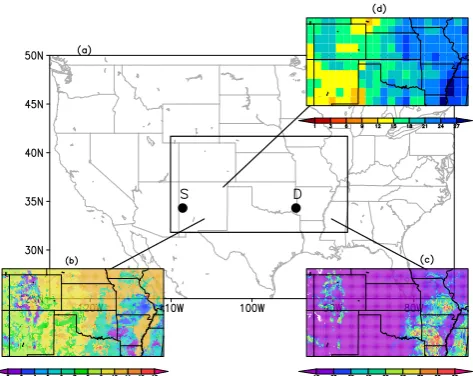
Fig. 1.(a) Simulation domain denoted by inner black box, (b) land cover category, (c) time averaged vegetation water content (kg/m2) from October 2002 to September 2003 and (d) time averaged soil moisture (% vol/vol) truth during September 2002 to September 2003. Black dots represent sparsely (S) and densely (D) vegetated pixels.
11
Fig. 1. (a) Simulation domain denoted by inner black box, (b) land cover category, (c) time-averaged vegetation water con-tent (kg m−2) from October 2002 to September 2003 and (d) time-averaged soil moisture (% vol/vol) truth during September 2002 to September 2003. Black dots represent sparsely (S) and densely (D) vegetated pixels.
from MEBM to the Aquarius nominal resolution of 1◦ at a 7-day revisit using orbital sampling software, Satellite Tool Kit (available at http://www.agi.com/resources/help/online/ stk/index.html). This approach precisely mimics the Aquar-ius sampling pattern and thereby yields more realistic mi-crowave measurements than assuming twice-daily overpass in Crow et al. (2005).
2.4 Retrieval model (RM)
We invert the synthetic observations of brightness temper-ature and backscatter at 1◦ resolution to soil moisture us-ing the multi-polarization iterative algorithm developed by Njoku and Li (1999). In this inversion process, the roughness and vegetation parameters are assumed to be the same for all polarizations. A single soil moisture value is obtained from multi-polarized microwave measurements. The RM uses the same sets of mathematical equations as the MEBM; however, the RM simplifies the real emission/backscatter processes by assuming that the noises added to MEBM simulations are parts of the actual processes. The real noises are not known in the retrieval process. The soil and vegetation parameters are the same as those used for MEBM but are linearly aggre-gated to 1◦resolution. The surface topography is assumed to be flat over the 1◦domain.
3 Simulation domain and design
The Aquarius OSSE is carried out over the central United States (31.8125◦–41.6875◦N, 110.0625◦–88.1875◦W; Fig. 1a), encompassing the Red–Arkansas river basin. Over this region, soil moisture has been shown to exert a dominant influence on water and energy variability (Koster et al., 2004). The selected study area has limited vegetation and inland water coverage (Fig. 1b), a favorable location for more accurate soil moisture retrievals. Meanwhile, the study area has a pronounced west–east contrast with vegetation decreasing towards the west (Fig. 1c). The CLM has spatial resolution of 0.125◦and time step of 30 min. After a spinup from March 2000 to September 2002, CLM is run 13 months spanning from September 2002 to September 2003, which captures the seasonal variations of diverse land surface conditions. The nature run soil moisture is extracted from a 5 cm surface CLM layer, corresponding to the sensing depth of the Aquarius L-band radiometer and scatterometer (Entekhabi et al., 2004). The reference “truth” is defined as the soil moisture at 1◦resolution Aquarius footprint (Fig. 1d) via direct aggregation of the original 0.125◦nature run. The Aquarius satellite will have overpass times of 06:00 and 18:00 local time. Since the surface temperature gradient is more stable and uniform at 06:00 than at 18:00 (Hornbuckle and England, 2005), we only choose the results at 06:00 (13:00 UTC) to address OSSE retrievals in this analysis.
The retrieved Aquarius soil moisture is subject to measure-ment error due to instrumeasure-ment noise and calibration error, and retrieval uncertainty arising from resolution degradation of soil and vegetation parameters. To account for uncertainty of measurement and retrieval process, we intend to be consis-tent with Zhan et al. (2006) by adding spatially and tempo-rally uncorrelated Gaussian noise with standard deviations of 1 K and 0.5 dB, for brightness temperature and backscatter, 20 %, 5 % and 20 % for surface roughness, vegetative struc-ture coefficient and vegetation water content, as well as 1.5 K for both soil and vegetation temperature to the 1◦pixels.
4 Results analysis
4.1 Soil moisture retrieval
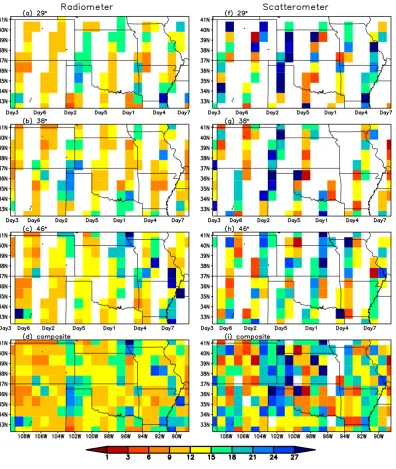
Fig. 2. The retrieved soil moisture (% vol/vol) at incidence angles of (a) and (f)29◦, (b) and (g)38◦, and
(c) and (h)46◦for synthetic observations of radiometer and scatterometer, and their respective 7-day averaged
composite d) and i) over the simulation domain during 1 to 7 September 2002.
12
Fig. 2. The retrieved soil moisture (% vol/vol) at incidence angles of (a) and (f) 29◦, (b) and (g) 38◦, and (c) and (h) 46◦for synthetic observations of radiometer and scatterometer, and their respective 7-day averaged composite (d) and (i) over the simulation domain during 1 to 7 September 2002.
and derive the composite spatial map for the radiometer and scatterometer as shown in Fig. 2d and i. The radiometer measurements almost cover the entire simulation domain, whereas the scatterometer shows several missing values. Dry conditions mostly dominate the simulation domain with wet areas scattered over northern Texas, eastern Kansas, and southern Arkansas.
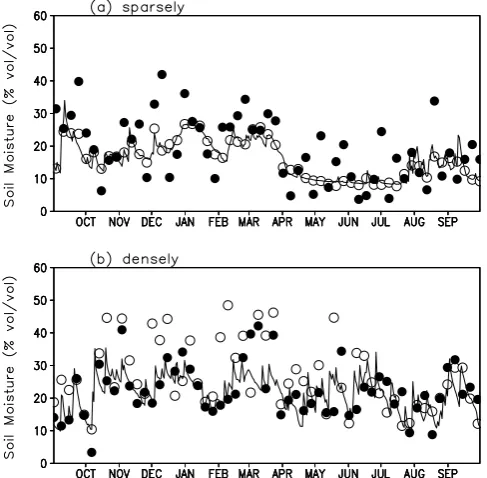
To further examine the ability of the Aquarius OSSE in de-scribing the soil moisture temporal variability, we choose two representative grid cells with comparably large vegetation
Fig. 3. Time variations of daily soil moisture (% vol/vol) retrievals from radiometer (open circle) and
scat-terometer (closed circle) at29◦incidence angle compared with the truth (black line) at (a) sparsely and (b)
densely vegetated pixels from September 2002 to September 2003.
13
Fig. 3. Time variations of daily soil moisture (% vol/vol) retrievals from radiometer (open circle) and scatterometer (closed circle) at 29◦ incidence angle compared with the truth (black line) at (a) sparsely and (b) densely vegetated pixels from September 2002 to September 2003.
truth. The correlation coefficients between retrievals and the truth are 0.98 and 0.63, statistically significant at the 5 % level. The root mean square errors (RMSEs) are 1.28 % and 8.23 % vol/vol, respectively. In comparison with the sparsely vegetated pixel, soil moisture retrievals at densely vegetated pixels tend to display larger temporal variation. In partic-ular, the simulated amplitude of variation is overestimated and the temporal phase is not well captured by the radiome-ter retrieval, leading to correlation coefficients of 0.70 and 0.67, and RMSEs of 9.49 % and 6.09 % vol/vol, respectively. Contrary to expectation, the retrieval accuracy of the scat-terometer increases in the presence of vegetation, likely be-ing caused by the error cancellbe-ing involved in the retrieval process. It is noticeable in Fig. 3b that the radiometer has larger soil moisture estimate uncertainties from mid-October to April compared to warm months. The reason is that the densely vegetated pixel has higher vegetation water content during the cold season than in warm season, likely attributed to winter wheat. These results indicate that vegetation cover has more impact on radiometer soil moisture retrievals in winter months than in summer months.
4.2 Error analysis
To further identify the accuracy of the soil moisture, we cal-culate the RMSE between composite retrievals and the truth at 1◦from September 2002 to September 2003 (Fig. 4).
Gen-Fig. 4.The root mean square error (RMSE, % vol/vol) between the truth and soil moisture retrieval composites for a) radiometer (left) and b) scatterometer (right) from September 2002 to September 2003.
14
Fig. 4. The root mean square error (RMSE, % vol/vol) between the truth and soil moisture retrieval composites for (a) radiometer (left) and (b) scatterometer (right) from September 2002 to Septem-ber 2003.
erally speaking, the radiometer-retrieved soil moisture has lower observed errors than the scatterometer soil moisture re-trievals. High RMSEs of radiometer soil moisture retrievals are confined over the western end and eastern portion of the region with high vegetation water content, whereas the large values of RMSE of scatterometer-derived products are pretty irregular, scattered over the simulation domain.
In order to see the accuracy of different measurements, we calculate the correlations and RMSEs for radiometer and scatterometer soil moisture retrievals at each incidence angle (Table 1a). The calculations are derived by pooling retrievals from all of the 1◦pixels in the OSSE domain during the entire simulation period. Soil moisture retrievals from radiometer have a larger correlation and lower RMSE than those from scatterometer for each incidence angle. In addition, the high-est accuracies for radiometer and scatterometer are at inci-dence angles of 29◦and 46◦, respectively. If the soil moisture retrievals at three incidence angles are combined together, the resultant correlations and RMSEs of composites are 0.78 and 0.68, as well as 5.94 % and 6.64 % vol/vol for radiometer and scatterometer.
Table 1. The correlation coefficient (corr) and root mean square error (RMSE, %vol/vol) between the truth and soil moisture retrievals at incidence angles of 29◦, 38◦and 46◦from synthetic radiometer and scatterometer measurements, and their respective composite from September 2002 to September 2003 for (a) the entire domain and (b) the entire domain but the grid cells with vegetation water content higher than 3 kg m−2screened out.
(a)
Measurement 29
◦ 38◦ 46◦ Composite
corr RMSE corr RMSE corr RMSE corr RMSE
Radiometer 0.82 5.44 0.77 5.74 0.77 6.41 0.78 5.94
Scatterometer 0.65 7.93 0.66 6.64 0.74 5.66 0.68 6.64
(b)
Measurement 29
◦ 38◦ 46◦ Composite
corr RMSE corr RMSE corr RMSE corr RMSE
Radiometer 0.90 3.31 0.82 4.24 0.82 4.65 0.84 4.18
Scatterometer 0.63 7.94 0.65 6.73 0.76 5.51 0.69 6.62
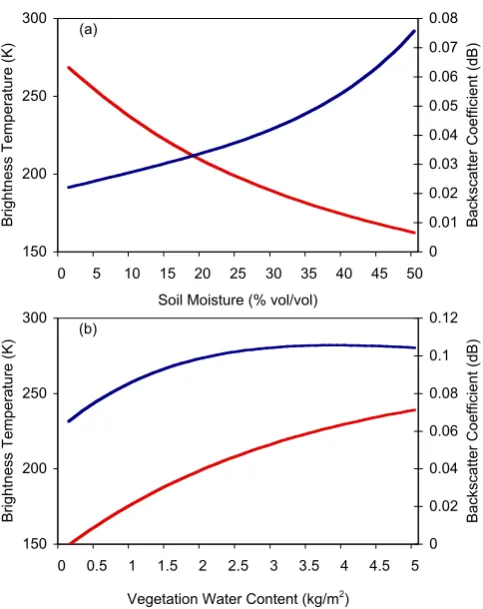
patterns or using information from the high-resolution land surface model or digital elevation model may provide infor-mation on the effect of spatial variability on the signal, or may allow the signal to be downscaled to a higher resolution. As Fig. 5 illustrates, the brightness temperature and backscat-ter nonlinearly vary with the soil moisture and vegetation wa-ter content. However, such nonlinear relationships cannot be reflected by linear aggregation used in the OSSE, which is confirmed by Zhan et al. (2008). These error sources would provide us valuable guidance for future designs in space-borne sensor and retrieval algorithm to effectively improve soil moisture retrieval accuracy.
5 Summary
A potential Aquarius soil moisture retrieval product using an OSSE technique is presented over the Red–Arkansas river basin. The retrieved soil moisture errors are estimated, and the sources for causing those errors involved in measure-ment and retrieval process are also identified. This is the first soil moisture OSSE aimed specifically at Aquarius and one of the few studies focused on retrieving soil moisture from both active and passive microwave observations. The Aquar-ius OSSE system has several distinct features: (1) a current state-of-the-art LSM model encapsulated in LIS, which in-tegrates surface and atmosphere observations; (2) a realistic OSM model, which mimics the Aquarius orbit and instru-ment sampling; (3) realistic ancillary data, such as the vege-tation parameter taken from MODIS; and (4) a larger simu-lation domain and longer simusimu-lation period than used in the previous Hydros OSSE work. All of these improved design aspects make this study unique and advantageous to investi-gate and assess the capability of Aquarius measurements.
150 200 250 300
0 5 10 15 20 25 30 35 40 45 50
Soil Moisture (% vol/vol)
Brightness Temperature (K)
0 0.01 0.02 0.03 0.04 0.05 0.06 0.07 0.08
Backscatter Coefficient (dB)
(a)
150 200 250 300
0 0.5 1 1.5 2 2.5 3 3.5 4 4.5 5
Vegetation Water Content (kg/m2)
Brightness Temperature (K)
0 0.02 0.04 0.06 0.08 0.1 0.12
Backscatter Coefficient (dB)
(b)
Fig. 5. The variations of synthetic observations of brightness temperature (K, red line) and backscattering coefficient (dB, blue line) at38◦incidence angle with H polarization in relation to (a) soil moisture (% vol/vol)
and (b) vegetation water content (kg/m2
) over clay soil covered with evergreen needleleaf/broadleaf. Soil temperature and vegetation temperature are set to be 300 K, vegetation water content is 0.5 kg/m2
in (a) and soil moisture is 3% vol/vol in (b).
15
150 200 250 300
0 5 10 15 20 25 30 35 40 45 50
Soil Moisture (% vol/vol)
Brightness Temperature (K)
0 0.01 0.02 0.03 0.04 0.05 0.06 0.07 0.08
Backscatter Coefficient (dB)
(a)
150 200 250 300
0 0.5 1 1.5 2 2.5 3 3.5 4 4.5 5
Vegetation Water Content (kg/m2)
Brightness Temperature (K)
0 0.02 0.04 0.06 0.08 0.1 0.12
Backscatter Coefficient (dB)
(b)
Fig. 5. The variations of synthetic observations of brightness temperature (K, red line) and backscattering coefficient (dB, blue line) at38◦incidence angle with H polarization in relation to (a) soil moisture (% vol/vol)
and (b) vegetation water content (kg/m2
) over clay soil covered with evergreen needleleaf/broadleaf. Soil temperature and vegetation temperature are set to be 300 K, vegetation water content is 0.5 kg/m2
in (a) and soil moisture is 3% vol/vol in (b).
15
Radiometer soil moisture retrievals generally have lower spatial RMSEs than scatterometer-derived soil moisture. High RMSEs of radiometer products are mainly found over the heavily vegetated region, while large values of RMSE of scatterometer products are dispersed over the simulation do-main. The temporal variation of soil moisture from both ra-diometer and scatterometer retrieval is well represented over the sparsely vegetated pixel with statistically significant cor-relations of 0.98 and 0.63, and RMSEs of 1.23 % and 8.23 % vol/vol. In contrast, over densely vegetated pixels, the simu-lated soil moisture displays larger temporal variation than the truth, resulting in lower correlations of 0.70 and 0.67, and higher RMSEs of 9.49 % and 6.09 % vol/vol. The correla-tions and RMSEs derived by pooling soil moisture retrievals from all 1◦ pixels in the OSSE domain during the simula-tion period further suggest that radiometer measurements are more accurate than scatterometer measurements in retrieving soil moisture.
Uncertainties in soil moisture retrieval products come from a variety of potential sources, such as measurement er-ror, vegetation and spatial aggregation. We seek to evaluate the impact of vegetation, land surface heterogeneity and in-land water on the retrieved soil moisture via sensitivity stud-ies for a few cases using a different LSM or assimilation strategy in a future study.
Acknowledgements. This work was supported by the NASA Rapid
Prototyping Capability (RPC) experiment project. Gabrielle De¨ Lannoy is a postdoctoral research fellow of the Research Founda-tion Flanders (FWO). We would like to acknowledge the comments from two anonymous reviewers that improved the manuscript. We would also like to thank Wade Crow for providing the Hydros OSSE nature run as reference, and Sujay Kumar and James Geiger for assisting LIS implementation.
Edited by: H. Svedhem
References
Cosgrove, B. A., Lohmann, D., Mitchell, K., Houser, P. R., Wood, E. F., Schaake, J., Robock, A., Marshall, C., Sheffield, J., Luo, L., Duan, Q., Pinker, R., Tarpley, J. D., Higgins, R., and Meng, J.: Real-time and retrospective forcing in the North American Land Data Assimilation System (NLDAS) project, J. Geophys. Res., 108, 8842, doi:10.1029/2002JD003118, 2003.
Crow, W. T., Chan, T., Entekhabi, D., Houser, P. R., Hsu, A., Jack-son, T. J., Njoku, E., O’Neill, P. E., Shi, J. C., and Zhan, X.: An observing system simulation experiment for hydros radiometer-only soil moisture products, IEEE Trans. Geosci. Remote Sens., 43, 1289–1303, 2005.
Dai, Y., Dickinson, R. E., Baker, I., Bonan, G., Bosilovich, M., Den-ning, S., Dirmeyer, P., Houser, P., Niu, G., Oleson, K., Schlosser, A., and Yang, Z.-L.: The Common Land Model (CLM), B. Am. Meteorol. Soc., 84, 1013–1023, 2003.
Dubois, P. C., Zyl, J. V., and Engman, E.: Measuring soil moisture with imaging radar, IEEE Trans. Geosci. Remote Sens., 33, 915– 926, 1995.
Entekhabi, D., Asrar, G. R., Betts, A. K., and Beven, K. J.: An agenda for land-surface hydrology research and a call for the sec-ond international hydrology decade, B. Am. Meteorol. Soc., 80, 2043–2058, 1999.
Entekhabi, D., Njoku, E., Houser, P., Spencer, M., Doiron, T., j. Smith, Girard, R., Belair, S., Crow, W., Jackson, T., and Kerr, Y.: The Hydrosphere State (HYDROS) mission concept: An earth system pathfinder for global mapping of soil moisture and land freeze/thaw, IEEE Trans. Geosci. Remote Sens., 42, 2184– 2195, 2004.
Hansen, M., DeFries, R., Townshend, J., and Sohlberg, R.: Global land cover classification at 1 km spatial resolution using a clas-sification tree approach, Int. J. Remote Sens., 21, 1331–1364, 2000.
Hornbuckle, B. K. and England, A.: Diurnal variation of vertical temperature gradients within a field of maize: Implications for Satellite microwave radiometry, IEEE Trans. Geosci. Remote Sens., 2, 74–77, 2005.
Kerr, Y. H., Waldteufel, P., Wigneron, J.-P., Delwart, S., Cabot, F., Boutin, J., Escorihuela, M.-J., Font, J., Reul, N., Gruhier, C., Ju-glea, S. E., Drinkwater, M. R., Hahne, A., Mart´ın-Neira, M., and Mecklenburg, S.: The SMOS mission: New tool for monitoring key elements of the global water cycle, Proc. IEEE, 98, 666–687, 2010.
Koster, R. D., Dirmeyer, P. A., Guo, Z. C., Bonan, G., Chan, E., Cox, P., Gordon, C. T., Kane, S., Kowalczyk, E., D. Lawrence, Liu, P., and Lu, C.: Regions of strong coupling between soil moisture and prediction, Science, 305, 1138–1140, 2004.
Kumar, S., Peters-Lidard, C. D., Tian, Y., Houser, P. R., Geiger, J., Olden, S., Lighty, L., Eastman, J. L., Doty, B., Dirmeyer, P., Adams, J., Mitchell, K., wood, E. F., and Sheffield, J.: Land In-formation System – An interoperable framework for high resolu-tion land surface modeling, Environ. Modell. Softw., 21, 1402– 1615, 2006.
Le Vine, D. M., Lagerloef, G. S. E., Colomb, F. R., Yueh, S. H., and Pellerano, F. A.: An instrument to monitor sea surface salinity from space, IEEE Trans. Geosci. Remote Sens., 45, 2040–2050, 2007.
Masutani, M., Woollen, J. S., Lord, S. J., Kleespies, T. J., Emmitt, G. D., Sun, H., Wood, S. A., Greco, S., Terry, J., Treadon, R., and Campana, K. A.: Observing system simulation experiments at NCEP, NCEP Office Note No. 451, National Centers for En-vironmental Prediction, Camp Springs, Maryland, 2006. Njoku, E. G. and Li, L.: Retrieval of land surface parameters using
passive microwave measurements at 6 to 18 Ghz, IEEE Trans. Geosci. Remote Sens., 37, 79–93, 1999.
Owe, M., de Griend, A. A. V., de Jeu, R., de Vries, J. J., Seyhan, E., and Engman, E. T.: Estimating soil moisture from satellite mi-crowave observations: Past and ongoing projects, and relevance to GCIP, J. Geophys. Res., 104, 19735–19742, 1999.
Robock, A., Vinnikov, K. Y., Srinivasan, G., Entin, J. K., Hollinger, S. E., Speranskaya, N. A., Liu, S. X., and Namkhai, A.: The global soil moisture data bank, B. Am. Meteorol. Soc., 81, 1281– 1299, 2000.
Interactions, 9, 1982–1998, 2005.
Zhan, X., Houser, P. R., Walker, J. P., and Crow, W. T.: A Method for retrieving high-Resolution Surface Soil Moisture from Hydros L-Band Radiometer and Radar Observations, IEEE Trans. Geosci. Remote Sens., 41, 215–229, 2006.