SHAFA ORTHOPEDIC JOURNAL, Vol. 1, No.2, May. 2014., p. 22-25
Original Article _____________________________________________
_____________________________________________________________________ [Cite this article as: Jafari D, Najd Mazhar F, Jalili A, ZareS, Hoseini Teshnizi S. The Inter and intraobserver reliability
The inter and intraobserver reliability of measurements of the
distal radius radiographic indices
Davod Jafari1, Farid Najd Mazhar2, *Alireza Jalili3, Shahram Zare4, Saeed Hoseini Teshnizi5
Department of Orthopedic Surgery, Mohammadi Hospital, Hormozgan University of Medical Sciences, Bandar Abbas, Iran. &. Department of Hand Surgery, Shafa Orthopedic Hospital, Iran University of Medical Sciences, Tehran, Iran.
Received: 27 Mar 3013 Revised: 17 April 2013 Accepted: 27 April 2013
Abstract
Background: Distal radius fracture is the most common forearm fracture. The goal of distal radius fracture
treatment is to restore normal anatomic indices. This study is designed for assessment of interobserver and intraobserver reliability of radiographic indices of the distal radius.
Methods: We evaluated posteroanterior and lateral standard radiographs of 10 normal wrists. The obtained
radiographs were evaluated for radial length, radial inclination and radial tilt by 4 observers and the process was repeated after 6 weeks.
Results: The interobserver reliability results for assessment of the radial length, radial inclination and radial tilt
by using the intraclass correlation coefficient (ICC) were good (ICC = 0.672, 0.649, 0.631 respectively). Intraobserver reliability results for radial length (ICC = 0.606) and radial tilt (ICC = 0.605) were good but for radial inclination moderate (ICC = 0.582).
Conclusions: Standard radiographs of wrist can be used for evaluation of radiographic indices with good or
moderate interobserver or intraobserver reliability.
Keywords: Distal radius, Interobserver, Intraobserver, Reliability.
__________________________________________________________________________________________
Introduction
In distal radius fracture which is the most common forearm fracture, radial length will shorten, radial inclination decrease, distal radius articular surface tilt dorsally (1) and the goal of treatment herein is to restore the normal anatomy of the fractured bone to establish the normal function of the hand
(2). Observer is an important source of error
in measurement, and the source of idea to evaluate interobserver and intraobserver
reliability (3). Distal radius radiographic
indices including radial length, radial inclination in posteroanterior (PA) view and radial tilt in lateral view are important in evaluation of radiographs before and after reduction of distal radius fracture. Despite the variety of classification systems, evaluation of reliability of the radiographic indices seems logical (4). This study is
conducted to evaluate the interobserver and
intraobserver reliability of measurements of the distal radius radiographic indices.
Methods
The study was approved by the institutional review board in our center. We evaluated standard wrist radiographs of normal side of 10 consecutive patients with contra lateral wrist trauma and distal radius fracture. The normal side radiographs were considered as a standard template for 1. MD., Associate Professor, Shafa Orthopedic Hospital,
Iran University of Medical Sciences, Tehran, Iran. [email protected]
2. MD., Assistant Professor, Shafa Orthopedic Hospital, Iran University of Medical Sciences, Tehran, Iran. [email protected]
3. (Corresponding author) MD., Assistant Professor,
Department of Orthopedic Surgery, Mohammadi Hospital, Hormozgan University of Medical Sciences, Bandar Abbas, Iran. [email protected]
4. MD., Associate Professor, Department of Epidemiology and Statistics, Hormozgan University of Medical
D. Jafari, et al.
comparison with the fractured side during the reduction process. For taking standard PA and lateral radiographs we used Palmer and his colleagues’ technique (5).
Inclusion criteria include skeletal maturity and no previous trauma and surgery on the normal wrist.
The exclusion criteria were previous history of trauma or fracture on the normal side, any musculoskeletal, rheumatologic disease and congenital anomaly of the wrist. We also excluded the radiographs which did not meet the standard criteria as recommended by Palmer (5). Number of cases from statistical standpoint was appropriate and comparable to similar studies (6).
The radiographs were reviewed by two attending orthopedic hand surgeons, and two orthopedic surgeons. Names and identifying marks on the radiographs were covered, and they were randomly numbered. The observers were blinded to each other results. All radiographs were read by all 4 observers. Then, the radiographs were randomly renumbered for a second reading after 6 weeks from the first reading session. The measured criteria were radial length, radial tilt and radial inclination. Radial length was measured in PA view as distance between two horizontal line perpendicular to the radial shaft, one at the level of the radial styloid tip and the other at the ulnar border of the distal radial articular surface. Radial inclination was the angle between the line tangential to distal radial articular surface and a line perpendicular to radial shaft in PA view, and the radial tilt was the angle between articular surface line and a line perpendicular to radial shaft in lateral view.
We used SPSS-16 software and intraclass
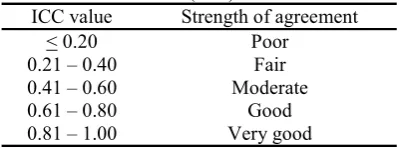
correlation coefficient (ICC) for statistical analyses. The. ICC is a descriptive statistics used for quantitative measurements. Generally the value of ICC ranges from 0 to 1, while the ICC approaches to the value of one, there is complete agreement between examiners, and as the ICC approaches to the value of zero, there is no agreement between examiners. Table 1 shows interpretation of ICC for inter and intraobserver reliability. The results assumed significant if p was < 0.05.
Results
Five cases were male and the remaining 5 were female. Five of radiographs were from the right and 5 from the left wrist. Mean and standard deviation of age were 29.3±4.3 years (19- 46 years), of radial length (measured by the observers) 13.36±1.41 mm (11 to 15.6), for radial inclination 24.5±2.02 degrees (18.4 to 30.5) and for radial tilt 10.5±1.82 degrees (3.7 to 15.7).
Interaclass correlation coefficients to assess inter observation reliability of radial length, radial inclination and radial tilt were 0.672, 0.649, and 0.631, respectively (p<0.001). These scores indicate a relatively good reliability of the examiners’ measurements. On the other hand, intra observer reliability for radial length (ICC= 0.606, p<0.001) and radial tilt (ICC= 0.605, p<0.001) was relatively strong, but for radial inclination it was moderate (ICC= 0.582, p<0.001).
Discussion
Fractures of the distal radius are common injuries, comprising approximately 8% to 17% of fractures seen in the emergency department (7). The goal of treatment of a distal radius fracture is to provide a pain free wrist which meets the functional demands and restoring the normal anatomy of the distal radius (2).There are extensive literature on challenges with the inter and intraobserver reliability of different kinds of classifications and measurements (8,9). This may indicates the concern about the validity Table 1. Interpretation of intraclass correlation
coefficient (ICC) values. Strength of agreement ICC value
Poor < 0.20
Fair 0.21 – 0.40
Moderate 0.41 – 0.60
Good 0.61 – 0.80
Reliability of distal radius radiographic indices and reliability of the measurements.
Several radiographic criteria were used for evaluation of distal radius fracture. Lidstrom proposed dorsal angle (radial tilt), and shortening (radial length) (10). Radial inclination was added to above criteria by Frykman and Hinding (11,12). These three criteria were used by Lafontaine to describe the criteria of an unstable distal radius fracture (13). Nesbitt et al (1)in assessment of instability factors in adult distal radius
fractures evaluated 4 radiographic
parameters, 1) radial inclination in PA view, 2) palmar tilt in lateral view, 3) radial length in PA view and 4) articular step off.
Numerous studies have been conducted to determine the normal values of the distal radius indices with similar results (14,15).
In current study mean of radial length measured by 4 observers was 13.36 mm, radial inclination 24.5 degrees and radial tilt 10.5 degrees. This finding is associated withthe results of previous studies in the literature (14-16).
Vander Lindenin (17) evaluated 250 distal radius fractures and concluded that radial inclination and radial shift are isolated but dorsal tilt has direct correlation with dorsal displacement. Therefore, displacement in distal radius fracture can be assessed with two criteria, one for dorsal tilt and displacement (dorsal tilt), and the other for radial displacement (radial inclination). Correction of these 2 criteria can correct radial length (17).
Importance of appropriate positioning of wrist for radiography is pointed out by Robertson and Garcia (18, 19). They concluded that the radiographic indices in PA view are not sensitive to malpositioning, though, indices in lateral view are very sensitive to malpositioning.
As mentioned, the observer is an important source of error in measurement. Evaluation of exact classification and the normal anatomical values in distal radius radiographs can lead the practitioner to manage the distal radius fracture appropriately to restore the normal anatomy and functional state. The reliability of
different classification systems in distal radius fracture has been evaluated previously by numerous studies with wide range of results (20-22). Review of the literature revealed the paucity of studies in the field of reliability of the distal radius radiographic indices. The current study
evaluated this intraobserver and
interobserver reliability. The ICC value for the mentioned reliabilities was around 0.60 which depicts a relatively strong correlation. We suggest further studies for evaluation of distal radius indices after achieving reduction following distal radius fracture.
Conclusions
The intraobserver and interobserver reliability of the distal radius radiographic indices including radial tilt, radial inclination and radial length was relatively good and can be used by practitioners for reference values in treatment process of the distal radius fracture.
Acknowledgment
We thank Dick Edelstein for improving the use of English in the manuscript.
References
1. Nesbitt KS, Faila JM, Les C. Assessment of
instability factors in adult distal radius fractures. J
Hand Surg [Am]. 2004; 29, 6: 1128-1138.
2. Orbay JL, Fernandez DL. Volar fixed-angle plate fixation for unstable distal radius fractures in the elderly patient. J Hand Surg [Am]. 2004; 29(1):96– 102.
3- Landis R. The measurement of observer agreement for categorical data. Biometrics. 1977; 33(1): 159-174.
4. Dibenedtto M, Lubbers M, Ruff M, Nappi J, Coleman C. Quantification of error in measurement of radial inclination angle and radial carpal distance. J Hand Surg. 2008; 16: 399-400.
5. Green DP, Pederson WC, Hotchkiss RN, Wolfe SW. Greens Operative Hand Surgery 5th ed. Philadelphia: Elsevier Churchill Livingstone; 2005. pp. 645-710.
6. Kural C, Sungur I, Kaya I, Ugras A, Ertürk A, Cetinus E. Evaluation of the reliability of classification systems used for distal radius fractures.
J Orthop Trauma. 2010, 33(11): 801.
D. Jafari, et al.
distal radius. J Am Acad Orthop Surg. 2005; 13(3):159–171.
8. Kreder HJ, Hanel DP, McKee M, Jupiter J, McGillivary G, Swiontkowski MF .Consistency of AO fracture classification for the distal radius. J Bone Joint Surg [Br]. 1996, 78: 726-731.
9. Jin WJ, Jiang LS, Shen L, Lu H, Cui YM, Zhou Q, et al. The interobserver and intraobserver reliability of the Cooney classification of distal radius fractures between experienced orthopaedic surgeons. J Hand Surg 2007, 32E: 5: 509-511.
10. Lidstrom A. Fractures of the distal end of the radius. A clinical and statistical study of end results. Acta orthop Scand. 1959; 41:1-118.
11. Frykman G. Fractures of the distal radius including sequelae, shoulder, hand, finger syndrome. Acta Orthop Scand. 1968; 108:1.
12. Hinding E. Fractures of the distal end of the forearm. Acta Orthop Scand. 1972; 43: 357-365.
13. Lafontaine M, Drelince P, Simons M. Instability of fractures of the lower end of the radius: apropos of a series of 167 cases. Acta Orthop Belg. 1989; 55: 203-216.
14. Jafari D, Taheri H, Shariatzadeh H, Mazhar FN, Jalili A, Ghahramani M. Radiographic indices in one
hundred fifty normal Iranian wrists. Med J Islam
Repub Iran. 2012; 26(3):132-139.
15. Szabo RM, Weber SC. Comminuted intraarticular fractures of the distal radius. Clin Orthop. 1998; 230: 39-48.
16. Frederic A, Ronald L. A normal data base of posteroanterior roentgenographic measurements of the wrist. J Bone Joint Surg [Am]. 1992; 74:1418-1429.
17. Vander Linden W, Ericson R. Colles, fracture. J
Bone Joint Surg [Am]. 1981; 63 (8):1285-1288. 18-Robertson C, Ellis R, Goetz T, Gofton W, Fenton p, Small C, et al. The sensitivity of carpal bone indices to rotational malpositioning. J Hand Surg. 2002; 27: 435-442.
19. Garcia-Elias M, Kai-Nan A, Amadio P, Cooney W, Linscheid R. Reliability of carpal angle determinations. J Hand Surg [Am]. 1989; 14: 1017-1021.
20. Audige L, Bhandari M, kellam J. How reliable are reliability studies of fracture classifications? Acta Orthop Scand. 2004; 75(2):184-194.
21. Andersen DJ, Blair WF, Steyers CM, Adams BD, El-Khouri GY, Brandser EA. Classification of distal radius fractures: an analysis of interobserver reliability and intraobserver reproducibility. J Bone Joint Surg [Am] .1996; 21: 574-582.
Reliability of distal radius radiographic indices reliability of the Fernandez classification of distal