EVALUATION OF MULCHING MATERIALS AS INTEGRATED WEED MANAGEMENT COMPONENT IN MAIZE CROP
Farman Ullah Shah*, G. Mustafa Sajid** and Sadar Uddin Siddiqui**
ABSTRACT:- Yield losses by weeds in maize crop and demonstrated efficacy of various mulches in weed management led to check the efficacy of various available mulches for suppressing weeds in maize crop at National Agricultural Research Centre (NARC), Islamabad during kharif (autumn) season 2011. The experiment was laid in Randomized Complete Block Design, (RBCD) having eight treatments and four replications. The treatments were black plastic, white plastic, sugarcane straw, wheat straw, live mulch, weeds as mulch, hand weeding and weedy check. Weed data
-2 -2
included weed density m , fresh and dry weight g m , while crop data
-2 -2 -1
included crop density m , fresh and dry weight g m , number of plant plot , -1
stover yield (g), plant height (cm), number of cobs plant , number of leaves
-1 -1
plant , average grain number of five cobs and grain yield (t ha ). With the
-2 -2
exception of hand weeding, minimum number of weeds 128 m and 164 m were recorded in black plastic and weeds as mulch, respectively, compared
-2
to 595 m in weedy check. Similarly, maximum grain yields (1.91 and 1.85 -1
t ha ) were recorded in black plastic and weeds as mulch, while minimum -1
grain yield (0.64 t ha ) was recorded in weedy check plots. The economic net returns of black plastic mulch and weeds as mulch were Rs. 39,824 and Rs. 38,291, respectively as compared to Rs. 21431 for weedy check. Yield increased by 21.1 and 16.5% over hand weeding by plastic mulch and weeds as mulch, respectively. Black plastic followed by weeds as mulch, are recommended to control weeds and get maximum yield as well as net economic return.
Key Words: Maize; Mulching; Weeds; Crop Yield; Pakistan.
INTRODUCTION
Maize, the third major cereal crop in the world and also in Pakistan after wheat and rice is the highest yielding cereal crop in the world. It has great importance in Pakistan because the rapidly increasing population is al-ready fearing the low availability of food. Maize is used as a staple food
especially in the rural areas of deve-loping countries including Pakistan (Arif et al., 2011). Rehman et al. (2008), reported that maize is grown twice a year in spring and autumn both for grain and fodder purposes due to short growing season. During 2012 maize was grown on 1,085,000 ha with an annual production of 4,631,000 ton (Anonymous, 2013).
*Department of Plant and Environmental Protection, PARC Institute of Advanced Studies in Agriculture, The University of Agriculture, Peshawar, Pakistan.
**Plant Genetic Resources Institute, National Agricultural Research Centre, Islamabad, Pakistan.
The two leading provinces for maize production in Pakistan are Khyber Pakhtunkhwa and Punjab, contri-buting 51 and 48% of the total pro-duction, respectively.
Maize is used for three main purposes as food, feed for poultry and livestock (Memon et al., 2011). It is used by a million of people in the form of bread, cake and porridge (Bukhsh et al., 2008; Sasson, 2010). In the total food grains production in the country, maize contributes 6.4 % (Rehman et al., 2008). It is used in various ways like as a food, fodder, used in industries to make corn oil, corn starch, corn flakes, corn syrups, lactic acid, alcohol etc. (Khan et al., 2011). Moreover, the biomass of plant above the ground minus grain (Mupangwa et al., 2007), is regarded as valuable forage stalks for the cattle feeding in dry season. Whereas, the maize, cut into pieces is commonly used for roasting purposes (Romney et al., 2003). Maize oil is used in cook-ing, bakery products, oleomarga-rine, salad dressing and pharmaceu-tical. It is also used in making plastics, cellophane, photographic films, dying of clothes, tanning of hides, soaps, varnishes, paints, etc. (Bukhsh et al., 2008).
High weed infestation in rainfed areas causes significant yield losses (Hussain et al., 2011). The main reasons for low yield of crops are high weeds infestation and poor weed management practices (Munsif et al., 2009). Weeds reduce the crop yield by competing for light, water and nutrients, carbon dioxide; besides they can play a role as alternative host for insect pests. Weeds not only impure the qualities of crop market value but also reduce the yield of a crop. Therefore, weed control is the
best tool for a profitable agriculture (Din et al., 2011).
Maize is sensitive crop with more risks due to climatic conditions and poor management practices includ-ing weed control which reduce the yield significantly (Munsif et al., 2009). In Pakistan, the production of maize is comparatively low related to other countries of the world, due to infestation of weeds, improper weed management practices and poor pla-nting methods. About 20-40% crop yield is lowered by weeds depending upon its density and species (Najafi and Tollenaar, 2005). Dalley et al. (2006) also concluded that the season-long weed competition redu-ced the maize yield considerably. The late growing weeds reduce the crop yield by competition, remain green to interfere and produce a large number of seeds that may produce future infestation in crop (Clay et al., 2005).
Weeds can be controlled effectiv-ely by integrated weed management (IWM) including biological, cultural, mechanical, chemical and genetic methods (Mahmoodi and Rahimi, 2009). High yielding agriculture mo-stly depends on using herbicides. But there are negative effects of herbi-cides, including deteriorated environ-ment and contaminated food (Coble, 1994). Hand weeding and cultivation are the most important physical methods for weed control (Ulloa et al., 2011), but not considered the best options (Wszelaki et al., 2007). Legu-mes as cover crops are reported to be essential for the improvement of soil nutrient status (Kaizzi et al., 2006). The legumes-cereals mixed cropping system increases soil fertility and give best yield compared to crop alone (Abdullah and Chaudhry, 1996).
weed control in maize. Mulch is mate-rial that covers the soil to impede weed growth & support crop plants growth. It reduces the need for chemi-cal sprays. This is important for agri-cultural land as it causes conserva-tion of soil and water, improves soil organic matter contents and soil structure, regulating soil tempera-ture and restoring the productivity of degraded land (Srivastava et al., 1993). Sugarcane dry leaves are used for mulching purposes and these are more effective for the control of weeds in field (Lorenzi et al., 1989). Plastic mulch is used by placing on the ridges with crop seeds beneath with perforations (Fisher, 1995). By using plastic mulch and returning crop residues had significantly affected the rainfed environment for several years. Transparent plastics are more effective for heating the soil, mainly for the soil solarization (Stapleton, 2000). On the other hand, black plastic mulches can increase soil temperature more than clear plastic in some cases when plastic mulches are narrowly in contact with the soil, increasing heat transmission at the mulch and soil interspaces (Ham and Kluitenberg, 1994).
The experiment was conducted to evaluate few types of mulch in rainfed environmental condition of Islama-bad to evaluate weed suppression ability of various mulching materials and to determine cost effectiveness of integrated weed management in maize.
MATERIALS AND METHOD
The materials for experiment were; seeds of maize and black gram, mulching materials like black plastic, transparent plastic, wheat straw,
sugarcane leaves and weeds. The maize variety (Agaiti 2000) and black
gram [Vigna mungo (L.) Hepper] were
used for the experiment. The expe-riment was conducted at NARC,
Islamabad during kharif (autumn)
season 2011. The maize was sown during August, 2011 in Randomized Complete Block (RCB) design with eight treatments and four replica-tions (3.5 m × 4 m) keeping 25 cm plant to plant and 75 cm row to row distance. In each row of live mulch
treatment, black gram (Vigna mungo)
was planted as live mulch, with 10 cm plant to plant distance. Maize was sown with the help of dibbler (Table 1). Data were recorded on plant height, fresh and dry weights (g), weed flora composition, weed density
-2
(m ), crop plant population, and number of cobs per plant, number of grains per cob, grain yield and stover yield was performed at crop harvest. A quadrate measuring 25 cm × 25 cm was used to sample weeds in each plot. Data was collected at 40 and 70 days after sowing for weeds and maize
Table 1. Treatments of the exp-eriment
T = Control (weedy check)1
T = Hand weeding (HW) at 30 and 45 DAS2
T = 3 Black plastic + HW 45 DAS
T = Transparent plastic + HW 45 DAS4
T = Live mulch (black gram) + HW 45 DAS5
T = Wheat straw (thin mulch) + HW 45 DAS6
T = Sugarcane (thick mulch) + HW 45 DAS7
T = Weeds were removed by hoeing and 8 laid in the same plot as mulch + HW
plant at harvest. The average data recorded for each treatment was subjected to the Analysis of Variance (ANOVA), using Statistix-8.1 com-puter software and the significance was tested by using Least Significant Differences (LSD) at P = 0.05 (Steel et al., 1997). To determine the costs of weed control, the calculation was done on the basis of variable costs and current local and market prices of plastics, straws, man-hours spent in hand weeding and seed of maize and live mulch etc.
RESULTS AND DISCUSSION
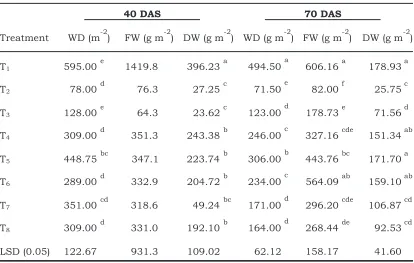
In general, data recorded at 40 and 70 DAS showed the lowest weed density as well as fresh and dry bio-masses in hand weeding treatments.
-2
Weed Density (m )
The density of weeds was taken twice (40 and 70 DAS) and it was found that mulches showed its effectiveness for weeds suppression. -2 In both data hand weeding (78 m
-2
and 71.5 m ) followed by black plastic -2
(128 m ) followed by wheat straw -2
(289 m ) in first and weeds as mulch -2
(164 m ) in the next data (Table 2), as compared to weedy check plots (595
-2 -2
m and 494 m ) affected weeds nega-tively in the consecutive data and the same results were reported by Gul et al. (2009) that weeds failed to germi-nate due to high temperature and lack of light under black plastic. So the results of different types of mul-ches indicated best control of grasses as well as broad leaf weeds.
Table 2. Weed density (WD), weed fresh weight (FW) and weed dry weight (DW) as affected by different mulches in maize crop
T1
T2
T3
T4
T5
T6
T7
T8
LSD (0.05)
595.00e
78.00d
128.00e
309.00d
448.75bc
289.00 d
351.00cd
309.00d
122.67
1419.8
76.3
64.3
351.3
347.1
332.9
318.6
331.0
931.3
396.23a
27.25 c
23.62c
243.38b
223.74b
204.72b
49.24bc
192.10b
109.02
494.50a
71.50e
123.00d
246.00c
306.00b
234.00c
171.00d
164.00d
62.12
606.16a
82.00f
178.73e
327.16cde
443.76bc
564.09ab
296.20cde
268.44de
158.17
178.93a
25.75c
71.56d
151.34ab
171.70a
159.10ab
106.87cd
92.53 cd
41.60 Treatment WD (m )-2 FW (g m )-2 DW (g m )-2 WD (g m ) FW (-2 g m )-2 DW (g m )-2
40 DAS 70 DAS
-2
Fresh Weight of Weeds (g m )
The fresh weights of weeds taken at 40 and 70 DAS was significantly affected by applying different types of mulches. The lowest values for fresh weights of weeds in both data were
-2
with black plastic (64.8 gm ) followed -2
by hand weeding (76.3 gm ) at 40 -2 DAS and hand weeding (82 m ) and
-2
black plastic (178.7 m ) at 70 DAS as compared to weedy check plots
-2 -2
(1419.8 m and 606.2 m ). Our results are in line with those reported by Khan and Pervej (2010) (Table 2).
-2
Dry Weight of Weeds (g m )
The minimum dry weights of weeds were recorded in hand weeding
-2
(27.25 g m ) followed by black plastic
-2
(60.77 g m ) at 40 DAS and hand -2
weeding (15.75 g m ) and black -2
plastic (71.56 g m ) at 70 DAS as compared to weedy check plots. Our results are parallel to the work of Khaliq et al. (2010). They reported that dry weights of weeds from weedy check plots were significantly greater than the mulches applied plots and
-2 hand weeding plots (396.23 g m and
-2
178.93 g m ) (Table 2).
-2
Crop Density (m )
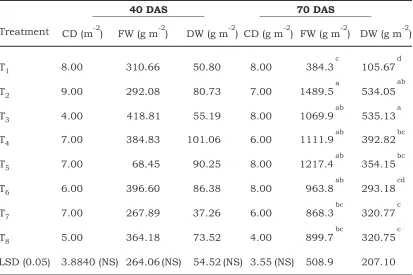
The data was recorded only for maize crop as frequently heavy rains caused plant damage to live mulch. Both the data (40 DAS and 70 DAS) showed that the crop density was not affected by applying mulches. Our
Table 3. Crop density (CD), fresh weight (FW) and dry weight (DW) at 40 and 70 DAS, as affected by different mulches in maize crop
T1
T2
T3
T4
T5
T6
T7
T8
LSD (0.05) 8.00
9.00
4.00
7.00
7.00
6.00
7.00
5.00
3.8840 (NS)
310.66
292.08
418.81
384.83
68.45
396.60
267.89
364.18
264.06 (NS)
50.80
80.73
55.19
101.06
90.25
86.38
37.26
73.52
54.52 (NS) 8.00
7.00
8.00
6.00
8.00
8.00
6.00
4.00
3.55 (NS)
384.3
c
1489.5
a
1069.9
ab
1111.9ab
1217.4
ab
963.8
ab
868.3
bc
899.7
bc
508.9
105.67
d
534.05
ab
535.13
a
392.82bc
354.15
bc
293.18
cd
320.77
c
320.75
c
207.10 Treatment CD (m )-2 FW (g m )-2 DW (g m ) CD (-2 g m ) FW (-2 g m )-2 DW (g m )-2
40 DAS 70 DAS
results are in contrast with the work of Gul et al. (2009) who reported that the plant density increased with the use of mulching materials. This may be due to the fact that we used dibbler and seed with high germination rate (Table 3).
-2
Crop Fresh Weight (g m )
The data on 40 DAS showed that mulching gave no significant effects on the crop plants (Table 3). Whereas, the data on 70 DAS indicated that maximum crop fresh weight was
re--2 corded in hand weeding (1489.5 g m )
-2 followed by live mulch (1217.4 g m ) due to two time weeding and ssion of weeds due to weed suppre-ssion ability of live mulch as com-pared to weedy check plots (384.3 g
-2
m ). Our results are in line with the work of Gul et al. (2009).
-2
Crop Dry Weight (g m )
Data on 40 DAS showed that mulching gave no significant effects on the crop plant's dry weight (Table 3). However, 70 DAS dry weight of maize plants was differently affected by various mulches (Table 3). The maximum dry weight was found in
-2
black plastic (535.1 g m ) followed by -2
hand weeding (534.1 g m ) compared -2 to weedy check plots (105.7 g m ). This was because the crop plants coll-ected from black plastic possessed large cobs as compared to other treat-ments. Our results are in conformity with that of Gul et al. (2009).
Plant Population per Plot
The number of crop plants from each subplot for all the treatments was non-significantly affected by mulches (Table 4); contradictory to
the work of Gul et al. (2009) who reported that mulches increased the plant population.
Stover Weight (kg)
The number of plants and plant height of the crop linearly contributed in increasing the stover yield of maize crop. Maximum stover yield was rec-orded in black plastic (3.77 kg) and weeds as mulch plots (3.4 kg) as compared to weedy check plots (1.5 kg). These results are in line with the work of Nawab et al. (1999) who reported that mulching significantly increased stover yield (Table 4).
Plant Height (cm)
Plant height of each individual selected crop plant showed signi-ficant variation. Maximum plant hei-ght was recorded in weeds as mulch (144.9 cm) followed by black plastic (142.2 cm) as compared to weedy check plots (100.6 cm). Our results are in agreement with those of Pervaiz et al. (2009). They reported that plant height was increased in those plots in which weeds were controlled as com-pared to weedy check at the time of harvest. In the present study the live mulch also competed with crop and reduced the plant height (Table 4).
-1
Number of Cobs Plant
-1
Number of Leaves Plant
The results showed that the number of leaves per maize plant was not significant and all the treatments indicated almost same number of leaves per plant (Table 4). As the experiment was performed in view of integrated weed management (IWM), no spray was applied for insect control; to evaluate mulch effect on insect damage. At harvest it was noted that leaves in all treatments were damaged equally by insects.
-1
Number of Grains Cob
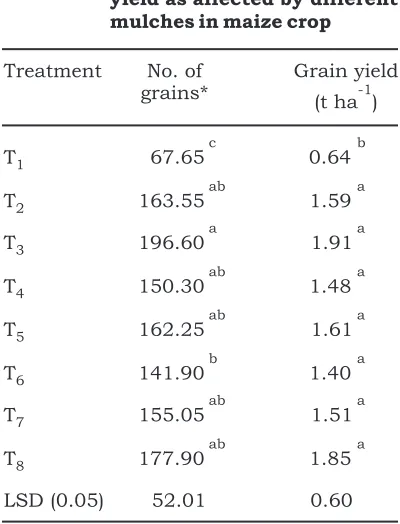
The data recorded for the number of grains per cob was significantly affected by applying mulches (Table 5). Data indicated that black plastic (196.6) and weeds as mulch (177.9) were the best treatments for the number of grain per cob of the maize crop as compared with weedy check plots (67.65). Our results are in line with Arif et al. (2011) who reported
Table 4. Maize crop data at harvest as affected by different mulches in maize crop
Treatment
T1
T2
T3
T4
T5
T6
T7
T8
LSD (0.05)
-1 # P Plot
49.25
53.75
48.25
45.25
47.50
45.25
48.50
50.50
6.56 (NS) SW (kg)
1.50c
3.35ab
3.77a
2.95abc
2.62bc
2.77ab
3.35ab
3.40ab
1.13
PH (cm)
100.60d
135.92a
142.18a
127.60ab
122.75ab
124.90ab
128.38ab
144.93a
18.43
-1 # Cobs Plant
0.87c
1.07ab
1.15 a
1.02abc
1.02abc
1.05ab
0.97bc
1.07ab
0.13
-1 # Leaves Plant
9.95
10.97
10.82
10.60
10.22
10.60
10.80
10.87
0.98 (NS)
Table 5. No. of grains cob-¹ and grain yield as affected by different mulches in maize crop
Treatment No. of grains*
Grain yield -1 (t ha )
T1 67.65c 0.64 b
T2 163.55ab 1.59a
T3 196.60a 1.91a
T4 150.30ab 1.48a
T5 162.25ab 1.61a
T6 141.90b 1.40a
T7 155.05ab 1.51a
T8 177.90ab 1.85a
LSD (0.05) 52.01 0.60
Means followed by same letters do not differ significantly at 5% probability level. NS = Non-significant. No. of plants Plot-¹; SW = Stover weight; PH = Plant Height; # Cobs Plant-¹ = No. of Cobs Plant-¹; # Leaves Plant-¹ = No of Leaves Plant-¹ .
#P Plot-¹; =
Means followed by same letters do not differ significantly at 5% probability level.
that number of grains increased sig-nificantly by using mulch residues.
-1
Grain Yield (t ha )
The grain yield was influenced by various treatments, however, remain-ed at par to each other. In this study due to frequent rains, there was no competition for moisture and results did not differ significantly. The re-sults showed that maximum grain was recorded from black plastic (1.91
-1 -1
t ha ) and weeds as mulch (1.85 t ha ) (Table 5). Our results are in line with the work of Easson and Fearnehough (2000) who reported that grain yield increased with the use of plastic and other mulch treatments as compared to weedy check plots. Similar results specifically for the mulch residues were also reported by Larbi et al. (2002).
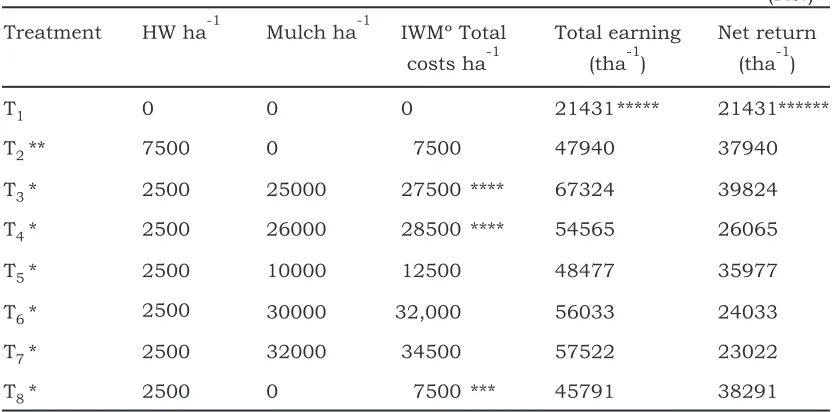
The economic net returns of
black plastic mulch and weeds as mulch are Rs. 39824 and Rs. 38291 respectively as compared to Rs. 21431 of weedy check (Table 6).
Simi--1 larly, minimum grain yield (0.65t ha ) was recorded in weedy check plots as compared to other treatments. It is thus concluded that black plastic followed by weeds as mulch, are best to control weeds and get maximum yield.
LITERATURE CITED
Abdullah, M., and M.T. Chaudhry. 1996. Improved fodder and seed production in central irrigated Punjab. Proc. National Con-ference on the Improvement Production and Utilization of Fodder Crops in Pakistan, held at NARC, Islamabad, Pakistan. p. 55-62.
Table 6. Cost benefits of various treatments in maize crop
* One hand weeding cost.; ** Three hand weeding cost.
*** Cost of hand weeding to obtain mulch (1 HW in same plot).
**** Can be used for two seasons; this may enhance economic benefit by cost sharing over two seasons.
-1
***** Maize price was taken Rs.40 kg .
-1
****** Small plots values were extrapolated to tons ha . º Integrated Weed Management.
Treatment HW ha-1 Mulch ha-1 IWMº Total -1 costs ha
Total earning -1 (tha )
Net return -1 (tha )
T1 0 0 0 21431***** 21431******
T2** 7500 0 7500 47940 37940
T3* 2500 25000 27500 **** 67324 39824
T4* 2500 26000 28500 **** 54565 26065
T5* 2500 10000 12500 48477 35977
T6* 2500 30000 32,000 56033 24033
T7* 2500 32000 34500 57522 23022
T8* 2500 0 7500 *** 45791 38291
Anonymous, 2013. Economic Survey of Pakistan. Ministry of Food and Agriculture, Government of Pakistan, Islamabad. p. 21.
Arif, M., M.T. Jan, M.J. Khan, M. Saeed, I. Munir, Z. Din, H. Akbar, S. Shah, and M.Z. Khan. 2011. Effect of cropping system and residue management on maize. Pakistan J. Bot. 43(2): 915-920. Bukhsh, M.A.A.H.A., R. Ahmad, Z.A.
Chema, and A. Ghafoor. 2008. Production potential of three maize hybrids as influenced by varying plant density. Pakistan J. Agri. Sci. 45(4): 413-417.
Clay, S.A., J. Kleinjan, D.E. Clay, F. Forcella, and W. Batchelor. 2005. Growth and fecundity of several weed species in corn and soybean. Agron. J. 97: 294-302. Coble, H.D. 1994. Future directions
and needs for weed science research. Weed Technol. 8: 410-412.
Dalley, C.D., M.L. Bernards, and J.J. Kells. 2006. Effect of weed removal timing and spacing on soil moisture in corn (Zea mays). Weed Technol. 20(2): 399-409. Din, I.U., G. Ullah, M.S. Baloch, I.U.
Awan, and E.A. Khan. 2011. Effect of phosphorous and herbicides on yield components of maize. Pakistan J. Weed Sci. Res. 17(1): 1-7.
Easson, D. L., and W. Fearnehough. 2000. Effects of plastic mulch, sowing date and cultivar on the yield and maturity of forage maize grown under marginal climatic conditions in Northern Ireland. Grass and Forage Science, 55: 221-231.
Fisher, P.D. 1995. An alternative plastic mulching system for improved water management in
dryland maize production. Agric.Water Manag. 27: 155-166. Gul, B., K.B. Marwat, G. Hassan, A.
Khan, S. Hussain, and I.A. Khan. 2009. Impact of tillage, plant population and mulches on biological yield of maize. Pakistan J. Bot. 41 (5): 2343-2349.
Ham, J. M., and G. J. Kluitenberg. 1994. Modeling the effect of mulch optical properties and mulch-soil contact resistance on soil heating beneath plastic mulch culture. Agric. and Forest Meteorology, 71(3-4): 403-424. Hussain, Z., F. Munsif, K. Ali, S.I.A.
Shah and A. Rahman. 2011. Evaluation of herbicides for weed management in maize and their impact on maize grain yield. Pakistan J. Weed Sci. Res. 17(4): 333-342.
Kaizzi, C.K., H. Ssali, and P.L.G. Vlek. 2006. Differential use and
benefits of Mucuna (Mucuna
pruriens var.utilis) and N fertilizers in maize production in contrasting agro-ecological zones of E. Uganda. Agric. Syst. 88: 44-60.
Khaliq, A., A. Matloob, M.A. Tanveer and M.S. Zamir. 2010. Organic
weed management in maize (Zea
mays L.) through integration of allelopathic crop residues. Pakistan J. Weed Sci. Res. 16(4): 409-420.
Khan, I.A., Z. Ullah, G. Hassan, K.B. Marwat, A. Jan, S.M.A. Shah, and S.A. Khan. 2011. Impact of different mulches on weed flora and yield of maize. Pakistan J. Bot. 43(3): 1601-1602.
yield of quality protein maize. The J. Agri. Sci. 5: 52-63.
Larbi, A., J.W. Smith, I.O. Adekunle, W.A. Agyare, L.D. Gbaraneh, R.J. T a n k o , J . A k i n l a d e , A . T . Omokaye, N. Karbo, and A. Aboh. 2002. Crop residues for mulch and feed in crop-livestock systems: impact on maize grain yield and soil properties in the West African humid forest and savanna zones. Exptl. Agric. 38: 253-264.
Lorenzi, H.J., M.O. Gandini, and A.L. Gazon. 1989. Trash blankets: the potential to control weeds and the effect on ratoon cane deve-lopment. In: Proceedings of the XX ISSCT Congr., Sao Paulo. p. 571-575.
Mahmoodi, S., and A. Rahimi. 2009. The critical period of weed control in corn in Birjand region, Iran. IJPP. 3(2): 91-96.
Memon, S.Q., M. Zakria, G.R. Mari, M.H. Nawaz, and M.Z. Khan. 2011. Effect of tillage methods and fertilizer levels on maize production. Pakistan J. Agri. Sci. 48(2): 117-120.
Munsif, F., K. Ali, I. Khan, H.U. Khan, and M. Anwar. 2009. Efficacy of various herbicides against weeds and their impact on yield of maize. Pakistan J. Weed Sci. Res. 15(2-3): 191-198.
Mupangwa, W., S. Twomlow, S. Walker, and L. Hove. 2007. Effect of minimum tillage and
mulching on maize (Zea mays L.)
yield and water content of clayey and sandy soils. Physics & Chemistry of the Earth. 32: 1127-1134.
Najafi, H., and T. Tollenaar. 2005. Response of corn at different leaf stages to shading by redroot
pigweed (Amaranthus retroflexus
L.). Iranian J. Weed Sci.1: 127-140.
Nawab, K., M. Hatam, B. A. Khan, K. Rashid, and M. Mansoor. 1999. Study of some morphological characters in maize as affected by time of weeding and plant spacing. Sarhad J. Agric. 15(1): 21-24.
Pervaiz, M.A., M. Iqbal, K. Shahzad, and A.U. Hassan. 2009. Effect of mulch on soil physical properties and N, P, K concentration in maize (Zea mays) shoots under two tillage system. Int. J. Agric. Bot. 11: 119-124.
Rehman, A., M.F. Saleem, M.A. Malik, A. Ali, and H.N. Asghar. 2008. Maize (Zea mays L.) productivity under varying plant density and nutrient levels. Pakistan J. Agric. Res. 21(1-4): 7-14.
Romney, D.L., P. Thorne, B. Lukuyu, and P.K. Thornton. 2003. Maize as food and feed in intensive smallholder systems: mana-gement options for improved integration in mixed farming systems of east and southern Africa. Field Crop Res. 84: 159-168.
Sasson, A. 2010. Climate change, biofuels and food security. Centre for Global Sustainability Studies, University Sains, Malaysia. p. 4. Srivastava, J.P., P.M. Tamboli, J.C.
English, R. Lal, and B.A. Stewart. 1993. Conserving soil moisture and fertility in the warm sea-sonally dry tropics. World Bank Technical Paper Number 221. The World Bank, Washington DC, USA.
837-841.
Steel, R.G.D., J.H. Torrie, and D. Dickey. 1997. Principles and procedures of statistics: A bio-metrical approach 3rd edn. McGraw Hill Book Co. Inc. New York, USA. p. 172-177.
Ulloa, S M., A. Datta, G. Malidza, R. Leskovsek, and S.Z. Knezevic. 2011. Timing and propane dose of broadcast flaming to control
weed population influenced yield of sweet maize (Zea mays L. var. rugosa). Field Crop. Res. 118: 282-288.
Wszelaki, A.L., D.J. Doohan and A. Alexandrou. 2007. Weed control and crop quality in cabbage (Brassica oleracea (capitata
group)] and tomato (Lycopersicon