Vol. 8, No. 1, 2015, 29-35
ISSN: 2320 –3242 (P), 2320 –3250 (online) Published on 13 June 2015
www.researchmathsci.org
29
International Journal of
On Qlick Transformation Graphs
V.R.Kulli
Department of Mathematics
Gulbarga University, Gulbarga 585 106, India e-mail: [email protected]
Received 2 June 2015; accepted 10 June 2015
Abstract. Let G be a graph with vertex set V, edge set E and block set B and let x, y, z be three variables each taking value + or –. The qlick transformation graph Gxyz is the graph whose vertex set is the union of the set of edges and the set of blocks of G. For any two vertices u and v in Gxyz, we define x, y, z as follows: (i) Let u, v ∈E. x = + if u and v are adjacent in G. x = – if u and v are not adjacent
in G.
(ii) Let u,v ∈ B. y= + if u and v are adjacent in G. y = – if u and v are not adjacent in G.
(iii) Let u ∈ E and v ∈ B, z = + if u and v are incident with each other in G. z = – if u and v are not incident with each other in G.
In this paper, we initiate a study of qlick transformation graphs.
Keywords: qlick graph, plick graph, line block graph, block line forest, qlick transformation graph.
AMS Mathematics Subject Classification (2010): 05C72
1. Introduction
By a graph we mean a finite, undirected graph without loops or multiple edges. All definitions and notations not given in this paper may be found in Kulli [1].
If b = {u1, u2, …, ur; r≥2} is a block of a graph G, then we say that vertex u1 and block b are incident with each other, as are u2 and b and so on. If b = {e1, e2, …, es; s≥1} is a block of G, then we say that edge e1 and block b are incident with each other, as are e2 and b and so on. If two distinct blocks b1 and b2 are adjacent with a common cutvertex, then they are adjacent blocks. This idea was introduced by Kulli in [2]. The vertices, edges and blocks of a graph are called its members.
30
The line block graph Lb(G) of G is the graph whose vertex set is the set of edges and blocks of G in which two vertices are adjacent if the corresponding blocks are adjacent or the corresponding members are incident. This concept was introduced in [8] and was studied, for example, in [9].
The block line forest Bf(G) of G is the graph whose vertex set is the set of edges and blocks of G in which two vertices are adjacent if the corresponding members are incident. This concept was introduced in [10]. Many other graph valued functions in graph theory were studied, for example, in [11, 12, 13, 14, 15, 16, 17, 18, 19].
The block graph B(G) of a graph G is the graph whose vertex set is the set of blocks of G and two vertices are adjacent if the corresponding blocks are adjacent. This concept was studied by Harary in [20] and further this was studied, for example, in [21, 22, 23]. The line graph L(G) of a graph G is the graph whose vertex set corresponds to the edges of G such that two vertices of L(G) are adjacent if the corresponding edges of G are adjacent. This concept was studied, for example, in [24, 25, 26, 27, 28, 29].
Some transformation graphs were studied, for example, in [30, 31]. Let G denote the complement of G.
2. Qlick transformation graphs
The qlick graph inspired us to introduce qlick transformation graphs. We now define qlick transformation graphs Gxyz when x or y or z is either + or –.
Definition 1. Let G be a graph with vertex set V, edge set E and block set B and let x, y, z
be three variables each taking value + or –. The qlick transformation graph Gxyz is the graph whose vertex set is the union of the set of edges and the set of blocks of G. For any two vertices u and v in Gxyz, we define x, y, z as follows.
(i) Let u, v ∈ E. x = + if u and v are adjacent in G. x = – if u and v are not adjacent in G. (ii) Let u, v ∈ B. y = + if u and v are adjacent in G. y = – if u and v are not adjacent in
G.
(iii) Let u ∈ E and v ∈ B. z = + if u and v are incident with each other in G. z = – if u and v are not incident with each other in G.
Using the above qlick transformation, we obtain eight distinct qlick transformation graphs: G– – –, G– – +, G– + –, G + – –, G – + +, G+ + –, G+ – +, G+++.
By definition, any vertex of G is not vertex of qlick transformation graph, so that we consider only graphs without isolated vertices.
31
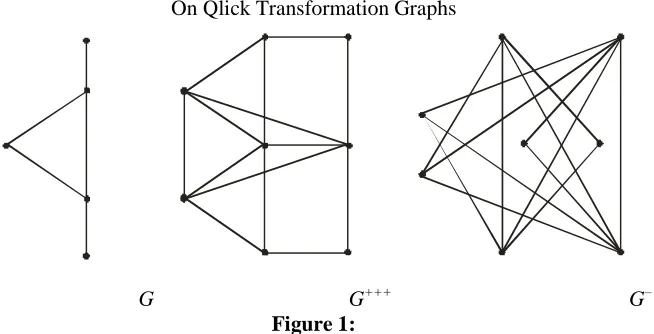
G G+++ G– – –
Figure 1:
Proposition 3. If G is a nontrivial connected graph, then
(1) G+++ =G− − − (2) G++− =G− − +
(3) +
G+−+ =G− − (4) + +
G+− − =G− .
Proof: Each follows from the definition of Gxyz and G.
Proposition 4. If Cp is a cycle with p ≥ 3 vertices, then
(1) Cp Cp Wp 1
+++ +−+ +
= = (2) Cp Cp K1 Cp
++−= +−− = U
(3) Cp Cp
−++ = −−+ (4)
1 p
p p
C−−−=C−+− =K + .
3. The qlick transformation graph G+++
Among qlick transformation graphs one is the qlick graph Q(G). It is easy to see that
Proposition 5. For any graph G without isolated vertices, Q(G) = G+++.
Remark 6. For any graph G without isolated vertices, L(G) and B(G) are vertex and also
edge disjoint induced subgraphs of G+++.
4. The qlick transformation graph G–++
Proposition 7. The line block graph Lb(G) is a spanning subgraph of the qlick transformation graph G–++.
Proof: This follows from definitions of Lb(G) and G–++.
Theorem 8. For any graph G without isolated vertices,
( )
( )
b
G−++ =L G ∪L G .
We now characterize graphs G for which G – + + = Lb(G).
Theorem 9. For a nontrivial connected graph G,
Lb(G) ⊆ G –++ .
Furthermore, Lb(G) = G –++ if and only if every pair of edges in G are adjacent.
32
Suppose Lb(G) = G –++. We now prove that every pair of edges in G are adjacent. On the contrary, assume G has two edges e1 and e2 such that they are not adjacent. Then the corresponding vertices of e1 and e2 are adjacent in G
–++
, but they are not adjacent in Lb(G). Thus Lb(G) ≠ G–++
, which is a contradiction. This proves that every pair of edges in G are adjacent.
Conversely suppose every pair of edges of G are adjacent. Then the corresponding vertices of edges of G are not mutually adjacent in G–++.Thus G –++ ⊆ Lb(G) and since Lb(G) ⊆ G–++
, this implies that Lb(G) = G –++.
Iterated qlick-transformation graphs G–++ are defined by (Gn) –++= G(G n–1) –++ for n ≥ 2 where (G1
) –++ = G–++.
Theorem 10. Let G be a nontrivial connected graph. The graphs G and G–++ are isomorphic if and only if G = K2.
Proof: Suppose G = G–++. We now prove that G = K2. On the contrary, assume G is a connected graph with p ≥ 3 vertices. We consider the following two cases.
Case 1. Suppose G is not a tree. Then G has at least p edges and has at least one block.
Thus G–++ has at least p+1 vertices. Therefore the number vertices of G is less than that in G–++. Hence G ≠ G–++,a contradiction.
Case 2. Suppose G is a tree. Then G has p – 1 edges and p – 1 blocks. Then G–++ has 2p– 2 vertices. Hence the number of vertices of G is less than that in G – ++. Thus G ≠ G–++, a contradiction.
From Case 1 and Case 2, we conclude that G = K2. Conversely suppose G = K2. Then clearly G = G –++. The following results are immediate.
Corollary 11. Let G be a nontrivial connected graph. Then G = (Gn) –++, n ≥1 if and only if G = K2.
Corollary 12. Let G be a graph without isolated vertices. Then G = (Gn) –++, n≥1 if and only if G = mK2, m≥1.
5. The qlick transformation graph G + – +.
Proposition 13. The plick graph P(G) is a spanning subgraph of the qlick transformation
graph G + – +.
Proof: This follows form definitions of P(G) and G + – +.
Theorem 14. For a nontrivial connected graph G, P(G) ⊆ G + – +. Furthermore, P(G) = G + – + if and only if G has at most one cutvertex.
Proof: By Proposition 13, P(G) ⊆ G + – +.
33
G + – +, but they are not adjacent in P(G). Thus P(G) ≠ G + – +, a contradiction. This proves that G has at most one cutvertex.
Conversely suppose G has at most one cutvertex. We now consider the following two cases.
Case 1. Suppose G has no cutvertex. Then clearly P(G) = G + – +.
Case 2. Suppose G has exactly one cutvertex. Then every pair of blocks in G are
adjacent. Then the corresponding vertices of blocks of G are not mutually adjacent in G +–+. Thus G +–+ ⊆ P(G) and since P(G) ⊆ G+ – +, it implies that P(G) = G + – +.
From Case 1 and Case 2, we conclude that P(G) = G + – +.
6. The qlick transformation graph G – – +
Proposition 15. The block line forest Bf(G) is a spanning subgraph of a qlick transformation graph G – – +.
Proof: This follows from definitions of Bf(G) and G – – +.
Theorem 16. For a nontrivial connected graph G,
( )
( )
( )
.f
G−−+ =B G ∪L G ∪B G We now characterize graphs G for which G – – + = Bf(G).
Theorem 17. For a nontrivial connected graph G,
Bf(G) ⊆ G – – + .
Furthermore, Bf(G) = G– – + if and only if G satisfies the following conditions. (i) every pair of edges are adjacent.
(ii) every pair of blocks are adjacent.
Proof: By Proposition 15, Bf(G) ⊆ G – – +.
Suppose Bf(G) = G – – +. Let G be a non trivial connected graph. We prove (i). On the contrary, assume a pair of edges are not adjacent in G. Then the corresponding vertices of edges in G – – + are adjacent, but they are not adjacent in Bf(G). Thus Bf(G) ≠ G – – +
, a contradiction. Hence G satisfies (i). We now prove (ii). On the contrary, assume a pair of blocks are not adjacent in G. Then corresponding vertices of blocks in G--+ are adjacent; but they are not adjacent in Bf(G). Thus Bf(G) ≠ G – – +
, a contradiction. Hence G satisfies (ii).
Conversely, suppose every pair of edges are adjacent in G. Then the corresponding vertices of edges of G are not mutually adjacent in G – – +. Also suppose every pair of blocks are adjacent in G. Then the corresponding vertices of blocks of G are not mutually adjacent in G – – + . Thus G – – + ⊆ Bf(G) and since Bf(G) ⊆ G – – +, it implies that Bf(G) = G – – +.
REFERENCES
34
2. V.R. Kulli, The semitotal block graph and the total-block graph of a graph, Indian J. Pure Appl. Math., 7 (1976) 625-630.
3. V.R. Kulli, On the plick graph and the qlick graph of a graph, Research Journal, 1 (1988) 48-52.
4. V.R. Kulli and B.Basavanagoud, A criterion for (outer-) planarity of the qlick graph of a graph, Pure and Applied Mathematika Sciences, 48(1-2) (1998) 33-38.
5. V.R. Kulli and B.Basavanagoud, Characterizations of planar plick graphs, Discussiones Mathematicae, Graph Theory, 24 (2004) 41-45.
6. B.Basavanagoud and V.R.Kulli, Hamiltonian and eulerian properties of plick graphs, The Mathematics Student, 74(1-4) (2004) 175-181.
7. B.Basavanagoud and V.R.Kulli, Plick graphs with crossing number 1, International J. Math. Combin., 2 (2011) 21-28.
8. V.R.Kulli, On line block graphs, International Research Journal of Pure Algebra, 5(4) (2015) 40-44.
9. V.R. Kulli, Planarity of line block graphs, Journal of Computer and Mathematical Sciences, 6(4) (2015) 206-209.
10. V.R.Kulli, The block-line forest of a graph, Journal of Computer and Mathematical Sciences, 6(4) (2015) 200-205.
11. V.R.Kulli, On common edge graphs, J. Karnatak University Sci. 18 (1973) 321-324. 12. V.R. Kulli, The block point tree of a graph, Indian J. Pure Appl. Math., 7 (1976)
620-624.
13. V.R.Kulli, On block line graphs, middle line graphs and middle block graphs, International Research Mathematical Archive, 6 (2015).
14. V.R. Kulli and N.S.Annigeri, The ctree and total ctree of a graph, Vijnana Ganga, 2 (1981) 10-24.
15. V.R. Kulli and M.S. Biradar, The blict graph and blitact graph of a graph, J. Discrete Mathematical Sciences and Cryptography, 4(2-3) (2001) 151-162.
16. V.R. Kulli and M.S. Biradar, The point block graph of a graph, Journal of Computer and Mathematical Sciences, 5(5) (2014) 476-481.
17. V.R. Kulli and M.S. Biradar, The line splitting graph of a graph, Acta Ciencia Indica, 28 (2001) 57-64.
18. V.R. Kulli and M.H. Muddebihal, Lict and litact graph of a graph, J. Analysis and Computation, 2 (2006) 33-43.
19. V.R. Kulli and N.S. Warad, On the total closed neighbourhood graph of a graph, J. Discrete Mathematical Sciences and Cryptography, 4 (2001) 109-114.
20. F. Harary, A characterization of block graphs, Canad. Math. Bull., 6 (1963) 1-6. 21. V.R. Kulli, Some relations between block graphs and interchange graphs, J.
Karnatak University Sci., 16 (1971) 59-62.
22. V.R. Kulli, Interchange graphs and block graphs, J. Karnatak University Sci., 16 (1971) 63-68.
23. V.R.Kulli, On block-cutvertex trees, interchange graphs and block graphs, J. Karnatak University Sci. 18 (1975) 315-320.
35
25. V.R.Kulli, On maximal minimally nonouterplanar graphs, Progress of Mathematics, 9 (1975) 43-48.
26. V.R. Kulli and D.G.Akka, On outerplanar repeated line graphs, Indian J. Pure Appl. Math., 12(2) (1981) 195-199.
27. V.R. Kulli, D.G.Akka and L.W. Bieneke, On line graphs with crossing number 1, J. Graph Theory, 3 (1979) 87-90.
28. V.R. Kulli and H.P. Patil, Graph equations for line graphs, total block graphs and semitotal block graphs, Demonstratio Mahematica, 19(1) (1986) 37-44.
29. V.R. Kulli and E. Sampathkumar, On the interchange graph of a finite planar graph, J. Indian Math. Soc., 37 (1973) 339-341.
30. V.R. Kulli, Entire total dominating transformation graphs, International Research Journal of Pure Algebra, 5(5) (2015) 50-53.
31. V.R. Kulli, Entire edge dominating transformation graphs, International Journal of