7
INTERNATIONAL JOURNAL OF ADVANCES IN ENGINEERING RESEARCH
EXPERIMENTAL INVESTIGATION ON STRENGTH
PERFORMANCE OF ULTRA HIGH PERFORMANCE
CONCRETE
PRABU.K 1, JOSE RAVINDRA RAJ.B2
1
M. Tech. Structural Engineering Student, Department of Civil Engineering, PRIST UNIVERSITY, Trichy-Thanjavur Highway, Vallam, Thanjavur- 613 403
2
Assistant Professor, Department of Civil Engineering, PRIST UNIVERSITY, Trichy-Thanjavur Highway, Vallam, Thanjavur- 613 403
ABSTRACT
Ultra High Performance concrete (UHPC) is one of the very latest trends in concrete technology and design of concrete structures. The typical composition of UHPC is based on fine aggregate mortar with a compressive strength over 150 MPa .Another typical property is the content of relatively fine fibers .The quantity of the fibers in concrete should assure higher load bearing capacity of a cracked cross section in comparison with an uncracked one. The high percentage of silica fume in UHPC (almost 25% of cement weight) changes the hydration kinetics and mechanical properties. Silica fume acts as micro filler in UHPC. It also reacts with calcium hydroxide, thus increasing final strength. Ultra High Performance concrete opens door to more slender structural elements and aesthetic designs than is possible with ordinary and other high strength concrete. The use of UHPC leads to smaller cross sections and hence it reduces the dead load of the structure. UHPC is preferred not only for economic al design but also for the durability which is one of the concerns of material engineering. It’s extremely dense micro structure makes UHPC quite suitable for architectural applications also. In this work silica fume was replaced with cement for 20% and steel fibre was added from 1% to 4%.compression strength and split tensile strength was performed and results were found to be good
1.INTRODUCTION
8
INTERNATIONAL JOURNAL OF ADVANCES IN ENGINEERING RESEARCH The main objective of the work is
To find the compressive ,split tensile strength for silica fume and steel fibre replaced concrete . Some examples of such standards currently used in relation to HPC are:
Ease of placement
Compaction without segregation Early age strength
Long-term mechanical properties Permeability
Density
Heat of hydration Toughness Volume stability
Long life in severe environments
Depending on its implementation, environmental
3.EXPERIMENTAL INVESTIGATION
CEMENT
Ordinary Portland cement of 53 grades (ultratech) was used for the study. Laboratory tests were conducted on cement to determine standard consistency, initial setting time, final setting time. Specific gravity of cement 3.15.Initial and final setting time 30min and 600min
FINE AGGREGATE AND COARSE AGGREGATE
Locally available good river sand was used. Laboratory tests were conducted on fine aggregate to determine the different physical properties as per IS 383(part III)-1970. River sand passing through 2.36 mm was used in this work. Specific gravity of sand 2.72
Size of coarse aggregate used in this work was 12.5mm .specific gravity of coarse aggregate is 2.86
WATER
9
INTERNATIONAL JOURNAL OF ADVANCES IN ENGINEERING RESEARCH SILICA FUME
Silica fume, also known as microsilica, is an amorphous (non-crystalline) polymorph of silicon dioxide, silica. It consists of spherical particles with an average particle diameter of 150 nm. Silica fume purchased from market was used. Specific gravity of silica fume was 2.5.
CHEMICAL ADMIXTURES
Super plasticizers also known as HRWR from FOSROC Company was used in this work. This super plasticizer helps to reduce water cement ratio
Steel Fibers
Steel fibers with 0.5mm diaand aspect ratio of 30 was used in this work
Mix proportions
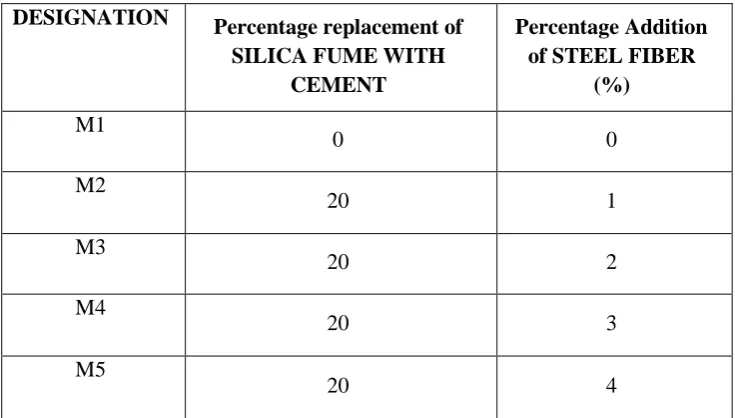
The UHPC mix of trial mix 1:0.5:1.82ratio was used. The water cement ratio was reduced from 0.4 to 0.30 by adding chemical admixtures. Cement was replaced by 20% silica fume. The fibers are also added with different percentages(0 to 4%). The mix proportions are shown in Table 1
Table 1 – Mix proportions
DESIGNATION Percentage replacement of SILICA FUME WITH
CEMENT
Percentage Addition of STEEL FIBER
(%) M1
0 0
M2
20 1
M3
20 2
M4
20 3
M5
10
INTERNATIONAL JOURNAL OF ADVANCES IN ENGINEERING RESEARCH
RESULTS AND DISCUSSION
COMPRESSIONSTRENGTH TEST
The cube specimen is of the size 150 x 150x150 mm were cast as per IS 516:1959. Curing was done for 1day,3days,7days,14days,28days and 56 days respectively Average compressive strength is shown in table 2.
Table 2 compressive strength of UHPC for different curing period
Curing
period M1 M2 M3 M4 M5
Average Compressive strength (N/mm2)
1 day 13.19 15.47 18.92 24.30 23.17
3 days 31.42 39.21 40.97 43.28 42.01
7 days 41.32 42.94 44.35 47.28 45.86
14 days 49.72 52.67 56.09 62.57 57.49
28 days 53.19 57.28 59.27 69.79 62.94
56 days 69.42 71.45 74.79 82.51 79.57
SPLIT TENSILE STRENGTH TEST
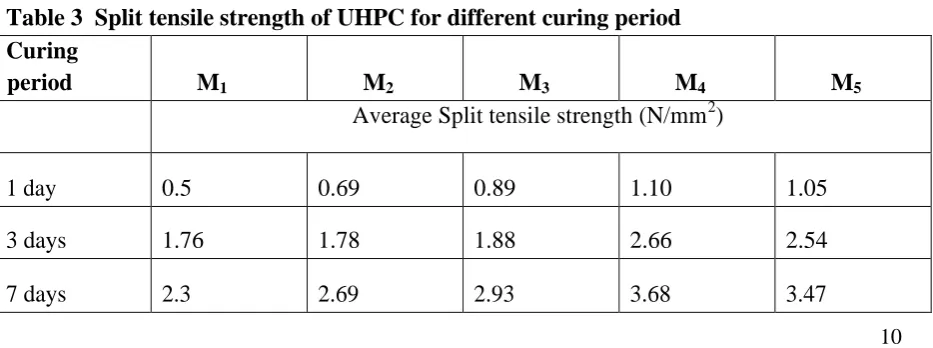
Split tensile test was carried as per IS 516:1959. Concrete cylinder of size 150mm diameter and 300mm height were casted. Proper quality control was maintained during casting.curing was done for 1day,3days,7days,14days,28days and 56 days respectively and calculation of strength was done using the formula 2P/πdl.
Average Split tensile strength is shown in table 3
Table 3 Split tensile strength of UHPC for different curing period Curing
period M1 M2 M3 M4 M5
Average Split tensile strength (N/mm2)
1 day 0.5 0.69 0.89 1.10 1.05
3 days 1.76 1.78 1.88 2.66 2.54
11
INTERNATIONAL JOURNAL OF ADVANCES IN ENGINEERING RESEARCH
14 days 3.45 3.63 3.77 4.57 4.41
28 days 4.66 4.88 4.92 5.42 5.31
56 days 5.96 6.12 6.56 7.21 6.98
CONCLUSION
Based on the experimental investigation, the following conclusions are drawn within the limitation.
1. The ultra-high performance concrete with trial mix ratio was found to give more strength but it was equal to high performance concrete.
2. But with the minimum ingredients More than 80MPa was achieved
3. Addition of mineral admixtures gives more strength up to certain percentage of replacement.
4. Compression strength both for normal and acid curing, split tensile strength, flexural strength test for 20% replacement of silica fume and fiber addition from 1% to 4% were found to be better than control concrete. Using of mineral admixtures are eco friendly. Setting time of these silica fume was little more than normal concrete. Ultra high performance concrete can be achieved only by proper maintaining of quality control.
5. Addition of steel fibers in the UHPC increased the 28 and 56 days cube compressive strength.
6. There was an increase in the cylinder tensile strength with the addition of steel fibers.
7. With the addition of steel fibers up to 3% strength was good.
REFERENCES
1. Books. J J. MegatJohari M.A and Mazloom M (2000) “Effect of Admixtures on the setting Time of High Strength Concrete”.
2. IS: 12269-1987 – Specification for 53 grade Ordinary Portland Cement, BIS. New Delhi, India.
3. IS:383-1987, Specification for Coarse and Fine Aggregate for concrete BIS, New Delhi, India.
4. IS 456-2000, Plain and Reinforced Concrete – Code of Practkce.BIS, New Delhi, India.
12
INTERNATIONAL JOURNAL OF ADVANCES IN ENGINEERING RESEARCH Super Plasticizers”
6. Aitcin.P.C (2004) “High Performance Concrete” E & FN SPON AN Imprint of Rout ledge, London.
7. (UHPFRC) Under High Tensile Deformation, “Cement and Concrete Research, Vol.38, pp 689-698.
8. Habel. K. Viviani. M. Debarie.E and Bruhwilder. E (2006) “Development of the mechanical properties of an Ultra-High Performance Fiber Reinforced Concrete (UHPFRC)” Cement and Concrete Research.
9. (ACI 363R, 1992). M.A. Rashid and M.A. Mansur / Journal of Civil Engineering (IEB),37 (1) (2009) 53-63
10.Cementing the future. Time (2008-12-04). Retrieved on 2012-04-20.
11."Ultra High Performance Fibre-Reinforced Concretes." Association Francais de Genie Civil, 2002.
12.Feng N.Q., Shi Y.X., Hao T.Y. (2000), “Influence of ultrafine powder on the fluidity and strength of cement paste”, Advance in Cement Research, Vol.12, No.3, pp89-95. 13.Kwan A.K.H. (2000),“Use of condensed silica fume for making high strength,
self-consolidating concrete”, Canadian Journal of Civil Engineering, Vol.27, No.4, pp620-627.
14.Kwan A.K.H., Cai Y.B., Chan H.C. (1995a), “Development of very high strength concrete for Hong Kong”, HKIE Transactions, Vol.2, No.2, pp9-16.
15.Kwan A.K.H., Cai Y.B., Chan H.C. (1995b), “Comparison of granitic and volcanic aggregates for making high strength concrete in Hong Kong”, HKIE Transactions, Vol.2, No.2, pp1-8.