Vol. 7, No. 3 (2017): 1772-1779 Research Article
Open Access
I
ISSSSNN:: 22332200--66881100
Problem Based Learning: A Modern teaching and
learning of Clinical Medical Sciences in Health
Professions’ undergraduate curriculum
Ismail Hegaze and Mohammed Abdalla Hussein*
Faculty of Applied Medical Sciences, October 6 University, Egypt.
* Corresponding author: Mohammed Abdalla Hussein, e-mail: [email protected]
ABSTRACT
It was debatable whether cadaveric dissection is the more indicated method for the learning of Medical Sciences, while there has been a vast increase in claims associated with the lack of medical knowledge. Problem-based learning (PBL) helps students develop their knowledge and understanding skills. This study aims to compare the effect of PBL and lecture-based learning (LBL) on examination results of undergraduate medical students of Medical Laboratory program, Faculty of Applied Medical Sciences, October 6 University, Egypt. This study was conducted in Clinical chemistry, immunology, molecular biology, epidemiology and nutrition courses at department of medical laboratories, Faculty of Applied medical Sciences, October 6 University, Egypt, at the first semester of 2016-2017 academic year. A total of 127 students were selected and they were divided into two groups as the LBL group (n= 109) and the PBL group (n=19). The pass, good, very good and excellence rates and examination scores of courses examination were collected. Methodological quality was evaluated based on the percentage ratio. The present study included 127 students and 5 courses (Clinical chemistry, immunology, molecular biology, epidemiology and Nutrition). A very significant improvement was observed among the students after the PBL sessions and they were also motivated by these sessions. The PBL model yielded higher course examination pass rates [23.5%], very good rates [41.1%], excellence rates [35.5%] and examination scores [94.4%] for clinical chemistry course. Also, the scores of students exposed to immunology are pass rates [12.5%], good rates [18.7%], very good rates [36.5%], excellence rates [31.3%] and examination scores [88.8%]. However, The PBL model yielded higher course examination pass rates [22%], good rates [16.6%], very good rates [27.7%], excellence rates [33.3%] and examination scores [100%] for Molecular biology course. In addition, the scores of students which exposed to epidemiology are pass rates [21.4%], good rates [14.3%], very good rates [35.7%], excellence rates [28.5%] and examination scores [77.7%]. Finally, The PBL model yielded higher course examination pass rates [0%], good rates [6.3%], very good rates [68.7%], excellence rates [25%] and examination scores [88.8%] for molecular biology course. PBL teaching model application is effective in the medical curriculum for a better understanding of Clinical chemistry, Immunology, Molecular biology, Epidemiology and Nutrition courses among the students in Faculty of Applied medical sciences, October 6 University.
Keywords:
Problem-based learning, clinical biochemistry, Applied medical sciences, October 6 University.1. INTRODUCTION
Biochemistry is one of the foundation sciences in the medical curriculum, which has immense importance in understanding the future clinical sciences, but it is generally considered to be a subject of just countless biochemical structures, pathways and reactions. In the traditional system of medical education, it was mainly taught by means of didactic lectures, tutorials and
practical classes, along with anatomy and physiology in the first year of the medical course of four years duration. Hence, it was teacher centered, with minimal active participation from the students and hence, the students lacked critical thinking. But these days, the education system is changing to a student centered teaching–learning process with the use of various
innovative teaching methods. This makes the students to be actively more involved in the process of learning and it thus prepares them for a lifelong self directed learning process [1]. As a result of this, students can have a meaningful learning, wherein the learner is motivated for effective learning rather than just the dispensing of information [2]. Learning is actually a process which results in some changes or modifications in the learners’ ways of thinking, feeling and doing as a result of practice, in this process sequential learning and integrated it with previous knowledge. Integrated teaching is an important strategy for promoting meaningful learning and for making it easily retainable by the learner. Many approaches are available for integrating the basic and clinical sciences. Problem Based Learning (PBL) is one such approach which can make learning more effective and interesting.
The problem-based learning (PBL) teaching model was first developed in 1969, and the approach has since become a popular education model internationally [3, 4]. According to World Health Organization data, the PBL teaching model has been used in more than 1,700 medical schools globally, and this number continues to grow [5]. Problem based learning (PBL) has been introduced into the academic programs offered by the Faculty of Applied medical sciences October 6 University at the start of the academic year 2012 [6]. Due to current shifts in approaches to medical education prevalent in Egypt, this model has been extensively applied as an experimental teaching method in Faculty of Applied medical sciences October 6 University.
The PBL teaching model is still controversial [7, 8]. Numerous studies have found that in medical education settings, relative to traditional, lecture-based learning (LBL) models, the PBL model presents certain advantages with respect to improving student abilities in inactive learning, two-way communication, clinical thinking, and teamwork [9–12]. A study by Abraham et al. suggested that physiology teaching outcomes could be improved through the use of the PBL teaching model [9]. A study by Mehadizadeh et al. demonstrated that anatomy students that had been instructed via PBL teaching methods not only achieved higher examination scores, but were also highly satisfied with this teaching method [11]. Furthermore, a study by the University of Missouri School of Medicine revealed that overtime, the PBL teaching model may improve the passing rate of the United States Medical Licensing Examination [12]. However, other researchers do not consider the PBL teaching model to be superior to the LBL teaching model with respect to the acquisition of theoretical and fundamental knowledge [13–18].
of introductory medical courses has not yet been conducted. For this study, meta-analysis methods were applied to compare the effects of PBL and LBL teaching models on course examination results of introductory undergraduate medical clinical biochemistry in Egypt, thereby providing a scientific basis for evaluating the necessity and feasibility of PBL application in clinical biochemistry.
2. MATERIALS AND METHODS
For this study, we used the following definition of PBL provided by Kinkade [19]: a curriculum of carefully selected activities that test the learner’s critical knowledge acquisition, problem-solving, self-directed learning, and team-participation capacities. Students work in small groups, generate hypotheses about the given case and learning objectives, work outside of class hours to fulfill learning objectives, and then reconvene and solve the problem.
Studies included in this review met the following inclusion criteria: 1) examination of PBL use as a teaching method for four-year undergraduate, medical curricula applied in biochemistry department, Faculty of Applied medical sciences October 6 University; and 2) use of randomized or nonrandomized controlled trials (RCTs), in which experimental groups were instructed using either the PBL teaching model alone or using the PBL teaching model in combination with the traditional LBL teaching model while control groups were instructed strictly based on the LBL teaching model. Course for which PBL was applied in Clinical chemistry, Immunology, Molecular biology, Epidemiology and Nutrition courses. Course examinations were used to assess study populations, and data on examination results were reported.
2.1 Statistical Analysis
All the results were expressed as percentage ratio. All analyses utilized SPSS 13.0 statistical package for Windows (SPSS, 13.0 software, Inc., Chicago, IL, 2003) (20). A one-way analysis of variance (ANOVA) was employed for comparisons of means of the different groups. A P-value < 0.05 was accepted as statistically significant.
3. RESULTS AND DISCUSSION
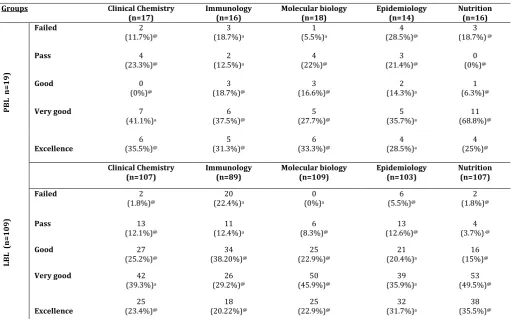
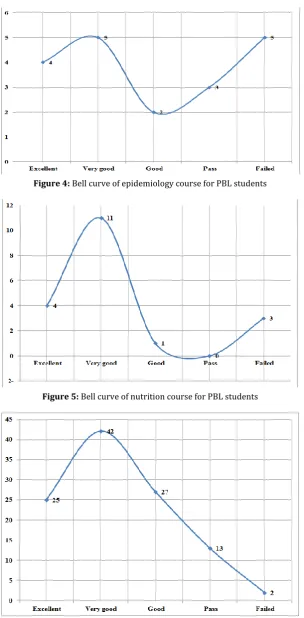
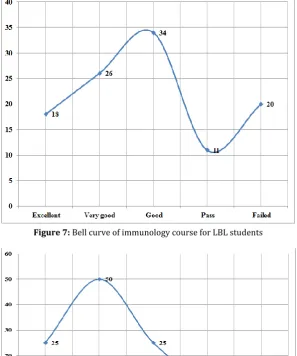
addition, the scores of students which exposed to epidemiology are pass rates [21.4%], good rates [14.3%], very good rates [35.7%], excellence rates [28.5%] and examination scores [77.7%]. Finally, The PBL model yielded higher course examination pass rates [0%], good rates [6.3%], very good rates [68.7%], excellence rates [25%] and examination scores [88.8%] for molecular biology course. On the other hand, The LBL model yielded higher course examination pass rates [12.1%], good rates [25.2%], very good rates [39.3%], excellence rates [32.4%] and examination scores [98.1%] for clinical chemistry course. Also, the scores of students which exposed to immunology are pass rates [12.4%], good rates [38.20%], very good
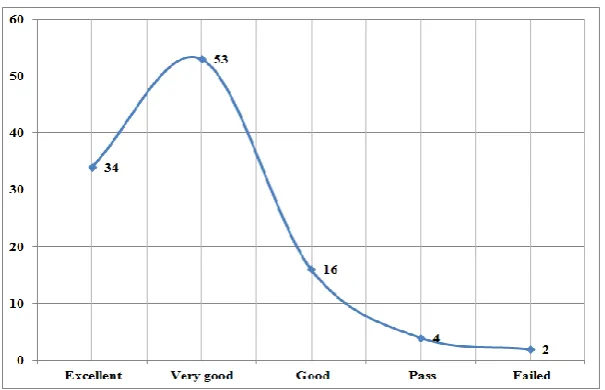
rates [29.2%], excellence rates [20.2%] and examination scores [81.6%]. However, The LBL model yielded higher course examination pass rates [8.3%], good rates [22.9%], very good rates [45.9%], excellence rates [22.9%] and examination scores [100%] for molecular biology course. In addition, the scores of students which exposed to epidemiology are pass rates [12.6%], good rates [20.4%], very good rates [35.9%], excellence rates [31.7%] and examination scores [94.5%]. Finally, The LBL model yielded higher course examination pass rates [3.7%], good rates [15%], very good rates [49.5%], excellence rates [35.5%] and examination scores [98.2%] for molecular biology course.
Table 1: Scores of students exposed to problem base learning (PBL) and lecture based learning (LPL) sessions in clinical chemistry, immunology, molecular biology, epidemiology and nutrition courses
Groups Clinical Chemistry
(n=17) Immunology (n=16) Molecular biology (n=18) Epidemiology (n=14) Nutrition (n=16)
PB L n =1 9 )
Failed 2
(11.7%)@ 3 (18.7%)a 1 (5.5%)a 4 (28.5%)@ 3
(18.7%) @
Pass 4
(23.3%)@ 2 (12.5%)a 4 (22%)@ 3 (21.4%)@ 0 (0%)@
Good 0
(0%)@ 3 (18.7%)@ 3 (16.6%)@ 2 (14.3%)a 1 (6.3%)@
Very good 7
(41.1%)a 6 (37.5%)@ 5 (27.7%)@ 5 (35.7%)a 11 (68.8%)@
Excellence (35.5%)6 @
5 (31.3%)@ 6 (33.3%)@ 4 (28.5%)a 4 (25%)@ LBL (n =1 09 ) Clinical Chemistry
(n=107) Immunology (n=89) Molecular biology (n=109) Epidemiology (n=103) Nutrition (n=107)
Failed 2
(1.8%)@ 20 (22.4%)a 0 (0%)a 6 (5.5%)@ 2 (1.8%)@
Pass 13
(12.1%)@ 11 (12.4%)a 6 (8.3%)@ 13 (12.6%)@ 4
(3.7%) @
Good 27
(25.2%)@ 34 (38.20%)@ 25 (22.9%)@ 21 (20.4%)a 16 (15%)@
Very good 42
(39.3%)a 26 (29.2%)@ 50 (45.9%)@ 39 (35.9%)a 53 (49.5%)@
Excellence (23.4%)25 @
18 (20.22%)@ 25 (22.9%)@ 32 (31.7%)a 38 (35.5%)@
Figure 1: Bell curve of clinical chemistry course for PBL students
Figure 4: Bell curve of epidemiology course for PBL students
Figure 5: Bell curve of nutrition course for PBL students
Figure 7: Bell curve of immunology course for LBL students
Figure 10: Bell curve of nutrition course for LBL students
PBL seems to be a good method of teaching, on the basis of results of the evaluation, wherein the whole process can be made students–centered. Our results were confirmed with some of the other medical education researches, which stated that PBL could help in developing an effective learning environment, with the use of specific learning objects [21-23]. It proved to be an interesting concept and it helped the students in improving their academic performances, as it helped in developing interest about the subject, as all the students were curious and attentive and it also motivated them to actively participate, with each one giving their inputs [24]. It also made the subject easier to learn and it also solidified their understanding of the subject. It helped them in developing logical thinking, clinical reasoning and diagnostic interpretation. This was also observed by other previous workers [25, 26]. In the present studies, the use of case studies in the clinical chemistry, immunology and molecular biology has shown a positive effect on the learning outcomes in excellence scour. However, PBL students exposed to epidemiology and nutrition courses have showed a positive effect on the learning outcomes in very good scour when compared with LPL exposed students. Our results confirmed with the results of Groves, [27], Sarmishtha, [28] and Schoeman et al., [29]. Care that should be taken during the selection of the case, in that it should reinforce the students’ understanding of the key concepts and the mechanistic processes of clinical chemistry, immunology and molecular biology. It seems that PBL might prove to be an interesting exercise and it can help the students in improving their academic performance. During the study, it was observed that a majority of the students enjoyed and embraced the PBL session and the ones who were not a part of it, also showed interest. It helped them in developing logical thinking, clinical reasoning and diagnostic interpretation. The results of the current study and the feedback of the students encouraged us in using PBL as a method of teaching, as it had a lot of positive impact on the students [30].
4. CONCLUSION
Research in science education investigates to find out the most effective learning environments to achieve learning objectives. Current study was also done for the above reason and also to compare it with the traditional, lecture style format of the content delivery. It has been felt that PBL could create effective learning environments and thus help in achieving the learning objectives. It has been observed that, Clinical case studies encourage active learning and the development of higher order thinking skills and promotes a student centered active learning with a focus on critical thinking and problem solving. At the same time, it has been observed that PBL has been found to be beneficial in other subjects for the medical students. In the present study, we observed that the students who were not given PBL, in the future they had been motivated to read and that they wanted to be part of such sessions.
5. REFERENCES
1. West DC, Pomerory JR, Park JK, et al., (2000) Critical thinking
in graduate medical education: a role of concept mapping assessment? JAMA. 284:1105–10.
2. Michael J. (2001). In pursuit of meaningful
learning. Advances in Physiology ducation. 25:145–58.
3. Jones RW. (2006): Problem-based learning: description,
advantages, disadvantages, scenarios and
facilitation. Anaesth Intensive Care. 34:485–488.
4. McParland M, Noble LM, Livingston G. (2004). The
effectiveness of problem-based learning compared with traditional teaching in undergraduate psychiatry. Med Educ. 38:859–867.
5. Liu Y, Fan X. (2007). On PBL teaching model in Chinese
medical education. Journal of Liaoning Medical University (Social Science Edition). 5:33–35.
6. Hala M, Nashwa A, Alaa E, et al., (2012). Assessing
Problem-Based Learning: A Case Study of a Medically Oriented Biophysics Problem-Based Learning Course. Journal of American Science 2012;8(12); 725-728.
7. Farrow R, Norman G. (2003). The effectiveness of PBL: the
debate continues. Is meta-analysis helpful? Med
Educ.37:1131–1132.
8. Schmidt HG, Cohen-Schotanus J, et al., (2009). Impact of
problem-based, active learning on graduation rates for 10 generations of Dutch medical students. Med Educ. 43:211– 218.
9. Abraham RR, Vinod P, Kamath MG, et al., (2008). Learning
10.Chou FH, Chin CC. (2009). Experience of problem-based learning in nursing education at Kaohsiung Medical University. Kaohsiung J Med Sci. 25:258–263.
11.Mahdizadeh M, Kermanian F, Iravani S, et al., (2008).
Comparing lecture and problem-based learning methods in teaching limb anatomy to first year medical students. Iran J Med Educ.2:379–388.
12.Enarson C, Cariaga-L (2001). Influence of curriculum type on
student performance in the United States Medical Licensing Examination Step 1 and Step 2 exams: problem-based learning vs. lecture-based curriculum. Med Educ. 35:1050– 1055.
13.Vernon DT, Blake RL. (1993). Does problem-based learning
work? A meta-analysis of evaluative research. Acad Med. 68:550–563.
14.Iputo JE, Kwizera E. (2005). Problem-based learning
improves the academic performance of medical students in South Africa. Med Educ. 39:388–393.
15.Schmidt HG, Cohen-Schotanus J, (2009). Impact of
problem-based, active learning on graduation rates for 10 generations of Dutch medical students. Med Educ. 43:211–218.
16.Gerald CK, Hoon EK, Mee LW, (2008). David K. The effects of
problem-based learning during medical school on physician competency: a systematic review. CMAJ. 178:34–41.
1. 14. Antepohl W, Herzig S. (1999). Problem-based learning
versus lecture-based learning in a course of basic pharmacology: A controlled, randomised study. Med Educ. 33:106–113.
2. 15. Tavakol M, Dennick R, Tavakol S. (2009). A descriptive
study of medical educators’ views of problem-based learning. BMC Med Educ. 4:66.
17.Guo WC, Xu LX, Gao YC, et al., (2009). Meta-analysis of study
on problem-based learning and lecture-based learning applied in clinical clerkship. Journal of Baotou Medical College.2009; 25:90–92.
18.Zha GY, Pan LP, Zhang JL. (2012). Meta-analysis of
effectiveness of PBL teaching on stomatology in China. China Higher Medical Education. 1:110–113.
19.Wang ZY. (2001). Meta-analysis of learning effect of PBL
teaching on medical students. China Higher Medical Education. 5:80–82.
20.Kinkade S. (2005). A snapshot of the status of problem-based
learning in US medical schools, 2003–04. Acad Med. 80:300– 301.
21.Abo-Allam, R.M., (2003) Data Statistical Analysis using SPSS
Program. 1 Ed., Publication for 1stUniversities, Cairo.
22.PA Burrowers. (2003). A student-centered approach to
teaching general biology that really works: Lord’s constructivist model put to a test. Am Biol.Teach. 65:491-502.
23.Surapaneni KM. (2010). The effect of integrated teaching
with Case Based Learning (CBL) in the biochemistry of
undergraduate medical curriculum. Journal of Clinical and
Diagnostic Research. 5: 3058-60.
24.M Reicks, T Stoebner, C Hassel. (2003). Evaluation of a
decision case approach to food biotechnology education at the secondary level. J Nutr Educ. 28:33-38.
25.Meyer C, Jones TB. (1993). Case studies. In promoting Active
Learning: Strategies for the College Classroom.San Francisco,CA: Jossey-Bass, 103-19.
26.Cliff WH, Wright AW. (1996). Directed case study method for
teaching human anatomy and physiology. Advances in
Physical Education. I5: S19-28.
27.Srinivasan M, Wilkes M, Stevenson F, et al., (2007).
Comparing problem based learning with case based learning:
effects of a major curricular shift at two institutions. Acad
Med.; 82(1):74-82.
28.Groves M. (2005). Problem based learning and learning
approach: is there a relationship? Adv Health Sci Edu. 10:
315-26
29.Sarmishtha Ghosh. (2007). Combination of didactic lectures
and case oriented problem solving tutorials toward better learning: perceptions of students from a conventional medical curriculum. Adv Physiol Educ. 31(2):193-97.
30.Schoeman JP, Van Schoor M, van der Merwe LL, et al., (2004).
A case based small group Co operative learning course in Pre clinical Veterinary Science aimed at bridging basic science and clinical literacy. JS Afr Vet Assoc. 80 (1):31- 36.
31.Sandhya Pillai nair, TruShna Shah, ShruTi S., (2013). Case
Based Learning: A Method for Better Understanding of Biochemistry in Medical Students. Journal of Clinical and Diagnostic Research. 2013; 7(8): 1576-1578.
*****