Journal of Applied Linguistics and Language Research Volume 3, Issue 4, 2016, pp. 121-134
Available online at www.jallr.com ISSN: 2376-760X
* Correspondence: Geoffrey Mokua Maroko, Email: [email protected] © 2016 Journal of Applied Linguistics and Language Research
Uncovering Cloze Testing Practices in Selected Practice
Papers for Primary Schools in Kenya
Geoffrey Mokua Maroko *
Senior Lecturer, Department of Languages and Linguistics, Machakos University, Kenya
Abstract
Reading comprehension is probably the most prominently tested skill in upper primary classes in Kenya. Most test papers, for instance, comprise a fifteen-item cloze test, a fictional passage and a factual one both of which contribute at least twenty items. While the latter two passages mainly focus on the learner’s ability to identify correct answers from the passage, a cloze test taker is expected to provide words that have been omitted deliberately. Assessment may depend on whether the exercise is objective (i.e. students are given multiple choices to use in a cloze) or subjective (i.e. students fill in a cloze with words that would make a given sentence grammatically correct). Consequently, cloze tests require the ability to understand context and vocabulary in order to identify the correct words or type of words that belong in the deleted parts of a text. However, cloze tests are probably the least understood aspect of language testing in schools. Thus, this paper seeks to address the following issues: What aspects of language are tested in cloze tests and how is this done? How are multiple choice questions constructed? What contextual clues are evident in cloze passages? It is hoped that answers to these and other issues could have implications for testing practices and also the development of essential skills for answering such tests.
Keywords: cloze test, deletion, item, response, distractor
IINTRODUCTION
able to restore the eliminated words if given enough contextual clues of the passage (Kuo, 2002). The general format of the cloze tasks used by school teachers and test writers is Multiple-choice Rational Cloze Test, also called the “Integrative Test” since the test writers wish to measure different language abilities.
The cloze procedure forces readers outside the sentence and interrupts their normal flow of reading. This use of information across sentence boundaries is an important aspect of reading comprehension, for it helps readers not only to recognize the interrelationships of language but also to develop an awareness of sequence both of which could help prediction. This reconstruction is at a more conscious level than in normal reading and could help to create an awareness of syntax and meaning.
The doze procedure offers help in developing scanning and search reading skills which are very often neglected in both first and second language reading (Rye, 1982: 45). More importantly, it helps readers to predict the missing words by guessing meaning from context. This is of great significance particularly for second language students who need to acquire many newer vocabulary terms and information on collocational characteristics of the words.
Some studies support the validity of cloze tests as a reading comprehension test, i.e., they are sensitive to intersentential or text-level constraints (e.g., Bachman, 1985; Jonz, 1990; Chavez-Oller et al., 1994), whereas others conclude that cloze tests measure only the ability to use local syntactic constraints (e.g., Alderson, 1979; 1980; Kibby, 1980; 1982; Markman, 1985). Since the practical value of cloze tests is high (i.e., they are relatively simple to construct and score), if it is established that cloze tests measure global-level comprehension ability, they would contribute to reducing the effort needed for materials development and help promote reading research and pedagogy. On the other hand, however, if cloze tests are not appropriate for measuring reading ability, test consumers have to use different kinds of tests.
would contribute to reducing the effort needed for materials development and help promote reading research and pedagogy.
Many studies on cloze and gap-filling tests have tended to focus on test scores, and process-oriented approaches have often not been taken up. However, other researchers have investigated the processes of taking these types of tests by examining verbal reports from test-takers (Storey, 1997; Sasaki, 2000; see also summaries by Cohen, 1984; 1998). Each study focused on different aspects of the test-taking processes and used various types of word deletion techniques and data collection methods. Storey (1997), for instance, investigated EFL learners’ processes of taking a multiple-choice gap-filling test based on a summary passage of an original text. In the study, words were deleted on the basis of their hypothesized importance in measuring inter-sentential understanding (e.g., discourse markers and anaphoric pronouns). Examining the learners’ think aloud verbal protocols, the researcher found that different items entailed varying degrees of construct validity. While some students used theoretically expected reading processes, others merely considered information intra-sententially. Still other students selected an option on the basis of elimination. Overall, the test was judged to have a good degree of validity.
In a study, Sasaki (2000) also examined the effects of cultural schemata on test-taking processes for cloze tests and used immediate retrospective introspection as one of the data sources. Culturally familiar and unfamiliar versions of a cloze test were given to EFL learners, and how they answered each item was analyzed. Results showed that students who read the culturally familiar cloze passage tried to solve more items and generally understood the text better.
The changing approaches to the teaching and testing of the cloze passages merits another look. In Kenya for instance, the cloze passage is integral to the terminal exams at both the primary and secondary school levels. The recommended materials in the Kenyan curriculum reveal that information on how to teach and/or learn the cloze passage is limited to exercises for practice. It is therefore unclear to both the teacher of English as to what constitutes the best practices in cloze passages. To plug this gap, this paper sets out to address the following concerns:
1. What aspects of language are tested in cloze tests and how is this done?
2. What strategies can a test-taker employ to recover deleted words in cloze passages?
3. How can teachers approach cloze passages in reading comprehension lessons? METHOD
Sampling
three of the researcher’s children in three different boarding primary schools were usually tested on materials from the three publishers. In an environment with many competing publishers of the test materials, it could not be by coincidence that three schools can choose most of their testing materials from only three publishers. The preference must be based on the assumption that the publishers had developed a reputation of producing superior materials compared to their competitors. The six sample tests were therefore believed to be authentic sources of data.
Next, the researcher approached the editors of the three publishers and requested to be introduced to at least one of the experienced setters of the cloze test in their materials. This yielded three respondents.
Data elicitation and analysis
The first stage in data elicitation involved closely reading the selected cloze passages to determine the aspect of language tested in each gap. A predetermined checklist including word classes, punctuation, phrasal verbs, spelling and mechanics was used to identify and tally the aspects of language tested. The outcome was used to classify aspects that are tested into categories and presented them in a frequency table.
In the second phase, the deletions were studied to establish the strategies setter used to create them. This activity relied on the researcher’s intuitive knowledge as a teacher of English for many years at both secondary school and universities. By attempting the recovery of missing words and expressions, the researcher was able to develop an inventory of linguistic, semantic and contextual clues guiding the process.
In order to corroborate the data arising from the two activities, the researcher engaged the setters to confirm and/or make amendments where necessary. The setters agreed with the researcher’s data but for very minor disagreements. However, these were discussed till consensus was reached to give the data the required inter-rater reliability. The findings were then discussed in line with existing relevant literature.
Consequently, the outcome of the procedure discussed above was used to develop a strategy that could be useful to the teachers of reading comprehension when teaching the cloze procedure in their language classrooms.
RESULTS AND DISCUSSION
Cloze testing practices
According to Bachman (1985), deletions in a cloze test can occur within the clause while others can occur across the clause but within the sentence. Other deletions can be across the sentence, within text with others occurring as extra-textual. The study data in this paper indeed revealed these patterns as itemized below:
(a) Deletion within clause; e.g.
(b) Deletions across the clause, within the sentence; e.g.
Loss of ____6____ muscle and sometimes consciousness are some of the ___7___ of epilepsy. (KLB)
(c) Deletions across the sentence, within a text; e.g.
He took a video picture of ___3___ starving girl. According to the____4___, she had collapsed on her way to the feeding centre. (Gesma)
(d) extra-textual. e.g.
What should she do when despair sets____9____ the kind of despair which makes a woman think she is in the middle of the ocean without knowing when she will be rescued? (Kenya Literature Bureau)
Example (a) indicates a deletion within a clause suggesting that recovery of the missing word should actually be based on the clause itself while in the coordinated sentence in (b), the test taker can check clues in the previous clause. In (c), the test take may look for clues in a separate sentence while in (d) the take may use ‘outside’ knowledge to supply the missing word. In his 1985 study, Bachman states that not all the deletions in a given cloze passage measure exactly the same abilities. To make a cloze test primarily a test of cohesion, Bachman suggests that deletions of Types (b) and (c) should be maximized and Types (a) and (d) should be minimized. But a versatile cloze test that incorporates all these strategies may have the potential to develop a stronger predictive ability in the learners.
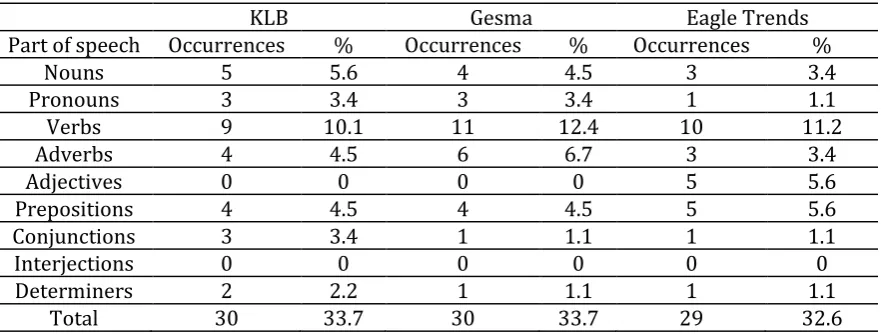
Secondly, parts of speech were found to be the main focus of testing in the sample papers. Patterns in the study data are summarized in Table 1.
Table 1. Parts of speech
KLB Gesma Eagle Trends
Part of speech Occurrences % Occurrences % Occurrences %
Nouns 5 5.6 4 4.5 3 3.4
Pronouns 3 3.4 3 3.4 1 1.1
Verbs 9 10.1 11 12.4 10 11.2
Adverbs 4 4.5 6 6.7 3 3.4
Adjectives 0 0 0 0 5 5.6
Prepositions 4 4.5 4 4.5 5 5.6
Conjunctions 3 3.4 1 1.1 1 1.1
Interjections 0 0 0 0 0 0
Determiners 2 2.2 1 1.1 1 1.1
Total 30 33.7 30 33.7 29 32.6
N=89
widely tested. However, it emerged that adjectives, conjunctions, and determiners recorded dismal occurrences at a combined frequency of 15.6%. The implications arising from the statistics is that while testers could be aware of the need to test learners’ linguistic competence in word classes, they fail to make deliberate efforts to ensure that all the parts of speech receive equal or near equal treatment. One possible consequence of this omission is development of competence in some word classes and not others.
It also emerged in the study data that word classes cannot be tested without the associated set of grammatical categories including tense and aspect, number, voice, degree and gender. Incidence for these was determined and summarized in Table 2.
Table 2. Grammatical categories
KLB Gesma Eagle Trends
Grammatical category Occurrences % Occurrences % Occurrences %
Tense & aspect 5 8.9 10 17.9 7 12.5
Number 5 8.9 6 10.7 4 7.1
Voice 2 3.6 4 7.1 5 8.9
Degree 2 3.6 3 5.4 1 1.8
Gender 1 1.8 1 1.8 0 0
Total 15 26.8 24 42.9 17 30.4
N=56
According to Table 2, Tense and Aspect had the highest Number of occurrences at a combined total of 39.3% followed by Number at a combined incidence of 26.7% and Voice at combined total of 19.6% in that order. It is also notable that the aspects Degree, and Gender recorded very low incidences at a combined frequency of 16.2%. It is possible to make connections between these patterns and what is captured in Table 1. The preponderance of tense and aspect, voice and number in Table 2 corroborates the results in Table 1 which show that verbs and nouns were the most heavily tested in the study data. Since adjectives were generally scantily tested as evidenced in Table 1, similar patterns emerge in Table 2 where the word class was the second least tested in the study data.
In addition to grammatical categories, other features such as agreement, homonymy, collocations, punctuation and spelling were detected in the test papers under study. Frequencies of their use are captured in Table 3.
Table 3. Other features
KLB Gesma Eagle Trends
Other features Occurrences % Occurrences % Occurrences %
Agreement 4 6.3 7 10.9 9 14.1
Homonymy 0 0 1 1.6 2 3.1
Collocations 10 15.6 13 20.3 11 17.2
Punctuation 0 0 0 0 1 1.6
Spelling 0 0 1 1.6 5 7.8
Total 14 21.9 22 34.4 28 43.8
Patterns in Table 3 reveal that Collocations recorded the highest number of occurrences at a combined total of 53.1%. It can also be noted that Agreement recorded the second highest number of occurrences at 31.3%. However, Spelling, Homonymy and Punctuation recorded the lowest incidences at 9.4%, 4.7% and 1.6% respectively. This imbalance suggests that the validity and reliability of test items could have been skipped during test processing. Interventions based on incomplete assessment of learner behavior may not achieve the desired competence levels in a second language such as English.
Another practice in cloze testing in Kenyan primary schools is the use of multiple choice questions. Given that test takers are expected to select an appropriate answer from a set of four multiple choices, it is necessary to have awareness on the nature of multiple choice questions. It is noteworthy that multiple choice questions are made up of three components namely the instruction, item and responses. The three elements are described as follows:
(a) Instruction
The instruction is a statement which directs the candidates on what they are expected to do (Palmer & Devitt, 2007). In cloze procedures, this instruction occurs before the cloze text. The following are the samples of such statements:
(i) Read the passage below. It contains blank spaces numbered 1-15. For each blank space, choose the best alternative from the choices given (Gesma).
(ii) The passage below contains blank spaces numbered 1-15. Select the best choices. (Eagle Trends)
(b) Item
Items refer to the number of deletions that candidates should fill (Al-Rukban, 2006). Items are also called stems. In the case of the KCPE trial tests, there are fifteen such deletions (items). All the gaps are numbered serially within the passage. Sets of four multiple choices from each of the 15 items are presented after the passage stepwise. (c) Responses
“What_____1_____ a woman do when she grows poor?” (KLB)
A. could B. should C. might D. would
In this example, the first part which is provides the prompt is called the stem. The options A-D are called responses out of which should is the correct response (key) while the rest are incorrect (distractors). According to Al-Rukban (2006), multiple choice questions have a high diagnostic power if distractors are constructed to address common mistakes or misconceptions. Hence, they can provide reliable and valid diagnostic information about student learning which can, in turn, inform teacher preparation and instructional practices.
From the discussion above, it is noteworthy that the cloze procedure is characterized by diversity of grammatical and semantic features. These include parts of speech and associated grammatical features such as number, tense, voice, aspect and degree; collocations; phrasal verbs; and vocabulary. Confirming this Ashimata (2003) notes that the things that cloze tests measure comprise various language-related knowledge and abilities including syntactic or grammatical knowledge and both lower-level (e.g., clausal and sentential) and higher-level (e.g., intersentential and textual) reading comprehension abilities depending on various factors such as type of text (e.g., Gamarra and Jonz, 1987; Jonz, 1989) and the proficiency level of the test-takers (e.g., Jonz, 1987; Fotos, 1991).Thus, in order to tackle a cloze test effectively, it is important to note the varieties of features involved. It is only in this way that the missing words can be recoverable.
Alderson (1980), Bachman (1982; 1985), Jonz (1990) advise that some words can be restored using only local linguistic knowledge (e.g., prepositions, idioms) whilst others need textual understanding (e.g., anaphora, lexical repetition, conjunctions). Hence, depending on the type of words deleted, test-takers are likely to activate different types of knowledge and/or ability. On the whole, one can argue that when the context is provided, the test-takers are likely to gain semantic and linguistic information and recover the gaps. However, it is important to add that for a cloze test to achieve the purpose of assessing linguistic competence, there is an urgent need to ensure that diverse features of language are tested and measures have to be made to distribute the weight of the treatment of each. Skilful moderation of the test papers should fulfil this quality control requirement.
Strategies used to recover the missing words
First, one should possess adequate prior knowledge of vocabulary. Some deletions would require specific vocabulary items that the test-taker should know. Consider the following example:
Epilepsy is a very common disease that ____1____ people’s brains and shows itself in many mental conditions. (KLB)
To supply the missing word, one must know what a disease can do to the brain. Accordingly, a word such as affects comes to mind. This information may or may not be supplied in the passage. Therefore, the reader’s previous knowledge of the world will help in determining the relationship between a disease and the brain and aid in the prediction of affects as the best candidate for the gap.
Secondly, it is crucial to be knowledgeable on sentence structure. Consider the example below:
Marwa drove past many long, low buildings to the car park and stepped on the ___6___ pedal as well ___7____ the clutch ____8____ the car stopped. (Eagle Trends)
It can be noted that supplying the words for deletions 6 (break) and 7 (as), the stopping of the car comes as a consequence or result of applying the brakes. Therefore, gap 8 can only logically be filled by and. Gap (6) is preceded by the determiner the and followed by the noun pedal, a gap that logically represents an attributive adjective which one can supply using the clue car park. Similarly, in gap (7), it needs to be known that adjectives can be used to show comparison by using the correlatives as…as. Finally, to supply and as best word for gap (8), one needs to know that one of the functions of the coordinating conjunction is to show consequence or result in a sentence.
Thirdly, an ability to make in-depth inferences from any contextual clues provided in the passage is very important in word recovery efforts. Consider the following example: They put down their tools and ran after the thief. Mzeras, the fastest runner in the village, soon _____15____ the thief. (Gesma)
When a thief is pursued by many people, the purpose is to get hold of him so that he/she can be handed over to the police for prosecution. From the context, there is the fastest runner of them all who logically must have caught up with (Gap, 15) the thief. To arrive at this conclusion, the reader must have the ability to make inferences using contextual clues provided.
Cohesion and coherence competence are also critical in uncovering the missing words in a cloze passage. While cohesion involves the creation of textuality through the use of discourse markers, coherence deals with the systematic arrangement of information in a passage. For example:
It is notable that someone was engrossed in episodes of soul searching. One gets the feeling from the excerpt that the speaker has asked herself many questions before. Therefore, using pragmatic inferencing (coherence), it is possible to supply Finally to plug gap 15 (cohesion).
Further, reading skills such as skimming and scanning come in handy when tackling a cloze test. Skimming would be particularly helpful when rapidly reading the gapped passage to get its theme/gist. The scanning skill will be of help when searching for contextual clues that could assist in identifying the deleted word.
Test takers must also recognize the centrality of textual sensitivity to constraints within and across sentences. The notion of concord (agreement) brings into effect this sensitivity especially in regard to number, tense, aspect, voice, gender and degree. Thus the cloze procedure is capable of measuring inter-sentential comprehension of test-takers. Consider the following example:
“What can a woman do when she grows poor?” she asked ____2___ , …
In this text, deletion 2 will be filled by the reflexive pronoun herself which agrees with its antecedent a woman in number and gender.
From the foregoing discussion, discovery of omitted words is dependent on morphological, syntactic, semantic and pragmatic competencies. These encompass such skills as clustering information, guessing meaning from the context, knowing how to confirm or reject predictions; and employing learners’ prior knowledge to predict omitted words.
PEDAGOGICAL IMPLICATIONS
It is clear that the cloze procedure is integral to language testing at the primary school level in Kenya. It is also probable that teachers have no universally accepted and reliable way of teaching the cloze procedure in the primary school level. This paper therefore has some pedagogical implications that could benefit both teachers of English and their learners. Accordingly, the following procedure could be used as a guide to teaching/learning the cloze procedure.
to control over the types of words and expressions deleted and thereby the language trait measured. It is through careful selection of words to delete that a reliable cloze test aimed to measure overall language proficiency can be developed. For this to be achieved a table of specifications should be used at the setting stage. Other important factors to consider include the following:
(a) Deletions should be spread widely apart to provide enough context necessary for facilitating recovery of the missing words.
(b) Since most cloze procedures focus on parts of speech, the deletions should be controlled to ensure all word classes are included.
(c) As cloze tests are expected to test language proficiency of the learners, such texts should possess an integrative character. Deletions could test learners’ understanding of grammatical categories such as number, tense, person, aspect and voice. In addition, it would be desirable to include deletions focusing on collocations, phrasal verbs and idioms.
(d) Setting of multiple choices should be carefully done to ensure all the four options are so close that each looks like the answer. In case of testing word classes and vocabulary, a thesaurus could help in providing words with similar meaning that may be used as distracters.
(e) To ensure the cloze test is reliable and valid, a group of teachers can come together to moderate it. As a guide, they could focus on the level of difficulty of the passage, spacing of the deletions, if variety of aspects of language are tested, whether multiple choices are carefully selected to avoid overlapping, and if there are sufficient clues to be used to recover the missing words.
The next stage should involve text presentation. The following approach may be used in the administration of reading the cloze passage.
(a) Ask the students to tackle the cloze test individually at first. For each response, ask the student to write down the clue(s) used to discover the deleted word. (b) Thereafter, divide the students into small groups where they compare their
responses and clues that guided recovery of the missing words. Each group could compile the agreed answers and clue(s) employed for each.
(c) In a plenary discussion, ask a representative from each group to present their findings. This should be followed by a discussion of each presentation.
(e) Summarize these key aspects of language tested in the passage and discovery procedures used to identify them on the board. Proceed and ask the learners to review these from time to time.
(f) Repeat the procedure with many more cloze passages and keep on updating the list of aspects of language tested and any new discovery procedure arising till the students become confident. This aspect enables the students to develop transfer of test-taking strategies to new cloze tests.
CONCLUSION
Based on the findings of the work reported in this paper, it is clear that the cloze passage still remains little understood despite having been tested for many years in the past. Owing to the limitations arising from its scope, a number of issues deserve to be investigated further. First, it could be interesting to expand the study to include actual scores attained in a cloze test and uncovering the reasons students provide for choosing their preferred responses.
Secondly, this study has unraveled features of the cloze passage from the perspective of the setter. It has emerged that it is publishers who play a central role in the construction of cloze passages. It is therefore probable that teachers of English have different perceptions to the cloze procedure. Consequently, it is recommended that a study seeking to sample their understanding, thinking, approach to teaching, attitudes and motivations could help discover best practices that may be used to design a syllabus for the cloze tests.
Thirdly, this study has made an effort to describe cloze passages with multiple questions. For a broader understanding of the subject, studies on cloze tests without multiple choices will be interesting to undertake. While the multiple choices do help in jogging the memory of the students and aid in recovering missing words, it would be important to find out the discovery efforts made by students where such prompts are lacking. Such studies could be based on high schools given that multiple choices are avoided at this level.
REFERENCES
Alderson, J.C. (1980). Native and non-native speaker performance on cloze tests. Language Learning, 30, 59–76.
Al-Rukban, M. (2006). Guidelines for the construction of multiple question tests. Journal of family and Community Medicine 13 (3), 125-133.
Bachman, L.F. (2000). Modern language testing at the turn of the century: assuring that what we count counts. Language Testing, 17 (1), 1-42.
Bachman, L.F. (1982). The trait structure of cloze test scores. TESOL Quarterly 16, 61– 70.
Bean, T.W. & Brandt, P. (2010). Evaluating a history text: A comparison of cloze and maze procedures, Reading World, 21(2), 116-122.
Bormuth, J.R. (1967). The implications and use of the cloze procedure in the evaluation of instructional programmes. CSEIP Occasional Report No. 3, University of California, Los Angeles.
Chavez-Oller, M.A., Chihara, T., Weaver, K.A. and Oller, J.W. Jr. (1994). When are cloze items sensitive to constraints across sentences? In Oller, J.W. Jr. and Jonz, J., editors, Cloze and coherence. London: Associated University Press, 229–45.
Cohen, A.D. (1984). On taking language tests: what the students report. Language Testing 1, 70–81.
Cohen, A. D. (1998). Strategies and processes in test taking and SLA. In Bachman, L.F. and Cohen, A. C., editors, Interfaces between second language acquisition and language testing research. Cambridge: Cambridge University Press, 90–111.
Gamarra, A.G. and Jonz, J. 1987: Cloze procedure and the sequence of text. In Readence, J. E. and Baldwin, R.S., editors, Research in literacy: merging perspectives. Rochester, NY: National Reading Conference, 17–24.
Hinofotis, F.B. (1987). Cloze testing: An overview. In M.H. Long & J.L. Richards (Eds.), Methodology in TESOL: A book of reading (pp 412-416). Massachusetts: Newbury House
Hoffmann, J.V. (1980). Studying contextual build-up during reading through cumulative cloze. Journal of reading behavior, 12(4), 337-441.
Holocomb, C.A. (2006). The cloze procedure and older adults: Effects of age and schooling. Educational Gerontology, 4(3), 279-295.
Fotos, S.S. (1991) The cloze test as an integrative measure of EFL proficiency: a substitute for essays on college entrance examinations? Language Learning 41, 313–36.
Jonz, J. (1990). Another turn in the conversation: what does cloze measure? TESOL Quarterly 24, 61–83.
Jonz, J. 1987: Textual cohesion and second-language comprehension. Language Learning 37, 409–38.
Kanji, K. & Kenich, K. (2009). Using cloze generator to make cloze exercises. International Journal of Pedagogies and Learning 5(2), 67-79.
Kibby, M.W. (1980). Intersentential processes in reading comprehension. Journal of Reading Behavior 12, 299–312.
Marino, J. (1980). Cloze passages: Guidelines for selection. Journal of Reading, March 479-483.
Markman, P.L. (1985). Rational deletion cloze and global comprehension in German. Language Learning 35, 423–30.
Palmer, E. & Devitt, P.G. (2007). Assessment of higher order cognitive skills in undergraduate education: modified essay or multiple choice questions? BMC Medical Education.
practice, 26th Yearbook of the National Reading Conference. Newark, Delaware:
International Reading Association.
Raymond, P. (1988). Cloze procedure in the teaching of reading. TESL Canada Journal, 6(1), 91-97.
Robinson, C.G. (2006). Cloze procedure: A review. Educational Research, 23(2) 128-133. Rye, J. (1982). Cloze procedure and the teaching of reading. London: Heinemann.
Sasaki, M. (2000). Effects of cultural schemata on students’ test-taking processes for cloze tests: a multiple data source approach. Language Testing 17, 85–114.
Storey, P. (1997). Examining the test-taking process: a cognitive perspective on the discourse cloze test. Language Testing 14, 214–31.
Taylor, W.L. (1953) ‘Cloze procedure’: a new tool for measuring readability. Journalism Quarterly 30, 415–33.
Terrant, M., Ware, J. & Mohammed, A.M. (2009). An assessment of functioning distractors in multiple choice questions: a descriptive analysis. BMC Medical Education.
Torres, M. & Roig, M. (2010). The cloze procedure as a test of plagiarism: The influence of text readability. The Journal of Psychology, 139(3), 221-232.