Seismic Isolation of Building-Equipment System Using Modified
Variable Friction Pendulum System
In this study, building-equipment system with Modified Variable Friction Pendulum System (MVFPS) is investigated under different earthquake ground excitations. Earthquake response of building-equipment system isolated with MVFPS is compared with Variable Friction Pendulum System (VFPS) and Friction Pendulum System (FPS) in order to find efficiency of MVFPS. Newmark’s linear acceleration method is used for solving governing equation of motion for building-equipment system. In this investigation, different storey buildings are considered. It is observed that MVFPS is more efficient in reducing the recoverable energy than FPS, but less efficient than VFPS. From the comparative study, it is found that FPS shows robust performance in comparison to MVFPS and VFPS in reducing equipment acceleration and displacement.
Darshak Patel1, V. R. Panchal2, Maulik Patel3
1,2Chandubhai S. Patel Institute of Technology, Charotar University of Science and Technology, Changa,
Gujarat, India.
3Knowledge Institute of Technology and Engineering, Bakrol, Gujarat, India.
1Email: [email protected]
1. Introduction
In last few decades, base isolation technique has gained vast adoption because it protects different types of structures, like water tanks, multi-storeyed buildings, bridges etc. against adverse effects of earthquake. The main concept of base isolation technique is that it reduces damages in building by shifting the fundamental time period of building from dominant periods of earthquake. After implementation of base isolation system in building, energy dissipation capability and fundamental time period of building increases. Buildings without base isolation attract more
Journal on Today’s Ideas - Tomorrow’s
Technologies
Journal homepage: https://jotitt.chitkara.edu.in/
Keywords: Base isolation, MVFPS, Building- equipment, Near-fault ground excitation
ARTICLE INFORMATION ABSTRACT
The Author(s) 2019. This article is published with open access at www.chitkara.edu.in/publications. https://doi.org//10.15415/ DOI: 10.15415/jotitt.2019.71003
earthquake forces where as buildings which have base isolation attract less amount of earthquake force and protect building against earthquake.
with VFPI, PF and FPS; they concluded that VFPI is more effective as compared to FPS and PF system. Lu et al. [2] considered sliding bearings with variable curvatures for near fault ground motions. They showed that CFPI and VFPI is more effective compared to FPS. Joshi et al. [3] studied performance of CFPI and VFPI in multi-storey building with building equipment and concluded that VFPI is more effective than CFPI. Bhayani and Panchal [4] carried out numerical study on multi-storey building with equipment isolated with PFPI and VFPI and demonstrated that VFPI is more effective than PFPI.
In this research work, MVFPS isolated multi-storey building with equal mass at all floor are considered. Here Equipment mass is taken 1% of total mass of building. Different near fault ground excitations are used to determine response of equipment displacement, equipment accelerations and recoverable energy of MVFPS
isolated building with view to examine the performance of MVFPS with building equipment. Comparison of MVFPS, VFPS and FPS has been made.
2. Concept of MVFPS
As variation of coefficient of friction is not easy to be attain in case of VFPS, Ali and Abbas [5] suggested MVFPS, which is more advantageous in real practice. The MVFPS system is the variation of VFPS system. The basic difference among FPS, VFPS and MVFPS lies in the variation of friction coefficient with respect to isolator displacement, which is demonstrated in Fig. 1. Variation of friction coefficient in case of MVFPS is similar to that of FPS throughout isolator except in displacement range from 0.5d to 1.5d (d is the value of isolator displacement with respect to extreme value of friction coefficient of VFPS). In this range, maximum value of friction coefficient of VFPS is considered.
3. Governing equation of motion
The governing equation of motion for building equipment system is given by Eq. (1).(1) Here, [M], [C] and [K] represents mass, damping and stiffness matrices having size of N X N; {r} stands for influence coefficient vector and its value is {1, 1, …, 1}T; and denotes acceleration and velocity vector, respectively, {x} denotes displacement with respect to base mass, 𝑥̈𝑔
indicates earthquake ground acceleration, while 𝑥̈𝑏 denotes base mass acceleration with respect to the ground. The equation of restoring force of MVFPS is given by Eq. (2).
(2) where Fx denotes frictional force in MVFPS,
k𝑏= W / R represents stiffness of MVFPS;
R indicates radius of concave interface of MVFPS.
The MVFPS can be subjected (before sliding) to the limiting frictional force, Q, which is given by Eq. (3).
(3) where µ and W indicate coefficient friction of MVFPS and weight of structure. Stiffness
k𝑏, of MVFPS is designed in such a way that certain value of isolation period, Tb, is obtained; which is given by Eq. (4).
(4)
In above equation M indicate total mass of the MVFPS-isolated building with equipment. The MVFPS has non-linear force deformation behaviour. So, it becomes very tough to solve the equations of governing motion of the building equipment system by classical modal superposition technique. Therefore, the
Newmark’s linear acceleration method is used to obtain solution of this equation over small time step.
4. Energy balance
Base isolators work as a combination of reducing the energy transferred to the structure and dissipating energy by applicable mechanism. Most of the time it becomes difficult to select convenient trade off among isolator displacements and structural deformations in order to obtain best isolator properties. With the help of energy quantities, it becomes easier to evaluate the isolator performance as it involves all the responsible quantities. Hence, it represents overall response of structure. The equation of energy balance stated by Uang and Bertero [6] for base isolated shown in Eq. (5).
(5)
where subscript ‘t’ indicates absolute values of response quantities. Simplified form of Eq. (5) is given by Eq. (6).
(6) In above equation, terms VK, Vr ,Vs and Vi
stand for to the kinetic energy, potential energy, strain energy and absolute input energy respectively. and indicate the non conservative energies because of structural damping and sliding friction.
The energy balance equation of a equipment resting on the MVFPS isolated building at any instant of time is given by Eq. (7).
Vk= ½ X (mass of the equipment) X (absolute velocity of the equipment) 2 (8) Vk= ½ X (stiffness of the equipment) (relative displacement of the equipment with respect to top floor) 2 (9)
5. Numerical study
In this study, MVFPS isolated one and five storey buildings with equal mass are considered. Also, light equipment with 1% of total floor mass of building
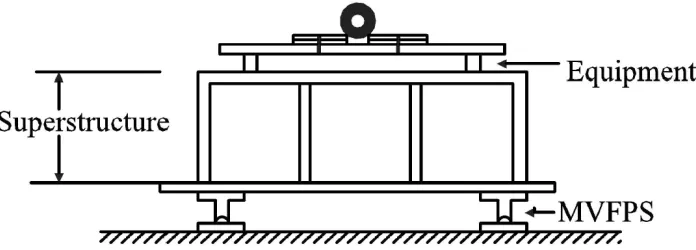
is considered at top. In this study, the response of building equipment system is carried out under six different near-fault ground excitations. Fig. 2 & 3 show one & five storey buildings with equipment at top isolated with MVFPS. Table 1 & 2 indicate characteristics of near-fault ground motion and properties of building & equipment.
Figure 2:One storey building with equipment isolated using MVFPS
Table 1: Characteristics of considered six earthquakes
Near-fault Ground excitation PGD (cm) (cm/s)PGV PGA(g)
1979, Imperial Valley (El Centro Array #5) 76.5 98 0.37
1979, Imperial Valley (E l Centro Array #7) 49.1 113 0.46
1994, Northridge (Newhall) 38.1 119 0.72
1992, Landers (Lucerne Valley) 230 136 0.71
1994, Northridge (Rinaldi) 39.1 175 0.89
1994, Northridge (Sylmar) 31.1 122 0.73
Table 2: Building and equipment properties
Mass of each floor 60080 kg
Storey stiffness for each floor 11260 kN/m
Equipment mass 1% of floor mass
Damping ratio of building 5%
Damping ratio of equipment 5%
Equipment –frequency 3.85 Hz
Ratio of base mass to floor mass 1.0
6. Results and discussion
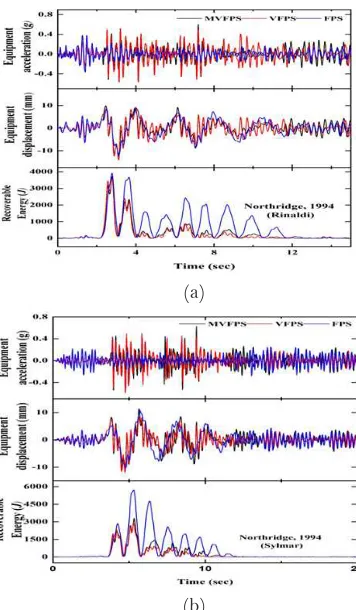
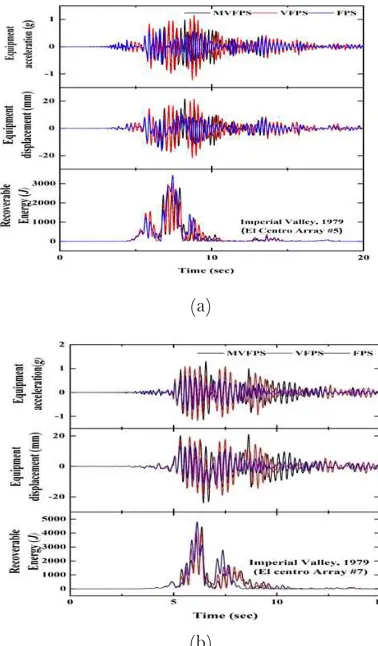
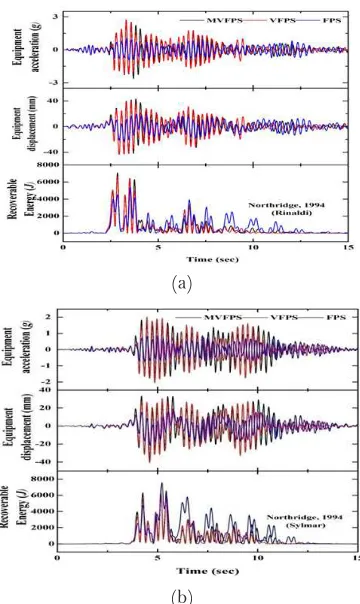
Fig. 4 to 6 depict time variation of equipment acceleration, equipment displacement and recoverable energy of building - equipment system of one storey building isolated using MVFPS, VFPS and FPS under near-fault ground motions and Fig. 8 to 10 depict time variation of equipment acceleration, equipment displacement and recoverable energy of building-equipment system of five
storey building isolated using MVFPS, VFPS and FPS under near field ground motions.
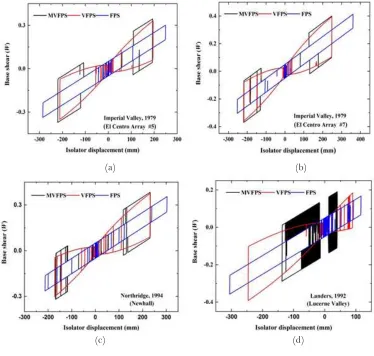
Fig. 7 and 11 demonstrate the hysteresis loops of MVFPS, VFPS and FPS for various near-fault ground motions for one and five storey buildings with equipment.
Table 3 & 4 shows comparison results of peak response quantities and isolator displacement and base shear under different earthquake ground excitations.
(b)
Figure 4: (a) and (b) Shows time vs. equipment acceleration, equipment displacement and re-coverable energy of single storey building-equipment isolated with MVFPS, VFPS and FPS
under Imperial Valley (El Centro Array #5) and Imperial Valley (El Centro Arra#7)
(a)
(b)
Figure 5: (a) and (b) Shows time vs. equipment acceleration, equipment displacement and recoverable energy of single storey building-equipment isolated with MVFPS, VFPS and
(a)
(b)
Figure 6: (a) and (b) Shows time vs. equipment acceleration, equipment displacement and recoverable energy of single storey building-equipment isolated with MVFPS, VFPS and
FPS under Northridge,1994 (Rinaldi) and Northridge, 1994 (Sylmar) Here in above figures, Fig 4 (a) & (b) shows
Time vs. equipment acceleration, displace-ment and recoverable energy of single storey building-equipment isolated with MVFPS, VFPS and FPS under Imperial valley (El Centro Array #5) in this earthquake ground excitations FPS is good compared to MVFPS and VFPS reducing equipment acceleration and equipment displacement But in case of recoverable energy VFPS show better per-formance compared to MVFPS and VFPS and in Imperial valley (El Centro Array#7) FPS is better in both equipment acceleration and equipment displacement compared to
MVFPS and VFPS and in MVFPS recover-able energy is less compared to VFPS and FPS.
In Fig 6 (a) Northridge 1994 (Rinaldi) in this earthquake ground excitations equipment ac-celeration and equipment displacement is less in FPS compared to MVFPS and VFPS and recoverable energy is less in VFPS and Fig 6 (b) shows that in Northridge 1994 (Sylmar)
earthquake ground excitations FPS shows robust performance compared to MVFPS and VFPS and also it founds that recoverable energy is very less in VFPS.
All the results value of Fig 4 to 6 shows in Table 3.
(a) (b)
(c) (d)
(e) (f)
(a)
(b)
Figure 8: (a) and (b) Shows time vs. equipment acceleration, equipment displacement and recoverable energy of five storey building-equipment isolated with MVFPS, VFPS and FPS
under different earthquake ground excitations
(b)
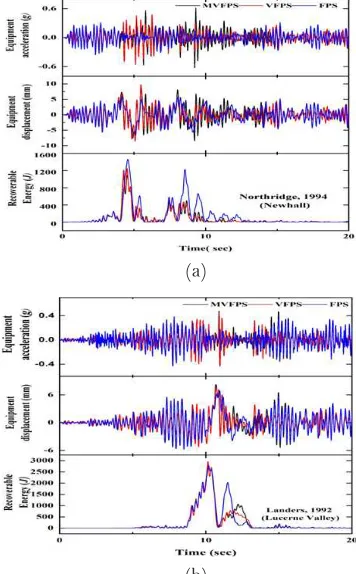
Figure 9: (a) and (b) Shows time vs. equipment acceleration, equipment displacement and recoverable energy of five storey building-equipment isolated with MVFPS, VFPS and FPS
under different earthquake ground excitations
(a)
(b)
Figure 10: (a) and (b) Shows time vs. equipment acceleration, equipment displacement and recoverable energy of five storey building-equipment isolated with MVFPS, VFPS and FPS
From above Figures, Fig. 8 (a) Imperial valley (El Centro Array#5) earthquake ground excitations shows that for five storey building-equipment system equipment acceleration and equipment displacement is less in FPS compared to MVFPS and VFPS and also recoverable energy result less in MVFPS and in Fig 8. (b) Imperial valley (El Centro Array#7) in this earthquake ground excitations FPS is good compared to MVFPS and VFPS. and recoverable energy found less in VFPS,
Both Fig. 9 (a) Northridge 1994 (Newhall) (b) Landers 1992 (Lucerne Valley) shows that equipment acceleration, displacement and recov-erable energy is less in FPS compared to MVFPS
and VFPS.
Fig. 10 (a) Northridge 1994 (Rinaldi) in this earthquake excitations equipment acceleration, displacement and recoverable energy is less in FPS compared to MVFPS and VFPS and 10 (b) shows that in Northridge 1994 (Sylmar) earth-quake excitations equipment acceleration place-ment is high in VFPS but recoverable energy val-ue is less in VFPS compared to MVFPS and FPS. Result values of Fig. 8 to 10 Which depict Time vs equipment acceleration, displacement and recoverable energy of five storey building-equip-ment isolated with MVFPS,VFPS and FPS under different earthquake ground excitations shows in Table 3.
(a) (b)
(e) (f)
Figure 11: (a to f) shows Hysteresis loop of MVFPS, VFPS and FPS for five storey building with equipment under different earthquake ground excitations
Table 3: Comparison of peak response quantities under different earthquake ground exci-tations
Earthquake
groundmotion Isolator
N = 1 N = 5
Equipment
Accelera-tion (g)
Equipment Displace-ment (mm) Recover-able Energy (J) Equipment Accelera-tion (g)
Equipment Displace-ment (mm) Recoverable Energy (J) Imperial Valley,1979 El Centro (Array #5)
MVFPS 0.48 7.531 1846 0.988 21.527 2794
VFPS 0.49 7.342 1766 1.151 21.719 3068
FPS 0.29 6.315 3047 0.6614 16.656 3439
Imperial Valley,1979
El Centro (Array #7)
MVFPS 0.52 10.04 2749 1.1353 22.484 4496 VFPS 0.57 10.51 2966 1.176 19.536 4167 FPS 0.28 7.70 3277 0.7621 13.514 4792
Northridge 1994 (Newhall)
MVFPS 0.63 8.68 1118 2.445 45.56 2863 VFPS 0.56 9.85 1250 1.5456 29.993 2905 FPS 0.36 6.645 1463 1.148 18.116 2544
Landers 1992 (Lucerne Valley)
MVFPS 0.48 8.23 2798.1 1.417 25.58 3946 VFPS 0.46 7.59 2957 1.0616 24.717 4451 FPS 0.43 6.87 2798.3 1.0184 21.697 3939
Northridge 1994 (Rinaldi)
MVFPS 0.6 12.5 3710 2.7115 43.717 7068 VFPS 0.57 14.1 3590 2.7823 43.584 6629 FPS 0.38 12.1 3917 1.1105 23.326 5049
Northridge 1994 (Sylmar)
Table 4: Comparison results of isolator displacement and base shear under different earth-quake ground excitations
Earthquake
ground motion Isolator
N = 1 N = 5
Isolator
Dis-placement (mm) Base shear (W) placement (mm)Isolator Dis- Base shear(W)
Imperial Valley,1979 El Centro(Array #5)
MVFPS 245.68 0.3971 220.43 0.3713 VFPS 238.71 0.3836 211.61 0.351
FPS 283.56 0.3352 285.62 0.3372
Imperial Valley,1979 El Centro (Array #7)
MVFPS 265.23 0.4168 248.67 0.3997 VFPS 262.01 0.41 248.61 0.3949 FPS 363.44 0.4156 361.21 0.4131
Northridge 1994 (Newhall)
MVFPS 236.99 0.3884 232.26 0.3831 VFPS 237.87 0.3826 233.13 0.3771 FPS 321.37 0.3723 303.42 0.3552
Landers 1992 (Lucerne Valley)
MVFPS 264.39 0.4159 137.4 0.2882 VFPS 258.77 0.4063 246.06 0.392
FPS 320.62 0.3725 305.43 0.3572
Northridge 1994 (Rinaldi)
MVFPS 513.7 0.651 473.22 0.626 VFPS 513.43 0.6531 476.88 0.6207
FPS 573.87 0.6273 528.34 0.5815
Northridge 1994 (Sylmar)
MVFPS 414.32 0.5668 413.47 0.5651 VFPS 399.6 0.5494 387.18 0.5831 FPS 557.09 0.611 540.43 0.5931
The above Table 3 shows result of Fig 4. to 6 for one storey building and fig 8 to 9 for five storey building with building equipment. From Table 3 it is clearly shows that increasing number of storey equipment acceleration, displacement and recoverable energy also increased.
Table 4 shows result of Fig. 7 and 11 for different earthquake ground excitations. This table depict result of isolator displacement and base shear for one storey and five storey building.
7. Conclusions
The Base isolated multi-storied building with light weight equipment at top is analyzed to determine its response under near-fault ground excitations with the help of Newmark’s linear acceleration method. One
and five storey buildings with equipment system isolated with MVFPS are compared with that of FPS and VFPS. The different response quantities examined are equipment displacement, equipment acceleration and recoverable energy. Following conclusions are derived from this comparative study:
and equipment displacement as compared to VFPS and MVFP.
It is found that in MVFPS, base shear and isolator displacement are less as compared to that of VFPS and FPS. The amount of energy dissipation is higher in case of MVFPS than that of FPS and VFPS. From this study it show that MVFPS is more efficient in reducing recoverable energy than FPS, but less efficient than VFPS.
References
[1]P. Murnal and R. Sinha, “Aseismic design of structure –equipment systems using variable frequency pendulum isolator”,
Nuclear Engineering and Design, vol. 231, pp. 129 – 139, 2004.
[2] L. Lu, “Near-fault seismic isolation using sliding bearings with variable curvatures”, 13th World Conference on
Earthquake Engineering, Canada, 2004
[3] M. Joshi, V. R. Panchal and D. P. Soni, “Aseismic design of building equipment system using conical friction pendulum isolator”, International Journal of Emerging Technology and Advanced Engineering , vol. 8, pp. 10 – 16, 2018.
[4] V. Bhayani and V. R. Panchal, “Seismic response of building-equipment isolated with polynomial friction pendulum isolator”, 2nd International Conference on
Current Research Trends in Engineering and Technology, Vadodara, 2018.
[5] A. Shaikhzadehi and A. Karamoddin, “Behaviour of sliding isolators with variable friction under near-fault earthquakes”, 7th International Conference
on Earthquake Engineering and Seismology, Iran, May 2015
[6] P. R. Bhavsar and V. R. Panchal, “Seismic behavior of multi-storied building isolated with modified variable friction pendulum system under harmonic
ground motions”, International Conference on Technology and Management (ICTM),
17th-18th February, Visnangar, Gujarat,
![Figure 1: Friction coefficient variation of FPS, VFPS and MVFPS [6]](https://thumb-us.123doks.com/thumbv2/123dok_us/8783508.1762882/2.522.114.441.355.586/figure-friction-coefficient-variation-fps-vfps-mvfps.webp)