Journal on Today’s Ideas – Tomorrow’s Technologies, Vol. 2, No. 2, December 2014 pp. 79–91
DOI: 10.15415/jotitt.2014.22006
Parametric Seismic Analysis of Tall Buildings
with Different Geometry and Constant Plan Area
AshIsh MOhAN shIVhAre1, K.K. PAThAK2,*, s.K. Dubey1
1Department of Civil engineering, MANIT, bhopal (MP) 462003, India
2Department of Civil and environmental engineering, NITTTr, bhopal (MP) 462002, India
*Email: [email protected]
received: August 18, 2014| revised: september 12, 2014| Accepted: November 11, 2014 Published online: December 30, 2014
The Author(s) 2014. This article is published with open access at www.chitkara.edu.in/publications
Abstract: In this study, seismic analysis of high rise building frames have been
carried out considering four buildings of different geometrical plan but same area , three diaphragms and four seismic zones. In this way total 48 frames were analysed for 27 load combinations. sTADD-Pro software has been used for analysis purpose. structural analyses results are collected in terms of maximum moments in columns and beams, storey displacement, peak storey displacement which are critically analysed to quantify the effects of various parameters.
Keywords: seismic; Maximum moment; base shear; storey displacement;
Peak storey displacement; Diaphragm
INTRODUCTION
Tall buildings are a special class of structures with their own peculiar characteristics and requirements (Chopra 1995). Tall buildings are often occupied by a large number of people. Therefore, their damage, loss of functionality, or collapse can have very severe and adverse consequences on the life and on the economy of the affected regions. each tall building represents a significant investment and as such tall building analysis is generally performed using more sophisticated techniques and methodologies. Therefore, understanding modern approaches to seismic analysis of tall buildings can be very valuable to structural engineers and researchers. behaviour of tall structures to seismic forces has to be critically examined considering various geometrical and seismic parameters. some of the prominent literature on the topic are as follows
shivhare, A. M. Pathak, K. K. Dubey,s. K.
Parametric seismic Analysis of Tall buildings with Different Geometry and Constant Plan Area satisfying all requirements of strength and ductility may still be subjected to
severe nonstructural damage, if the interstorey drifts are not restricted properly by means of shear walls. several stringent deflection criteria as well as a damage control index are introduced to be conscientiously determined and checked during the design calculations for the purpose of controlling damage especially to nonstructural elements. seong-Kwon Moon and Dong-Guen Lee (1994) adopted the rigid floor diaphragm assumption for the analysis of multistorey building structures because of the simplicity in the analysis procedure.
The objective of the present study is to investigate the effectiveness of building frame, considering different geometrical plans with constant area under various seismic parameters. This is achieved by doing comparative analysis of the building frames with rigid diaphragm, semi-rigid diaphragm and without diaphragm building frames. Analyses results are critically studied to reach to some concrete conclusions.
METHODOLOGY
This study includes comparative study of behaviour of high rise building frames considering different geometrical plan but constant area configurations and diaphragm constraints under earthquake forces. A comparison of results in terms of moments, displacements has been made. Following steps are adopted in this study:
step-1 selection of building geometry, bays and story (4 geometry)
step-2 selection of diaphragm models - without diaphragm, semi rigid diaphragm and rigid diaphragm (3 types)
step-3 selection of 4 seismic zones (II, III, IV, V)
step-4 Formation of load combination (27 load combinations) step-5 Modelling of building frames using sTADD.Pro software
step-6 Analyses considering different diaphragm models, seismic zones and each load combinations (48 cases )
step-7 Comparative study of results in terms of maximum moments in columns and beams, story displacement, peak story displacement.
STRUCTURAL MODELLING AND ANALYSIS
(a) Modelling of building frames
shivhare, A. M. Pathak, K. K. Dubey,s. K.
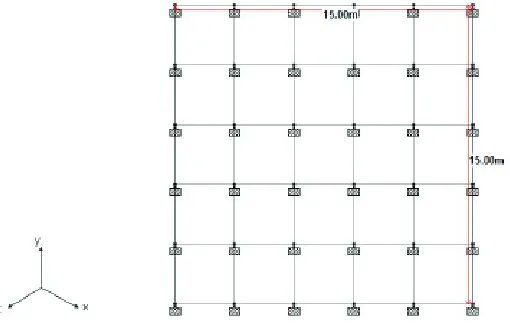
CAse-1:
squarein plan area is 225 sq. m and 13 storey height.
CAse-2:
rectanglein plan area is 225 sq. m and 13 storey height.
CAse-3:
Trapezoidalin plan area is 225 sq. m and 13 storey height.
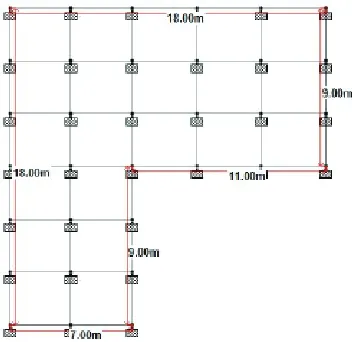
CAse-4:
L-shapein plan area is 225 sq. m and 13 storey height.
structural models for the four cases are shown in Fig. (1-4). No. of beams and columns for these cases are given in Table 1. Modeling of the building frames are carried out using the GuI of sTAAD.Pro software (ref.11) .
Figure 1: structural model of CAse-1
Parametric seismic Analysis of Tall buildings with Different Geometry and Constant Plan Area
Figure 3: structural model of CAse-3
Figure 4 : structural model of CAse-4
(b) Types of diaphragms
The following three types of diaphragm conditions have been considered for
analysis-Type-A : Model without Diaphragm constraint.
Type-b : Model with semi rigid Diaphragm constraint in the plane of slab (XZ Plane).
shivhare, A. M. Pathak, K. K. Dubey,s. K.
(c) Material and geometrical properties
Following material properties have been considered in the modelling -Density of rCC: 25 kN/m3
Density of Masonry: 20 kN/m3
young’s modulus of concrete : 2x10⁴ N/mm2
Poisson ratio : 0.17
The foundation depth is considered at 2.0m below ground level and the typical storey height is 3.0 m. The column size is 450mm x 450mm, and the beam size is 230mm x 450mm.
(d) Loading conditions
Following loading are conducted for analysis -1) Dead Loads:
a. self wt. of slab considering 150mm thick slab = 0.15*25 = 3.75 kN/m2
b. Floor finish load = 1 kN/m2
c. Water proofing load on roof = 2.5 kN/m2
d. Masonry wall load = 0.25 x 2.55 x 20 = 12.75 kN/m 2_ Live Loads:
a. Live load on typical floors = 2 kN/m2
b. Live load on roof = 1.5 kN/m2
3) earthquake Loads:
All the building frames are analyzed for 4 seismic zones
The earthquake loads are derived for following seismic parameters as per Is: 1893(2002)
a. earth Quake Zone-II,III,IV,V b. response reduction Factor : 5 c. Importance Factor : 1
d. Damping : 5%
e. soil Type: Medium soil
Table 1: No. of beams and columns in different cases
CAse
MeMber CAse-1 CAse-2 CAse-3 CAse-4
Columns 540 525 510 495
Parametric seismic Analysis of Tall buildings with Different Geometry and Constant Plan Area
(e) Structural Analysis
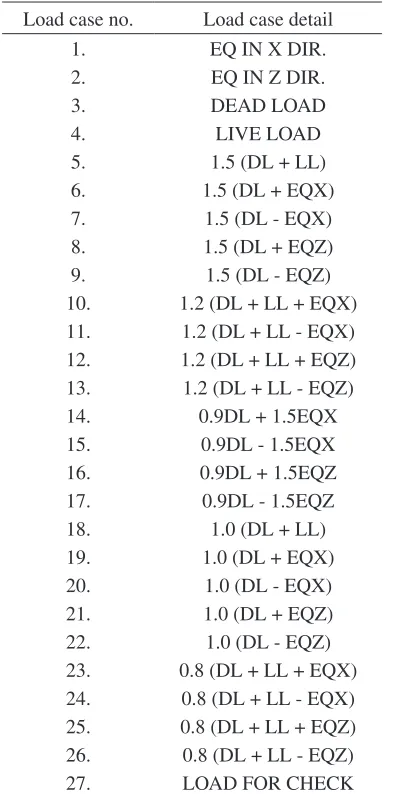
structural analyses of the building frames are carried out using sTAAD.Pro software (ref.11) . All the columns are rigidly supported at ground and 27 load combinations, given in Table 2, are considered for the analysis purposes. Application of boundary and loading conditions are done through the GuI mode of software.
Table 2: Load Combinations.
Load case no. Load case detail
1. eQ IN X DIr.
2. eQ IN Z DIr.
3. DeAD LOAD
4. LIVe LOAD
5. 1.5 (DL + LL)
6. 1.5 (DL + eQX)
7. 1.5 (DL - eQX)
8. 1.5 (DL + eQZ)
9. 1.5 (DL - eQZ)
10. 1.2 (DL + LL + eQX) 11. 1.2 (DL + LL - eQX) 12. 1.2 (DL + LL + eQZ) 13. 1.2 (DL + LL - eQZ)
14. 0.9DL + 1.5eQX
15. 0.9DL - 1.5eQX
16. 0.9DL + 1.5eQZ
17. 0.9DL - 1.5eQZ
18. 1.0 (DL + LL)
19. 1.0 (DL + eQX)
20. 1.0 (DL - eQX)
21. 1.0 (DL + eQZ)
22. 1.0 (DL - eQZ)
23. 0.8 (DL + LL + eQX) 24. 0.8 (DL + LL - eQX) 25. 0.8 (DL + LL + eQZ) 26. 0.8 (DL + LL - eQZ)
shivhare, A. M. Pathak, K. K. Dubey,s. K.
RESULT AND DISCUSSION
results of structural analyses can be described under following heads -
a. Moments in columns and beams
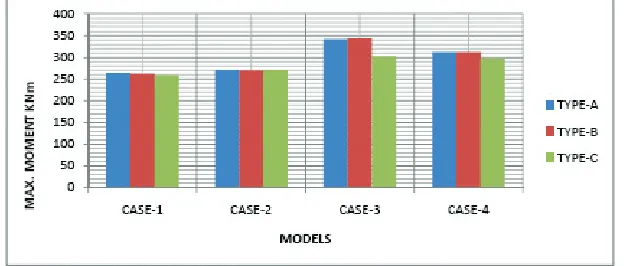
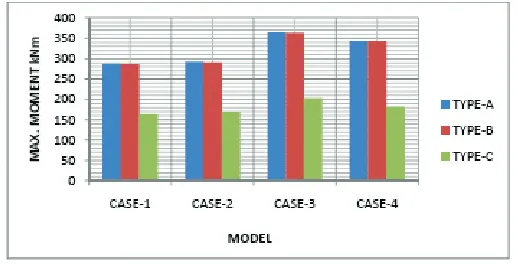
Minimum and maximum moments in columns for different cases are shown in Fig. 5 and 6. The minimum moment in column are observed in TyPe-C, CAse-1 and ZONe-II and the maximum moments are observed in TyPe-b, CAse-3 and ZONe-V. It is also found that the moments in columns are less than moments in beam TyPe-A and TyPe-b but in TyPe-C it is inverse means moment in beam in TyPe-C is less than column moment in TyPe-C. Moment in columns decreases from TyPe-A to TyPe-C and it is also observed from graphs that in CAse-3 moments are maximum in both beam and column.
Figure 5 : Graph of min. moment in column TyPe-C, CAse-1
and ZONe-II
Parametric seismic Analysis of Tall buildings with Different Geometry and Constant Plan Area Minimum and maximum moments in beams for different cases are shown
in Fig. 7 and 8. The minimum moment in beam are observed in TyPe-C, CAse-1 and ZONe-II and the maximum moments are observed in TyPe-A, CAse-3 and ZONe-V. Moment in beam decreases from TyPe-A to TyPe-C. It can be observed that variation in moments with respect to types is maximum in beam than column irrespective of cases. hence beam moments can be drastically reduced using rigid diaphragm model.
Figure 7 : Graph of min. moment in beam TyPe-C, CAse-1 and ZONe-II
Figure 8 : Graph of max. moment in beam in TyPe-A, CAse-3 and
ZONe-V
b. Storey displacement
shivhare, A. M. Pathak, K. K. Dubey,s. K.
Figure 9 : Graph of min. storey displacement in TyPe-C ZONe-II
(CAse-2), Z-direction
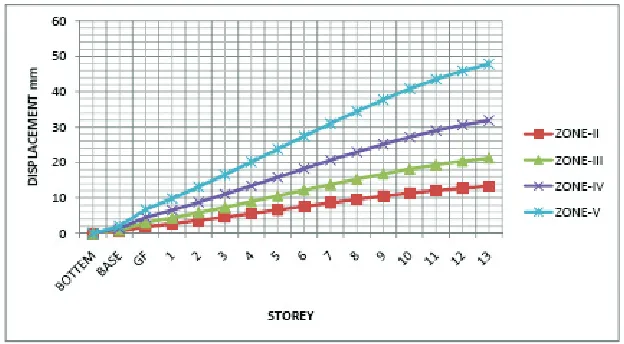
Figure 10 : Graph of max. storey displacement in TyPe-b, ZONe-V
(CAse-4), X-direction
Parametric seismic Analysis of Tall buildings with Different Geometry and Constant Plan Area
c. Peak storey displacement
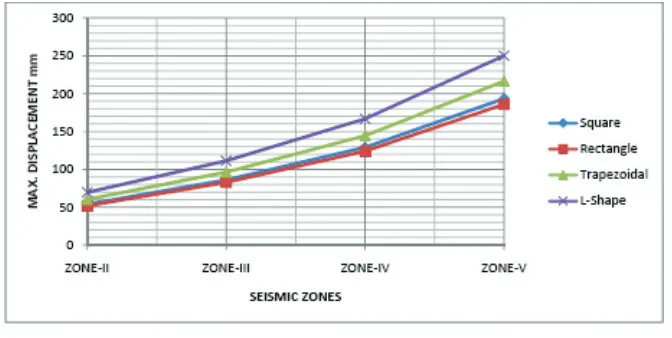
Minimum and maximum peak storey displacement are shown in Fig. 11 and 12. The minimum peak storey displacement is in TyPe-C, CAse-2 and ZONe-II in X direction and the maximum peak storey displacement is in TyPe-A, CAse-4 and ZONe-V in X direction. The peak storey displacement in TyPe-C is less than half of TyPe-A and TyPe-b. It mean that TyPe-C stiffness is twice that of TyPe-A and TyPe-b. As per nature of graph, it is seen that CAse-2 has less peak displacement and CAse-4 has maximum peak displacement.
Figure 11 : Graph of min. peak storey displacement in TyPe-C, ZONe-II
(CAse-2), X-direction
Figure 12 : Graph of max. peak storey displacement in TyPe-A, ZONe-V
shivhare, A. M. Pathak, K. K. Dubey,s. K.
CONCLUSIONS
In this study, performance of building frames are studied considering various geometrical and seismic parameters. For this 48 frame cases are analysed considering 27 load combinations. result of this parametric study shows that diaphragm modelling has major influence on moment and displacement. Moments in beams are more sensitive to diaphragm models than that of columns. It has been found from the analysis of various building with different geometry plans but same area that the rigid diaphragm is more effective in case of a building of nearly rectangle in plan. The analysis done in the present study clearly shows that semi-rigid diaphragm models produce more frame displacement and moments than the rigid diaphragm models. Although, no building in real sense, can be provided with a perfect rigid diaphragm, it can be concluded that the structural economy of the building shall be proportional to the degree of rigidity of the diaphragm.
REFERENCES
[1] Chopra, A. K., Dynamics of structures : Theory and Applications to earthquake engineering Prentice-hall. Inc., englewood Cliffs, New Jersey, 1995.
[2] Dong-Guen Lee, hyun-su Kim, Min hah Chun, efficient seismic analysis of high-rise building structures with the effects of floor slabs, engineering structures, 24(5),2002, 613-623. http://dx.doi.org/10.1016/s0141-0296(01)00126-2
[3] Guoxin Wang, Weizheng Wang, Katayoun b. Aafshar, Dragi Dojcinovski, seismic instrumentation of high-rise buildings, Progress in Natural science, 19(2), 2009, 223–227. http://dx.doi.org/10.1016/j.pnsc.2008.06.011
[4] hong Fan, Q.s. Li, Alex y. Tuan, Lihua Xu, seismic analysis of the world’s tallest building, Journal of Constructional steel research, 65(5), 2009, 1206–1215.
http://dx.doi.org/10.1016/j.jcsr.2008.10.005
[5] ho Jung Lee, Mark A. Aschheim, Daniel Kuchma, Interstory drift estimates for low-rise flexible diaphragm structures, engineering structures, 29(7), 2007, 1375-1397.
http://dx.doi.org/10.1016/j.engstruct.2006.08.021
[6] Kai hu, yimeng yang, suifeng Mu, Ge Qu , study on high-rise structure with Oblique Columns by eTAbs, sAP2000, MIDAs/GeN and sATWe, Procedia engineering, 31, 2012, 474-480. http://dx.doi.org/10.1016/j.proeng.2012.01.1054
[7] Lucia Tirca, Liang Chen., The influence of lateral load patterns on the seismic design of zipper braced frames, engineering structures, 40(7), 2012, 536-555.
http://dx.doi.org/10.1016/j.engstruct.2012.03.017
[8] rana roy, sekhar Chandra Dutta., Inelastic seismic demand of low-rise buildings with soil-flexibility, International journal of Non-Linear Mechanics, 45(4), 2010, 419-432.
http://dx.doi.org/10.1016/j.ijnonlinmec.2009.12.014
[9] seong-Kwon Moon, Dong-Guen Lee; effects of inplane floor slab flexibility on the seismic behavior of building structure , engineer structure 16(2), 1994, 129-144.
http://dx.doi.org/10.1016/0141-0296(94)90038-8
Parametric seismic Analysis of Tall buildings with Different Geometry and Constant Plan Area
[11] user`s manual , sTADD-Pro. software, 2013
[12] Wilkinson s.M., hiley r.A., A non-linear response history model for the seismic analysis of high-rise framed buildings, Computers & structures, 84(5–6), 2006, 318–329.
http://dx.doi.org/10.1016/j.compstruc.2005.09.021