A Study of Notions of Participation and
Discourse in Argument Structure Realisation
Brian Murphy
PhD Computer Science
2007
Declaration
I hereby declare that this thesis is entirely my own work and that it has not been submitted as an exercise for a degree at any other university. I give permission to the Library to lend or copy this thesis upon request.
Acknowledgements
First and foremost I would like to thank my supervisor Carl. He was unfailingly generous with his time, and always provided hands-on support as this work developed. Working with him was a truly enjoyable and mind-broadening experience, which led me along winding path from computational linguistics to cognitive science. I would also like to thank the examiners Tim Fernando and par-ticularly Ellen Bard for their detailed and insightful comments – this work is much improved as a result.
General academic thanks to all my colleagues at the Computational Linguistics Group, for chats and for always being willing pilot participants. They and my undergraduate students also have to be thanked for keeping me sane over the years of study.
Thanks to my mother and father for getting me here in the first place. And thank you Clare for your endless patience, love and support – not to mention the copious quantities of great food that literally fuelled this thesis. A final special thanks to my son, whose impending arrival provided an extra special motivation during revisions.
Contents
1 Introduction 1
1.1 Semantic and Syntactic Assumptions . . . 7
1.2 Equivalence of Meaning . . . 9
1.3 Grammaticality and Acceptability . . . 10
1.4 Document Outline . . . 13
2 Review of Role and Linking Theories 15 2.1 Introduction . . . 15
2.2 A Prehistory of Linking . . . 19
2.2.1 The Indic Tradition . . . 20
2.2.2 The Chinese Tradition . . . 22
2.2.3 The Arabic Tradition . . . 23
2.2.4 The European Tradition . . . 25
2.2.5 Conclusion . . . 27
2.3 Atomic Role Approaches . . . 27
2.3.1 Derivative Approaches . . . 34
2.4 Localist Approaches . . . 38
2.5 Decompositional Approaches . . . 47
2.6 Prototype Approaches . . . 51
2.6.1 Derivative Approaches . . . 54
2.7 Discourse Approaches . . . 57
2.8 Conclusions . . . 58
3 Empirical Investigations of Argument Structure Realisation 60 3.1 Notes on Methodology . . . 61
3.1.1 Selection of Materials . . . 61
3.1.2 Judgement Experiments . . . 62
3.1.2.1 Selecting Participants . . . 63
3.1.2.2 Experimental Procedures . . . 63
3.1.2.3 Judgement Scales for Acceptability . . . 65
3.1.2.4 Annotation and Categorisation Exercises . . . 68
3.1.3 Corpus Experiments . . . 69
3.1.3.1 Tagging and Parsing . . . 70
3.2 Diathesis Acceptability Experiments . . . 71
3.2.1.1 The English Dative and Benefactive Constructions . . . 72
3.2.1.2 The English Passive Construction . . . 73
3.2.1.3 The German Passive Construction . . . 78
3.2.1.4 The Chinesebaandbeiconstructions . . . 80
3.2.1.5 Coding of Semantic Features . . . 83
3.2.2 The English Dative and Benefactive Diatheses . . . 89
3.2.2.1 Background . . . 89
3.2.2.2 Materials . . . 89
3.2.2.3 Procedure . . . 92
3.2.2.4 Results . . . 95
3.2.2.5 Discussion . . . 100
3.2.3 The English Passive Diathesis . . . 101
3.2.3.1 Background . . . 101
3.2.3.2 Materials . . . 102
3.2.3.3 Procedure . . . 102
3.2.3.4 Results . . . 103
3.2.3.5 Discussion . . . 104
3.2.4 The German Passive Diathesis . . . 104
3.2.4.1 Background . . . 104
3.2.4.2 Materials . . . 104
3.2.4.3 Procedure . . . 107
3.2.4.4 Results . . . 107
3.2.4.5 Discussion . . . 109
3.2.5 The ChinesebeiandbaDiatheses . . . 110
3.2.5.1 Background . . . 110
3.2.5.2 Materials . . . 110
3.2.5.3 Procedure . . . 112
3.2.5.4 Results . . . 113
3.2.5.5 Discussion . . . 114
3.2.6 Effect of Background Knowledge on Acceptability Responses . . . 115
3.2.6.1 Background . . . 115
3.2.6.2 Method . . . 116
3.2.6.3 Results . . . 117
3.2.6.4 Discussion . . . 118
3.2.7 Effect of Judgement Scales on Acceptability Responses . . . 118
3.2.7.1 Background . . . 118
3.2.7.2 Method . . . 120
3.2.7.3 Results . . . 121
3.2.7.4 Discussion . . . 127
3.2.8 General Discussion . . . 128
3.3 Corpus Validation Exercise . . . 130
3.3.1 Background . . . 130
3.3.2 Materials . . . 131
3.3.3 Procedure . . . 131
3.3.3.2 Automatic Coding . . . 134
3.3.4 Results . . . 135
3.3.5 Discussion . . . 137
3.4 Expert Annotation of Roles . . . 139
3.4.1 Background . . . 139
3.4.2 Materials . . . 139
3.4.3 Procedure . . . 140
3.4.4 Results . . . 141
3.4.5 Discussion . . . 143
3.5 Conclusion . . . 145
4 Conclusion 147 4.1 Modularity and Language Processing . . . 148
4.2 Competition in Clause Generation . . . 153
4.3 A Numerical Model of Linking in English . . . 158
4.3.1 Number of Proto-Roles . . . 162
4.3.2 Parameterisation . . . 165
4.3.3 Operation of the Model . . . 168
4.3.4 Evaluation . . . 172
4.4 Implications . . . 177
4.5 Final Remarks . . . 181
A Notations Used 183 B Experimental Materials 185 C Additional Tables and Figures 203 C.1 Diathesis Experiment Results . . . 204
C.2 Data Histograms . . . 216
C.3 Convergence of Rating Scale Data . . . 220
List of Figures
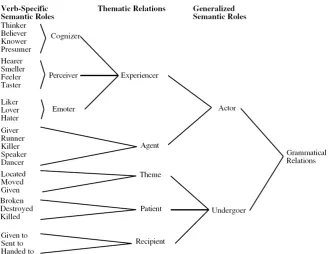
2.1 Van Valin’s hierarchy of role types (van Valin, 1999, figure 1, p.364) . . . 17
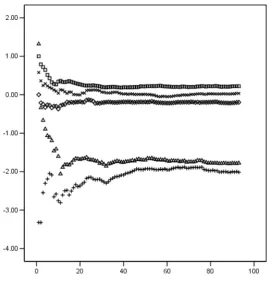
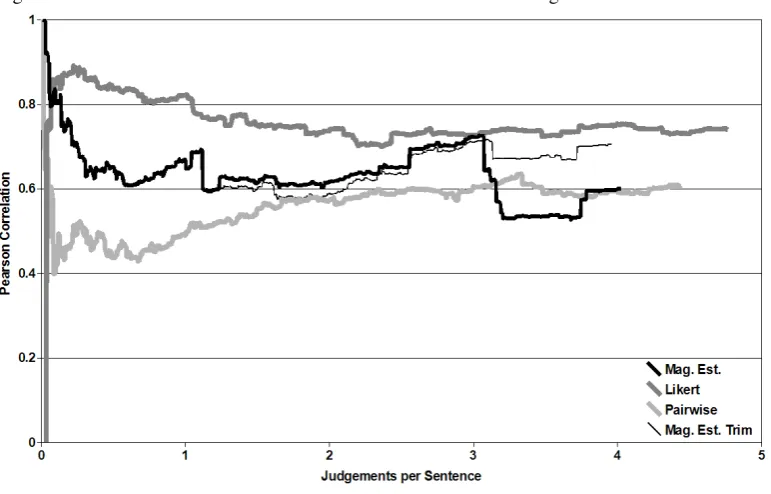
3.1 Convergence of mean judgement for practice sentences, as responses were received . 96 3.2 Convergence of median judgement for practice sentences, as responses were
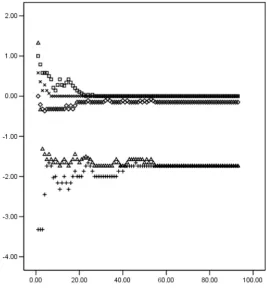
re-ceived . . . 97 3.3 Correlation of data from three measurement scales to a magnitude estimation
bench-mark . . . 124
4.1 Two modular views of sentence production . . . 149 4.2 Judged diathesis success scores and model predictions . . . 176
C.1 Histograms of simulated sampling distributions on acceptability of English experi-mental sentences . . . 217 C.2 Histograms of simulated sampling distributions on acceptability of English
experi-mental passive diatheses . . . 218 C.3 Histograms of simulated sampling distributions on acceptability of English
experi-mental dative/benefactive diatheses . . . 219 C.4 Correlation of data from three measurement scales to a magnitude estimation
bench-mark; upper tercile of sentences (most acceptable) . . . 220 C.5 Correlation of data from three measurement scales to a magnitude estimation
bench-mark; middle tercile of sentences (marginally acceptable) . . . 220 C.6 Correlation of data from three measurement scales to a magnitude estimation
List of Tables
2.1 Sowa (2000) role grid . . . 35
2.2 Some examples of Gruber’s verb features (1976, p.209) . . . 39
3.1 Summary of experimental materials for English acceptability experiment . . . 93
3.2 Effect of animacy on success of English dative/benefactive diatheses . . . 98
3.3 Relative contribution of semantic and discourse features to the English dative and benefactive diatheses . . . 99
3.4 Associations between determining factors of the Dative/Benefactive diatheses . . . . 100
3.5 Effect of animacy on success of English passive diathesis . . . 103
3.6 Relative contribution of semantic and discourse features to the English passive . . . . 103
3.7 Associations between determining factors of the English passive diathesis . . . 103
3.8 Summary of experimental materials for German acceptability experiment . . . 107
3.9 Effect of animacy on success of German passive by means of sentence difference scores . . . 108
3.10 Relative contribution of semantic and discourse features to the German passive . . . 109
3.11 Associations between determining factors of the German passive diathesis . . . 109
3.12 Summary of experimental materials for German acceptability experiment . . . 112
3.13 Effect of animacy on success of Chinesebeiandbaconstructions by means of sen-tence difference scores . . . 114
3.14 Relative contribution of semantic and discourse features to the Chinesebeiconstruction114 3.15 Relative contribution of semantic and discourse features to the Chinesebaconstruction114 3.16 Associations between determining factors of thebeiandbadiatheses . . . 115
3.17 Effect of existing background knowledge on judgements . . . 117
3.18 Effect of explicit context on judgements . . . 118
3.19 Effect of implicit context on judgements . . . 118
3.20 Comparison of response rates to Likert, Magnitude Estimation and Pairwise Com-parison measurement scales. . . 121
3.21 Pearson linear correlations between benchmark data and three judgement scales . . . 123
3.22 Spearman rank correlations between benchmark data and three judgement scales . . 123
3.23 Comparing means across groups of sentences . . . 125
3.24 Comparing means across groups of judgements . . . 126
3.25 Comparing means across groups of judgements, normalised for sample size . . . 126
3.26 BNC composition . . . 131
3.28 Correlations between selected features of common nouns and argument positions in
the British National Corpus . . . 137
3.29 Overview of responses for annotation exercise . . . 141
3.30 Confusion figures for annotation exercise . . . 142
3.31 Agreement measures over different role sets . . . 144
4.1 Correlations and weightings for Proto-Roles . . . 166
4.2 Correlations and weightings for Proto-Positions . . . 167
C.1 English benefactive and dative sentences, ranked by success of diathesis . . . 204
C.2 English benefactive and dative sentences, ranked by success of diathesis (continued) . 205 C.3 English related fillers sentences, ranked by success of diathesis . . . 205
C.5 English passive sentences, ranked by success of diathesis . . . 206
C.6 German passive sentences, ranked by success of diathesis . . . 207
C.7 German passive sentences, ranked by success of diathesis (continued) . . . 208
C.8 German passive sentences, ranked by success of diathesis (continued) . . . 209
C.9 German related filler sentences, ranked by success of diathesis . . . 210
C.10 Chinesebasentences, ranked by success of diathesis . . . 211
C.11 Chinesebasentences, ranked by success of diathesis (continued) . . . 212
C.12 Chinesebeisentences, ranked by success of diathesis . . . 213
C.13 Chinesebeisentences, ranked by success of diathesis (continued) . . . 214
Abstract
Chapter 1
Introduction
“And therefore, for any man to go about to add to their number, will be but like the inventing of a Disease, for which he can expect but little thanks from the World.”
Wilkins (1668, p.13) speaking on the prospect of new artificial languages
The work presented in this thesis is a contribution to the large body of work on the nature of linking – that is, how the conceptual form of situations determines the form of the expressions used to describe them. Rather than proposing an intricate representational model directly on the basis of an articulated theory (an artificial language of sorts), the approach adopted here is to row back on many of the assumptions made about the relationship between syntax, semantics and discourse. A series of empirical studies attempt to identify some of the properties of events and their participants that most strongly determine argument structure realisation in English. Some of these studies are then replicated in German and Chinese to test their language generality. No assumptions of modularity are made1, and features of semantics and discourse are equally entertained. In particular, this work
attempts to explain as much of linking as possible using general principles of grammar, rather than searching for explanations in the lexical semantics of individual verbs.
This chapter starts with an overview of different approaches that linguistics has taken to the question of argument linking, addressing the tension between language-general and verb-specific patterns: general phrase structure rules and transformations; lexicon-based listing approaches; se-mantic role category schemas; decomposition of verb lexical sese-mantics; prototype characterisations of argument structure positions; and approaches that look to elements of discourse structure and pragmatics to explain argument structure realisation. Three subsections then follow to examine the minimal assumptions made in this work: on the nature of semantics and syntax; equivalence of meaning in paraphrases and diatheses (i.e. alternations); and the relationship between theoretical grammaticality and judged acceptability. The chapter then concludes with an outline of the structure of this document.
The mapping between meaning and argument structure is certainly not a simple one, even within a single language. Across languages it varies widely, the opposition of nominative and ergative languages being the most dramatic one. Early generative accounts of argument structure realisation (Chomsky, 1957) provided a simple account of how argument structure patterns for a language were specified by universal phrase structure rules – a monotransitive sentence such as 1.1 could
1Neither in the global sense of Fodor (1983), nor in the language internal sense of Chomsky (e.g. 1986) or Bock and
be generated by the rules in 1.2. Diatheses such as the passive (1.3) could be accounted for by transformational rules (1.4).
(1.1) [S[NPJohn] [VPloves [NPMary]]]
(1.2) a. S→NP VP
b. VP→V NP
(1.3) Mary is loved by John
(1.4) NP1 V NP2→NP2beVbyNP1
However it is clear that additional constraints apply. For example a large class of predicative and stative verbs that take a single noun-phrase argument nevertheless resist passivisation (considerbe, resemble, seem, weigh), and there are many semantic constraints on admissibility of noun-phrases as verb arguments (consider*Golf played Johnand*Send Rome that package).2
Subsequent work in the generative semantics tradition (Katz and Fodor, 1963; Katz and Postal, 1964) suggested that verbs specified semantic features of admissible arguments by so-called selec-tional restrictions (e.g. the subject ofplayshould be animate; the object ofphoneshould be animate), but again it is easy to find counterexamples:
(1.5) I phoned [the hospital]inanimateagain after Christmas.3
Chomsky later suggested that the argument structure of basic clauses is projected from the lexical entry of the verb in question (Chomsky, 1981). Large-scale lexica have been constructed to specify the linking patterns between semantics and syntax for individual verbs (e.g. Fillmore, 1982; Palmer, 2000; Dorr, 2001) but these can miss important generalisation of the syntax semantics mapping (Levin and Rappaport Hovav, 2005, pp.20-24). Argument structures are not entirely arbitrary. For example, a wide class of verbs that denote tangible or metaphorical transfer (e.g. give, send;tell, teach) can undergo the dative diathesis (Levin, 1993). Some pairs of near-synonymous verbs, such asraise/rise,fell/fall,set/sitandlay/liecontrast an explicitly causative event (Agent-Patient) with one in which causation is either implicit or absent. A sentence of the first type, e.g. X raised Y, is often synonymous with a causative construction containing the counterpart from the second set, e.g. X made Y rise(though in this case the causation may not be as immediate). English also has many unaccusative verbs such asbreak or meltthat can appear with the transitive frame Agent– Verb–Patient also.4 But this pattern is not universally productive, as verbs of similar meaning may variously require a transitive construction (e.g.destroy), or an unaccusative (e.g. collapse) form, or accept either (e.g. break down) (1.6). Even such requirements are subject to exceptions – in (1.7) collapseis used transitively.5
(1.6) a. The hordes broke down/destroyed/*collapsed the city walls
b. The city walls broke down/*destroyed/collapsed
2The hash symbol ‘*’ is used to mark sentences that are syntactically illformed. See the appendix (page 183) for a list of
marks and other notations used. The use of such informal notation of acceptability is discussed in section 1.3.
3Radio Programme Summary. [http://www.rte.ie/radio1/liveline/1020814.html – viewed August 2007]
4Here unaccusative refers to any monotransitive verb with a patient-like subject, without making any commitment to the
Chomskyan conception of such verbs having an underlying object.
(1.7) ... a truck filled with high explosives ... drove into the lobby ... and detonated,collapsing all four floorsof that building down upon itself.6
Neither can listing approaches account for novel argument structures, such as the use of gold-watchas a verb below (1.8), or the transitive use of the verbsneezeto express caused motion (1.9).
(1.8) G.W. Dickinson, ex-superintendent of the Montana Union, has been gold-watched by the employees of the company.7
(1.9) Sally sneezed the napkin off the table8
Construction Grammar accounts (Fillmore and Kay, 1987; Goldberg, 1995, 2006) have suggested that argument structures should be seen as lexical entities in themselves, which can be polysemous, in the same way that words are: central senses are related to the prototypical use of an argument structure, and other senses can be derived by relaxing the central definition (see Goldberg, 1995, chapter 3) or by metaphorical extension (e.g. compare give someone a toyandgive someone a headache). For example the dative construction (1.10) is viewed by Goldberg as having six senses (1995, p.75), with the five non-central senses inheriting most of their structure from the central sense. But clearly, such an approach is similarly subject to the problems of delineating word senses in the lexicon, and in deciding which sense a particular utterance expresses (see for example Robins, 1987; Geeraerts, 1993; Kilgarriff, 1997a,b).9
(1.10) a. ‘XCAUSESYTO RECEIVEZ’ (central sense) Example: Joe gave Sally the ball.
b. Conditions of satisfaction imply ‘XCAUSESYTO RECEIVEZ’
Example: Joe promised Bob a car.
c. ‘XCAUSESYNOT TO RECEIVEZ’ Example: Joe refused Bob a cookie.
d. ‘XACTS TO CAUSEYTO RECEIVEZ at some future point in time’ Example: Joe bequeathed Bob a fortune.
e. ‘XENABLESYTO RECEIVEZ’ Example: Joe permitted Chris an apple.
f. ‘XINTENDS TO CAUSEYTO RECEIVEZ’ Example: Joe baked Bob a cake.
A final problem for listing approaches is that argument structure patterns change over time. Some verbs, such asprogressandconverge, are now being used transitively (1.11, 1.12), although they were previously intransitive (both are listed as having intransitive subcategorisation frames only in theCOMLEXcomputational lexicon, Grisham et al., 1994). Recently there has also been an increased
6US Marine Spokesman Major Robert Jordan on BBC Radio report, 23rd October 1983.
7The MadisonianNewspaper, Montana, February 1889. [http://www.stcboston.org/archives/articles/nouns.shtml] 8Goldberg (1995, p.6)
9Identifying sense distinctions is rated by editors as one of the most difficult tasks in dictionary making (Kilgarriff, 1997a,
use of nouns being used as verbs directly (1.13, 1.14), replacing light verb constructions such ashave an impactandmake a transition.10
(1.11) “There is a very detailed statutory review process required prior to the designation of any new university and there are significant wider issues that need to be considered in progressingthat.11
(1.12) Scientists will be discussing what has been dubbed “Tower of Babel" technology - soft-ware that canconvergedifferent wireless gadgets into a single device.12
(1.13) The Sudanese government has said it will not agree to the African Union force in Darfur beingtransitionedinto a UN force.13
(1.14) He added recent developments had removed “a number of near-term uncertainties that have beenimpactingthe company recently".14
Communities of speakers can quickly innovate distinctive speech patterns, particularly when their experience of an event type differs from that in the wider community. The verbtransitionbelow seems to have emerged from the assimilation of returning of soldiers to civilian life in the United States at the end of the Second World War.15
(1.15) They were being “transitioned" into teachers of mathematics, physics and engineering. I asked if this were not a form of beating “swords into plough shares” ...16
The verbholdis used intransitively in commercial air transport – while an air traffic controller can speak (transitively) of holding an aircraft at a particular altitude, while it waits to land, pilots also speak of holding (intransitively) at that altitude. Confusion between this technical use and the word’s more conventional sense has caused at least one accident.17
Perhaps the earliest account in the Chomskyan tradition that attempted to generate argument syntax entirely on semantic principles was Fillmore (1968). Fillmore suggested an inventory of se-mantic classes of argument (initially termedcases, later calledroles) which determined the form of their syntactic realisation – in particular what arguments would be realised as subject and direct ob-ject and what prepositions would introduce other phrases. However this and other related approaches suffered from profound problems of decidability (Fillmore, 1977a; Dowty, 1989). It was not clear what criteria could be used to put an upper limit on the number of roles in an inventory, nor how each argument of an utterance could be uniquely and unambiguously assigned a single role label (Fillmore’s and related approaches, and their limitations, are discussed at length in section 2.3).
10The first attested examplesimpactandtransitionas transitive verbs recorded by the Oxford English Dictionary are 1945
and 1975 respectively, and they appear to have originated in technical usage in North America. Taking newspaper archives as a guide, their use appears to have increased approximately three-fold and ten-fold respectively over the last twenty years. They are now being used productively in non-technical contexts outside of North America, for example by speakers of South African (1.13) and British English (1.14).
11Department of Education spokesperson, quoted in the Irish Examiner Newspaper, 11th September 2006. 12BBC News Website, 27th September 2006 [http://news.bbc.co.uk/2/hi/technology/5382086.stm].
13Jane’s Information Group Website [http://www.janes.com/defence/news/jdw/jdw060911_1_n.shtml, viewed 11th
September, 2006].
14“Smallpox scare is good news for Acambis”,Guardiannewspaper, 13th September 2006.
15Half the stories returned by the Google News Archive [http://news.google.com/archivesearch] before 1970 concern
mil-itary themes.
16Gettysburg TimesNewspaper, October 30th, 1960.
Localist approaches (Gruber, 1965; Jackendoff, 1972, 1983, 1990) attempted to describe verb-argument relations in terms of analogy to the spatial domain (section 2.4). For example, the partici-pantMaryin (1.16a) would be classed as a Goal argument, because it shares the prepositiontowith the physical endpoint (Goal)Belfastin the clause (1.17a).
(1.16) a. Post the letter to Mary
b. Post Mary the letter
(1.17) a. Post the letter to Belfast
b. * Post Belfast the letter
While this approach suffered from similar decidability problems to those of non-localist role inven-tories, it contributed some innovations to the literature on linking. Jackendoff (1972) proposed that a hierarchy of semantic roles, similar to that used by Fillmore (1968) for subject and object selection, could also determine the realisation of structures such as reflexives and passives (see Levin and Rap-paport Hovav, 2005, chapter 6 for a view of hierarchy based approaches). He also used a predicate decomposition of the semantics of individual verbs to describe their behaviour and the role class of their arguments. For example the verbbreakmight have a lexical entry such as:
(1.18) cause(Agent,change(Theme, Not Broken, Broken))
Predicate decompositions of this type have been used by many authors (e.g. Rappaport and Levin, 1988; Pinker, 1989; Croft, 1993; Krifka, 2004; Beavers, 2004) to posit semantic representations that would account for patterns of diathesis realisation (see section 2.5). An early account by Pinker (1989) suggested that verbs that could appear in the dative diathesis (such as bring, send, give) had two closely related but distinct senses: one involved movement of the Theme towards its Goal, while the second entailed final possession of the Theme by the Goal. The fact that locations cannot possess things, would rule out the sentence (1.17b). Similarly, thespray/loaddiathesis has been seen as expressing holistic affectedness of its direct object (Rappaport and Levin, 1988): thehayis fully loaded in (1.19a), and thetruckin in (1.19b).
(1.19) a. John loaded hay onto the truck.
b. John loaded the truck with hay.
While these are simple and elegant accounts, clear counter-examples can be found that demonstrate their rigidity. In (1.20) the double object construction is used despite the Goalhimnever being in possession of the Theme birthday cards. And it seems implausible in (1.21) that the amount of pesticidesprayed is being asserted, since it is in a generic reference.
(1.20) Grant Mann would have been 31 last Friday.His family sent him birthday cards, but he never received them, he was already dead.18
(1.21) EPA’s decision would make the acceptable exposure level of the pesticide one-tenth of what’s currently allowed, the Post said. Farmers will still be allowedto spray the pesti-cide on crops, but its agricultural use will be reduced to a degree not yet decided.19 18British National Corpus (BNC, Burnage and Dunlop, 1992) text K1K: Central Television news script.
19Associated Press story on environmental warning; reposted to a discussion forum on keeping skunks as pets, viewed
David Dowty (1989; 1991) addressed the brittleness of predicate decomposition approaches and the decidability problems of role approaches by making use of Rosch’s (1973) notion of prototypes to allow role membership to be graded. In this way an argument may be a strong ProtoAgent (in which case it will likely be realised as a subject), strong ProtoPatient (in which case it will try to appear as direct object) or it may be neither (tending to appear as an oblique). When two arguments are similarly good candidates for an argument position, then either or both may take that position. This flexibility accounts in part for truth-conditionally equivalent diatheses, such as the dative and bene-factive diathesis, and for the existence of synonymous verb pairs with opposing argument structures, such asplease/likeorfear/frightenandmeetorresemble. However Dowty cannot explain cases in which one or other of the diathesis variants is preferred for pragmatic and text structuring reasons (a full discussion is given in section 2.6).
The structure of discourse can also have effects on the realisation of argument structure. It is uncontroversial that in a wide range of languages, given information tends to appear earlier in a sentence than new information, to provide conversational continuity and aid the listener in placing the new content to come (this is termed cohesion). There is also a widespread tendency for long and unwieldy sentence constituents to be placed at the end of the sentence if possible – consider complement clefts, that relocate a subject complement after the verb (1.22b), and “postponements” (1.23b) where a relative clause dislocates from its noun phrase to move after a verbal particle (Biber et al., 1999, p.935). This may also interact with verb diatheses, such as (1.24).
(1.22) a. [That she had overcome her kleptomania and become a politician]compwas a source
of pride to her
b. It was a source of pride to her [that she had overcome her kleptomania and become a politician]comp
(1.23) a. ? He found something [that would change things forever]reltoutpart20
b. He found something outpart[that would change things forever]relt
(1.24) a. I baked youiobj[those currant buns that your friend from work that you introduced
me to yesterday was talking about]dobj21
b. ? I baked [those currant buns that your friend from work that you introduced me to yesterday was talking about]dobjfor youiobj
The perspective chosen by a speaker or writer can also have an effect on argument structure (cf. Talmy’s 1985 figure/ground and the viewpoint and focus of Langacker, 1990). The difference be-tween the verbsbuyandsellcan be seen as a choice of which participant (the purchaser or the vendor) is to be given prominence or has particular salience. If such alternate verb pairs are not available, the passive construction may be used to place what is ordinarily a verbal complement in the subject position. Some authors have also observed a degree of egotism in the choice of argument structures. Kuno (1976) suggests that speakers prefer to speak in the first or second person, than the third per-son, if available argument structures make this possible, and Fillmore (1977b) suggests that human, active participants have privileged access to the subject position. The “natural topic hierarchy” of Croft (1991) is essentially an anthropocentric scale for argument selection, by which speakers give prominence to situation entities with which they are more likely to identify or empathise.
20The question mark symbol ‘?’ is used to mark sentences that are questionably wellformed. See the appendix (page 183)
for a list of marks and other notations used.
It should be clear from this discussion that the mechanisms that determine the realisation of argu-ment structure are varied and controversial. Similar controversy continues on the nature of syntactic representations. Chomskyan models assume that syntax is entirely autonomous (Chomsky, 1986, 1995) of other parts of the linguistic faculty. Lexical Functional Grammar (Kaplan and Bresnan, 1982) allows interaction between distinct levels of representation for syntax, semantics and prag-matics, while Head Driven Phrase Structure Grammar (Pollard and Sag, 1994) adopts a monostratal approach. On the other hand, experimental work, such as that by Tanenhaus et al. (1995) and Ha-goort (2003) has suggested that both extralinguistic context, and general background knowledge, are quickly and apparently seamlessly integrated into online language processing (this evidence is discussed at greater length in section 4.1). Views of modularity (e.g. Fodor, 1983), have also faced theoretical challenge (Vigliocco and Hartsuiker, 2002).
As a result of these fundamental disagreements about the nature of the linguistic faculty in gen-eral, and about argument structure linking in particular, an empirical approach is taken in this thesis. First of all, as few assumptions as possible are made (these minimal assumptions about linguistic representations are described in the following section 1.1). An attempt is then made to identify what linguistic features have the strongest effect on the process of linking, or association with realised argument positions (chapter 3). In particular, features of verbal arguments, and of verb-argument relationships are examined – in common with some authors (e.g. Fillmore, 1968; Dowty, 1991) and in contrast with others (e.g. Levin and Rappaport Hovav, 2005).
The remainder of this chapter deals with some preliminary assumptions: on semantic and syn-tactic categories (section 1.1); on equivalence of meaning between paraphrases, and so diathesis variants (1.2); and on the nature of formal grammaticality and judged acceptability (1.3). An outline of the thesis follows (1.4).
1.1
Semantic and Syntactic Assumptions
In this thesis minimum assumptions are made on the nature of syntax. One syntactic quantity that is assumed is grammatical function. Nominative languages generally have syntactic means for differ-entiating subject (usually identified with causers, and with topical prominence) and object (identi-fied with affected parties) from each-other, and from more oblique arguments (Keenan, 1976; Dryer, 2005). Many also have a fourth function, that can be termed the indirect object, which patterns with marginally affected but animate participants (Palmer, 1994).
In the context of diatheses, canonical grammatical function is referred to. It is to be understood as the grammatical function that an argument would assume in a neutral unmarked case. If a speaker is to understand the nature of participation encoded by a verb’s relationship with its arguments, canonical grammatical function must be specified in the grammar: for example to recognise that the participant that is the subject ofbuymay also appear as thefrom-phrase ofsell, or to recognise the semantic parallelisms among the variants in (1.25).22 The alternative terms “logical subject/object”
or “deep subject/object” are avoided, out of a desire to avoid making commitments to a linguistic representation of utterances that differs from surface structures. This is roughly equivalent to a Davidsonian representation (1.25e), where predicate argument positions are conventionally linked to the English verb with which it shares its name, and grammatical function is assumed from the
22Such linking patterns may be specified in the lexical entry of every verb, or they may only be specified for verbs whose
ordering (conventionally Subject–DirectObject–IndirectObject–Other). However this does not entail that a fully articulated predicate representation of utterances has an independent existence. Such structures are only assumed in the lexicon. Such a semantic representation are not implausible, but empirical evidence is lacking to settle on its precise form.
(1.25) a. John sold a dud to Mary
b. John sold Mary a dud
c. A dud was sold by John to Mary
d. Mary was sold a dud by John
e. sell(e, John, Present, Mary)∧vendor(e, John)∧goods(e, Present)∧buyer(e, Mary)
For similar reasons, no appeal is made to the argument/adjunct distinction in this thesis. The prob-lems with this division are well known – for example, attempts to annotate argumenthood and ad-juncthood were abandoned in the Penn Treebank project, as consistent guidelines for identifying them could not be arrived at (Marcus et al., 1994).
This is the case particularly in the divergence between semantic and syntactic demands for argu-ments. Syntactic adjuncthood is typically defined by optionality – that is whether it can be omitted or not. Semantic adjuncthood is defined by compositionality – that is the contribution it makes to the description is independent of the meaning of the verb to which it applies. For example the verbeat could be said to have Food as a semantic argument, but it may go syntactically unrealised. Similarly a Location and Time argument is semantically necessary for every concrete verb (as tangible things necessarily happen sometime and somewhere), but these are syntactically optional for most verbs, though required for some (e.g.originate,last).
However from the point of view of the work described here, all relationships between verbs and their dependent clauses have semantic content, and therefore deserve to be described, as wide coverage role systems such asUNL do (Uchida and Meiying, 2001 – see next chapter). For the purposes of this thesis, all dependent clauses of a verb will be termed arguments.
On the referential nature of the semantic and discourse features considered here, a cognitive intensional model is followed. When deciding whether such and such an entity is, for example, Affected, it is the proposition encoded in the utterance that is referred to. Features should not be seen as attributes of verbs or nominals. That is, the subject of an agentive verb is not necessarily volitional, even though it may generally be the case (one can break something accidentally, for example) and an animate nominal is not necessarily aware (consider a person being pick-pocketed, or a patient in a coma). The proposition encoded in the utterance is considered independently of any modal or attitudinal predicates under which it is embedded – that is independently of both its ultimate truth and the degree of confidence the speaker is expressing in it.
(1.26) a. A rubber bullet hit him on the face
b. He was/got hit on the face by/with a rubber bullet
c. He might have been/got hit on the face by/with a rubber bullet
d. I think/suspect/doubt that he was/got hit on the face by/with a rubber bullet
e. He wasn’t/didn’t get hit on the face by/with a rubber bullet
If on the other hand the feature of Affectedness was specified in a lexical entry as Dowty (1991) suggests (and it is reasonable to assume that the entry for the canonical object of the verbhitwould involve affectedness), one would expect the passive construction in (1.27b) to be similarly well-formed to (1.26b-e). The fact that it is not suggests that the contribution of semantics to linking may be independent of modality and truth-conditions.
(1.27) a. A snowflake hit him on the face
b. # He was/got hit on the face by/with a snowflake23
1.2
Equivalence of Meaning
This thesis deals with meaning-preserving diatheses, and alternative choices of lexicalisation, whether within or between languages, and so presupposes the notion of sentential synonymy. While the importance of differences in pragmatic weight, or discourse function is recognised and treated ex-tensively, the notion of a relatively fixed “literal” or “propositional” meaning underlying sentence variants is also appealed to.
Quine refers to this as “empirical meaning” (1964, p.460), which is “what remains when, given discourse together with all its stimulatory conditions, we peel away the verbiage.” In reference to truth equivalence between sentences, he is interested in “broad synonymy [where] two sentences command assent concomitantly and dissent concomitantly” (Quine, 1960, p.62). Frege seems to agree that certain diatheses do not change meaning:
The sentences ‘M gave document A to N’, ‘Document A was given to N by M’, ‘N received document A from M’ all express exactly the same thought. (Frege, 1897, p.141)
The same notion is appealed to in the theory of translation. For example in legal translation, the objective is the “fidelity” of the target language text, and a differentiation is made between the “situ-ational equivalence” (i.e. literal meaning) and “pragmatic correspondence” (i.e. similarity of form) (Šarˇcevic, 1997, pp.2, 16, 79). In general translation, Larson (1984, pp.225) bases her Meaning-Based Translation approach on “primary meaning” which may be unchanged between several forms “which encode the same proposition”. Though Barnwell (1974, pp.170-171) stresses that “focus, emphasis and prominence” cannot be ignored in translation, she also recognises a “referential mean-ing” that remains unchanged by passive and dative diatheses. Stylistic or pragmatic factors may drive the choice of diatheses: Baker (1992, pp.99-110) mentions the use of the passive in technical English to convey objectivity, and Larson (1984, pp.245-247) comments on its use in Hebrew as a device to avoid direct reference to the Jewish god, but neither denote a propositional meaning that differs from their active counterparts.
23The hash symbol ‘#’ is used to mark sentences that are semantically illformed. See the appendix (page 183) for a list of
The relative stability of meaning through diatheses also has some experimental support. Honeck (1973) describes an experiment in which participants were asked to judge similarity of meaning between sentence variants. Base active sentences (such as 1.28a) were compared to several variants: passive versions (1.28b); active versions with nouns and verbs replaced by near-synonyms (1.28c); passive versions with near-synonyms (1.28d); and others in which canonical grammatical functions were exchanged (1.28e). Participants judged that the passive diathesis changed meaning least, while exchanging canonical functions changed meaning most.
(1.28) a. The struggle evoked the feelings that changed the lad
b. The feelings that changed the lad were evoked by the struggle
c. The fight produced the emotions that altered the boy
d. The feelings that changed the lad were evoked by the struggle
e. The feelings evoked the struggle that changed the lad
While some authors have claimed that the dative diathesis encodes subtle differences in semantics, attested examples such as (1.20) and (1.21) suggest that this may not be the case. In the diathe-sis experiments described in this thediathe-sis, acceptability judgements are heavily contextualised (with surrounding authentic text, and background descriptions) to constrain divergent interpretations of diathesis variants.
1.3
Grammaticality and Acceptability
Opinion differs on the nature of grammaticality or acceptability. An early scholar of Arabic, S¯ıbawa-yhi (see section 2.2.3) distinguished utterances as being ‘straight’ (intelligible) or ‘crooked’ (those from which no meaning could be extracted). ‘Straight’ utterances were further divided into those that were ‘good’ (wellformed) and ‘bad’ (illformed but still meaningful). Additional categories of acceptability that he appeals to are felicity (infelicitous sentences are ‘weak’) and frequency – something might be attested in use, but (in the view of a prescriptive grammarian) illformed (Bohas et al., 1990, pp.40-41).
It is common practice among contemporary linguists to use the asterisk to indicate that (in their, or their colleagues’ opinion) an utterance is not grammatical, and the question mark for those that are marginally grammatical. The question mark may also be used to signal a lower degree of confidence in the grammatical status of an utterance, and linguists often resort to ad-hoc combinations such as “*?” and “**” to express finer distinctions, though their precise usage varies (Schütze, 1996).
In Chomskyan grammars, wellformedness is entirely a syntactic phenomenon (Chomsky, 1957, p.15), independent of intepretability or plausibility: such a grammar would admit the first sentence below while rejecting the second, on the basis that the sequence of categories in the first (Adj-Adj-N-V-Adv) is licensed.
(1.29) a. Colorless green ideas sleep furiously
b. Furiously sleep ideas green colorless
from selectional restrictions being violated. These restrictions and the semantic properties on which they depend (such as animacy) are specified as syntactic features in the lexicon, so an utterance can be licensed without recourse to interpretation. The more fundamental phrase-structure rule violations of (1.30c) result in more profound ungrammaticality for Chomsky. Chomsky later modified this view by appealing to a competence/performance dichotomy, seeing grammaticality as a feature of (the inaccessible) competence and acceptability a (measurable) feature of performance (see Schütze, 1996, p.20).24
(1.30) a. John plays golf
b. Golf plays John
c. John plays and
Optimality Theory is an elaboration of Chomskyan principles in which the wellformedness of an utterance depends on the full set of candidate utterances that could communicate the same meaning or fulfil the same communicative goal (Prince and Smolensky, 1997). A strict hierarchy of discrete and universal constraints is used to select theoptimaland sole grammatical candidate utterance, dis-carding all other candidates as ungrammatical. It assumes that weaker constraints cannot ‘gang up’ on stronger ones, meaning that relative grades of ungrammaticality cannot be expressed (Legendre et al., 2006). Variations on Optimality Theory that permit ganging-up of constraint violations and allow for grades of grammaticality have also been proposed (e.g. Linear Optimality Theory, Keller, 2006).
Some other grammatical theories appeal to an absolute notion of grammaticality, such as that found in classical Chomskyan approaches, but admit considerations beyond syntax. In both Lexi-cal Functional Grammar (Kaplan and Bresnan, 1982) and Role and Reference Grammar (van Valin, unpublished) syntactic, semantic and pragmatic levels of representation are mutually constraining, and all must be wellformed and mutually consistent to yield a grammatical utterance. Head-Driven Phrase Structure Grammar (Pollard and Sag, 1994) demands unification (mutual satisfaction) be-tween its syntactic and semantic representations to construct a wellformed representation, and so allows the power of predicate logics to contribute to grammaticality.
However, there is ample empirical evidence that grammaticality is a more complex quantity (Schütze, 1996; Sorace and Keller, 2005). Psycholinguistic research has identified several be-havioural correlates of violations of linguistic wellformedness. Reaction-times in making gram-maticality judgements have been used to chart the development of language in both first and second language learners, varying continuously as a function of acquired competence (Wulfeck, 1993; Mc-Donald, 2000), and with the nature of the violation (Kail, 2004). Eye-tracking experiments can detect difficulties in parsing and comprehension during reading – eye-movements regress (back-track) to earlier points in a sentence, and the durations of these regressions vary with the degree of lexical and structural ambiguity (Rayner, 1998, pp.375, 387, 390-391).25 The location and dura-tion of these regressions can be used to study the processing of syntactic phenomena such as long distance dependencies (Traxler and Pickering, 1996).
24This approach has come in for considerable criticism (e.g. Wasow and Arnold, 2005, p.1484), for two reasons. Firstly,
it is curious to attempt to study an inaccessible phenomenon (grammaticality) when an accessible one is so easily accessed (acceptability). Secondly, any language phenomena that do not conform with a pre-existing theory can be dismissed as being subject to often unspecified “extralinguistic” performance factors. A theory made on such a basis is unfalsifiable.
25Eye-tracking equipment uses video cameras to identify the direction of gaze of each eye, by following the position of the
Electroencephalography (EEG) can be used to detect variations in voltage that have been shown to be elicited by either semantic or syntactic violations (Osterhout and Nicol, 1999).26 TheN400 voltage component is seen in response to semantic anomalies, such as violations of selectional re-strictions (e.g. The cat won’t bake...), while the P600 component appears for stimuli with low level syntactic anomalies, such as lack of agreement in inflectional forms (e.g.The cat won’t eating ...). However later work suggests that the “syntactic”P600 component also appears in response to thematic incongruities (such as the syntactically well formedThe hearty meal was devouring ...; Kim and Osterhout, 2005), that the “semantic”N400 component can be elicited by sentences that demand syntactic restructuring (such as garden-path sentences; see Bornkessel and Schlesewsky, 2006), and that the amplitude of anN400 is increased by a simultaneous syntactic violation (Ha-goort, 2003, combined semantic and syntactic anomalies within single noun phrases of Dutch, with structures such asThesingularsalty craftsmenplural). These complications, together with the fact that
theP600 component is also elicited by “oddball” stimuli in other modalities (e.g. a single image of an artefact, presented among a long sequence of animal images) means that it cannot be viewed as a unique identifier of grammatical violations. Imaging studies have also identified areas of the brain that respond differentially to syntactic and semantic violations.27 Ni et al. (2000) found increased activity around Broca’s area for verb form anomalies (e.g.Trees can grew) and around Wernicke’s area for semantic anomalies (e.g. Trees can eat). Newman et al. (2001) also elicited differential activations in both hemispheres of the brain for syntactic violations (word order errors, such asI cut Max’s with apple caution) and semantic violations (implausible sentences such asI sailed Todd’s ho-tel to China). However Kuperberg et al. (2000) failed to find any significant difference in activation between violations of verb selectional restrictions (e.g.My mother ironed a kiss) and verb syntactic valency (e.g.His father chattered the umbrella), despite having detected differences for wellformed but less plausible sentences such asThe woman painted the insect.
It has also been suggested that perceived acceptability, particularly markedness, is a function of frequency – that is we find an anomalous sentence strange, simply because we rarely or never hear such a structure. Even nominally ungrammatical phrases such asspeak propercan become accept-able, either by habituation, or a deeper process of grammaticalisation (see e.g. Tabor, 1993). For example, Greenbaum (1977) showed a very high correlation between judgements of the frequency and acceptability of several constructions (including the passive, subjunctive, and past/perfect tenses in English), and others have seen the statistical probability of a particular utterance, either as a string of words or in terms of its likely syntactic structure, as being a possible operationalisation of gram-maticality (see e.g. Manning and Schütze, 1999).
Acceptability, claimed usage and actual usage do not always correspond to each other neatly (Schütze, 1996, p.60). For example, Murphy and Vogel (2007) demonstrate that while the observed corpus prevalence of adjective co-ordinations (e.g. “black and white” versus “white and black”)
26Electroencephalography most commonly records small variations in voltage at the scalp, which are induced by neural
activity within the skull (recordings under the skin of the scalp, or within the skull are also possible). The most common paradigm for analysis are event-related potentials (ERPs): small deflections of voltage that can be discovered by taking grand averages over multiple participants and multiple stimuli, of electrical activity immediately following the anomalous point in each stimulus. Various components have been identified and they are usually named for their polarity, and the latency after stimulus onset at which they peak. For example, theN400 is a negative deflection, relative to the activity seen for wellformed stimuli, that typically peaks 400 milliseconds after onset.
27Magnetic resonance imaging (MRI) uses a combination of a magnetic field and radio energy to excite hydrogen nuclei in
is a good indicator of judged acceptability, the same cannot be said for the English relativisers that/which/who: despite its being judged acceptable by participants, a sentence such as (1.31), using the relativiserthatto modify a noun phrase that describes a human, is radically less frequent than a corresponding sentence usingwhoas the relativiser.28
(1.31) ... Perry Mason, a fictional TV lawyer that who helped the poor ...29
Given the difficulties in using the sorts of evidence just described, acceptability judgement exper-iments are perhaps the most appropriate general purpose methodology for investigating the well-formedness of individual utterances, as long as certain methodological precautions are taken (as are described in sections 3.1.2.2 and 3.1.2.3).
1.4
Document Outline
Chapter 2 is an extensive discussion of varied approaches to argument structure and linking, from pre-modern times, to the Generative revolution and beyond. The reader may choose to focus on the sections on lexical decomposition (2.5), proto-type approaches, most prominently that of Dowty (1991) (2.6), and explanations based on elements of pragmatics and discourse structuring (2.7), as these are more recent, and most relevant to the work presented here.
In the empirical chapter (3), the first set of experiments (3.2) compared the relative acceptability of diathesis variants in judgement exercises with native-speaker participants of three languages: En-glish, German and Standard Chinese.30 Diatheses are interesting, because they constitute minimal pairs, whose interpretation and pragmatic context is fixed (contextual descriptions were supplied for all items to control interpretation). By comparing the relative acceptability of diathesis pairs, the effect of syntactic, semantic and discourse constraints can be examined, independently of con-founding factors such as the overall plausibility of the sentence, the familiarity of its vocabulary, and the elegance or clumsiness of its expression. The diatheses chosen for these experiments were the dative/benefactive constructions in English, the passive construction in English and German, and the Chinesebei andbaconstructions (both of which have functional and structural similarities to the passive). These constructions were chosen because they are reasonably frequent in everyday language, involve manipulations of argument structure that involve nuclear grammatical roles (sub-jects and ob(sub-jects) and because they are all well-studied in the literature. The results showed that a range of pragmatic and semantic factors have a significant effect on the perceived wellformedness of diathesis forms, some of them in more than one language. The magnitude of some effects was also comparable to that elicited by clear violations of phrase structure.
A follow-on corpus experiment (section 3.3) attempted to validate some of the results of the judgement experiments on a larger scale, by searching for associations between argument structure positions, and lexical or morphosyntactic features that are known to pattern together with semantic and discourse features of interest (for example, lexical animacy is often a prerequisite for agency,
28A Google search yielded 58,300 documents for the phrase “lawyer who helped” and 339 documents for “lawyer that
helped”. Nevertheless, in an acceptability task (Murphy and Vogel, 2007), judges gave the sentence containing “the lawyer that” a mean acceptability score of 1.3 on a 7 point Likert scale, where +3 signified “perfect”, 0 signified “strange” and−3 signified “unacceptable”.
29BNC text B21: Non-fiction, Stephanie Spindler 1991,Learn to live.
30Standard Chinese, also known as Mandarin Chinese, is the official language of both the People’s Republic of China,
and definiteness is associated with givenness). While this did provide qualified support, the effect sizes were small.
An annotation exercise among trained linguists next aimed to evaluate the level of agreement that exists between experts on the proper semantic classification of verbal arguments (section 3.4). A set of semantic role labels (also termed thematic roles) was given to classify the arguments of an arbitrary set of English sentences. The degree of agreement seen varied from role to role, suggesting that some role categories might be better defined than others. Projections for several macro-role sets were compared to estimate what level of agreement they would be expected to garner, and the results suggested that schemes such as those of Dowty (1991) and Primus (1999) are superior to traditional role sets of greater granularity.
In the conclusion, the implications of the experimental results are discussed. They support the suggestion that many types of information come to bear, and that some form of competition is at play (compare La Heij, 1988; Dowty, 1991; Prince and Smolensky, 1997) during the linking process (see sections 4.1 and 4.2). In particular, the lack of an integrated approach, that allows syntactic, semantic and discourse features to operate together in the choice of argument structures, appears to account for many of the weaknesses of previous approaches.
Chapter 2
Review of Role and Linking Theories
2.1
Introduction
The dominant approach to linking in linguistics has been to assume a set of semantic categories (termed semantic or thematic roles), describing the relationship between verb and argument, partic-ularly the nature of the argument referent’s participation in the event denoted by the verb. In this chapter the development of notions of roles is charted at length, from precursors that came before Chomskyan linguistics, early approaches broadly within a Chomskyan syntactic framework, localist and other decompositional approaches within the discipline of semantics, through to more recent approaches that make use of Rosch’s notion of prototypes. A largely separate strand of research has looked to various discourse and pragmatic factors, such as information structure, topical salience and argument weight to explain linking patterns.
The remainder of this section introduces the notion of semantic (or thematic) roles, together with questions of the appropriate level of granularity that should be used in such inventories, and how they can be exploited in grammatical frameworks. A short review of related experimental evidence follows, before the section concludes with an outline of this chapter.
Role categories are generalisations over different notions of participation, most often used in the-ories of argument structure realisation. They describe the nature of the semantic relationship between arguments and the verbs that they are governed by, and are often assumed to be universal. Often they are limited to core arguments, but some approaches do reach further out into the sentences, such as the account of alternatingfor/toprepositional phrases in Wechsler (1991) or of nominalisations in Barker and Dowty (1993). A practical interlingua like the Universal Networking Language (Uchida and Meiying, 2001) aims to annotate all dependency relationships found in running text.
Roles are widely appealed to outside of lexical semantics. They are used as a descriptive de-vice in linguistics generally, in frameworks as diverse as Head-Driven Phrase Structure Grammar, Role and Reference Grammar, Lexical Functional Grammar, and Chomskyan theories as well being assumed in many works of neurolinguistics, psycholinguistics and computational linguistics. This is despite a notable lack of consensus on what set of roles should be used, and precisely how they should be defined. The following is a “textbook” description of typical participant semantic roles (Saeed, 1997, chapter 6):
Agent the (typically volitional) initiator, or doer of an action
Theme the entity whose state, movement or location is described
Experiencer the entity aware of, but not affected by the situation
Beneficiary the entity for which the action is performed
Instrument the entity with which the action is performed
Goal the location towards which an entity moves
Source the location away from which an entity moves
Circumstantial roles are sometimes also referred to, usually corresponding to the more oblique ar-guments in a sentence:
Cause the situation that precipitated this one
Condition situation that would precipitate this one
Purpose aim of the situation
Manner way in which a situation takes place
Measure extent (e.g. in cost, time or distance) associated with the situation
Location location at which the situation takes place
Temporal the time at which the situation takes place
Many variations on such typologies have been suggested. For example some see the Theme as simply a marginal or neutralised Patient. Variations on Agent include Effector (or Actor, a non-sentient, but active causer) and Instigator (an Agent who orders or encourages another Agent to act, without taking part themselves). Some suggest a Recipient role, while for others that is a subtype of Beneficiary; or alternatively both are subsumed in Experiencer. Experiencers are also sometimes treated as a kind of Patient, if their resultant cognitive state can be considered a form of affectedness. The spatial Source and Goal roles are also often generalised to cover non-spatial start and end-points, describing Reasons and Consequences, or Donors and Recipients.
A related question is that of granularity. As van Valin (1999) points out, many theories share a basic two-way opposition of what he calls Generalised Semantic Roles or Macro-Roles (see fig-ure 2.1), but disagree on how and to what extent the space below them should be carved up.1 A
compromise must be made between the detail of description provided by verb-specific roles, and the broader generalisations that can be expressed more efficiently with higher level roles. There is no obvious upper-limit on the number of roles that can be useful – Dowty (1991, p.553f) cites Lakoff who considered thirteen different varieties of Agent.
Many role based accounts specify (or assume) the uniqueness of role relationships with respect to a verb. By such a specification (e.g. Chomsky’s Theta Criterion, 1981) each syntactic slot of a verb is identified with a single role in the lexicon, and no slot can share a role label with another slot of that same verb. Extending this to sentences, arguments must be attached to one and only one role, and roles must be attached to one and only one argument (this condition applies with respect to a single verb, so it is not violated by raising verbs). While this seems like a reasonable proposal,
Figure 2.1: Van Valin’s hierarchy of role types (van Valin, 1999, figure 1, p.364)
it is not always clear which among several aspects of participation determine the role category of an argument. A Hearer may be classified as an Experiencer, but a Listener has both the causal volitional qualities of Agent, and the passive quality of an Experiencer. In a commercial transaction situation the buyer may be considered a Recipient and the vendor a Donor if one assumes that the goods are the more salient object. But since money also conventionally changes hands, the buyer can also be viewed a Donor and the seller a Recipient.
Verb diatheses, and near synonym verb pairs have also presented both puzzles and opportuni-ties for role theories. Verbs describing situations in which there is not a clear causal asymmetry between their arguments often come in pairs, such aslike/please, and it has often been a challenge to determine whether or to what extent their role specifications are shared, and further, how these specifications interact with the distribution of these verbs. Diatheses like dative shift or the passive pose similar challenges: for example are the roles identical between an active sentence and its pas-sive counterpart, and if so, what is the semantic determinant for making a choice between the two forms.
In fields outside linguistics, semantic role-like categories are often appealed to. Early artificial intelligence attempts at integrating semantics into sentence generation and parsing included Wilks (1975), who used semantic clause templates such as Agent-Action-Object, together with selectional restrictions for automated analysis, while Schank and Abelson (1977) used scripts (generalised ac-counts of episodic knowledge) whose slots resemble roles somewhat. This idea also shows up in sociology as “recipe knowledge", that is conventionalised “pragmatic competence in routine per-formances" (Berger and Luckmann, 1967, p.42). Role like categories also continue to be used in machine translation systems such as Dorr (1993); Dorr et al. (2004) (which is based on Jackendoff’s Lexical Conceptual Structure), Nyberg and Mitamura (2000) and Uchida and Meiying (2001).
state-of-the-art methods do not give direct access to the cognitive representations active during language processing. However a range of experiments have suggested that notions of participation and of saliency are co-active during language use, and have behavioural effects.
Early behavioural experiments in four languages (English, Italian, Turkish and Serbo-Croatian) (Slobin and Bever, 1982) established that young children (2 to 4 years old) default to a canonical sentence structure during comprehension of clauses containing unknown monotransitive verbs, in-terpreting subjects as agents and objects as patient. Lee (1996, p.306) found that Chinese children between the ages of 3 and 5 have difficulty producing sentences that diverge from the default clause structure, using the non-canonicalbei(agentive marker) andba(affectedness marker) constructions incorrectly.
Aphasics whose language deficit is primarily grammatical2 have also been shown to prefer default sentence schemas of Agent–Verb–Patient (Nicol and Love, 2000) and Experiencer–Verb– Stimulus (Piñango, 2006) during comprehension and production (for a Subject–Verb–Object lan-guage). Constructions that deviate from these defaults, such as passives, or object-gapped rela-tive clauses, cause particular difficulties for these patients (Love and Oster, 2002; Faroqi-Shah and Thompson, 2003).
Reaction time andEEGinvestigations of sentence acceptability suggest similar defaults. Tanen-haus et al. (1987) showed increased reaction times in a decision task on garden path sentences such asBill passed the test to his friendand Bornkessel and Schlesewsky (2006) showed that ambiguous German sentences that did not conform to an Agent–Verb–Patient or Experiencer–Verb–Stimulus pattern elicited an event-related-potential (P400) that is associated with structural reanalysis.
Structural priming experiments also provide evidence that aspects of structure and meaning are active during production and comprehension. A series of experiments by Katerine Bock and others have demonstrated that the use of a particular sentence structure increases the probability of it being reproduced in subsequent utterances. For example, all other things being equal, the choice of a double-object dative construction (such asgive her the gun) or of a NounPhrase–PrepositionalPhrase construction (such asgive the gun to her) is biased (i.e. primed) by the presence of one or other of these constructions in preceding discourse (Chang et al., 2003). Constituent ordering alone can be primed, as a sentence such as (2.1a) can prime the superficially similar but structurally distinct (2.1b) (ibid.p.32).
(2.1) a. The 747 was landing by the control tower
b. The 747 was alerted by the control tower
It has also been demonstrated that both sortal features (e.g. animate/inanimate) and role features (e.g. agent/patient) of an argument operate independently in structure priming. Bock et al. (1992) found that inanimate subjects in priming sentences promoted the use of inanimate subjects in an elicited utterance that followed, regardless of structural match or mismatch (primes and elicited utterances both came in active and passive forms). And Chang et al. (2003, p.33) showed that a sentence such as (2.2) primed (2.3a) over (2.3b) (both variants are identical in terms of the grammatical categories and semantic types of their arguments, but the first is more similar to 2.2 in terms of semantic role structure).
(2.2) The man sprayed wax on the car
(2.3) a. The workers scuffed dirt across the kitchen floor
b. The workers scuffed the kitchen floor with dirt
Finally, factors of discourse structuring have been shown to operate during sentence production. Arnold et al. (2000) gave pairs of participants a picture description task. The structures they produced tended to postpone heavy (i.e. long or structurally complex) constituents and those that are new to the discourse to the end of the utterance.
In this chapter the scene for semantic roles is set by examining early scholarship on argument structure, identifying ideas that were to resurface later after the advent of Chomskyan grammar (section 2.2). Then five main strands or approaches to roles for semantic description and argument linking are examined. The first (see section 2.3) is that first put forward by Fillmore (1968) of a small number of primitive atomic roles that form the core of a sub-syntactic representation to replace the deep structure of early Chomskyan theory. While the problem of proliferation of roles is a significant one, many variations on this theme have been suggested including Fillmore (1982), Somers (1987), Dixon (1991), Sowa (2000) and Uchida and Meiying (2001), some of which use situation or verb classes to constrain possibilities.
Localist approaches (section 2.4), introduced first by Gruber (1965) and developed by Jackend-off (1972, 1983, 1990), attempt to explain sentence structure via the prepositions used, and more generally by spatial analogy, though this often leads to indeterminacy of analysis. Predicate decom-positional theories (Rappaport and Levin, 1988; Pinker, 1989; Croft, 1993; Krifka, 2004) instead look to verb-internal semantics to explain the argument realisation patterns of particular construc-tions, but their rigid specifications of what structures are licenced do not seem to account for the full range of usage (section 2.5) .
Section 2.6 describes the prototype approach introduced by Dowty (1989, 1991) which addresses the overly rigid nature of previous explanations, and which has been expanded upon for integration into both generative (Baker, 1997; Reinhart, 2002; Haiden, 2005) and constraint-based grammar formalisms (Sanfilippo, 1990; Davis, 1996).
The final strand (section 2.7) addresses the effect of discourse related factors on argument realisa-tion. Several authors (Kuno, 1976; Fillmore, 1977b; Croft, 1991) have suggested that anthropomor-phic saliency (i.e. the speaker’s empathy or identification with event participants) is one determining factor in argument structure realisation, and others have added givenness and constituent weight to similar models.
The reader may choose to concentrate on the discussion of Dowty (section 2.6) and of discourse-based approaches (section 2.7) as they provide the main theoretical background to the type of model suggested by the empirical studies in the next chapter, and to examine section 2.5 as it introduces some phenomena that will be used for evaluation of a proposed model of linking presented in chapter 4.3.
2.2
A Prehistory of Linking
together with the approaches they had to explaining the relationship between verbs and their depen-dent clauses, in particular the manifestation of these relationships through word order, adpositions and morphological case-marking.
2.2.1
The Indic Tradition
In ancient India, the study of the sacred Hindu texts, theVeda, was accompanied by six auxiliary disciplines of knowledge, orved¯a˙nga. Besidesjyotís.a‘astronomy’ and kalpa‘ritual’, four were concerned with language: chandas‘meter’, ´siks.¯a ‘phonology’, nírvacana´s¯astra ‘lexicology’ and vy¯akaran. a‘ grammar’. The last two, in particular, are of interest because of their significant semantic content. Nírvacana´s¯astra was the study of words, and of how they came to bear their meaning (Kahrs, 1999, pp.xiii-xiv,48). Certain words were deemed to beanvartha“in accordance with that which it signifies”, that is to have metaphysical inherent meaning. This is similar to the biblical account of Adam naming animalsnominibus suis‘by their own names’ (Eco, 1995, pp.7-8), and can also be compared to the irreducible core of terms in the Natural Semantic Metalanguage (Wierzbicka, 1996). More generally, a paradigmatic model of word substitution under different contexts was used to explore the semantics of individual lexemes – effectively a synonymy-based theory.
Thevy¯akaran. a, or grammatical, tradition is best known through P¯an.ini’s work, theAs.t.¯adhy¯ay¯ı (circa 5C BC). This is considered by some to be an early forerunner of generative grammar (cf. Lyons, 1968; Paik, 1974) by virtue of its formal and productive nature. In addition to a surface anal-ysis of sentences by subject/predicate structure and case marking, as is seen in European traditions of grammar, P¯an.ini also postulated formal categories for word-class and grammatical function, over 4,000 technical rules, and two underlying structural representations.
Central to P¯an.ini’s theory of representation are the k¯araka: “factors in an action” (“facteurs de l’action”,Rocher, 1968, p.23) which apply to “direct participants in an action” (Kahrs, 1999, p.51). P¯an.ini uses them to account for the relations between semantic relations and case syntax, between passive and active sentences, and between verbs and their nominalisations. Crucially, the eight syntactic cases of Sanskrit are decoupled from the sixk¯araka categories (Verhagen, 2001, pp.278-283). P¯an.ini seems to have seen the verb as central to the sentence (as seen in the next examples, the verb bears subject case), and recognised two of the cases of Sanskrit, the vocative and the genitive, as being of a different semantic kind, as they do not describe any relationship to an action. The remaining six cases (nominative, accusative, dative, instrumental, ablative and locative) are prototypically associated with a particulark¯araka, but there is no one-to-one correspondence. Verhagen (2001, p.280) gives this translation of P¯an.ini’s original definitions, with modern equivalent terms:
kartr. The [k¯araka which functions] independent[ly with respect to other participants in a given action] is [termed] agent
karman That [k¯araka] which the agent most wishes to reach [through the action in question] is [termed] direct object
karan. a That [k¯araka] which, more than any other [participant in a given action] serves as means [for the accomplishment of that action] is [termed] instrument
<