A Fuzzy Sequential Pattern Mining Algorithm Based on Independent Pruning
Strategy for Parameters Optimization of Ball Mill Pulverizing System
Hui Cao, Yanbin Zhang, Lixin Jia, Gangquan Si
State Key Laboratory of Electrical Insulation and Power Equipment, Electrical Engineering School, Xi’an Jiaotong University, Xi’an,
Shaanxi, 710049, China
e-mail: [email protected], [email protected], [email protected], [email protected]
http://dx.doi.org/10.5755/j01.itc.43.3.5180
Abstract. This paper presents a fuzzy sequential pattern mining algorithm based on independent pruning strategy for parameters optimization of ball mill pulverizing system. Based on the Apriori-alike process, the proposed algorithm uses the independent pruning strategy to mine the fuzzy sequential patterns, which could enhance the efficiency of the algorithm. Then, the optimal values of the process variables are determined by a searching method with the mined sequential patterns. The improved fuzzy sequential pattern support and the fuzzy sequential pattern confidence are adopted to ensure the accuracy of the mined sequential patterns. Moreover, the sliding time window technique is used to ensure the completeness of mining results. The experimental results for parameters optimization of ball mill pulverizing system also verify that the proposed algorithm could determine the optimal values correctly and the running time is not long. In addition, the proposed algorithm has been put into practice successfully and the statistic data show that the pulverizing capability of ball mill pulverizing system is increased and the energy consumption would be reduced.
Keywords: ball mill pulverizing system; parameters optimization; data mining; fuzzy sequential pattern mining; independent pruning strategy.
1. Introduction
Energy saving is very necessary with the increase of the development demand and the energy crisis [1]. Ball mill pulverizing system of the thermal power plant is a typical high energy consumption equipment. It provides the pulverized coal powder for the boiler and uses 15-25% of the whole energy consumption of the thermal power plant [2]. Moreover, ball mill pulveri-zing system has been used in more than sixty percent thermal power plants in China for its adaptability to various kinds of coal [3]. Therefore, optimizing the ball mill pulverizing system is of important theoretical significance and practical motivation for the serious situation of coal and power shortages [4].
To optimize the ball mill pulverizing system is to let it work on the optimal state, namely, the process variables of ball mill pulverizing system are set as their optimal values respectively. Some fuzzy technique ba-sed algorithm have been applied for ball mill pulve-rizing system. A new self-tuning fuzzy controller is proposed and the coefficients of the deviation and its differential can be adjusted automatically [5]. A Takagi-Sugeno fuzzy modeling based on subtraetive clustering is presented for ball mill pulverizing system and may be beneficial for the design of the advanced
could be implemented for ball mill pulverizing system conveniently [12,13], but the initial points and the searching direction always affect the optimization results. Particle swarm optimization (PSO) [14] and genetic algorithm (GA) [15] are the heuristics algo-rithms. However, PSO and GA may be trapped in the premature convergence. Hill-climbing method, PSO and GA perform based on a fitness function, and a precision optimization function for a complex industrial process may not be built easily. Because the industrial process always has large inertia, large delay and time-variance, the optimization function modeled by the history field data would become unsuitable with the working condition changing. Since these approaches would cost long time, the optimal values of process variables determined according to the fitness function only may represent the history working condition and may not be used for the current working condition. Furthermore, Hill-climbing method, PSO and GA usually try the different values of process variables and the efficiency of the industrial process would be affected. Especially, for PSO and GA, the initial values are selected randomly, and some initial values of process variables at the same time for representing the system states may not be exist in reality. Hence, the realization of these optimization algorithms would be limited in field. In addition, optimizing the industrial process is generally a multi-variables optimization task, and the coupling between the process variables would limit the application of these methods. If the system state of industry process could be represented by some form of knowledge, for example, linguistic rules, the feasibility of industry process optimization in field would be improved in a certain extent.
Sequential pattern mining is an important activity in data mining. It finds frequently occurring ordered events or subsequences as patterns [16] and has found a variety of applications, such as touring guiding service [17], web page access analysis [18], customer relation-ship management [19], etc. For an industrial process, such as the ball mill pulverizing system, the values of the process variables are typically measured at equal time intervals and recorded in the field database, and the database could be seemed as a sequence database. We perform the sequential pattern mining on the field data to obtain the sequential patterns and let them be represented in the form of the association rules, that the process values of variables are expressed by lin-guistic terms in the antecedent, and the steady-state values of variables and the optimization goal are expressed by linguistic terms in the consequence. Then, according to the mined sequential patterns and the measurement values, the optimal values of the process variables on the current working condition would be determined without tedious searching process. The sequential pattern mining algorithm is first introduced in [20] and some improved algorithms are presented recently [21-23].
However, they could not be adopted for the indus-trial process optimization directly. The current algo-rithms mainly focus on detecting all frequent sequential patterns rather than estimation of the association rules for optimization. Not all of mined sequential patterns are suitable for optimization, for example, the fre-quent sefre-quential patterns denoting the relationship of a variable at different time would be useless. Although we could remove the unnecessary frequent sequential patterns in the postprocessing, some necessary fre-quent sefre-quential patterns may not be found in mining process with the unsuitable threshold of the minimum support. Moreover, the field database of industrial process includes the measured values of the variables on the different working conditions. If the number of records in the database on any working condition is less, the sequential patterns of the working condition would be ignored because the supports of them are smaller.
In the paper, we propose a fuzzy sequential pattern mining algorithm based on independent pruning strate-gy for parameters optimization of ball mill pulverizing system. The algorithm partitions the quantitative attri-butes by the membership functions and uses an Apriori-alike process to mine the fuzzy sequential patterns based on the independent pruning strategy, which could enhance the efficiency of the algorithm. Then, the algorithm determines the optimal values of the process variables by a searching method with the mined sequential patterns. Furthermore, the sliding time window technique is adopted to ensure the complete-ness of mined results, and the improved fuzzy sequential pattern support and the fuzzy sequential pattern confi-dence are proposed to ensure the accuracy of the mined sequential patterns. The organization of this paper is as follows: In Section 2, the characteristics of ball mill pulverizing system are introduced. The proposed algo-rithm is explained in detail in Section 3. In Section 4, the experiments are presented to verify the effecti-veness and the practicability of the proposed algo-rithm. Finally, Section 5 concludes the paper.
2. Ball Mill Pulverizing System
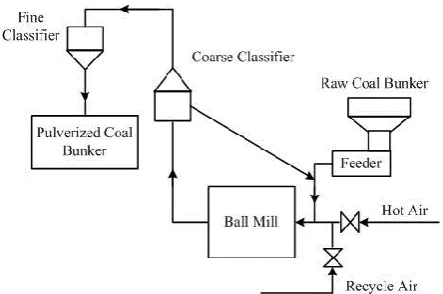
The schematic representation of a ball mill pulverizing system is shown in Fig. 1. The ball mill is fed with raw coal, and at the same time, the hot air and the recycle air are blown into the ball mill to dry and deliver the coal powder. After pulverizing, the coal powder is transferred into the coarse classifier and the fine classifier. The unqualified powder is fed back for further pulverizing while the accepted powder is stored in the pulverized coal bunker finally.
Ball Mill Pulverizing System
𝑝𝑐(𝑙) versus 𝑙 represent the power of ball mill motor and the pulverizing capability, respectively. 𝑝𝑚 and
𝑝𝑐𝑚 are the maximum values of 𝑝(𝑙) and 𝑝𝑐(𝑙) , respectively. For 𝑙 < 𝑙1, the pulverizing capability is so small that the ball mill works inefficiently and the lower level of the ball mill load leads to the mill wall worn faster. For 𝑙 > 𝑙2 , the ball mill works in the unstable region and the higher level of the ball mill load may lead the ball mill to be clogged. For 𝑙 is in the interval (𝑙1, 𝑙2 ), the pulverizing capability is larger and the change of the power of ball mill motor becomes less, so the ball mill works efficiently. However, for enhancing the pulverizing capability, it is no use merely increasing the coal feed based on the ball mill load, and the outlet temperature and the inlet negative pressure should be controlled in the suitable value respectively. For example, if the outlet temperature is too low, the drying will not be sufficient with the coal feed increasing and the pulverizing capability would be decreased. Furthermore, letting the outlet temperature be higher would be a risk that the coal powder in the mill might be ignited [25]. The inlet negative pressure affects the delivery of coal powder. If the value of the inlet negative pressure is not enough high with the coal feed increasing, the pulverized coal powder would not be transferred efficiently and the pulverizing capability could not be increased. Moreover, increasing the inlet negative pressure blindly would make some coal powder be released outside the ball mill causing environmental pollution and bodily injury. Therefore, to optimize the ball mill pulverizing system is to determine the optimal values of the ball mill load, the outlet temperature and the inlet negative pressure respectively with the pulverizing capability being maximal.
3. The Algorithm
In this section, the proposed algorithm will be dis-cussed in detail. The proposed algorithm includes two procedures. One is the fuzzy sequential patterns mining algorithm based on independent pruning strategy, the other is the optimal values searching method based on the mined fuzzy sequential patterns. Some notations would be explained beforehand. For an industrial pro-cess, 𝑥1, 𝑥2, … , 𝑥𝑝 are the process variables and 𝑝 is the number of process variables. 𝑦1, 𝑦2, … , 𝑦𝑞 are the regulation variables, which are used for adjusting the actuators, and 𝑞 is the number of regulation variables. 𝓏 is the optimization goal variable. We assume that 𝑠𝑥1, 𝑠𝑥2, … , 𝑠𝑥𝑝 are the steady-state values of
𝑥1, 𝑥2, … , 𝑥𝑝, respectively. Since the mined sequential pattern should be represented in the form of the rules, 𝐴𝑆 = {𝑥1, 𝑥2, … , 𝑥𝑝, 𝑦1, 𝑦2, … , 𝑦𝑞} and 𝐶𝑆 = {𝑧, 𝑠𝑥1,
𝑠𝑥2, … , 𝑠𝑥𝑝} could be regarded as the antecedent set and the consequent set, respectively. If these variables are deemed as the dimensions of the sequence database, the database used for sequential pattern mining is 𝐷 = {𝑥1, 𝑥2, … , 𝑥𝑝, 𝑦1, 𝑦2, … , 𝑦𝑞, 𝓏, 𝑠𝑥1, 𝑠𝑥2, … , 𝑠𝑥𝑝}.
Figure 1. Ball mill pulverizing system
Figure 2. Characteristics of ball mill pulverizing system
Procedure 1. Fuzzy Sequential Patterns Mining Algorithm Based on Independent Pruning Strategy.
Input: 𝐷 , the minimum support 𝜎(𝑠𝑢𝑝) , the minimum confidence 𝜎(𝑐𝑜𝑛𝑓), the size of sliding time window 𝑤𝑠, the gap of sliding time window 𝑤𝑔.
Output: fuzzy sequential patterns.
Step 1. Transforming the 𝐴𝑆 to 𝐴𝑆∗ by considering the changes of the variables.
In the actual working, the operators always adjust the regulation variables according to the working condition and the industrial process would be from one steady state to the other steady state. Consequently, the changes of the process variables and the regulation variables should be considered for fuzzy sequential pattern mining. The antecedent set 𝐴𝑆 is trans formed to 𝐴𝑆∗, which is
𝐴𝑆∗= {𝑥
1, 𝑥2, … , 𝑥𝑝, 𝑦1, 𝑦2, … , 𝑦𝑞, ∆𝑥1, ∆𝑥2,
… , ∆𝑥𝑝, ∆𝑦1, ∆𝑦2, … , ∆𝑦𝑞}
where ∆𝑥1, ∆𝑥2, … , ∆𝑥𝑝 , represent the changes of 𝑥1,
𝑥2, … , 𝑥𝑝 and ∆𝑦1, ∆𝑦2, … , ∆𝑦𝑞 , represent the changes of 𝑦1, 𝑦2, … , 𝑦𝑞.
Because the variables are recorded in the database at equal time intervals, the changes could be calculated based on a record with its next neighbor record. For example, 𝑥1(𝑡) and 𝑥1(𝑡 + 1) are the measured values of 𝑥1 at time 𝑡 and 𝑡 + 1 , respectively, and △ 𝑥1=
Then the sequence database 𝐷 becomes 𝐷∗, which is
𝐷∗= {𝑥
1, 𝑥2, … , 𝑥𝑝, 𝑦1, 𝑦2, … , 𝑦𝑞, ∆𝑥1, ∆𝑥2, … ,
∆𝑥𝑝, ∆𝑦1, ∆𝑦2, … , ∆𝑦𝑞, 𝓏, 𝑠𝑥1, 𝑠𝑥2, … , 𝑠𝑥𝑝}. The number of dimensions of 𝐷∗ is (3𝑝 + 2𝑞 + 1). Step 2. Partitioning the quantitative dimensions of 𝐷∗.
For fuzzy sequential patterns mining, we use an Apriori-alike process which could be implemented in field easily. Since every dimensions of 𝐷∗ are quantita-tive, they should be partitioned firstly. Nevertheless, the sharp boundary may under-emphasize or over-emphasize the objects near the boundaries of intervals in the mining process. To deal with the problem, fuzzy sets are used in partitioning [26].
We assume that the linguistic variables of 𝑥1, 𝑥2, … ,
𝑥𝑝, 𝑦1, 𝑦2, … , 𝑦𝑞, 𝓏, 𝑠𝑥1, 𝑠𝑥2, … , 𝑠𝑥𝑝 are 𝑋1, 𝑋2, … , 𝑋𝑝,
𝑌1, 𝑌2, … , 𝑌𝑞, 𝑍, 𝑆𝑋1, 𝑆𝑋2, … , 𝑆𝑋𝑝, respectively. To faci-litate the quantitative dimension partition, they use the same fuzzy universe and the linguistic terms. The unified fuzzy universe is [0, 1], and the set of fuzzy linguistic terms are {S, RS, M, RB, B}, where S, RS, M, RB and B represent smallest, relatively smaller, middle, relatively bigger, biggest, respectively. More-over, the triangular function is adopted as membership function and the variables use the same membership function shown in Fig. 3.
Figure 3. Membership function of the variables
It is assumed that the linguistic variables of ∆𝑥1,
∆𝑥2, … , ∆𝑥𝑝, ∆𝑦1, ∆𝑦2, … , ∆𝑦𝑞 are ∆𝑋1, ∆𝑋2, … , ∆𝑋𝑝,
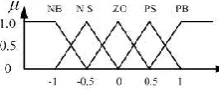
∆𝑌1, ∆𝑌2, … , ∆𝑌𝑞, respectively, and the unified fuzzy universe of them are all [-1, 1]. The set of fuzzy lin-guistic terms is {NB, NS, ZO, PS, PB}, where NB, NS, ZO, PS and PB represent negative big, negative small, zero, positive small and positive big, respectively, and they use the same membership function shown in Fig. 4.
Figure 4. Membership function of the change-variables
After the quantitative dimensions are partitioned, each dimension of 𝐷∗ is extended to a set of sub-dimensions. For example, the sub-dimensions of 𝑥1 are
𝑥1𝑆, 𝑥1𝑅𝑆, 𝑥1𝑀, 𝑥1𝑅𝐵 and 𝑥1𝐵 , respectively, and the sub-dimensions of ∆𝑦2 are ∆𝑦2𝑁𝐵, ∆𝑦2𝑁𝑆, ∆𝑦2𝑍𝑂, ∆𝑦2𝑃𝑆 and
∆𝑦2𝑃𝐵, respectively.
The partitioned sequence database is named 𝐷̃ . 𝐷̃ = {𝑥1𝑆, 𝑥1𝑅𝑆, 𝑥1𝑀, 𝑥1𝑅𝐵, 𝑥1𝐵, … , 𝑥𝑝𝑆, … , 𝑥𝑝𝐵, 𝑦1𝑆, … , 𝑦1𝐵, … ,
𝑦𝑞𝑆, … , 𝑦𝑞𝐵, ∆𝑥1𝑁𝐵, ∆𝑥1𝑁𝑆, ∆𝑥1𝑍𝑂, ∆𝑥1𝑃𝑆, ∆𝑥1𝑃𝐵, … , ∆𝑥𝑝𝑁𝐵, … ,
∆𝑥𝑝𝑃𝐵, ∆𝑦1𝑁𝐵, … , ∆𝑦1𝑃𝐵, … , ∆𝑦𝑞𝑁𝐵, … , ∆𝑦𝑞𝑃𝐵, 𝓏𝑆, … , 𝓏𝐵, 𝑠𝑥1𝑆,
… , 𝑠𝑥1𝐵, … , 𝑠𝑥𝑝𝑆, … , 𝑠𝑥𝑝𝐵}. Since the number of dimen-sions of 𝐷∗ is (3𝑝 + 2𝑞 + 1 ), the number of dimen-sions of 𝐷̃ is 5 ⋅ (3𝑝 + 2𝑞 + 1).
Moreover, each object in 𝐷∗ is transformed into the fuzzy membership value. 𝑑1∗ is an object in 𝐷∗ , and
𝑑1∗= {𝑣(𝑥1), … , 𝑣(𝑥𝑝), 𝑣(𝑦1), … , 𝑣(𝑦𝑞), 𝑣(∆𝑥1), … ,
𝑣(∆𝑥𝑝), 𝑣(∆𝑦1), … , 𝑣(∆𝑦𝑞), 𝑣(𝓏), 𝑣(𝑠𝑥1), … , 𝑣(𝑠𝑥𝑝)}, where 𝑣(⋅) represents the measured value of the corres-ponding variable. 𝑑1∗ is transformed into the fuzzy membership values and becomes 𝑑1. 𝑑1= {𝜇𝑆(𝑣(𝑥1)),
𝜇𝑅𝑆(𝑣(𝑥
1)), 𝜇𝑀(𝑣(𝑥1)), 𝜇𝑅𝐵(𝑣(𝑥1)), 𝜇𝐵(𝑣(𝑥1)), … ,
𝜇𝑆(𝑣(𝑥𝑝)), … , 𝜇𝐵(𝑣(𝑥𝑝)), 𝜇𝑆(𝑣(𝑦1)), … , 𝜇𝐵(𝑣(𝑦1)),
… , 𝜇𝑆(𝑣(𝑦
𝑞)), … , 𝜇𝐵(𝑣(𝑦𝑞)), 𝜇𝑁𝐵(𝑣(∆𝑥1)),
𝜇𝑁𝑆(𝑣(∆𝑥
1)), 𝜇𝑍𝑂(𝑣(∆𝑥1)), 𝜇𝑃𝑆(𝑣(∆𝑥1)), 𝜇𝑃𝐵(𝑣(∆𝑥1)),
… , 𝜇𝑁𝐵(𝑣(∆𝑥
𝑝)), … , 𝜇𝑃𝐵(𝑣(∆𝑥𝑝)), 𝜇𝑁𝐵(𝑣(∆𝑦1)),
… , 𝜇𝑃𝐵(𝑣(∆𝑦
1)), … , 𝜇𝑁𝐵(𝑣(∆𝑦𝑞)) , … , 𝜇𝑃𝐵(𝑣(∆𝑦𝑞)),
𝜇𝑆(𝑣(𝓏)), … , 𝜇𝐵(𝑣(𝓏)), 𝜇𝑆(𝑣(𝑠𝑥
1)), … , 𝜇𝐵(𝑣(𝑠𝑥1)),
… , 𝜇𝑆(𝑣(𝑠𝑥
𝑝)) , … , 𝜇𝐵(𝑣(𝑠𝑥𝑝))}, where, for example, μS(v(x1)) represents the membership value with res-pect to v(x1) for the fuzzy linguistic term 𝑆.
Step 3. 𝐷̃ is divided into several sub-sequence datasets by the sliding time window.
Since 𝐷̃ records the field data of different working conditions, the longer time span for sequence pattern mining may reduce the significance of the pattern and weaken the strength of the implication of the pattern [27]. Moreover, if the number of the records of any working condition is relatively small, namely, the support values is small, the sequence pattern for the working condition may not be detected. Therefore, the sliding time window is adopted to ensure the completeness of mining results, and 𝐷̃ would be divided into several sub-sequence datasets. The 𝑚 th sub-sequence dataset could be written as 𝐷𝑆𝑚=
{𝑑(𝑚−1)𝑤𝑔+1, 𝑑(𝑚−1)𝑤𝑔+2, … , 𝑑(𝑚−1)𝑤𝑔+𝑤𝑠}, where 𝑚 ∈ {1, 2, … , 𝑀} , 𝑀 is the number of subsequence datasets, and 𝑑𝑐 , 𝑐 ∈ {(𝑚 − 1)𝑤𝑔 + 1, (𝑚 − 1)𝑤𝑔+
2, … , (𝑚 − 1)𝑤𝑔+ 𝑤𝑠}, is an object in 𝐷𝑆𝑚.
Step 4. Load the first sub-sequence dataset 𝐷𝑆1 and perform the following steps on 𝐷𝑆1.
Step 5. Choose only one sub-dimension from the sub-dimensions set of 𝑥𝑖 and ∆𝑥𝑖 , respectively, where
𝑖 ∈ {1, 2, … , 𝑝}, and join them to be a candidate se-quence pattern antecedent (CSPA). For example, {𝑥1𝑆, ∆𝑥1𝑁𝐵} and {𝑥1𝑅𝑆, ∆𝑥1𝑍𝑂} are two different CSPAs. The fuzzy sequential pattern support (SSup) of the CSPA is calculated as given below:
SSup(CSPA) = ∑ [∏𝑂 𝜇(𝑜𝑘)
𝑘∈CSPA ]
𝑤𝑠
𝑘=1
where 𝑜𝑘 is an element of CSPA for the 𝑘th object in the sub-sequence dataset, ∏𝑂 𝜇(𝑜𝑘)
Ball Mill Pulverizing System
product of the membership value with respect to each element of the CSPA.
If SSup(CSPA) ≥ 𝜎(𝑠𝑢𝑝) , the CSPA is the strong sequence pattern antecedent(SSPA). The strong sequence pattern antecedent set of 𝑥𝑖 is SSPAS(𝑥𝑖) and could be obtained by the ergodic process of all possible combinations of the sub-dimensions set of 𝑥𝑖 and ∆𝑥𝑖, where 𝑖 ∈ {1, 2, … , 𝑝} . Because both 𝑥𝑖 and ∆𝑥𝑖 have five sub-dimensions, the number of all possible combinations of the sub-dimensions set of 𝑥𝑖 and ∆𝑥𝑖 is 25.
Step 6. By the same way as in Step 5, the strong sequence pattern antecedent sets of all process variables would be obtained and they are SSPAS(𝑥1), SSPAS(𝑥2) ,…, SSPAS(𝑥𝑝) . The strong sequence pattern antecedent sets of all regulation variables would be obtained also and they are SSPAS(𝑦1), SSPAS(𝑦2), , SSPAS(𝑦𝑞).
Step 7. Choose one SSPA form SSPAS (𝑥1) , SSPAS(𝑥2) , … , SSPAS(𝑥𝑝 ), SSPAS(𝑦1 ), SSPAS(𝑦2 ),
… , SSPAS(𝑦𝑞) respectively, and join them to be a candidate combination sequence pattern antecedent (CCSPA). If the SSup value of the CCSPA is larger than or equal to 𝜎(𝑠𝑢𝑝), the CCSPA is strong combination sequence pattern antecedent (SCSPA). After doing the ergodic process of all possible combination of SSPA of SSPAS(𝑥1 ), SSPAS(𝑥2) , … , SSPAS(𝑥𝑝 ), SSPAS(𝑦1 ), SSPAS(𝑦2 ), … , SSPAS(𝑦𝑞 ), we could get the strong combination sequence pattern antecedent set (SCSPAS).
The Apriori Principle is an important theorem and it means that if an itemset is infrequent, then all of its supersets must be infrequent too [28]. Therefore, for Steps 5-7, we determine SSPA of every two antecedents firstly and then obtain SCSPAS based on the Apriori Principle, that would decrease the complexity of the proposed algorithm.
Step 8. Choose only one sub-dimension from the sub-dimensions set of 𝓏, 𝑠𝑥1, 𝑠𝑥2, … , 𝑠𝑥𝑝 respectively, and join them to be a candidate combination sequence pattern consequence (CCSPC). If the SSup value of the CCSPC is larger than or equal to 𝜎(𝑠𝑢𝑝), the CCSPC is the strong combination sequence pattern consequen-ce (SCSPC). The strong sequenconsequen-ce pattern consequenconsequen-ce set (SCSPCS) could be obtained by the ergodic process of all possible combinations for the sub-dimensions set of 𝓏, 𝑠𝑥1, 𝑠𝑥2, … , 𝑠𝑥𝑝.
Step 9. Join one CCSPA of SCSPAS, which is re-presented by 𝐴, and one CCSPC of SCSPCS, which is represented by 𝐵, to be a candidate sub-sequence pat-tern (CSSP). The fuzzy sequential patpat-tern confidence (SConf) of CSSP could be computed as given below:
SSup(CSPA) =
∑ [∏𝑎𝑘∈𝐴𝜇(𝑎𝑘)× ∏𝑏𝑘∈𝐵𝜇(𝑏𝑘)] 𝑤𝑠
𝑘=1
∑ [∏𝑎𝑘∈𝐴𝜇(𝑎𝑘) 𝑤𝑠
𝑘=1 ]
where 𝑎𝑘 is an element of 𝐴 for the kth object in the sub-sequence dataset, 𝑏𝑘 is an element of 𝐵 for the kth object in the sub-sequence dataset, ∏𝑎𝑘∈𝐴𝜇(𝑎𝑘) is the product of the membership value with respect to each element of 𝐴 , ∏𝑏𝑘∈𝐵𝜇(𝑏𝑘) is the product of the membership value with respect to each element of 𝐵, and “×" is the product operation.
If the SConf value of the CSSP is larger than or equal to 𝜎(𝑐𝑜𝑛𝑓), the CSSP is the strong subsequence pattern(SSSP), and the strong sub-sequence pattern set(SSSPS) would be obtained by doing the ergodic process of all possible combinations of CCSPA of SCSPAS and CCSPC of SCSPCS.
For Steps 5-9, we present the independent pruning strategy on the antecedent set and the consequent set respectively, that not only ensures the standardization of mined sequence patterns but also enhances the efficiency of the algorithm.
Step 10. Slide the time window and load the next sub-sequence dataset. Repeating Steps 5-9, we can obtain other strong sub-sequence pattern sets.
Step 11. If all of sub-sequence datasets have been loaded, then do the next step, otherwise, go to Step 10. Step 12. Merge all strong sub-sequence pattern sets of every sub-sequence dataset to get the fuzzy sequential patterns of 𝐷 and output the results.
Let 𝑚𝑓𝑠𝑝𝑡 , 𝑡 ∈ {1, 2, … , 𝑁} represent a mined fuzzy sequential pattern and 𝑁 be the number of mined fuzzy sequential patterns. So, the set including all mined fuzzy sequential patterns is represented by MFSP. In the field, the following procedure could be implemented easily for determining the optimal values of 𝑥1, 𝑥2, … , 𝑥𝑝.
Procedure 2. Optimal Values Searching method with Fuzzy Sequential Patterns
Input: MFSP.
Output: the optimal values of 𝑥1, 𝑥2, … , 𝑥𝑝. Step 1. We assume that 𝑥1′, 𝑥2′, … , 𝑥𝑝′, 𝑦1′, 𝑦2′, … , 𝑦𝑞′ are the measurement values of 𝑥1, 𝑥2, … , 𝑥𝑝, 𝑦1, 𝑦2, … ,
𝑦𝑞 respectively on the current working condition. Fuzzificate 𝑥1′, 𝑥2′, … , 𝑥𝑝′, 𝑦1′, 𝑦2′, … , 𝑦𝑞′ based on the membership functions shown in Fig. 3 and Fig. 4, respectively. Then, combine the linguistic terms of them to obtain some initial antecedents. An initial antecedent is represented by {𝑋1′, 𝑋2′, … , 𝑋𝑝′, 𝑌1′, 𝑌2′, … ,
𝑌𝑞′} , where 𝑋1′, 𝑋2′, … , 𝑋𝑝′, 𝑌1′, 𝑌2′, … , 𝑌𝑞′ are the corres-ponding linguistic terms of 𝑥1′, 𝑥2′, … , 𝑥𝑝′, 𝑦1′, 𝑦2′, … , 𝑦𝑞′ , respectively.
Step 3. The linguistic terms of ∆𝑥1, ∆𝑥2, … , ∆𝑥𝑝 in ISP are ∆𝑋1, ∆𝑋2, … , ∆𝑋𝑝, respectively. Defuzzificating
∆𝑋1′, ∆𝑋2′, … , ∆𝑋𝑝′ and transferring them to the corres-ponding real value ranges could obtain ∆𝑥1′, ∆𝑥2′,
… , ∆𝑥𝑝′. It is assumed that the temporary optimal values of 𝑥1, 𝑥2, … , 𝑥𝑝 are (𝑥1′+ ∆𝑥1′), (𝑥2′+ ∆𝑥2′), … , (𝑥𝑝′+
∆𝑥𝑝′) respectively.
Step 4. Operate the actuators according to these temporary optimal values. If there is a controller for the industrial process in the field, the set values of 𝑥1, 𝑥2,
… , 𝑥𝑝 are adjusted to be (𝑥1′+ ∆𝑥1′), (𝑥2′+ ∆𝑥2′), … ,
(𝑥𝑝′ + ∆𝑥𝑝′) respectively.
Step 5. After the industrial process enters the other steady state again, the change of the optimization goal 𝓏 is evaluated. For example, the optimization goal is pulverizing capability. The larger the value of pulveri-zing capability, the better the optimization goal. If 𝓏 becomes better, then calculate the current values of ∆𝑦1, ∆𝑦2, … , ∆𝑦𝑞 , which are named as ∆𝑦1′, ∆𝑦2′, … ,
∆𝑦𝑞′ , respectively. Fuzzificate ∆𝑦1′, ∆𝑦2′, … , ∆𝑦𝑞′ to obtain their linguistic terms ∆𝑌1′, ∆𝑌2′, … , ∆𝑌𝑞′, respecti-vely.
Step 6. Scan MFSP to find the sequential pattern including {𝑋1′, 𝑋2′, … , 𝑋𝑝′, 𝑌1′, 𝑌2′, … , 𝑌𝑞′, ∆𝑌1′, ∆𝑌2′, … ,
∆𝑌𝑞′}, which is named as the candidate sequential pattern (CSP), namely, CSP ⊃ {𝑋1′, 𝑋2′, … , 𝑋𝑝′, 𝑌1′, 𝑌2′,
… , 𝑌𝑞′, ∆𝑌1′, ∆𝑌2′, … , ∆𝑌𝑞′}, then the CSP is recorded in the target sequential pattern set (TSPS).
Step 7. Scan the MFSP based on {𝑋1′, 𝑋2′, … , 𝑋𝑝′, 𝑌1′,
𝑌2′, … , 𝑌𝑞′}, and find other ISP. Repeating Steps 3-6, we would obtain other CSP.
Step 8. If no new ISP is found, then do the next step, otherwise, go to Step 7.
Step 9. If the ergodic process of all possible initial antecedents has been completed, then do the next step, otherwise, go to Step 2.
Step 10. If TSPS = 𝜙, it means that the industrial process has been in proximity to the optimal state for the current working condition. If TSPS ≠ 𝜙, then de-fuzzificate the corresponding linguistic terms of 𝑆𝑋1, 𝑆𝑋2, … , 𝑆𝑋𝑝 and transfer them to their real value range. So, the optimal values of 𝑥1, 𝑥2, … , 𝑥𝑝 for the current working condition would be obtained.
By the proposed algorithm, the optimal values of process variables are determined and the optimization for industrial process is realized. For the optimal values searching procedure of the proposed algorithm, the optimization goal must be evaluated after the industrial process enters the steady state. Because the number of ISP is small, the proposed algorithm would not spend much time. In Section 4, we will use the experiment results based on the real data and the field curves of ball mill pulverizing system to further verify the effective-ness of the proposed algorithm.
4. Experimental Results
In this section, we present some experiments to evaluate the effectiveness of our algorithm. We would compare our algorithm with the hill-climbing method, PSO and GA for the ball mill pulverizing system. The field database of QinLing Thermal Power Plant is used for the experiments. All algorithms are implemented in MATLAB 7.0.4 and the running environment is an Athlon64 X2 3600+ machine with 1 GB of RAM and running Windows XP Professional. In addition, our proposed algorithm has been put into practice in QinLing Thermal Power Plant and the results of field operation would be presented.
For the ball mill pulverizing system, the ball mill load, the outlet temperature and the inlet negative pre-ssure are process variables and represented by 𝑙, 𝑜𝑡 and 𝑛𝑝, respectively. The opening degree of hot air damper and the opening degree of recycle air damper are regu-lation variables and represented by 𝑢ℎ and 𝑢𝑟, respecti-vely. Because the objective of optimization is to maxi-mize the efficiency of ball mill pulverizing system, pulverizing capability (𝑝𝑐 ) is the optimization goal variable. Hence, the sequence database used for sequential pattern mining is {𝑙, 𝑜𝑡, 𝑛𝑝, 𝑢ℎ, 𝑢𝑟, 𝑝𝑐, 𝑙𝑠, 𝑜𝑡𝑠,
𝑛𝑝𝑠} , where 𝑙𝑠 , 𝑜𝑡𝑠 and 𝑛𝑝𝑠 represent the steady state value of 𝑙, 𝑜𝑡 and 𝑛𝑝 , respectively. { 𝑙, 𝑜𝑡, 𝑛𝑝, 𝑢ℎ, 𝑢𝑟} and {𝑝𝑐, 𝑙𝑠, 𝑜𝑡𝑠, 𝑛𝑝𝑠} are the antecedent set and the consequent set, respectively.
Although our algorithm does not need the fitness function, hill-climbing method, PSO and GA need a fitness function. Therefore, for analyzing and compa-ring our algorithm with hill-climbing method, PSO and GA expediently, the model of 𝑝𝑐 on 𝑙 , 𝑜𝑡 and 𝑛𝑝 , which is named as 𝑝𝑐(𝑙, 𝑜𝑡, 𝑛𝑝) , would be built and used as the fitness function for the hill-climbing method, PSO and GA. The data used for modeling are chosen from the field database of QinLing Thermal Power Plant and shown in Table 1. The data are the average value of the variables for different steady states and the ranges of 𝑝𝑐(𝑙, 𝑜𝑡, 𝑛𝑝) are[0, 100]%, [0, 300]°C and [-1000, 0]Pa, respectively. When ball mill pulverizing system works stably, it accords with the rule of indestructibility of matter, namely, the coal feed per unit of time equals the quantity of pulverized coal powder per unit of time. Although 𝑝𝑐 could not be measured directly, it equals the coal feed per unit of time in the steady state. Therefore, we adopt the coal feed per unit of time to represent the pulverizing capa-bility and the range is [0, 100]ton/h. In Table 1, the pulverizing capability of ID.6, 49.3ton/h, is largest among the data, namely, 79.5%, 95.1°C and -657.4Pa are the optimal values of 𝑙 , 𝑜𝑡 and 𝑛𝑝 , respectively. Moreover, the least square support vector machine [29] is adopted for modeling.
Ball Mill Pulverizing System
Table 1. Real data of ball mill pulverizing system for modeling
ID 𝒍(%) 𝒐𝒕(°C) 𝒏𝒑(Pa) 𝒑𝒄(ton/h)
1 76.1 109.5 -730.8 40.7
2 71.9 125.4 -807.9 38.7
3 78.2 102.7 -549.4 45.3
4 77.1 107.9 -907.4 44.7
5 82.0 111.6 -585.7 42.3
6 79.5 95.1 -657.4 49.3
7 81.2 101.6 -926.6 48.3
8 83.7 109.3 -887.1 42.0
9 86.3 108.8 -944.8 38.0
10 65.9 122.5 -928.3 38.0
11 75.1 95.6 -945.3 41.7
12 69.1 110.0 -894.1 43.0
13 67.9 113.5 -794.8 42.3
14 69.0 102.3 -742.8 44.3
15 68.7 101.2 -842.2 43.7
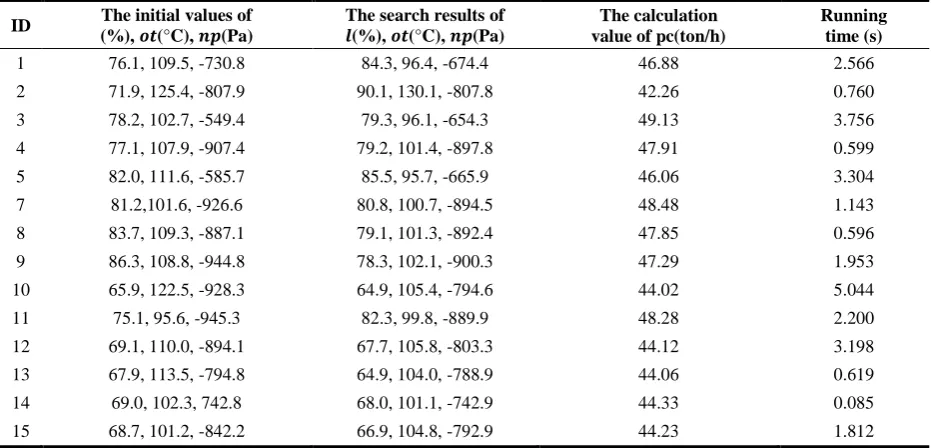
except the ID.6. In Table 2, for the initial value of 𝑙, 𝑜𝑡 and 𝑛𝑝 being 78.2 %, 102.7°C and-549.4Pa, respecti-vely, the optimal value of 𝑙 , 𝑜𝑡 and 𝑛𝑝 are 79.3%, 96.1°C and -654.3Pa, respectively, and the calculation value of 𝑝𝑐 is 49.13ton/h, which approximates the real maximum, 49.3ton/h, namely, the hillclimbing method succeeds in finding the approximate optimal values. However, for other initial values, the hill-climbing me-thod could not find the optimal values for the calcula-tion value of 𝑝𝑐 approximating the real maximum. Especially, for the initial values of 𝑙, 𝑜𝑡 and 𝑛𝑝 being 71.9%, 125.4°C and -807.9Pa, the calculation value of 𝑝𝑐 is only 42.26ton/h and the corresponding values of 𝑙, 𝑜𝑡 and 𝑛𝑝, which are 90.1%, 130.1°C and -807.8Pa, respectively, would not be the real optimal values. Therefore, although the hill-climbing method could find the optimal values for a certain initial values, the local optimization problem would impact the optimization effectiveness of the ball mill pulverizing system. Furthermore, since the minimum value of running time is 0.085 second and the maximum value of running time is 5.044 second, the running time of the hill-climbing method would be affected by the initial values greatly.
Table 2. Optimization results of the hill-climbing method
ID The initial values of (%), 𝒐𝒕(°C), 𝒏𝒑(Pa)
The search results of
𝒍(%), 𝒐𝒕(°C), 𝒏𝒑(Pa)
The calculation value of pc(ton/h)
Running time (s)
1 76.1, 109.5, -730.8 84.3, 96.4, -674.4 46.88 2.566
2 71.9, 125.4, -807.9 90.1, 130.1, -807.8 42.26 0.760
3 78.2, 102.7, -549.4 79.3, 96.1, -654.3 49.13 3.756
4 77.1, 107.9, -907.4 79.2, 101.4, -897.8 47.91 0.599
5 82.0, 111.6, -585.7 85.5, 95.7, -665.9 46.06 3.304
7 81.2,101.6, -926.6 80.8, 100.7, -894.5 48.48 1.143
8 83.7, 109.3, -887.1 79.1, 101.3, -892.4 47.85 0.596
9 86.3, 108.8, -944.8 78.3, 102.1, -900.3 47.29 1.953
10 65.9, 122.5, -928.3 64.9, 105.4, -794.6 44.02 5.044
11 75.1, 95.6, -945.3 82.3, 99.8, -889.9 48.28 2.200
12 69.1, 110.0, -894.1 67.7, 105.8, -803.3 44.12 3.198
13 67.9, 113.5, -794.8 64.9, 104.0, -788.9 44.06 0.619
14 69.0, 102.3, 742.8 68.0, 101.1, -742.9 44.33 0.085
15 68.7, 101.2, -842.2 66.9, 104.8, -792.9 44.23 1.812
Table 3. Optimization results of GA and PSO
Algorithm The search results of (%), 𝒐𝒕(°C), 𝒏𝒑(Pa)
The calculation value of 𝒑𝒄(ton/h)
Running time (s)
GA 79.4, 98.3, -634.5 48.5 71.527
PSO 78.9, 98.6, -673.6 48.3 35.591
The operating parameters of PSO and GA are set according to the values used in [14] and [15], respectively. The maximum number of iterations is 200 and the size of the initial population is 100. For PSO,
the acceleration coefficients, 𝑐1 and 𝑐2, are both 2, and the inertia weight, 𝑤 , is calculated by 𝑤 = 𝑤𝑚𝑎𝑥− 𝑤𝑚𝑎𝑥−𝑤𝑚𝑖𝑛
𝑛𝑚𝑎𝑥 ⋅ 𝑛 , where 𝑤𝑚𝑎𝑥 is the maximum value of
equals 0.4, 𝑛𝑚𝑎𝑥 is the maximum number of iterations, and 𝑛 is the 𝑛 th iteration. For GA, the crossover and mutation factors are 0.6 and 0.1, respectively. We perform the PSO and GA based on 𝑝𝑐(𝑙, 𝑜𝑡, 𝑛𝑝), and the initial values of populations of PSO and GA are both random within the known range of 𝑙, 𝑜𝑡 and 𝑛𝑝. The optimization results of GA and PSO are presented in Table 3, and the optimization process of GA and PSO is shown in Fig. 5. The experimental results show that the effectiveness of GA is relatively better than that of PSO, and PSO has faster convergence speed. However, the unsuitable parameters, for example, the maximum number of iterations, would affect the optimization results of the GA and PSO. For instance, in Fig. 5, the fitness function values of PSO and GA are still relatively small until the 80th iterations and PSO and GA begin convergence after about the 100th iterations. Although the experimental results verify that both PSO and GA outperform the hill-climbing method, the running time of PSO and GA is much larger than that of hill-climbing method. Moreover, for PSO and GA, more than one initial point is selected randomly. Nevertheless, for a real industrial process, such as ball mill pulverizing system, searching from multi-initial points at the same time can not be operated. Moreover, random initialization would let some initial values represent the states which do not exist in reality. Hence, the actual situation of the field would limit the application of the kinds of optimization algorithms.
Figure 5. Optimization process of GA and PSO
For our algorithm, the time complexity of the pro-posed fuzzy sequential pattern mining algorithm is far less than that of current sequential pattern mining algo-rithm. Hence, we firstly evaluate the time performance and the scalability of the proposed fuzzy sequential pattern mining algorithm. The field data of the ball mill pulverizing system of QinLing Thermal Power Plant are adopted as the test dataset and it includes 10000 ob-jects. Let 𝜎(𝑠𝑢𝑝) = 1 , 𝜎(𝑐𝑜𝑛𝑓) = 1 , 𝑤𝑠 = 1000 and
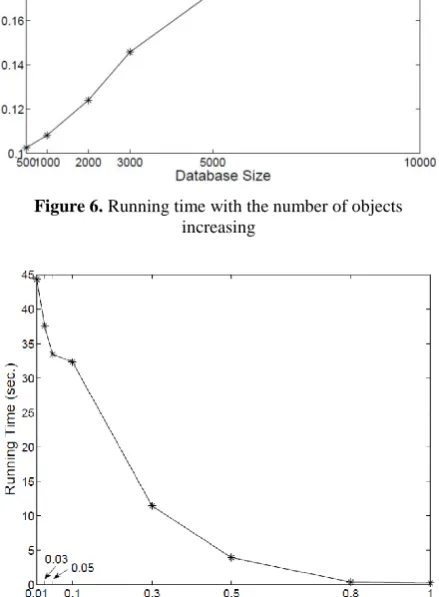
𝑤𝑔= 500. Experimental results with the number of objects increasing are shown in Fig. 6. With the number of objects increasing from 500 to 10000, the running time increases about only 0.1 second. For the number of objects being 10000, the running time is only 0.223
second. Therefore, the proposed algorithm has better performance. To evaluate the scalability of the mini-mum support, the number of objects in the field dataset is fixed at 10000. Let 𝜎(𝑐𝑜𝑛𝑓) = 1 , 𝑤𝑠 = 1000 and
𝑤𝑔= 500 . Experimental results with 𝜎(𝑠𝑢𝑝) increa-sing from 0.01 to 1 are shown in Fig. 7. When 𝜎(𝑠𝑢𝑝) changes from 0.01 to 0.8, the size of SSPA, SCSPA and SCSPC becomes smaller gradually with 𝜎(𝑠𝑢𝑝) in-creasing, and the running time decreases greatly. When 𝜎(𝑠𝑢𝑝) changes from 0.8 to 1, the size of SSPA, SCSPA and SCSPC does not change significantly, and the running time barely changed at all. To evaluate the scalability of the minimum confidence, the number of objects in the field dataset is still fixed at 10000. Let 𝜎(𝑠𝑢𝑝) = 1, 𝑤𝑠= 1000 and 𝑤𝑔= 500. Experimental results with 𝜎(𝑐𝑜𝑛𝑓) increasing from 0.01 to 1 are shown in Fig. 8. When 𝜎(𝑐𝑜𝑛𝑓) changes from 0.01 to 1, the running time decreases about only 0.04 second. Because the size of SCSPA and SCSPC would determine the size of CSSP, they affect the running time greatly. Since 𝜎(𝑐𝑜𝑛𝑓) is only used for obtaining SSSP from CSSP, 𝜎(𝑐𝑜𝑛𝑓) would not affect the running time. Hence, the proposed algorithm has better scalability for 𝜎(𝑠𝑢𝑝) and 𝜎(𝑐𝑜𝑛𝑓).
Figure 6. Running time with the number of objects increasing
Ball Mill Pulverizing System
Table 4. Mined fuzzy sequential patterns
IF THEN
𝐿 𝑂𝑇 𝑁𝑃 𝑈ℎ 𝑈𝑟 ∆𝐿 ∆𝑂𝑇 ∆𝑁𝑃 ∆𝑈ℎ ∆𝑈𝑟 𝑃𝐶 𝐿𝑠𝑣 𝑂𝑇𝑠𝑣 𝑁𝑃𝑠𝑣
RB RB M RB M PS PS NS NS PS RS M M M
RB B RB M PS PS PS NS NS PS RS RB RB M
RB RS M B RB PS PS NB PS NB RB RB RB RB
RB RS M M RS PS NS ZO NS PS RB B RS RB
RB RS B RS RS PS ZO PB ZO PB RB B RS RB
B M RB RS M ZO ZO NS ZO NS M RB M M
B RB M RB B PS NB NB PS PS RB RS M RB
B S M RB RB PS NS NS PS PB B RS RB M
B B M RS M NB PS NB NS NS B RB RB RS
B M M M M NB NS NS PS PS RB B M RS
M M RS M RB NS PS NS PS NS B B RB RB
M M RB S S PB NS PS NS PB M RB M M
M B M M M NS NB NB NS NS M M M B
M S B M RB PS NS NS NB NS S M RS M
M RS B RB RB PS PS PS NS PS S M RB RB
M M S M RS PS NS PS NS NS B RB M M
RS M S M B PS PS NS PS NB B RB M RS
RS S M RB B PS PB NS PB NS B M M RB
RS M M M M PS PS NS ZO NS M M RS RS
RS RS M RB RS PS RS PB NS PS RS M S M
S S M RB S PB PS NS NB PB RS RB M RB
S S B M S PB PS NS PS PS S B RB M
S RB M RB RB PS PS PS PB NS RS M RB RS
S B M RB B PS PS NS NS NS RS RS M M
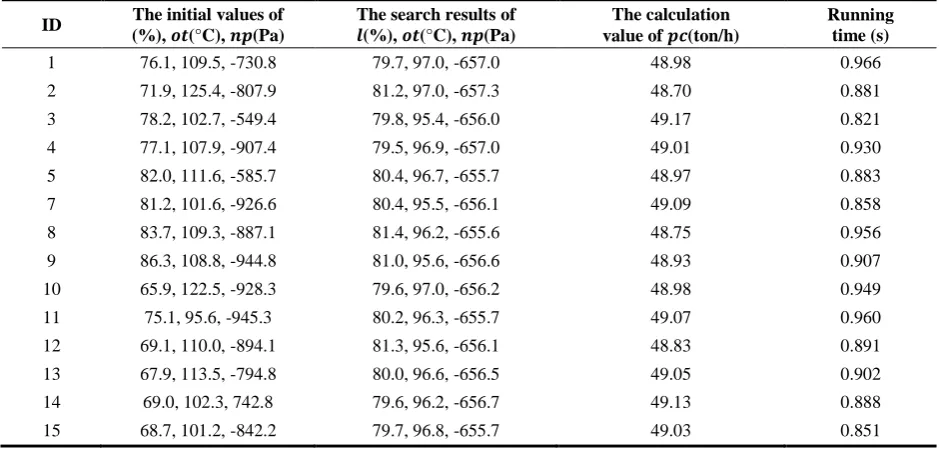
Table 5. Optimization results of our algorithm
ID The initial values of (%), 𝒐𝒕(°C), 𝒏𝒑(Pa)
The search results of
𝒍(%), 𝒐𝒕(°C), 𝒏𝒑(Pa)
The calculation value of 𝒑𝒄(ton/h)
Running time (s)
1 76.1, 109.5, -730.8 79.7, 97.0, -657.0 48.98 0.966
2 71.9, 125.4, -807.9 81.2, 97.0, -657.3 48.70 0.881
3 78.2, 102.7, -549.4 79.8, 95.4, -656.0 49.17 0.821
4 77.1, 107.9, -907.4 79.5, 96.9, -657.0 49.01 0.930
5 82.0, 111.6, -585.7 80.4, 96.7, -655.7 48.97 0.883
7 81.2, 101.6, -926.6 80.4, 95.5, -656.1 49.09 0.858
8 83.7, 109.3, -887.1 81.4, 96.2, -655.6 48.75 0.956
9 86.3, 108.8, -944.8 81.0, 95.6, -656.6 48.93 0.907
10 65.9, 122.5, -928.3 79.6, 97.0, -656.2 48.98 0.949
11 75.1, 95.6, -945.3 80.2, 96.3, -655.7 49.07 0.960
12 69.1, 110.0, -894.1 81.3, 95.6, -656.1 48.83 0.891
13 67.9, 113.5, -794.8 80.0, 96.6, -656.5 49.05 0.902
14 69.0, 102.3, 742.8 79.6, 96.2, -656.7 49.13 0.888
15 68.7, 101.2, -842.2 79.7, 96.8, -655.7 49.03 0.851
For evaluating the effectiveness of our algorithm, we firstly perform our fuzzy sequential pattern mining algorithm on the field database of ball mill pulverizing system of QinLing Thermal Power Plant, which inclu-des 10000 objects, and let 𝜎(𝑠𝑢𝑝) = 1, 𝜎(𝑐𝑜𝑛𝑓) = 1, 𝑤𝑠 = 1000 and 𝑤𝑔= 500. Then, we could obtain the
Figure 8. Scalability of the minimum confidence
Based on the mined fuzzy sequential patterns, we perform our searching method with the same initial values as shown in Table 2. Our searching method dose not need the fitness function and is used directly on the field database of ball mill pulverizing system of QinLing Thermal Power Plant. For example, our algo-rithm could directly obtain the change of 𝑝𝑐, and the current values of ∆𝑢ℎ and ∆𝑢𝑟 by scanning the field database. The optimization results of our algorithm are shown in Table 5. For evaluating the effectiveness of our algorithm, we use the model 𝑝𝑐(𝑙, 𝑜𝑡, 𝑛𝑝) to calcu-late the value of 𝑝𝑐 . Moreover, the defuzzification is accomplished by the centroid of area method. For Table 5, the search results show that our algorithm could determine the approximate optimal values with different initial values. For the initial value of 𝑙, 𝑜𝑡 and 𝑛𝑝 being 78.2%, 102.7°C and-549.4Pa, respectively, our algorithm could find two target sequential patterns, which are {RB, RS, M, M, RS, PS, NS, ZO, NS, PS, RB, B, RS, RB} and {B, M, RB, RS, M, ZO, ZO, NS, ZO, NS, M, RB, M, M}. Defuzzificating the two target sequential patterns can obtain the values of 𝑙 , 𝑜𝑡 and 𝑛𝑝, which are 79.8%, 95.4°C and -656.0Pa, respecti-vely, and the calculation value of 𝑝𝑐 is 49.17ton/h. For the initial value of 𝑙, 𝑜𝑡 and 𝑛𝑝 being 71.9%, 125.4°C and -807.9Pa, respectively, we could obtain the target sequential patterns, which are {RB, RS, B, RS, RS, PS, ZO, PB, ZO, PB, RB, B, RS, RB} and {M, M, RB, S, S, PB, NS, PS, NS, PB, M, RB, M, M}. The optimal values of 𝑙, 𝑜𝑡 and 𝑛𝑝 are 81.2%, 97.0°C and -657.3Pa, respectively, and the calculation value of 𝑝𝑐 is 48.70ton/h. Since our algorithm includes fuzzificating process and defuzzificating process, the search result does not absolutely equal the real maximum, that barely affect the real effectiveness of the ball mill pulverizing system. In addition, the running time of our algorithm is not larger than that of the hill-climbing method and much smaller than that of PSO and GA.
Numerical results verify that our algorithm could determine the approximate optimal values correctly and is not affected by the initial values of process variables. Moreover, our algorithm has been put into practice in
QinLing Thermal Power Plant successfully. Before finding the optimal values, the ball mill load, the outlet temperature, and the inlet negative pressure are set according to the values supplied by the operating rules. The running curves of thirty minutes are shown in Fig. 9. To facilitate analysis, the measured values of all variables are normalized to [0, 1]. In Fig. 9, although the ball mill load, the outlet temperature and the inlet negative pressure are relatively stable, the coal feed per unit of time is not large, namely, the pulverizing capabi-lity is not high. After our algorithm was performed in the field, the ball mill load, the outlet temperature, and the inlet negative pressure are set according to the results of our algorithm. The running curves of thirty minutes are shown in Fig. 10. Similarly, the measured values of all variables are normalized to [0, 1]. In Fig. 10, the ball mill load, the outlet temperature and the inlet negative pressure are almost stable, and the coal feed per unit of time becomes larger. The statistic data show that the coal feed per unit of time is increased about 20%, namely, the pulverizing capability is increa-sed about 20%, and the energy consumption would be reduced.
Figure 9. Running curves of real thermal power plant before optimization
Ball Mill Pulverizing System
5. Conclusions
In the paper, we propose a fuzzy sequential pattern mining algorithm based on independent pruning strate-gy for parameters optimization of ball mill pulverizing system. The algorithm uses the independent pruning strategy to mine the fuzzy sequential patterns and then determines the optimal values of the process variables by the searching method with the mined sequential patterns. The proposed algorithm has some advantages as follows. First, the proposed algorithm could deter-mine the close enough approximate value of the real optimal value of process variables effectively. Second, the optimization results of our algorithm are almost not affected by the initial values of process variables and the running time of our algorithm is smaller than that of the other tested algorithms. Third, the proposed algo-rithm presents the independent pruning strategy to en-hance the efficiency of the algorithm. Fourth, the pro-posed algorithm adopts the improved fuzzy sequential pattern support and the fuzzy sequential pattern confi-dence to ensure the accuracy of the mined sequential patterns. Fifth, the proposed algorithm uses the sliding time window technique to ensure the completeness of mining results. The experimental results for parameters optimization of ball mill pulverizing system also verify the effectiveness of the proposed algorithm. Our algorithm has been put into practice successfully and the statistic data show that the pulverizing capability is increased and the energy consumption is reduced. Moreover, the algorithm could be applied in other complex industry systems, for example, the mineral processing. In the future research work, we will use some advance methods to further decrease the running time of our algorithm.
Acknowledgements
This work is supported by National Natural Science Foundation of China (61005058, 61375055), Program for New Century Excellent Talents in University (NCET-12-0447), Natural Science Foundation of Shaanxi Province of China (2014JQ8365), State Key Laboratory of Electrical Insulation and Power Equipment (EIPE12309) and Fundamental Research Funds for the Central University.
References
[1] S. C. Kaushik, V. Siva Reddy, S. K. Tyagi. Energy and exergy analyses of thermal power plants: A review.
Renewable and Sustainable Energy Reviews, 2011,
Vol. 15, No. 4, 1857-1872.
[2] M. I.Menhas, M. Fei, L. Wang, L. Qian. Real/binary co-operative and co-evolving swarms based multivariable PID controller design of ball mill pulverizing system. Energy Conversion and
Management, 2012, Vol. 54, No. 1, 67-80.
[3] T. Chai, L. Zhai, H. Yue. Multiple models and neural networks based decoupling control of ball mill coal-pulverizing systems. Journal of Process Control, 2011, Vol. 21, No. 3, 351-366.
[4] T. Chai, L. Zhang, C.-Y. Su, H. Wang. An intelligent mill load switching control of the pulverizing system for an alumina sintering process. IEEE Transactions on
Control Systems Technology, 2012, Vol. 20, 677-687.
[5] C. Liu,W. Liang, C. Li. The self-tuning fuzzy control algorithm for ball mill pulverizing system of power plant. In: Proceedings of CSEE, 2001, Vol. 21, No. 12, pp. 93-96.
[6] Sh. B. Chen, T. J. Zhang, Z. G. Xu, W. Leng. A dyna-mic fuzzy modelling method for ball pulverizing sys-tems based on mechanism analysis. Chinese Journal of
Power Engineering, 2005, Vol. 25, No. 2, 244-248.
[7] H. Cao, L. Jia, G. Si, Y. Zhang. An interpolation-based fuzzy controller for load control of ball mill pulverizing system. Advanced Materials Research, 2011, Vol. 219-220, 1030-1034.
[8] D. Xing, W. Yan, X. Li. Development and application of thermal calculation software for inter-bin ball mill coal pulverizing system. Electric Power, 2006, 39, 77-80.
[9] J. Wei, J. Wang, S. Guo. Mathematic modeling and condition monitoring of power station tube-ball mill systems. In: Proceedings of the 2009 American Control
Conference, St. Louis, MO, USA, June 10-12, 2009, pp.
4699-4704.
[10] D. Wang, P. Han, D. Peng. Optimal for ball mill pulverizing system and its applications. In: Proceedings of 2002 International Conference on Machine Learning
and Cybernetics, Beijing, China, November 14-5, 2002,
pp.2131-2136.
[11] Y. Luo, L. Jia, W. Cai, H. Liu. Set-point optimization and control of coal-pulverizing systems with ball-tube mil. In: Proceedings of the 4th IEEE Conference on
Industrial Electronics and Applications, Xi’an, China,
May 25-27, 2009, pp. 1690-1694.
[12] Q. Liu, J. Huang, G. He, G. Lian, S. Sun. Self-optimized control strategy for ball mill pulverizing system. Journal of Xi’an Jiaotong University, 2000, Vol. 34, 30-34.
[13] X. Li, Y. Zeng, J. Sun, Y. Li, H.-Y. Wu. Fuzzy optimi-zation control system and its application in ball mill pul-verizing system. In: Proceedings of the 15th IEEE
Inter-national Conference on Fuzzy Systems, Vancouver, BC,
Canada, July 16-21, 2006, pp. 615-620.
[14] Y. Hao, X. Yu, G. Zhao, Z. Lv. Optimization for ball mill operation based on improved particle swarm optimization algorithm. Journal of Southeast University
(Natural Science Edition), 2008, Vol. 38, No. 3,
419-423.
[15] H. Wang, M. Jia, P. Huang, Z. Chen. A study on a new algorithm to optimize ball mill system based on modeling and GA. Energy Conversion and
Management, 2010, Vol. 51, No. 4, 846-850.
[16] J. Han, M. Kamber. Data mining, concepts and techniques(Second Edition). Morgan Kaufmann, San
Francisco, USA, 2006.
[17] C.-Y. Tsai, J. J. H. Liou, C.-J. Chen, C.-C. Hsiao.
Generating touring path suggestions using time-interval sequential pattern mining. Expert Systems with
Applications, 2012, Vol. 39, No. 3, 3593-3602.
[18] B. Mallick, D. Garg, P. S. Grover. Progressive CFM-miner: an algorithm to mine CFMsequential patterns from a progressive database. International Journal of
Computational Intelligence Systems, 2013, Vol. 6,
[19] T. C. K. Huang. Discovery of fuzzy quantitative se-quential patterns with multiple minimum supports and adjustable membership functions. Information Sciences, 2013, Vol. 222, 126-146.
[20] R. Srikant, R. Agrawal. Mining sequential patterns. In:
Proceedings of the 7th International Conference on
Data Engineering, Taipei, Taiwan, March 6-10, 1995,
pp. 3-14.
[21] P. Fournier-Viger, U. Faghihi, R. Nkambou, E. Mephu Nguifo. CMRules: Mining sequential rules common to several sequences. Knowledge-Based Sys-tems, 2012, 25, 63-76.
[22] B. Shim, K. Choi, Y. Suh. CRM strategies for a small-sized online shopping mall based on association rules and sequential patterns. Expert Systems with
Applica-tions, 2012, Vol. 39, No. 9, 7736-7742.
[23] Y.-H. Hu, F. Wu, Y.-J. Liao. An efficient tree-based algorithm for mining sequential patterns with multiple minimum supports. Journal of Systems and Software, 2013, Vol. 86, No. 5, 1224-1238.
[24] L. Jia, X. Li. Self-optimization combined with fuzzy logic control for ball mill. International Journal of
Computers, Systems and Signals, 2000, Vol. 1, No. 2,
231-239.
[25] T. Chai, H. Yue. Multivariable intelligent decoupling control system and its application. Acta Automatica
Sinica, 2005, Vol. 31, No. 1, 123-131.
[26] C.-H. Chen, T.-P. Hong, V. S. Tseng. Mining fuzzy frequent trends from time series. Expert Systems with
Applications, 2009, Vol. 36, No. 2, 4147-4153.
[27] Y.-L. Chen, Y.-H. Hu. Constraint-based sequential pa-ttern mining: The consideration of recency and compac-tness. Decision Support Systems, 2006, Vol. 42, No. 2, 1203-1215.
[28] P.-N. Tan, M. Steinbach, V. Kumar. Introduction to data mining. Addison Wesley Higher Education, USA, 2006.
[29] J. A. K. Suykens, T. Van Gestel, J. De Brabanter, B. De Moor, J. Vandewalle. Least Squares Support Vector Machines, World Scientific Publishing Co. Pte.
Ldt, Singapore, 2002.