© 2014 Electronic Journal of Science Education (Southwestern University/Texas Christian University) Retrieved from http://ejse.southwestern.edu
GENETICS PROBLEM SOLVING IN HIGH SCHOOL TESTING IN KENYA: EFFECTS OF METACOGNITIVE PROMPTING DURING TESTING.
Catherine Muhonja Aurah
Masinde Muliro University of Science & Technology KENYA
Jerrell Craig Cassady Ball State University USA
Tom John McConnell Ball State University USA
Abstract
This study investigated the effectiveness of using metacognitive prompts during testing for improving results in a Genetics Problem Solving Test (GPST). The study, a pre-test post-test, control group quasi-experimental design involving 2x2x2 analysis of covariance (ANCOVA) also investigated the moderating effects of gender and school type. A total of 2,138 high school students purposively selected from seventeen high schools in Western province, Kenya, participated in the study using three validated instruments; Biology Ability Test (BAT), Genetics Problem Solving Test (GPST), and Metacognitive Prompting Questionnaire (MPQ). Findings showed that metacognitive prompting (MP) had a significant effect on students’ genetics problem solving ability, F(1, 2137) = 10.909, p < 0.001. The findings also revealed gender differences, with girls outperforming boys on the genetics problem solving test. Furthermore, a significant interaction between metacognitive prompting and school type showed that students in provincial schools benefited from MPs more than students from district schools. This study established a foundation for instructional methods for biology teachers and recommendations are made for implementing metacognitive prompting in a problem-based learning environment in high schools and science teacher education programs in Kenya.
Please address all correspondence to: Catherine Muhonja Aurah, Masinde Muliro University of Science & Technology, P.O. Box 190-50100, Kakamega, KENYA, [email protected]
Key Words: Metacognition, Metacognitive Prompting, Problem solving Introduction
Electronic Journal of Science Education ejse.southwestern.edu For The United States schools, this was highlighted in the new Next Generation Science Standards that emphasize these skills in addition to core disciplinary knowledge (NGSS Lead States, 2013).
Metacognition and Learning
Identification of the key factors that are associated with high levels of problem solving ability in learners has led several researchers to investigate the relationship between metacognition and other constructs such as problem solving (Rozencwajg, 1992; Tsui & Treagust, 2003, 2004). Metacognition" is often simply defined as "thinking about thinking” (Flavell, 1979), which is a loose description at best. Attempts to more carefully operationalize metacognition have led to varied explanations of the component skills that comprise this broad term. Specific areas of attention have identified constructs such as memory-monitoring and regulation (Martinez, 2006; Schneider & Lockl, 2002), meta-reasoning, awareness and self-awareness (Schraw et al., 2006). Ultimately, the goal for educators who promote metacognition is to provide students with the skills necessary to be self-sufficient learners who can effectively determine if they are successfully learning information, or if more work must be done to master skills or understand concepts (Flavell, Miller, & Miller, 2002). Expansions to Flavell's basic definition can be essentially summarized as learners planning, monitoring, and evaluating their learning efforts.
Studies on metacognition have demonstrated that students with strong metacognitive skills are more successful in problem solving (Schoenfeld, 1985). Research on problem solving for biology and genetics problems in particular has confirmed that metacognition – in particular students’ abilities to monitor their own thinking – is a principle variable for explaining success (Orcajo & Aznar, 2005; Stewart & Dale, 1989; Tekkaya, Çapa, & Yılmaz, 2000). This is a natural expectation, as a learner’s awareness and understanding of their thought processes lay the foundation for effective problem solving; expert problem-solvers and effective thinkers of all kinds must be self-aware. These experts plan strategies for attacking thinking problems, and when they experience difficulties, they stop, analyze, and reflect (Eflkides, 2008, 2009; Teong, 2003 ). Metacognition also refers to the ability to reflect on one's own performance (National Research Council, 2000). Students learn to monitor and direct their own progress, asking key questions of themselves which helps maximize effective strategies and avoid perseverating on unproductive approaches (Perkins &Salomon, 1989).
Metacognitive Prompting
Electronic Journal of Science Education ejse.southwestern.edu Compared to feedback, which provides knowledge of results (Butler & Winne, 1995; Mory, 2004), or supplies corrective enrichment information (Mevarech & Kramarski, 1997), MP stimulates reflection during problem solving – thereby promoting self-regulated learning experiences.
Metacognitive prompts help students stay on task, keep track of their effort and progress (Koechlin & Zwaan, 2007), and engage in more efficient problem solving in mathematics (Hoffman & Spatariu, 2008). Different forms of metacognitive prompting have been effective across many educational contexts, including math (Hoffman & Spatariu, 2008; Kramarski & Gutman, 2006); computer science (Schwonke, Hauser, Nuckles & Renkl, 2006), biology (Conner (2007), and science (Davis, 2003). The theoretical rationale offered in the cited research is that MP promotes the use of self-regulation strategies such as selecting and monitoring strategies, evaluating process and outcomes, and revising ideas in order to perform effectively.
This line of research has demonstrated the importance of recognizing the role of students’ self-efficacy and competence in the discipline when implementing MP. Hoffman and Spatariu (2008) revealed that self-efficacy and metacognitive prompting increased problem-solving performance and efficiency separately through activation of reflection and strategy knowledge while solving mathematics problems. Schwonke, Hauser, Nuckles, & Renkl (2006) investigated the effectiveness of cognitive and metacognitive prompts in a computer-based environment in order to support the writing of learning protocols. They found that the quality of the learning protocols and the learning outcomes improved significantly by fostering the acquisition of declarative knowledge and deep understanding.
Metacognitive prompting that specifically promotes personal autonomy has also been found to be more effective. Conner (2007), who used cues and prompts in a final-year high school biology class in order to broaden stude nts’ thinking about bioethical issues associated with cancer found that planning for and using cues in units of work helped students to become more responsible for their own learning. This technique essentially provided scaffolding that supported students as independent critical thinkers prompting them to think carefully about their activities, and actively employ metacognitive strategies such as planning, monitoring and reflection, rather than focusing on smaller goals. Similarly, Davis (2003) compared the effectiveness of generic (“stop and think”) and directed prompts (hints about what to think about) in middle school students studying physical science. The generic prompts helped students develop significantly more coherent understandings than those who received directed prompts, illustrating the potential of MP as a scaffolding technique to enhance autonomous understanding of science.
Electronic Journal of Science Education ejse.southwestern.edu ability in the domain of interest has not been established. Finally, it is not clear whether the prompts have differential impact for males and females.
Gender Differences
Many studies have focused on gender differences in science achievement and accessing careers and education in STEM disciplines (Chipman, Brush & Wilson, 1985; Fennema, 1984; Linn & Hyde, 1989; Oakes, 1990; Lee & Burkam, 1996). The differential representation of men and women in the scientific community has been foretold by achievement patterns evident in the elementary and secondary levels (Cakiroglu, 1999). For example, Bacharach, Baumeister, & Furr (2003) examined the science performance among eighth grade students in The United States. They found that the average eighth grade science achievement scores were significantly different for males and females. However, contemporary assessments show that gender differences in science achievement have narrowed over time (Britner & Pajares,2006; Freeman, 2004), though differences in achievement as well as stereotypes about science courses being more favorable for males still exist (DeBacker & Nelson, 2001; Miyake et al., 2010; Nosek et al., 2009). While female students enroll in more advanced high school science courses than before (Freeman, 2004), they are less likely to report enjoying them (Freeman, 2004; Meece, Glienke, & Burg, 2006; Weinburgh, 2000).
This trend is not specific to The United States. In Kenya, secondary school ends with the Kenya Certificate of Secondary Education (KCSE) examination. Students are expected to take two science subjects drawn from the cluster of Chemistry, Biology and Physics. However, most schools treat Biology and Chemistry as compulsory courses. It is very important for students to be proficient in these subjects because they play an important role in career choices and professional development. Scores on this test have historically documented that female students perform lower than their male counterparts in science subjects in the Kenya Certificate of Secondary Examination (KCSE). Poor performance in the sciences limits girls’ opportunities in competitive professional courses that are science oriented. Furthermore, Kenya’s vision 2030 initiative aims at making the country a newly industrializing middle income country providing high quality of life for all citizens. The realization of this vision calls for increasing science achievement of both men and women in the country so that they can contribute to nation building. However, this vision is not likely to be realized as long as girls continue to underachieve in subjects that determine their placement in science oriented fields which are expected to spur industrialization.
However, there is no documented study investigating the effects of metacognitive prompting on problem solving in Kenya based on gender and school type. It is against this background that this study seeks to establish the effectiveness of using metacognitive prompts in improving the ability of high school students in solving genetics problems while controlling for the effects of gender, school type, and individuals’ background scientific knowledge.
Methods
Research Design
Electronic Journal of Science Education ejse.southwestern.edu full factorial model that investigated the main effects of the experimental treatment (metacognitive prompting), gender, and school quality on genetics problem solving. Quasi-experimental design was appropriate for this study because randomly assigning individual participants to experimental and control conditions was impossible due to the nature of pre-existing intact classes of students (Johnson & Christensen, 2004). Seventeen high schools in Kenya agreed to participate in the study. From those schools, classrooms were randomly assigned to the experimental and control conditions by a member from each class drawing a ‘YES’ or a ‘NO’ token from a hat. Students in the ‘YES classes’ were assigned to the experimental group while those in ‘NO classes ’ were assigned to the control group. The result was two equivalent groups of students in the experimental and control conditions drawn from each school. Genetics instruction for both groups conformed to standards included in the national curriculum. The experimental group received metacognitive prompts embedded in their post-test, while the control group received their post-test without any metacognitive prompting.
The study was guided by five research questions:
1. To what extent does metacognitive prompting (MP) during the post-test influence test results on the genetics problem solving test (GPST)?
2. To what extent does gender interact with MP to influence scoring on the GPST? 3. To what extent does school type interact with MP to influence scoring on the GPST? 4. To what extent does school type interact with gender to influence scoring on the
GPST?
5. To what extent do school type, gender, and MP interact to influence scoring on the GPST?
A prediction was put forth for each question. MP would positively impact students’ scores on a GPST [Question 1] and that MP would significantly interact with gender to influence genetics problem solving ability [Question 2]. In addition, school type would significantly interact with MP [Question 3]and with gender to influence genetics problem solving ability [Question 4]. Finally, there would be a significant interaction effect of MP, gender and school type on students’ problem solving ability in genetics [Question 5].
Context
Electronic Journal of Science Education ejse.southwestern.edu like the people within them, have different characteristics. Academic achievement differentials across these school types abound.
In Kenya, genetics is one topic taught in biology at the high school level. This topic covers aspects such as: variations, mitosis and meiosis, monohybrid crossings, sex-determination, co-dominance and mutation (Kenya Institute of Education, 2010). Typically, problem solving in genetics entails working out textbook problems under the guidance of the teacher. Students are only required to study the examples and deduce the answers from the textbook and teacher’s lecture notes. Yet solving problems should be based on the identification of the problem and the construction and verification of hypothesis, just like the process of investigation. The sequence of topics makes sense from the point of view of the discipline but not from the point of view of the students. For example, the concept of DNA is introduced before the gene concept. Students work with closed problems of the cause–effect type and the study of meiosis is theoretical, not applied to the distribution of chromosomes in the inheritance of characteristics. In fact, the structuring of the biology curriculum in which the topic of meiosis is isolated from heredity adds to the abstract character of genetics. This topic is taught a year before genetics is taught.
Participants
A sample of 2,138 form four (12th grade) students from 17 schools in the Western Province of Kenya was purposively sampled for this study. Demographic include: age with M = 21 years (min = 18; max = 24), Males = 1,063 (49.7%), Females = 1,075 (50.3%); Luhya tribe (n= 1628, 76.1 %), Non-Luhya tribes= (n = 510, 33.9), Provincial schools = 9 schools, n = 1306, 61.1% and District schools = 8 schools, n = 832, 38.9%. The sample comprised of 1080 participants in the experimental condition (with MP) and 1058 in the control group (No MP). Instruments
In addition to providing individual demographic information, students in the study completed two assessments examining their understanding of science topics. The first, the Biology Ability Test (BAT), served as a measure of background knowledge in the field of biology. The primary outcome measure was the Genetics Problem Solving Test (GPST). Both assessments were developed by the researchers in collaboration with experts in the target curriculum for the purposes of this study.
Electronic Journal of Science Education ejse.southwestern.edu Genetics Problem Solving Test (GPST).This test was an 18-item classroom assessment focused on solving problems from the domain of genetics (Appendix B). For comparison to the biology curriculum in the United States, the questions correspond to HS-LS3 in the Next Generation Science Standards (NGSS Lead States. 2013).
Validation. Both face and content validity for BAT and GPST were achieved through expert review. Face validity is a very basic form of validity in which one determines if a measure appears (on the face of it) to measure what it is supposed to measure. In other words, does the measure "appear" to measure what it is supposed to measure? It serves asa first step in determining validity. According to De Vellis, (2003), content validity is the extent to which a specific set of items reflects a content domain. Two primary goals of an expert review are to reveal problems with an instrument so that they can be remedied prior to going into the field or to sort items into groups that are more or less likely to exhibit measurement errors. We recruited the critical review team to assess each item used in both measures on a three-point rating scale (1= Not relevant, 2 = Relevant, 3 = Highly Relevant).
To establish that the measures were sufficiently valid for the instructional context used in the study, a copy of each of the tests and instructions for evaluating the items on the relevancy rating scale were sent to four expert high school biology teachers in Kenya for review. The teachers were asked to review the items for clarity and completeness in covering most, if not all, areas tested for a genetics topic and related concepts for form four (grade 12) students, as well as to establish face and content validity of the instruments and items. The rater’s review showed that all items on BAT were relevant and appropriate to be administered to form four students. The average rating ranged from a score of 2 (relevant) to 3 (highly relevant), with an overall mean rating of 2.56.
The rater’s report for GPST indicated that items 19 and 20 were not relevant because the sub-topic of dihybrid inheritance was removed from the biology syllabus three years ago. Those two items were excluded from the final version of the GPST. All remaining items were rated relevant, with the mean rating ranging from 2 (relevant) to 3 (highly relevant), with an overall mean rating of 2.83.
Metacognitive Prompting Intervention
Electronic Journal of Science Education ejse.southwestern.edu The metacognitive prompts included comprehension questions, strategic questions, reflection, and connection questions, to be completed during the problem solving tests (see Appendix C for prompts). Two comprehension questions were designed to encourage students to reflect on a problem before solving it. Four strategic questions were designed to encourage students to think about what strategy might be appropriate for the given problem and to provide a reason or rationale for that strategy choice. Four reflection questions were designed to foster self-monitoring, self-explaining, and self-evaluation in the problem solving process. Finally, four connection questions were designed to encourage students to identify and recognize deep-structure problem attributes so that they could activate relevant strategy and background knowledge.
Data Collection Procedures
Prior to randomly assigning the classes to the experimental and control conditions, all students completed the Biology Ability Test (BAT) in their classrooms to serve as a pretest that would enable statistically controlling for pre-existing individual differences in biology knowledge. Next, intact classes were randomly assigned to experimental and control groups as described previously. After a two-hour break, all students completed the GPST version consistent with their experimental conditions (MP vs no-MP).
Data Analysis Procedures
Data analyses included review of descriptive statistics to identify general trends in the sample, as well as inferential statistics to focus on the primary research question examining the impact of the intervention. A 2 x 2 x 2 factorial Analysis of Covariance (ANCOVA) was conducted to evaluate the effects of three independent variables (IV’s) on genetics problem solving ability (GPSA). The IV’s were gender, school type (provincial and district) and treatment condition (MP and control). In addition, students’ performances on the background knowledge measure (BAT) completed at the beginning of the study was used as a covariate. The covariate increased the power to detect group differences and precision of estimates (Field, 2005). This is particularly critical when the covariate is likely to be related to the dependent variable (DV) (Field, 2013), which was anticipated in this design and confirmed in our preliminary analyses. The dependent variable was genetics problem solving ability, operationalized as the student’s score on the genetics problem solving test (GPST).
Results
Statistical Assumptions
Electronic Journal of Science Education ejse.southwestern.edu Barrett, & Morgan, 2005). The covariate was measured prior to the implementation of the intervention and results did not impact placement in the treatment group, therefore independence was satisfied. The homogeneity of regression slopes assumption was tested by running an ANCOVA using a customized model. We specified a model that included interaction terms for the IV’s (Gender, school type, and MP) by the covariate (CV) (background knowledge ability level), and using GPSA as the DV. The customized ANCOVA revealed a non-significant IV-CV interaction between gender and BK (F = 1.381, p = 0.252); a non-significant Treatment (MP)*BK interaction (F= 1.991, p = 0.137; and a significant PROV (school type)*BK interaction, F= 10.669, p < 0.001. Effectively, this finding indicates that the influence of BK on GPSA was equal for both boys and girls and for both treatment groups but was not equal for both school types (Provincial and District). The assumption of homogeneity of regression slopes is therefore violated for the CV ‘background knowledge’ in the case of school category; meaning that we cannot interpret the relationships between school type and the dependent variable (GPST) because the interpretation changes when the values of the covariate differ. However, according to Sullivan & D’Agostino( 2003), this assumption is generally robust when sample sizes are fairly equal and sufficiently large. Since sample sizes across the treatment groups in this study are fairly equal (Control group: n= 1058; MP group: n = 1080), and the sample size is sufficiently large (N = 2,138) we argue that ANCOVA can be carried out in spite of the assumption breach reported here. Hence, we use the General Linear Model (GLM) approach to analyze the data. Thus, while regression slope homogeneity test raises some concerns with regard to assumption compliance, we argue that ANCOVA in this case is sufficiently robust to be conducted.
Descriptive Statistics
Examination of the performance levels for the Genetics Problem Solving Test (GPST) and Biology Ability Test (BAT) demonstrate no indications for either ceiling or floor effects. Furthermore, the distribution of scores across possible ranges demonstrated a broad performance range for GPST (range = 2 - 40, with a possible range 0 – 40; M = 25.28; SD = 8.38) and the BAT (range = 5 - 30, possible range 0 – 30; M = 17.38; SD =5.46).
Primary Results
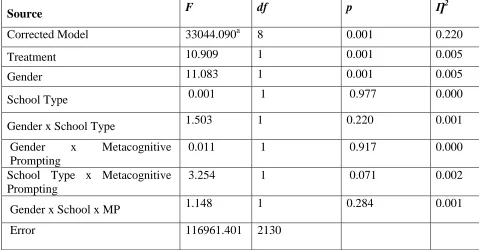
Electronic Journal of Science Education ejse.southwestern.edu Table 1: Summary Table of Analysis of Covariance (ANCOVA) on Students’ Genetics Problem Solving Ability
Source F df p Ƞ
2
Corrected Model 33044.090a 8 0.001 0.220
Treatment 10.909 1 0.001 0.005
Gender 11.083 1 0.001 0.005
School Type 0.001 1 0.977 0.000
Gender x School Type 1.503 1 0.220 0.001
Gender x Metacognitive Prompting
0.011 1 0.917 0.000
School Type x Metacognitive Prompting
3.254 1 0.071 0.002
Gender x School x MP 1.148 1 0.284 0.001
Error 116961.401 2130
a. R Squared = .220 (Adjusted R Squared = .217)
Note: Covariates appearing in the model are evaluated at the following values: BAT = 17.3
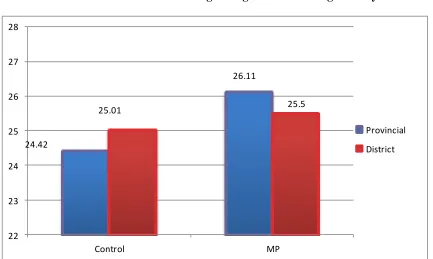
Electronic Journal of Science Education ejse.southwestern.edu 24.42
26.11
25.01 25.5
22 23 24 25 26 27 28
Control MP
Provincial
District
Figure 1: Interaction effect of Metacognitive Prompting and School Type
This non-significant trend suggests that metacognitive prompting positively influenced the performance of provincial school students, with virtually no effect noted for the district school students. This finding may prove to be of minimal practical significance, but does bear some attention in future studies exploring the impact of metacognitive prompting in different academic populations.
Discussion
The purpose of the present study was to examine the impact of metacognitive prompting on student performance on a high school genetics problem solving test. The full model used in this investigation allowed us to control for and test the effects of gender, type of school attended, and prior knowledge in biology to ensure that the treatment effect was identified directly. The results suggested that metacognitive prompting is beneficial in supporting student performance on the genetics problem solving test, regardless of the condition. In addition, females performed better than boys on the outcome measure in this sample drawn from Kenyan high school students.
Metacognitive Prompting During Tests
Electronic Journal of Science Education ejse.southwestern.edu cognitive awareness and utilization of typically overlooked strategies that support deep problem solving. An example of a question with embedded MP was:
" Construct a diagram to show the possible phenotype arising in the children of a marriage between a woman with blood group A and a man with blood group B, where both parents are heterozygous"
{MP: Can the problem be solved in steps? Yes/No}
Our results suggest that classroom teachers can effectively include metacognitive prompts in tests to guide students to activate the problem solving strategies they have learned during their studies. However, it is imperative to recognize that the use of the metacognitive prompting strategies induced in this setting cannot replace effective preparation – they merely guide learners in the process of identifying the structure of problems, creating connections with prior knowledge, and selecting learning strategies (Mevarech & Kramarski, 1997).
Electronic Journal of Science Education ejse.southwestern.edu systematic and strategic during problem solving. Similarly, Schraw et al. (2006) and Schraw (1998) urge educators to provide explicit instruction in cognitive and metacognitive strategies.
Gender Differences
The noted gender difference in this study was remarkable given the long standing results that males tend to score higher than females in science assessments, and females tend to be underrepresented in advanced science programs. The differential representation of men and women in the scientific community has been foretold by achievement patterns evident in the elementary and secondary levels (Cakiroglu, 1999). The present study has indicated that this is not always the case because girls outperformed boys regardless of the treatment group. Worthy to note is that this test was a direct measure of problem solving in genetics; not general knowledge. Most studies on gender differences have confined themselves to general knowledge as opposed to specific measures such as genetics problem solving. It is important to note that recent assessments show that gender differences in science achievement have narrowed over time (Britner, 2008; Freeman, 2004), though differences in achievement as well as stereotypes about science courses being more favorable for males still exist (DeBacker & Nelson, 2001; Miyake et al., 2010; Nosek et al., 2009).
Conclusions and Recommendations
One very important factor of effective problem solving in science is the strength of what the learner already knows. Propelled by this discovery, science educators and researchers have geared their efforts towards understanding the characteristics, strengths, and weaknesses of the individual learner so as to design appropriate instructional programs that will meet his / her needs. Consequent upon the claim in literature that metacognitive prompting leads to meaningful problem solving and the findings of this study that metacognitive prompting significantly improves problem solving, it is recommended that biology teachers should embrace metacognitive prompting strategy and other participatory strategies during instruction and testing. A brief metacognitive intervention may be a promising way to address the problem solving limitations in genetics and by extension in biology. By so doing, learners would be guided to learn step wisely and meaningfully and would be assisted to develop problem solving skills in genetics and by extension in biology. Also, teachers should allow equal encouragement among the male and female students with varying levels of problem solving ability.
Electronic Journal of Science Education ejse.southwestern.edu metacognitive prompting. More research on gender differences is recommended to further investigate this counter-finding.
References
Bacharach, V. R., Baumeister, A. A., & Furr, R. M. (2003). Racial and gender science
achievement gaps in secondary education. The Journal of Genetic Psychology, 164(1)115-126.
Bin, X. (2008). Application of Learning Strategies and College English Reading Achievements. US-China Foreign Language, 6(5), 39–45.
Britner, S. L. (2008). Motivation in high school science students: A comparison of gender differences in life, physical, and earth science classes. Journal of Research in Science Teaching, 45(8), 955- 970.
Britner, S. L., & Pajares, F. (2006). Sources of science self-efficacy beliefs of middle school students. Journal of Research in Science Teaching, 43, 485-499
Butler, D. L., & Winne, P. H. (1995). Feedback and Self-Regulated Learning: A Theoretical Synthesis. Review of Educational Research, 65, 245-281.
Bybee, R. (1997). Achieving Scientific Literacy. Portsmouth, NH: Heinemann.
Bybee, R., &Taylor, J. (2006). The BSCS 5E Instructional Model: Origins and Effectiveness. Colorado Springs, CO: BSCS.
Cakiroglu J (1999) Gender differences in the science classroom. Hacettepe Universitesi Egitim Fakultesi Dergisi 16-17: 123-133
Conner, L. N. (2007). Cueing Metacognition to Improve Researching and Essay Writing in a Final Year High School Biology Class. Research in Science Education. 2007, 37: 1-16. Davis, E. A. (2003). Prompting middle school science students for reflection: Generic and
Directed prompts. The Journal of the Learning Sciences, 12: 91–142.
Davis, A. E. and Linn M. (2000). Scaffolding students’ knowledge integration: prompts for reflection in KIE. International Journal of Science Education, 22: 819-837.
DeBacker, T. K., & Nelson, R. M. (2001). Motivation to learn science: Differences related to gender, class type, and ability. The Journal of Educational Research, 93, 245-254.
DeHaan, R. L. (2005). The Impending Revolution in Undergraduate Science Education. Journal of Science and Educational Technology. 14, 253–270.
DeVellis, R. F. (2003). Scale development: Theory and applications, (2nd ed) Newbury Park, CA: Sage
Efklides, A. (2008). Metacognition: Defining its Facets and Levels of Functioning in Relation to Self-regulation and Co-regulation. European Psychologist, 13, 277-287.
Efklides, A. (2009). The role of metacognitive experiences in the learning Process. Psicothema, 21(1), 76–82. Retrieved September 30, 2012, from http://www.psicothema.com/pdf/ 3598.pdf
Fennema, E. (1984). Mathematics learning and the sexes: A review. Journal for Research in Mathematics Education, 5, 126-139.
Electronic Journal of Science Education ejse.southwestern.edu Flavell, J. H. (1979). Metacognition and cognitive monitoring: A new area of cognitive-
developmental inquiry. American Psychologist, 34 (10), 906-911.
Flavell, J. H., Miller, P. H., & Miller, S. A. (2002). Cognitive Development. (4th ed.). Upper Saddle River, New Jersey: Prentice Hall.
Freeman, C. E. (2004). Trends in Educational Equity of Girls & Women: 2004 (NCES 2005–016). Retrieved from Washington, DC: U.S. Government Printing Office:
Hake, R. (2005). The Physics Education Reform Effort: A Possible Model for Higher Education. National Teachers’ Learning Forum 15, 1–6
Hoffman, B., & Spatariu, A. (2008). The Influence of Self-efficacy and Metacognitive Prompting on Math Problem solving Efficiency. Contemporary Educational Psychology, 33, 875-893.
Johnson, R. B., & Christensen, L. B. (2004). Educational research: Quantitative, qualitative, and mixed approaches (3rd ed.). Boston , MA: Allyn and Bacon.
Kauffman, D. F. (2004). Self-regulated Learning in Web-based Environments: Instructional Tools Designed to Facilitate Cognitive Strategy Use, Metacognitive Processing and Motivational Beliefs. Journal of Educational Computing Research, 30, 139–161.
King, A. (1992). Facilitating Elaborative Learning Through Guided Student-Generated Questioning. Educational Psychologist. 27: 111 – 126.
King, A. (1994). Guiding Knowledge Construction in the Classroom: Effects of Teaching Children How to Question and How to Explain. American Educational Research Journal, 31, 338–368.
Koechlin, C. and Zwaan, S., (2007). Assignments Worth the Effort: Questions Are Key. Teacher Librarian. 34: 14-19.
Kramarski, B., & Gutman, M. (2006). How Can Self-Regulated Learning Be Supported In Mathematical E-Learning Environments? Journal of Computer Assisted Learning, 22, 24–33.
Kramarski, B., & Zeichner, O. (2001). Using Technology to Enhance Mathematical Reasoning: Effects of Feedback and Self-Regulation Learning. Educational Media International, 38(2/3), 77–82
Lee VE and DT Burkam (1996) Gender differences in middle grade science achievement: Subject domain, ability level, and course emphasis. Science Education 80 (6): 613-650. Leech, N.A., Barrett, K.C., & Morgan, G.A. (2004). SPSS for intermediate statistics: Use
and interpretation. Mahwah, NJ: Lawrence Erlbaum Associates
Linn MC and JS Hyde (1989) Gender mathematics and science. Educational Researcher 18: 17-19.
Martinez, M. E. (2006). What is metacognition? Phi Delta Kappan, 696-699.
Meece, J. L., Glienke, B., & Burg, S. (2006). Gender and motivation. Journal of Social Psychology, 44, 351-73.
Mevarech, Z., & Kramarski, B. (1997). IMPROVE: A Multidimensional Method for Teaching Mathematics in Heterogeneous Classrooms. American Educational Research Journal, 34, 365–394.
Miyake, A., Kost-Smith, L. E., Finkelstein, N. D., Pollock, S. J., Cohen, G. L., & Ito, T.
Electronic Journal of Science Education ejse.southwestern.edu Mory, E. H. (2004). Feedback Research Revisited. In D. H. Jonassen (Ed.), Handbook of
Research on Educational Communications and Technology (Pp. 745–784). Mahwah, NJ: Lawrence Erlbaum Associates.
National Research Council (NRC) (2000). How People Learn: Brain, Mind, Experience, and School. Washington, DC: National Academies Press;.
Nelson, C. E. (2008). Teaching Evolution (and All of Biology) More Effectively: Strategies for Engagement, Critical Reasoning, and Confronting Misconceptions. Integrative and Comparative Biology Advance Access.
http://icb.oxfordjournals.org/cgi/reprint/icn027v1.pdf (accessed 15 September 2008). NGSS Lead States. 2013. Next Generation Science Standards: For States, By States.
Washington, DC: The National Academies Press.
Nosek B. A., Smyth, F.L., Sriram, N., Lindner, N.M. Devos, T., Ayala, A., Greenwald, A. G. (2009). National differences in gender-science stereotypes predict national sex differences in science and math achievement. PNAS, 106, 10593-10597.
Oakes, J. (1990). Opportunities, Achievement, and Choice of Women and Minority Students in Science and Math. Review of Research in Education, 16, 153-222.
Orcajo, T. I., & Aznar, M. M. (2005). Solving problems in genetics II: Conceptual restructuring. International Journal of Science Education, 27 (12), 1495–1519.
Perkins DN and Salomon G. (1989). Are cognitive skills context-bound? Education Research. 18:16–25.
Rozencwajg (1992). Analysis of Problem Solving Strategies in Physics. Current
Psychology of Cognition, 16 (3), 353-382. Journal of Psychology of Education1, 5-22. Rozencwajg, P., (2003). Metacognitive Factors in Scientific Problem solving Strategies.
European Journal of Psychology of Education, 18 (3), 281-294
Schneider, W. & Lockl, K. (2002). The development of metacognitive knowledge in children and adolescents. In Perfect, T. & Schwartz, B. (Eds.), Applied metacognition. Cambridge, UK: Cambridge University Press.
Schoenfeld, A. (1985). Mathematical Problem Solving. Orlando, FL: Academic Press.
Schraw, G., Crippen, K. J., & Hartley, K. (2006). Promoting self-regulation in science education: Metacognition as part of a broader perspective on learning. Research in Science Education, 36, 111-139.
Schwonke, R. Hauser, S. Nuckles, M. and Renkl, A., (2006). Enhancing computer-
supported writing of learning protocols by adaptive prompts. Computers in Human Behavior. 22: 77–92
Schraw, G. (1998). Promoting general metacognitive awareness. Instructional Science, 26(1-2), 113- 125.
Schraw, G., Crippen, K. J., & Hartley, K. (2006). Promoting self-regulation in science education: Metacognition as part of a broader perspective on learning. Research in Science Education, 36, 111-139.
Stewart J. H. & Dale, M. (1989) High School Students’ Understanding of Chromosome/Gene Behaviour during Meiosis. Science Education, 73, 501–521.
Electronic Journal of Science Education ejse.southwestern.edu Tekkaya, C., Çapa, Y. & ve Yılmaz, Ö. (2000). Biyoloji öğretmen adaylarının genel biyoloji konularındaki kavram yanılgıları. Hacettepe Üniversitesi Eğitim Fakültesi Dergisi, 18, 140–147.
Teong, K. (2003). The Effect of Metacognitive Training on Mathematical Word-Problem Solving. Journal of Computer Assisted Learning, 19, 46-45.
Tsui, C. and Treagust, D. (2003). Learning genetics with computer dragons. Journal of Biological Education, 27(2), 96-98.
Tsui, C. and Treagust, D.F. (2004). Conceptual Change in Learning Genetics: An Ontological Perspective. Research in Science & Technology Education, 22, 185–202. C-Y., & Treagust, D. F. (2007). Understanding Genetics: Analysis of Secondary Students’ Conceptual Status. Journal of Research in Science Teaching, 44 (2), 205 – 235.
Veenman, M. V. J., Kerseboom, L, & Imthorn, C. (2000). Test anxiety and metacognitive
skillfulness: Availability versus production deficiencies. Anxiety, Stress, and Coping, 13, 391–412.
Weinburgh, M. H. (2000). Gender, ethnicity, and grade level as predictors of middle school students’ attitudes toward science. Current Issues in Middle Level Education. 72-84 Wittrock, M. C. (1990). Generative Processes of Comprehension. Educational Psychologist, 24,
Electronic Journal of Science Education ejse.southwestern.edu Appendix A
Biology Ability Test (BAT)
1. Define the following terms [2 points]
a) Genotype____________________________________________________ b)Phenotype____________________________________________________
2. Tim and Jan both have freckles, but their son Michael does not. Show with a Punnett square how this is possible [2points]
If Tim and Jan have another child, what is the probability that it will have freckles? (1 pt.) 3. Mendel believed that the characteristics of pea plants are determined by the: [1point]
A. Inheritance of units or factors from both parents B. Inheritance of units or factors from one parent
C. Relative health of the parent plants at the time of pollination D. All of the above
4. An allele is: [1 point]
A. Another word for a gene B. A homozygous genotype C. A heterozygous genotype
D. One of several possible forms of a gene
5. Phenotype refers to the ______________________ of an individual. [1 point] A. Genetic makeup
B. Actual physical appearance C. Recessive alleles
D. None of the above
6. When the genotype consists of a dominant and a recessive allele, the phenotype will be like _________________ allele. [1 point]
A. The dominant B. The recessive C. Neither
D. A blend of both alleles
7. Assuming that two parent plants are homozygous for Yellow and Green color, why would all of the F1 generation have yellow phenotypes? [1 point]
A. Because the F1 genotypes are homozygous B. Because yellow is dominant over green
C. Because both parents passed on yellow alleles D. Because green is dominant over yellow
Electronic Journal of Science Education ejse.southwestern.edu A. Unit inheritance
B. Segregation
C. Independent assortment D. Dominance
9. In a cross between yellow and green pod plants, all F1 plants are yellow pods. When the F1 plants are self-fertilized, green pods appear in F2 generation. What accounts for the green pea seed in the F2 generation? [1 point]
A. On average, 1 out of 4 offspring of heterozygous parents will be homozygous recessive
B. The yellow allele is dominant over the green one C. The F1 generation parents are homozygous yellow D. The F1 generation parents are homozygous green
10. The idea that for any particular trait, the pair of alleles of each parent separate and only one allele from each parent passes to an offspring is Mendel's principle of: [1 point]
A. Independent assortment B. Hybridization
C. Segregation
D. Incomplete dominance
11. One of the earliest events that distinguish meiosis occurs in prophase I and involves: [1 point]
A. Condensation of chromosomes B. Loss of the nuclear membrane
C. Movement of chromosomes towards the metaphase plate D. Pairing of homologous chromosomes
12. Coral in the ocean grows by budding, where the new organism grows out of the old one by mitosis. This form of replication is an example of: [1 point]
A. meiosis to produce a zygote B. asexual reproduction
C. sexual reproduction D. gamete formation
13. _________________ most closely resembles events of mitosis except that the cells are ___________. [2 points]
A. interphase, diploid B. meiosis II, diploid C. interphase, haploid D. meiosis II, haploid
Electronic Journal of Science Education ejse.southwestern.edu B. homologous chromosomes cross over
C. chromatids are separated during anaphase
D. homologous chromosomes behave independently 15. What is the purpose of meiosis? [1 point]
A. To ensure the constancy of chromosome number from sperm to eggs.
B. To ensure the constancy of chromosome number from one generation to another and permit genetic variations.
C. To allow sex
D. To make life more fun
16. When genes are sex-linked it means that: [1 point]
A. The genes are dependent on the sex drive of the individual
B. The genes are expressed only if the proper sex hormones are present. C. The genes are located only on the Y chromosome
D. The genes are located only on the X chromosome.
17. In a cross of Tt X tt, what proportion of the offspring would be tall? (T = Tall, t = Short) [1 point]
A. All the offspring would be tall B. 1/2
C. 1/4
D. None of the offspring would be tall.
18. What is the major value in using a Punnett square? [1 point] A. Shows all gametic combination
B. Shows genotypic ratio C. Shows phenotypic ratio D. Shows A, B, and C
19. Which statement is not true? [1 point] A. Genotype determines phenotype B. Phenotype determines genotype
C. A phenotype is the physical appearance of a trait in an organism D. Alleles are different forms of the same gene
20. Fill in the blanks [3 points]
Law Parent Cross Offspring Phenotype % Phenotype
DOMINANCE TT x tt
tall x short Tt (tall)
____
SEGREGATION Tt x Tt
tall x tall
_____ _____
Electronic Journal of Science Education ejse.southwestern.edu 21. The phenotype of a pea plant can best be determined by: [1 point]
A. Analyzing its genes B. Looking at it
C. Crossing it with a recessive plant D. Eating it
22. The appearance resulting from a given gene combination is referred to as the [1 point] A. Genotype
B. Phenotype C. Prototype D. Alleleotype
23. Distinguish between the following terms as used in genetics. [2 points] A. Homozygous
B. Heterozygous
24. Based on what you have learned about Mendel’s experiments with pea plants, which two of the following statements is not correct? [1 point]
A. The gene for wrinkled seeds is an allele of the gene for smooth seeds.
B. White flowers and purple flowers are determined by different alleles of the same gene.
C. The gene for wrinkled seeds is an allele of the gene for purple seeds. D. The alleles for smooth seeds and purple flowers are dominant. 25. Matching
Below are results from some crosses, some of which would have surprised Mendel a bit. Match each with the term that best describes what’s going on [5 points].
In a cross between two parents with the same phenotype, 3/4 of the offspring resemble the parents and 1/4 do not.
a. complete dominance b.incomplete dominance Two pure-breeding parents are crossed. All offspring have
a phenotype that is different from either parent.
c. codominance d. overdominance A child with blood type AB is born to a type A parent and
a type B parent
e. multiple alleles f. dihybrid cross A child with blood type O is born to a type A parent and a
type B parent
Electronic Journal of Science Education ejse.southwestern.edu Appendix B
Genetics Problem Solving Test (GPST)
with Embedded Metacognitive Prompting Questionnaire (MPQ) for Experimental Group
Instructions
Answer all questions in the spaces provided. Show all your working where required so as to earn full points.
1. Who is famously regarded as the father of genetics? [1 point] 2.
2. The point at which chromatids join in a chromosome is called__________ and the point where crossing over takes place is called________________
{MP: Do you know what the problem/task is about? Yes/No} [2 points]
3. How many chromosomes are found in the following cells of a human being? [2 points] a. Somatic cells
b. Gamete cells
4. Differentiate between mitosis and meiosis [2 points] 5. Alternate forms of a gene are called alleles [1 point]
oTrue
oFalse
6. Crossing over takes place during metaphase 1 of meiosis [1 point]
oTrue
oFalse
7. Independent assortment and crossing over result into variation [1 point]
oTrue
oFalse
8. In peas, seeds may be round (R) or wrinkled (r). What proportion of the offspring in the following crosses would be expected to be wrinkled? [3 points]
{MP: Have you solved similar problems before? Yes/No} a. RR x rr
b. Rr x Rr c. Rr x rr
9. In cattle, RR = red, Rr = roan, and rr = white. What are the predicted color phenotypes for the offspring from crosses between: USE PUNNETT SQUARE TO PREDICT [6 points]
{MP: Are these problems similar to probability in any way? Yes/No} a. a red bull and a white cow
Electronic Journal of Science Education ejse.southwestern.edu c. roan bull and a roan cow
10. The inheritance of color blindness in humans is due to a recessive gene located on the X chromosome (X linked).
XC (normal), Xc (color blind)
{MP: Is there a faster method to solve the problem? Yes/No}
a. If a color-blind boy is born to parents both of whom have normal vision, what are the genotypes of the three individuals? [3 points]
b. What is the probability that the second child born to that couple will be a color-blind daughter? [1 point]
{MP: Can you think of a strategy or principle that is appropriate for solving or addressing the problem or task? Yes/No}
11. In garden peas, long stems are dominant to short stems. 100 long all of which had one short parent are interbred (bred to each other). 1600 offspring result. Please answer the following questions about these progeny. (SHOW YOUR WORKING)
{MP: What strategy are you using to solve the problems? Yes/No}.
a. About how many long pea plants would you expect to find among the offspring? [2 points]
b. What ratio of long stem to short stem plants would you expect among the offspring? [1 point]
c. What would you expect the overall phenotypic ratio among the 1600 offspring to be? [1 point]
12. B is a dominant allele coding for black fur on rabbits and b is a recessive allele coding for white fur on rabbits. Fill in the following blanks with the correct cross of the following: [5 points]
{MP: Is there any other information that you need to answer this question? Yes/No} (1) BB x bb, (2) Bb x Bb, (3) bb x bb, (4) Bb x bb
a. All (100%) of the offspring are white: __________
b. One quarter (25%) of the offspring are white: __________ c. All (100%) of the offspring are black: ___________
d. Three-quarters (75%) of the offspring are black: __________ e. One-half (50%) of the offspring are white: __________
13. In an investigation plants with red flowers were crossed with plants with white flowers. All the F1 plants had pink flowers.
a. Give reasons for the appearance of pink flowers in F1generation [2 Points]
b. If a plant from F1 generation was selfed, state the phenotypic ratio of the F2 generation. USE PUNNETT SQUARE TO ANSWER. [3 points]
c. Name two causes of variation in a species [2 points]
Electronic Journal of Science Education ejse.southwestern.edu 14. Construct a diagram to show the possible phenotype arising in the children of a marriage between a woman with blood group A and a man with blood group B, where both parents are heterozygous.[6 points]
{MP: Can the problem be solved in steps? Yes/No}
The Table below shows short messages (SMS) on cellphone communication and can be used as analogies of gene mutations. Use this information to answer questions 15 - 16
{MP: Do you think the strategies you are using can help to solve the problems? Yes/No} Table: Analogies of Gene Mutation
Intended Message Actual message (sent)
Gene Mutation
Changes leading to distortion of message Buy me a skirt Buy me a shirt
My grandmother went shopping
My grandmother went hopping
This is my team This is my mate Auntie is staying Auntie is straying
15. For each of these messages in the table above, identify the type of gene mutation and fill in the 3rd column. [2 points]
16. For each of the messages above, state the changes that cause the distortion in the intended message [4 points]
(MP: Are you sure your answers are correct? Yes/No}
17. Both John and Cathy have normal color-vision. After 10 years of marriage, Cathy gives birth to a colorblind son. John filed for divorce, claiming he’s not the father of the child.
{MP: Is there an aspect of genetics that this problem addresses? Yes/No}
a. Is John justified in his claim for non-paternity? Explain why [2 points] b. From which grandparent could the son have inherited his X chromosome?
[4 points]
Cathy’s Mom: _________ Cathy’s Dad: _________ John’s Mom: __________ John’s Dad: _________
18. Blood typing is often used in paternity cases (where there is a dispute about whether a particular man is the father of a child) as a preliminary screening method to rule out some possible fathers. You are the judge in a paternity suit where the mother is not sure which of three men is the father of her child. You order blood tests for everyone and get these results:
Mother: type A Child: type B Mr. X type B Mr. Y: type O Mr. Z: type AB
Electronic Journal of Science Education ejse.southwestern.edu Based on these results can any of these men be eliminated (are there any who cannot be the father)? If so, which one(s)? Briefly explain your reasoning [6 points]
A pure-breeding plant with red flowers, yellow seeds, square stems, and serrated leaves with white veins is crossed with a pure-breeding plant having white flowers, pink seeds, round stems and smooth-edged leaves with green veins. All the offspring have red flowers, pink seeds, square stems, and serrated leaves with yellow veins.
Electronic Journal of Science Education ejse.southwestern.edu Appendix C:
Metacognitive Prompting Questionnaire (MPQ)
STRATEGIC QUESTIONS:
1. Can you think of a strategy or principle that is appropriate for solving or addressing the problem or task? Yes/No
2. Is there another strategy you can use to solve this problem besides the punnett square? Yes/No 3. What strategy are you using to solve the problems? Yes/No
4. Can the problem be solved in steps? Yes/No COMPREHENSION QUESTIONS
5. Are these problems similar to probability in any way? Yes/No 6. Do you understand the concept behind this question? Yes/No REFLECTION QUESTIONS
7. Do you think the strategies you are using can help to solve the problems? Yes/No 8. Can your answer be checked for accuracy? Yes/No
9. Are you sure your answers are correct? Yes/No
10. Is there a faster method to solve the problem? Yes/No CONNECTION QUESTIONS
11. Is there any other information that you need to answer this question? Yes/No 12. Is there an aspect of genetics that this problem addresses? Yes/No