doi: 10.5681/jcs.2013.019
http:// journals.tbzmed.ac.ir/ JCS* Corresponding Author: Bahareh Akbarzadeh(MSc), E-mail: [email protected]
This study was extracted from the MSc thesis in nursing (thesis code: 324; The Ethics Committee of Tabriz University of Medical Sciences code:914).This research is registered in Iranian Registry of Clinical Trials by: IRCT201204078315N4
The Effect of Simulation Teaching on Baccalaureate Nursing Students’
Self-confidence Related to Peripheral Venous Catheterization in Children:
A Randomized Trial
Leila Valizadeh1, Abolghasem Amini2, Eskandar Fathi-Azar3, Shahrzad Ghiasvandian4, Bahareh Akbarzadeh1*
1
Department of Nursing, Faculty of Nursing and Midwifery, Tabriz University of Medical Sciences, Tabriz, Iran 2
Department of Medical Education, Education Development Center, Tabriz University of Medical Sciences, Tabriz, Iran 3
Department of Educational Psychology, Tabriz University, Tabriz, Iran 4
Department of Nursing, Faculty of Nursing and Midwifery, Tehran University of Medical Sciences, Tehran, Iran
ARTICLE INFO ABSTRACT
Article type: Original Article
Introduction:In recent decades, nursing instructors have tended to use simulation rather than traditional methods due to benefits such as increased self-confidence. However, little academic literature is available to verify this claim. The procedure of establishing peripheral venous catheterization in pediatric patients is of great importance. Therefore, the researchers attempted to review the effect of the simulation teaching method on nursing students' self-confidence related to peripheral venous catheterization in pediatric patients. Methods:In this trial, 45 students in the 5th and 6th semester of nursing school in the first half of school year 2012 from the Faculty of Nursing and Midwifery, Tabriz University of Medical Sciences, Iran, were randomly assigned to three groups (a control group, and two intervention groups). They were trained in establishing peripheral venous catheterization in pediatric patients through simulation teaching method and practical training. The students' self-confidence was assessed by C-Scale before and after the intervention. Results:The students’ self-confidence score showed a significant increase in the simulation group after the intervention in comparison to other groups (p = 0.03). Conclusion:Results revealed a significant increase in self-confidence of nursing students related to peripheral venous catheterization in pediatric patients by simulation. This substantiates the assertion that simulation can improve self-confidence. Due to the low sample size, further studies with larger population are suggested.
Article History: Received: 15 Jan. 2012 Accepted: 28 Feb. 2012 ePublished: 1 Jun. 2013
Keywords: Simulation method Students
Pediatric nursing Peripheral venous catheterization
Introduction
Most newly graduated nurses do not have the required skills to perform psychomotor
procedures.1 Difficulty in finding a safe
clinical environment, where it is possible to provide good clinical experiences for students during the limited time of nursing education, can be one of the causes.2 In fact, this is more prevalent in pediatric units; since, due to the crowdedness of hospitals
most children are being treated on an outpatient basis. Furthermore, most children who are being hospitalized suffer from acute illnesses.3 Moreover, for the child's safety, parents and staff prohibit some activities
from being done by students.4 Therefore,
nursing instructors who have the
158 | Journal of Caring Sciences, Jun 2013; 2 (2), 157-164 Copyright © 2013 by Tabriz University of Medical Sciences
non-traditional methods to enhance the clinical experiences of students .2,5
In order to increase learning opportunities for students, in recent decades faculty members tend to use simulation, such as the
use of mannequin and standard patients.5 To
be precise, simulation was used for the first time in the military and aviation industries. The use of simulation in nursing education
began in the UK.6 In fact, simulation refers to
those activities that reflect the reality of a clinical environment. In other words, it includes activities such as role-playing, and using interactive videotapes and mannequins that help students in learning. Moreover, it gives them the opportunity to show their ability in decision-making, critical thinking,
and other skills.7 creating an environment in
which learners can gain cognitive,
psychometric, and affective areas of knowledge without fear of harm to the patient are benefits of the simulated
environment.8 However, this method is
time-consuming, expensive, and requires
personnel to launch simulators.9,10
In a research, Parker et al. (2011) showed that using the simulation technique leads to
satisfaction and self-confidence.11 Students'
self-confidence has a significant impact on their understanding and feeling of success in their clinical practices.12 Feeling of efficacy, self-esteem, and self-confidence influence students' ability to accept their role as a
nurse.13 In the research of Thomas and
Mackey (2011) a significant increase was observed in the level of students’ confidence, who were trained clinical skills using simulation, compared to the traditional training group in areas such as diagnosis and symptoms of disease, patient assessment,
nursing interventions, and evaluation.14
Soucy (2011) indicated no significant difference in the confidence scores of students who received simulation training in pediatric care.15
Given the growing use of simulation in nursing education, and since it is costly and time consuming, further research is required
to determine the benefits of this method.16
There should be further research on students’ self-confidence in order to prove that stimulation leads to increased confidence; a characteristic that plays a significant role in students' clinical success.
One of the most common and important nursing skills which is performed by nurses, and one of the most challenging skills taught in schools of nursing is peripheral venous catheterization for fluids and intravenous medication; it can have serious side effects on
patient in case of any mistakes.17,18
Implementing this skill in a safe way with minimal damage and stress to the child and his or her family is one of the main daily tasks of a nurse. Nursing students always try to gain confidence in performing intravenous catheter insertion.19 In fact, success in this skill requires not only knowledge of the techniques and skills in performing its steps, but also requires confidence that can be
achieved through practice.20
Considering students' self-confidence in pediatric clinical training is of great importance, because students are often anxious
in the beginning of these courses. 21 This is due
to their patients being smaller and more delicate than adults. Moreover, parents are usually present at the time of care, and this can be stressful and threatening for nursing
students.22 However, in the undergraduate
nursing education curriculum in Iran, nursing clinical skills related to pediatric patients is taught through using pictures and slide lectures. In other words, students do not practice these skills in a laboratory environment before entering the real clinical situation.
There is little empirical literature on the effect of simulation on the self-confidence of students in performing psychomotor skills. Moreover, establishing peripheral venous catheterization in pediatric patients is of great
importance. Therefore, the researcher
catheterization in pediatric patients through an experimental study. There researchers aim was also to help the growing body of knowledge in this area and to suggest additional clinical skill training in pediatric nursing for bachelor students.
Materials and methods
The present research is a controlled, three-group trial. All participants were nursing students from the Faculty of Nursing and Midwifery, Tabriz University of Medical
Sciences, Iran. Students were in the 5th and 6th
semester of the first half of 2012 (45 subjects). Instruments used in this research included an infant mannequin named Crisis which had the possibility of establishing a peripheral venous catheterization in basilica vein, cephalic vein, dorsal hand vein of the upper limb bows, saphenous vein, and lower extremity venous arch on the foot. In addition, the confidence scale to measure
self-confidence during performing
psychomotor skills was (C-Scale) a self-report tool which the authors have obtained permission to use. This scale was developed by Ms. Susan Erin Grundy in 1993. Moreover, its reliability was specified through Cronbach’s alpha scores which were between 0.84 to 0.93.23
The C-Scale contains five statements on a five-point scale (1: procedure without confidence, 5: procedure with full confidence) in which students must determine the case
that better represents their ability
inperipheral venous catheterization in pediatric patients. The minimum score is 5 and maximum is 25. In the present research, the validity of this instrument was assessed by ten experts (nursing faculty members, especially pediatrics and psychologists). Its reliability was examined through test-retest in collaboration with the bachelor nursing
students in the 8th semester (R = 0.8).
Before obtaining informed consent, the aim of the study and its benefits and advantages were explained orally and in written form to all subjects. Then, students
who wished to participate were asked to complete the consent and demographic form.
The inclusion criteria included willingness
to participate in the study, and to be in the 5th
and 6th semester of undergraduate nursing.
The exclusion criteria included having an experience of peripheral venous catheter-ization in pediatric patients and having clinical experience, being a guest or transfer (temporary) student from a second or third class university, and refusing to participate in training sessions or pre-test and post-test.
Finally, 22 students in their 6th semester and
25 students in their 5th semester participated
in our study.
Instruments and steps related to
peripheral venous catheterization for
pediatric patients were explained by the researcher through lecture and use of pictures and slides (common method in the curriculum related to theory-based courses of pediatric patients) in about 15 minutes for all subjects. After pre-test, students were asked to perform the procedure on an infant mannequin in the clinical laboratory in a run time of up to 15 minutes under supervision of an examiner. Then, they determined their self-confidence during the procedure on the target scale of assessing self-confidence about psychomotor skills.
In the next step, participants from each semester were randomly assigned to three groups (one control and two intervention
groups). 22 students in the 6th semester were
randomly divided into three groups (a group of 8 people, and 2 groups of 7 people). After that, they were randomly assigned to the control group (n=7), simulations group (n = 8), and demonstration group (n = 7). One student of the demonstration group was
excluded because of her fathers death and
not participating in the post-test, and one of
the students in their 5th semester was
160 | Journal of Caring Sciences, Jun 2013; 2 (2), 157-164 Copyright © 2013 by Tabriz University of Medical Sciences
number of participants in the simulation group was 16, demonstration group 14, and control group was 15. In the simulation group, at least 4 students (power = 0.9) were required to determine the effect of teaching method on students' self-confidence related to peripheral venous catheterization in children.
In the simulation method of teaching students practiced the peripheral venous catheterization procedure in a clinical laboratory (practice room) on infant mannequins under supervision of the researcher. In this method, they entered the laboratory two by two. Before starting; the objectives, equipment, and environment were introduced. Then, they were given a written scenario about taking care of a child who has severe dehydration and needs compensation of fluids and electrolytes by establishing a peripheral venous line and a detailed description of the environment,require-ments, expectations of students, and their role. One of the students played the role of a nurse who had to establish peripheral venous catheterization on an infant mannequin within 25 minutes. In addition, he or she had to build an appropriate relationship with the parents. Another student had the role of an observer. The researcher played the role of facilitator and also the role of parents while handling the whole scenario. The researcher and student, who played the role of the observer, recorded the necessary points related to implementation and communication with parents during the procedure. Then students switched roles with each other. At the end, there was a 20-minute question and answer course with researcher as a facilitator. During this part, students provided feedbacks about their personal feelings of simulation and their skill while establishing peripheral venous catheterization. Furthermore, in case of need the researcher provided the necessary feedback to student and responded to their questions and concerns. Teaching and learning by this method takes 45 minutes in total.
In the demonstration group, the researcher first discussed the aim and requirements of the procedure with the students and then displayed the procedure on a mannequin for 20 minutes. Then, each student practiced the procedure for 25 minutes on the mannequin. The total time of this method was 45 minutes. In the control group, subjects were trained through the lecture method by using slides and images, which is a common method in theory-based courses on peripheral venous catheterization in pediatric patients. Therefore, they did not receive any additional training.
Two weeks after training, all participants in the research, took post-test individually. All students were asked to implement the target procedure on infant mannequins in the clinical laboratory within 15 minutes (at maximum) under the supervision of the examiner. Then, they had to determine their self-confidence during performing the procedure using the mentioned scale. Instructors checked all factors to achieve equal performance.
In addition, to prevent information pollution, which may be caused by competition between students, it was explained to all of them that the research did not aim to evaluate them; but to evaluate teaching methods. Therefore, they were asked not to talk about it to each other. Moreover, they did not have access to a training mannequin during the research, except during teaching sessions, pre-test, and post-test.
Data were analyzed using SPSS for Windows (version13; SPSS Inc., Chicago, IL., USA) with 95% confidence level and significance level of 0.05.
Results
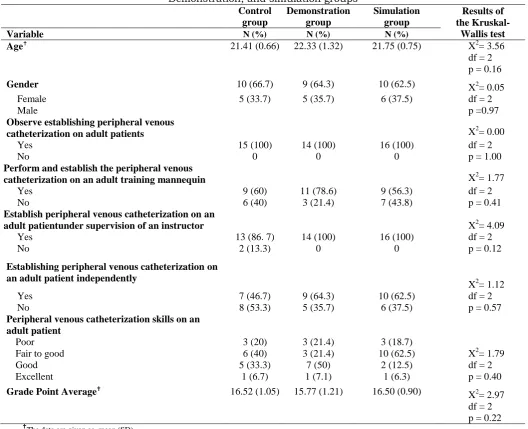
Table 1.Socio-demographic and learning profile of nursing students in the control, Demonstration, and simulation groups
Control group
Demonstration group
Simulation group
Results of the Kruskal-Wallis test
Variable N (%) N (%) N (%)
Age 21.41 (0.66) 22.33 (1.32) 21.75 (0.75) X2= 3.56
df = 2 p = 0.16
Gender 10 (66.7) 9 (64.3) 10 (62.5) X2
= 0.05
Female 5 (33.7) 5 (35.7) 6 (37.5) df = 2
Male p =0.97
Observe establishing peripheral venous
catheterization on adult patients X2= 0.00
Yes 15 (100) 14 (100) 16 (100) df = 2
No 0 0 0 p = 1.00
Perform and establish the peripheral venous
catheterization on an adult training mannequin X2= 1.77
Yes 9 (60) 11 (78.6) 9 (56.3) df = 2
No 6 (40) 3 (21.4) 7 (43.8) p = 0.41
Establish peripheral venous catheterization on an
adult patientunder supervision of an instructor X2= 4.09
Yes 13 (86. 7) 14 (100) 16 (100) df = 2
No 2 (13.3) 0 0 p = 0.12
Establishing peripheral venous catheterization on an adult patient independently
X2= 1.12
Yes 7 (46.7) 9 (64.3) 10 (62.5) df = 2
No 8 (53.3) 5 (35.7) 6 (37.5) p = 0.57
Peripheral venous catheterization skills on an adult patient
Poor 3 (20) 3 (21.4) 3 (18.7)
Fair to good 6 (40) 3 (21.4) 10 (62.5) X2= 1.79
Good 5 (33.3) 7 (50) 2 (12.5) df = 2
Excellent 1 (6.7) 1 (7.1) 1 (6.3) p = 0.40
Grade Point Average 16.52 (1.05) 15.77 (1.21) 16.50 (0.90) X2= 2.97
df = 2 p = 0.22
The data are given as mean (SD)
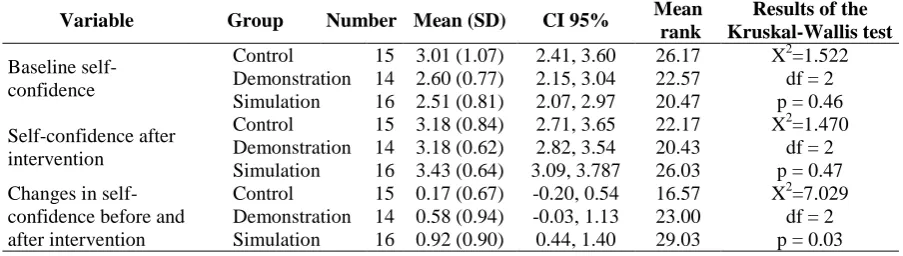
In order to determine the effect of teaching methods on self-confidence of nursing students related to peripheral venous catheterization in each group, the mean score of pre-test and post-test were compared. In the simulation group with p = 0.009 the increase in self-confidence in the post-test was statistically significant based on the Wilcoxon test (Table 2). Simulation teaching method increased self- confidence. In addition, comparison of the dependent variables (self-confidence) between the three groups by Kruskal-Wallis test (with p = 0.03) showed significant statistical differences
(Table 3). Simulation teaching method had the highest average rank among others.
Discussion
The results demonstrated that the simulation method in peripheral venous catheterization in pediatric patients leads to a significant increase in self-confidence of students compared to the method of demonstration and lecture using slides and images (current method of teaching this skill
on pediatric patients in nursing
162|Journal of Caring Sciences, Jun 2013; 2 (2), 157-164 Copyright © 2013 by Tabriz University of Medical Sciences
The descriptive study by Kaddoura on ten newly graduated nursing students showed that students who were trained through simulation method, had more confidence in
the care of patients.24 The semi-experimental
research using pre-test and post-test designed by Thomas and Mackey (2012) on 24 nursing students, also showed significant increase in confidence scores in aspects of diagnosis and symptoms, patient assessment, nursing, and evaluating in comparison with the traditional
method group.14 Based on the intervention
study by Tiffen et al. on 32 nursing students of advanced performance level, self-confidence of students who were trained
cardiovascular assessment through
simulation increased significantly compared to the group who were trained by lecture and
using models.25Moreover, in a research
conducted by Brown and Chronister, a significant increase was observed in the
Table 2. Comparison of nursing students' self-confidence related to peripheral venous
catheterization in pediatric patients before and after intervention in each group
Group Number Mean
(SD)
Before CI 95%
MeanR ank
Mean (SD)
After CI 95%
Mean Rank
Results of the Wilcoxon test
Control 15 3.01 (1.07) 2.41, 3.60 26.17 3.18 (0.84) 2.71, 3.65 22.17 Z = -0.56
p = 0.57
Demonstration 14 2.60 (0.77) 2.15, 3.04 22.57 3.18 (0.62) 2.82, 3.54 20.43 Z = 1.926
p = 0.054
Simulation 16 0.51 (0.81) 2.07, 2.93 20.47 3.43 (0.64) 3.09, 3.78 26.03 Z = -2.621
p = 0.009
Table 3. Comparison of nursing students' self-confidence between the three groups of control,
Demonstration, and simulation related to peripheral venous catheterization in pediatric patients
Variable Group Number Mean (SD) CI 95% Mean
rank
Results of the Kruskal-Wallis test
Baseline self-confidence
Control 15 3.01 (1.07) 2.41, 3.60 26.17 X2=1.522
df = 2 p = 0.46
Demonstration 14 2.60 (0.77) 2.15, 3.04 22.57
Simulation 16 2.51 (0.81) 2.07, 2.97 20.47
Self-confidence after intervention
Control 15 3.18 (0.84) 2.71, 3.65 22.17 X2=1.470
df = 2 p = 0.47
Demonstration 14 3.18 (0.62) 2.82, 3.54 20.43
Simulation 16 3.43 (0.64) 3.09, 3.787 26.03
Changes in self-confidence before and after intervention
Control 15 0.17 (0.67) -0.20, 0.54 16.57 X2=7.029
df = 2 p = 0.03 Demonstration 14 0.58 (0.94) -0.03, 1.13 23.00
Simulation 16 0.92 (0.90) 0.44, 1.40 29.03
self-confidence of nursing students who were trained electrocardiogram course through simulation in addition to lecture compared to those who only received training through lectures.26
The results of the above mentioned studies confirm the findings of the present research, and indicate the effect of simulation method on increased self-confidence of nursing students in carrying out procedures. However, these studies did have some limitations. For example, Tiffen et al. did not assess demographic characteristics before the
intervention, the congruity of nursing
students about their experiences of
cardiopulmonary assessment was not
determined, they did not include a pre-test, and their instruments were made by the researcher. In the research by Brown and Chronister, the applied data collection instruments were also self made. Another point is that the validity of the instruments had not been determined which reduced validation and generalizability of the results.
between self-confidence of the students who were trained acute myocardial infection through simulation compared to those who
were trained by lecture.27
In addition, the results of the study by Soucy on 49 nursing students did not show a significant difference in the self-confidence of students who were trained caring for pediatric patients through simulation, compare to those trained through the
traditional method.15
The cause of the inconsistency of these results with the present study could be the type of study, applied instruments, and training method.
As mentioned earlier, nursing students are usually anxious at the beginning of pediatric internship, because children are
smaller and more fragile than adults.21 In
addition, parents are usually present at the bedside. Simulation in pediatric clinical nursing education allows students to actively learn and develop confidence in pediatric nursing care without the fear of putting the patient at risk and being scrutinized by the parents. Better judgment can be made about the demonstration
method with a greater sample size.22
Conclusion
The results of the present study showed that simulation results in increased self-confidence of nursing students related to
peripheral venous catheterization. To
determine the effect of the demonstration method on increasing self-confidence of nursing students 50 subjects (power = 0.9) were needed. Due to the limited sample size of our study, further research is suggested in this regard, and on the effect of simulation on nursing students' skills related to peripheral venous catheterization in pediatric patients and on the effect of increased self-confidence on students' skill.
The results of our study could be used in planning pediatric training courses for students of medical sciences, especially
nursing students who are in close contact with patients, and for health care professionals who have an important responsibility in providing high quality services.
Ethical issues
None to be declared.
Conflict of interest
The authors declare no conflict of interest in this study.
Acknowledgments
We are grateful for the support from the Research Council and the Research Deputy of Tabriz University of Medical Sciences, the students who participated in the study, our examiner, and staff of the School of Nursing and Midwifery, Tabriz University of Medical Sciences.
References
1. Salyers VL. Teaching psychomotor skills to beginning nursing students using a web-enhanced approach: a quasi-experimental study. Int J Nurs Educ Scholarsh 2007; 4:Article11.
2. Bultas MW. Enhancing the pediatric undergraduate nursing curriculum through simulation. J Pediatr Nurs 2011; 26(3):224-9.
3. Lambton J, O'Neill SP, Dudum T. Simulation as a strategy to teach clinical pediatrics within a nursing curriculum. Clinical Simulation in Nursing 2008; 4(3):e79-e87.
4. Sullivan-Mann J, Perron CA, Fellner AN. The Effects of simulation on nursing students' critical thinking scores: A Quantitative Study. Newborn and Infant Nursing Reviews 2009; 9(2):111-6.
5. Suplee PD, Solecki SM. Creating and
Implementing pediatric simulation experiences for licensed practical nursing students. Clinical Simulation in Nursing 2011; 7(4): e127-e132.
6. Wilford A, Doyle TJ. Integrating simulation training into the nursing curriculum. Br J Nurs 2006; 15(17):926-30.
164 | Journal of Caring Sciences, Jun 2013; 2 (2), 157-164 Copyright © 2013 by Tabriz University of Medical Sciences
8. Birkhoff SD, Donner C. Enhancing pediatric clinical competency with high-fidelity simulation. J Contin Educ Nurs 2010; 41(9):418-23.
9. Decker S, Sportsman S, Puetz L, Billings L. The evolution of simulation and its contribution to competency. J Contin Educ Nurs 2008; 39(2):74-80.
10.Ziv A, Wolpe PR, Small SD, Glick S. Simulation-based medical education: an ethical imperative. Acad Med 2003; 78(8):783-8.
11.Parker RA, McNeill JA, Pelayo LW, Goei KA,
Howard J, Gunter MD. Pediatric clinical
simulation: a pilot project. J Nurs Educ 2011; 50(2):105-11.
12.Goldenberg D, Andrusyszyn MA, Iwasiw C. The effect of classroom simulation on nursing students' self-efficacy related to health teaching. J Nurs Educ 2005; 44(7):310-4.
13.Tanner CA. Thinking like a nurse: a research-based model of clinical judgment in nursing. J Nurs Educ 2006; 45(6):204-11.
14.Thomas C, Mackey E. Influence of a clinical simulation elective on baccalaureate nursing student clinical confidence. J Nurs Educ 2012; 51(4):236-9.
15.Soucy EC. The effects of high-fidelity simulators on nursing students' critical thinking and self-confidence [dissertation]. Prescott Valley, AZ: Northcentral University; 2011.
16.Harder BN. Use of simulation in teaching and learning in health sciences: a systematic review. J Nurs Educ 2010;49(1):23-8.
17.Jamison RJ, Hovancsek MT, Clochesy JM. A pilot study assessing simulation using two simulation methods for teaching intravenous cannulation. Clinical Simulation in Nursing 2006; 2(1):e9-e12.
18.Good ML. Patient simulation for training basic and advanced clinical skills. Med Educ 2003; 37(Suppl 1):14-21.
19.Newhouse RP, Dearholt SL, Poe SS, Pugh LC. Johns hopkins nursing evidence-based practice: model and guidelines. Philadelphia: Sigma Theta Tau International Honor Society of Nursing; 2007.
20.Hicks FD, Coke L, Li S. The Effect of
High-Fidelity Simulation on Nursing Students'
Knowledge and Performance: A Pilot Study. Chicago, IL: National Council of State Boards of Nursing, Inc.; 2009.
21.Linder LA, Pulsipher N. Implementation of Simulated learning experiences for baccalaureate pediatric nursing students. Clinical Simulation in Nursing 2008; 4(3):e41-e47.
22.Harris MA. Simulation-enhanced pediatric clinical orientation. J Nurs Educ 2011; 50(8):461-5.
23.Grundy SE. The confidence scale: development and psychometric characteristics. Nurse Educ 1993; 18(1):6-9.
24.Kaddoura MA. New graduate nurses' perceptions of the effects of clinical simulation on their critical thinking, learning, and confidence. J Contin Educ Nurs 2010; 41(11):506-16.
25.Tiffen J, Graf N, Corbridge S. Effectiveness of a low-fidelity simulation experience in building confidence among advanced practice nursing graduate students. Clinical Simulation in Nursing 2009; 5(3):e113-e117.
26.Brown D, Chronister C. The effect of simulation learning on critical thinking and self-confidence when incorporated into an electrocardiogram nursing course. Clinical Simulation in Nursing 2009; 5(1):e45-e52.